
What the Buddha Taught, p1Among the founders of religions the Buddha (if we are permitted to call him the founder of a religion in the popular sense of the term) was the only teacher who did not claim to be other than a human being, pure and simple. Other teachers were either God, or his incarnations in different forms, or inspired by him. The Buddha was not only a human being; he claimed no inspiration from any god or external power either. He attributed all his realization, attainments and achievements to human endeavor and human intelligence. A man and only a man can become a Buddha. Every man has within himself the potentiality of becoming a Buddha, if he so wills it and endeavors.
All posts by John Hughes
Daily Dharma – April 26, 2024
Bhikṣus! It is a very long time since that Buddha passed away. Suppose someone smashed all the earth-particles of one thousand million Sumeru-worlds into ink-powder. Then he went to the east[, carrying the ink-powder with him]. He inked a dot as large as a particle of dust [with that ink-powder] on the world at a distance of one thousand worlds from his world. Then he went again and repeated the inking of a dot on the world at every distance of one thousand worlds until the ink-powder was exhausted. What do you think of this? Do you think that any mathematician or any disciple of a mathematician could count the number of the worlds [he went through]?
The Buddha gives this explanation in Chapter Seven of the Lotus Sūtra. Our concept of time can be limited to what happens in the brief existence we enjoy in this world. We often feel we have no time for what is necessary, much less what we enjoy. With this limited viewpoint, we can find it hard to believe that we have enough time to become enlightened. The Buddha reminds us that there is no shortage of time, and that in all of our existence, we will have opportunities to increase our capacity to benefit others.
The Daily Dharma is produced by the Lexington Nichiren Buddhist Community. To subscribe to the daily emails, visit zenzaizenzai.com
Day 3
Day 3 covers the first half of Chapter 2, Expedients.

Having last month considered why the Buddha appears to expound various teachings, we consider why the Buddhas teach only Bodhisattvas.
“Śāriputra! The present Buddhas, the present World-Honored Ones, of many hundreds of thousands of billions of Buddha-worlds of the ten quarters benefit all living beings, and give them peace. These Buddhas also expound various teachings with innumerable expedients, that is to say, with stories of previous lives, parables, similes and discourses, only for the purpose of revealing the One Buddha-Vehicle. The living beings who hear the teachings from these Buddhas will also finally obtain the knowledge of the equality and differences of all things.
“Śāriputra! These [present] Buddhas teach only Bodhisattvas because they wish to show the insight of the Buddha to all living beings, to cause them to obtain the insight of the Buddha, and to cause them to enter the Way to the insight of the Buddha.
“Śāriputra! So do I. I know that all living beings have various desires. I also know that they have attachments deep in their minds. Therefore, I expound various teachings to them with stories of previous lives, parables, similes and discourses, that is to say, with various expedients according to their natures.
“Śāriputra! I do all this for the purpose of causing them to realize the teaching of the One Buddha-Vehicle, that is, to obtain the knowledge of the equality and differences of all things. Śāriputra! There is not a second vehicle in the worlds of the ten quarters. How can there be a third?
See Expedient Words
What the Buddha Taught
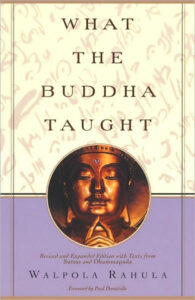 In 1959 Walpola Sri Rahula published a concise summary of the teachings of the Buddha. The Rev. Dr. Rahula, 1907-1997, was a trained Buddhist monk in Sri Lanka. As explained by Paul Demieville in the Foreword:
The book … is a luminous account, within reach of everybody, of the fundamental principles of the Buddhist doctrine, as they are found in the most ancient texts, which are called ‘The Tradition’ (Āgama) in Sanskrit and “The Canonic Corpus’ (Nikāya) in Pali.
As Rahula explains in his Preface:
I have tried in this little book to address myself first of all to the educated and intelligent general reader, uninstructed in the subject who would like to know what the Buddha actually taught. For his benefit I have aimed at giving briefly, and as directly and simply as possible, a faithful and accurate account of the actual words used by the Buddha as they are to be found in the original Pali texts of the Tripiṭaka, universally accepted by the scholars as the earliest extant records of the teachings of the Buddha.
In 1974 a second edition was published which added a number of selected sutras.
Personally, as a follower of Nichiren, I have read this book from the perspective of the teachings of the Lotus Sutra. I have set aside a number of quotes from the book which I will be publishing daily through June 12. I’ve selected these quotes as explanations of the foundational teachings of the Buddha.
However, some of what Rahula teaches is problematic for me as a devotee of Japanese Buddhism. In addressing the Buddha’s spirit of tolerance, Rahula writes:
What the Buddha Taught, p4-5In the third century B.C., the great Buddhist Emperor Asoka of India, following this noble example of tolerance and understanding, honored and supported all other religions in his vast empire. In one of his Edicts carved on rock, the original of which one may read even today, the Emperor declared:
‘One should not honor only one’s own religion and condemn the religions of others, but one should honor others’ religions for this or that reason. So doing, one helps one’s own religion to grow and renders service to the religions of others too. In acting otherwise one digs the grave of one’s own religion and also does harm to other religions. Whosoever honors his own religion and condemns other religions, does so indeed through devotion to his own religion, thinking “I will glorify my own religion.” But on the contrary, in so doing he injures his own religion more gravely. So concord is good: Let all listen, and be willing to listen to the doctrines professed by others.
We should add here that this spirit of sympathetic understanding should be applied today not only in the matter of religious doctrine, but elsewhere as well.
This spirit of tolerance and understanding has been from the beginning one of the most cherished ideals of Buddhist culture and civilization. That is why there is not a single example of persecution or the shedding of a drop of blood in converting people to Buddhism, or in its propagation during its long history of 2500 years. It spread peacefully all over the continent of Asia, having more than 500 million adherents today. Violence in any form, under any pretext whatsoever, is absolutely against the teaching of the Buddha.
It may be true that “Violence in any form, under any pretext whatsoever, is absolutely against the teaching of the Buddha,” but that was not the experience in Japan. As the History of Japanese Religion by Masaharu Anesaki points out, the Tendai soldier monks of Mount Hiei felt compelled to pick up arms and battle Nichiren’s followers.
History of Japanese ReligionThe last and bitterest of the combats was fought in Miyako in 1536, when the soldier-monks of Hiei in alliance with the Ikkō fanatics attacked the Nichirenites and burnt down twenty-one of their great temples in the capital and drove them out of the city. Shouts of “Namu Myōhō Renge Kyō,” the slogan of the Nichirenites, vied with “Namu Amida Butsu,” the prayer of the Ikkō men; many died on either side, each believing that the fight was fought for the glory of Buddha and that death secured his birth in paradise.
Again, as a follower of Nichiren and the Lotus Sutra, I stumble when I encounter discussions of “Truth.”
Early in the book The Rev. Dr. Rahula addresses this topic:
What the Buddha Taught, p5The question has often been asked: Is Buddhism a religion or a philosophy? It does not matter what you call it. Buddhism remains what it is whatever label you may put on it. The label is immaterial. Even the label ‘Buddhism,’ which we give to the teaching of the Buddha, is of little importance. The name one gives it is inessential.
What’s in a name?
That which we call a rose,
By any other name would smell as sweet.In the same way Truth needs no label: it is neither Buddhist, Christian, Hindu nor Moslem. It is not the monopoly of anybody. Sectarian labels are a hindrance to the independent understanding of Truth, and they produce harmful prejudices in men’s minds.
A few pages later The Rev. Dr. Rahula underscores this with the words of the Buddha:
What the Buddha Taught, p10-11Asked by the young Brahmin to explain the idea of maintaining or protecting truth, the Buddha said: ‘A man has a faith. If he says “This is my faith,” so far he maintains truth. But by that he cannot proceed to the absolute conclusion: “This alone is Truth, and everything else is false.” In other words, a man may believe what he likes, and he may say ‘I believe this.’ So far he respects truth. But because of his belief or faith, he should not say that what he believes is alone the Truth, and everything else is false.
The Buddha says: ‘To be attached to one thing (to a certain view) and to look down upon other things (views) as inferior — this the wise men call a ‘fetter.’
Is it a “fetter” to hold that the Lotus Sutra is the supreme teaching of the Buddha, that it encompasses and embraces all of the provisional lessons taught before it?
I will leave it at “This is my faith.”
Book Quotes
Daily Dharma – April 25, 2024
Faith is nothing special. A wife loves her husband, the husband devotes his life to her, parents do not give away their children, and children do not desert their mother. Likewise, believe in the Lotus Sutra, the Buddha Śākyamuni, the Buddha Tahō, all Buddhas, Bodhisattvas and deities. Then chant “Namu Myoho Renge Kyo.” This is faith.
Nichiren wrote this in his Letter to the Nun Myoichi (Myoichi Ama Gozen Gohenji). For many people, Buddhism can be a complicated practice requiring years of study, mastering difficult concepts, even learning new languages. In this letter, Nichiren emphasizes the simple, everyday aspects of our faith and practice. He describes how we can start from the simple love and concern we have for each other, chant “Namu Myoho Renge Kyo” to grow the seeds of faith in our Buddha nature and awaken compassion and wisdom in all beings, and find the joy of the Buddha Dharma in our everyday experience.
The Daily Dharma is produced by the Lexington Nichiren Buddhist Community. To subscribe to the daily emails, visit zenzaizenzai.com
Day 2
Chapter 1, Introductory (Conclusion)
Having last month considered the tale of Fame Seeking, we conclude Chapter 1, Introductory.
The ray of light of [Sun-Moon-] Light Buddha,
That is, the good omen, was the same as what I see now.
Judging from this, the present Buddha also will expound
The Sūtra of the Lotus Flower of the Wonderful Dharma.The good omen I see now is like that of old.
This is an expedient employed by the Buddhas.
The present Buddha is also emitting a ray of light
In order to reveal the truth of the reality [of all things].[Mañjuśrī said to the multitude:]
All of you, know this, join your hands together,
And wait with one mind!
The Buddha will send the rain of the Dharma
And satisfy those who seek enlightenment.The Buddha will remove
Any doubt of those who seek
The teaching of the Three Vehicles.
No question will be left unresolved.
Daily Dharma – April 24, 2024
Anyone who rejoices at hearing this sūtra,
And who receives it respectfully,
Know this, has already reached
The stage of not-returning.
The Buddha sings these verses in Chapter Three of the Lotus Sūtra. The state of non-returning means having the certainty of reaching enlightenment. As Bodhisattvas, when we go into any realm, whether higher or lower, it is to benefit the beings there. It is easy to become discouraged by the difficulties we face in this world of conflict, and to forget that we are not alone in our efforts to help others. When we return to the joy of the Lotus Sūtra, the Buddha reminds us of who we are, what we are doing, and where we are going, no matter what obstacles we may find.
The Daily Dharma is produced by the Lexington Nichiren Buddhist Community. To subscribe to the daily emails, visit zenzaizenzai.com
Day 1
Day 1 covers the first half of Chapter 1, Introductory
Having last month considered the sūtra expounded by the Buddha and the reaction of the audience, we consider the ray of light emitted by the Buddha.
Thereupon the Buddha emitted a ray of light from the white curls between his eyebrows, and illumined all the corners of eighteen thousand worlds in the east, down to the Avchi Hell of each world, and up to the Akanistha Heaven of each world. The congregation saw from this world the living beings of the six regions of those worlds. They also saw the present Buddhas of those worlds. They also heard the Dharma expounded by those Buddhas. They also saw the bhikṣus, bhikṣunīs, upāsakās and upāsikās of those worlds who had already attained [the various fruits of] enlightenment by their various practices. They also saw the Bodhisattva-mahāsattvas [of those worlds] who were practicing the Way of Bodhisattvas [in various ways] according to the variety of their karmas which they had done in their previous existence, and also according to the variety of their ways of understanding [the Dharma] by faith. They also saw the past Buddhas [of those worlds] who had already entered into Parinirvana. They also saw the stupas of the seven treasures which had been erected to enshrine the śarīras of those Buddhas after their Parinirvana.
Daily Dharma – April 23, 2024
The good men or women who keep, read, recite, expound or copy this Sūtra of the Lotus Flower of the Wonderful Dharma, will be able to obtain eight hundred merits of the eye, twelve hundred merits of the ear, eight hundred merits of the nose, twelve hundred merits of the tongue, eight hundred merits of the body, and twelve hundred merits of the mind.
The Buddha gives this teaching in Chapter Nineteen of the Lotus Sūtra. This is another reminder that the practice of the Wonderful Dharma does not take us out of the world of conflict we live in. Instead, it helps us to use the senses we have, in ways we did not think were possible, to see the world for what it is. Merits in this sense are not status symbols. They are an indication of clarity, of our faculties not being impeded by anything that blocks their capacity.
The Daily Dharma is produced by the Lexington Nichiren Buddhist Community. To subscribe to the daily emails, visit zenzaizenzai.com
Another Innumerable Day Before Day 1
Having last month in the Sutra of Innumerable Meanings considered the tenth of the 10 beneficial effects of this sutra, we consider the Bodhisattva Fully Composed’s reaction to the 10 beneficial effects of this sutra.
“O you of good intent! Such is the incomparable, all-ferrying Infinite Meanings Sutra! It possesses awe-inspiring power to the highest extent, and its value is supreme and unsurpassed! It can open the way for every being that is bound by delusive passions to attain the most sublime fruit—to forever rise above the cycle of births and deaths and attain emancipation. Thus is this sutra named Infinite Meanings! It can open the way for all living beings still in the stages of having delusive worldly passions to germinate the sprouts of all of the countless ways of bodhisattvas and let the tree of beneficial works flourish, thrive, and increase in breadth and reach. That is why this sutra is marked by its ten unimaginable powers for beneficial effect!”
With that, the great-being bodhisattva Fully Composed and the eighty thousand great-being bodhisattvas addressed the Buddha in one voice, saying: “World-honored One! The profound, transcendent, incomparable, all- ferrying Infinite Meanings Sutra expounded by the Buddha is true and correct in its content and principles, and its value is supreme and unsurpassed! It is embraced by the buddhas of the past, present, and future together. It is impervious to the influence of disruptive forces and the influence of differing views, and is neither corrupted nor destroyed by any deluded perception or the cycle of births and deaths. This sutra therefore has the inconceivable power of ten such kinds of beneficial effect and greatly benefits all living beings inclusively. It enables each and every great-being bodhisattva to attain the specialized focus of mind of infinite meanings, or to gain access to a hundred thousand Dharma-grasping empowerments, or to achieve the various bodhisattva stages and insights, or to attain realization as pratyekabuddha, or to realize the fruits of the four stages of arhatship. The World-honored One has willingly and compassionately expounded such a teaching for all of us and enabled us to harvest the great benefits of the Dharma. This is extremely unusual, unique, and unprecedented! The World-honored One’s compassionate favor is truly difficult to repay!”
At that moment the universe of a thousand-million Sumeru worlds trembled and shook in six ways, and several kinds of heavenly blossoms—blue, crimson, yellow, and white lotus flowers— rained from the sky above. Also, a rain of many and various kinds of heavenly incense and garments, garlands of celestial jewels, and priceless celestial treasures came spiraling down from the skies above as offerings to the Buddha, the bodhisattvas, the śrāvakas, and the great multitude. Celestial bowls and containers were filled to over- flowing with hundreds of heavenly delicacies that were spontaneously fully satisfying by appearance and aroma. Celestial flags, celestial banners and canopies, and marvelous celestial amusements were arranged everywhere, and heavenly music and songs were played and sung in praise of the Buddha. Also, buddha worlds in the eastern direction, as numerous as the Ganges River’s sands, likewise trembled and shook in six ways. Heavenly flowers, heavenly incense and garments, garlands of celestial jewels, priceless celestial treasures, celestial bowls and containers, hundreds of heavenly delicacies that were spontaneously fully satisfying by appearance and aroma, celestial flags, celestial banners and canopies, and marvelous celestial amusements also rained down. Heavenly music and songs were played and sung in praise of those buddhas, bodhisattvas, śrāvakas, and great assemblies. In the southern, western, and northern directions, in the four intermediate directions, and in the upper and lower regions it was like this as well.