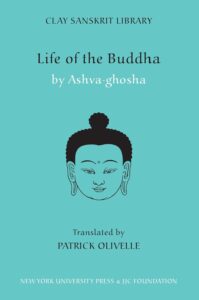
This continues my discussion of the epic poems of Aśvaghoṣa
 Aśvaghoṣa’s Handsome Nanda is a detailed explanation of how a rich, handsome, happily married young man was persuaded to give it all up to venture upon the good path.
(As this point of the story, Nanda has been told he is to become a monk but Nanda refuses. He is brought to the Buddha, who says:)
What is more, you have seen the flaws of family life, and you have heard of the bliss of giving it up; yet still you have no mind to leave your home, like a death-desiring man who will not leave a place of plague. How can you be so fixated with the wasteland of samsara that you have no urge to venture upon the good path, even when you have been set on that very path? You are like a merchant who has wandered from his caravan!
Only a man who is so stupid that he would settle down to sleep in a house ablaze on all sides, rather than escaping from it, would be oblivious to the world burning with the fire of time, with its flames of disease and old age. It is dreadful that a convicted man being led out for execution should be drunk, laughing and babbling; so too is it dreadful that a man should be careless and contrary-minded while Death stands by with a noose in his hand. When kings and householders have gone, are going and will go forth, leaving behind their relatives and possessions, you give consideration to incidental loves!
Handsome Nanda, p107
Again the Burning House allusion.
Eventually, Nanda is convinced to give up his beautiful wife in exchange for a promise that if he agrees to take vows and follows the path he will be rewarded in heaven where the ápsarases – heavenly beings more beautiful than his wife – will attend him. The futility of this goal is explained to Nanda by Ananda:
́”I understand from your expression your motive in practicing dharma, and knowing it, I am moved to both laughter and compassion on your account. Just as someone would carry a heavy rock on his shoulder to use as a seat, likewise you are laboring to uphold the rules of restraint for the sake of sensual indulgence! Just as a wild ram draws back when he is about to charge, likewise this celibacy of yours is undertaken for the sake of sex. Just as businessmen like to buy goods to make a profit, so you practice dharma as an article for trade, not to become peaceful. Just as a farmer scatters seed to produce a particular fruit, likewise you have let go of sense objects because of your weakness for them.
You are seeking out suffering with your thirst for sensory experience, as though someone would want to be ill just to enjoy the pleasure of a remedy. Just as a man looking for honey does not notice a precipice, so in your focus on the ápsarases you do not see your resulting fall. What is this celibacy of yours? While your heart is ablaze with the fire of lust, you carry out your observances with your body only, and are not celibate in your mind.
Handsome Nanda, p219
I particularly enjoyed the line: “Just as businessmen like to buy goods to make a profit, so you practice dharma as an article for trade, not to become peaceful.” Reminds me of my days in Soka Gakkai: Need something? Chant. Not getting it quick enough? Chant more.
Once Nanda realizes that trading lust for his wife for lust for ápsarases is not a bargain, he goes to see the Buddha. After Nanda explains his change of heart, the Buddha says:
“Oh! This comprehension is the presursor of Excellence arising in you, just as when a firestick is rotated, smoke arises as a precursor of fire.”
Handsome Nanda, p233
The Buddha goes on to explain the role “faith” plays:
When a man believes there is water underground, and is in need of it, then he digs the earth assiduously. If a man doesn’t need a fire, or if he does not believe that fire comes from firesticks, then he would not rotate the firesticks; but when that condition is true, he rotates them. And if a farmer did not believe that corn is produced from the earth, or if he had no need of corn, he would not sow seeds in the ground.
That is why I refer to faith particularly as ‘the hand,’ since it reaches out to the true dharma like an unimpaired hand reaches out for a gift. It is described as ‘the sense organ’ because of its prevalence, and as ‘strong’ because of its persistence, and as ‘wealth’ because it allays the impoverishment of virtue. It is declared to be ‘the arrow’ by reason of its protection of the dharma, and it is named ‘the jewel’ because it is so hard to find in this world. What is more, it is said to be ‘the seed,’ since it causes the arising of Excellence; again, it is called ‘the river’ because it cleanses wickedness.
As faith is the primary factor in the arising of dharma, I have called it different names on various occasions due to its effects. Therefore you should nurture this shoot of faith; when it grows, dharma grows, just as a tree grows when its roots grow. When a man’s vision is blurred and he is weak in resolve, his faith wavers, for it is not operating towards its proper outcome.
As long as reality is not seen or heard, faith is not firm or strongly fixed. But when a man’s senses are governed by the rules of restraint and he sees reality, then the tree of faith is fruitful and supportive.
Handsome Nanda, p237-239
I could have used this definition of faith in my 800 Years of Faith project.
But faith without action has little value. In the chapter describing the Noble Truths, Nanda learns about applying himself to the path.
Just as a substance may be pungent in flavor yet when eaten ripe may prove to be sweet, so an endeavor may be hard in its execution but when it ripens through the accomplishment of its aims, prove to be sweet. Endeavor is paramount, for it is the foundation of doing what needs to be done, and without endeavor there would be no accomplishment at all. All success in the world arises from endeavor, and if there were no endeavor evil would be complete.
Men without endeavor won’t acquire what has not yet been acquired, and they are bound to lose what has been acquired. They experience self-contempt, wretchedness, the scorn of their superiors, mental darkness, lack of brilliance, and a loss of learning, restraint and contentment; a great fall awaits them. When a competent person hears the method but makes no progress, when he knows the supreme dharma but wins no higher estate, when he leaves his home but finds no peace in freedom—the reason for this is his own laziness, and not an enemy.
Handsome Nanda, p313
For me, the discussions covering the law of cause and effect have the deepest resonance. Here are some examples:
The reason for this suffering during one’s active life in the world is not a God, not nature, not time, not the inherent nature of things, not predestination, not accident, but the hosts of faults such as desire. You must understand thereby that man’s active life continues because of its faults. It follows that people who are subject to passion and mental darkness die repeatedly, while someone free from passion and mental darkness is not born again.
Handsome Nanda, p289
Since individuality is produced by conditions, and there is no maker or thinker, and individual activity arises from a network of causes, Nanda saw that this world is empty.
Since the world is not self-dependent and has no power to set things in motion, and no one exercises sovereignty in actions, and since states of existence arise in dependence on all sorts of things, he understood that the world was without self.
Then, like feeling a cool breeze from fanning oneself during the hot season, or like getting fire that is latent in wood by rubbing sticks together, or like finding underground water by digging for it, he reached the hard-to-reach supramundane path.
With his bow of true knowledge, binding on his armor of mindfulness, standing in his chariot of pure vows of moral self-restraint, he stood determined to fight for victory against his enemy, the defilements, which were ranged in the battlefield of his mind. Holding the sharp weapon of the constituents of enlightenment, and standing on the excellent chariot of well-directed effort, with his army which consisted of the elephants of the constituents of the path, he gradually penetrated the ranks of the defilements. With the arrows of the four foundations of mindfulness, each with its own range of application, in an instant he burst apart the four enemies which consist of distorted views, the causes of suffering.
Handsome Nanda, p325
For he who understands that while a particular activity in the here and now is not caused by something else, it is also not without cause, and who recognizes that everything is dependent on a variety of things—he sees the ultimate noble dharma. And he who sees that dharma is tranquil, benign, without age or passion, and unexcelled, and sees that its teacher, Buddha, is the best of the noble ones—he has won insight.
Handsome Nanda, p327
As a postscript I offer this:
Just as a light which is extinguished does not travel to the earth or the sky, nor to the directions or any intermediate directions but, because its oil is used up, merely ceases, so he who has reached nirvana travels not to the earth, not to the sky, nor to any of the directions or intermediate directions, but, because his defilements have ended, just attains peace.
Handsome Nanda, p291
I hope this is my experience when I finally “shuffle off this mortal coil.”