
Category Archives: Blog

Mother’s Day

Mother's Day, May 8, 2016
Mother’s Day, May 8, 2016

On April 15, 2016, at 6:10am Eastern time, my wife’s mother died. She had been in hospice care at home for several weeks. The end was not unexpected, but as happens it was still a surprise. This is the first death of a close relative since I became a Nichiren Shu Buddhist.

One of the important aspects of Buddhism and especially Nichiren’s teachings is the practice one does for others, especially parents.

When my wife’s mother died I had been reading Kaimoku-sho. In it Nichiren writes:

Filial devotion preached in Confucianism is limited to this life. Confucian sages and wise men exist in name only because they do not help parents in their future lives. Non-Buddhist religions in India know of the past as well as the future, but they do not know how to help parents. Only Buddhism is worthy of being the way of sages and wise men, as it helps parents in future lives.

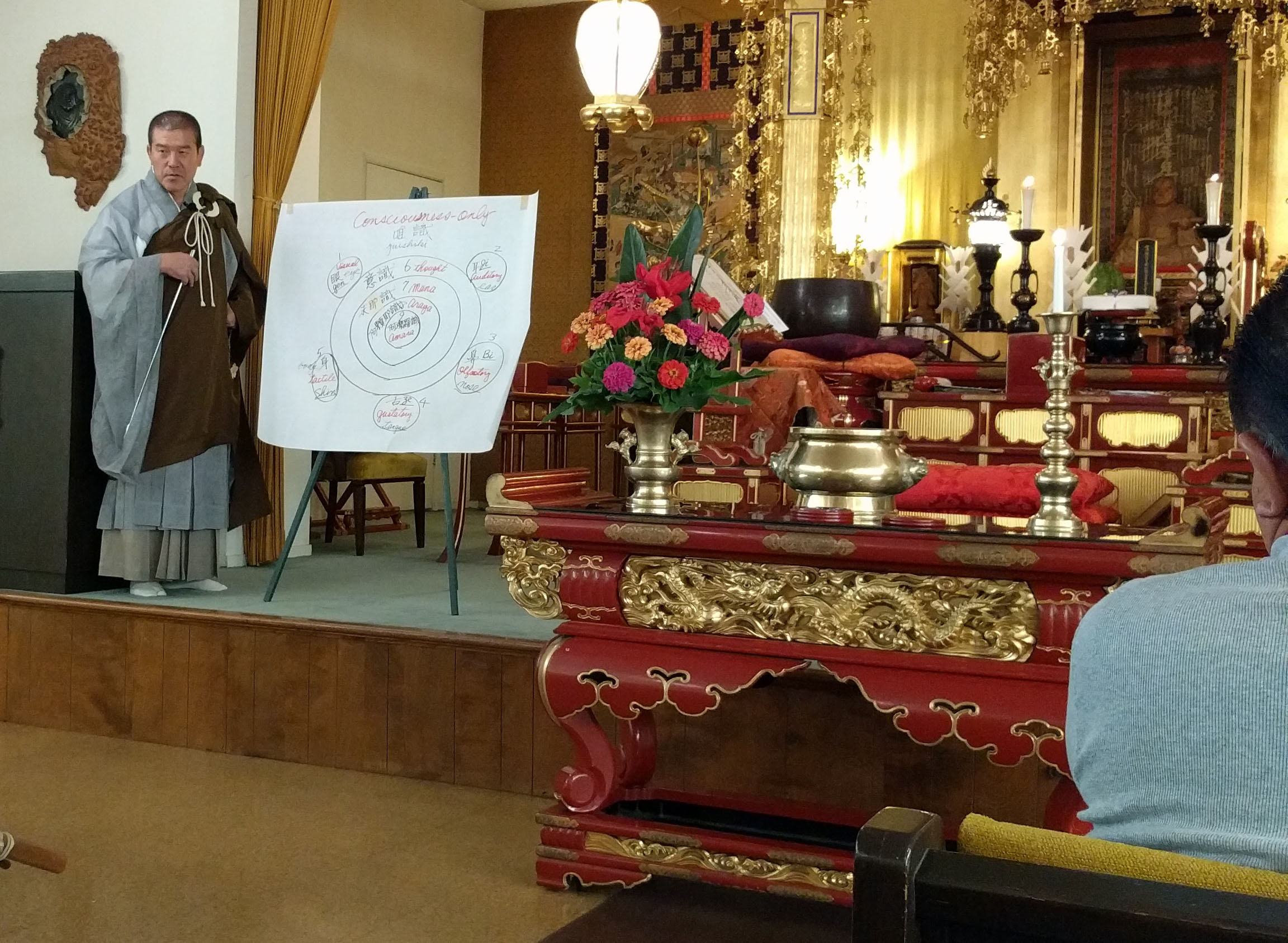
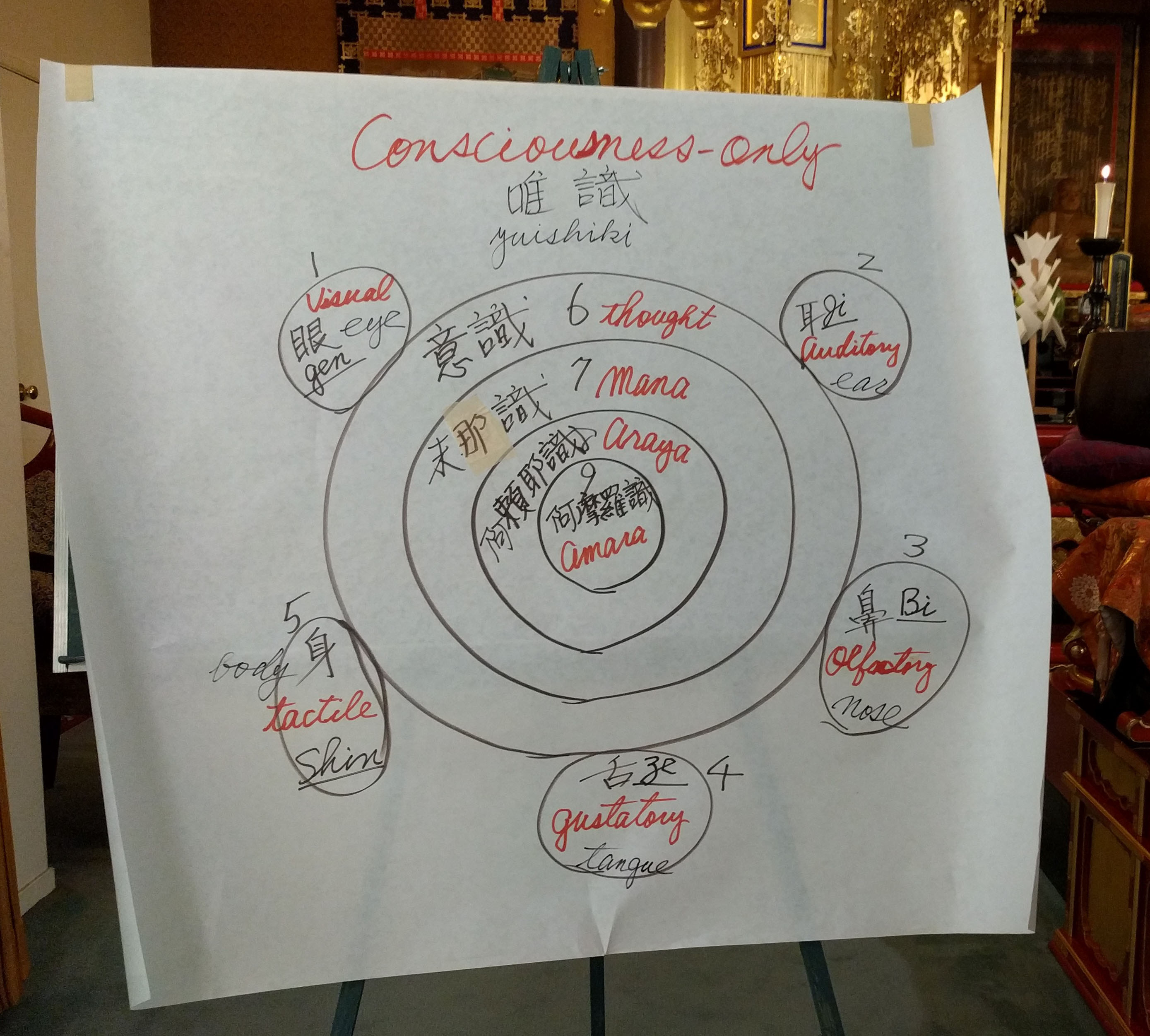
Back in March, I wrote about Ven. Kenjo Igarashi’s discussion of death and the 49-day ceremony for the dead. Recently I asked him if he could put this teaching in writing so that I could better explain it to my wife. In response, he used the 49-day journey as the topic for his May sermon included in the church’s Nichiren News newsletter.

The Significance of the 49-Day Journey After Death
Last November marked the 40-year anniversary since I first became an overseas minister. Since then, I have spent these past several months reflecting on my various experiences throughout my journey as a Buddhist priest in the United States. It led me to realize that while I have much more that I wish to tell to you about Buddhism, there are also many concepts that need further explanation. One example that comes to mind is the importance of the 49th day memorial service for the deceased, which is specific to Buddhist traditions. Its significance is often times downplayed or even forgotten, when compared to the notion of holding funeral services. I wish to elaborate on this topic by briefly taking you through the 49-day journey of the deceased.

When an individual passes away, it is said that 49 nails are hammered into their body and soul, restraining both the physical body and soul from moving. Every seven days, starting from the day of the individual’s passing, until the 49th day, we hold memorial services for the individual. Seven nails will be removed every seventh day, until all 49 of these nails are removed, to ultimately free the deceased’s soul. On the 49th day, there will be a trial or hearing held in front of the so-called ”judge”, who will be standing in front of six gates, bearing no signs. However, we all know that each of these gates leads the individual to six possible realms of existence. These include hell, those of hungry spirits, animals, ashura, humans, or the heavenly beings. Everyone wants to either return as a human being, or enter the realm of heavenly beings. This judge in front of the six gates, will not guide this individual to the proper gate, but only instruct them to choose one. The individual will choose the gate based on what they may think is only instinct, yet this decision will also be guided by the actions that the individual took during their time on this earth.

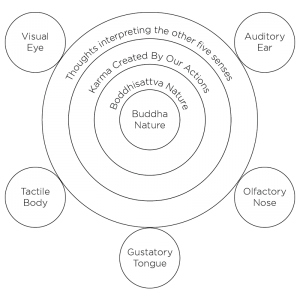
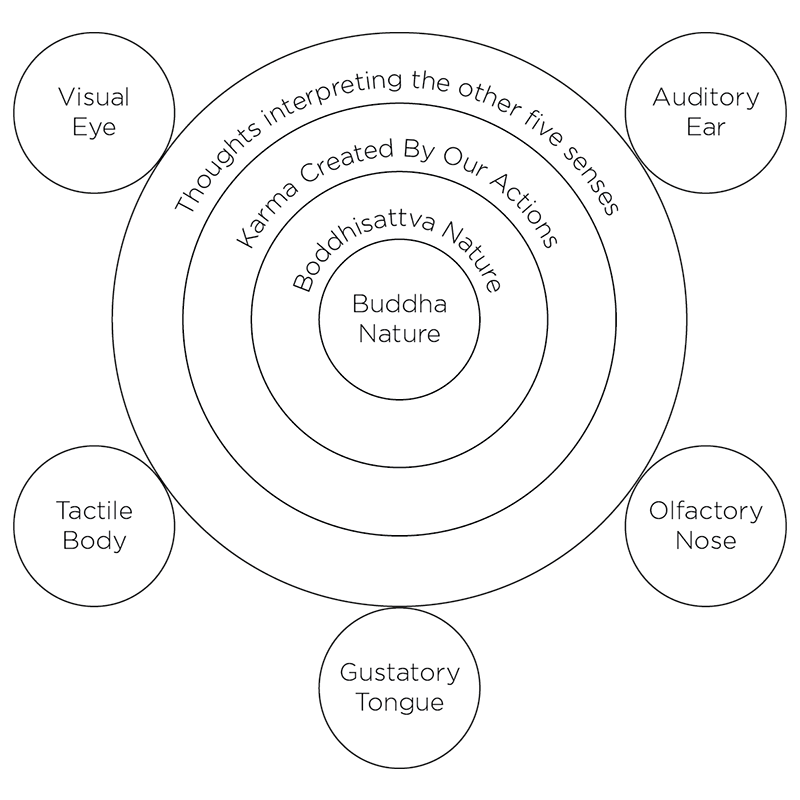
While it may seem as if we take little part in the deceased individual’s 49-day journey, this is not the case. One way we can assist them, is by chanting ”Namu myo ho renge kyo”, which as you know, is the name of the Buddha nature that we all possess. We chant this odaimoku throughout the 49 days to call upon the deceased individual’s Buddha nature. If you recall, the Buddha nature can be imagined as the inside of a seed, while the outer shell represents bad karma resulting primarily from previous actions. Whenever we chant the odaimoku, the Buddha nature slowly grows. While this is a slow process, the more we chant, the more the Buddha nature shows, until it finally appears by sprouting through the outer shell. If the Buddha nature does not appear at the end of the 49 days, the individual will not be able to reach Enlightenment.

While death signifies the end of an individual’s time in this world, it does not mark the ultimate endpoint of their spirit. Please remember that your Buddhist practice can serve an important purpose in providing happiness for not only yourself, but also others, including the deceased.

Sunday in Charlotte Again

Rev. Ryusho Jeffus during eye-opening ceremony for Omandala
Rev. Ryusho Jeffus during eye-opening ceremony for Gohonzon
Bandon\
Brandon

Attended online services at Myosho-ji, Wonderful Voice Buddhist Temple, Charlotte, NC. The service included the eye-opening ceremony for an Omandala to be presented to Brandon, a member of the Charlotte temple who lives in Indiana.

Following the service Brandon thanked Ryusho Shonin and expressed his deep appreciation for the opportunity to attend the Charlotte services regularly. I felt guilty that I only attend Charlotte services when there are no services at the Sacramento Nichiren Buddhist Church. I suppose I should be happy with my good fortune, but today I felt greedy in comparison to those who don’t have a local sangha.

Founder’s Day

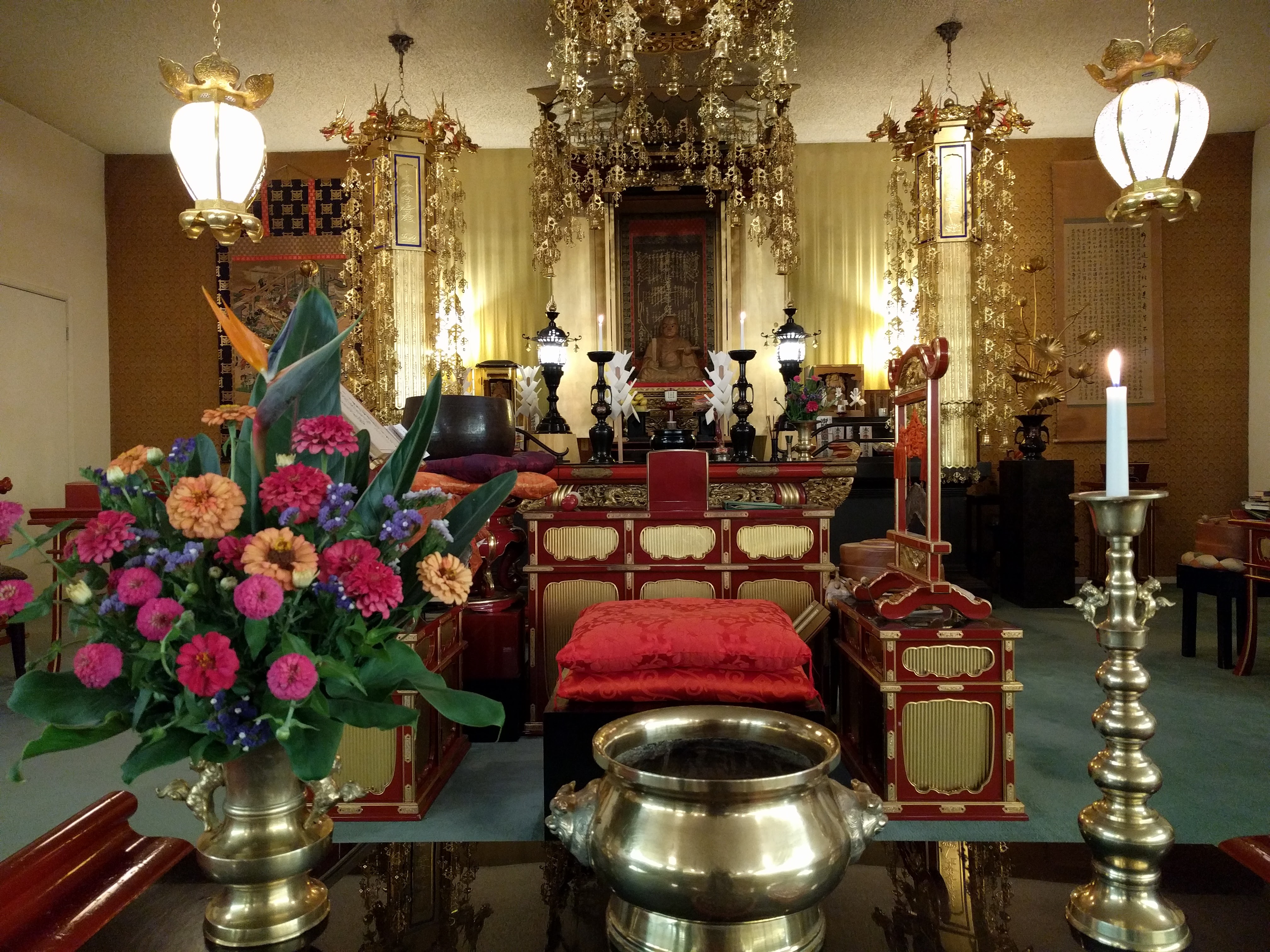
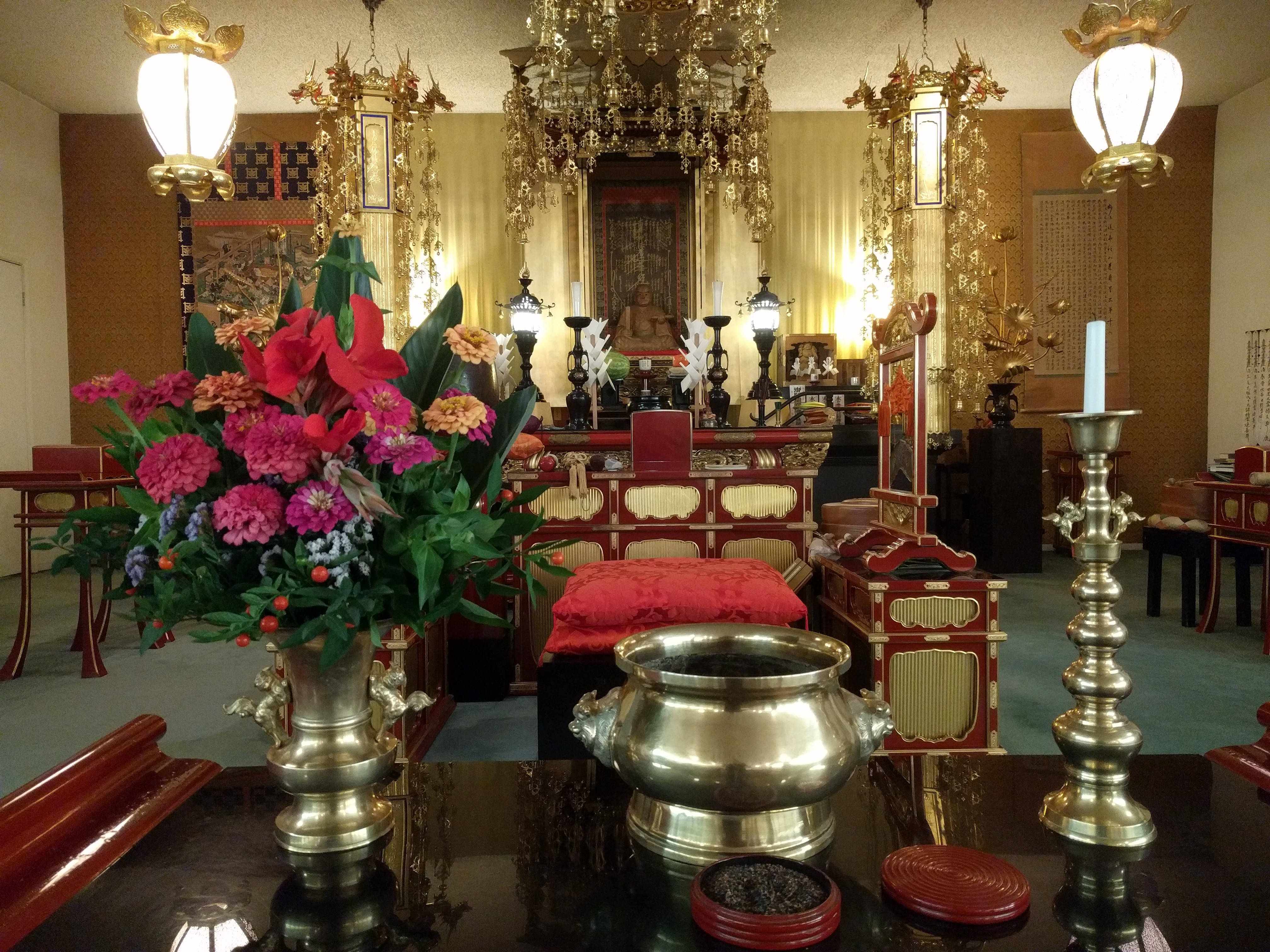
Ven. Kenjo Igarashi prepares altar before the Kaishu-e service honoring the founding of the Nichiren Shu lineage.
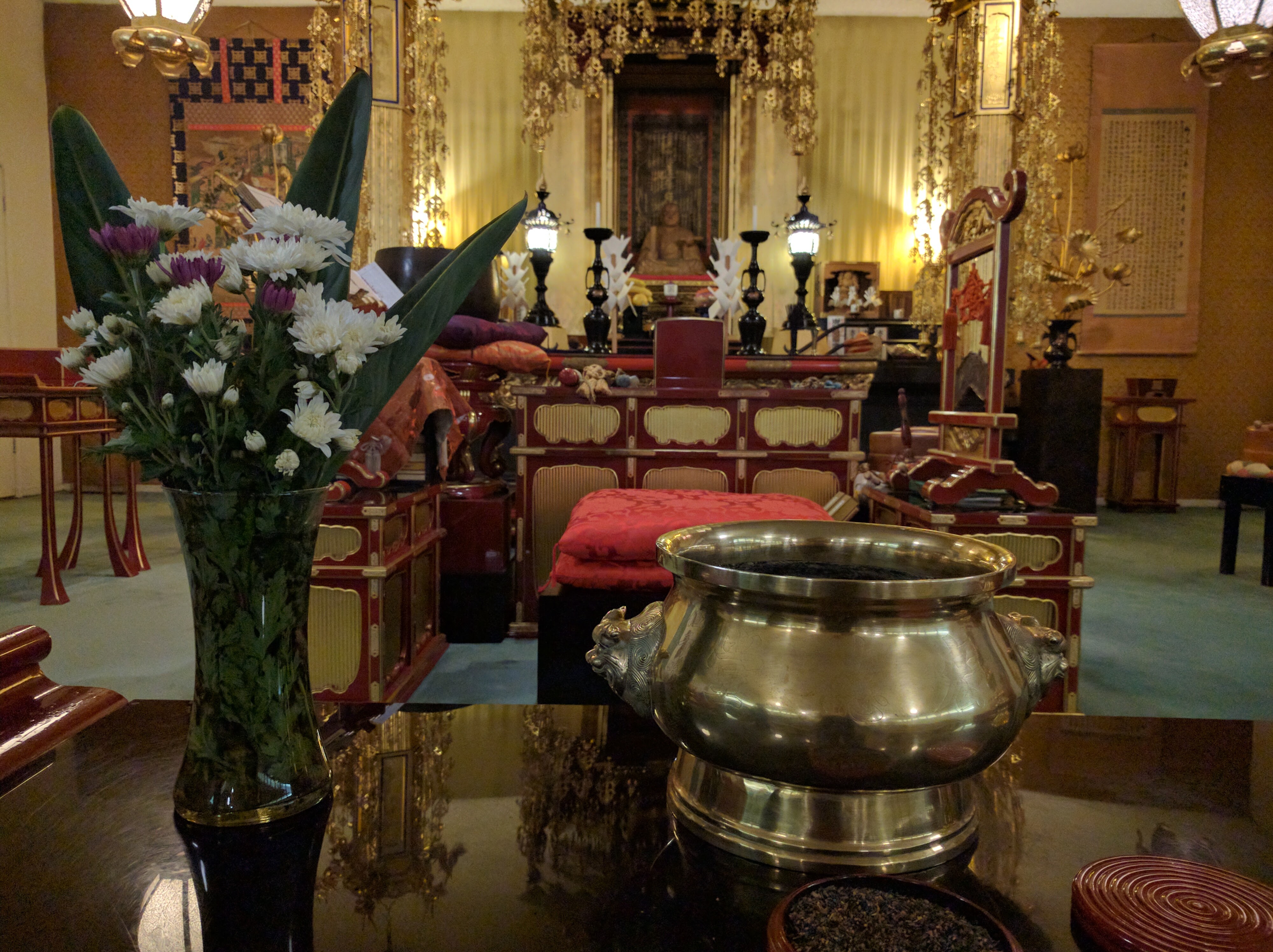
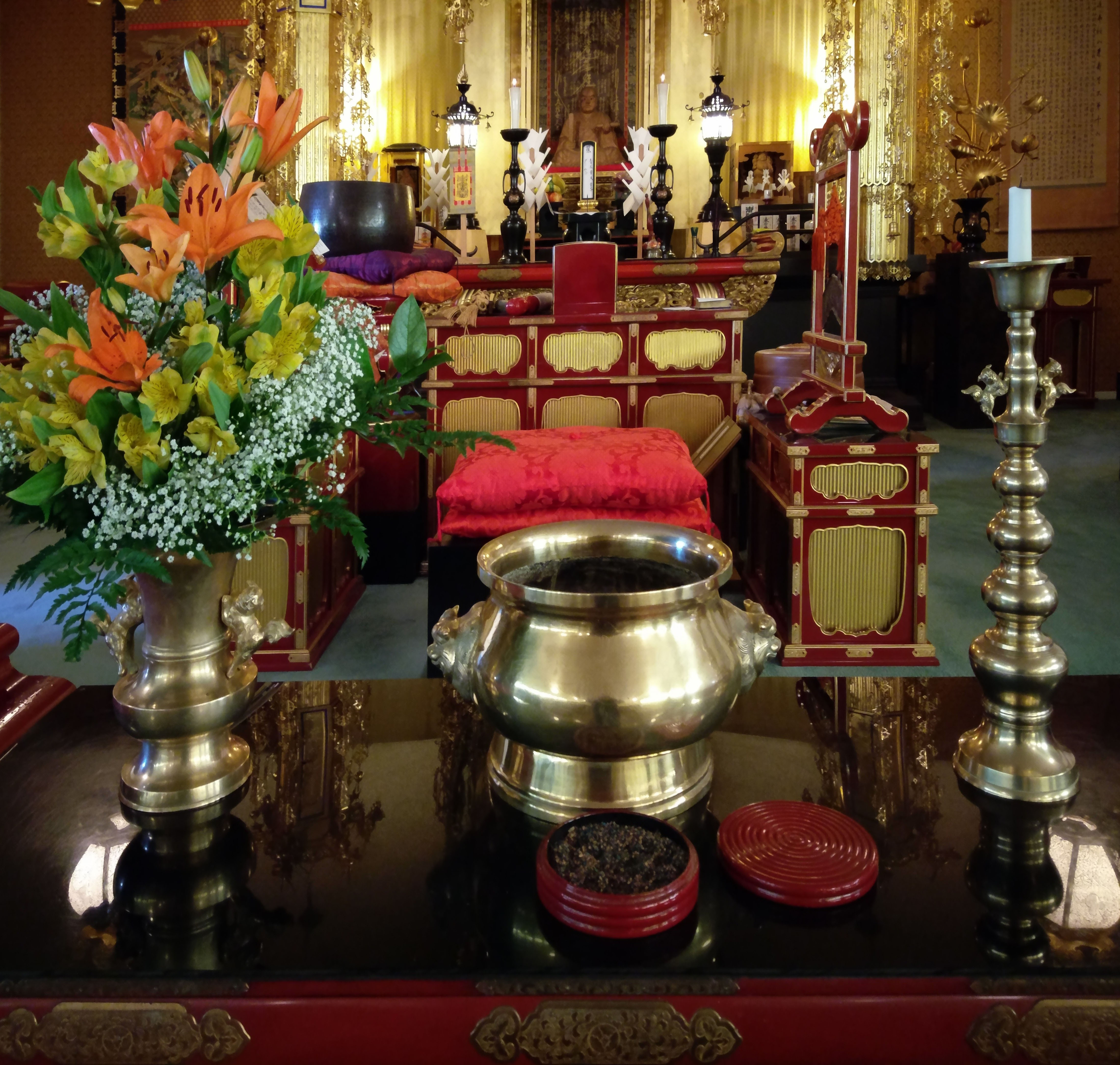
Flowers next to the incense offering bowl.

On the morning of April 28, 1253, Nichiren Shonin chanted Namu Myoho Renge Kyo to the rising sun, setting the stage for the restoration of devotion to the Lotus Sutra and the Eternal Buddha as the Buddhist practice best suited for the Latter Days of the Dharma. Out of this effort grew the Nichiren Shu tradition that continues today.

Today’s service at the Sacramento Nichiren Buddhist Church celebrated Kaishu-e, the founding of Nichiren Shu.

As an aside, we also learned today that it was on April 28, 1968, that Ven. Kenjo Igarashi took his original vows to become a priest.

And about this fixation of mine on flowers. For more than 25 years I practiced a variety of Nichiren Buddhism that shuns statues and allows only greens, no flowers, on altars. Having both the joy of flowers and the physical representation of the objects of devotion has proved to be one of my favorite aspects of Nichiren Shu practice. With the constant references to offerings of flowers in the Lotus Sutra and Nichiren’s promotion of statues as objects of devotion, it seems so unnatural to have ever not had flowers and statues on my altar.

Flowers next to hand-carved wooden tablet of Chapter 16 of the Lotus Sutra.

More Birthday Wishes

San Jose Nichiren Buddhist Church setup for Hanamatsuri service

Traveled to San Jose to attend the Hanamatsuri service at Myokakuji Betsuin. The flower festival celebrating the birth of Sakyamuni is one of my favorite services and this year, as coincidence would have it, I was able to see two different versions of the tradition.

Recited during the ceremony:

The Coming of the Buddha
(From Chapter II Expedients)

The Buddhas, the World-Honored Ones, appear in the worlds in order to cause all living beings to open [the gate to] the insight of the Buddha, and to cause them to purify themselves. They appear in the worlds in order to show the insight of the Buddha to all living beings. They appear in the worlds in order to cause all living beings to obtain the insight of the Buddha. They appear in the worlds in order to cause all living beings to enter the Way to the insight of the Buddha. Sariputra! This is the one great purpose for which the Buddhas appear in the worlds.

Last week in Sacramento

Happy Birthday, Sakyamuni

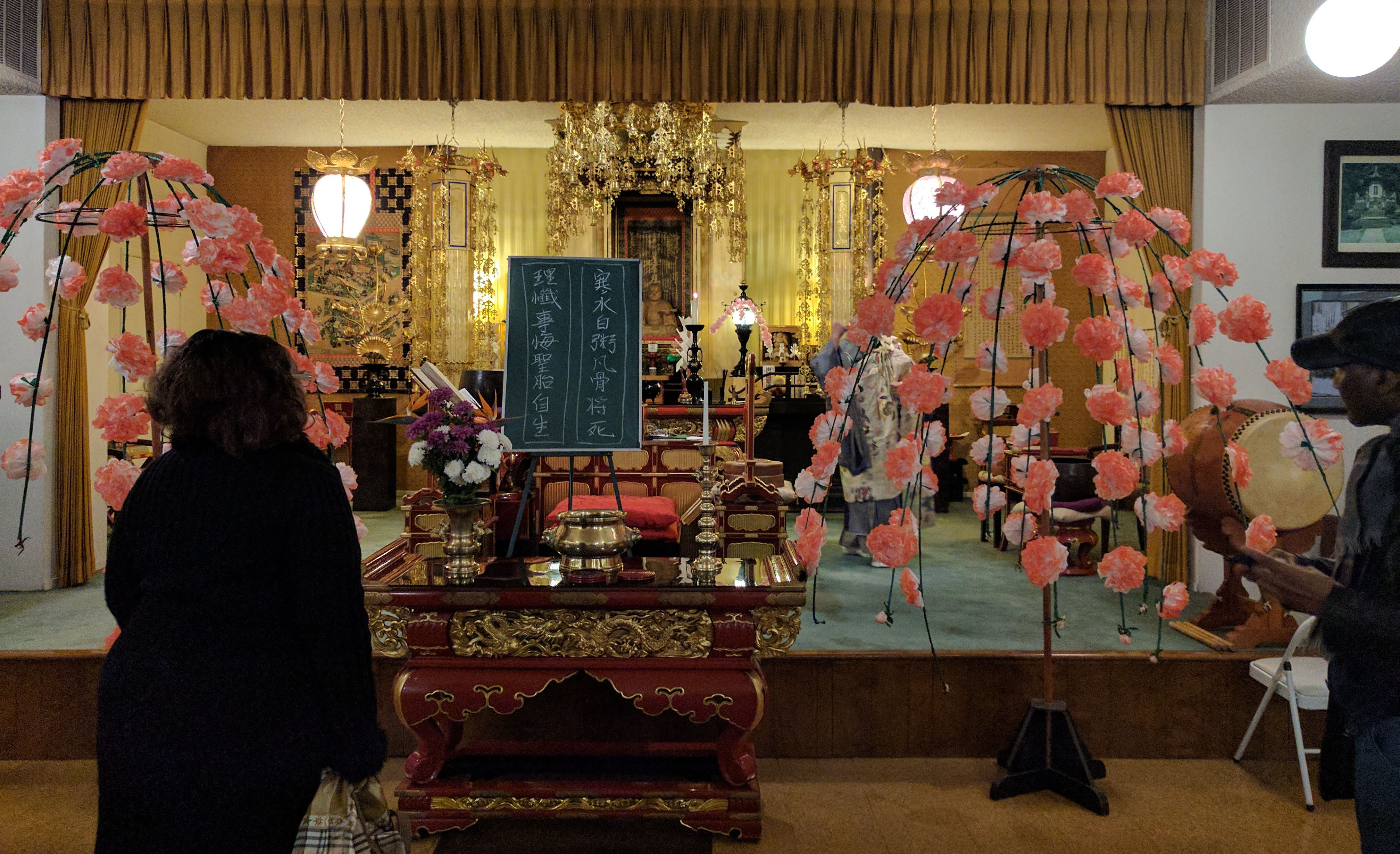
Hanamatsuri (flower festival) decorations in front of the altar on April 10, 2016

During the service parishioners use ladle to pour sweet tea over the statue and bathe the baby Sakyamuni.

Today was Hanamatsuri, the flower festival service honoring the birth of Sakyamuni Buddha. The beautiful flower arrangement covering the statue of the baby Sakyamuni was done by Ven. Kenjo Igarashi using flowers grown on the grounds of the Sacramento Nichiren Buddhist Church.

According to tradition, when Sakyamuni was born he immediately walked seven steps and declared, “I alone am honored in heaven and on earth” as he pointed up with one hand and down with the other to indicate he would unite heaven and earth.

Rev. Igarashi’s sermon covered why it is important to make good causes, using the tale of a selfish junior priest as a lesson in the cause and effect consequences of being greedy.

Following the service, everyone was invited for “refreshments” – sushi rice, pasta salad (I’m sure there is a Japanese term for that dish but I don’t know it), barbecue chicken and three different dessert cakes.

Making the gathering even more enjoyable was the welcome provided to two guests who were attending services for the first time.

Daily Breathing Meditation

The latter part of the seventh fascicle of the Commentary on the Great Sun Buddha Sutra, which both Grand Masters Kobo and Dengyo saw, reads: “It is needless to say that reciting sutras earnestly in the Tendai Sect is namely the perfect and sudden way of breathing meditation.”

Hasshu Imoku-sho, Writings of Nichiren Shonin, Doctrine 2

Each of Sakyamuni’s countless sutras is a river flowing into the Sutra of the Lotus Flower of the Wonderful Dharma, the all encompassing ocean of the Buddha’s teaching. Each chant of Namu-Myoho-Renge-Kyo recites not only the Lotus Sutra but all of the Buddha’s sutras.

Namu Myoho Renge Kyo, Namu Myoho Renge Kyo, Namu Myoho Renge Kyo – the perfect and sudden way of breathing meditation.

My Thoughts Exactly

Today’s Daily Dharma contains this advice:

The thoughts we have are mostly words, and the words are about the things we want. Words can help us make sense of the world around us, especially the words the Buddha uses to teach us. But words can also confuse us when we mistake our expectations for the reality of the world. When the Buddha calls us to become Bodhisattvas, to realize that our happiness is linked to that of all beings, his words open a part of our mind with which we are not familiar. He asks us to set aside the habits we have learned from this world of conflict and see his world in a new way.

As someone who made a career of words and the arrangement of words to communicate ideas, such a reminder of the power of the Buddha’s words is particularly compelling.

This advice from the Daily Dharma echoes the English translation of the Verses for Opening the Sutra that I recite each day:

The most excellent teaching of the Great Vehicle is very difficult to understand. I shall be able to approach enlightenment when I see, hear or touch this sutra. Expounded is the Buddha’s truth. Expounding is the Buddha’s essence. The letters composing this sutra are the Buddha’s manifestation.

One word wraps all of my thoughts in the same way the Odaimoku encompasses the ocean of the Buddha’s teaching. That word in my mind is “faith.”

Spring Ohigan

Ohigan Service March 27, 2016

Today was the Spring Ohigan ceremony. Church members were encouraged to write the names of deceased ancestors on a slip of paper and give it to the priest. During the service, the priest said a prayer for each of the ancestors, citing their names individually.

From Wikipedia:

Ohigan is a Buddhist holiday exclusively celebrated in Japan during both the Spring and Autumnal Equinox. It is observed by nearly every Buddhist sect in Japan. The tradition extends from mild weather that occurs during the time of equinoxes, though the origin of the holiday dates from Emperor Shōmu in the 8th century. People who normally worked in the fields had more leisure time to evaluate their own practices, and to make a renewed effort to follow Buddhism. Today, special services are usually observed in Japanese Buddhist temples, and Japanese temples abroad, based on the particular Buddhist tradition or sect.

The etymology of Ohigan means “the other or that shore of Sanzu River”, which is a common euphemism used in Buddhist literature to refer to Enlightenment. One crosses from this shore of ignorance and suffering to the other shore of Enlightenment and peace.

At the end of the service, Ven. Kenjo Igarashi explained that Ohigan, beyond the prayers for ancestors, is a reminder of the Six Paramitas that Nichiren’s followers practice. He then explained the six. Rather than attempt to paraphrase what he said I’m going to reprint an explanation from Rev. Ryuei McCormick‘s book Lotus Seeds:

The awakened qualities which we develop through our practice are known as the Six Perfections (in Sanskrit, paramitas). The Six Perfections enable us to do the work of a bodhisattva. They are generosity, discipline, patience, energy, meditation, and wisdom.

These Six Perfections are a restatement of the Eightfold Path.

Six Perfections and Eightfold Path

The real difference between the Six Perfections and the Eightfold Path is the addition of generosity and patience, although these are implied by right intentions. By including these two perfections as separate items, it makes explicit the fact that we are not really following the Eightfold Path unless we are generous and patient with others. In this way, the Six Perfections underscore the compassionate dimension that is integral to Mahayana Buddhism.

God in Heaven

Ven. Kenjo Igarashi serves members of the Sacramento Nichiren Buddhist Church, but also Nichiren Shu practitioners in Chicago and elsewhere. As he was mentioning last week, he performs a lot of funerals. At last week’s service, he offered an outline of the reason behind the Japanese traditional 49 day ceremony for the dead. It went something like this:

When a person dies the “spirit” is nailed to this world with seven nails. Every 7 days, a trial is held before a judge/prosecutor, with a different deity in charge at each hearing. Different things in the dead person’s life are considered in each hearing. The “spirit” is not allowed to present a defense. Instead, prayers of family members serve to mitigate any bad things or enhance any good things. After each hearing a nail is removed.

On the 49th day hearing, the last nail is removed and the deity in charge points to six unmarked doors. The doors are gateways to the six lower realms — hell, hungry spirits, animals, angry spirits, humans and heaven. The “spirit,” now free, must choose which door to exit. The prayers of family members help make the best choice.

In my brief exposure to Nichiren Shu, I’ve discovered quite a spectrum. For example, I find Rev. McCormick, with his rigorous academic approach, at one extreme end of the spectrum in regard to deities and their role in Buddhism and Rev. Igarashi at the other extreme. (I suspect Rev. Igarashi’s 500 days of esoteric ascetic practice has that effect.)

When I read the Lotus Sutra and Nichiren’s writings, I feel deities ought to be a real aspect of Buddhism. But how? Our modern world makes it hard to “believe” in deities. Personally, I enjoy what I term my “What if…” openness that accepts infinite possibilities with a bemused smile.

I have to give you an example. This is from Nichiren’s Rationale For Remonstration With Hachiman (Writings of Nichiren Shonin, Doctrine 1) :

The Sutra of Transmission of the Buddhist Teaching, fascicle 1, speaks of the previous life of Venerable Kasyapa:

Once upon a time there lived a Brahman named Nyagrodha in the Kingdom of Magadha. Because of the great merit of his good acts for a long time in a previous life. . . , he was immensely rich and piled up vast wealth in this life. . . , which was worth a thousand times more than that of the king of Magadha. (…) Although he was very wealthy, he was childless, so the Brahman said to himself, “My days are numbered, but I have nobody to inherit my treasures filled in the warehouse. I wish to have a child.” Thus the Brahman prayed to the forest god in the neighborhood for good luck of having a child. Having prayed for years without any luck, he became furious and said to the forest god: “I have prayed to you for the last several years to no avail. I am going to pray to you from the bottom of my heart for seven more days. If it does not do any good, I am going to burn down your shrine.” Hearing this, the forest god in agony relayed his problem to the Four Heavenly Kings, who in turn reported the matter to Indra.

Indra looked around all over the world, but could not find anyone worthy of being Nyagrodha’s child, so he went to the King of the Brahma Heaven for help. With his divine eye, the King of the Brahma Heaven then closely observed the whole world, finding a heavenly being in the Brahma Heaven who was about to die. The King told him that if he was to be reborn in the human world, he should be born as a child of Nyagrodha Brahman in Jambudvipa. The dying being answered that he did not want to be reborn in a family of a Brahman because Brahman dharma includes many evil and false views. The King of the Brahma Heaven told him again: “Nyagrodha Brahman is a powerful man of virtue that there is no one in the world worthy to be born as his child. If you are reborn to his family, I will protect you lest you should fall into “evil view.” Thereupon the heavenly being in the Brahma Heaven answered, “I will respectfully follow your words.”

The King of the Brahma Heaven then reported the turn of events to Indra, who in turn informed the forest god. Elated by the good news, the forest god called upon the Brahman at home saying, “You should no longer have a grudge against me. Your wish will be fulfilled in seven days.” As expected, the wife of the Brahman became pregnant in seven days and gave birth to a baby boy ten months later. (…) This is Venerable Kasyapa today.

This is just a fun story by modern perspectives. But “What if…” and you smile and consider how rich is the universe of 3,000 realms at this moment.

Myosho-ji Monday Night Study – March 21, 2016

Kanjin Cederman Shonin chief priest of Enkyo-ji in Seattle joined Ryusho Jeffus and others from Myosho-ji, Wonderful Voice Buddhist Temple, in Charlotte, NC, as a guest speaker. Kanjin Cederman shared some of his thoughts about ‘Organic Buddhism’ and how it is in accord with the teachings of the Lotus Sutra. He also shared a little about his life as well as his training as a Buddhist including his time before Nichiren Shu.