Category Archives: LS32

Lessons of Devadatta and the Dragon King’s Daughter

This is another in a series of weekly blog posts comparing and contrasting the Sanskrit and Chinese Lotus Sutra translations.


In comparing Senchu Murano’s English translation of the story of Devadatta and the Dragon King’s Daughter with H. Kern’s English translation from the Sanskrit, we need to start with the fact that this chapter wasn’t translated by Kumārajīva. According to the explanation in Murano’s Introduction, Chapter 12 was translated by Fa-i in 490 CE and inserted into Kumārajīva’s version at the beginning of the sixth century. In Kern’s translation, the material doesn’t appear as a separate chapter but is instead spliced onto the end of Chapter 11, Apparition of a Stūpa.

The two translations appear even closer than the chapters translated by Kumārajīva. Take for instance the opening scene.

Kern offers:

Thereupon the Lord addressed the whole company of Bodhisattvas and the world, including gods and demons, and said: Of yore, monks, in times past I have, unwearied and without repose, sought after the Sūtra of the Lotus of the True Law, during immense, immeasurable Æons; many Æons before I have been a king, during many thousands of Æons. Having once taken the strong resolution to arrive at supreme, perfect enlightenment, my mind did not swerve from its aim. I exerted myself to fulfil the six Perfections (Pāramitās), bestowing immense alms: gold, money, gems, pearls, lapis lazuli, conch-shells, stones (?), coral, gold and silver, emerald, Musāragalva, red pearls; villages, towns, boroughs, provinces, kingdoms, royal capitals; wives, sons, daughters, slaves, male and female; elephants, horses, cars, up to the sacrifice of life and body, of limbs and members, hands, feet, head.

Murano offers:

Thereupon the Buddha said to the Bodhisattvas, gods, men and the four kinds of devotees:

“When I was a Bodhisattva] in my previous existence, I sought the Sūtra of the Lotus Flower of the Wonderful Dharma for innumerable kalpas without indolence. I became a king [and continued to be so] for many kalpas. [Although I was a king,] I made a vow to attain unsurpassed Bodhi. I never faltered in seeking it. I practiced alms-giving in order to complete the six pāramitās. I never grudged elephants, horses, the seven treasures, countries, cities, wives, children, menservants, maidservants or attendants. I did not spare my head, eyes, marrow, brain, flesh, hands or feet. I did not spare even my life.”

The principal difference is that Murano’s translation inserts material within square brackets that he felt necessary for clarity.

Another telling similarity is the “error” concerning the direction from which the Stūpa of Treasures arrived.

At the beginning of Chapter 11, Murano has the Buddha explain that:

“The perfect body of a Tathāgata is in this stūpa of treasures. A long time ago there was a world called Treasure-Purity at the distance of many thousands of billions of asaṃkhyas of worlds to the east [of this world]. In that world lived a Buddha called Many-Treasures.”

Kern, however, says:

Thus asked, the Lord spake to Mahāpratibhāna, the Bodhisattva Mahāsattva, as follows: In this great Stūpa of precious substances, Mahāpratibhāna, the proper body of the Tathāgata is contained condensed; his is the Stūpa; it is he who causes this sound to go out. In the point of space below, Mahāpratibhāna, there are innumerable thousands of worlds. Further on is the world called Ratnaviṣuddha, there is the Tathāgata named Prabhūtaratna, the Arhat, &c.

While Many Treasures lived in the east in Chapter 11, both Murano and Kern agree that the stūpa arrived from the nadir in the story of the Dragon King’s Daughter.

Murano has:

At that time Many-Treasures, the World-Honored One, who had come from the nadir,’ was accompanied by a Bodhisattva called Accumulated-Wisdom. The Bodhisattva said to Many-Treasures Buddha, “Shall we go back to our home world?”

Kern has:

At that moment a Bodhisattva of the name of Pragñākūṭa, having come from beneath the Buddha field of the Tathāgata Prabhūtaratna, said to the Tathāgata Prabhūtaratna: Lord, let us resort to our own Buddha-field.

Next: Encouragement

Daily Dharma – Jan. 23, 2023

Having made these offerings [to the Buddha], he emerged from the samādhi, and thought, ‘I have now made offerings to the Buddha by my supernatural powers. But these offerings are less valuable than the offering of my own body.’

In Chapter Twenty-Three of the Lotus Sūtra, the Buddha tells the story of Gladly-Seen-By-All-Beings Bodhisattva, the previous life of Medicine-King Bodhisattva. This Bodhisattva practiced under an ancient Buddha, and made exorbitant offerings to that Buddha through his supernatural powers. He then realized that all the riches of the universe that he could conjure up paled in comparison to the treasure of his own body and his own life. He then made an offering of his body to the Buddha, which illuminated innumerable worlds. Nichiren wrote often of the hardships he faced in his life and those of his followers. He wrote of “reading the Lotus Sūtra with our bodies,” meaning bringing the Buddha’s wisdom to life in our lives. When we act according to the Wonderful Dharma, no matter what hardships we face, then we too are living the Lotus Sūtra, and making a perfect offering from our gratitude to the Buddha.

The Daily Dharma is produced by the Lexington Nichiren Buddhist Community. To subscribe to the daily emails, visit zenzaizenzai.com

Day 20

Day 20 completes Chapter 15, The Appearance of Bodhisattvas from Underground, and concludes the Fifth Volume of the Sutra of the Lotus Flower of the Wonderful Dharma.


Having last month considered the Buddha’s explanation of he taught these Bodhisattvas, we consider Maitreya’s doubts.

Thereupon Maitreya Bodhisattva-mahāsattva and the innumerable Bodhisattvas in the congregation doubted the Buddha’s words which they had never heard before. They thought:

‘How did the World-Honored One teach these great, innumerable, asaṃkhya Bodhisattvas, and qualify them to attain Anuttara-samyak-saṃbodhi in such a short time?’

[Maitreya Bodhisattva] said to the Buddha:

“World-Honored One! When you, the Tathāgata, were a crown prince, you left the palace of the Śākyas, sat at the place of enlightenment not far from the City of Gaya, and attained Anuttara-samyak-saṃbodhi. It is only forty and odd years since then.

“World-Honored One! How did you do these great deeds of the Buddha in such a short time? Did you teach these great, innumerable Bodhisattvas, and qualify them to attain Anuttara-samyak-saṃbodhi by your powers or by your merits?

“World-Honored One! No one can count the number of these great Bodhisattvas even if he goes on counting them for thousands of billions of kalpas. They have already planted roots of good, practiced the way, and performed brahma practices under innumerable Buddhas from the remotest past.

“World-Honored One! It is difficult for anyone in the world to believe this. It is as difficult as to believe a handsome, black-haired man twenty-five years old who points to men a hundred years old and says, ‘They are my sons,’ or as to believe men a hundred years old who point to a young man and say, ‘This is our father. He brought us up.’ You are like the young man. It is not long since you attained enlightenment. But it is many thousands of billions of kalpas since the great multitude of these Bodhisattvas began to practice the Way strenuously in order to attain the enlightenment of the Buddha. During that time they entered into, stayed in, and came out of many hundreds of thousands of billions of samadhis, and obtained great supernatural powers. They performed brahma practices for a long time. They learned good teachings one by one, and obtained the ability to answer questions skillfully. They are regarded as the treasures of the world of men by all the people of the world because they are rare. Today you say that, after you attained the enlightenment of the Buddha, you caused them to aspire for enlightenment, taught them, and led them into the Way to Anuttara-samyak-saṃbodhi.

“World-Honored One! You did these deeds of great merit although it is not long since you attained Buddhahood. We believe that your words given according to the capacities of all living beings are infallible, and that we understand all that you know. But the beginners in Bodhisattvahood after your extinction, if they hear these words of yours, will not receive them by faith but commit the sin of violating the Dharma. Therefore, World-Honored One! Explain all this so that we may be able to remove our doubts and that the good men in the future may have no doubts when they hear these words of yours!”

The Daily Dharma from Dec. 9, 2022, offers this:

World-Honored One! It is difficult for anyone in the world to believe this. It is as difficult as to believe a handsome, black-haired man twenty-five years old who points to men a hundred years old and says, ‘They are my sons,’ or as to believe men a hundred years old who point to a young man and say, ‘This is our father. He brought us up.’

Maitreya Bodhisattva explains his perplexity to the Buddha in Chapter Fifteen of the Lotus Sūtra. The Buddha had just revealed that he was who taught all the Bodhisattvas who have appeared from underground to continue teaching the Wonderful Dharma after the extinction of the Buddha. Maitreya realizes that his doubts are no different from those of those gathered to hear the Buddha teach and asks the Buddha to explain. When our experience does not match what the Buddha teaches, we should not keep silence and just accept what he tells us. It is only through sincere questioning that we find the Buddha’s mind and make it our own.

The Daily Dharma is produced by the Lexington Nichiren Buddhist Community. To subscribe to the daily emails, visit zenzaizenzai.com

Day 19

Day 19 concludes Chapter 14, Peaceful Practices, and begins Chapter 15, The Appearance of Bodhisattvas from Underground.


Having last month concluded Chapter 14, Peaceful Practices, we begin Chapter 15, The Appearance of Bodhisattvas from Underground, and consider the request of the Bodhisattva-mahāsattvas, more than eight times the number of the sands of the River Ganges, who had come from the other worlds.

Thereupon the Bodhisattva-mahāsattvas, more than eight times the number of the sands of the River Ganges, who had come from the other worlds, rose from among the great multitude, joined their hands together towards the Buddha, bowed to him, and said:

“World-Honored One! If you permit us to protect, keep, read, recite and copy this sūtra, and make offerings to it strenuously in this Sahā-World after your-extinction, we will [do so, and] expound it in this world.”

Thereupon the Buddha said to those Bodhisattva-mahāsattvas:

“No, good men! I do not want you to protect or keep this sūtra because there are Bodhisattva-mahāsattvas sixty thousand times as many as the sands of the River Ganges in this Sahā-World. They are each accompanied by attendants also numbering sixty thousand times as many as the sands of the River Ganges. They will protect, keep, read, recite and expound this sūtra after my extinction.”

The Daily Dharma from Nov. 21, 2022, offers this:

No, good men! I do not want you to protect or keep this sūtra because there are Bodhisattva-mahāsattvas sixty thousand times as many as the sands of the River Ganges in this Sahā-World. They are each accompanied by attendants also numbering sixty thousand times as many as the sands of the River Ganges. They will protect, keep, read, recite and expound this sūtra after my extinction.

The Buddha makes this declaration to the uncountable number of Bodhisattvas who came from other worlds to hear him teach in Chapter Fifteen of the Lotus Sūtra. These Bodhisattvas had responded to the Buddha’s question of who would keep and expound the Buddha’s highest teaching after his death. They promised that they would remain in this world of conflict and fulfill the Buddha’s request. After the Buddha spoke these words, an unimaginable number of Bodhisattvas came up from underground and paid their respects to the Buddha. We can understand this story, and this image, as showing that our capacity for enlightenment, and our ability to benefit all beings, is already within us. We do not need an outside agent to give these to us.

The Daily Dharma is produced by the Lexington Nichiren Buddhist Community. To subscribe to the daily emails, visit zenzaizenzai.com

Day 18

Day 18 concludes Chapter 13, Encouragement for Keeping this Sutra, and begins Chapter 14, Peaceful Practices.


Having last month considered the proper practices the Bodhisattva-mahāsattvas should perform and the the proper things the Bodhisattva should approach, we consider how a retired place is the first thing to find.

“He should always make it a pleasure to sit in dhyāna. He should live in a retired place and concentrate his mind. Mañjuśrī! [A retired place] is the first thing he should approach.

“The Bodhisattva-mahāsattvas also should know the following truth. All things are insubstantial. They are as they are. Things are not perverted. They do not move. They do not go. They do not turn. They have nothing substantial just as the sky has not. They are inexplicable. They are not born. They do not appear. They do not rise. They are nameless. They are formless. They have no property. They are immeasurable and limitless. They have no obstacle or hindrance. He should see all this. Things can exist only by dependent origination. Only perverted people say, ‘Things are permanent and pleasant.’ This truth is the second thing he should approach.”

The Daily Dharma from May 12, 2021, offers this:

He should always make it a pleasure to sit in dhyāna. He should live in a retired place and concentrate his mind. Mañjuśrī! [A retired place] is the first thing he should approach.

The Buddha gives this explanation to Mañjuśrī Bodhisattva in Chapter Fourteen of the Lotus Sūtra in which he describes the peaceful practices of a Bodhisattva. For those who are awakening their nature as Bodhisattvas to benefit all beings, and setting aside their attachment to their own suffering, this can be a difficult transition. Our habits of engaging with the drama and delusion in the world can be too strong to overcome. This is why the Buddha emphasizes the importance of quietly reflecting on what happens around us, and our reactions to them. Through dhyāna meditation, we learn not to believe everything we think, and that we can change our understanding of the world. We also learn that allowing our minds to change is the only way we can benefit other beings.

The Daily Dharma is produced by the Lexington Nichiren Buddhist Community. To subscribe to the daily emails, visit zenzaizenzai.com

Day 17

Day 17 covers all of Chapter 12, Devadatta, and opens Chapter 13, Encouragement for Keeping this Sutra.


Having last month considered in gāthās when the Buddha was a King seeking the Dharma in his previous existence, we learn the identity of the seer.

The Buddha said to the bhikṣus:

“The king at that time was a previous life of myself. The seer at that time was a previous life of Devadatta. Devadatta was my teacher. He caused me to complete the six pāramitās. He caused me to have loving-kindness, compassion, joy and impartiality. He caused me to have the thirty-two major marks and the eighty minor marks [of the Buddha]. He caused me to have my body purely gilt. He caused me to have the ten powers and the four kinds of fearlessness. He caused me to know the four ways to attract others. He caused me to have the eighteen properties and supernatural powers [of the Buddha]. He caused me to have the power of giving discourses. I attained perfect enlightenment and now save all living beings because Devadatta was my teacher.”

The Daily Dharma from Dec. 8, 2022, offers this:

I attained perfect enlightenment and now save all living beings because Devadatta was my teacher.

The Buddha makes this declaration in Chapter Twelve of the Lotus Sūtra. Devadatta was a cousin of the Buddha who became jealous of the Buddha’s enlightenment. Several times he tried to kill the Buddha. He also caused a split in the Buddha’s Sangha, and convinced a young prince to kill his father and usurp the throne. Devadatta was so evil that he fell into Hell alive. Despite all this, the Buddha credits Devadatta with helping him become enlightened, and assures Devadatta personally that he will become enlightened. This shows us that even those beings who create great harm have Buddha nature. They may not deserve our admiration, but they at least deserve our respect.

The Daily Dharma is produced by the Lexington Nichiren Buddhist Community. To subscribe to the daily emails, visit zenzaizenzai.com

Day 16

Day 16 concludes Chapter 11, Beholding the Stūpa of Treasures, and completes the Fourth Volume of the Sūtra of the Lotus Flower of the Wonderful Dharma.


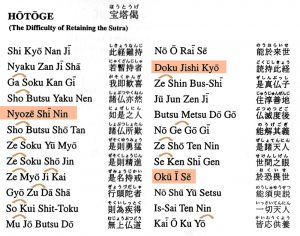
Having last month considered the difficulty in teaching this sutra, we conclude Chapter 11, Beholding the Stūpa of Treasures with Hōtōge.

Good men!
Who will receive and keep this sūtra,
And read and recite it
After my extinction?
Make a vow before me
[To do all this]!

It is difficult to keep this sūtra.
I shall be glad to see
Anyone keeping it even for a moment.
So will all the other Buddhas.
He will be praised by all the Buddhas.
He will be a man of valor,
A man of endeavor.
He should be considered
To have already observed the precepts,
And practiced the dhuta.
He will quickly attain
The unsurpassed enlightenment of the Buddha.

Anyone who reads and recites this sūtra in the future
Is a true son of mine.
He shall be considered to live
On the stage of purity and good.

Anyone, after my extinction,
Who understands the meaning of this sūtra,
Will be the eye of the worlds
Of gods and men.

Anyone who expounds this sūtra
Even for a moment in this dreadful world,
Should be honored with offerings
By all gods and men.

[Here ends] the Fourth Volume of the Sūtra of the Lotus Flower of the Wonderful Dharma.

These verses have a distinctive beat. The origin of that beat is explained in Lotus in a Sea of Flames:

Hotoge words with beats

“I am no magistrate,” said the official. “I am not interested in your arguments. I am only interested in getting you onto that ship, out of Kamakura, and on to Izu. Now keep quiet!”

Nichiren put his palms together and bowed. His disciples cried out to him, some in tears. The guards kept back all but one. Nichiro, now a strong young man of 16, would not be cowed. He slipped past the guards and ran down to the boat just as it was being pushed off into the surf.

“Get back!” screamed the official.

But Nichiro would not get back. Crying for his master as he reached out to him, he waded out into the bay after the boat. Nichiren exhorted him to be calm, but his disciple was too overwrought and would not listen. “Take me with you!” He shouted again and again. Exasperated, the official took an oar and struck the young monk with bone shattering force. Clutching at his broken right arm, Nichiro finally backed away, his face white with pain.

Tears fell from Nichiren’s eyes as he saw his faithful disciple so brutalized. “Nichiro! Calm yourself. Is this how a disciple of the Buddha should act? From now on, when you see the sun setting in the west behind Izu, think of me. When I see the sun rising from the sea, I shall think of you.”

Nichiro nodded. “Forgive me, master.” Becoming faint, he went down on his knees in the water, sweat and tears coursing down his face. One of the guards finally reached him and escorted him back to where Nissho and the other monks were gathered.

As the boat moved away Nichiren began to chant the final verses from the eleventh chapter of the Lotus Sutra, “It is difficult to keep this sutra. I shall be glad to see anyone keeping it even for a moment.” The rocking of the waves caused his voice to fade in and out, giving the recitation an odd rhythm. The passage ended with, “Anyone who expounds this sutra even for a moment in this dreadful world should be honored with offerings by all gods and men.” From that point on Nichiren knew that he and his disciples had truly become practitioners of the Lotus Sutra as its predictions of hardships that would be faced by the teachers of the True Dharma began to be fulfilled in their own lives.

Day 15

Day 15 concludes Chapter 10, The Teacher of the Dharma, and opens Chapter 11, Beholding the Stūpa of Treasures.


Having last month considered the requirements for expounding the Lotus Sutra, we consider the Buddha’s promise to manifest men and women to hear the dharma from the Teacher of the Dharma.

“Medicine-King! Although I shall be in another world [after my extinction], I will manifest men and women [by my supernatural powers], dispatch them [to the expounder of the Dharma], and have them collect people to hear the Dharma from him. I also will manifest monks, nuns and men or women of faith [by my supernatural powers], dispatch them, and have them hear the Dharma from them. These people manifested [by my supernatural powers] will hear the Dharma [from him], receive it by faith, follow it, and not oppose it. If he lives in a retired place, I will dispatch gods, dragons, demigods, gandharvas, asuras, and others to him, and have them hear the Dharma from him. Although I shall be in another world, I will cause him to see me from time to time. If he forgets a phrase of this sūtra, I will tell it to him for his complete [understanding].”

See The Teacher of the Dharma

Day 14

Day 14 covers all of Chapter 9, The Assurance of Future Buddhahood of the Śrāvakas Who Have Something More to Learn and the Śrāvakas Who Have Nothing More to Learn, and opens Chapter 10, The Teacher of the Dharma.


Having last month considered the promise of Buddhahood for those who keep, read, recite, expound and copy even a phrase of the Sūtra of the Lotus Flower of the Wonderful Dharma, we consider the evil of criticizing those who read and recite this sutra.

“Medicine-King! An evil man who speaks ill of me in my presence with evil intent for as long as a kalpa is not as sinful as the person who reproaches laymen or monks with even a single word of abuse for their reading and reciting the Sūtra of the Lotus Flower of the Wonderful Dharma.

“Medicine-King! Anyone who reads and recites the Sūtra of the Lotus Flower of the Wonderful Dharma, know this, will be adorned just as I am. I will shoulder him. Wherever he may be, bow to him! Join your hands together towards him with all your heart, respect him, make offerings to him, honor him, and praise him! Offer him flowers, incense, necklaces, incense powder, incense applicable to the skin, incense to burn, canopies, banners, streamers, garments, food and various kinds of music! Make him the best offerings that you can obtain in the world of men! Strew the treasures of heaven to him! Offer him heaps of the treasures of heaven! Why is that? It is because, while he is expounding the Dharma with joy, if you hear it even for a moment, you will immediately be able to attain Anuttara-samyak-saṃbodhi.”

The Daily Dharma from Oct. 11, 2022, offers this:

Medicine-King! An evil man who speaks ill of me in my presence with evil intent for as long as a kalpa is not as sinful as the person who reproaches laymen or monks with even a single word of abuse for their reading and reciting the Sūtra of the Lotus Flower of the Wonderful Dharma.

The Buddha declares this sentence in Chapter Ten of the Lotus Sūtra. Since the Buddha is secure in the enlightenment he enjoys, anyone attacking him either questioning his enlightenment or disparaging his wisdom is only going to make themselves look bad. Attacking someone just starting on the path towards enlightenment could lead them to doubt the value of the Wonderful Dharma. It is beneficial to remember these words, not just for what they mean about how we treat others, but for how we treat ourselves.

The Daily Dharma is produced by the Lexington Nichiren Buddhist Community. To subscribe to the daily emails, visit zenzaizenzai.com

The Details of the Stūpa of Treasures

This is another in a series of weekly blog posts comparing and contrasting the Sanskrit and Chinese Lotus Sutra translations.


Chapter 11, Beholding the Stūpa of Treasures, is another chapter where several details mark the differences between Senchu Murano’s English translation of Kumārajīva’s Chinese Lotus Sutra and H. Kern’s English translation of an 11th century Nepalese Sanskrit Lotus Sutra.

Take the act of Śākyamuni opening the Stūpa of Treasures.

Murano offers:

Now he opened the door of the stūpa of the seven treasures with the fingers of his right hand. The opening of the door made a sound as large as that of the removal of the bolt and lock of the gate of a great city.

While Kern says:

The Lord then, with the right forefinger, unlocked the middle of the great Stūpa of jewels, which showed like a meteor, and so severed the two parts. Even as the double doors of a great city gate separate when the bolt is removed, so the Lord opened the great Stūpa, which showed like a meteor, by unlocking it in the middle with the right forefinger.

Interestingly, Leon Hurvitz’s English translation, which merges Kumārajīva’s Chinese with a Sanskrit compilation, says Śākyamuni used “his right finger” to open the door.

The description of the Buddha Many Treasures is significantly different between Murano and Kern.

Murano says:

At that instant all the congregation saw Many Treasures Tathāgata sitting with his perfect and undestroyed body on the lion-like seat in the stūpa of treasures as if he had been sitting in dhyāna-concentration. They also heard him say:

“Excellent, excellent! You, Śākyamuni Buddha, have joyfully expounded the Sūtra of the Lotus Flower of the Wonderful Dharma. I have come to hear this sūtra [directly from you].”

But Kern adds:

The great Stūpa of jewels had no sooner been opened than the Lord Prabhūtaratna, the Tathāgata, &c., was seen sitting cross-legged on his throne, with emaciated limbs and faint body, as if absorbed in abstract meditation, and he pronounced these words: Excellent, excellent, Lord Śākyamuni; thou hast well expounded this Dharmaparyāya of the Lotus of the True Law. I repeat, thou hast well expounded this Dharmaparyāya of the Lotus of the True Law, Lord Śākyamuni, to the (four) classes of the assembly. I myself, Lord, have come hither to hear the Dharmaparyāya of the Lotus of the True Law.

As for Hurvitz, he has the body “whole and undecayed” and says nothing of “emaciated limbs” or “faint body.”

Then there’s the Lion’s Roar that’s heard. But who roared?

Murano says:

(The Buddha said to the great multitude.)
Who will protect
And keep this sūtra,
And read and recite it
After my extinction?
Make a vow before me to do this!

Many-Treasures Buddha,
Who had passed away a long time ago,
Made a loud voice like the roar of a lion
According to his great vow.

But Kern says:

10. Let him who after my extinction shall keep this Dharmaparyāya quickly pronounce his declaration in the presence of the Lords of the world.

11. The Seer Prabhūtaratna who, though completely extinct, is awake, will hear the lion’s roar of him who shall take this resolution.

Hurvitz notes the Sanskrit variation but sticks with Many Jewels roaring.

The differences in Chapter 11, as with earlier chapters, are significant but not consequential. It’s still all the Lotus Sutra.

Next: Lessons of Devadatta and the Dragon King’s Daughter