Category Archives: LS32

800 Years: Tests of Faith

Is anything harder to believe than the idea that bad fortune is a good thing? It certainly plays havoc with one’s faith, especially when the Lotus Sutra promises divine protection. The story of Never-Despising Bodhisattva in Chapter 20 is a case in point.

According to Nichiren, Never-Despising Bodhisattva’s suffering at the hands of those angered by his constant promises of future Buddhahood lessened the weight of past bad actions in his previous lives and made possible his eventual enlightenment. As Nichiren explains in “Tenjū Kyōju Hōmon, Lightening the Karmic Retribution”:

“The Nirvana Sūtra preaches a doctrine called ‘lightening the karmic retribution.’ It proclaims that when a retribution accumulated from the evil karma in one’s previous lives is too heavy to be atoned for in this life, one will have to endure the suffering in hell in the future. One may, however, bear hell’s suffering in the present life instead so that one’s suffering in hell in a future life disappears instantly and one will instead be able to receive the blessings of the realm of humanity and that of heavenly beings, as well as the blessings of the Three Vehicles and attain Buddhahood after death. It was not without reason that Never-Despising Bodhisattva was spoken ill of, slandered, beaten with sticks and pieces of wood, or had rubble thrown at him. His persecution in this life seems to be the consequences of his slandering the True Dharma in his previous lives. Therefore it is stated in the sūtra, ‘His sins have been atoned.’ I believe it means that Never-Despising Bodhisattva’s past sin ceased to exist through his persecution.”

Writings of Nichiren Shōnin, Followers I, Volume 6, Page 29

It can also be said that the evil done by those who abused Never-Despising Bodhisattva not only benefitted him but also benefited his abusers. According to Haiyan Shen’s interpretation of T’ien-t’ai Chih-i’s The Profound Meaning of the Lotus Sutra, Chih-I saw such evil as the source of good.

“Evil assists sentient beings in pursuing good deeds and in accumulating merits. This is exemplified through evidence from the Lotus Sūtra. One example is drawn from one of the previous lives of the Buddha, when he was known as Sadāparibhūta-bodhisattva [Never-Despising]. This bodhisattva bowed humbly to everyone, claiming that someday they would all become Buddhas. His actions infuriated many people, and they scolded and beat him. As a result, those beings had to suffer from their karman in hell. However, as soon as they paid their dues, the cause and condition of their previous meeting with the bodhisattva matured, and they were able to meet the Buddha in their present lifetime. Upon receiving the Buddha’s teaching in the Lotus Sūtra, they entered the stage of non-retrogression. This case shows that the evil karman of beings in the past gives rise to the opportunity for beings to be taught by the Buddha in the present. This benefit is produced by the evil karman from one’s former action.”[Vol. 2, Page 259-260]

The Profound Meaning of the Lotus Sutra: Tien-tai Philosophy of Buddhism


Table of Contents Next Essay

Day 1

Day 1 covers the first half of Chapter 1, Introductory


Having last month considered why Maitreya asks Mañjuśrī about what he’s seeing, we repeat in gāthās and consider what Maitreya sees.

Thereupon Maitreya Bodhisattva, wishing to repeat what he had said, asked him in gāthās:

Mañjuśrī!
Why is the Leading Teacher
Emitting a great ray of light
From the white curl between his eyebrows?

[The gods] rained mandārava-flowers
And mañjūṣaka-flowers.
A breeze carrying the fragrance of candana
Is delighting the multitude.

Because of this, the ground has become
Beautiful and pure;
And this world quaked
In the six ways.

The four kinds of devotees
Are joyful.
They are happier than ever
In body and mind.

The light from [the white curls]
Between the eyebrows of the Buddha illumines
Eighteen thousand worlds to the east.
Those worlds look golden-colored.

See Familiar and Unfamiliar Appearances

Another Innumerable Day Before Day 1

Having last month considered the Dharma approach of Infinite Meanings, we consider the question of Bodhisattva Fully Composed.

At that time the Bodhisattva Fully Composed again addressed the Buddha, saying: “World-honored One! A Dharma discourse by the World-honored One is beyond thought and word; the fundamental nature of living beings is also beyond thought and word; and emancipation by a Dharma approach is likewise beyond thought and word! We have no doubts concerning the teachings the Buddha has expounded, but because the minds of living beings give rise to uncertainty, we put forth a question once more.

“World-honored One! For more than forty years, ever since achieving enlightenment, the Tathāgata, for the benefit of living beings, has continuously discoursed on the principle of the four modes of all phenomena, the meaning of suffering, and the meaning of emptiness; on ever changingness, nonexistence of self, non-greatness, non-smallness, non-origination, and non-cessation; on the formlessness of all things; and on the natures and aspects of phenomena being intrinsically empty and tranquil—neither coming nor going, neither appearing nor disappearing.

“Those who hear you variously realize the stage of an ardent mind, the stage of attaining the highest still-unsettled condition, the stage of attaining irreversible good roots,13 the stage of ultimate worldly perception; or the fruit of entering the stream, the fruit of one remaining return, the fruit of non-returning, the fruit of arhatship; or the way of pratyekabuddha; or the awakening of the aspiration for enlightenment (bodhicitta) and ascent to the first stage, the second stage, the third stage, or all the way to the tenth stage of development in bodhisattva practice.

“In what way does the essence of what you have just now expounded differ from that of all the doctrines you have expounded in the past, such that you say that a bodhisattva who practices the deeply profound, supreme, all-ferrying Infinite Meanings Sutra will surely realize—and quickly achieve—ultimate enlightenment? This is the matter in question. I earnestly wish that the World-honored One, out of compassion for all, would explain this in detail for the benefit of living beings far and wide, and ensure that those who hear this teaching in the present and in the future are not left enmeshed in doubt.”

See Relying Solely on the Golden Words of the Buddha

Daily Dharma – Sept. 22, 2022

Medicine-King Bodhisattva and Medicine-Superior Bodhisattva have already obtained those great merits. Because they planted the roots of virtue under many hundreds of thousands of billions of Buddhas [in their previous existence], they obtained those inconceivable merits. All gods and men in the world should bow to those who know the names of these two Bodhisattvas.

The Buddha gives this explanation to the great multitude gathered to hear him in Chapter Twenty-Seven of the Lotus Sūtra. These two Bodhisattvas had been brothers under a great King in their previous life. They used wonders to lead their parents to a Buddha who was teaching the Wonderful Dharma in that world. By knowing the story of these two Bodhisattvas, we also know about the Wonderful Dharma and the Ever-Present Buddha who leads us through all our lives to his enlightenment. When we realize that through our practice we are worthy of respect from all beings, including ourselves, there is no need to demand respect from anyone. We are secure in our assurance of enlightenment.

The Daily Dharma is produced by the Lexington Nichiren Buddhist Community. To subscribe to the daily emails, visit zenzaizenzai.com

Between Day 32 and Day 1: The Specialized Focus of Mind

Having last month considered keeping the buddhas of the ten directions in mind, we consider how Universal Sage Bodhisattva will help the practitioner and the specialized focus of mind the practitioner will attain.

When purification from self-amendment has been gained, Universal Sage Bodhisattva will reveal himself again and constantly remain at the practitioner’s side, whether walking, standing, sitting, or lying down. He will continually expound the teachings for the practitioner’s benefit, even in the practitioner’s dreams; when the practitioner awakes, she or he will realize the joy and comfort of the Dharma. After such a process has continued night and day for three-times-seven days, the practitioner will then attain a Dharma-grasping empowerment (dhāraṇī) of interaction and exchange. With the attainment of this Dharma-grasping empowerment, he or she will remember, retain, and never forget all the explanations of the marvelous Dharma given by the buddhas and bodhisattvas. The practitioner will also regularly see in dreams the seven past buddhas of this world, and although Śākyamuni Buddha alone among them expounds the Dharma for the practitioner, every one of these World-honored Ones gives praise to the Great Vehicle sutras.

At this time the practitioner should once again undertake self-amendment and pay homage to the buddhas of the ten directions. After homage has been offered to the buddhas of the ten directions, Universal Sage Bodhisattva, abiding before the practitioner, will teach and instruct the practitioner regarding all karmic causes and conditions from his or her past lives and to avow all of his or her very grave faults and impure acts. The practitioner must then avow them in his or her own words while facing the World-honored Ones. When the practitioner’s avowal is completed, he or she will then immediately attain the specialized focus of mind in which buddhas reveal themselves.

While engaged in this specialized focus of mind, the practitioner will fully and clearly behold, in the eastern direction, the buddha Akṣobhya and the Land of Wonderful Joy. In this same manner he or she will clearly and completely behold buddhas and magnificent wonderful lands in each of the ten directions. After having seen buddhas in all of the ten directions, the practitioner will envision a person with a diamond cudgel on top of an elephant’s head who, with the cudgel, signifies each of the six sense faculties. After the six sense faculties have been so indicated, for the practitioner’s benefit Universal Sage Bodhisattva will expound the method of self-amendment to purify them. Over the course of one to seven days,16 the practitioner will do self-amendment as he or she is taught. Through the power of the engaged specialized focus of mind in which buddhas reveal themselves, and through Universal Sage Bodhisattva’s well-composed explanation of the method, the practitioner’s ears will gradually hear sounds without encumbrance, the practitioner’s eyes will gradually see things without encumbrance, and the practitioner’s nose will gradually smell scents without encumbrance, as is extensively expounded in the Dharma Flower Sutra.

See The Diamond Pounder

Daily Dharma – Sept. 21, 2022

You, the World-Honored One, know
What all living beings have deep in their minds,
What teachings they are practicing,
And how much power of wisdom they have.

The children of Great-Universal-Wisdom-Excellence Buddha proclaim this to their father in a story told by Śākyamuni Buddha in Chapter Seven of the Lotus Sūtra. In our preoccupation with our pursuits in this world of conflict we are so focused on our schemes that we have forgotten the Buddha’s wisdom dormant in us all. With the Lotus Sūtra, the Buddha leads us to an unfamiliar and even uncomfortable way of seeing the world. But it is only when we leave the false safety of our delusions that we can truly benefit ourselves and others.

The Daily Dharma is produced by the Lexington Nichiren Buddhist Community. To subscribe to the daily emails, visit zenzaizenzai.com

Day 32

Day 32 covers Chapter 28, The Encouragement of Universal-Sage Bodhisattva, closing the Eighth Volume of the Sutra of the Lotus Flower of the Wonderful Dharma.


Having last month considered the prediction for those who keep, read and recite the Sūtra, we conclude Chapter 28, The Encouragement of Universal-Sage Bodhisattva.

Therefore, Universal-Sage! When you see the keeper of this sūtra in the distance, you should rise from your seat, go to him, receive him, and respect him just as you respect me.

When the Buddha expounded this chapter of the Encouragement of Universal-Sage, as many Bodhisattvas as there are sands in the River Ganges obtained the dhārāṇis by which they could memorize hundreds of thousands of billions of repetitions of teachings, and as many Bodhisattvas as the particles of dust of one thousand million Sumeru-worlds [understood how to] practice the Way of Universal-Sage.

When the Buddha expounded this sūtra, the great congregation including the Bodhisattvas headed by Universal-Sage, the Śrāvakas headed by Śāriputra, and the other living beings such as gods, dragons, men and nonhuman beings, had great joy, kept the words of the Buddha, bowed [to him], and retired.

[Here ends] the Eighth Volume of the Sūtra of the Lotus Flower of the Wonderful Dharma.

The Daily Dharma from May 7, 2022, offers this:

Therefore, Universal-Sage! When you see the keeper of this sūtra in the distance, you should rise from your seat, go to him, receive him, and respect him just as you respect me.

The Buddha gives this instruction to Universal-Sage Bodhisattva in Chapter Twenty-Eight of the Lotus Sūtra. When we open our eyes to the wonders of the world, and truly appreciate the innumerable beings who share it with us, we can feel alone and insignificant. The Buddha’s Wonderful Dharma shows us both the unimaginable expanse of this universe and the importance of our place in it. None of us can be replaced. Our purpose is neither the futile pursuit of pleasure, nor to make our isolated existence permanent. We are here to open the gate of the Buddha’s wisdom to all beings, to show all beings the joy of enlightenment, and to help them put themselves on the path to enlightenment. We do this by cultivating respect for all beings and, heeding the instructions in this verse, respecting all beings as much as we would the Buddha himself.

The Daily Dharma is produced by the Lexington Nichiren Buddhist Community. To subscribe to the daily emails, visit zenzaizenzai.com

Day 31

Day 31 covers Chapter 27, King Wonderful-Adornment as the Previous Life of a Bodhisattva.


Having last month considered the wonders displayed by the two sons and the effect those wonders had on their father, we consider two sons’ request to renounce the world.

“Thereupon the two sons descended from the sky, came to their mother, joined their hands together, and said to her, ‘Our father, the king, has now understood the Dharma by faith. He is now able to aspire for Anuttara-samyak-saṃbodhi. We did the work of the Buddha for the sake of our father. Mother! Allow us to renounce the world and practice the Way under that Buddha!’

“Thereupon the two sons, wishing to repeat what they had said, said to their mother in gāthās:

Mother! Allow us to renounce the world
And become śramaṇas!
It is difficult to see a Buddha.
We will follow that Buddha and study.
To see a Buddha is as difficult
As to see an udumbara[-flower ]
To avert a misfortune is also difficult.
Allow us to renounce the world!

“The mother said, ‘I allow you to renounce the world because it is difficult to see a Buddha.’

The Daily Dharma from May 25, 2022, offers this:

To see a Buddha is as difficult
As to see an udumbara[-flower].
To avert a misfortune is also difficult.

These verses are sung by two sons of a king in a story told by the Buddha in Chapter Twenty-Seven of the Lotus Sūtra. In the story, the boys have heard the Dharma from a previous Buddha and are asking permission from their parents to leave home and follow that Buddha. The legend of the udumbara flower is that it only blooms every 3000 years. Meeting a Buddha is not to be taken for granted. However, it is still important to remember the ties of our families. Rather than leaving in secret from their home, the sons’ asking permission from their parents creates more benefits. The King and Queen accompany their sons and learn the Wonderful Dharma. As Bodhisattvas it is important to use our relationships wisely as we lead all beings to enlightenment.

The Daily Dharma is produced by the Lexington Nichiren Buddhist Community. To subscribe to the daily emails, visit zenzaizenzai.com

Kern’s Sanskrit and Hurvitz’s Sanskrit

This is another in a series of weekly blog posts comparing and contrasting the Sanskrit and Chinese Lotus Sutra translations.


Before I leave the topic of 10 suchnesses and their absence in H. Kern’s 1884 translation, I want to digress for a moment to discuss the difference between the English translation of the Lotus Sutra published by Leon Hurvitz and other English language translations of Kumārajīva’s Chinese Lotus Sutra. Hurvitz translated both Kumārajīva’s Chinese and the Sanskrit, at times merging the two.

Hurvitz’s Sanskrit document was not the same as the Nepalese Sanskrit manuscript written on palm leaves and dated C.E. 1039 that Kern used. Instead, Hurvitz incorporated a later Sanskrit document compiled by Kern and Bunyiu Nanijio.

Unless otherwise noted, the Skt. Quotations are from H. Kern and Bunyiu Nanjio, eds., Saddharmapuṇḍarika, Bibliotheca Buddhica, vol. 10 (St. Petersburg: Académie Impériale des Sciences, 1912), and the translations are made from the same text.

First published in 1908, Kern and Bunyiu Nanijio combined multiple manuscripts in order to create one Sanskrit Lotus Sutra. From the book’s  “Preliminary Notice”:

The text of the for Saddharmapuṇḍarika, is now published for the first time, based upon the following MSS.:
A.: MS. of the Royal Asiatic Society, London.
B.: MS. of the British Museum, London.
Ca.: Add. MS. 1682 of University Library, Cambridge.
Cb.: Add. MS. 1683 of University Library, Cambridge.
K.: MS. in the possession of Mr. Ekai Kawaguchi, acquired in Nepal.
W.: MS. in the possession of Mr. Watters, formerly British Consul in Formosa.
O.: Indicates readings found in sundry fragments of MSS., all from Kashgar, now in possession of Mr. N.F. Petrovskij, and deposed by him in the Asiatic Museum of the Imperial Academy of Sciences in St. Petersburg. The fragments, though belonging to different MSS., show all of them the same peculiarities and evidently belong to the same family of texts.
P.: The lithographic text in Nāgarī published by Ph. Ed. Foucaux in his work Parobole de l’Enfant égaré (Paris, 1854).

A more detailed account will be given in the Preface after the completion of the whole work.
The Editors

The text includes extensive footnotes pointing out which manuscripts contain or don’t contain material. Here is a screenshot from the end of the prose section of Chapter 2 and beginning of the gāthās:
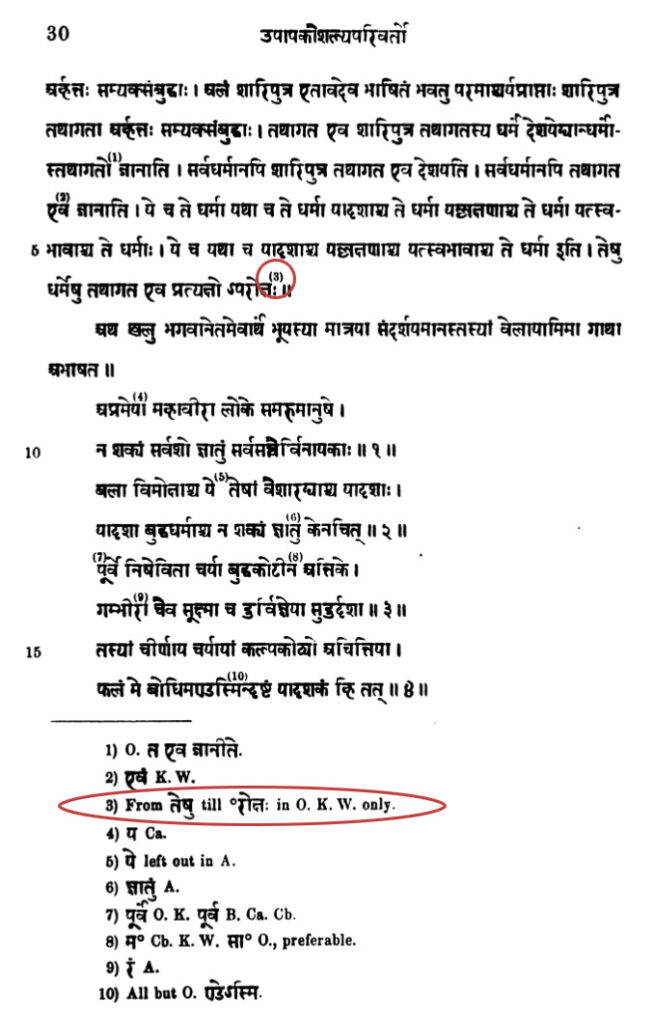
20220812_kern-page30
Note 3, which appears where the 10 suchnesses would be found, says this part is only found in three of the manuscripts used in this compilation.

There is a significant difference between Kern’s translation of Chapter 2 and the translation of the same portion by Hurvitz.

Kern concludes the initial prose section of Chapter 2 with:

Enough, Śāriputra, let it suffice to say, that the Tathāgatas, &c., have something extremely wonderful, Śāriputra. None but a Tathāgata, Śāriputra, can impart to a Tathāgata those laws which the Tathāgata knows. And all laws, Śāriputra, are taught by the Tathāgata, and by him alone; no one but he knows all laws, what they are, how they are, like what they are, of what characteristics and of what nature they are.

As pointed out last week, this is a far cry from Kumārajīva’s 10 suchnesses:

No more, Śāriputra, will I say because the Dharma attained by the Buddhas is the highest Truth, rare [to hear] and difficult to understand. Only the Buddhas attained [the highest Truth, that is,] the reality of all things’ in regard to their appearances as such, their natures as such, their entities as such, their powers as such, their activities as such, their primary causes as such, their environmental causes as such, their effects as such, their rewards and retributions as such, and their equality as such [despite these differences].

When Hurvitz translated the Sanskrit version of the Lotus Sutra compiled by Kern and Nanijio, he found something closer Kumārajīva:

Enough, Śāriputra! Let this statement, at least, stand: the Thus Gone Ones, the Worthy Ones, the Properly and Fully Enlightened Ones, have arrived at the supremely wonderful, Śāriputra. Therefore let it be the Thus Gone One, Śāriputra, who shall teach the dharma of the Thus Gone One, what dharmas the Thus Gone One knows. All the dharmas, every one of them, Śāriputra, does the Thus Gone One himself teach. All the dharmas, every one of them, Śāriputra, does the Thus Gone One himself know. Which the dharmas are, how the dharmas are, what the dharmas are like, of what appearance the dharmas are, and of what essence the dharmas are: which and how and like what and of what appearance and of what essence the dharmas are, indeed it is the Thus Gone One who is the manifest eyewitness of these dharmas.

In this case, Hurvitz put this translation of the Sanskrit in his notes at the back. However, in other places he incorporates the unique content of the Sanskrit to create a translation of the Lotus Sutra that blends Kumārajīva’s Chinese with elements of the Sanskrit.

For example, in Murano’s translation of Kumārajīva, Chapter 3 concludes:

[Expound it to those]
Who receive [this sūtra]
And put it on their heads,
And who do not seek
Any other sūtra
Or think of the books of heresy!

(The Buddha said to Śāriputra:)
Those who seek the enlightenment of the Buddha
Are as various as previously stated.
A kalpa will not be long enough
To describe the variety of them.
They will be able to understand [this sūtra] by faith.
Expound to them
The Sūtra of the Lotus Flower of the Wonderful Dharma!

Kern contains additional material:

146. And he who keeps (in memory) the great Sūtras, while he never shows any liking for other books, nor even knows a single stanza from another work; to all of them thou mayst expound this sublime Sūtra.

147. He who seeks such an excellent Sūtra as this, and after obtaining it devoutly worships it, is like the man who wears a relic of the Tathāgata he has eagerly sought for.

148. Never mind other Sūtras nor other books in which a profane philosophy is taught; such books are fit for the foolish; avoid them and preach this Sūtra.

149. During a full Æon, Śāriputra, I could speak of thousands of koṭis of (connected) points, (but this suffices); thou mayst reveal this Sūtra to all who are striving after the highest supreme enlightenment.

In Hurvitz’s translation, we get a blended conclusion:

If there is a bhikṣu
Who for the sake of all-knowledge
Seeks the dharma in all four directions,
With joined palms receiving it on the crown of his head,
Desiring merely to receive and keep
The scriptures of the great vehicle,
Not accepting so much
As a single gāthā from the other scriptures,
For men like him,
And only for them, may you preach.
As a man wholeheartedly
Seeks the buddhaśarīra,
So may one seek the scriptures
And, having found them, receive them on the crown of one’s head,
Such a person shall never again
Wish to seek other scriptures,
Nor has he ever before thought
Of the books of the unbelievers.
For men like him,
And only for them, may you preach.
I say to you, Śāriputra,
That I, in telling of this sort
Of seekers of the buddha path,
Could spend a whole kalpa and still not finish.
If they are men of this sort,
Then they can believe and understand,
And for their sakes you may
Preach the Scripture of the Fine Dharma Flower.

Something to consider when Hurvitz’s translation is used in comparing English translations of the Lotus Sutra.

One last point: The order of chapters is different between Kern’s original English translation and the later compilation that Hurwitz’s used in his translation.

Hurvitz Sanskrit Kern’s Sanskrit
1. Introduction
(nidānaparivarta)
Introductory
2. Skill in means
(upāyakauśalyaparivarta)
Skillfulness
3. Parable
(aupamyaparivarta)
A Parable
4. Strong inclination, attachment
(adhimuktiparivarta)
Disposition
5. Medicinal herbs
(auṣadhīparivarta)
On Plants
6. Prophecy
(vyākaraṇaparivarta)
Announcement of Future Destiny
7. Former connection
(pūrvayogaparivarta)
Ancient Devotion1
8. Prophecy to five hundred mendicant monks
(pañcabhikṣuśata vyākaraṇaparivarta)
Announcement of the Future Destiny of the Five Hundred Monks
9. Prophecy to Ānanda and others
(Ānandādivyākaraṇaparivarta)
Announcement of the Future Destiny Of Ānanda, Rahula, and the Two Thousand Monks
10. Preachers of dharma
(dharmabhāṇakaparivarta)
The Preacher
11. Apparition of the stūpa
(stūpasaṃdarśanaparivarta)
Apparition of a Stūpa
Devadatta chapter is included at end of Chapter 11
12. Fortitude
(quanchi pin)
Exertion
13. Pleasant conduct
(sukhavihāraparivarta)
Peaceful Life
14. Rise of bodhisattvas out of an aperture in the earth
(bodhisattva-pṛthivīvivarasa mudgamaparivarta)
Issuing of Bodhisattvas from the Gaps of the Earth
15. The life span of the Thus Gone One
(tathāgatāyu pramāṇaparivarta)
Duration of the Life of the Tathāgata
16. Circuit of merits
(puṇyaparyāyaparivarta)
Of Piety
17. Exposition of the merits of appropriate joy
(anumodanāpuṇyanirdeśaparivarta)
Indication of the Meritoriousness of Joyful Acceptance
18. Praise of the dharma preachers
(dharmabhāṇakānuśaṃsāparivarta)
The Advantages of a Religious Preacher
19. Sadāparibhūtaparivarta Sadāparibhūta
20. The constituents of magic power of the Thus Gone One
(tathāgatarddhyabhisaṃskāraparivarta)
Conception of the Transcendent Power of the Tathāgatas
21. Entrustment
(anuparīndanāparivarta)
Spells (Dhārāṇis)
(Entrustment, called The Period, appears at end)
22. The former connection of Bhaiṣajyarāja
(Bhaiṣajyarājapūrvayogaparivarta)
Ancient Devotion of Bhaiṣajyarāja
23. Gadgadasvaraparivarta Gadgadasvara
24. The exposition of the miracles of Avalokiteśvara, entitled the
Chapter of Samantamukha
(samantamukhaparivarto nāmāvalokiteśvaravikurvaṇanirdeśaḥ)
Chapter Called that of the All-Sided One, Containing a Description of the Transformations of Avalokiteśvara
252 Magic formulas
(dhārāṇiparivarta)
Ancient Devotion
See Note 1
26. The former connection of Śubhavyūharāja
(Śubhavyūharājapūrvayogaparivarta)
Encouragement of Samantabhadra
27. The encouragements of Samantabhadra (Samantabhadrotsāhanaparivarta) The Period

Notes

1
Both Chapter 7 and Chapter 25 have the same title in Kern’s translation. return
2
In the Preface to the Revised Edition of Hurvitz’s Lotus Blossom of the Fine Dharma, a comparison of chapter titles between Kumārajīva and the Kern and Bunyiu Nanijio compilation lists the final chapter numbers as 21. Magic formulas, 25. The former connection of Śubhavyūharāja, and 26. The encouragements of Samantabhadra. return

Next: The Problem with Arhats and Pratyekabuddhas

Day 30

Day 30 covers all of Chapter 26, Dhāraṇīs


Having last month met the 10 rākṣasas daughters and the Mother-Of-Devils, we consider the vow of the rākṣasas.

They said to the Buddha:]

“Anyone may step on our heads, but shall not trouble this teacher of the Dharma. Neither shall any yakṣa, rākṣasa, hungry spirit, pūtana, kṛtya, vetāda, kumbhāṇḍa, umāraka, apasmāraka, yakṣa-kṛtya or human kṛtya. Neither shall anyone who causes others to suffer from a fever for a day, two days, three days, four days, seven days or forever. Neither shall anyone who takes the shape of a man, a woman, a boy or a girl and appears in his dream.”

Then they sang in gāthās before the Buddha:

Anyone who does not keep our spells
But troubles the expounder of the Dharma
Shall have his head split into seven pieces
Just as the branches of the arjaka-tree [ are split].

Anyone who attacks this teacher of the Dharma
Will receive the same retribution
As to be received by the person who kills his parents,
Or who makes [sesame] oil without taking out worms [from the sesame],
Or who deceives others by using wrong measures and scales,
Or by Devadatta who split the Saṃgha.

Having sung these gāthās, the rākṣasas said to the Buddha:

“World-Honored One! We also will protect the person who keeps, reads and recites this sūtra, and acts according to it so that he may be peaceful, that he may have no trouble, and that poison taken by him may be neutralized.”

The Daily Dharma from Nov. 12, 2021, offers this:

Anyone who does not keep our spells
But troubles the expounder of the Dharma
Shall have his head split into seven pieces
Just as the branches of the arjaka-tree [are split].

The ten rakṣasī demons and Mother-of-Devils sing these verses in Chapter Twenty-Six of the Lotus Sūtra. They are among the many gods and other supernatural beings who vow to protect all those who keep and practice the Buddha Dharma. These verses help us to understand the nature of those who create harm in the world and to develop a heart of compassion towards them. The nature of delusion is that it sets up a world separate from the world we all share. It puts a barrier between us and the world out of fear that this world will harm us. The Buddha’s teachings show us how to develop the courage to live in harmony with this world, rather than splitting ourselves from it, and splitting ourselves in it.

The Daily Dharma is produced by the Lexington Nichiren Buddhist Community. To subscribe to the daily emails, visit zenzaizenzai.com