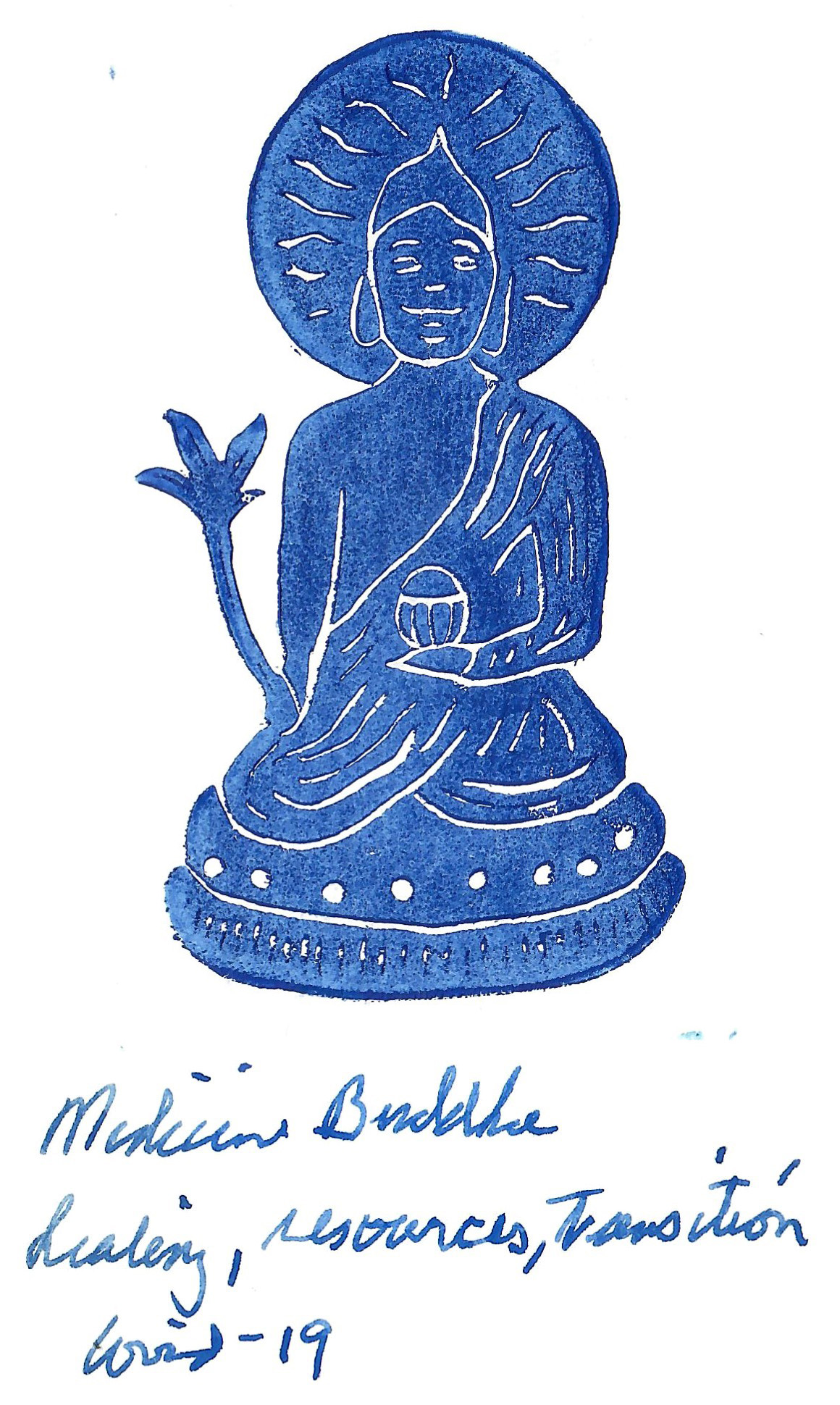
Category Archives: Medicine Master

The Right Questions

This quote is from Master Hsuan Hua‘s commentary on the Medicine Master Sūtra, but it applies to all Buddhist studies.


Does anyone have opinions or questions about the principles of the sūtra? Do you have any insights into the sūtra’s meaning? We should all bring out our opinions and questions for discussion.

The principles that we study in Buddhism are neither your principles, nor my principles, nor the Buddha’s principles. They are the principles of logic and wisdom that everyone should follow. Buddhism is not like certain religions that use faulty reasoning to keep people ignorant and uninformed so that they will accept the tenets of the religion without questioning them.

Buddhism comes from a kind of collective wisdom. What accords with wisdom is the truth, while what does not cannot be practiced. The principles that we are investigating are not imposed from on high with the purpose of keeping us ignorant and uninformed. Therefore, everyone has the right to speak. Using our wisdom, we should determine which doctrines are correct and which are not. We need to have Dharma-selecting vision so that we can judge for ourselves, not just follow the opinions of others. We must develop our own wisdom. Each person should open his “mine of wisdom” and discover his own genuine wisdom.

The wisdom of each Buddha is the same.

Hsuan Hua, Medicine Master Sutra commentary, p114-115

Medicine Master Buddha’s Mantra


This is a stylized version of Medicine Master Buddha’s Mantra with 108 repetitions.


Below are quotes from Master Hsuan Hua‘s commentary on The Sutra of the Merit and Virtue of the Past Vows of Medicine Master Vaiḍūrya.


Sūtra:
At that time, the World-Honored One entered a samādhi called “extinguishing the suffering and distress of all beings.” After he entered this samādhi, a great light came forth from the prominence on top of his head. From amid that light he proclaimed this magnificent dhārāṇi:

Na mo bo qie fa di. Bi sha she. Ju lu bi liu li. Bo la po. He la she ye. Da tuo jie duo ye. E la he di. San miao san pu tuo ye. Da zhi tuo nan. Bi sha shi. Bi sha shi. Bi sha she. San mo jie di. Suo he.

Commentary:
If you recite this very short mantra faithfully and single-mindedly, you will find that it has infinitely many wonderful functions. A doctor can use this mantra to enable his patients to have a speedy recovery. With the mantra’s help, he can become an extremely good doctor. Everyone, whether you are a doctor or not, should recite this mantra. If you recite it on behalf of sick people, they will soon get well.

The mantra consists of transliterated sounds, which cannot be explained. You are not supposed to understand what the mantra means. It is wonderful precisely because it is not understood.

Hsuan Hua, Medicine Master Sutra commentary, p114-115

Medicine Master Buddha’s Ninth Vow

The ninth great vow concerns destroying the nets of demons and gaining liberation from the dense forests of the wrong views of heretics. Medicine Master Buddha said: “I vow that in a future life when I attain Bodhi, I shall free sentient beings from the nets of demons.” Right now as people, we are very close to the demons and very far from the Buddhas. If we wish to be a demon, we can do so anytime. If we wish to become Buddhas, we have to break through many dense forests of wrong views. We have to cast out wrong views and constantly cultivate right views before we can escape the demons’ nets. As these nets are very tough to break, we may easily become followers of demons and asuras. If we are always getting angry or doing stupid things, we are in the demons’ nets.

When a fisherman nets a big fish, he thinks, “What a big fish I’ve caught for supper today!” When a demon catches a person in its net, it thinks, “Great! I’ve got another person for my retinue.” How can we escape the nets of demons? It’s very simple. Just avoid getting mad and doing stupid things. Demons use their tricks to lead people to believe in wrong views, and it’s very difficult for them to get free. However, if we rely on the power of Medicine Master Buddha’s vow, it becomes very easy to escape the demons’ nets.

Hsuan Hua, Medicine Master Sutra commentary, p76-77

Medicine Master Buddha’s Fifth Vow

Because Medicine Master Buddha knew that living beings have many bad habits and faults and are prone to make mistakes, he made the fifth great vow, saying: I vow that in a future life when I attain Bodhi, when I become a Buddha, I shall enable limitless and boundless numbers of sentient beings, which includes you and me, who cultivate Brahmā conduct within my Dharma to perfectly uphold the three clusters of precepts without exception.” Brahmā conduct refers to pure conduct, to the strict observance of the precepts. Medicine Master Buddha vows that whoever practices the Buddha-dharma will be able to perfectly uphold the pure precepts. Pure upholding of precepts can be compared to a perfectly round, full moon.

The Three Clusters of Pure Precepts

  1. The precepts for gathering in living beings
  2. The precepts comprised of wholesome dharmas
  3. The precepts comprised of the rules of discipline and deportment

Since it’s not easy for people to uphold the precepts, Medicine Master Buddha vowed, “Should there be any violation, upon hearing my name, they will regain their purity. In the event of having violated the precepts, if one hears my Buddha-name, one will return to the origin and not fall into the lower destinies. One will not fall into the hells, the realm of hungry ghosts, or the animal realm.”

In the “three clusters of pure precepts,” each cluster is a collection of many precepts. Just as there are said to be “three hundred rituals and three thousand modes of awe-inspiring deportment,” the precepts comprised of the rules of discipline and deportment are also a large collection of rules.

Wholesome dharmas refers to innumerably many kinds of dharmas. The precepts comprised of wholesome dharmas tell us to “do no evil and practice all good.” The precepts for gathering in living beings encompass all living beings. One wants to take all living beings across to Buddhahood. The three clusters of precepts are very many and therefore not easy to cultivate. What should we do if we accidentally transgress them? Medicine Master Buddha’s vow says, “If sentient beings transgress the precepts, after they hear my name, they will attain purity. They won’t fall into the lower destinies.”

Think it over. Medicine Master Buddha works so hard to gather in living beings. Shouldn’t we acknowledge his compassion? Shouldn’t we cultivate the precepts seriously and stop relying on his aid? Don’t think, “Medicine Master Buddha has vowed to save me even if I violate the precepts, so I don’t have to worry.” If we violate a precept unintentionally, without realizing it, he can help us regain purity. On the other hand, we cannot violate the precepts on purpose and think that the Buddha will save us.

Hsuan Hua, Medicine Master Sutra commentary, p68-69

Medicine Master Buddha’s 7th Vow

Below are quotes from Master Hsuan Hua‘s commentary on The Sutra of the Merit and Virtue of the Past Vows of Medicine Master Vaiḍūrya.


Sūtra:
“The seventh great vow: ‘I vow that in a future life when I attain Bodhi, if there are sentient beings beset by many illnesses and who are poor and wretched without aid, without a place to turn, without a doctor, without medicine, without relatives, and without a family, upon hearing my name, they shall be cured of their illnesses, be peaceful and happy in body and mind, gain a family and relatives, acquire abundant property and wealth, and eventually realize unsurpassed Bodhi.”

Commentary:
Many newcomers still don’t know who Medicine Master Vaiḍūrya Light Tathāgata is. I shall tell you a little more about this Buddha. He is a great king of physicians who cures people without using medicine. Living beings only need to hear his name, and their illnesses will be cured.

Chinese physicians use the methods of observing, listening, inquiring, and feeling the pulse to diagnose a patient’s condition. Physicians are classified as “spiritual,” “sagely,” “skillful,” or “clever.” The “spiritual” are the very best, while the “sagely” are not quite as incredible. “Skillful” refers to those who have to apply some skill and effort before they can know a person’s condition. The “clever” can know in an ingenious way. In general, the “spiritual” know by observing; the “sagely” know by listening; the “skillful” know through inquiring; and the “clever” know through feeling the pulse. Ordinary doctors must use these four methods to diagnose sickness.

Medicine Master Buddha, however, doesn’t use these methods. He can cure people as long as they sincerely recite his name. That’s his special way of helping people. Such formidable spiritual power comes from the following vow.

The seventh great vow: “I vow that in a future life when I attain Bodhi, if there are sentient beings beset by many illnesses who are poor and wretched without aid, without a place to turn, without a doctor, without medicine, without relatives, and without a family. They have no one who can help them, and no safe place where they can take refuge. Being sick is the greatest suffering. They are poor and alone and beset by hardships.

Upon hearing my name, they shall be cured of their illnesses. If they hear my name, ‘Medicine Master Buddha Who Quells Disasters and Lengthens Life,’ they will be cured of all disease, without having to take medication or get shots, X-rays, or CAT scans. There’s no need for electrotherapy, acupuncture, or any other treatments or operations. However, this passage doesn’t mean that doctors will be out of business, so doctors should not worry.

These people will be peaceful and happy in body and mind, gain a family and relatives, acquire abundant property and wealth. They will fully regain physical and mental health. They will not be alone in the world, nor will they be poor.

And finally, they will eventually realize unsurpassed Bodhi.” All living beings have the Buddha-nature and can become Buddhas. The Buddha didn’t say, “I alone can become a Buddha, and no one else can.” Buddhism is very democratic. The Buddha is just the same as us, except that he has great wisdom, so he doesn’t say or do confused things. We study the Buddha’s teachings in order to learn to live in harmony, be good people, and ultimately, become wise Buddhas. However, if we do not behave properly, we will never become wise.

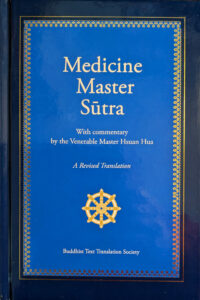
Hsuan Hua, Medicine Master Sutra commentary, p72-74

Next: Medicine Master Buddha’s Mantra