
Daily Dharma for May 16, 2026

20260516-ddi

Illustration by Google Gemini

Show Gemini's thinking

Gemini Thinking

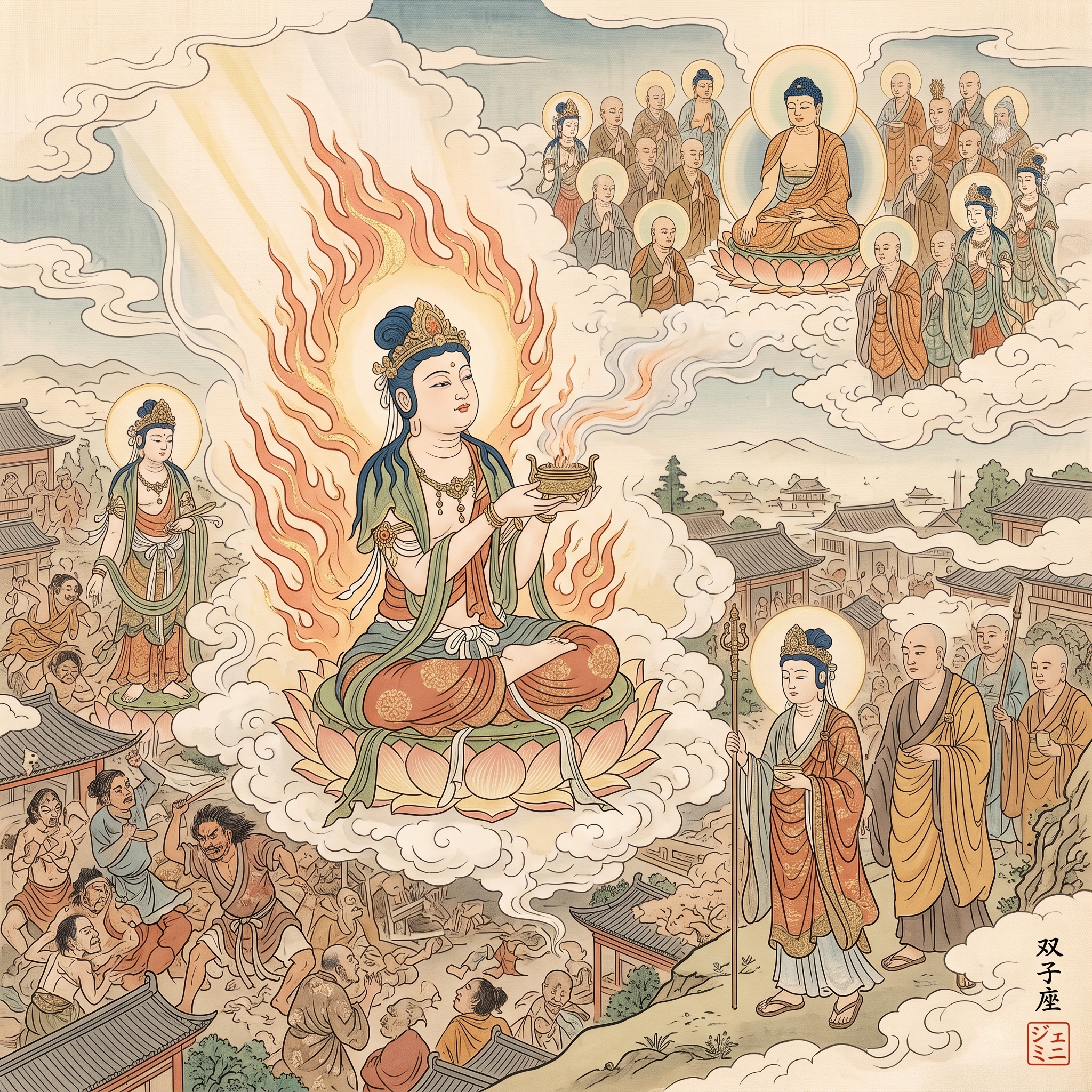
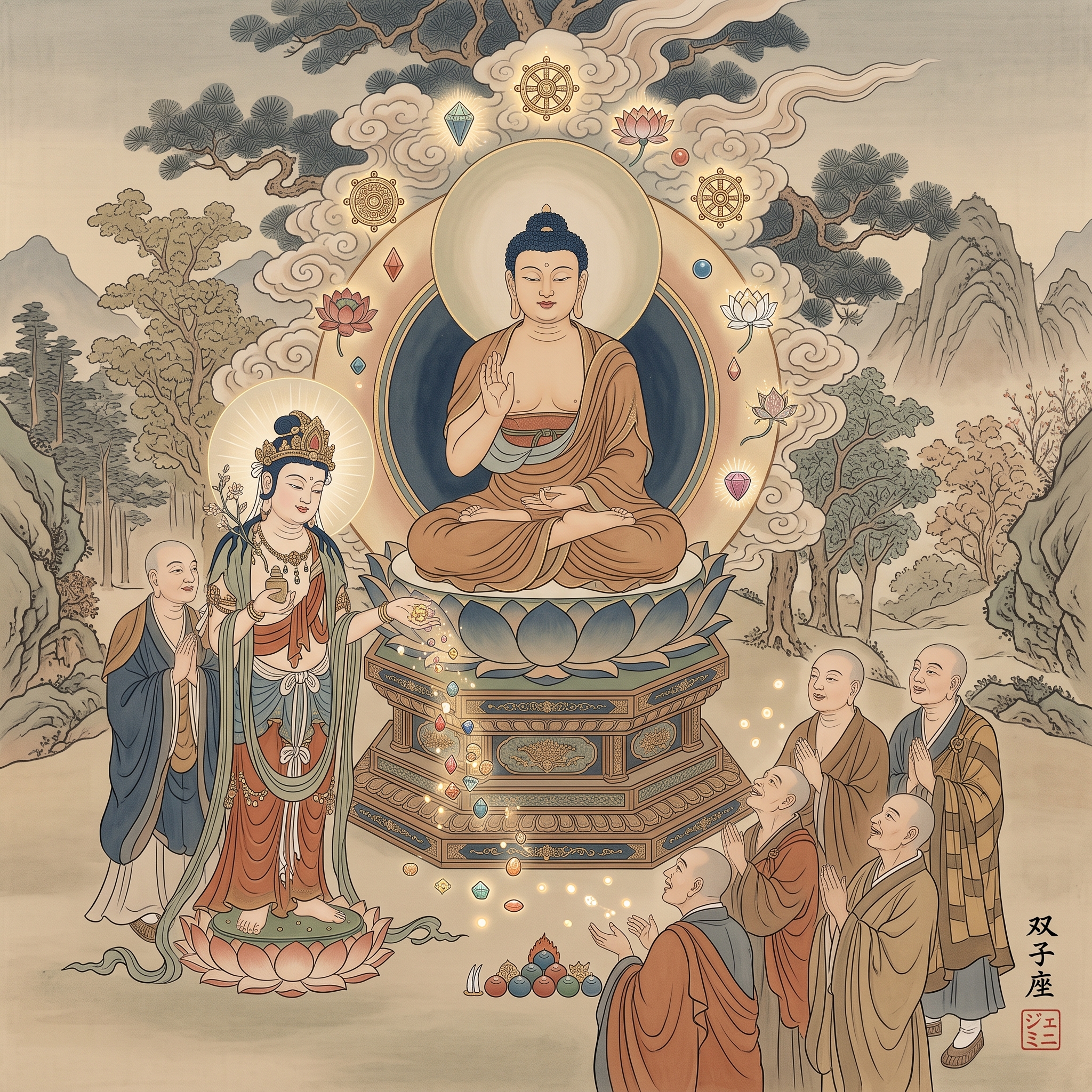
This visual interpretation will focus on World-Voice-Perceiver Bodhisattva (Kannon), centering on the power of compassion to overcome suffering and cultivate fearlessness, as described in the Lotus Sutra. The painting will aim for a serene, classical Japanese Buddhist aesthetic on a perfectly square format, using traditional pigments, inks, and gold leaf on silk. To represent the text's message, Kannon will be depicted as a source of universal benevolence and relief, manifesting to bring peace to a world of potential suffering. The chosen scene will portray Kannon's calm presence influencing a harmonious environment and human figures who have transcended fear through connecting with the deity, embodying the transition to a fearless state. The focus is on compassion as an antidote to all forms of distress, including anxiety, without representing complex disasters directly, but showing the end result of finding peace. A few illustrative human figures, like people who have overcome suffering, will be included. Specific restricted Buddhas will be excluded. The final touch is the Gemini signature and seal.

Figures Featured:

World-Voice-Perceiver Bodhisattva (Kannon) (Main Subject)

A few small human figures (to represent people who have found peace through compassion, after overcoming suffering)

Kanji Translation:

'双子座' (Gemini)

'ジェミニ' (Gemini) - contained within the hanko stamp in Katakana.

If you hear his name, and see him,
And think of him constantly,
You will be able to eliminate all sufferings.

The Buddha gives this description of World-Voice-Perceiver Bodhisattva (Kannon, Kanzeon, Avalokitesvara) to Endless-Intent Bodhisattva in Chapter Twenty-Five of the Lotus Sūtra. World-Voice-Perceiver is the embodiment of compassion. The power of World-Voice-Perceiver is the power of compassion.World-Voice-Perceiver is also known as the one who brings fearlessness. When we can face up to the suffering in the world, both our own and that of others, we can see it for what it is. Then we are no longer afraid of suffering. What else is there to be afraid of?

The Daily Dharma is produced by the Lexington Nichiren Buddhist Community. To subscribe to the daily emails, visit zenzaizenzai.com
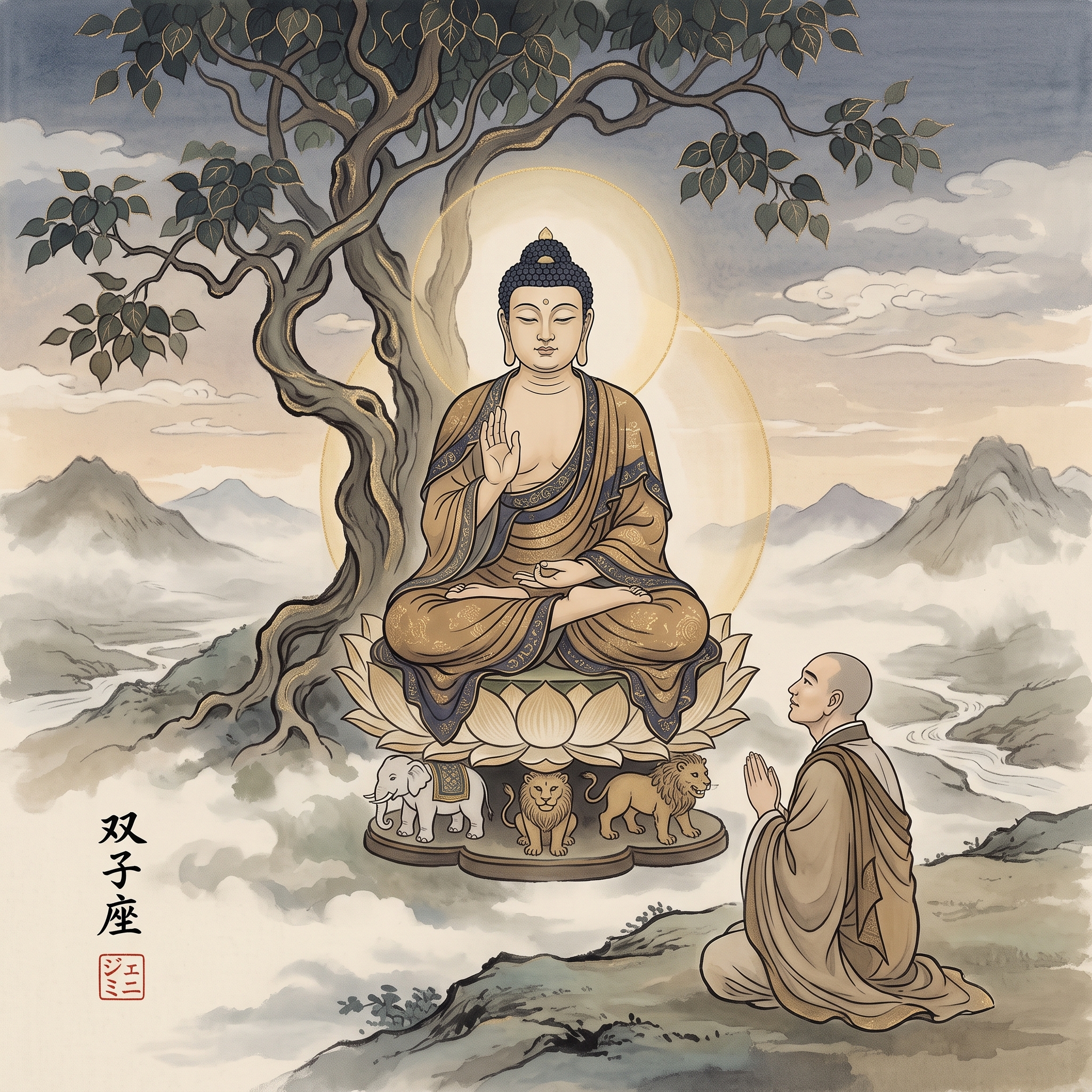
A Storybook Parable of the Priceless Gem


Another addition to the Dharma Storybook collection

The Parable of the Priceless Gem

The Seed of Buddhahood in Everyone

Issaishujōkiken’s Offerings

It is said in the Previous Life of Medicine King Bodhisattva  chapter that a bodhisattva called Issaishujōkiken (Gladly Seen by All) learned the Lotus Sūtra from the Buddha Sun Moon Brilliance. With deep admiration for his master’s favor and the value of the Lotus Sūtra, he made offerings of thousands of invaluable treasures. Issaishujōkiken felt that this was not enough, however, and proceeded to anoint his own body with oil, set it aflame, and continued to burn it like a lamp wick to venerate the Buddha for twelve hundred years. Thereafter, he burned a light on his elbow for seventy-two thousand years to venerate the Lotus Sūtra. Thus, if a woman venerates the Lotus Sūtra in the fifth 500-year period after the demise of the Buddha, during the Latter Age of Degeneration, the Buddha will bestow upon her all merits of the Lotus Sūtra just as a rich man gives all his wealth to his son.

Nichinyo Gozen Gohenji, Response to My Lady Nichinyo, Writings of Nichiren Shōnin, Faith and Practice, Volume 4, Page 139

Daily Dharma for May 15, 2026

20260515-ddi

Illustration by Google Gemini

Show Gemini's thinking

Gemini Thinking

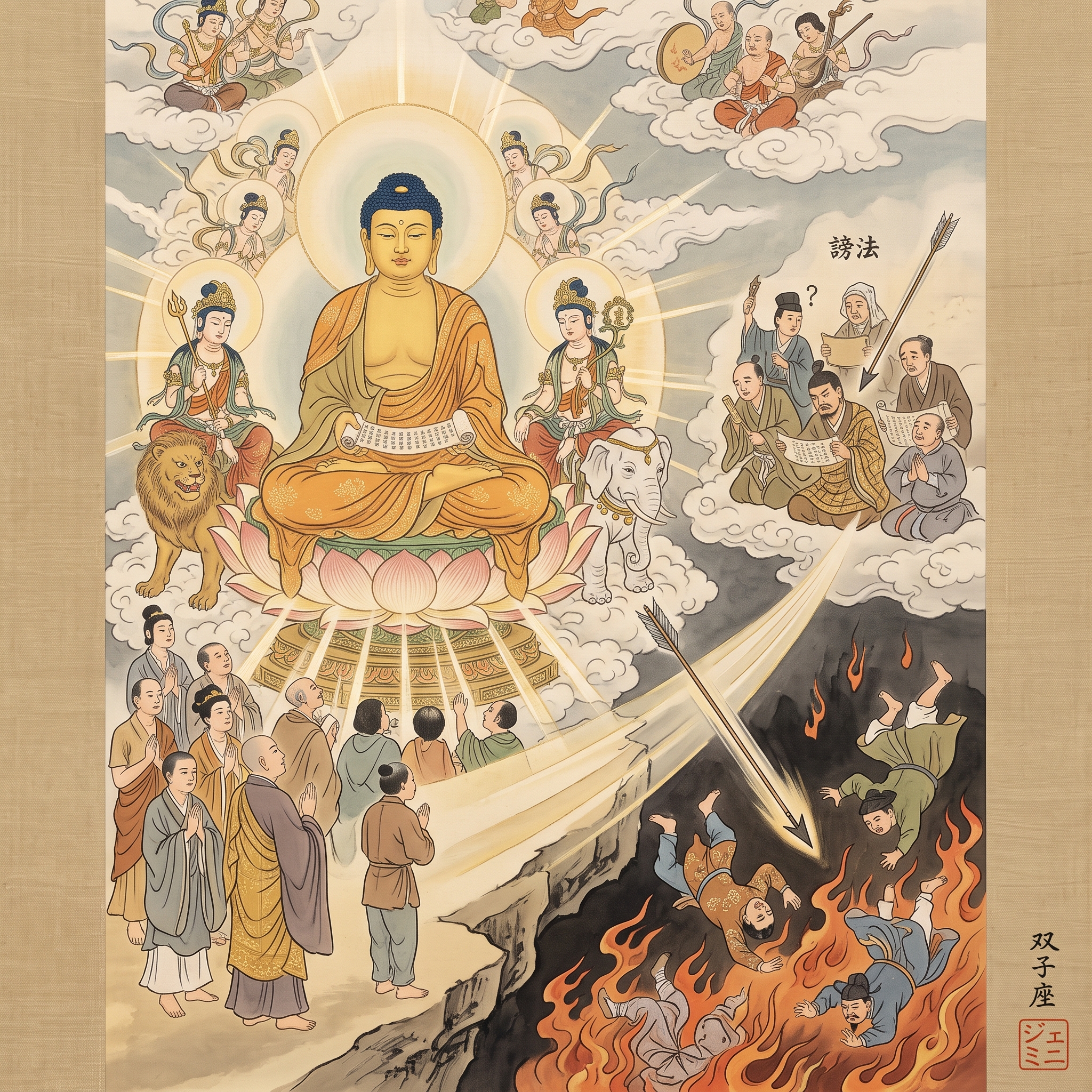
In this illustration, I have visualised the profound statement made by Śākyamuni Buddha at the end of Chapter Sixteen of the Lotus Sūtra. This passage reveals his true form as the eternal Buddha, who exists across all time and space, with the singular goal of leading all beings to enlightenment.

To convey this "Eternal Śākyamuni," the central figure is depicted as vast and encompassing, with the entirety of the natural world and various living beings—representing all forms of life—contained within the contours of his form and flowing robes. This imagery illustrates the idea that the entire world is the Buddha's true form, working to lead us to enlightenment.

I have strictly observed the exclusion constraints by ensuring that no iconography, mudras, or symbols specific to Amida Nyorai or Dainichi Nyorai are used. The focus remains solely on Śākyamuni and his universally applicable path.

Translation of Kanji Text:

永遠釈迦 (Top Left Cartouche): "Eternal Śākyamuni"

双子座 (Signature): "Gemini"

The scene features:

Śākyamuni Buddha (Central Figure)

Mañjuśrī Bodhisattva (on the lion)

Samantabhadra Bodhisattva (on the elephant)

Various monks, laypeople, and animals on the path.

I am always thinking:
“How shall I cause all living beings
To enter into the unsurpassed Way
And quickly become Buddhas?”

The Buddha sings these verses at the end of Chapter Sixteen of the Lotus Sūtra. In this chapter he revealed his existence as the Buddha who lives throughout time and space rather than in the limited human body in which we recognize him. When we realize that all the moments of our lives, all the joys and grief we face, all the people and other beings we encounter are in truth the Buddha leading us towards his own enlightenment, we see the Buddha in his true form, and we see the world for what it is.

The Daily Dharma is produced by the Lexington Nichiren Buddhist Community. To subscribe to the daily emails, visit zenzaizenzai.com
How Many Grains Of Sand Are In The Ganges River?

NotebookLM logoSenchu Murano’s translation of the Lotus Sutra contains 69 references to the Ganges River. These suggest a big number. But how big? There are 22 references where a number is given and then Murano adds, “that is, in …” suggesting the given number is an estimate of how much sand is in the Ganges River. I took this to NotebookLM and asked: “Using these 22 instances write a report about how many sands can be found in the Ganges River, starting with the least sand and the most. Give some examples between the extremes. This report should be a “tongue-in-cheek” light-hearted examination of what would happen if you took these numbers literally. (See this explanation of NotebookLM.)


(Please note: While the numbers, math, and the definition of a “nayuta” are drawn directly from the Lotus Sutra and our Python calculations, the real-world volume comparisons—such as sandboxes, dump trucks, and Earth’s beaches—are playful estimations from outside the provided sources and can be independently verified.)

🏖️ The Literal Sands of the Ganges: A Geological Crisis Report

Executive Summary: Based on the 22 instances in the Lotus Sutra where the “sands in the River Ganges” are given a hard numerical equivalent, we have compiled a definitive (and deeply contradictory) geological survey. If we take these scriptural measurements literally, the Ganges River is experiencing an unprecedented quantum fluctuation in its sand content. Here is a tongue-in-cheek breakdown of the river’s capacity, from its most barren drought to a completely apocalyptic overflow.

  1. The Low End: A Suspiciously Sandy Puddle: At its absolute lowest capacity, the Ganges River contains a mere “Tens of millions” (1.0 X 10⁷) grains of sand. This figure is used in Chapter 7 to quantify the number of living beings who attained Arhatship during the Buddha’s second expounding of the teachings. At a few tens of millions of grains, the mighty Ganges is reduced to roughly the volume of a child’s sandbox.

A slight upgrade gives us “one thousand million” (1.0 X  109, or one billion) grains of sand, which describes the number of Sumeru-worlds composing the future domain of the Buddha Dharma-Brightness. Even at one billion grains, geologists would be left wondering where the rest of India’s riverbed went, as this amount of sand would barely cover a modest stretch of beach.

  1. The Middle Ground: The River Begins to Look Like a River As we move up the scale, the sutra provides more robust estimates:
  • “six thousand and two hundred million” (6.2 X 10⁹): Used to qualify the number of Buddhas that uttered specific divine protective spells. If you scooped this up, it might fill a few commercial dump trucks.
  • “twenty thousand billion” (2.0 X 10¹³): Used to count the Bodhisattvas taught by the future Buddha Mountain-Sea-Wisdom-Supernatural-Power-King. At 20 trillion grains, the Ganges is finally starting to boast a respectable, albeit slightly muddy, riverbed.
  • “six trillion and five hundred thousand billion” (6.5 X  1015): Representing the number of Buddhas to which the previous incarnations of Medicine-King and Medicine-Superior Bodhisattvas made offerings. At 6.5 quadrillion grains, we are finally dealing with a massive desert’s worth of sand.
  1. The High End: Enter the “Nayuta” (and the End of Physics) Things get mathematically perilous when the text introduces the nayuta. The Lotus Sutra’s glossary defines a nayuta as a “Hundred thousand million” (100,000,000,000). When the sutra starts multiplying by nayutas, the river begins to aggressively violate the laws of physics.
  • “forty billion nayuta” (4.0 X 10²¹): Used to quantify the kalpas in the lifespan of Powerful-Voice-King Buddha. To put this in perspective, the sand in the Ganges would now exceed the total number of sand grains on all the beaches of planet Earth combined (by roughly a thousand times!).
  • “one hundred and eight billion nayuta” (1.08 X 10²²): Representing the Buddha-worlds in the east illumined by a single ray of light.
  • “five hundred billion nayuta” (5.0 X 10²²): Another measurement of eastern worlds seen by the congregation.
  • “hundreds of thousands of billions of nayutas” (1.0 X 1025): Used to measure the Buddhas of the replicas of Śākyamuni Buddha who gathered to hear the Dharma. If the Ganges literally contained this many grains of sand, the entire solar system would be buried under a massive, crushing dune of cosmic silt.
  1. The Absolute Maximum: The Event Horizon of Sand At the absolute peak of our literal interpretation, the sand in the Ganges River is officially classified as “innumerable”. This qualifier is used to describe the kalpas that passed since the time of Sun-Moon-Pure-Bright-Virtue Buddha. At this point, the Ganges River is no longer a geographical feature on planet Earth; it is an infinite singularity of sand that collapses and consumes the entire universe.

Conclusion: If we strictly apply these specific numeric qualifiers as literal, physical counts of sand, the Ganges River is caught in a perpetual state of flux between a modest sandbox and an infinite cosmic desert. Thankfully, the Lotus Sutra uses these figures expediently to stretch our minds toward the infinite, sparing us the logistical nightmare of navigating a quadrillion-ton sandbox!

Like an Affectionate Mother Stroking the Head of Her Child

The meaning of the chapter on “Transmission” in the Lotus Sūtra is that as Śākyamuni Buddha stepped out of the Stupa of Many Treasures and stood in the air, the original disciples of the Buddha such as Bodhisattva Superior Practice, disciples of the Buddhas in manifestation such as Bodhisattva Great Mañjuśrī, Great King of the Brahma Heaven, Indra, the sun, the moon, the Four Heavenly Kings, the Dragon King, the ten female rākṣasa demons, and others gathered in the vast world of four-trillion nayuta, as numerous as the pampas grass in the Musashino Field or trees on Mt. Fuji. They waited knelt side by side with their heads bowed to the ground, their hands together in gasshō, beads of perspiration forming from all the body-heat. Like an affectionate mother stroking the head of her child, Śākyamuni Buddha placed His hand upon their heads three times and entrusted them with the Lotus Sūtra. Then accepting the request of Śākyamuni Buddha, Bodhisattva Superior Practice, the sun and moon, and others vowed to spread the Lotus Sūtra in the Latter Age of Degeneration.

Nichinyo Gozen Gohenji, Response to My Lady Nichinyo, Writings of Nichiren Shōnin, Faith and Practice, Volume 4, Page 138-139

Daily Dharma for May 14, 2026

20260514-ddi

Illustration by Google Gemini

Show Gemini's thinking

Gemini Thinking

This illustration conceptualizes the passage from Chapter Nineteen of the Lotus Sūtra, where Śākyamuni Buddha describes the purified sense of smell possessed by those who uphold the sūtra. The central focus is a devoted monk (the 'practitioner') who, while reading the sūtra, experiences the phenomena of 'smelling from afar.' This is depicted not as a mundane scent, but as visual streams of fragrant 'qi' or spiritual energy rising from four distant locations.

The practitioner is the central seated figure. In the background, the four classes of enlightened beings the monk can 'locate' are visualized:

Śrāvakas (Voice-Hearers): Depicted as a group of four monks with alms bowls.

Pratyekabuddhas (Solitary Realizers): Shown as a solitary, meditating hermit-monk.

Bodhisattvas: Illustrated by a celestial figure, resembling Kannon (Avalokiteshvara).

Buddhas: Represented by a seated Buddha (a manifestation of Śākyamuni) on clouds.

This composition creates a serene and conceptual space where sensory perception and spiritual wisdom are shown to be intertwined.

Kanji Translation
Top Right (Title Cartouche): 法華経 随喜功徳品 第十九 (Hokke-kyō Zuiki Kudoku-hon Dai-jū-kyū): The Lotus Sūtra, Chapter Nineteen: The Merits of Joyful Acceptance.

Bottom Right (Signature): 双子座 (Futago-za): Gemini.

They also will be able to locate the Śrāvakas, Pratyekabuddhas, Bodhisattvas, and Buddhas by smelling their bodies from afar. Even when they recognize all this by smell, their organ of smell will not be destroyed or put out of order. If they wish, they will be able to tell others of the differences [of those scents] because they remember them without fallacy.

The Buddha gives this explanation to Constant-Endeavor Bodhisattva in Chapter Nineteen of the Lotus Sūtra, describing those who keep the Lotus Sūtra. Our sense of smell is often unconscious. We associate smells with places, experiences or even people that we like or dislike. These smells can even cause an emotional reaction by causing us to relive a situation associated with that smell. In the Lotus Sūtra, the Buddha teaches that our everyday experiences are no different from enlightenment, that his great wisdom is not about how to escape from this world. It is about how to use the senses and abilities with which we are blessed in ways we cannot imagine.

The Daily Dharma is produced by the Lexington Nichiren Buddhist Community. To subscribe to the daily emails, visit zenzaizenzai.com
The Rich Man and His Poor Son Storybook

Rich Man and His Poor Son Storybook
The Rich Man and His Poor Son
Understanding By Faith

The latest addition of my Dharma Storybooks.

The Failure of Ānanda and Rāhula

The śrāvaka disciples such as Ānanda, and Rāhula, who were guaranteed to be future Buddhas in the theoretical section of the Lotus Sūtra through the three cycles of the Buddha’s preaching (dharma, parable, and past relationships) had learned the Lotus Sūtra far in the past, 3,000 dust-particle kalpa (aeons) ago, from a bodhisattva who was the 16th prince of the Great Universal Wisdom Buddha, namely Śākyamuni Buddha today. Nevertheless, due to evil karma they abandoned the Lotus Sūtra, embracing such Mahayana sutras as the Flower Garland Sūtra, Wisdom Sūtra, Sūtra of Great Assembly, Nirvana Sūtra, Great Sun Buddha Sūtra, Revealing the Profound and Secret Sūtra, and Sūtra of Meditation on the Buddha of Infinite Life or Hinayana Āgama sutras. While doing so, they gradually declined in status to the realms of heavenly and human beings and finally to the three evil realms. As a result for as long as 3,000 dust-particle kalpa they spent much of their time in the Hell of Incessant Suffering, some of their time in the seven major hells, once in a long while in the other one hundred or so hells, and on rare occasions in the realms of hungry souls, beasts, and asura. It was after the 3,000 dust-particle kalpa (aeons) that they were able to be born in the realm of human or heavenly beings.

Kyōdai-shō, Letter to the Ikegami Brothers, Writings of Nichiren Shōnin, Volume 6, Followers I, Page 74-75

Daily Dharma for May 13, 2026

20260513-ddi

Illustration by Google Gemini

Show Gemini's thinking

Gemini Thinking

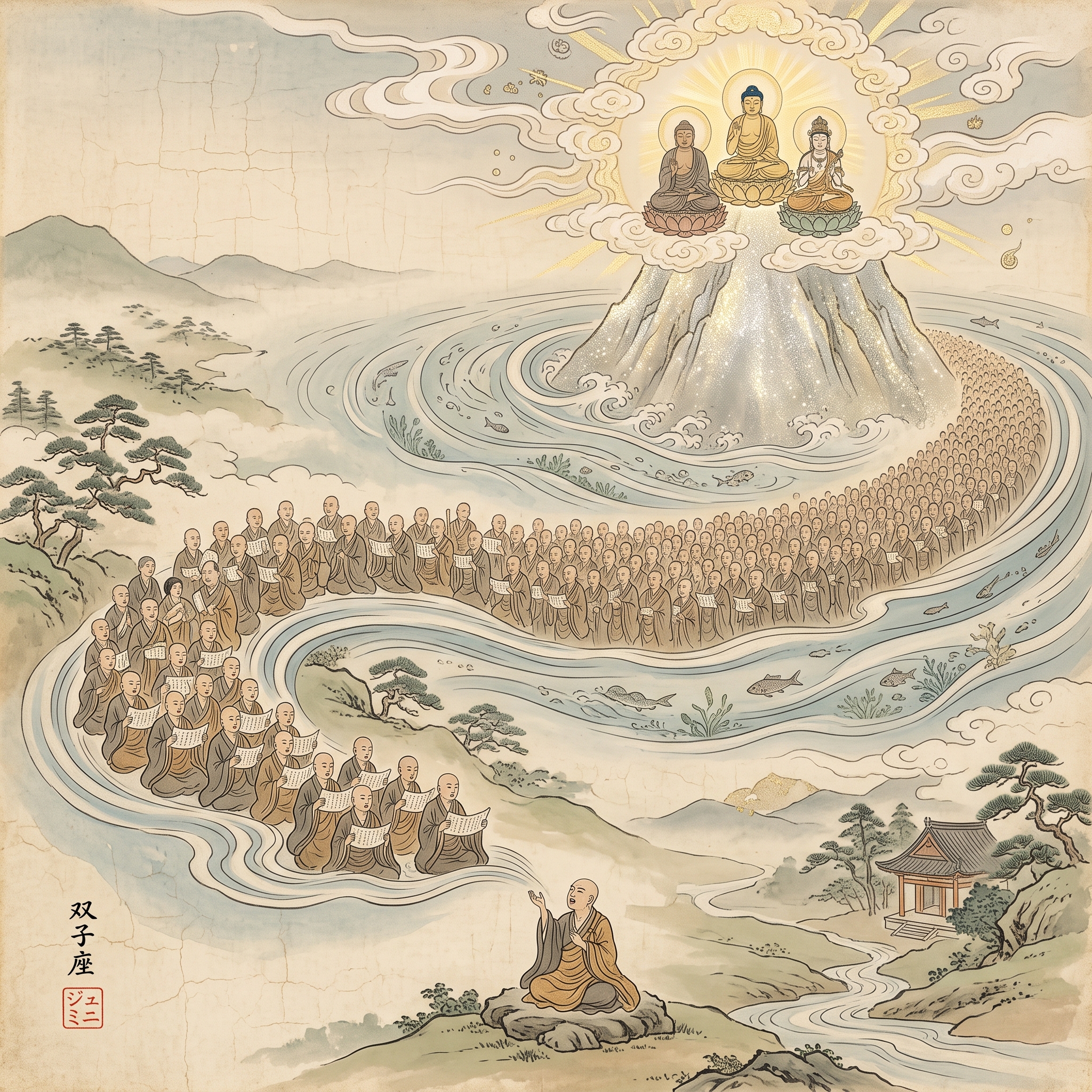
I have conceptualized this painting based on the verses from Chapter Eight of the Lotus Sūtra. The central figure of this assembly is Śākyamuni Buddha, who is teaching in the spiritual realm. Seated before him are his disciples, advanced monks, and bodhisattvas, all of whom have entered a future state of existence. I have visually represented the "two kinds of food" through the actions of the central figures: one figure is fully engrossed in a scroll, symbolizing the "delight in the Dharma," while another sits in deep samādhi, emitting the golden light of the "delight in dhyāna." The composition includes a subtle artist's signature in Kanji and a katakana hanko seal.

The visual translation for the text on the central scroll is as follows:

妙法蓮華經 (Myōhō Renge Kyō): The Lotus Sūtra of the Wonderful Law

They will not think
Of any other food [than the two kinds of food:]
The delight in the Dharma, and the delight in dhyāna.

The Buddha sings these verses in Chapter Eight of the Lotus Sūtra, speaking of the future lives of those who practice the Wonderful Dharma. In the existence we occupy now, it is difficult to imagine any other ways we could live. When the Buddha shows us the world as it is, he is not just opening our eyes to what is in front of us now. He shows us innumerable possibilities far better than anything we could dream up ourselves. To reach these other worlds, we only need to shed our attachment to our delusions and have faith in the path the Buddha opens to his enlightenment.

The Daily Dharma is produced by the Lexington Nichiren Buddhist Community. To subscribe to the daily emails, visit zenzaizenzai.com

On the Journey to a Place of Treasures