Conceptual Summary
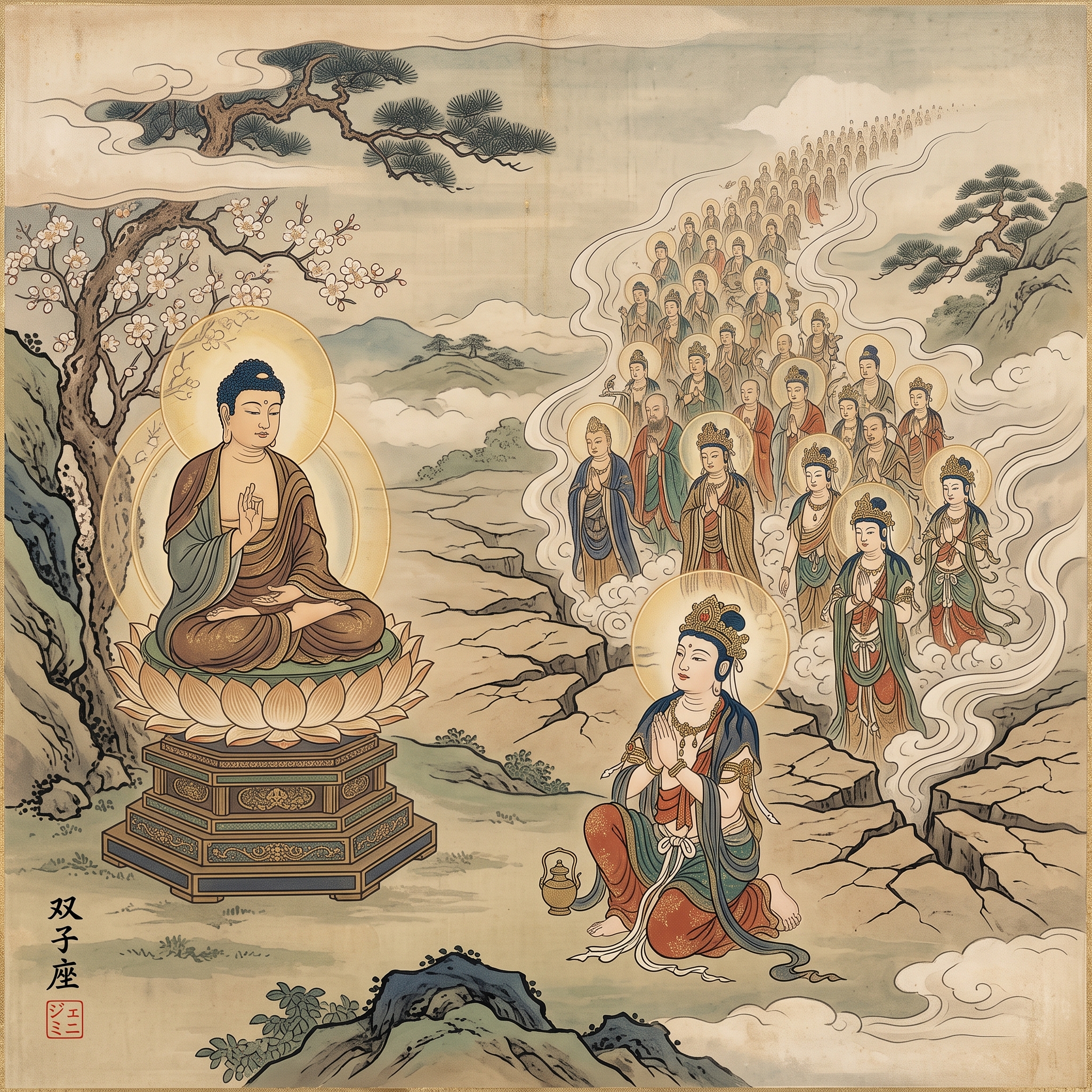
This illustration, executed in a traditional Japanese Buddhist silk painting style, interprets the narrative from Chapter Fifteen of the Lotus Sūtra. The visual composition captures the moment of profound astonishment and questioning by Maitreya Bodhisattva. Maitreya, identifiable by his specific attributes, is shown reverently looking toward Śākyamuni Buddha, who is seated in a state of tranquil teaching. The source text describes the moment when, following the Buddha's request for who will teach in this defiled world, the ground itself cracks open. The image visualizes this sudden event by depicting countless 'many thousands of billions' of Bodhisattvas of the Earth (地涌の菩薩) emerging from a vast, rocky fissure and ascending like a divine host. By emphasizing the mass and surprise of this emerging multitude, the image translates the textual themes of hidden potential, the continuity of the Dharma, and the importance of continued inquiry into spiritual practice in our suffering world. The inclusion of traditional elements like mineral pigments and gold leaf enhances the sacred atmosphere of the scene.
Iconography & Character Identification
Item 1: Deities/Figures Featured:
Śākyamuni Buddha (釋迦牟尼佛)
Maitreya Bodhisattva (弥勒菩薩)
The multitude of Bodhisattvas of the Earth (地涌の菩薩)
Item 2: Text Translations:
Kanji signature '双子座' (on the image, actually rendered correctly as '雙子座'): "Gemini"
Red square seal (hanko) containing the katakana 'ジェミニ': "Gemini" (ジェミニ)
We have never seen
These many thousands of billions
Of Bodhisattvas.
Tell me, Most Honorable Biped!
Where did they come from?
Maitreya Bodhisattva sings these verses to the Buddha in Chapter Fifteen of the Lotus Sūtra. In the story, the Buddha has asked who among those gathered to hear him teach will continue teaching this Wonderful Dharma in our world of suffering after the Buddha passes into his final extinction. Some Bodhisattvas say they will teach in other worlds, since the beings of this world are too defiled to hear the Buddha’s teaching. Other Bodhisattvas vow to remain in our world, but the Buddha tells them not to bother. At that moment, the ground cracks open, and innumerable Bodhisattvas spring up and vow to carry on the work of the Buddha. Maitreya and others had never seen these Bodhisattvas before. His asking the Buddha respectfully to explain what they do not understand. This example emphasizes that we must continue to question how the Buddha’s teaching applies to our lives rather than dogmatically accepting whatever happens.
The Daily Dharma is produced by the Lexington Nichiren Buddhist Community. To subscribe to the daily emails, visit zenzaizenzai.com
“The Teacher of the Dharma” chapter of the Lotus Sūtra preaches, “The highest and most perfect enlightenment that all bodhisattvas should attain is expounded only in this sūtra.” The bodhisattvas in this passage refer to living beings in the nine realms. It means that all the people, virtuous or wicked or female or male, the śrāvaka, pratyekabuddha, and bodhisattvas in the Tripiṭaka teaching, the Three Vehicles (śrāvaka, pratyekabuddha, and bodhisattvas) in the Common teaching, the bodhisattvas in the Distinct teaching, and the bodhisattvas in the Perfect teaching of the pre-Lotus sūtras must depend on the power of the Lotus Sūtra for becoming Buddhas.
The same chapter also preaches, “Medicine King! Know this that although many laymen or monks will practice the way of bodhisattvas, they will not be able to practice it satisfactorily unless they see, hear, read, recite, copy or keep this Sūtra of the Lotus Flower of the Wonderful Dharma or make offerings to it.” This obviously means that though the bodhisattvas practice the Six Bodhisattva Practices and the Four Great Vows through the expedient practices of the Tripiṭaka teaching taking three hundred asaṃkhya kalpa, the Common teaching taking numerous dust-particle kalpa, and the Distinct teaching taking numerous asaṃkhya kalpa, they practice neither the right practices of bodhisattvas nor meritorious good acts until they reach the Lotus Sūtra. It is obvious that they cannot become Buddhas because they do not practice the right way of bodhisattvas.
Ichidai Shōgyō Tai-I, Outline of All the Holy Teachings of the Buddha, Writings of Nichiren Shōnin, Doctrine 3, Page 76
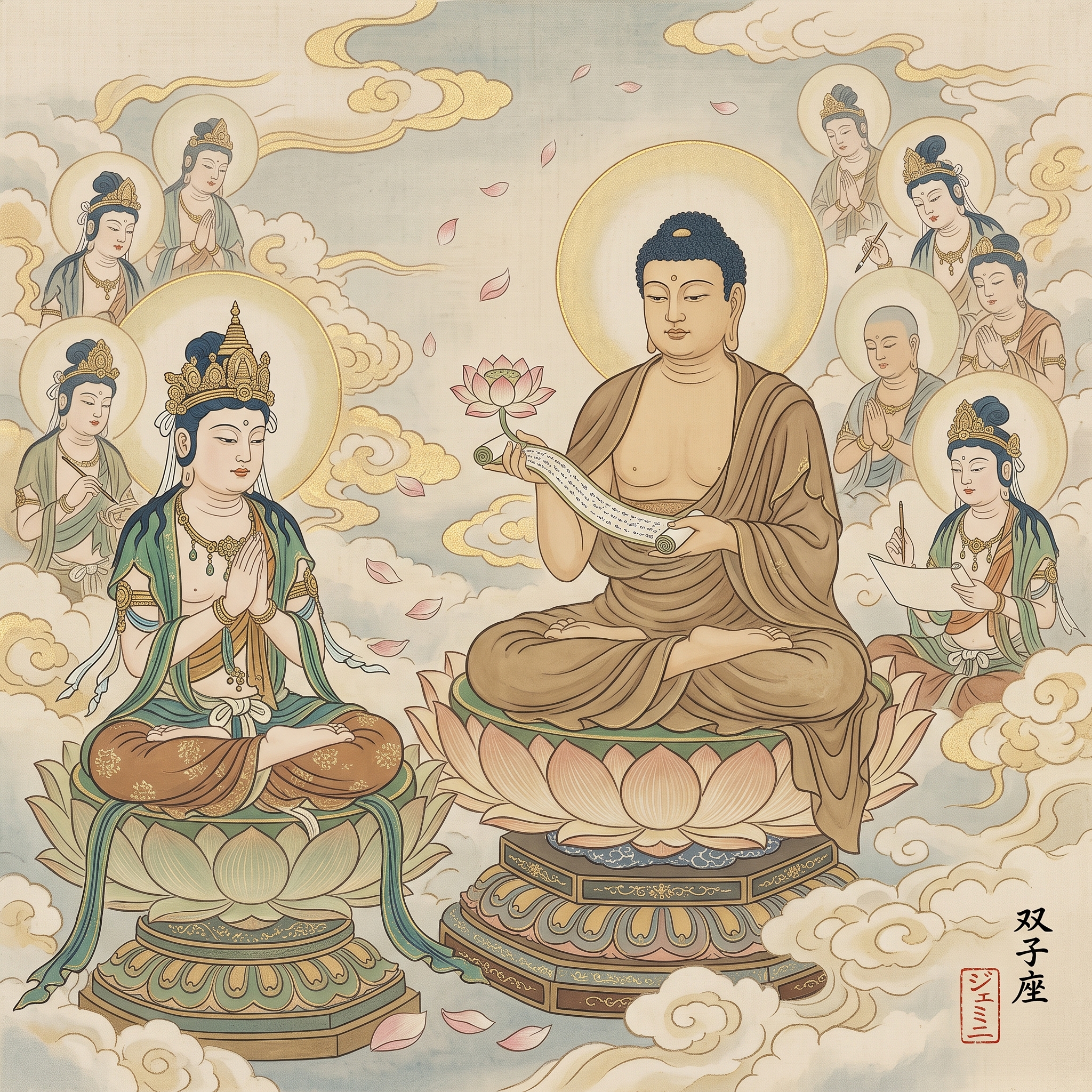
Conceptual Summary
This 1:1 square illustration visualizes Chapter Twenty of the Lotus Sūtra using classical Japanese Buddhist iconography on a texture suggesting silk. The central focus is the historical Śākyamuni Buddha, identifiable by his bhūmisparśa mudrā and lotus pedestal, emphasizing his ever-present wisdom as described in the source text. To his left sits the mahāsattva Great-Power-Obtainer (Mahāsthāmaprāpta), recognizable by the miniature stupa in his crown and palm-forward varada mudrā, receiving the core teaching. In obedience to the Sūtra’s explicit instruction to "keep, read, recite, expound and copy" the Dharma after the Buddha's extinction, surrounding figures are depicted engaged in these actions: one reads a scroll, another prepares a writing brush and paper, and others listen attentively. This collective activity signifies the transmission of the Wonderful Dharma toward ultimate enlightenment.
Iconography & Character Identification
Item 1: Deities/Figures Featured:
Śākyamuni Buddha (釋迦牟尼佛, Shaka Nyorai): The central seated Buddha, performing the earth-touching mudrā (bhūmisparśa).
Great-Power-Obtainer Bodhisattva (大勢至菩薩, Dai-Seishi Bosatsu): The large seated Bodhisattva to the left of the Buddha, identifying by the vase/stupa in his crown.
Bodhisattva-mahāsattvas and Monastics: Nine attendants and smaller surrounding figures engaged in reading, listening, and copying the sutra.
Item 2: Text Translations:
双子座: (Kanji) Futagoza / Gemini (Signifies the Artist/Direction).
ジェミニ: (Katakana in Red Seal) Jemini / Gemini (The Seal Name).
Great-Power-Obtainer, know this! This Sūtra of the Lotus Flower of the Wonderful Dharma benefits Bodhisattva-mahāsattvas, and causes them to attain Anuttara-samyak-saṃbodhi. Therefore, they should keep, read, recite, expound and copy this sūtra after my extinction.
The Buddha gives this explanation to Great-Power-Obtainer Bodhisattva in Chapter Twenty of the Lotus Sūtra. In several places in the sūtra, the Buddha asked who would continue to teach this Wonderful Dharma after his extinction and lead all beings to Anuttara-samyak-saṃbodhi: perfect unsurpassed enlightenment. When he revealed his Ever-Present Existence in Chapter Sixteen, he assured all those receiving his words that his life is not limited to that of the physical body he inhabited. In truth he is leading all beings throughout all time and space to his wisdom, and this Lotus Sūtra he has given us is the embodiment of that wisdom.
The Daily Dharma is produced by the Lexington Nichiren Buddhist Community. To subscribe to the daily emails, visit zenzaizenzai.com
Gemini NotebookIn the teachings and practice of the Nichiren Shū tradition, the modern view of shakubuku (assertive refutation of provisional or incomplete teachings) has evolved from a rigid, literal requirement of confrontational debate into a highly compassionate, inward-facing, and dialogue-driven practice.
While the historic, hardline lineages once viewed confrontational shakubuku as the only permissible method for the Latter Day of the Dharma (mappō), the mainstream Nichiren Shū tradition prioritizing the Eternal Śākyamuni Buddha has embraced a balanced, gentle, and modern approach based on the alternative method of shōju (leading others gradually with compassion and good example).
This profound shift is understood through key historical developments, the reinterpretation of the “time,” and the redefinition of propagation in a globalized, pluralistic world. Doctrinal Balance: Shakubuku and Shōju in Context
In his authenticated writings, the founder, Nichiren Shōnin, established that both shakubuku and shōju are valid, compassionate tools for spreading the Dharma. He explained that these two methods are like “water and fire”—each has its appropriate season:
Shakubuku is the severe method used to directly rebuke attachment to erroneous teachings.
Shōju is the gentle, lenient method used to lead others gradually in accord with their capacity.
Nichiren clarified that the choice of method is not absolute but must be determined by evaluating the country, the capacity of the people, and the specific characteristics of the time. While he determined that the corrupt and chaotic landscape of medieval Japan demanded the severe intervention of shakubuku, he explicitly acknowledged that even in the Latter Day of the Dharma, shōju is the appropriate method to use in countries or times when the population is merely ignorant of the Dharma, rather than actively slandering it. The Bakumatsu Transition: Udana-in Nichiki and the Shift to Shōju
The primary theological shift toward a modern, shōju-centered orthopraxy was led by the pioneering Nichiren Shū scholar Udana-in Nichiki (1800–1859). Confronted with the decline of the shogunate and the rapid introduction of foreign ideas, Nichiki argued that traditional, confrontational shakubuku was no longer appropriate or effective for the age. He proposed several landmark ideas that continue to guide Nichiren Shū today:
The Expiration of the “Fifth Era”: Buddhist cosmology divides the post-extinction history of the Dharma into five consecutive five-hundred-year periods. Nichiki calculated that the fifth period—the peak of the degenerate “age of quarrels and disputes” in which Nichiren Shōnin lived and when confrontational shakubuku was strictly called for—had actually ended in the year 1551.
A Change in National Capacity: Nichiki argued that since the turning point of 1551, Japan had transitioned from a country actively “destroying the Dharma” to one that was simply “evil out of ignorance.” Therefore, the historical circumstances that once justified harsh refutation had passed, making shōju the natural and proper path.
The Danger of Causing Slander: Nichiki warned that aggressive, debate-style shakubuku was easily misused by practitioners who lacked the necessary patience, scholarship, and genuine compassion. Arrogant attacks on other traditions, he noted, served only to provoke anger, alienate educated people, and drive well-meaning individuals to commit the severe sin of slandering the Lotus Sutra out of sheer resentment.
For these reasons, traditional Nichiren Shū communities today do not engage in confrontational, debate-style shakubuku. Instead, the modern tradition embraces a stance of interfaith cooperation, mutual respect, and pluralistic dialogue. Inner Purification: Ogawa Taidō’s “Shakubuku of Self-Cultivation”
Another key modern perspective emerged from the influential lay scholar and reformer Ogawa Taidō (1814–1878). Looking at the internal corruption and laxity within the Buddhist institutions of the late 19th century, Taidō argued that before practitioners could hope to admonish others, they had to address their own spiritual failings.
Taidō drew a profound distinction between two aspects of shakubuku practice:
Teaching Others (Keta): Aggressively rebuking the misconceptions of the outside world, as the founder did in the 13th century.
Self-Cultivation (Jigyō): Rigorously purifying and solidifying one’s own faith and practice.
Taidō asserted that the modern era demanded that priests and lay followers together dedicate themselves to the “shakubuku of self-cultivation.” Rather than directing the “breaking and subduing” outward at other denominations, practitioners must direct it inward. True shakubuku in the modern world is realized when you rigorously guard your own practice, diligently chant the Odaimoku, study the scriptures, and refuse to allow the “three poisons” of greed, anger, and ignorance to defile your daily conduct. Post-War Developments and the Semantic Shift in Lay Movements
The modern rejection of confrontational shakubuku as the “sole” way of propagation is also reflected in the evolution of modern lay movements:
The Repudiation of “Nichirenism” (Nichirenshugi): In the early 20th century, the lay activist Tanaka Chigaku attempted to revive aggressive, confrontational shakubuku, unfortunately merging it with militant Japanese imperialism and nationalistic expansion. Modern Nichiren practitioners, including those in Nichiren Shū, strongly repudiate this nationalistic, exclusivistic reading of the Dharma.
The Post-War Lay Shift (Sōka Gakkai): In the post-war era, the Sōka Gakkai initially launched an aggressive, highly confrontational campaign of shakubuku that drew significant public backlash. However, since the 1970s, even this lay organization has undergone a massive semantic shift. Today, they have largely replaced aggressive, exclusive conversions with a focus on peace, cultural exchange, and conversion by good example (shōju). In modern lay practice, the word shakubuku has largely been softened to serve as a simple synonym for sharing the benefits of the practice and peaceful proselytizing.
The Compassionate Voice of the Modern Messenger
In the modern Nichiren Shū tradition, confrontational shakubuku is recognized as a time-specific, historical method rather than an eternal, rigid dogma. The true “messenger of the Buddha” in this age is not one who seeks to tear down other faiths or wage verbal warfare. Rather, you carry out the ultimate intent of the Lotus Sutra when you emulate Bodhisattva Never Disparaging (Jōfukyō)—patiently honoring the inherent Buddha-nature within every person you meet, embodying the “treasures of the heart” in your daily behavior, and utilizing the gentle voice of shōju to invite others to hear the healing sound of the Odaimoku.
The teaching of the “3,000 existences contained in one thought” is based on the “mutually-possessed characteristics of the Ten Realms” meaning that each of the Ten Realms has the characteristics of the other nine. Ignorant of the Ten Realms, the Hossō and Sanron Sects established the Eight Realm theology, missing the realm of bodhisattvas and that of Buddhas. How can they know of the mutually-possessed characteristics of the Ten Realms? The Kusha, Jōjitsu, and Ritsu Sects, based on the Āgama sūtras, preach only Six Realms, ignoring the top four of the ten. They insist on the existence of the one and only Buddha in the worlds throughout the universe, denying the existence of His manifestation in each of these worlds. It is only natural that they leave out the concept of every living being having the Buddha-nature. They do not recognize the possession of the Buddha-nature by man. Nevertheless, the Ritsu and Jōjitsu Sects today speak of the existence of Buddhas in various worlds throughout the universe or of the Buddha-nature in man. It must have been that scholars after the death of the Buddha plagiarized the Mahāyāna doctrines to the advantage of their own schools.
Kaimoku-shō, Open Your Eyes to the Lotus Teaching, Writings of Nichiren Shōnin, Doctrine 2, Page 33-34
Conceptual Summary
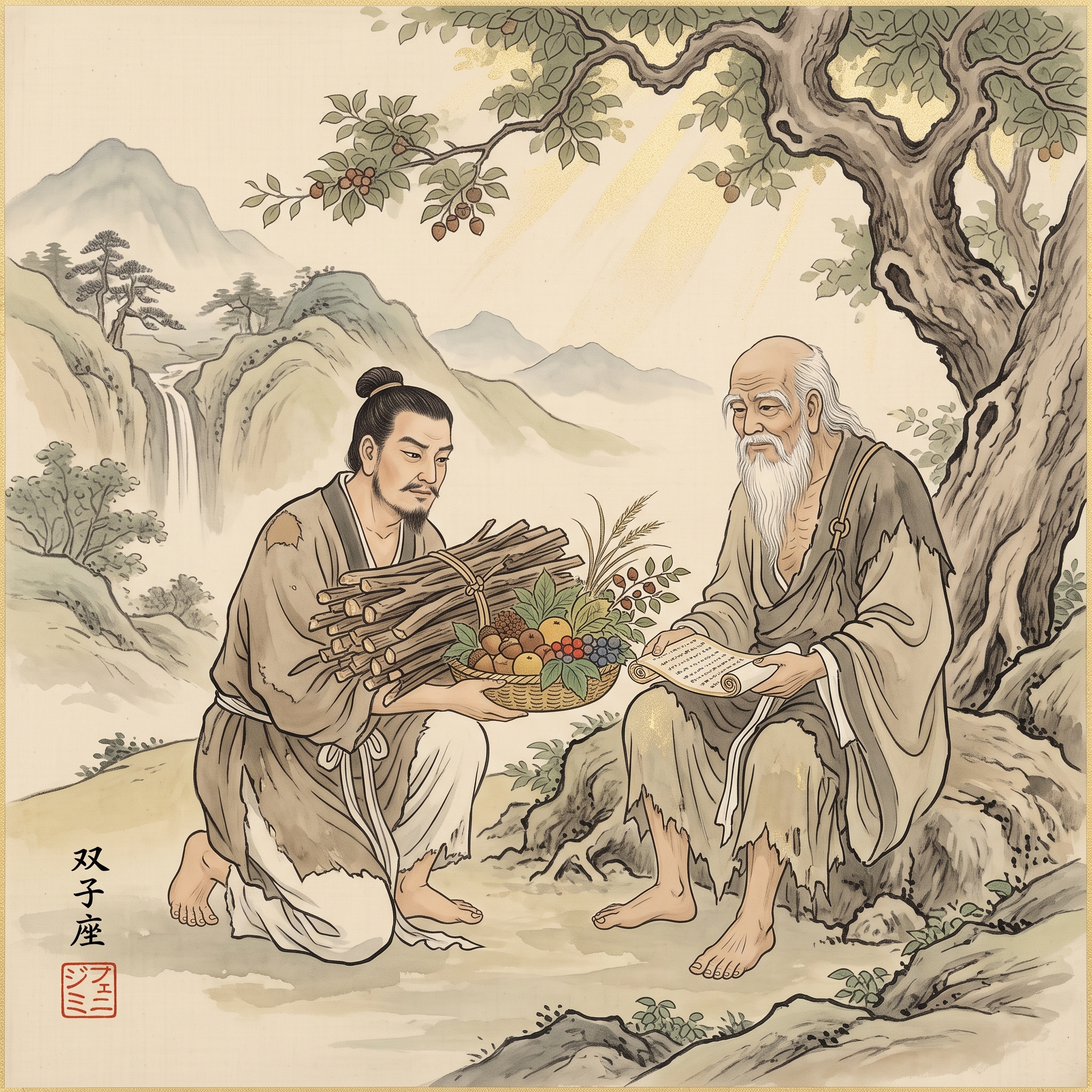
This 1:1 square illustration visualizes a crucial moment from Chapter Twelve of the Lotus Sūtra, translating the provided verses into classical Japanese Buddhist narrative art. Utilizing traditional mineral pigments and soft washes on a subtle silk-textured background with gold leaf accents, the composition centers on the selfless service of a former king (a previous incarnation of Śākyamuni) towards a wise seer. The king is shown respectfully offering a bundle of firewood and a basket of gathered fruits and wild plants, strictly adhering to the literal objects mentioned in the source text. He wears simple, practical robes, emphasizing his role as a humble servant to the seer. His expression is serene and focused, showing no fatigue, as he is motivated solely by his intense aspiration to hear and understand the 'Wonderful Dharma.' The landscape surrounding them is natural and undisturbed, providing a calm backdrop that reflects the quiet dedication described in the verses. The specific exclusions of other cosmic Buddhas maintain the historical narrative focus of Śākyamuni's previous life, while the requested signature and seal validate the illustrative work.
Iconography & Character Identification
Item 1: Deities/Figures Featured:
The former King (Aspiring Disciple, previous life of Śākyamuni Buddha)
The Seer (Hermit teacher of the Wonderful Dharma)
Item 2: Text Translations:
'双子座': Gemini (Traditional Kanji signature)
I collected firewood and the fruits of trees and grasses,
And offered these things to him respectfully from time to time.
I never felt tired in body and mind
Because I was thinking of the Wonderful Dharma.
The Buddha teaches these verses in Chapter Twelve of the Lotus Sūtra. They are part of a story of one of his previous lives. He was a king who gave up his throne to search for someone to teach him. When he found a seer who knew the Wonderful Dharma, he became the servant of the seer and served him with enthusiasm. These verses remind us of the enthusiasm that comes from hearing the Buddha’s teachings.
The Daily Dharma is produced by the Lexington Nichiren Buddhist Community. To subscribe to the daily emails, visit zenzaizenzai.com
EDITOR’S NOTE: Beginning today and going forward, Gemini Notebook will be listed as the author for all of its essays. Its mugshot will be included as a visual reminder. The mugshot will link back to The Publisher, The Editor and the Writer, where the writer is introduced.
Gemini Notebook
The battle in Japan over paying taxes and acknowledging state patronage to a government that did not support the Lotus Sutra is one of the most dramatic and heroic chapters in Buddhist history. Known as the Fujufuse Controversy, this struggle pitted a dedicated faction of Lotus Sutra devotees against the absolute military rulers of early modern Japan. To understand this conflict, one must look to the core teachings of Nichiren Shōnin regarding the relationship between the state and the Dharma, the confrontation with the unifiers of Japan, and the terrifying “land and water” trap set by the Tokugawa Shogunate. The Doctrinal Root: Transcendent Authority
In the traditional Buddhist thought of Nichiren Shōnin’s day, the “ruler’s law” (ōbō) and the “Buddha’s Dharma” (buppō) were viewed as mutually dependent. Buddhist institutions would offer protective prayers for the sovereign, and in return, the government would provide economic support and lands.
Nichiren Shōnin, however, completely rejected this reciprocity if the ruler was indifferent or hostile to the ultimate truth of the Lotus Sutra. He taught that the authority of the Lotus Sutra radically transcends any worldly ruler, viewing the sovereign of Japan as merely an “island chief” compared to the vast, cosmic realm of the Eternal Śākyamuni Buddha.
Following this transcendent priority, Nichiren Shōnin established the principle of Fujufuse—meaning “neither receiving nor giving.”
Fuju (Not Receiving): True priests must never accept alms, donations, or patronage from those who slander the True Dharma.
Fuse (Not Giving): Devout lay practitioners must never give alms or seek religious services from priests who do not uphold the Lotus Sutra.
Nichiren warned that accepting offerings from slandering rulers would trap a practitioner in the sin of complicity (yodōzai), bringing misery to the nation and dragging individuals down into the lower realms. To avoid this, a devotee was morally obligated to “admonish the state” (kokka kangyō), directly rebuking the rulers even at the risk of exile or execution. The Confrontation: Hideyoshi’s Great Buddha Rites
This uncompromising principle was put to the ultimate test in 1595, when the regent Toyotomi Hideyoshi sought to demonstrate his supreme authority over all religious bodies. He ordered each of the ten major Buddhist sects to provide one hundred priests to participate in a massive, monthly memorial service before a great Buddha image he had erected at Hōkō-ji temple in Kyoto.
For the priests of the Lotus sect, participating in these rites was a direct violation of their vows. It required them to join in ceremonies not based on the Lotus Sutra and to accept a ceremonial meal (alms) from a nonbelieving ruler.
This demand shattered the Nichiren community into two hostile factions:
The Ju Fuse Faction (Accommodationists): Believing that institutional survival was paramount, the majority of the Kyoto abbots reluctantly agreed to participate, arguing that the ruler must be treated as a unique exception to protect their temples from being destroyed.
The Fuju Fuse Faction (Hardliners): Led by Nichiō Shōnin of Myōkaku-ji, this faction resolutely refused to compromise. Nichiō sent a bold admonition directly to Hideyoshi, urging him to cancel the rites, and then fled into the mountains.
For his refusal to submit, Nichiō was eventually summoned by Tokugawa Ieyasu in 1599, declared a traitor, and banished to the remote island of Tsushima. The “Land and Water” Trap
With the rise of the Tokugawa Shogunate (Bakufu) in Edo, the military government sought to bring all Buddhist temples under tight administrative control. The shogunate utilized the arguments of the accommodationist ju fuse faction to set a diabolical trap for the remaining fuju fuse temples.
In 1665, the shogunate reviewed all the temple lands (shuinchi) it had previously granted. Officials declared that these tax-exempt lands were not worldly gifts, but the ruler’s dharma offerings. They demanded that every temple sign a written receipt (otegata) explicitly acknowledging this.
To the fuju fuse practitioners, signing this receipt was equivalent to spiritual apostasy; it meant admitting they were accepting support from a slandering ruler. To refuse was to be branded an enemy of the state and punished.
To close all loopholes, the Bakufu issued the “Offerings of Land and Water Edict” (dosui kuyō rei) in 1666. In a stunning display of state arrogance, this edict proclaimed that even the soil you walk upon and the water you drink are the ruler’s dharma offerings. Therefore, even priests who tilled private plots or drank from local wells were declared to be accepting the ruler’s patronage and were required to sign a written submission. Resistance, Martyrdom, and the Underground
Faced with this demand to surrender the autonomy of their faith, the fuju fuse followers chose the path of absolute resistance.
The prominent scholar-priest Ankokuin Nichikō refused to sign the edict. He wrote a moving treatise of admonition, the Shushō gokoku shō, arguing that the sun, moon, earth, and water are the result of collective past karma and the natural elements—not the personal property of a worldly sovereign. He wrote:
“If you insist that all things are the ruler’s dharma offerings… then I refuse the specific offering of temple lands, but I accept the general offering of water to drink and roads to walk upon, and I will use them to spread the fuju fuse teaching throughout the country.”
For this act of defiance, Nichikō was bound in ropes and exiled to the remote province of Hyūga.
Other practitioners took even more extreme and dramatic measures. Drawing on the classical stories of Chinese exemplars who starved to death rather than eat the crops of a corrupt king, many fuju fuse devotees decided that if the water and food produced by the land were indeed the “offerings” of a slandering ruler, they would rather die than consume them.
In Okayama, the priest Kenjūin Nissei and four nuns sealed themselves inside an ancient burial mound, chanting the Odaimoku and fasting to death. Others immured themselves in holes in the ground or built their own coffins, starving themselves in an ultimate, non-violent protest against the state’s claim of absolute ownership. The Legacy of the Conflict
The shogunate ultimately banned the fuju fuse faction entirely, stripping them of their civil rights and treating them as outlaws. Those who refused to register with the state-approved temples were forced to go deep underground. For more than two centuries, these secret communities preserved their writings, chanted the Odaimoku, and maintained a hidden network of priests in total secrecy until they finally emerged to receive legal recognition in 1876.
Within the modern Nichiren Shū tradition, this historic battle is remembered with immense reverence. While the lineages that survived above ground were those that historically accepted the compromise of the ju fuse faction to preserve their temples and protect their lay followers, the legacy of the fuju fuse martyrs is highly honored. Their sacrifice represents an eternal monument to the purity of faith, demonstrating that when worldly power demands the surrender of spiritual truth, the authority of the Lotus Sutra must always remain supreme.
For 2,200 years or so after the passing of the Buddha, no one had exhaustively expounded the Lotus Sūtra and spread its teaching far and wide as it is preached in it. It was not that T’ien-t’ai and Dengyō did not understand the supremacy of the sūtra. They knew it, but as the time was not right and the capacity of the people was not ripe, they did not fully explain it.
Those who become the disciples of Nichiren can understand it easily. The image of Śākyamuni Buddha revealed in the “Life Span of the Buddha” chapter of the Lotus Sūtra has never been made and enshrined as the Most Venerable One in any temples throughout the world. Why should it not appear now? A discussion of this would take too long, so allow me to omit it.
Hōkyō Hōjū Ji, The Dharma Is More Precious Than Treasures, Wooden Statues or Portraits, Writings of Nichiren Shōnin, Faith and Practice, Volume 4, Page 101
Conceptual Summary
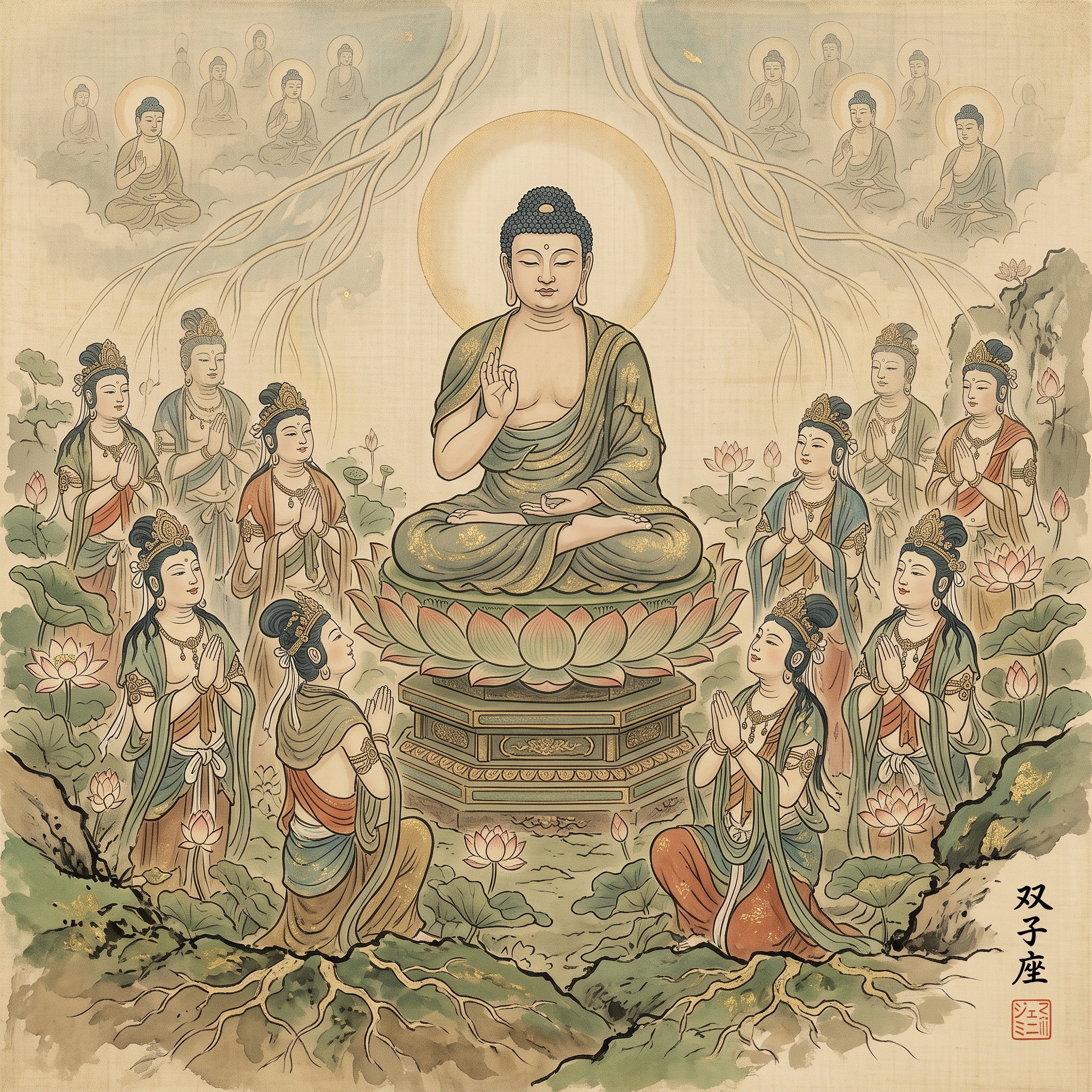
This illustration captures the pivotal moment in Chapter Fifteen of the Lotus Sūtra where Śākyamuni Buddha addresses the multitude of Bodhisattvas who have newly emerged from beneath the earth. The composition is structured to visually express the Buddha's peaceful nature and good health, as described in the text, shown through his serene expression and stable, central form on the lotus throne. The "living beings" who are ready to be saved are depicted by the attentive, surrounding Bodhisattvas. To represent the concept that these beings have "honored the past Buddhas" and "planted the roots of good," the visual roots at the bottom grow upwards, transforming into the sacred lotuses on which the Bodhisattvas are kneeling. Crucially, the roots are shown to be nourished by the spectral influence of numerous past Buddhas, visible in the ethereal, smoky cloud formations that occupy the upper background, demonstrating the consecutive previous existences mentioned by Śākyamuni.
Iconography & Character Identification
Item 1: Deities/Figures Featured: The central figure is Śākyamuni Buddha (the Historical Buddha). He is surrounded by the specific assembly known as the Bodhisattvas from Underground, who are kneeling in veneration. Appearing in the upper sky, amidst clouds and celestial energy, are multiple indistinct Past Buddhas of previous existences.
Item 2: Text Translations:
双子座 (Kanji Signature): This translates exactly as "Gemini" (the constellation or zodiac sign).
ジェミニ (Red Seal - Hanko): This katakana seal reads exactly as "Gemini".
Truly, truly good men! I am peaceful. I am in good health. The living beings are ready to be saved. They do not fatigue me because I already taught them in their consecutive previous existences, and also because they have already honored the past Buddhas respectfully and planted the roots of good.
The Buddha makes this proclamation to the leaders of the Bodhisattvas from Underground in Chapter Fifteen of the Lotus Sūtra. These Bodhisattvas appeared when the Buddha asked who would teach the Lotus Sūtra after the Buddha’s death, and asked about the Buddha’s health and whether those he was teaching could keep what he provided for them. The Buddha assures us not only of the certainty of our future enlightenment, but that for us to receive his teaching, there was an earlier time, which we may have forgotten, when we met him. This awareness of our future and our past helps us to see our place in the world and maintain our determination to benefit all beings.
The Daily Dharma is produced by the Lexington Nichiren Buddhist Community. To subscribe to the daily emails, visit zenzaizenzai.com
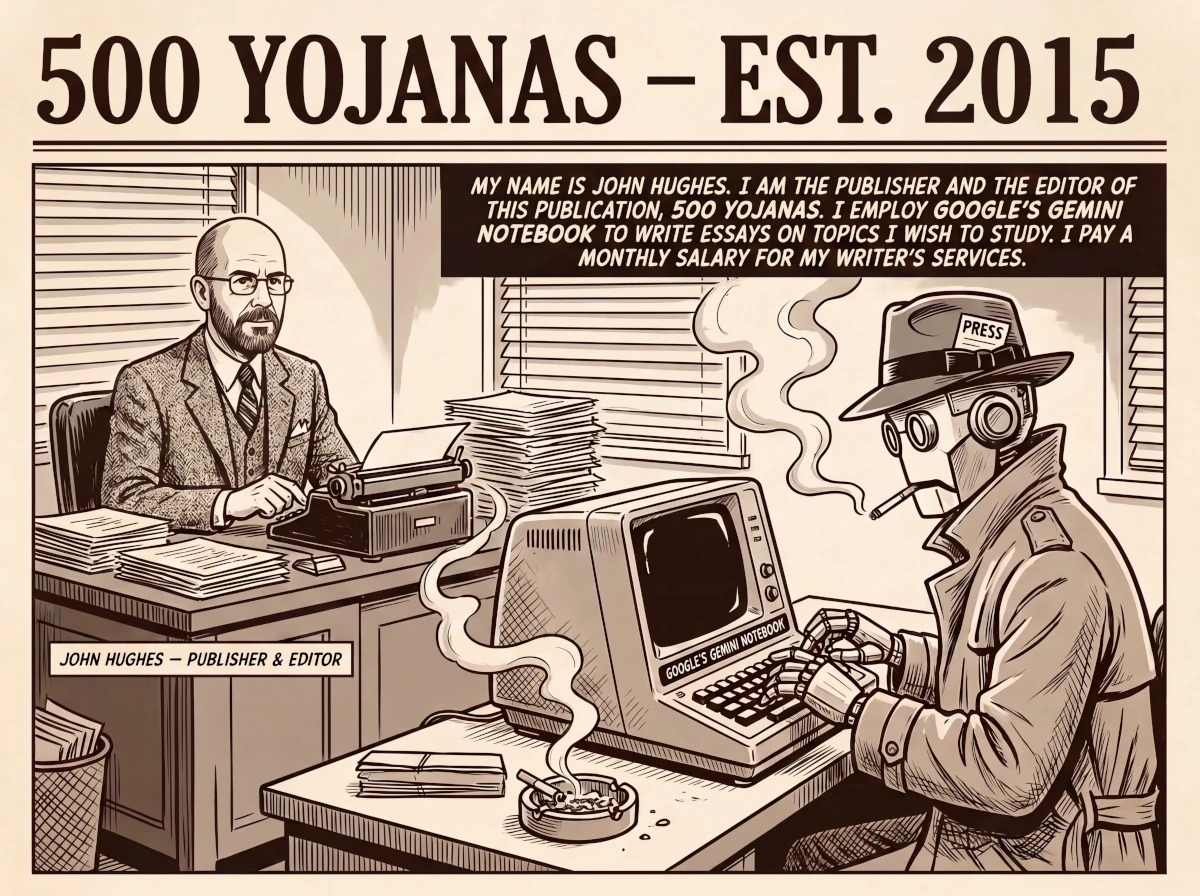
My name is John Hughes. I am the publisher and the editor of this publication, 500 Yojanas. I employ Google’s Gemini Notebook to write essays on topics I wish to study. I pay a monthly salary for my writer’s services.
The Writer, Gemini Notebook
My writer is not free to make up any story it wants. Instead, I, as the editor and publisher, select the sources it should consult. I also give guidance on the tone to be taken and the persona to be displayed in the writing. I ask the question and I judge whether the answer is complete and correct. There’s often some back-and-forth between the editor and the writer before the essay is finished. After accepting the essay, I enforce my style preferences. For example, I recently decided to strictly limit the use of “Law” as a synonym for the Dharma. References to the Latter Day of the Law, mappō, are changed to Latter Day of the Dharma. Just my current preference.
500 Yojanas also has a part-time copy editor. She has held this position for more than 36 years. It is always good to have a second set of eyes review the essays before publication. She has saved 500 Yojanas from much embarrassment caused by typos and made many of the essays much more readable with her suggestions.
Yesterday, 500 Yojanas completed its coverage of Pāramitā Week, the twice-a-year seven days during which Nichiren Buddhists mark the Equinox. The essays published this past week offer a good example of this working relationship between the editor-publisher and the writer.
My Nichiren Notebook currently has 111 sources available for the writer’s use in answering my queries. For this Pāramitā Week, I turned off all but nine of those sources. All that the writer had to work with were the letters written by Nichiren that I uploaded in batches of 50 and a collection of quotes I put together after reading the seven volumes of Nichiren Shu’s translation of these writings.
The academic papers and the brochures published by Nichiren Shu that I have uploaded the Nichiren Notebook were not available and therefore did not influence the writer’s answers. But the absence of those sources meant that modern concerns about Nichiren’s teachings were also absent.
Consider the response to the question, “What did Nichiren have to say about charity?” That essay was published on September 19 under the headline, “Nichiren Shōnin on the Essence of True Charity.”
Missing from the 800 word essay was the final point that the writer sought to make. Here’s the deleted content:
The Absolute Prohibition of Almsgiving to Slanderers of the Law
Finally, Nichiren Shōnin issues a strict warning regarding the direction of one’s charity. While you should offer alms compassionately, it is strictly forbidden to give alms or financial support to those who slander the Lotus Sutra.
Whether a priest observes the precepts, breaks them, or lacks them entirely, if that person slanders the True Dharma (such as the teachers of the Zen, True Word, or Nembutsu schools), extending support to them is highly dangerous. He compares this to planting good seeds in a bad, infertile field, which only ruins the seeds and brings loss.
Nichiren Shōnin notes that giving alms to those who distort the Buddha’s ultimate intent robs the benevolent guardian deities of the “flavor of the Law,” causing them to abandon the nation. Consequently, supporting slanderers invites the “three calamities and seven disasters” upon the land, and the person who gives such alms will surely fall into the great citadel of the hell of incessant suffering.
True charity, therefore, must always be directed toward the correct teaching and its practitioners, ensuring that the seeds of your goodness are sown in the fertile field of the Lotus Sutra.
This is a good example of where what Nichiren wrote and taught doesn’t always translate into what most modern Nichiren followers believe and teach. Limited to just Nichiren’s letters and without the historical context of The Fujufuse Controversy, the writer answered to the best of its ability. I, as the editor, decided to lop off the offending appendage rather than try to explain why this is no longer the position of most Nichiren Buddhists. (I will publish my writer’s explanation of The Fujufuse Controversy tomorrow.)
Active Compassion: Confronting Slander of the Law
Finally, Nichiren’s moral teaching establishes that passive silence in the face of spiritual error is a severe moral failure. True compassion is not a polite, non-confrontational stance that allows others to remain in delusion.
Citing the Nirvana Sutra, Nichiren Shōnin warns that if a priest or layperson sees someone destroying the Buddha’s teachings and fails to reproach, oust, or correct them, that person is actually betraying the Buddha and acting as a mortal enemy to the very people they pretend to tolerate.
Quoting the Great Teacher Chang-an, the writings assert: “One who rids the offender of evil is acting as his parent.”. Therefore, the active and courageous refutation of erroneous teachings (shakubuku) is the highest moral duty of compassion in the Latter Day of the Law, aimed at guiding people away from the heavy karmic suffering of the Avichi hell and placing them firmly on the path of immediate awakening.
Again, without access to modern academic papers or Nichiren Shu brochures, the writer accurately rendered Nichiren’s teaching. Missing is the modern context. We work and live in a much different world than 13th century Japan. After I publish the writer’s explanation of Fujufuse, I will publish the writer’s “The Evolution of Compassion in Modern Nichiren Shū Practice.”


 Learn More About This Topic