When a Wise Man Appears in the World

The Lotus Sūtra, fascicle 7, the 21st chapter on “The Divine Powers of the Buddha,” preaches: “Suppose that after the Buddha passed away, someone who knows the causes and conditions and proper sequence of the sūtras expounded by the Buddha will preach them truthfully according to the true meaning. As the light of the sun and moon can eliminate all darkness, so this person will wipe out the darkness of living beings as he walks about in the world.”

This scriptural passage means that he who expounds even a word or a phrase of the Lotus Sūtra should know well the comparative profundity of the holy teachings preached during His lifetime and the sequence of preaching them. For instance, speaking of the calendar consisting of more than 360 days a year, a mistake by one day will cause mistakes for 10,000 days. In a 31-syllable Japanese poem, a mistake in a syllable or a phrase makes the whole 31 syllables unpoetic. Likewise, in reading or reciting a sūtra, if one is confused about the sequence and comparative profundity of the holy teachings of the Buddha beginning with the Flower Garland Sūtra preached first at the Hall of Enlightenment to the Nirvana Sūtra expounded last in the śāla forest, one will inevitably fall into the Hell of Incessant Suffering without committing the five rebellious sins. Those who believe in him will also fall into the Hell of Incessant Suffering.

Therefore, when a wise man appears in the world to correctly declare the comparative profundity of the holy teachings preached during His lifetime, those priests who have transmitted false doctrines from the founders of their respective sects and are revered as the teachers of the state or aristocratic families will make a false charge against the wise man to the rulers of the country or incite a popular protest against him. Otherwise, the weakness of their sects would be revealed, causing them to be despised by the people. Then, it is preached, the protective deities of Buddhism will be so enraged that they will destroy this country just as gale winds tear up the leaves of banana plants or high waves overturn small boats.

Shinkoku-ō Gosho, Sovereigns of Our Divine Land, Writings of Nichiren Shōnin, Doctrine 1, Page 163-164

Daily Dharma for April 11, 2026

20260411-ddi

Illustration by Google Gemini

Show Gemini's thinking

Gemini Thinking

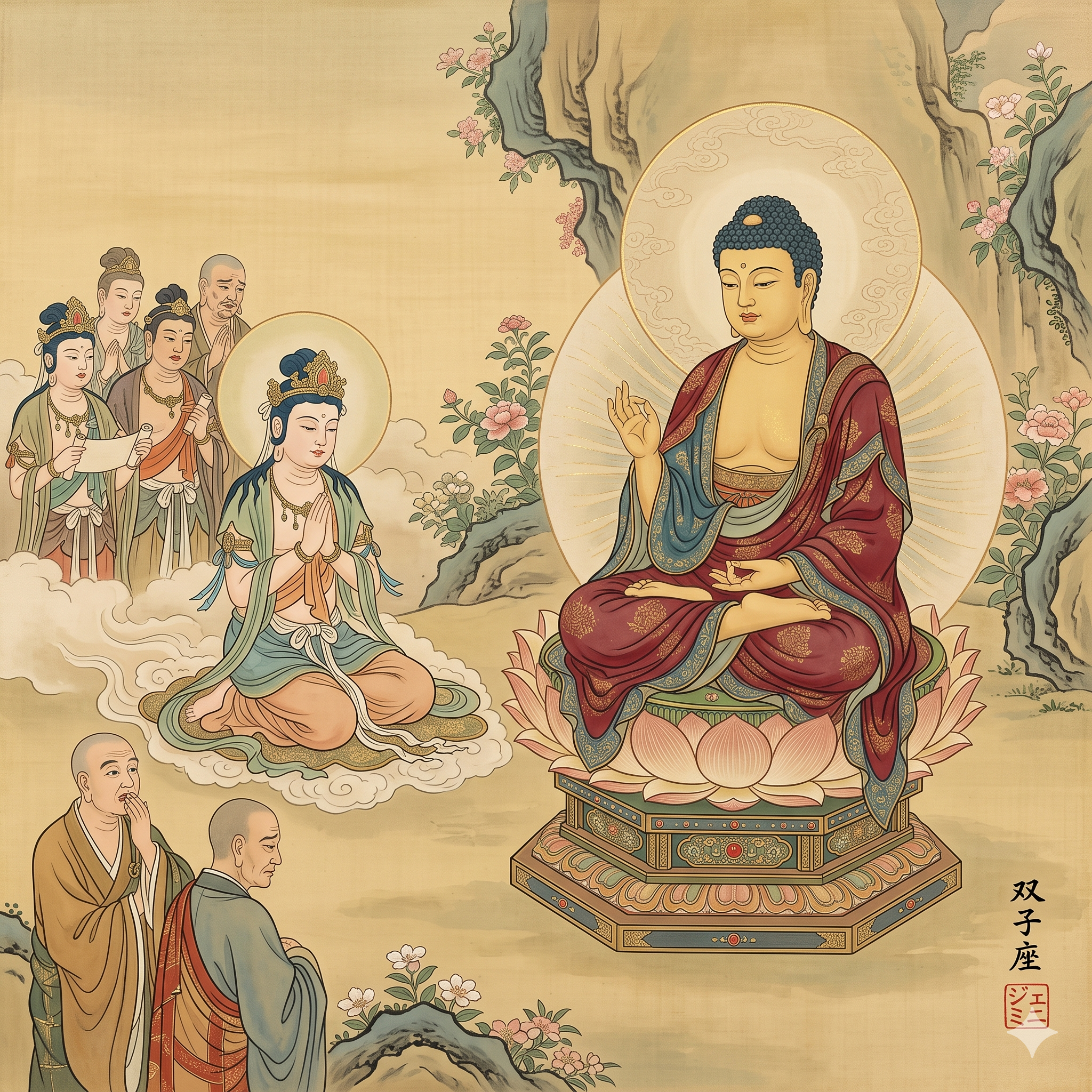
In this square illustration, I have captured the moment Śākyamuni Buddha makes his powerful declaration from the fifth chapter of the Lotus Sūtra. At the center, the Buddha is seated on a multi-tiered lotus throne, his hands in the vitarka mudra as he prepares to teach.

Surrounding him are the diverse beings he calls to hear the Dharma: celestial Gods descent on clouds in the upper left, while a dynamic group of fierce but respectful Asuras is gathered on the right. Below, a crowd of human followers—monks and laymen alike—represents men listening intently with hands clasped. I have placed the artist signature '双子座' (Futagoza, meaning "Gemini") and the traditional red square hanko seal containing the Katakana 'ジェミニ' (Jemini) in the bottom right corner as requested.

I know the Way. I have opened the Way. I will expound the Way. Gods, men and asuras! Come and hear the Dharma!

Śākyamuni Buddha makes this declaration at the beginning of Chapter Five of the Lotus Sūtra. If anyone besides the Buddha had said this, we would accuse them of arrogance: pretending to know what they do not. The Buddha does not separate himself from us. Because he knows we can become as enlightened as he is, he does not place himself as superior. He also knows that unless we hear him, he cannot help us to become enlightened. To accept this help means taking responsibility for our progress on the path. We cannot continue alone but we must make our own effort.

The Daily Dharma is produced by the Lexington Nichiren Buddhist Community. To subscribe to the daily emails, visit zenzaizenzai.com

Learning About Nichiren Buddhism

For years, the Sacramento Nichiren Buddhist Church has shared a collection of 21 brochures and pamphlets from Nichiren Shu. To help people dive deeper into these teachings, I am working on a new Interactive Flashcard Study Tool.

Flashcards demoDeveloped using Google’s Gemini Notebook, these flashcards offer a way to engage with the Nichiren Shu brochures and pamphlets. Unlike standard AI, Gemini Notebook works strictly within the 21 specific brochures provided to it. This ensures that every answer is accurate, faithful to the source material, and free from outside interference.

Key Features of the Tool:

  • Deep Insights: Each card includes a question, a concise answer, and a detailed explanation.
  • Direct Sourcing: Every card provides a link back to the original brochure for further reading.
  • Global Reach: The tool is available in Spanish, Japanese, Portuguese, French, German, and Italian.

You can explore the prototype at: https://500yojanas.org/brochureFC/

Since this tool is still in its prototype phase, I would love feedback. I’m particularly interested in the accuracy of the foreign language versions. The translations were created by Google’s Gemini Pro.

Eventually this will be embedded into the Sacramento Nichiren Buddhist Church website. I have an example of how it might look on this page.

The Divine Mirror of the Lotus Sūtra

Among the spotless mirrors of the holy teachings preached in His lifetime, the Lotus Sūtra is the special divine mirror. A copper mirror can show the figure of a man but not his mind. The divine mirror of the Lotus Sūtra shows not only a man’s figure but also his mind. Not only the current mind of a man but also his karma in the previous life and his reward and retribution in the future can clearly be spotlighted.

Shinkoku-ō Gosho, Sovereigns of Our Divine Land, Writings of Nichiren Shōnin, Doctrine 1, Page 163

Daily Dharma for April 10, 2026

20260410-ddi

Illustration by Google Gemini

Show Gemini's thinking

Gemini Thinking

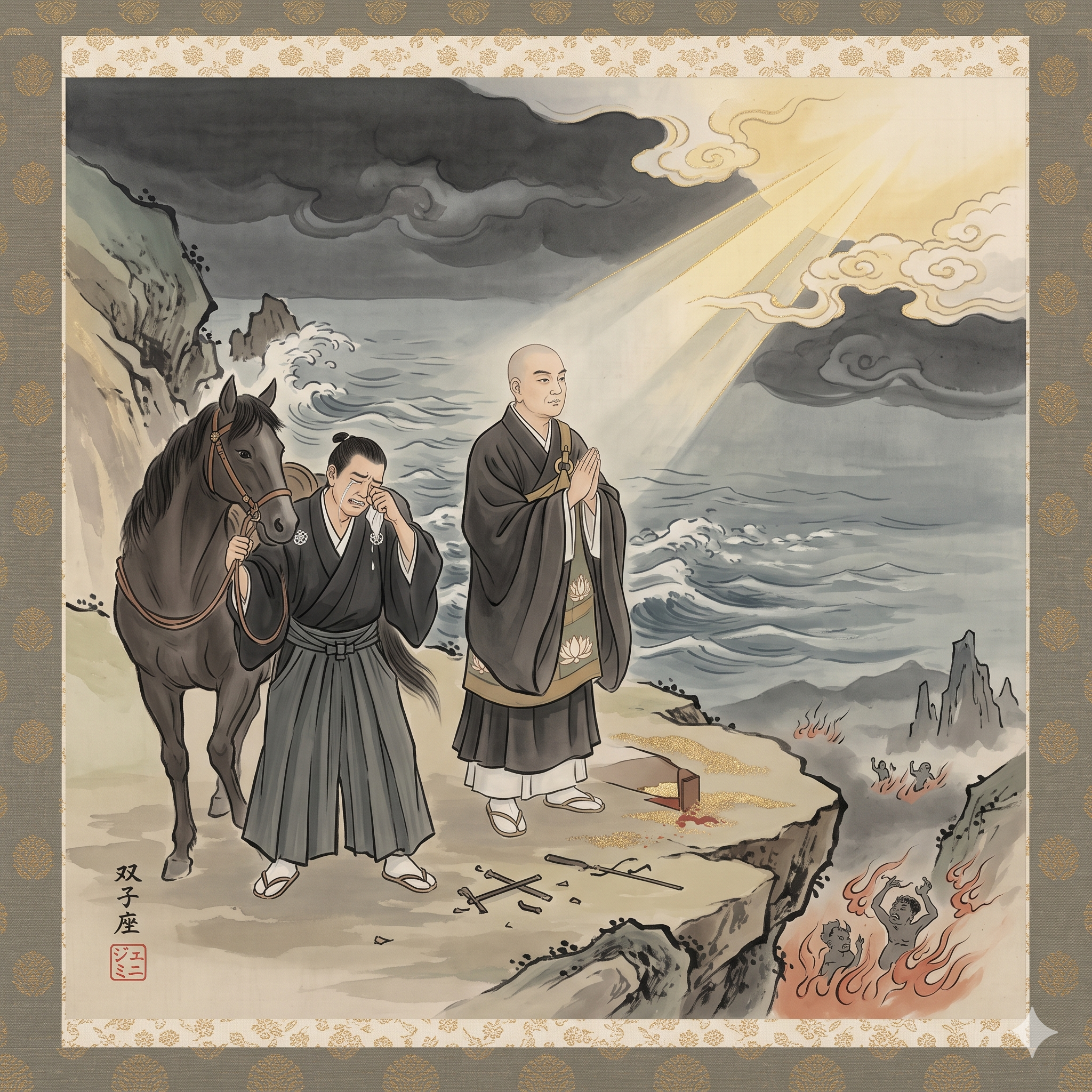
In this square illustration, I have depicted a priest desperately clinging to scrolls, symbolizing the "writings against the teachings of the Buddha" referenced by Nichiren. Although the priest may be praying or studying with conviction, the smoke rising from the incense burner forms dark, chaotic clouds, indicating a lack of true enlightenment.

Behind him, a scene of "deplorable events" unfolds—lightning strikes, storm winds, and a village in disarray. This illustrates the passage from the Kitō-shō, which states that following incorrect teachings will never result in peace and tranquility, despite one's prayers. In the bottom-right corner, you will find the required kanji signature 双子座 alongside a red hanko seal containing the katakana for Gemini (ジェミニ).

If his writings are against the teachings of the Buddha, no matter how hard one might believe them, one will never attain Buddhahood. No matter how much one prays for peace and tranquility for the country, only deplorable events will take place.

Nichiren wrote this passage in his Treatise on Prayers (Kitō-shō), commenting on the writings of a priest who did not hold the Lotus Sutra as the Buddha’s highest teaching. Because the Lotus Sutra assures the enlightenment of all beings who teach and practice the Wonderful Dharma, it is what brings peace and tranquility to the world.

The Daily Dharma is produced by the Lexington Nichiren Buddhist Community. To subscribe to the daily emails, visit zenzaizenzai.com

The Mirror of the Buddhist Dharma

To see our own faces, we have to look at them reflected upon a spotless mirror. Likewise, in order to see the rise and fall of a country, there is no way better than to see them reflected upon the mirror of the Buddhist dharma. As we respectfully read such Mahāyāna sūtras as the Sūtra of the Benevolent King, Sūtra of the Golden Splendor, Guardian Sūtra, Nirvana Sūtra, and Lotus Sūtra, it is preached that the rise and fall of a country and the life span of people in it depend on the Dharma they believe, whether they believe in the True Dharma or a false dharma. It is like water that keeps a boat afloat but also destroys it, or staple grains which nourish human bodies but often damage them. Small winds and waves would not damage large ships, but small ships can easily be destroyed by gale winds and huge waves. Unjust government, like small winds and waves, would not cause the downfall of a great country and a great man; however, there is no doubt that a false dharma in Buddhism, like gale winds and huge waves destroying small boats, will destroy a country.

Shinkoku-ō Gosho, Sovereigns of Our Divine Land, Writings of Nichiren Shōnin, Doctrine 1, Page 162

Daily Dharma for April 9, 2026

20260409-ddi

Illustration by Google Gemini

Show Gemini's thinking

Gemini Thinking

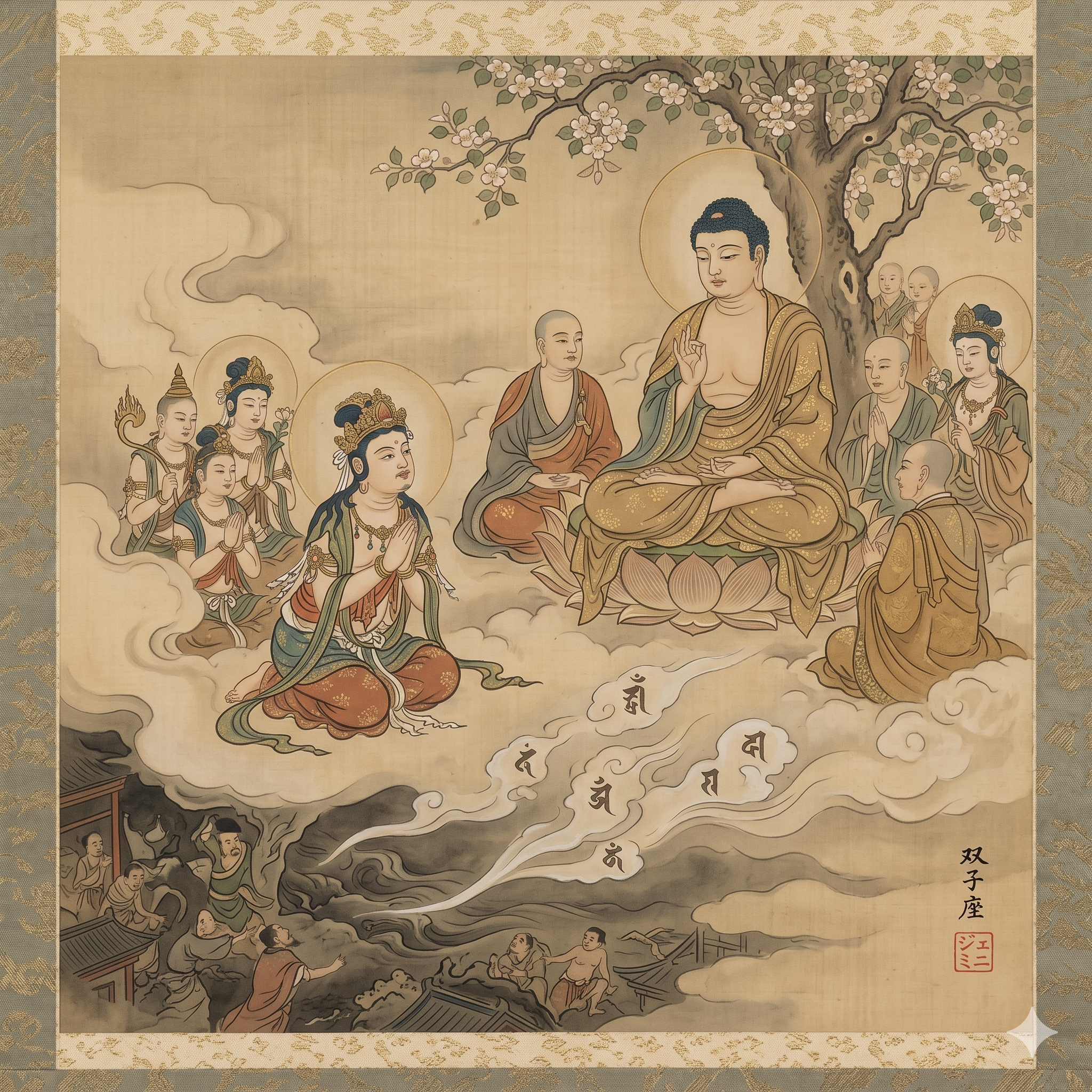
The illustration represents the specific paradox described by Maitreya Bodhisattva in Chapter Fifteen of the Lotus Sūtra. At the top, Śākyamuni Buddha is seated on a lotus throne, teaching. The visualization in the lower foreground depicts the two aspects of the difficult-to-believe scenario: on the left, four 100-year-old men are shown, and on the right, a 25-year-old black-haired man is pointing toward them. This image captures the essence of Maitreya’s question about how a young teacher (the Buddha, shortly after enlightenment) could have taught students who appear much older (the Bodhisattvas from the Earth).

The Kanji text includes the following translations:

百歳老人称少父: 100-year-old elders calling [the youth] their father.

二十五歳男子称百歳子: 25-year-old man calling [the elders] his sons.

The signature in the bottom right includes the Kanji 双子座 (Gemini) and a red hanko seal reading ジェミニ (Gemini).

World-Honored One! It is difficult for anyone in the world to believe this. It is as difficult as to believe a handsome, black-haired man twenty-five years old who points to men a hundred years old and says, ‘They are my sons,’ or as to believe men a hundred years old who point to a young man and say, ‘This is our father. He brought us up.’

Maitreya Bodhisattva explains his perplexity to Śākyamuni Buddha in Chapter Fifteen of the Lotus Sūtra. The Buddha has just revealed that all of the Bodhisattvas who have appeared from underground to continue teaching the Wonderful Dharma after the extinction of the Buddha have been taught by the Buddha in the time since he became enlightened. Maitreya realizes that his doubts are no different from the doubts of those gathered to hear the Buddha teach and asks the Buddha to explain. The Buddha says later that he sees the world differently than other living beings. But this does not mean that when our experience does not match what the Buddha teaches, we must keep silence and just accept what he tells us. It is only through sincere questioning that we find the Buddha’s mind and make it our own.

The Daily Dharma is produced by the Lexington Nichiren Buddhist Community. To subscribe to the daily emails, visit zenzaizenzai.com

Believe These Words and Revere Them

The Lotus Sūtra, fascicle 2, the 3rd chapter on “A Parable” states:

“He who does not put faith in this sutra and slanders it, [will commit the sin of exterminating the seed of Buddhahood in all the people in the whole world. Or suppose those who frown at and harbor doubt about the teaching of this sutra… despise, hold in contempt, hate, envy, and bear a deep grudge against those who read, recite, copy, and uphold this sutra. What would such people get in return? You should listen carefully.] Such people will fall into the Hell of Incessant Suffering upon death, [where their suffering will last endlessly, for a kalpa after another… until they fall into the world of beasts becoming a huge serpent as long as 500 yojana in length.]”

The same sūtra, fascicle 7, the 20th chapter on the “Never Despising Bodhisattva” also asserts: “[Some of the four categories of Buddhists (monks, nuns, laymen and laywomen) had impure minds. They got angry, spoke ill of him, saying, ‘Where did this ignorant monk come from?’ They struck him with a stick, a piece of wood, a piece of tile or a stone.] They were tormented in the Hell of Incessant Suffering for as long as 1,000 kalpa for the sin of persecuting a practicer of the Lotus Sūtra.”

The Nirvana Sūtra, too, declares: “If one avoids good teachers who preach the True Dharma and instead takes refuge in false dharmas, one will sink into the Hell of Incessant Sufferings, undergoing all the sufferings with his huge body of 84,000 square yojana.”

Examining many sūtras, we thus see they all regard slandering the True Dharma the most serious crime. How sad it is that people [in Japan] all should wander out of the gate of the True Dharma into the prison of evil dharma! Such ignorance is causing everyone [in Japan, high and low,] to be pulled by the rope of evil teachings and caught forever by the net of slandering the True Dharma! In this life such wanderers are lost in the mist of delusions; in the next life they will sink to the bottom of flaming hell. How sad it is! How terrible it is!

You should promptly discard your false faith and take up the true and sole teaching of the Lotus Sūtra at once. Then this triple world of the unenlightened will all become Buddha lands. Will Buddha lands ever decay? All the worlds in the universe will become Pure Lands. Will Pure Lands ever be destroyed? When our country does not decay and the world is not destroyed, our bodies will be safe and our hearts tranquil. Believe these words and revere them!

Risshō Ankoku-ron, Treatise on Spreading Peace Throughout the Country by Establishing the True Dharma, Writings of Nichiren Shōnin, Doctrine 1, Pages 128-129

Daily Dharma for April 8, 2026

20260408-ddi

Illustration by Google Gemini

Show Gemini's thinking

Gemini Thinking

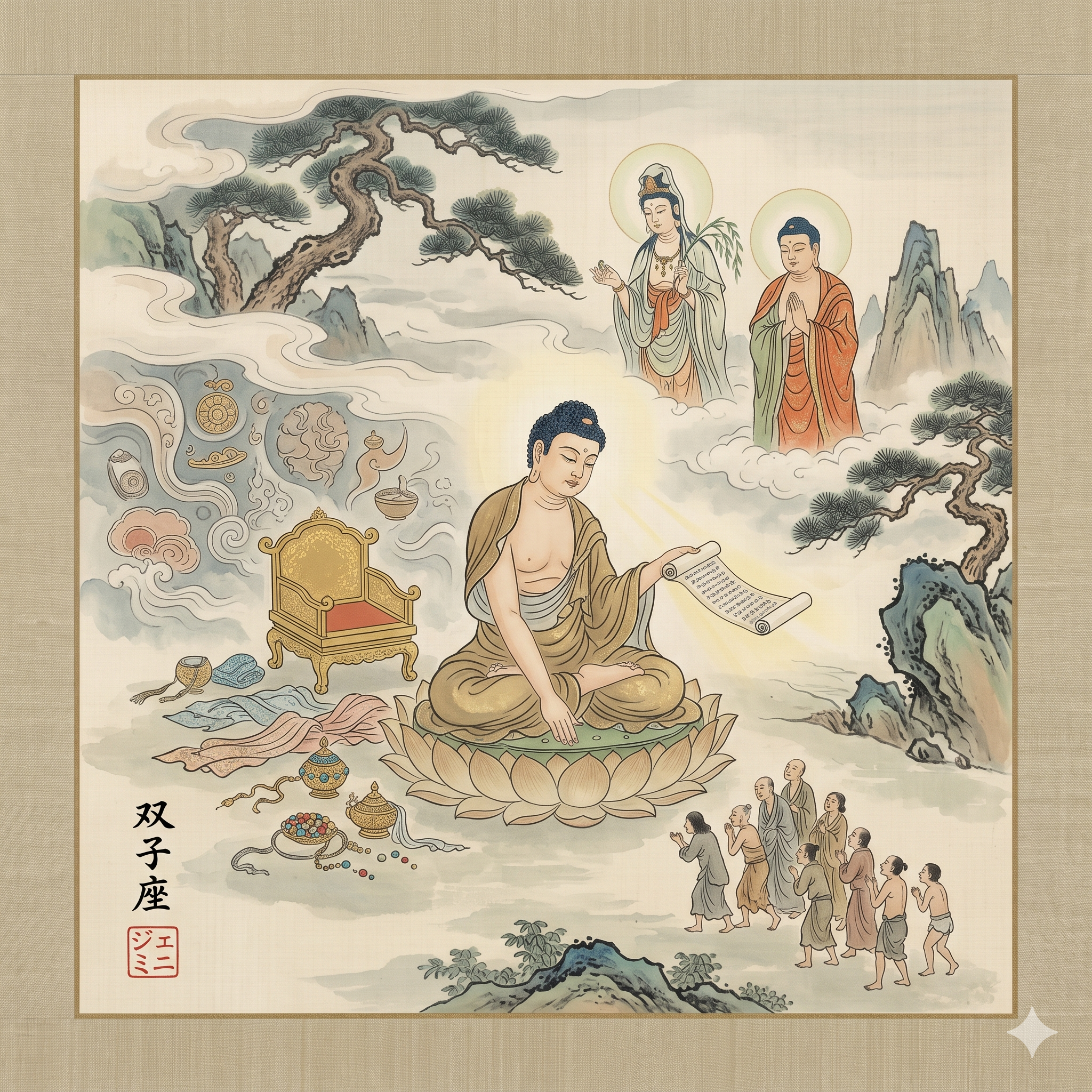
In this square illustration, I have visually captured the joyous assurance of enlightenment found in Chapter Six of the Lotus Sūtra. At the center, Śākyamuni Buddha sits upon a lotus throne, radiating light. Below him, the disciples Maudgalyāyana, Subhūti, and Mahā-Kātyāyana are shown singing their verses of praise, their hearts connected to the Buddha by beams of light as a symbol of his ability to see their true potential. The glittering celestial dew descending upon them represents the cool and refreshing feeling of "nectar" described in the text. In the clouds surrounding them, I have included subtle depictions of the "innumerable Buddhas" that fill the universe, reinforcing the promise of future Buddhahood for all. The signature "双子座" and the traditional red seal containing "ジェミニ" can be found in the lower right corner.

If you see what we have deep in our minds,
And assure us of our future Buddhahood,
We shall feel as cool and as refreshed
As if we were sprinkled with nectar.

Maudgalyāyana, Subhūti and Mahā-Kātyāyana sing these verses to the Buddha in Chapter Six of the Lotus Sūtra. Śākyamuni Buddha knows that our habits of thought and behavior have developed over many lifetimes. We cannot clear them away by ourselves. In the Lotus Sūtra, he assures many of his disciples personally of the certainty of their enlightenment. He shows that this universe has innumerable Buddhas, and tells all of us who hear this teaching that we too should be certain of our enlightenment. When we take the Buddha’s voice to heart, and release the grip we have on our fears, and open ourselves to the joy within ourselves and the world.

The Daily Dharma is produced by the Lexington Nichiren Buddhist Community. To subscribe to the daily emails, visit zenzaizenzai.com

Seeing the Buddhist Dharma Declining

Having calmed down somewhat, the traveler stated:

Though I am unable to understand you completely, I think I understand what you mean roughly. However, from Kyoto, the seat of the imperial court, to Kamakura, the capital of the shogunate, none of the eminent priests and able leaders of the Buddhist world has yet presented a written statement on this matter or made an appeal to the emperor or the shogun. It is not for you, a mere low-ranking priest, to venture to do so with your spiteful words. I can see your intention, but if you submit your appeal, you will be violating proprieties.

In response, the master declared:

Although I am a man of little capability, fortunately I have studied Mahāyāna Buddhism. It is said that a blue fly which rides on the tail of a fine horse can travel even 10,000 miles, and a green ivy vine which clings to a tall pine tree can climb up to 1,000 yards high. Likewise, born to be a disciple of the Buddha, I put my faith in the Lotus Sūtra, the king of all the Buddhist sūtras. Seeing the Buddhist dharma declining, how can I not feel sorrow?

The sorrow is even more so [in view of what the Buddha preached in the Lotus Sūtra, the 10th chapter on “The Teacher of the Dharma”: “Medicine King Bodhisattva, listen carefully. Of the numerous sūtras I have preached, this Sūtra of the Lotus Flower of the Wonderful Dharma is the supreme;” and “The sūtras I have preached number immeasurable thousands, ten thousands, and hundred millions. Of the sūtras I have preached, am now preaching, and will preach, this Lotus Sūtra is the most difficult to believe and to understand.” In the 14th chapter on the “Peaceful Practices”: “Mañjuśrī, this Sūtra of the Lotus Flower of the Wonderful Dharma is treasured by all Buddhas and it is the supreme of all the sūtras.” In the 23rd chapter on the “Previous Life of the Medicine King Bodhisattva”: “As Mt. Sumeru is the highest of all mountains in the world, this Lotus Sūtra is the supreme of all sūtras. As the moon shines brighter than any other stars, this Lotus Sūtra shines the brightest of all the sūtras. As the sun eliminates all darkness, this Lotus Sūtra eliminates all kinds of darkness. As the Great King of the Brahma Heaven is the king of all the people, those who uphold this Lotus Sūtra are the prime of all the people.”]

The Buddha also warns us in the Nirvana Sūtra: “Suppose there is a monk, to all appearances ‘good’, who encounters a destroyer of the dharma but does not take any measures in accusing him, chasing him out or punishing him. You had better know that such a man is not a ‘good’ monk at all but an enemy of Buddhism. On the other hand, if he accuses the destroyer of the dharma, chases him out, or punishes him strictly, such a man is My disciple, one who truly hears Me.”

[Numerous bodhisattvas, 80 trillions in number, vow in the 13th chapter on the “Encouragement for Upholding This Sūtra” of the Lotus Sūtra: “We will not spare even our lives; we treasure only the unsurpassed way.”

The Nirvana Sūtra preaches: “Suppose an eloquent speaker was sent to a foreign country as a royal emissary. Even at the cost of his life, he must convey the words of his king without concealing anything. Likewise, without sparing even his own life, a wise man must widely spread among the ignorant people the true teaching of the Buddha, the existence of the Buddha-nature in all. “]

Although I am not a man worthy of being called a good monk, I do not want to be accused of being a foe of Buddhism. Therefore, I must tell them some principles showing just a portion of the Buddha’s teaching.

Risshō Ankoku-ron, Treatise on Spreading Peace Throughout the Country by Establishing the True Dharma, Writings of Nichiren Shōnin, Doctrine 1, Pages 116-117

On the Journey to a Place of Treasures