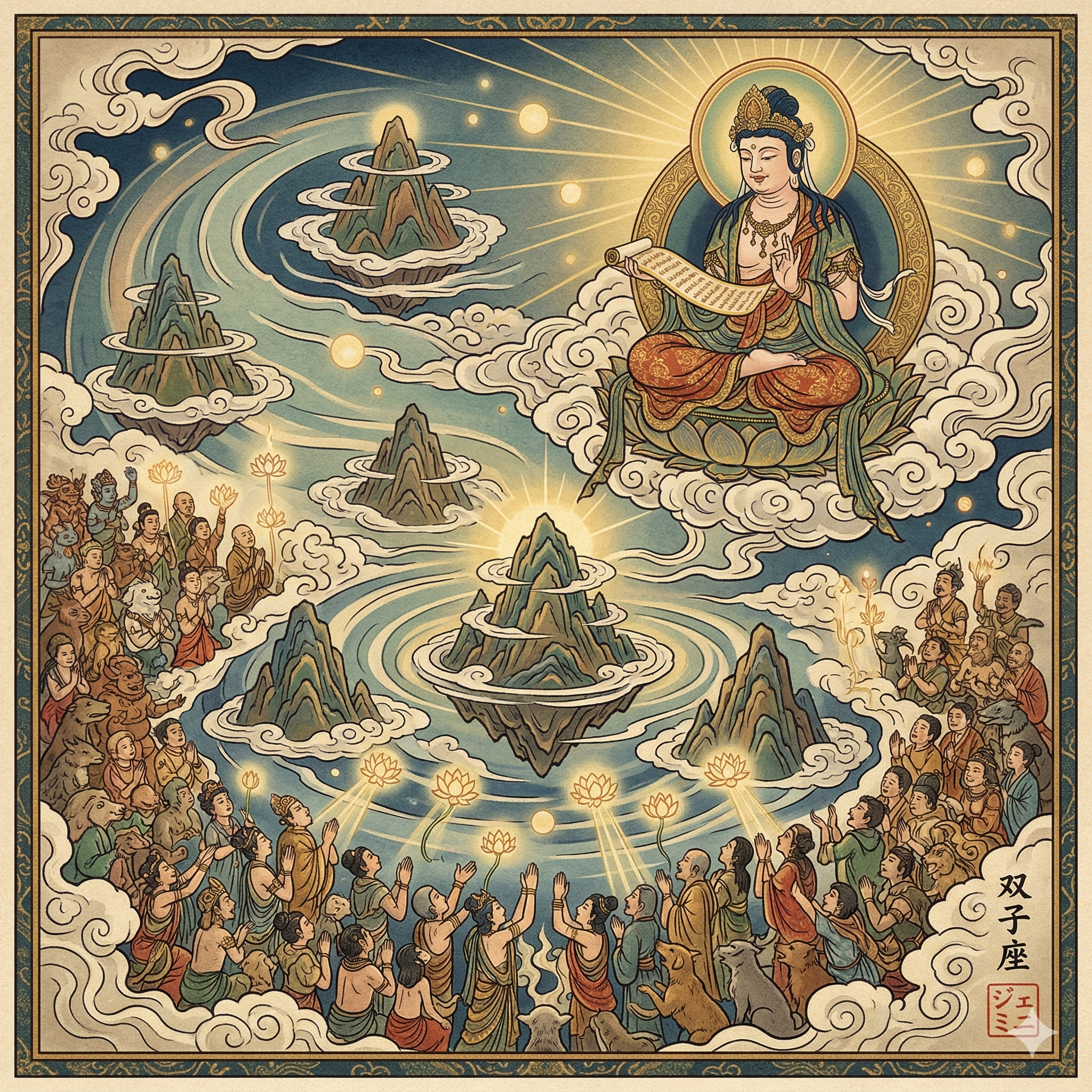
Yoshiro Tamura: Endless Bodhisattva Practice

[C]hapter 16 is traditionally understood as showing that Shakyamuni is the Everlasting Original Buddha, and from that point of view, is regarded as the core of the second half of the Lotus Sutra. Since it does maintain the eternal life of Shakyamuni, such an interpretation certainly seems reasonable, but it is important to notice how that eternal life is taught.

The inception of the revelation of the everlasting life of Shakyamuni Buddha is in chapter 15, where a question is raised about the countless bodhisattvas who emerged from the earth and were said to have been taught from the remote past by Shakyamuni. Here at its inception, the teaching of the eternity of Shakyamuni Buddha is already related to bodhisattvas.

Thus, since I became Buddha a very long time has passed, a lifetime of innumerable countless eons of constantly living here and never entering extinction. Good sons, from the beginning I have practiced the bodhisattva way, and that life is not yet finished…

In short, unlimited, endless bodhisattva practice is used to demonstrate the eternal life of the Buddha.

Yoshiro Tamura, "Introduction to the Lotus Sutra", p102-103

Myōhō Renge Kyō Promise for Aug. 28, 2025

“A Bodhisattva-mahāsattvas who performs this third set of peaceful practices in the latter days after [my extinction] when the teachings are about to be destroyed, will be able to expound the Dharma without disturbance. He will be able to have good friends when he reads and recites Myōhō Renge Kyō. A great multitude will come to him, hear and receive Myōhō Renge Kyō from him, keep Myōhō Renge Kyō after hearing Myōhō Renge Kyō, recite Myōhō Renge Kyō after keeping Myōhō Renge Kyō, expound Myōhō Renge Kyō after reciting Myōhō Renge Kyō, copy Myōhō Renge Kyō or cause others to copy Myōhō Renge Kyō after expounding Myōhō Renge Kyō, make offerings to the copy of Myōhō Renge Kyō, honor Myōhō Renge Kyō, respect Myōhō Renge Kyō, and praise Myōhō Renge Kyō.”

Lotus Sutra, Chapter 14

About this project

Yoshiro Tamura: The Measure of Faith in Buddhism

In Christianity, where the absolute God of monotheism was affirmed, the relation between reason and faith became a big issue, and arguments developed around three positions—having faith in order to know, knowing in order to have faith, and having faith although it is irrational. In Buddhism, such serious arguments never arose, because the conception of God found in monotheism does not exist in Buddhism. In other words, the Everlasting Buddha of chapter 16 of the Lotus Sutra is essentially different from the One God, the supreme deity commonly seen in India, and from the monotheistic deity of Christianity and other religions.

Yoshiro Tamura, "Introduction to the Lotus Sutra", p84

Myōhō Renge Kyō Promise for Aug. 27, 2025

Anyone who keeps Myōhō Renge Kyō will be able to cause me to rejoice.
He also will be able to bring joy
To [the Buddhas of] my replicas
And also to Many-Treasures Buddha who once passed away.

He also will be able to see
The present, past and future Buddhas
Of the worlds of the ten quarters,
Make offerings to them, and cause them to rejoice.

Lotus Sutra, Chapter 21

About this project

Yoshiro Tamura: The Everlasting, Imperishable Shakyamuni Buddha

Some readers may get the impression from [Chapter 16] that this everlasting, imperishable Shakyamuni Buddha is the personal God of monotheism. Hendrik Kern, who edited the Sanskrit text of the Lotus Sutra and translated it into English, had such an impression. His research led him to conclude that the Lotus Sutra is similar to the Bhagavad Gita and had been influenced by it. The Bhagavad Gita is presumably from about first century India. Its ancient religious poetry is full of songs of praise for a monotheistic and personal God. Most Indian people, down to the present, have come to love to recite its beautiful and passionate verses. …

Yet there is reason to disagree with this. Gita teaches a Creator and a cosmic creation, while in the Lotus Sutra the Everlasting Buddha is not regarded as the Creator, and there is no term equivalent to “creation.” Furthermore, the Bhagavad Gita emphasizes passionate and fanatical devotion (bhakti) to God, while we cannot find the idea of passionate and fanatical devotion to God anywhere in the Lotus Sutra.

Yoshiro Tamura, "Introduction to the Lotus Sutra", p84

Myōhō Renge Kyō Promise for Aug. 26, 2025

To sum up, all the teachings of the Tathāgata, all the unhindered, supernatural powers of the Tathāgata, all the treasury of the hidden core of the Tathāgata, and all the profound achievements of the Tathāgata are revealed and expounded explicitly in Myōhō Renge Kyō. Therefore, keep, read, recite, expound and copy Myōhō Renge Kyō, and act according to the teachings of Myōhō Renge Kyō with all your hearts after my extinction!

Lotus Sutra, Chapter 21

About this project

Yoshiro Tamura: The Everlasting Original Buddha

Chapter 16, responding to the perplexity of people in chapter 15, explains that Shakyamuni Buddha is really the Everlasting Original Buddha using the metaphor of the five hundred dust particles worth of eons. Suppose someone ground into fine dust five hundred thousand billions of myriads (nayuta) of countless (asaṃkhya) three-thousand great thousandfold worlds, and just one particle of this dust was deposited on every five hundred thousand billions of myriads of innumerable lands until all of the dust was exhausted, and then all of these worlds, those with a particle of dust and those without, were ground into dust. If one particle of dust is regarded as equivalent to an eon, the period of time equivalent to all of the dust particles is nowhere near as long as it has been since Shakyamuni became a buddha.

An eon is a long time. A nayuta is usually taken to mean one hundred billion. The word asaṃkhya means an uncountable number. And “three-thousand great thousandfold worlds” refers to the result of adding together three kinds of thousandfold world—small, medium, and large. It is said that a small thousandfold world corresponds to the solar system, a medium one to the galaxy, and a large one to a nebula. In chapter 7, there is a story in which one of these three-thousand great thousandfold worlds is ground into particles of dust and one particle is deposited on every thousandth world. It is called “the parable of the three thousand dust particles of eons.” In short, the story emphasizes the Buddha’s eternal life by means of these similes of very large numbers.

Yoshiro Tamura, "Introduction to the Lotus Sutra", p81

Identifying the Bodhisattvas of the Peaceful Practices Chapter

Chinese Master Hsuan Hua’s commentary on the Lotus Sutra includes an outline of the Lotus Sutra created by Ouyi Zhixu (1599-1655 CE). As I make my way through the 14 volumes I’ve been copying each chapter’s outline.

The outline has some interesting details that I had not noticed in my 100-plus readings of the Lotus Sutra. For example, back in March I pointed out that in Chapter 1 the outline explains that Maitreya is describing Bodhisattvas practicing the six pāramitās in sequence and then out of sequence as he tells Mañjuśrī  what he sees in the eighteen thousand worlds in the east illuminated by the light of the Buddha.

In Ouyi Zhixu’s outline for Chapter 14 he makes a very important distinction that I’ve only found in one other English translation of Kumārajīva’s Chinese translation of the Lotus Sutra – Senchu Murano’s translation.

Back in February 2023, when I was Comparing H. Kern’s translation of the Lotus Sutra to Senchu Murano’s, I discovered that Murano’s translation stood alone on a key point at the opening of Chapter 14, Peaceful Practices. (See this post.)

Murano begins the chapter:

Thereupon Mañjuśrī Bodhisattva-mahāsattva, the Son of the King of the Dharma, said to the Buddha:

“World-Honored One! These Bodhisattvas are extraordinarily rare. They made a great vow to protect, keep, read, recite and expound this Sūtra of the Lotus Flower of the Wonderful Dharma in the evil world after your extinction because they are following you respectfully. World-Honored One! How should an [ordinary] Bodhisattva-mahāsattvas expound this sūtra in the evil world after [your extinction]?

In comparing Murano to Kern, I found Kern said Mañjuśrī was not asking about “ordinary” bodhisattvas, but asking specifically how  the extraordinarily bodhisattvas of the previous chapter should propagate the sutra in the evil age after the Buddha’s extinction. In fact, every one of the English translations I had of the Lotus Sutra agreed with Kern. The closest anyone got to Murano was Leon Hurvitz’s translation, which incorporates both Kumārajīva’s Chinese and a 19th century compilation Sanskrit document. He offered:

At that time, Mañjuśrī the dharma prince, the bodhisattva-mahāsattva, addressed the Buddha, saying, “O World-Honored One! Very rarely do there exist such bodhisattvas as these, who out of respectful obedience to the Buddha utter a great vow to keep and hold, to read and recite this Scripture of the Dharma Blossom in the latter evil age! O World-Honored One! How can a bodhisattva-mahāsattva preach this scripture in the latter evil age?”

Hurvitz is the only translator other than Murano who doesn’t specify that Mañjuśrī  is referring to the Bodhisattvas of the previous chapter.

Learning this was very discouraging to me. I have always enjoyed the chapter as a teaching for “ordinary” Bodhisattvas in this evil world.

But then I read Ouyi Zhixu’s outline for Chapter 14:

  • D5. “Practices of Peace and Joy” Chapter
    • El. Question
      • F1. Praising the Bodhisattvas of profound practice, discussed in the previous chapter, who are able to propagate the sūtra in accord with the Dharma
      • F2. Asking how Bodhisattvas who are starting to practice can propagate the sūtra in the troubled age

Hsuan Hua Lotus Sutra Commentary, v15, p245

Interestingly, the Lotus Sutra translation that accompanies Chinese Master Hsuan Hua’s commentary on the Lotus Sutra doesn’t make this distinction and instead follows the other English translations.

At that time the Dharma Prince Bodhisattva Mahāsattva Mañjuśrī said to the Buddha, “World Honored One, all these Bodhisattvas are extremely rare. Reverently complying with the instructions of the Buddha, they have made great vows to protect, uphold, read, and teach this Dharma Flower Sutra in the future troubled age. World Honored One, how should these Bodhisattvas Mahāsattvas teach this sūtra in the future troubled age?”

I’m enjoying Ouyi Zhixu agreement with Murano, but I’m wondering why Ouyi Zhixu stands apart from the other translators.

Myōhō Renge Kyō Promise for Aug. 25, 2025

Anyone, after my extinction,
Who understands the meaning of Myōhō Renge Kyō,
Will be the eye of the worlds
Of gods and men.

Lotus Sutra, Chapter 11

About this project

Purification for Maura Michiko

Maura Michiko receives her first kaji kito purification blessing from Rev. Kenjo Igarashi
My 1-month-old granddaughter Maura Michiko receives her first kaji kito purification blessing from Rev. Kenjo Igarashi. Three generations attended the service at the Sacramento Nichiren Buddhist Church.

On the Journey to a Place of Treasures