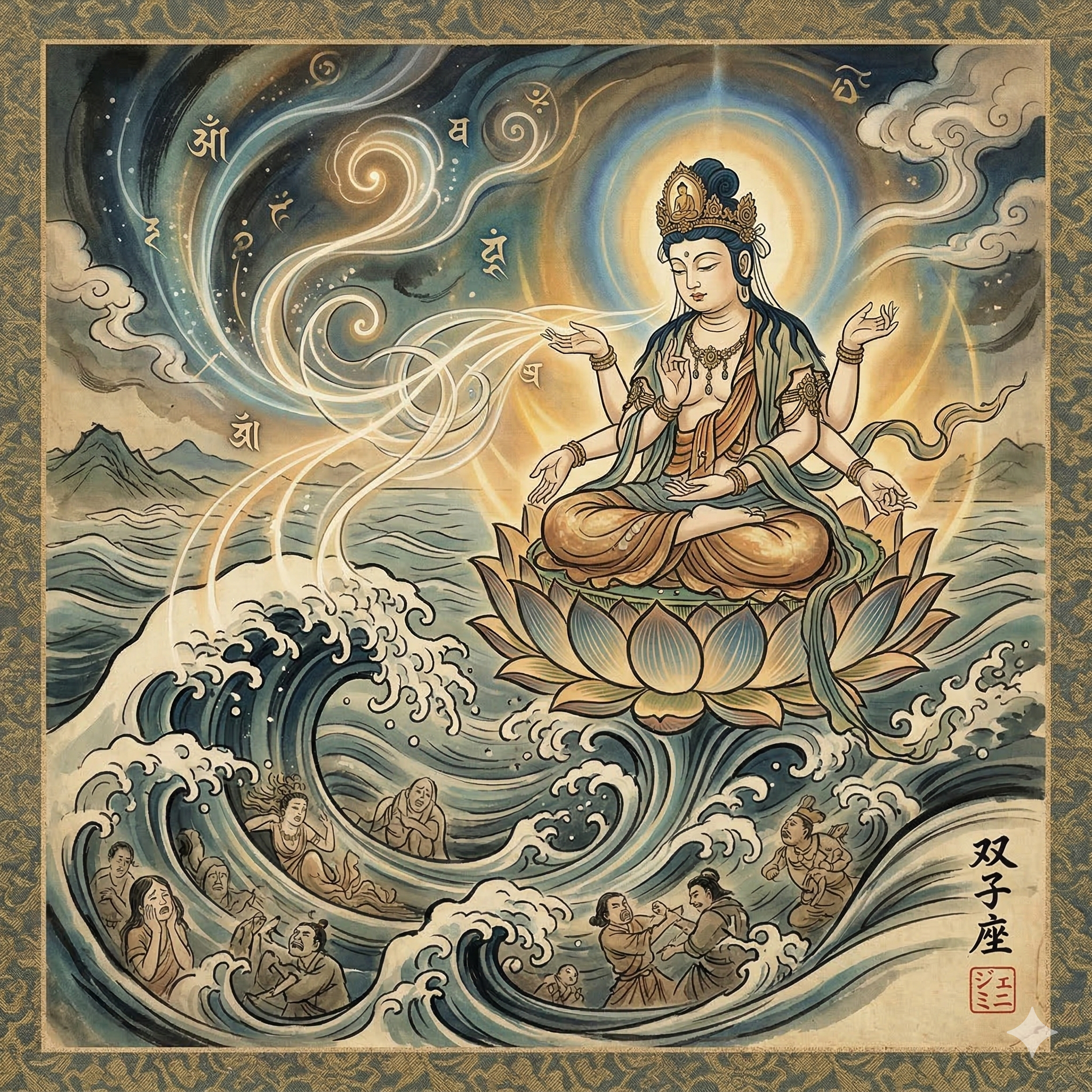
Myōhō Renge Kyō Promise for Sept. 2, 2025

The Lotus School … is based on the most truthful words of all teachings of the Buddha. Not only does the Lotus Sūtra consist of true words but also provisional sūtras preached by the Buddha during His lifetime, upon flowing into the great ocean of the Lotus Sūtra, are all converted to the sūtra of the true words by the power of the Lotus Sūtra. Let alone the daimoku of the Lotus Sūtra.

Myōhō-ama Gozen Gohenji, A Reply to My Lady, the Nun Myōhō

About this project

Yoshiro Tamura: Everlasting Bodhisattva Practice

The Everlasting Buddha is not a Creator but unceasingly engages in bodhisattva practice. Moreover, the sutra teaches that our becoming a buddha is substantially the same as it is for the Everlasting Original Buddha, but is expressed in different terms. For what purpose, then, does the sutra insist upon the idea of Everlasting Original Buddha? We can summarize it in the following three points:

  1. It resolves views of the Buddha—in other words, its purpose is to bring together and make coherent the various buddhas. In this regard, we can say that whereas we find the unity of Dharma or truth in chapter 2, we find the unity of Buddha or the personal in chapter 16.
  2. It shows that we can see the personal life of the Everlasting Original Buddha wherever there is unified truth—that is, it reveals that the unifying truth of the cosmos is not merely a matter of natural law, but that the eternal body of truth, which affects all life, is personal and dynamically alive.
  3. It shows that the dynamism of eternal life can inspire us in the midst of religious practice within this life. This is why chapter 16 teaches that Shakyamuni Buddha is the Everlasting Original Buddha and that he has never ceased doing bodhisattva practice.
Yoshiro Tamura, "Introduction to the Lotus Sutra", p104-105

The Lotus Sūtra’s Spiritual Potency

Note: This is another in the monthly excerpts from “Tales of the Lotus Sutra.”


There was a certain bhikṣunī, her name [long since] forgotten, who lived on the outskirts of the Kunshan district of Suzhou. She became a nun at an early age and took to constant recitation of the Lotus Sūtra, which she performed devotedly a day for some twenty-odd years. In appearance she was unusually beautiful and refined, so much so that anyone who caught sight of her was struck immediately with affection for her. During the first year of the Yongchang era [689] a certain district office manager named Zhu began to entertain wicked fantasies about her and sought to press her with his less than honorable designs. Yet the bhikṣunī remained firm in her chastity and refused to give in to him.

Angered by her rejection, Zhu made a great deal of trouble for the abbey and intentionally sought to disrupt their regular means of livelihood. The bhikṣunīs were at a total loss as to where to turn to rid themselves of this plight. Whereupon, the nun who kept the Lotus said, “How could the Lotus Sūtra fail to show its spiritual potency in this matter?” She then donned her purified robe, entered the Buddha hall, burned incense, and professed [solemn] vows.

Not long thereafter the office manager, availing himself of some official pretext, came to the abbey to pass the night. His heart, of course, harbored other intentions. But the very instant he sought to find his way to the nun’s quarters, his lower extremities were seized with a burning pain and his male member dropped off. Rivulets of perspiration streamed from his skin, leprous ulcers broke out over his entire body, and his eyebrows, beard, and sideburns all fell out. The office manager grievously recanted, but even after trying a hundred remedies, he still was never completely cured.

Buddhism in Practice, p443-444

About this project

Myōhō Renge Kyō Promise for Sept. 1, 2025

Except for bodhisattvas such as Superior Practice and Limitless Practice, highest-ranking leaders of the bodhisattvas who emerged from the earth, no one is allowed to appear in the 500-year period at the beginning of the Latter Age of Degeneration and to spread the five letters of myō, hō, ren, ge, and kyō, which is the substance of all existing things. Furthermore, no one else can form the Most Venerable One (honzon) with the two Buddhas, Śākyamuni and Many Treasures, seated side by side inside the Stupa of Treasures. This is because these (daimoku and honzon) are the gist of the “actual three thousand existences contained in one thought” doctrine expounded in the “Life Span of the Buddha” chapter in the essential section of the Lotus Sūtra, and it should be spread by bodhisattva disciples of the Original Buddha.

Shohō Jisso-shō, Treatise on All Phenomena as Ultimate Reality

About this project

Yoshiro Tamura: The Seven Parables of the Lotus Sutra

[In the parable of the good physician], a father—a physician—cannot convince his children, whose minds have been warped by poison, to take an antidote. So he leaves some medicine for them, disappears, and then sends someone to tell his children that he is dead. Hearing this, a deep longing for the father arises in the hearts of the children, bringing them to take the medicine. As a result they are cured and their eyes opened. Hearing that they had recovered, the father reappears. The children in the parable correspond to lost and wandering beings, and the father corresponds to the Everlasting Original Buddha. The father’s disappearance is comparable to that of the Everlasting Original Buddha, who has a kind of temporary extinction in order to correct the people’s hearts and minds and open their eyes.

The parables of the three carriages in chapter 3, and of the lost son in chapter 4, the simile of the rain and plants in chapter 5, the parables of the magic city in chapter 7, the jewel in the hem in chapter 8, the jewel in the topknot in chapter 14, and this parable of the physician’s sons in chapter 16 are called the seven parables of the Lotus Sutra and have been highly valued from ancient times.

Yoshiro Tamura, "Introduction to the Lotus Sutra", p90

Myōhō Renge Kyō Promise for Aug. 31, 2025

In the future, when you see good men or women who believe in the wisdom of the Tathāgata, you should expound Myōhō Renge Kyō to them, and cause them to hear and know Myōhō Renge Kyō so that they may be able to obtain the wisdom of the Buddha. When you see anyone who does not receive Myōhō Renge Kyō by faith, you should show him some other profound teachings of mine, teach him, benefit him, and cause him to rejoice. When you do all this, you will be able to repay the favors given to you by the Buddhas.”

Having heard these words of the Buddha, the Bodhisattva-mahāsattvas were filled with great joy. With more respect than ever, they bent forward, bowed, joined their hands together towards him, and said simultaneously. “We will do as you command. Certainly, World-Honored One! Do not worry!”

Lotus Sutra, Chapter 22

About this project

Yoshiro Tamura: the Concrete and Actual Shakyamuni Buddha

[The] Lotus Sutra maintains that the actual and concrete Shakyamuni is in reality a version of the eternal. That is, the eternity of Shakyamuni Buddha that is emphasized is not a truth-body behind him, but the concrete and actual Shakyamuni himself. In other words, the concrete, historical, actual Shakyamuni is the living embodiment of eternal life. His death or extinction, on the other hand, was just an expression of a convenient, temporary device.

The Buddha appears to be invisible in the teaching of chapter 16, in order to open the eyes of those who have narrow ways of thinking about being and nonbeing, and such. This is his so-called extinction. Those who have their eyes open know that the concrete and actual Shakyamuni Buddha exists eternally. This matter is summarized in lines of beautiful poetry in the verses at the end of the chapter. Kumarajiva’s translation of them begins with a phrase that has been lovingly recited from ancient times: “Since I became a buddha . . .”

Yoshiro Tamura, "Introduction to the Lotus Sutra", p89

Myōhō Renge Kyō Promise for Aug. 30, 2025

Anyone who keeps Myōhō Renge Kyō
Will have his mind purified as previously stated.
Although he has not yet obtained the wisdom-without-āsravas,
He will be able to obtain these merits of the mind.

Lotus Sutra, Chapter 19

About this project

Yoshiro Tamura: The Transhistorical Shakyamuni and the Historical Shakyamuni

[T]he actual Shakyamuni is the living form of eternal life and the manifestation of a transhistorical Shakyamuni in history. Accordingly, even if that manifestation disappears, Shakyamuni does not. He exists eternally, beyond ordinary ways of viewing or thinking about being and nonbeing. Those who go beyond such ways of viewing or thinking can grasp this. This is the second meaning of the theory of everlasting Shakyamuni Buddha. In brief, the transhistorical Shakyamuni Buddha and the historical Shakyamuni Buddha are united. …

the Stupa indicates that the worlds of the ten directions are unified into one buddha-land. This, too, is intended to reveal that Shakyamuni Buddha is a unifying Buddha.

Chapter 16 finally completely reveals that Shakyamuni is really the Everlasting Original Buddha. Shakyamuni himself emphasizes this, saying that the everlasting Shakyamuni goes beyond the ways of thinking about and viewing things used by ordinary people, who cling to being and nonbeing. The sutra says:

“The Tathagata has insight into the threefold world as it really is. For him there is no birth or death, neither retreat from nor emergence into the world, no transmigration or extinction, neither being nor nonbeing, neither existence nor nonexistence, neither sameness nor difference, and neither deception nor non-deception. He does not see the threefold world through the eyes of an ordinary person.”

Thus, those who are deluded by inverted or perverse ways of thinking cannot see Shakyamuni:

Perverse living beings fail to see me
Even though I am close.

It is before those who are upright and gentle, and have put attachment to desire behind them, that Shakyamuni appears:

And when the living have become faithful,
Honest and upright and gentle,
Then, together with the assembly of monks
I appear on Holy Eagle Peak.

In other words, those who are free from attachment to such things as being and nonbeing are able to see the Buddha.

Yoshiro Tamura, "Introduction to the Lotus Sutra", p87-88

Myōhō Renge Kyō Promise for Aug. 29, 2025

“A man on a plateau, feeling thirsty,
Dug a hole in order to get water.
As long as he saw the dug-out lumps of earth were dry,
He knew that water was still far off.
When he found the earth wet and muddy,
He was convinced that water was near.

In the same manner, Medicine-King, know this!
Those who do not hear
Myōhō Renge Kyō
Are far from the wisdom of the Buddha.”

Lotus Sutra, Chapter 10

About this project

On the Journey to a Place of Treasures