
Lessons and Learning

20210411_memorial-prayers
Ven. Kenjo Igarashi explains meaning of Memorial Prayers

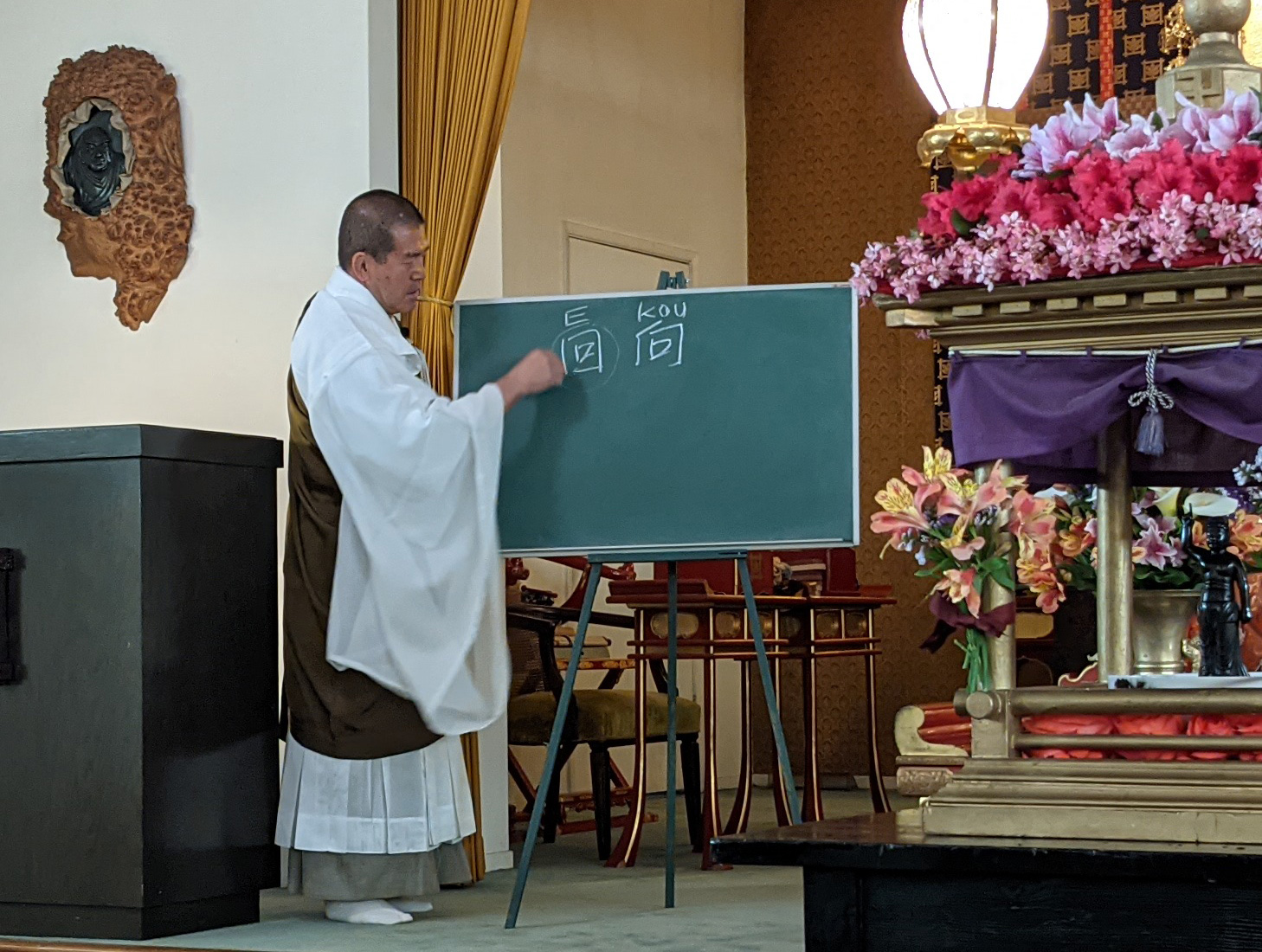
Following the Hanamatsuri service Sunday, Ven. Kenjo Igarashi brought out his portable chalkboard and set in on an easel next to his lectern. Already written in chalk were two Chinese characters. These were labeled E and Kou, which translate to Memorial Prayers.

For some reason I feel compelled to point out that the easel originally was part of a large floral display used at a funeral.  After the funeral, the display was moved to the parking lot and attendees were invited to scavenge individual flowers to take home. When all the flowers were gone, Rev. Igarashi kept the easel. The thin green legs of the easel and the green chalkboard look as if they were purchased together. The easel can be found on the altar dais behind a curtain next to his lectern.

And I think the juxtaposition of these two peripherally related tidbits inadvertently illustrates why I am unable to give a detailed recounting of  the sermon Rev. Igarashi gave on the topic of Memorial Prayers.

Last month, I recorded  Rev. Igarashi’s sermon after the Ohigan service, knowing in advance that I’d want a record of what he  said so I could add it to my Higan content. But instead of immediately posting the sermon after I transcribed the recording, I let it sit around for a week. Sunday I didn’t record the sermon and instead I am left to try to remember the lesson he gave.

Here is my dilemma: I want to explain the lesson I took from the sermon on E Kou without impugning Rev. Igarashi’s lesson. What I took in, what I recall, the lesson I received – it’s quite possible none of that was Rev. Igarashi’s intent.

This is what happens when “a bhikṣu, a bhikṣunī, an upāsakā, an upāsikā, or some other wise person, whether young or old, rejoices at hearing this sūtra in a congregation after my extinction. After leaving the congregation, he or she goes to some other place, for instance, to a monastery, a retired place, a city, a street, a town, or a village. There he or she expounds this sūtra, as he or she has heard it, to his or her father, mother, relative, friend or acquaintance as far as he or she can. Another person who has heard [this sūtra from him or her], rejoices, goes [to some other place] and expounds it to a third person. The third person also rejoices at hearing it and expounds it to a fourth person. In this way this sūtra is heard by a fiftieth person.” [Chapter 18, The Merits of a Person Who Rejoices at Hearing This Sutra]

What I can provide is my “fiftieth person” understanding. Please don’t blame Rev. Igarashi.

For Memorial Services, I’ve operated under a simple understanding: I accumulate merit with my practice and during the services I transfer that merit to my deceased ancestors. “Simple” is key here. Rev. Igarashi explained that the merit attained from our daily practice allows us to seek the intercession of Śākyamuni, Tahō Buddha, the great Bodhisattvas and all the protective deities. That’s where the power to help our deceased ancestors lies.

When I heard this I was reminded of a quote from Nichiren:

The Lotus Sūtra is called “Zui-jii,” namely it expounds the true mind of the Buddha. Since the Buddha’s mind is so great, even if one does not understand the profound meaning of the sūtra, one can gain innumerable merits by just reading it. Just as a mugwort among hemp plants grows straight and a snake in a tube straightens itself, if one becomes friendly with good people, one’s mind, behavior, and words become naturally gentle. Likewise, the Buddha thinks that those who believe in the Lotus Sūtra become naturally virtuous.

Zui-jii Gosho, The Sūtra Preached in Accordance to [the Buddha’s] Own Mind, Writings of Nichiren Shōnin, Faith and Practice, Volume 4, Page 155

It is this merit of Śākyamuni that we are able to transfer to our deceased ancestors. The more we practice Namu Myōhō Renge Kyō, our practice of the Lotus Sutra, the greater the merit. Rev. Igarashi explained that we need to devote our entire body to the effort. Not literally but figuratively like Gladly-Seen-By-All-Beings Bodhisattva, in the previous life of Bodhisattva Medicine King, who sacrificed his body as an offering to the Buddha.

Rev. Igarashi recalled his five times through the grueling Aragyo 100-day ascetic practice to illustrate how he gained his ability to offer purifying prayers for those who attend Kaji Kito services.

I will be 70 in December. Not a lot of physical body I can devote to my practice, but what there is goes to Namu Myōhō Renge Kyō.
20210412_new-juzu

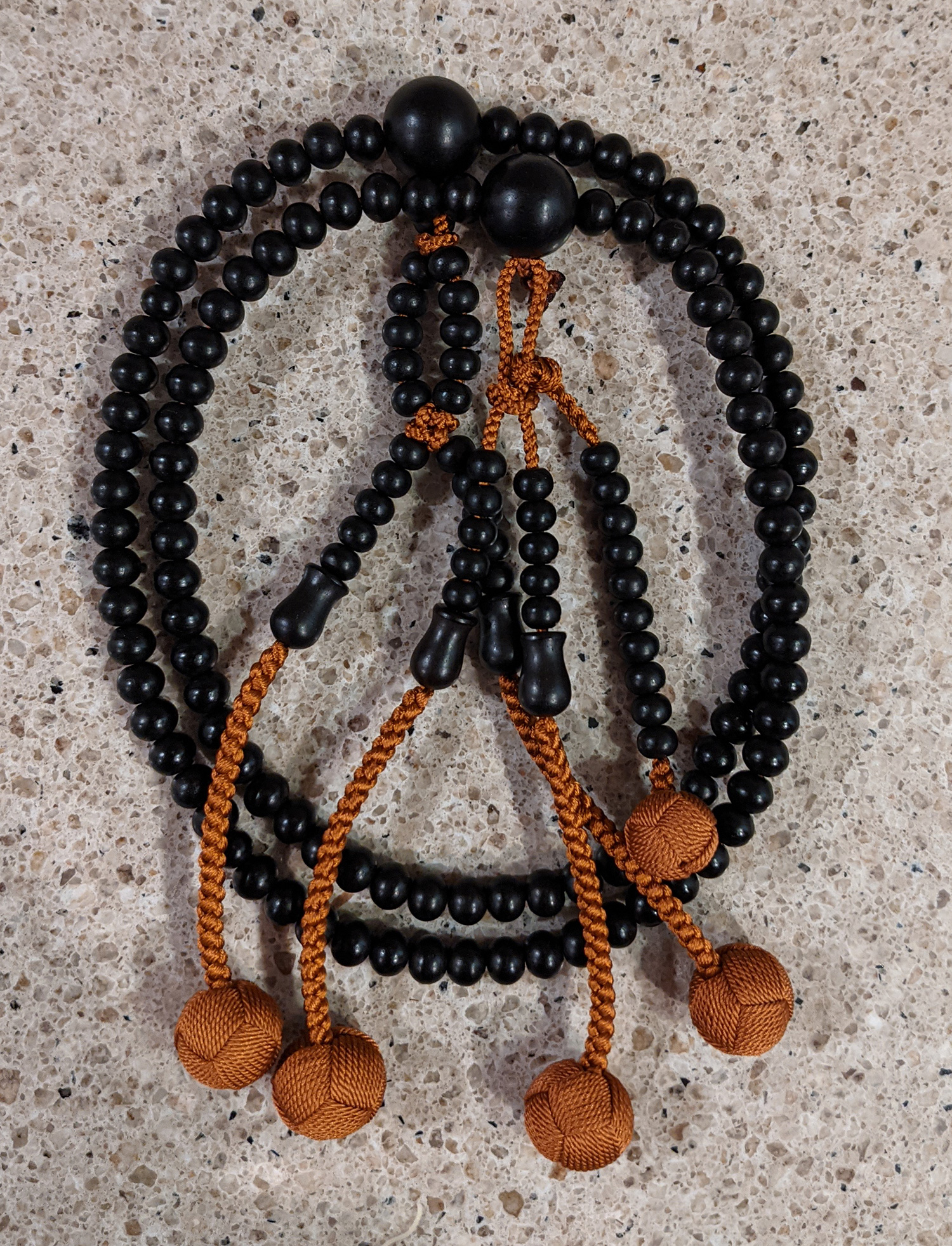
While I was at the church I asked Rev. Igarashi to bless a new set of Juzu I had purchased from the Nichiren Buddhist International Center. The beads came with a brochure, which offered this tidbit:

Prayer Beads are used by all Buddhists and by many other religions as well. These beads are called Juzu or Nenju in Japanese, Mala by the Tibetans and in Sanskrit they are called Japamala. When the Romans first saw prayer beads (Japamala) used by the Hindus, they mistakenly heard “jap” instead of “japa.” Jap in Sanskrit stands for rose. Translated into Latin Japmala comes out as “Rosarium” and in English as “Rosary.” The Juzu or Mala may have been the inspiration for the prayer beads used by some Christians and Muslims today.

San’mon

Adoration of Gohonzon

In the Maṇḍala Gohonzon, the object of our worship, is shown the origin of how the Mandala was written.

One day in the 12th month of 1274 (11th year of Bunnei), I (Nichiren) wrote the Gohonzon in the village of Hakii, Province of Kai (the present-day Minobusan, Yamanashi Prefecture).

Nichiren

It was the time when over 2220 Years had passed since Śākyamuni Buddha passed away. Nevertheless, in the three countries of India, China and Japan, namely in the world, there had never existed a Gohonzon like this. This is probably because none of our past masters attempted to spread the Gohonzon among the society even though they were aware of its existence. Or it may be that nobody knew about it.

Śākyamuni Buddha, after careful consideration, determined that He should conceal the Gohonzon until the arrival of an opportune moment to reveal it, leaving it to the people in the period of Mappō.

In fact, the Buddha preached in the Lotus Sutra that His messenger, Jōgyō Bosatsu, should spread the Buddha’s teachings in the first 500 years of Mappō. As predicted by the Buddha, Nichiren Daishōnin appeared in this world to reveal the Gohonzon, and expounded the teachings of the Odaimoku.

Signature given by Nichiren Shōnin himself.
Namu-myōhō-renge-kyō
Easy Readings of the Lotus Sutra

Entering the World of the Lotus Sūtra

The minds of living beings dwelling in the nine realms and the six paths are different. For instance, the faces of people, regardless if they are in a small group of a few people or a large group of a hundred or a thousand in number, are all about the same size — about 30 centimeters — but there is no pair of faces completely identical to each other. As their minds are different, their faces, too, are not the same. If the minds of two or ten people are different, how much more so are the differences between the minds of all living beings in the nine realms and the six paths? As a result the inclinations of people are varied as well. Some love to watch flowers while others love the moon. Some like a sour taste while others a bitter taste. Some love the small-sized while others prefer the large-sized. People’s sense of value also differs. Some prefer the good while others indulge in wickedness. People are thus varied and diverse. However, when they enter the world of the Lotus Sūtra, they all become one body and their minds are one. It is like how the many river waters will have the same salty taste upon entering the ocean, or how the many birds become a single golden color upon nearing Mt. Sumeru.

Sennichi-ama Gohenji, A Reply to Sennichi-ama, Writings of Nichiren Shōnin, Volume 7, Followers II, Pages 159-160

Daily Dharma – April 12, 2021

The “mutual possession of ten realms” doctrine is as difficult to maintain as it is to see fire in a rock or flowers in wood. However it is not totally impossible because rocks spark when struck together and a tree blooms in spring. It is most difficult to believe that the realm of Buddhas is contained in the realm of humans because it is like saying that fire is in water or water in fire.

Nichiren wrote this in his treatise on Spiritual Contemplation and the Most Venerable (Kanjin Honzon-Shō). “Mutual Expression of Ten Realms” is one of the more difficult ideas from the Chinese Master T’ien-t’ai. Nichiren uses it to illustrate what the Buddha teaches in the Lotus Sūtra: that Buddha nature is contained within all beings. Even though this idea is difficult, we can see it in the transformations of everyday objects we encounter: rocks, fire, flowers and trees. With his similes, Nichiren reminds us that with the Lotus Sūtra as our guide, we can see the Buddha Dharma in all aspects of our lives.

The Daily Dharma is produced by the Lexington Nichiren Buddhist Community. To subscribe to the daily emails, visit zenzaizenzai.com

Day 15

Day 15 concludes Chapter 10, The Teacher of the Dharma, and opens Chapter 11, Beholding the Stūpa of Treasures.

Having last month considered the support the Buddha offers those who expound the Dharma, we repeat in gāthās the three things needed to be done before expounding this sutra.

Thereupon the World-Honored One, wishing to repeat what he had said, sang in gāthās:

If you wish to give up all indolence,
Hear this sūtra!
It is difficult to hear this sūtra.
Few receive it by faith.

A man on a plateau, feeling thirsty,
Dug a hole in order to get water.
As long as he saw the dug-out lumps of earth were dry,
He knew that water was still far off.
When he found the earth wet and muddy,
He was convinced that water was near.

In the same manner, Medicine-King, know this!
Those who do not hear
The Sūtra of the Lotus Flower of the Wonderful Dharma
Are far from the wisdom of the Buddha.

In this profound sūtra
The teachings for the Śrāvakas are criticized.
Those who hear
That this sūtra is the king of all the sūtras,
And think over this sūtra clearly after hearing it,
Know this, will approach the wisdom of the Buddha.
If you wish to expound this sūtra,
Enter the room of the Tathāgata,
Wear the robe of the Tathāgata,
Sit on the seat of the Tathāgata,
[And after doing these three things,]
Expound it to people without fear!

To enter the room of the Tathāgata means to have great compassion.
To wear his robe means to be gentle and patient.
To sit on his seat means to see the voidness of all things.
Expound the Dharma only after you do these [three] things!

See The Buddha’s Room, Robe, and Seat

The Buddha’s Room, Robe, and Seat

Toward the end of Chapter 10, we find these words:

If people are to teach this sutra,
Let them enter the Tathagata’s room,
Put on the Tathagata’s robe,
And sit on the Tathagata’s seat.

Facing the multitude without fear,
Let them teach it clearly everywhere,
With great compassion as their room,
Gentleness and patience as their robe,
And the emptiness of all things as their seat.
Doing this, they should teach the Dharma. (LS 232)

In this beautiful poetic expression we have another indication of what it means to follow the bodhisattva way. It means nothing terribly complicated, just the very difficult matter of being compassionate, gentle, and patient and living from an understanding of the emptiness of all things. To enter the room of the Buddha, wear his robe, and sit on his seat is a wonderful metaphor for living the life of a bodhisattva, living the Dharma in a way that goes beyond our sixteen simple practices. This is what it means to be a teacher of the Dharma.

The Stories of the Lotus Sutra, p133-134

Bathing the Baby Śākyamuni

This slideshow requires JavaScript.

After a Zoom Hanamatsuri service, it was a joy to celebrate IRL – In Real Life – at the Sacramento Nichiren Buddhist Church.

Seigon

Words of oath before reciting the Lotus Sutra

To carry out the Way of the Buddha as a Buddha, Śākyamuni Buddha has been expounding His teachings without rest, from the beginning to this day, not only in our world but also in innumerable worlds.

Among His teachings, the Lotus Sutra is the most important. If you devote yourself completely to the faith in the Lotus Sutra, you will surely become a person who truly practices the Way of the Buddha.

All of you, even after my death, should continue having faith in the Lotus Sutra and reciting it. Make this oath before me now.

Namu-myōhō-renge-kyō
Easy Readings of the Lotus Sutra

Faith, Practice and Teaching

Whether or not we manifest the function of being bodhisattvas from beneath the ground depends solely on our practice, and not on a hollow claim. We can’t just say we are and not actually be acting in that capacity. The emerged from the ground bodhisattvas say they wish to obtain the dharma; in this case the dharma is attained through understanding by faith, by carrying out the practices, and by teaching others. The list is a joined list meaning it isn’t complete unless everything in the list is present. We cannot study in isolation, nor can we practice in isolation, nor can we just go around telling others about Buddhism and not do the practice.

Lecture on the Lotus Sutra

Spreading Myō, Hō, Ren, Ge, and Kyō in the Latter Age of Degeneration

Śākyamuni Buddha did not feel safe to entrust great bodhisattvas such as Samantabhadra and Mañjuśrī to spread the five Chinese characters of myō, hō, ren, ge, and kyō in the Latter Age of Degeneration. The Buddha, therefore, entrusted the job to the four leaders including Bodhisattva Superior Practice among the numerous bodhisattvas that emerged from the soil. As I contemplate the religious meaning of this, I wonder if Bodhisattva Superior Practice entered your body in order to help me to spread the Lotus Sūtra? Or was it the Buddha’s discretion?

Shijō Kingo-dono Gohenji, Response to Lord Shijō Kingo, Writings of Nichiren Shōnin, Followers I, Volume 6, Page 142