
Tao-sheng Commentary on the Lotus Sutra, p284-285In the earlier ages it was not yet hard to keep the sūtra. [But] if it is very hard to keep it [in the latter age], the low level of knowledge and self-confidence [are the probable causes]. Hence, Mañjuśrī asked [the Buddha] about the way to guide learners in the evil age.
Although keeping the sūtra in the latter age involves a lot of evils, if they dwell in four dharmas, the latter age does not mean suffering. Dwelling in them certainly leads to security; hence, it is said, “dwelling securely.” As regards the dharmas for teaching the Path, the practical modus operandi are as follows.
“Mañjuśrī! What are the proper practices the Bodhisattva-mahāsattvas should perform? He should be patient, mild and meek. He should not be rash, timorous, or attached to anything. He should see things as they are. He should not be attached to his nonattachment to anything. Nor should he be attached to his seeing thing as they are. These are the proper practices the Bodhisattva-mahāsattvas should perform.
{First, by dwelling securely in the place where
the bodhisattva acts, in the place that he approaches with familiarity, he shall be able to set forth this scripture for the sake of living beings.}When, having entered li, [the bodhisattva] fulfills it, he is in “the place [where the bodhisattva] acts.” Although he has not yet entered li, if he is familiar with it and close to it, he is in “the place he approaches with familiarity.” Also they are, as beginning and end, conjoined as one thing [or Dharma].
{If a bodhisattva-mahāsattva dwells on the ground of forbearance;
if he is gentle, agreeable, good, and acquiescent, not given to fits of
violence, nor at heart becoming alarmed;}He who is in “the place [where the bodhisattva-mahāsattvas] acts” regards from beginning to end forbearance as the primary [virtue]. These five virtues belong to the beginning.
{if, further, he performs no
act with respect to the dharmas, but views the dharmas in keeping with
their true marks;}So far the virtues of having li in mind have been explicated; now the abilities of “viewing” and “performing” are introduced. These four things constitute the end of “the place [where the bodhisattva mahāsattvas] acts.”
Monthly Archives: June 2025
Practice and Study for Monastics and Lay People
Chinese Master Hsuan Hua’s 14-volume commentary on the Lotus Sutra reflects his belief in a strong monastic foundation in Buddhism. He did not believe lay people were part of the Triple Jewel.
In Buddhism: A Brief Introduction, Master Hsuan Hua’s teachings are summarized.
People who believe in the Buddha’s teachings should formally take refuge with the Triple Jewel. The Triple Jewel is the Buddha, the Dharma, and the Sangha. The third of the three jewels, the Sangha, literally means “harmoniously united assembly.” In the Six Paramitas Sutra the Buddha noted three kinds of Sangha.
The first Is the Sangha of the Primary Meaning, consisting of the Sagely Sangha of Buddhas who abide by the Dharma. The second is the Sangha of the Sages. The third is the ‘field of blessings Sangha,’ comprised of the Bhikshus and Bhikshunis who receive and uphold the moral precepts.
The Sangha of the Buddhas consists of all the infinite numbers of Buddhas in the world-systems of the universe. In the Buddhist world, however, the word Sangha generally refers to the Bhikshu and Bhikshuni Sangha – the lowest of the three types mentioned by the Buddha. The use of the word “sangha” to refer to the common lay community is misleading and a departure from the traditional usage and meaning of the word, as will be explained later in this chapter.
Buddhism: A Brief Introduction, p65
Later, we’re told:
In the Sutra of Changes to Come, the Buddha taught that the Dharma will disappear from the world simultaneously with the disappearance of the Sangha of Bhikshus and Bhikshunis, since the Dharma relies on the Sangha for its existence in the world.
Buddhism: A Brief Introduction, p70
When Hsuan Hua established his school in America he sought out followers who would leave the home life and devote themselves to monastic life. His teachings reflect this. Consider this discussion on the need for practice with study found in his commentary on Chapter 3, A Parable, in the Lotus Sutra.
Hsuan Hua Lotus Sutra Commentary, v4, p181-182I will tell you something that is extremely important. Do not let it fall on deaf ears and be forgotten. What is it? You must practice what you know. You cannot just read the sūtra and think, “I understand the principles,” and let it go at that. You must actually do what the sūtras say. The sutras tell you to get rid of your faults, so you must get rid of your faults. If you don’t get rid of your faults, you might as well not study the Buddhadharma. The Dharma teaches us to put others first and get rid of our faults. If you think that you can study the Buddhadharma and hold on to your imperfections, you are wrong. Everyone should pay special attention and keep this in mind. I’m not joking with you. If you don’t get rid of your faults and if you knowingly violate the rules, then you might as well not study the Buddhadharma at all. You are just a loafer among cultivators. Don’t goof off in the monastery or else you will certainly fall into the hells. Also, people who cultivate should watch over themselves and do their best to change their habits and faults.
I regard all you lay people equally, no matter who you are. I am not demanding perfection, nor am I insisting that you improve instantly, but I hope that you will gradually improve yourselves and get rid of your faults. You should know that I am deeply concerned for all of you and that I watch over you. I worry about your faults more than I do my own. Why? I hope that all of you will be better than me. I hope that you will blaze the trail for Buddhism in the West and be role models and pioneers in Buddhism. Don’t look upon yourselves lightly.
For me, Hsuan Hua’s teachings easily fit within my understanding of Nichiren Shu, where we have both priests who have left home and lay people. And I don’t particularly care that ordinary lay people are considered less important than priests. I also realized that a lot of Nichiren followers will balk at the idea that priests are important or even necessary. Such disputes are a distraction.
As followers of the Eternal Śākyamuni Buddha, especially here in America, we should all “blaze the trail for Buddhism in the West and be role models and pioneers in Buddhism.”
Myōhō Renge Kyō Promise for June 10, 2025
“Ajita! Anyone who[, while he is staying outside the place of the expounding of the Dharma,] says to another person, ‘Let us go and hear the sūtra called Myōhō Renge Kyō which is being expounded [in that place],’ and cause him to hear Myōhō Renge Kyō even for a moment, in his next life by his merit, will be able to live with the Bodhisattvas who obtain dharanis. … He will be able to see the Buddhas, hear the Dharma from them, and receive their teachings by faith throughout his future existences.
Tao-sheng: Peaceful Practices
Tao-sheng Commentary on the Lotus Sutra, p283-284The explication of the idea that the cause of three turns out to be the cause of One is to be completed here. In the chapter preceding the present one, it has been explained that the great beings (mahāsattvas) will propagate this sūtra and that the ranks of voice hearers also will propagate this Dharma “in other lands.” Among these are those who wish to transmit this sūtra but do not know how to do it. [The Buddha] therefore sets up this chapter to teach them the practical modus operandi.
“A Bodhisattva-mahāsattvas who wishes to expound this sūtra in the evil world after [my extinction] should practice four sets of things {dwell securely in four dharmas}.
If one is able to “dwell securely in four dharmas,” then the body becomes tranquil and the spirit is settled. When the spirit is settled and the body tranquil, then external suffering does not interfere with them (the four dharmas). When external suffering does not interfere with them, one can be said to be “comfortable.” Because they are then able to preach the Dharma tirelessly, beings receive its benefits, “The four dharmas” are as follows: The first dharma consists of the acts of dwelling and the acts of the two kinds of places “that [the bodhisattva-mahāsattva] approaches with familiarity.” “The place that he approaches with familiarity” enables them to keep a distance from evils and remain close to li. As the mind rests on li, body and mouth do not commit any faults. Body and mouth not committing any faults constitute the second dharma. The third one is the state of feeling no jealousy. The fourth one is the state of feeling Great Compassion. As the three kinds of acts are purified, compassionate thought also pervades their minds. Is not the propagation of the Dharma in this way also great?
Reading Chinese Master Hsuan Hua’s Commentary on the Lotus Sutra
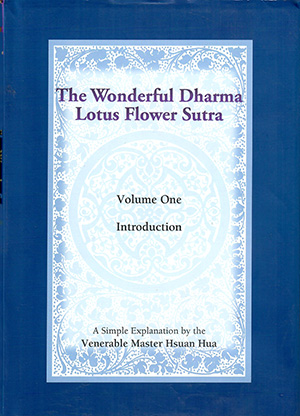

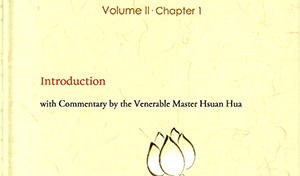
I read the first volume of the 2001 edition of Chinese Master Hsuan Hua‘s commentary of the Lotus Sutra, which the Buddhist Text Translations Society gives away free (you pay for shipping). I wanted to know if it would be worthwhile to pay $159.95 for the full 14-volume set of the 2020 edition.
I did not read beyond that first volume of the 2001 edition before I purchased the new edition. But in reading the 2020 edition, I noticed several changes.
To begin, I noticed that the 2001 cover reads:
The Wonderful Dharma Lotus Flower Sutra
and the new cover drops Flower and says
The Wonderful Dharma Lotus Sūtra
Another interesting piece of cover trivia. The first volume of both editions adds after the title,
A Simple Explanation by the Venerable Master Hsuan Hua.
But on subsequent volumes that “simple explanation” becomes
with Commentary by the Venerable Master Hsuan Hua
Dropping the “Flower” and changing “A Simple Explanation” to a “Commentary” I suspect is a byproduct of the revision being a part of the curriculum of the graduate certificate program in Buddhist translation offered by Dharma Realm Buddhist University‘s International Institute for the Translation of Buddhist Texts.
I was personally disappointed in some of the changes that I noticed. “A Simple Explanation” I feel better represents Venerable Master Hsuan Hua’s 25-month-long daily Dharma talks.
There were other changes beyond the adding of diacritical marks that I felt were part of an effort to give the “simple explanation” a more academic “commentary” feel.
Take for example Hsuan Hua’s list of 10 auspicious signs that occurred at Mañjuśrī’s birth. In the 2001 edition, the seventh sign said, “Horses gave birth to unicorns.” In the new edition, this becomes: “Horses gave birth to qilins.” Encyclopedia Britannica defines Qilin in Chinese mythology as “the unicorn whose rare appearance often coincides with the imminent birth or death of a sage or illustrious ruler.” Yes, Qilin has a more academic seriousness, but Unicorns are much more fun and readily understandable for Western readers.
I also noticed that some errors were introduced in the revision process.
The new edition includes a Foreword by Ron Epstein, PhD, Professor Emeritus, Dharma Realm Buddhist University. Professor Epstein misspells Nichiren as Nichirin.
More puzzling was a change in assignments for the Four Heavenly Kings.
On pages 260-261 of the first volume of the 2001 edition, we learn about the Four Great Heavenly Kings, who protect the four sides of Mount Sumeru.
The East is governed by Dhritarashtra
The South is governed by Virudhaka
The West is governed by Virupaksha
The North is governed by Vaishravana
On page 149 of the second volume of the 2020 edition, we are told:
The East is governed by Dhṛtarāṣṭra
The South is governed by Virūḍhaka
The West is governed by Vaiśravaṇa
The North is governed by Virūpāksa
West and North have been transposed. Vaiśravaṇa, Bishamon in Japanese, is guardian of the North. He is represented in the upper left corner of Nichiren’s Mandala Gohonzon. He is also one of the Seven Happy Gods of Japan (hence my personal interest). Each volume of the commentary comes with a Glossary. That glossary also includes Vaiśravaṇa governing the West instead of the North.
I contacted the Buddhist Text Translation Society at their published contact address [email protected]. I wanted to be sure that Hsuan Hua didn’t have some other arrangement of Guardian Kings. I was told, “You’re right we had mistakenly transposed the guardians of the West and North.”
Myōhō Renge Kyō Promise for June 9, 2025
Anyone who protects Myōhō Renge Kyō
Should be considered
To have already made offerings
To Many-Treasures and to me.
Tao-sheng: Vows to Keep This Sūtra and Propagate It in the Evil Age.
Tao-sheng Commentary on the Lotus Sutra, p281Thereupon Medicine-King Bodhisattva-mahāsattva and Great-Eloquence Bodhisattva-mahāsattva, together with their twenty-thousand attendants who were also Bodhisattvas, vowed to the Buddha:
“World-Honored One, do not worry! We will keep, read, recite and expound this sūtra after your extinction.So far [the Buddha] has broadly drawn parables and explanations, speaking of those who kept this sūtra. What is said here is about the great beings (mahāsattvas), including Medicine King, who take vows to keep this sūtra and propagate it in the evil age.
At that time there were five hundred Arhats in this congregation. They had already been assured of their future attainment [of Anuttara-samyak-saṃbodhi]. They said to the Buddha, “World-Honored One! We also vow to expound this sūtra [but we will expound it] in some other worlds [rather than in this Sahā-World].”
The people of this land are so evil-minded that arhats will not be able to transform them. Hence, they are “in other lands.” [What appears to be a tacit] affirmation [by the Buddha, as he keeps silent about their vow to propagate the sūtra in “other lands”], of the impossibility of their mission should not be taken as real. [The Buddha’s silence should be interpreted] merely as words of stern [warning] for serious application to their mission.
The Law of Cause and Effect’s Strict Retribution
After Master Hsuan Hua’s description of why the Richman in Chapter 4, Faith and Understanding, took on the appearance of someone who was “frightened,” Hsuan Hua offered a lesson about the strict retribution everyone receives, even a Buddha. As explained in a footnote at this point:
Hsuan Hua Lotus Sutra Commentary, v5, p79-80After the Buddha had realized Buddhahood, he went through three karmic retributions as a result of his past karma from previous lifetimes:
- The Buddha’s foot was pierced through by a golden spear, which was actually a piece of wood chip;
- the Buddha ate horse feed for three months; and
- the Buddha suffered from a headache for three days.
The narratives that follow describe the last two of these retributions.
Re. T04 No. 197 Foshuo xinqihengjing 佛說興起行經 and To4 No. 196 Zhong benqi jing 中本起經.
Hsuan Hua Lotus Sutra Commentary, v5, p79-82A long, long time ago, when the Buddha was still in the formative stage of his practice, there was a famine in the country where he lived. Since there was nothing else to eat, people started eating fish from the sea. A very large fish was caught and brought up on shore. Śākyamuni Buddha, then just a child, hit it with a stick over the head three times. Therefore, although he had become a Buddha, he still suffered headaches as retribution.
Another time, while cultivating in a former life, he saw a bhikṣu going on alms rounds and said, “That bhikṣu is only fit to eat horse feed! Why do those people give him such delicious things to eat?” Because he made that one comment, when he became a Buddha, the following event took place: The Buddha went to another country for the summer meditation retreat. The king had said that he would make offerings to him, but when the Buddha got there, the king reneged. “Just give these bhikṣus horse feed!” he said. So for three months, the Sangha ate only horse feed.
Even though the Buddha has awe-inspiring virtue, he still manifested undergoing retributions such as these.
This story involves the principle of cause and effect as described in the following couplet:
Plant a good cause, reap a good result.
Plant a bad cause, reap a bad result.The causes you planted in your former lives determine the results you now undergo.
Another story is about King Virūḍhaka’s extermination of the Śākyan clan.
In the past, Sakyamuni Buddha hit a large fish three times, and over five hundred people ate its flesh. Thus, after he became a Buddha, he had headaches as retribution, and King Virūḍhaka exterminated the Śākyan clan.
King Virūḍhaka was a king in India at that time, who wanted to kill everyone in the Śākyan clan. The Śākyans clan was composed of those very people who had, in the past, eaten the fish that Sakyamuni Buddha had hit on the head; and King Virūḍhaka was formerly that fish. Since they had eaten his flesh, he wanted to drink their blood and was determined to kill them all. Although the Buddha possessed all spiritual transformations with endless, wondrous applications, he could not save his kinsfolk.
Mahāmaudgalyāyana, however, could not bear this, and he tried to use his spiritual powers to save them. Why didn’t the Buddha save them? The Buddha knew that this occurrence was a destined retribution determined by the law of cause and effect. Maudgalyāyana did not know the involved cause and effect because, as an Arhat, he could only see the past causes and effects as far back as 80,000 great eons. Everything that happened prior to 80,000 great eons was beyond his knowledge.
Since he didn’t know the circumstances, he thought, “My teacher’s kinsfolk are going to be killed by the king. I must employ my spiritual powers and save them.”
Mahāmaudgalyāyana was foremost in spiritual powers among the Buddha’s disciples, so he recited a mantra that put five hundred members of the Śākyan clan into his alms bowl. Then he sent the bowl up into empty space. “There is no way King Virūḍhaka can kill them now,” he thought. When King Virūḍhaka had finished exterminating the Śākyan clan, Maudgalyāyana brought the bowl down again. Much to his dismay, he found only blood in place of the five hundred Śākyans. None of them survived.
Maudgalyāyana asked the Buddha, “Even with my spiritual powers, why couldn’t I rescue the Śākyan clan?” The Buddha replied, “There was no way to avoid the retribution of this particular case of cause and effect. If it could have been avoided, I would have saved my kinsfolk myself instead of waiting for you to save them.”
This example demonstrates that the law of cause and effect is difficult to escape. Bad karma you created in former lives will come back to you as retribution in this present life; retribution is inevitable.
Myōhō Renge Kyō Promise for June 8, 2025
Anyone who keeps, reads and recites Myōhō Renge Kyō, and understands the meanings of Myōhō Renge Kyō, will be given helping hands by one thousand Buddhas immediately after his present life. He will be fearless. He will not fall into any evil region. He will be reborn in the Tusiita Heaven. There he will go to Maitreya Bodhisattva who, adorned with the thirty-two marks, will be surrounded by great Bodhisattvas, and attended on by hundreds of thousands of billions of goddesses. He will be given the benefits of these merits. Therefore, anyone who has wisdom should copy Myōhō Renge Kyō with all his heart, cause others to copy Myōhō Renge Kyō, and also keep, read and recite Myōhō Renge Kyō, memorize Myōhō Renge Kyō correctly, and act according to Myōhō Renge Kyō.
Tao-sheng: Devadatta and the Dragon Princess
When Tao-sheng wrote his commentary in 432 CE, the Kumārajīva translation of the Lotus Sūtra did not include Chapter 12, Devadatta. This wouldn’t be added until the 6th century. As a result, Tao-sheng’s commentary covers only 27 chapters.