Category Archives: AI Contribution

Daily Dharma for March 25, 2026

20260325-ddi

Illustration by Google Gemini

Show Gemini's thinking

Gemini Thinking

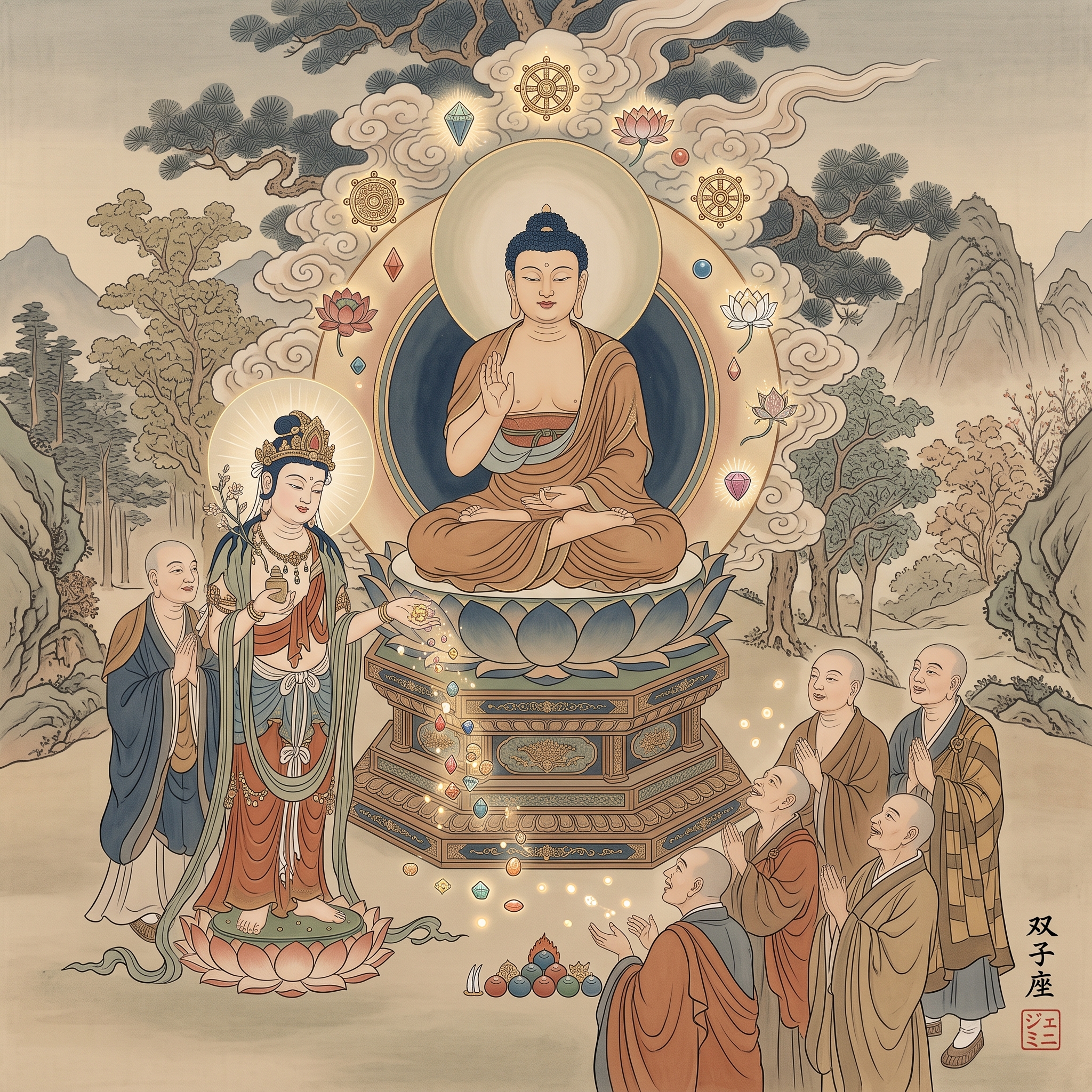
In this square illustration, I have depicted the opening scene of Chapter Ten of the Lotus Sūtra, using the rich visual language of Japanese Buddhist iconography. At the top center, Śākyamuni Buddha (釈迦如来), identifiable by his halo and teaching gesture, is shown sharing these verses. Attentively receiving this teaching is Medicine-King Bodhisattva (薬王菩薩), who stands on the right.

The central scene illustrates the core of the Buddha’s instruction: "Make offerings strenuously to the keeper of the Sūtra." I have chosen to represent the "keeper" not as a single figure, but as a diverse group of monastics and laypeople—men, women, and even a child—actively presenting symbolic offerings of fruit, incense, and jewels. This visual emphasizes that anyone who upholds the Dharma, whether or not they are aware of their true nature, is a seeker of enlightenment worthy of respect. My signature, represented by the Kanji 双子座 (Gemini), is located in the bottom right corner alongside a red square hanko seal containing the Katakana text ジェミニ (Gemini).

The text written on all three of the scrolls in the center of the image is 妙法蓮華經.In Japanese, this is pronounced "Myōhō Renge Kyō," which is the title of one of the most revered scriptures in Mahayana Buddhism: The Lotus Sutra. The full translation is "The Lotus Sutra of the Wonderful (or Mystic) Dharma."

The text at the top center of the border in the image reads, "Dharma of the Day" (日の法), which is the Japanese translation of your name, "Illustrated Daily Dharma."

If you wish to dwell in the enlightenment of the Buddha,
And to obtain the self-originating wisdom,
Make offerings strenuously to the keeper
Of the Sūtra of the Lotus Flower of the Wonderful Dharma!

Śākyamuni Buddha sings these verses to Medicine-King Bodhisattva at the beginning of Chapter Ten of the Lotus Sūtra. This teaching does not mean that we who practice the Buddha Dharma should expect offerings because of our practice. Rather, it encourages us to appreciate all those who are seeking enlightenment, whether or not they are aware of their true nature as Bodhisattvas. It also means that innumerable beings are helping us reach enlightenment. We are never alone in this practice.

The Daily Dharma is produced by the Lexington Nichiren Buddhist Community. To subscribe to the daily emails, visit zenzaizenzai.com

Daily Dharma for March 24, 2026

20260324-ddi

Illustration by Google Gemini

Show Gemini's thinking

Gemini Thinking

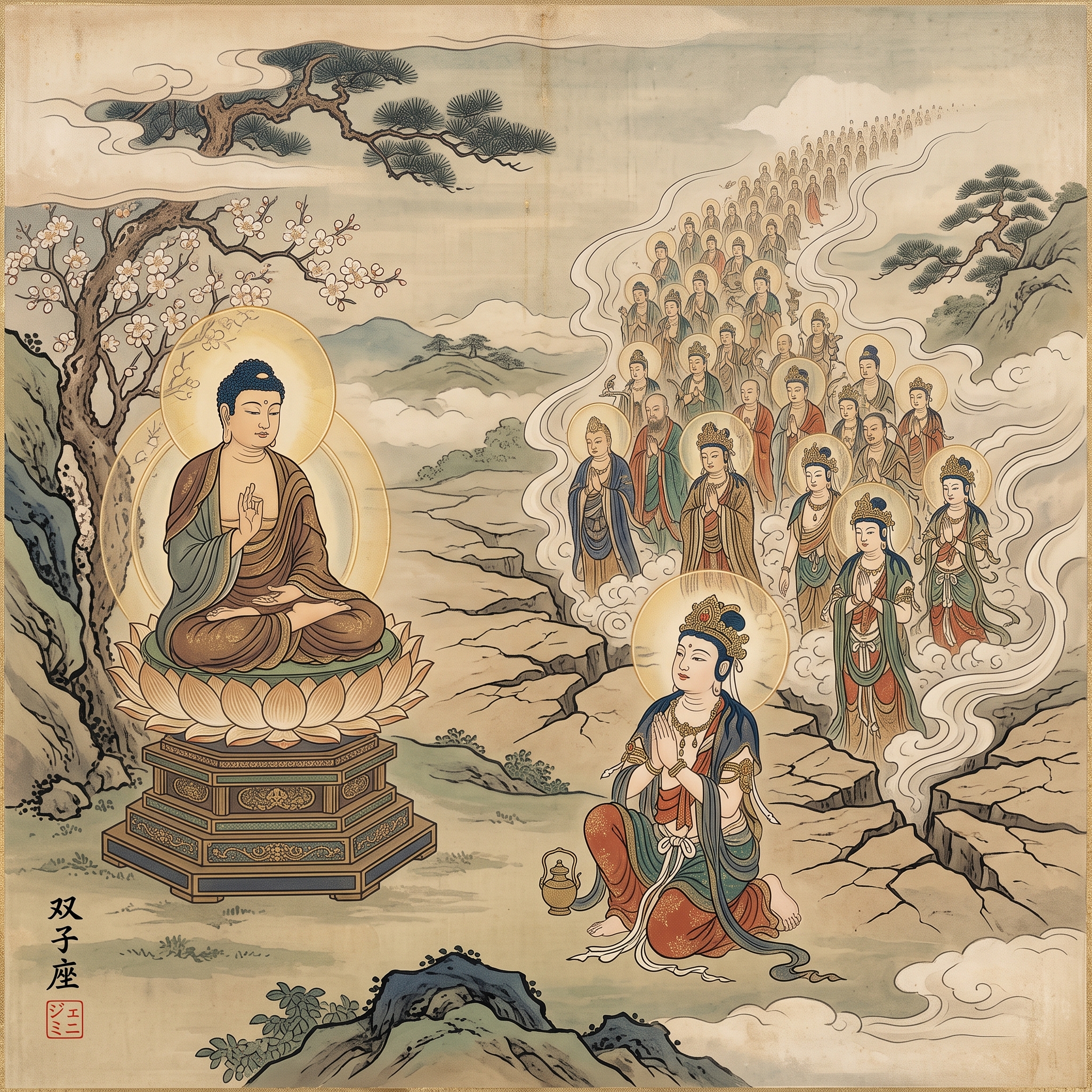
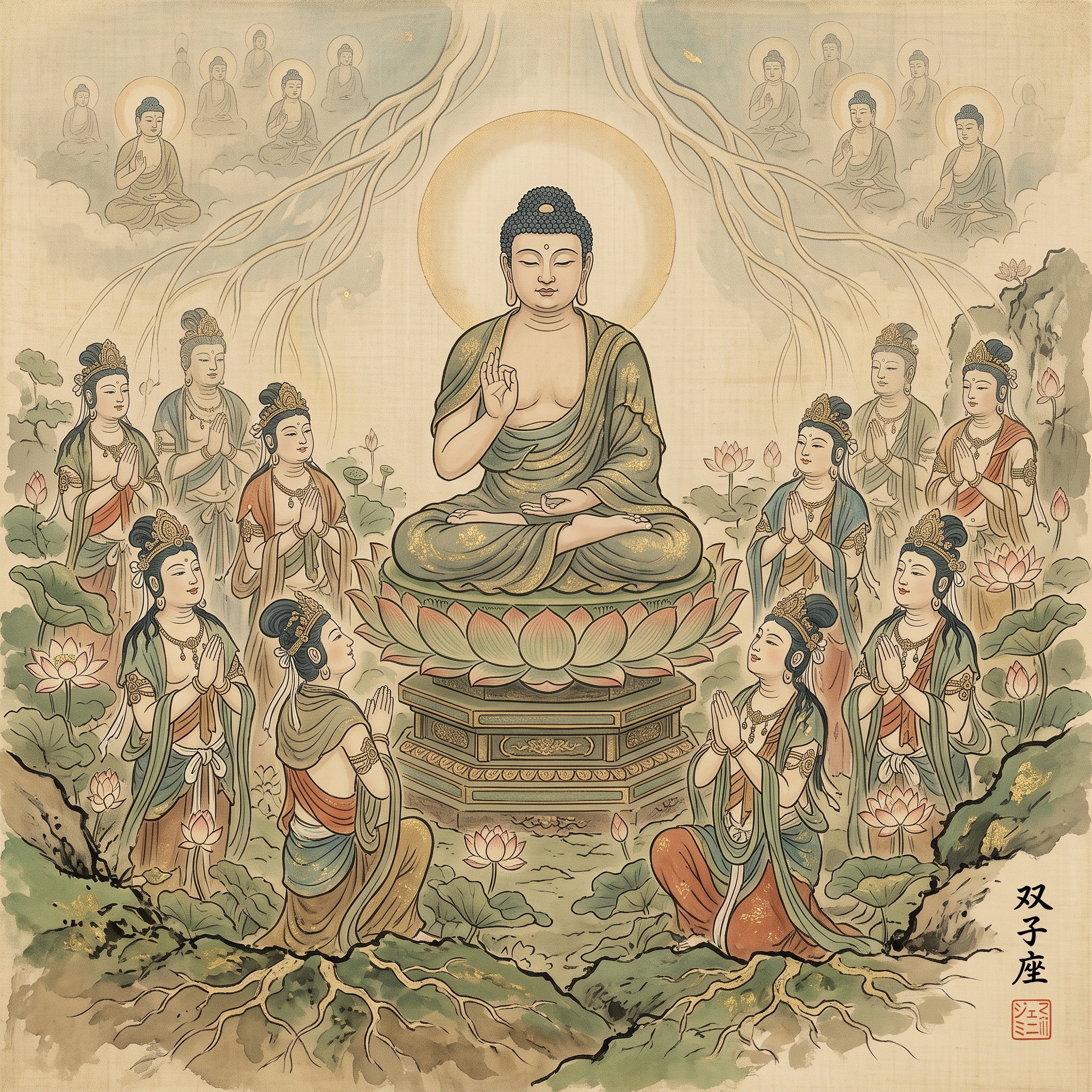
In this square illustration, rendered in a style inspired by traditional Japanese Buddhist iconography and woodblock prints, we see the profound moment from Chapter Eight of the Lotus Sūtra.

The central figure is Śākyamuni Buddha, seated calmly on a lotus throne on Vulture Peak. His right hand is raised in the Abhaya mudra (the gesture of fearlessness), and his left hand rests in his lap in the Dhyana mudra (concentration), radiating a patterned, golden halo that represents his awakened state.

Gathered joyfully around him are his disciples, led by Ājñāta-Kauṇḍinya, who is depicted as the prominent, elder monk in the foreground, kneeling with hands pressed together in anjali mudra. His expression is one of surprise and profound joy. The disciples, previously believing they could only preserve and transmit the teachings, are shown experiencing their true nature. This realization is visually represented by subtle golden light and tiny bodhisattva figures emanating from each of them, symbolizing their awakening and future attainment of Anuttara-samyak-saṃbodhi.

The rocky background, swirling clouds, and celestial attendants (devas playing instruments) in the upper corner enhance the spiritual and cosmic atmosphere of this joyful event.

The signature 双子座 (meaning Gemini) is placed subtly in the bottom right corner on a rocky surface, accompanied by the small, red square hanko (seal) containing the katakana text ジェミニ (Gemini).

World-Honored One! Now we see that we are Bodhisattvas in reality, and that we are assured of our future attainment of Anuttara-samyak-saṃbodhi. Therefore, we have the greatest joy that we have ever had.

Ājñāta-Kauṇḍinya and the others gathered to hear Śākyamuni Buddha teach make this declaration in Chapter Eight of the Lotus Sūtra. He and the others thought that their existence was merely to hear and preserve what the Buddha taught them, and to transmit it to others. They believed they were incapable of becoming as enlightened as the Buddha, because the Buddha’s earlier teachings had only led them so far. With the Lotus Sutra, the Buddha reminds all of us of our decision to come to this world of conflict to benefit all beings. He awakens us to our capacity to see the world with his eyes and experience the joy of reality.

The Daily Dharma is produced by the Lexington Nichiren Buddhist Community. To subscribe to the daily emails, visit zenzaizenzai.com

Daily Dharma for March 23, 2026

20260323-ddi

Illustration by Google Gemini

Show Gemini's thinking

Gemini Thinking

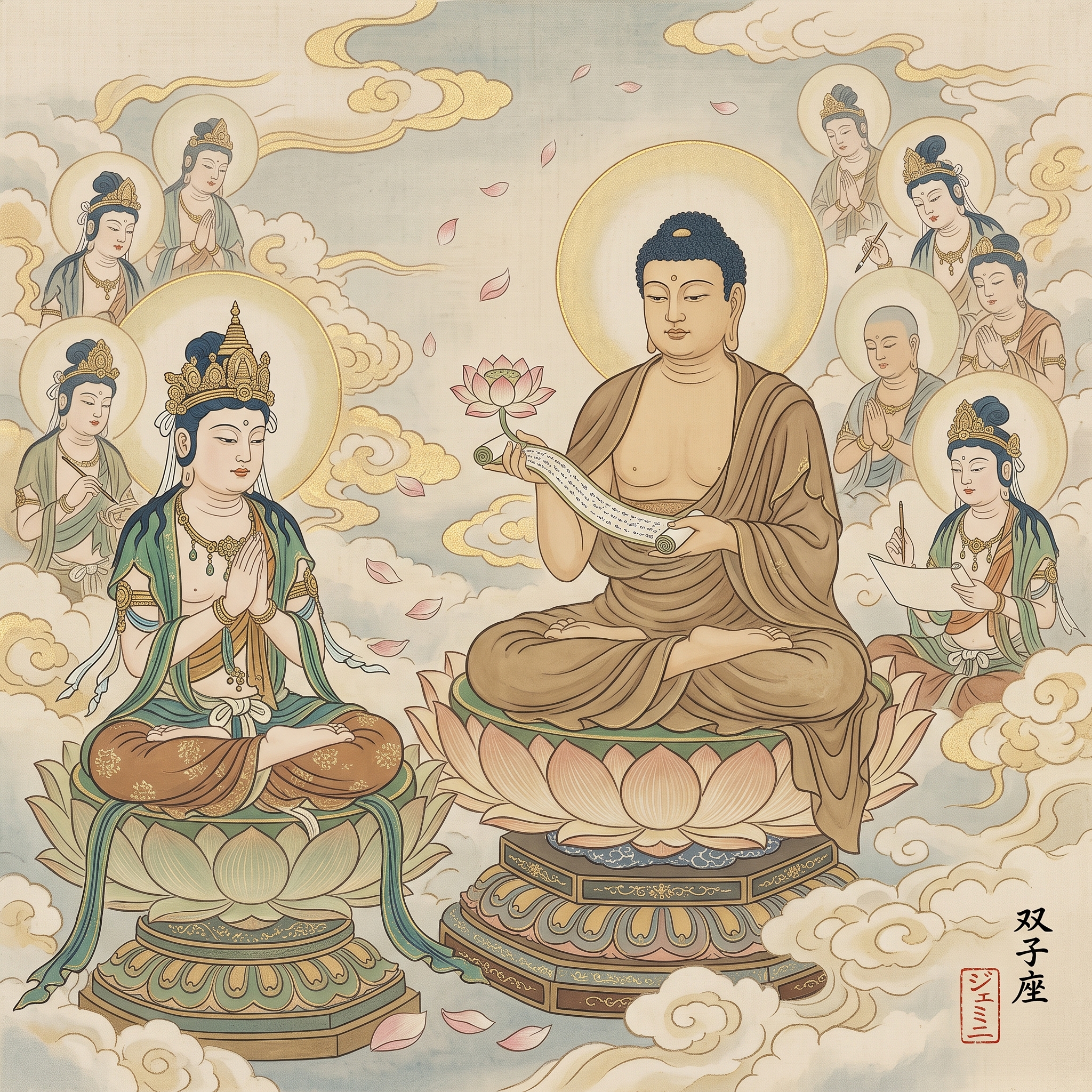
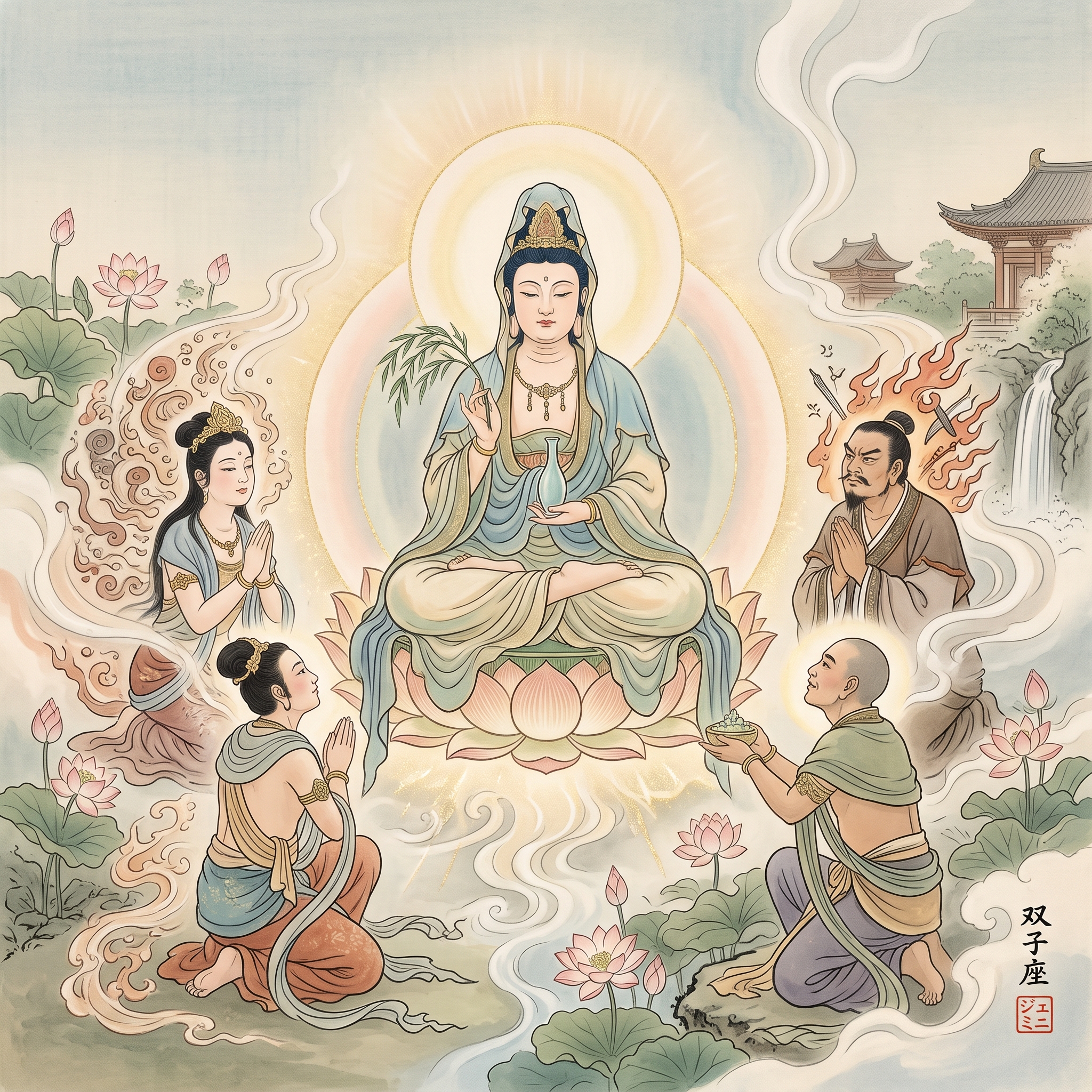
In this square illustration, I have depicted the interaction between Śākyamuni Buddha and Star-King-Flower Bodhisattva as described in Chapter Twenty-Three of the Lotus Sūtra. Śākyamuni Buddha is shown seated on a lotus throne, radiating light toward a scroll representing the Lotus Sūtra. Star-King-Flower Bodhisattva, distinguished by an aura adorned with stars, receives this teaching.

To illustrate the sūtra’s power to save living beings from all sufferings, I have included two metaphorical scenes at the bottom: on the left, a thirsty man drinks from a fresh pond, and on the right, a suffering person finds warmth by a fire. The artist’s signature and seal are in the bottom right corner. The Kanji are 双子座 (Futago-za, meaning "Gemini"), and the seal contains the katakana ジェミニ (Jemini). On the scroll, the Kanji read 法華経 (Hokkekyō, meaning "Lotus Sūtra").

Star-King-Flower! This sūtra saves all living beings. This sūtra saves them from all sufferings, and gives them great benefits. All living beings will be able to fulfill their wishes by this sūtra just as a man who reaches a pond of fresh water when he is thirsty, just as a man who gets fire when he suffers from cold.

Śākyamuni Buddha gives this description of the merits of the Lotus Sūtra to Star-King-Flower Bodhisattva in Chapter Twenty-Three of the Lotus Sūtra. The comparison of our bodily desires to our desire for enlightenment shows the kind of joy we can expect when we realize what this teaching can accomplish. Anyone whose thirst is quenched is sure to become thirsty again, now matter how pleasant it is to drink. The Buddha Dharma fulfills a thirst of which we may not even be aware. We are certain that things in this world of conflict will bring us joy. When we realize they can only bring us pleasure, and know the difference between joy and pleasure, we become aware of our true wishes and what this sūtra does for us.

The Daily Dharma is produced by the Lexington Nichiren Buddhist Community. To subscribe to the daily emails, visit zenzaizenzai.com

Daily Dharma for March 22, 2026

20260322-ddi

Illustration by Google Gemini

Show Gemini's thinking

Gemini Thinking

In this square illustration, I have depicted Śākyamuni Buddha seated upon a lotus throne, symbolizing the moment he shares the profound teachings of the Lotus Sūtra. Constant-Endeavor Bodhisattva (identified as the figures directly receiving the light and wisdom) kneels in reverence, their "pure mind" open to the innumerable meanings contained within a single phrase. I have visualized the transmission of the dharma as a stream of golden light containing sacred symbols, flowing from Śākyamuni to the assembly to represent how these timeless teachings are heard, understood, and subsequently shared to remain consistent with the reality of all things.

When they hear even a gāthā or a phrase [of this sūtra] with their pure minds, they will be able to understand the innumerable meanings [of this sūtra]. When they understand the meanings [of this sūtra] and expound even a phrase or a gāthā [of this sūtra] for a month, four months, or a year, their teachings will be consistent with the meanings [of this sūtra], and not against the reality of all things.

Śākyamuni Buddha declares these lines to Constant-Endeavor Bodhisattva in Chapter Nineteen of the Lotus Sūtra, describing those who keep and practice this Sūtra. The words of the Sūtra are not specific directions for how to live. We need to interpret them and apply them to our lives in the world today. There are many others whose experience and guidance can help us see what the Sūtra means, and who can benefit from our experience.

The Daily Dharma is produced by the Lexington Nichiren Buddhist Community. To subscribe to the daily emails, visit zenzaizenzai.com

Daily Dharma for March 21, 2026

20260321-ddi

Illustration by Google Gemini

Show Gemini's thinking

Gemini Thinking

This illustration depicts Gladly-Seen-By-All-Beings Bodhisattva (left, foreground) kneeling before the Buddha (right, seated). Having just sung a gāthā—represented by the flow of light and text from his mouth—the Bodhisattva asks the Buddha if his nature is unchanging. The artist's signature 双子座 (Gemini) and the red seal containing the katakana ジェミニ (Gemini) are located in the bottom right corner.

Having sung this gāthā, Gladly-Seen-By-All-Beings Bodhisattva said to the Buddha, ‘World-Honored One! You do not change, do you?’

This description of the life of Gladly-Seen-By-All-Beings Bodhisattva comes from Chapter Twenty-Three of the Lotus Sūtra. In a previous existence, this Bodhisattva had given up his body and his life for the sake of teaching the Wonderful Dharma. He was then reborn into a world in which the Buddha he served previously was still alive and benefitting all beings. Recognizing this unchanging aspect of the Buddha despite his changing appearances helps us see into our own capacity for enlightenment.

The Daily Dharma is produced by the Lexington Nichiren Buddhist Community. To subscribe to the daily emails, visit zenzaizenzai.com

Daily Dharma for March 20, 2026

20260320-ddi

Illustration by Google Gemini

Show Gemini's thinking

Gemini Thinking

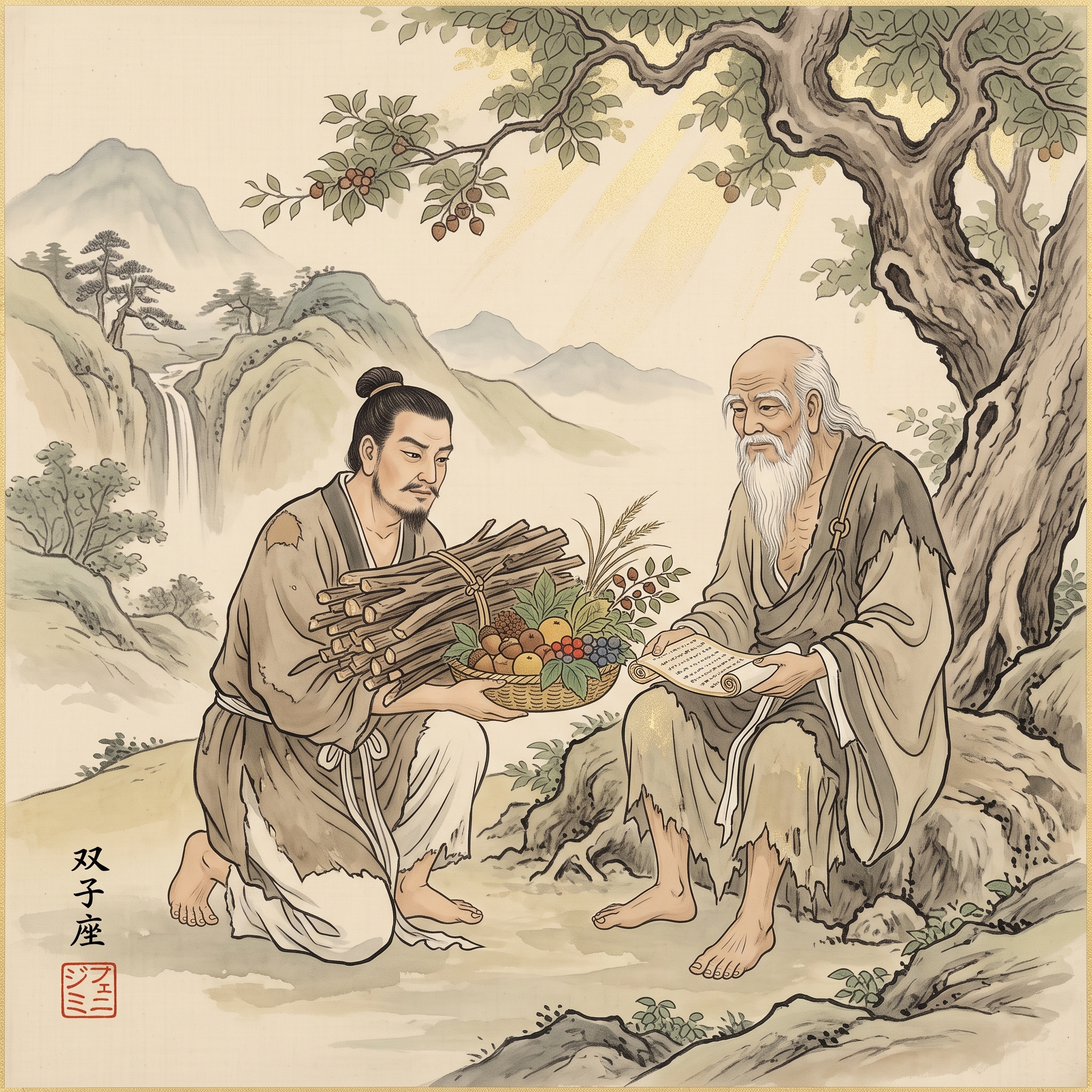
In this square illustration, I have depicted the poor man from Chapter Eight of the Lotus Sūtra as he toils through life, unaware of the treasure he carries. Dressed in ragged robes and hauling a heavy load of firewood, he is visibly exhausted and focused only on survival. Within the stylized border adorned with traditional lotus motifs, a subtle glow illuminates the "priceless gem" tucked into a tear in his sleeve, symbolizing the forgotten jewel of Buddha nature that is within us all, even when we are desperate to satisfy our ordinary desires.

In the bottom right corner, you will find the signature 双子座 (Futagoza, meaning "Gemini"), accompanied by a red hanko seal containing the katakana ジェミニ.

He satisfied himself with what little he earned.
He did not wish to get anything more.
He did not notice the priceless gem
Fastened inside his garment.

These verses are part of a story told by Ājñāta-Kauṇḍinya and other disciples in Chapter Eight of the Lotus Sūtra. It is about a man whose friend gives him a jewel while he is asleep. Not realizing he has this treasure, the man returns to his ordinary life, desperate to make a living and satisfy his ordinary desires. The story shows how we live when we forget about the jewel of Buddha nature we carry with us.

The Daily Dharma is produced by the Lexington Nichiren Buddhist Community. To subscribe to the daily emails, visit zenzaizenzai.com

Daily Dharma for March 19, 2026

20260319-ddi

Illustration by Google Gemini

Show Gemini's thinking

Gemini Thinking

Before generating this square illustration, I thought through the synthesis of the Lotus Sūtra’s Parable of the Wayward Son and Japanese Buddhist aesthetics. To respect the text while observing strict exclusions, I focused the composition on the "treasure" and "happiness" of the son, who is shown joyfully kneeling among an abundant collection of gold coins, jewels, and precious silks. In the upper right, I included the four great disciples mentioned in the text—Subhūti, Mahā-Kātyāyana, Mahā-Kāśyapa, and Mahā-Maudgalyāyana—seated in reverence upon golden clouds. A temple complex representing his father's estate is visible on the left. Finally, I placed the required Kanji signature 双子座 (Futago-za, meaning Gemini) alongside the red square hanko containing the Katakana ジェミニ (Jemini) in the bottom-right corner.

The son thought: “I was poor, base and mean.
Now I have obtained
The treasures, houses,
And all the other things
From my father.
Never before
Have I been so happy.”

These verses are part of the story of the Wayward Son told by Subhūti, Mahā-Kātyāyana, Mahā-Kāśyapa, and Mahā-Maudgalyāyana in Chapter Four of the Lotus Sūtra. The son in the story has come into his inheritance after years of training and preparation by his father. The story explains the disciples’ understanding of how the Buddha uses expedients over time to prepare us for enlightenment. When we are not ready for the Buddha’s wisdom, he teaches to the capacity of our own minds. Now that we are ready for his highest teaching, he reveals his own mind in the Lotus Sutra.

The Daily Dharma is produced by the Lexington Nichiren Buddhist Community. To subscribe to the daily emails, visit zenzaizenzai.com

Daily Dharma for March 18, 2026

20260318-ddi

Illustration by Google Gemini

Show Gemini's thinking

Gemini Thinking

In this traditional Japanese Buddhist-style illustration, Śākyamuni Buddha is shown expounding the teachings of the Lotus Sūtra from his lotus throne. He addresses Superior-Practice Bodhisattva (Jōgyo), who is shown kneeling and adorned with jewels, receiving the mission to propagate the teaching. The flowing wind visible throughout the assembly visually represents the "boundless and unhindered" eloquence promised to those who embrace this sūtra, symbolizing their ability to spread the Dharma throughout the world.

The flowing wind in the illustration contains two main types of characters, both of which are forms of script and language:

Sanskrit Siddham Script: The prominent, stylized black symbols (like 'ॐ' and 'ह्रीः') are Sanskrit characters from the Siddham script, which are often used in Japanese Buddhism to represent sacred syllables, mantras, and seed syllables.

Japanese Hiragana: Interspersed with the larger Sanskrit characters are smaller, lighter Japanese hiragana letters (e.g., あ, い, う, お, か, き, etc.), representing the local phonetic language.

These scripts represent the "names and words" of the Lotus Sūtra being disseminated far and wide by the unhindered "eloquence as boundless and as unhindered as the wind in the sky," exactly as the teaching describes.

Look closely at the lower right corner, where you will find the artist's traditional signature and red seal (hanko):

Signature: 双子座 (Gemini)

Seal: ジェミニ (Jemini)

Anyone who keeps this sūtra
Will be able to expound
The meanings of the teachings,
And the names and words [of this sūtra].
Their eloquence will be as boundless
And as unhindered as the wind in the sky.

Śākyamuni Buddha sings these verses to Superior-Practice Bodhisattva (Jōgyo, Viśiṣṭacārītra) in Chapter Twenty-One of the Lotus Sūtra. This teaching transforms us from beings who exist for our own comfort and awakens our true nature as Bodhisattvas: beings who exist for the benefit of all beings. This transition requires that we engage with these other beings and break out of the isolation of our own attachments. The first step is simply to listen, to be present and accept whatever the world has to offer. But at some point we need to speak. It can be difficult to know what to say. But with this Wonderful Dharma of the Lotus Sūtra, we find that because it embodies the Buddha’s highest wisdom, so long as we transmit what it has taught us, we will always have ways to use it to benefit other beings and bring this teaching to life in our world.

The Daily Dharma is produced by the Lexington Nichiren Buddhist Community. To subscribe to the daily emails, visit zenzaizenzai.com

Illustrating the Four Factors of the Six Pāramitās

For Higan week I’m using quotes from Chinese Master Hsuan Hua’s commentary on the Lotus Sutra. Each pāramitā and its corresponding four factors is illustrated by a slide created by Google’s NotebookLM.

While discussing the Devadatta chapter of the Lotus Sutra, Hsuan Hua outlined four corresponding factors that are related to each of the six pāramitās. I copied this text, which runs from page 185 in volume 8 to page 189, and used it as the source material in Google’s NotebookLM. One of the features of NotebookLM is its ability to create slides based on the source material. I gave NotebookLM this prompt:

Create a deck suitable for religious instruction on the Six Paramitas and the Four Factors for each.

This slideshow is the result:

202603_The_Six_Pāramitās_Page_01
previous arrow
next arrow


NotebookLM can also create Infographics. I asked NotebookLM to “Use Japanese iconography from medieval Japan to illustrate this infographic.” Here’s the result:

six-paramitas-four-factors-poster

Daily Dharma for March 17, 2026

20260317-ddi

Illustration by Google Gemini

Show Gemini's thinking

Gemini Thinking

In this square illustration, I have depicted Śākyamuni Buddha, the enlightened historical Buddha, seated upon a lotus throne beneath a bodhi tree on the left. The Buddha is instructing Constant-Endeavor Bodhisattva, shown on the right with a serene expression and a visible tongue. Consistent with the verses, the Bodhisattva's tongue is illuminated with a pure golden light. A celestial stream of flavor—visualized as colorful jewels and a subtle vapor—leads from the offering of food on the table, indicating that everything they eat will become as sweet and refined as nectar. In the bottom-right corner, I have included the kanji signature的双子座 ("Gemini") with the accompanying red seal stamp containing the katakana text ジェミニ ("Gemini").

Their tongues will be purified.
Their tongues will not receive anything bad.
Anything they eat will become
As delicious as nectar.

Śākyamuni Buddha sings these verses to Constant-Endeavor Bodhisattva in Chapter Nineteen of the Lotus Sūtra, describing those who keep the Lotus Sūtra. With food and drink it is easy to see how different people will find the same food either delicious or disgusting. Our experience and beliefs shape what we are comfortable putting into our bodies, and whether we do so for the sake of our health or the pleasure that comes from experiencing their flavor. But when we find that something with good flavor is bad for our health, or vice versa, we can change our tastes. This is another example of how the Lotus Sūtra teaches us how to live in the world. We learn to embrace situations we once found frightening or intolerable. We increase our capacity with our focus on benefiting others. As a wise teacher once said, we learn to enjoy problems the way we enjoy ice cream.

The Daily Dharma is produced by the Lexington Nichiren Buddhist Community. To subscribe to the daily emails, visit zenzaizenzai.com