All posts by John Hughes

Day 13

Day 13 covers all of Chapter 8, The Assurance of Future Buddhahood of the Five Hundred Disciples.

Pūrṇa, the son of Maitrāyaṇī, is the subject of the opening. Of note: He praises the Buddha without asking anything in return.

‘The World-Honored One is extraordinary. What he does is exceptional. He expounds the Dharma with expedients by his insight according to the various natures of all living beings of the world, and saves them from various attachments. The merits of the Buddha are beyond the expression of our words. Only the Buddha, only the World-Honored One, knows the wishes we have deep in our minds.’

Pūrṇa, explains the Buddha, is the most excellent expounder of the Dharma: “No one except the Tathāgata excels him in eloquence.”

He did the work of the Buddha, that is, taught all living beings so that the world of the Buddha might be purified.

And in gāthās:

He obtained great supernatural powers
And the four kinds of unhindered eloquence.
Seeing who was clever, and who was dull,
He always expounded the Pure Dharma.

He expounded the Dharma of the Great Vehicle
To hundreds of thousands of millions of living beings,
And caused them to dwell in the Dharma
So that the worlds of those Buddhas might be purified.

Eventually, after protecting and expounding the Dharma of innumerable Buddhas, “He will perform the Way of Bodhisattvas step by step for innumerable, asaṃkhya kalpas, and then attain Anuttara-samyak-saṃbodhi in this world.”

In contrast to Pūrṇa’s joy, the twelve hundred Arhats thought: “How glad we shall be if we are assured of our future Buddhahood by the World-Honored One just as the other great disciples were!”

They understand that the teaching wasn’t withheld; they just did not remember that they carried that lesson. They offer The Parable of the Pricess Gem.

You, the World-Honored One, saw that the aspiration for the knowledge of all things was still latent in our minds; therefore, you awakened us, saying, ‘Bhikṣus! What you had attained was not perfect extinction. I caused you to plant the good root of Buddhahood a long time ago. [You have forgotten this; therefore,] I expounded the teaching of Nirvāṇa as an expedient. You thought that you had attained true extinction when you attained the Nirvāṇa [which I taught you as an expedient].’

“World-Honored One! Now we see that we are Bodhisattvas in reality, and that we are assured of our future attainment of Anuttara-samyak-saṃbodhi. Therefore, we have the greatest joy that we have ever had.”

(2013-02-01). The Lotus Sutra: The Sutra of the Lotus Flower of the Wonderful Dharma (Kindle Locations 4277-4282). Nichiren Buddhist International Center. Kindle Edition.

The Job of a Priest

Sacramento Nichiren Buddhist Church service
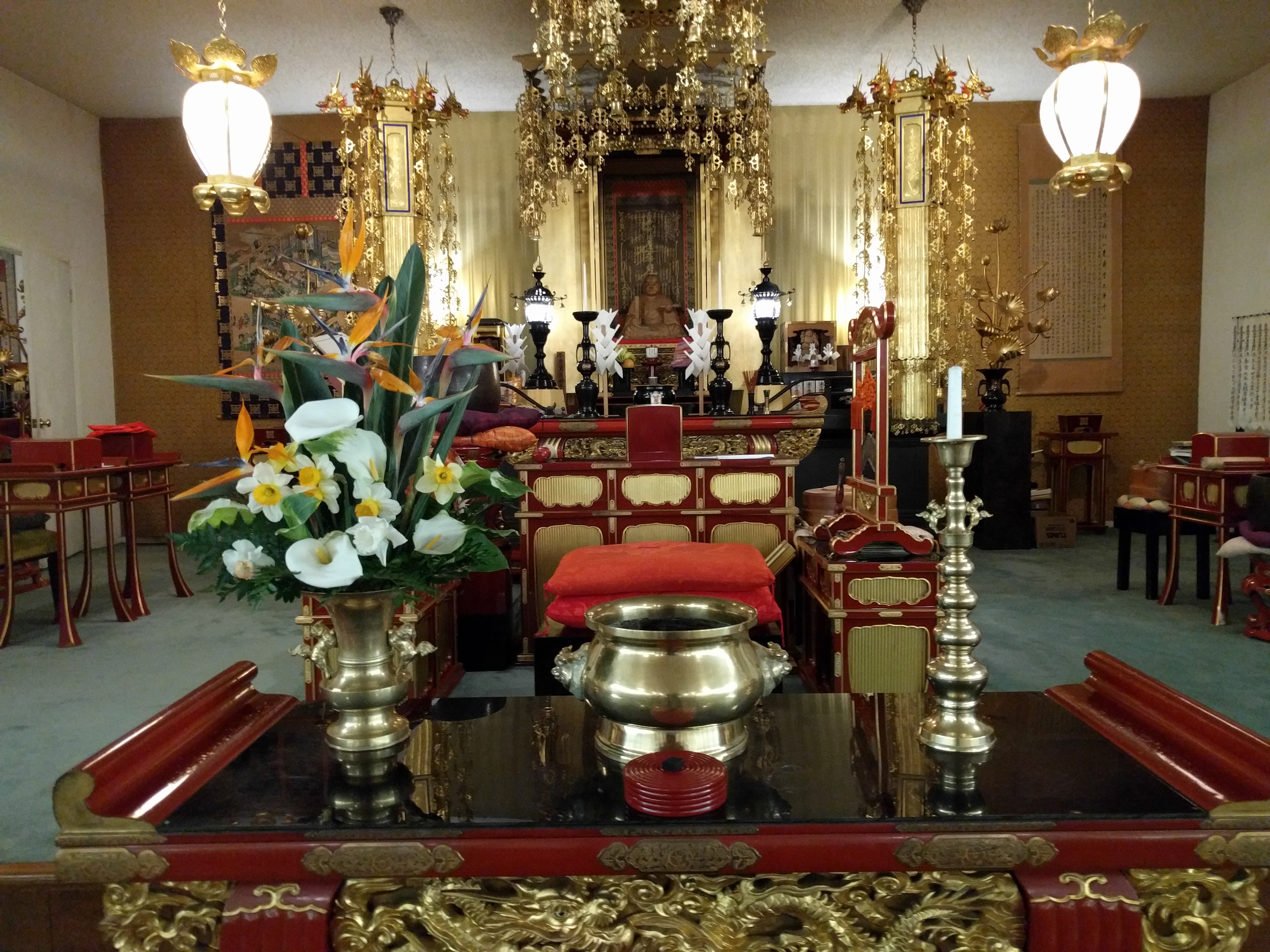
Ven. Kenjo Igarashi prepares altar prior to Kaji Kito service Nov. 29, 2015

The Sacramento Nichiren Buddhist Church was founded more than 75 years ago. The church members are honored to have had Ven. Kenjo Igarashi attending to their spiritual needs for 26 years and hope to have him continue to do so for years to come. So you can imagine the reaction when Ven. Kenjo Igarashi told a meeting of church members that new requirements promulgated by the Head Office of Nichiren Shu may force him to resign his position.

On Nov. 4, 2015, the Head Office of Nichiren Shu announced:

As previously announced, according to the Nichiren Shu Bylaw revisions implemented on April 1, 2015, all previous overseas missionary points administered under the district head system are now administered directly by the Head Office of Nichiren Shu and will be known as an “International Propagation Point”. In order to prevent discord between Nichiren Shu policies and international propagation point propagation, the International Section of the Nichiren Shu Head Office has set management regulations for international propagation.

The requirements for incorporation articles and directory of the board of trustees is noncontroversial. What’s troubling Ven. Kenjo Igarashi is the requirement that he, as the Kokusai Fukyoshi of the Sacramento Church, have a contract with the church’s trustees:

Exchange of a written agreement between board of trustees of the international propagation point and the appointed Kokusai Fukyoshi. When a Kokusai Fukyoshi is assigned to more than one international propagation point, agreements must be signed and exchanged by each assigned point.

Complicating this is the fact that Ven. Kenjo Igarashi travels routinely to Chicago and Los Angeles to hold scheduled services for Nichiren Shu followers.

The problem is not so much the idea of a contract but the specific nature of the document requested:

Agreement Conditions
1) Duration
2) Place of Work
3) Duties of Kokusai Fukyoshi
The phrase “An appointed head, assistant or associate Kokusai Fukyoshi must be the religious
leader” must be included in the agreement.
4) Work Hours
5) Work Breaks?
6) Holidays
7) Vacation
8) Salary
9) Salary Payment
10) Leaves of Absence?
11) Termination
12) Confidential Information
13) Agreement Renewal
14) Jurisdiction
15) Consultation

Work hours? Work Breaks? Holidays? Vacation? Ven. Kenjo Igarashi wants nothing to do with this. He became a priest to serve Nichiren Shu followers. He didn’t volunteer to participate in aragyo, a 100-day ascetic practice, five separate times in order to qualify for additional vacation time.

A footnote in the Head Office memorandum suggests the requirements for existing Kokusai Fukyoshi may be less strict:

Regarding the written agreement between the board of trustees and the appointed Kokusai Fukyoshi, please follow the recommended format of this documentation as much as possible. The Head Office understands that there are many cases in an agreement between a temple and Kokusai Fukyoushi. We think the important thing is to exchange a written agreement between the two.

The unanimous consensus of those church members in attendance Sunday was that a way should be found to allow Ven. Kenjo Igarashi to continue to serve the Sacramento Nichiren Buddhist Church. The deadline for submitting the required documents is Jan. 30, 2016.

International Propagation Point memo and contract outline

Daily Dharma – Nov. 29, 2015

Thereupon Medicine-King Bodhisattva said to the Buddha, “World-Honored One! Now I will give dhāraṇī-spells to the expounder of the Dharma in order to protect him.”

This promise to the Buddha from Medicine-King Bodhisattva comes in Chapter Twenty-Six of the Lotus Sutra. The dhāraṇīs are given in a language that nobody understands any more. But this does not reduce their effectiveness. In the second chapter of the Lotus Sutra, the Buddha declared that his wisdom cannot be reached by understanding alone. There is another, nonverbal aspect of his teaching that we must comprehend. The dhāraṇīs not only give us reassurance that beings we cannot comprehend are helping us to become enlightened, they also remind us to look for the unspoken teachings that are part of the Buddha Dharma.

The Daily Dharma is produced by the Lexington Nichiren Buddhist Community. To subscribe to the daily emails, visit zenzaizenzai.com

Day 12

Day 12 concludes Chapter 7, The Parable of the Magic City, and completes the third volume of the Lotus Sutra.

Having heard appeals from the Brahman-heavenly-kings of the 10 quarters and the sixteen princes, Great-Universal-Wisdom-Excellence Tathāgata turned the wheel of the Dharma:

The wheel of this teaching could not be turned by any other one in the world, be he a śramaṇa, a brāhmaṇa, a god, Māra or Brahman. The Buddha said, ‘This is suffering. This is the cause of suffering. This is extinction of suffering. This is the Way to extinction of suffering.’

Then he expounded the teaching of the twelve causes, saying, ‘Ignorance causes predisposition. Predisposition causes consciousness. Consciousness causes name-and-form. Name-and-form causes the six sense organs. The six sense organs cause impression. Impression causes feeling. Feeling causes craving. Craving causes grasping. Grasping causes existence. Existence causes birth. Birth causes aging-and-death, grief, sorrow, suffering and lamentation. When ignorance is eliminated, predisposition is eliminated. When predisposition is eliminated, consciousness is eliminated. When consciousness is eliminated, name-and-form is eliminated. When name-and-form is eliminated, the six sense organs are eliminated. When the six sense organs are eliminated, impression is eliminated. When impression is eliminated, feeling is eliminated. When feeling is eliminated, craving is eliminated. When craving is eliminated, grasping is eliminated. When grasping is eliminated, existence is eliminated. When existence is eliminated, birth is eliminated. When birth is eliminated, aging-and-death, grief, sorrow, suffering and lamentation are eliminated.’

But the 16 princes wanted more:

They said to the Buddha simultaneously, ‘World-Honored One! All these Śrāvakas of great virtue, many thousands of billions in number, have already done [what they should do]. World-Honored One! Expound to us the teaching of Anuttara-samyak-saṃbodhi! If we hear that teaching, we will study and practice it. World-Honored One! We wish to have the insight of the Tathāgata. You know what we have deep in our minds.’

Twenty thousand kalpas later, the Buddha “expounded to the four kinds of devotees the sūtra of the Great Vehicle called the ‘Lotus Flower of the Wonderful Dharma, the Dharma for Bodhisattvas, the Dharma Upheld by the Buddhas.’” The Buddha then retired to a quiet place for

When the Buddha completed the expounding of this sūtra, the sixteen śrāmaṇeras kept, recited and understood this sūtra in order to attain Anuttara-samyak-saṃbodhi. The sixteen śrāmaṇeras, [who were] Bodhisattvas, received this sūtra by faith. Some Śrāvakas understood it by faith, but the other Śrāvakas and other living beings, thousands of billions in number, doubted it.

The Buddha then practised dhyāna-concentration for eighty-four thousand kalpas, while the 16 princes expounded the Lotus Sutra to the four kinds of devotees.

At this point, it might be helpful to recall what Śākyamuni said at the end of the previous chapter:

Now I will tell you
About my previous existence
And also about yours.
All of you, listen attentively!

Each of the śrāmaṇera princes eventually became Buddhas. “[T]he sixteenth śrāmaṇera is I, Sakyamuni Buddha. I attained Anuttara-samyak-saṃbodhi in this Sahā-World.”

Those living beings as many as there are sands in the River Ganges, whom I taught [when I was a śrāmaṇera], included you bhikṣus and those who will be reborn as my disciples in Śrāvakahood after my extinction.

And in gāthās:

I was one of the sixteen śrāmaṇeras.
You were among those to whom I expounded the Dharma.
Therefore, I now lead you with expedients
To the wisdom of the Buddha.

Because I taught you in my previous existence,
I expound the Sūtra of the Lotus Flower of the Wonderful Dharma
In order to lead you into the Way to Buddhahood.
Think it over! Do not be surprised! Do not be afraid!

The Parable of the Magic City

The Buddhas expound the teaching of the Three Vehicles
Only as an expedient.
There is only the One Buddha-Vehicle.
The two [vehicles] were taught only as resting places.

Daily Dharma – Nov. 28, 2015

Many priests in the Latter Age of Degeneration do not discern the capacity of people. When it is impossible to discern the capacity of people, the true teaching should be preached vigorously.

Nichiren wrote this passage in his Treatise on Chanting the Great Title of the Lotus Sūtra (Shō Hokke Daimoku-shō). When the Buddha taught using expedient means, he could see the delusions and attachments of those whom he taught, and adjust his teachings to them for their benefit. For us who live in this time where most people are not aware of the ever-present Buddha Śākyamuni, all we need to know about those whom we wish to benefit is that they are convinced that this age is headed towards ruin. We cannot know who is ready to receive the Buddha’s highest teaching. Therefore our generosity compels us to provide the teaching that leads towards enlightenment, not merely the teaching that leads away from suffering.

The Daily Dharma is produced by the Lexington Nichiren Buddhist Community. To subscribe to the daily emails, visit zenzaizenzai.com

Day 11

Day 11 continues Chapter 7, The Parable of the Magic City

When Great-Universal-Wisdom-Excellence Buddha attained Anuttara-samyak-saṃbodhi, five hundred billion Buddha-worlds in each of the ten quarters quaked in the six ways, and all those worlds, including those intercepted from the brilliant rays of light of the sun and the moon by the neighboring worlds, were illumined [by great rays of light], and the living beings of those worlds were able to see each other for the first time. They said to each other, ‘How did you appear so suddenly?’ The palaces of the gods of those worlds, including the palace of Brahmans, also quaked in the six ways. The great rays of light which illumined all those worlds were brighter than the rays of light emitted by those gods.

And with that we watch as first the Brahman-heavenly-kings of the five hundred billion worlds in the east puzzle over what has happened:

Did a god of great virtue or a Buddha
Appear somewhere in the universe?

Each of the 10 directions – east, southeast, south, southwest, west, northwest, north, northeast, nadir and zenith – travel to the land of Great-Universal-Wisdom-Excellence Buddha, finding him and his 16 sons. Each makes offerings to the Buddha and ask that he turn the wheel of the Dharma.

Brahman-heavenly-kings each in his own way welcome the arrival of the Buddha. The Brahman-heavenly-kings of the Zenith led by Great Brahman-heavenly-king Śikhin, for example, say:

How good it is to see a Buddha,
To see the Honorable Saint who saves the world!
He saves all living beings
From the prison of the triple world.

The All-Knower, the Most Honorable One of Gods and Men,
Opens the gate of the teachings as sweet as nectar,
And saves all living beings
Out of his compassion towards them.

There has been no Buddha
For the past innumerable kalpas.
Before you appeared,
The worlds of the ten quarters were dark.

The living beings in the three evil regions
And asuras are increasing.
The living beings in heaven are decreasing.
Many fall into the evil regions after their death.

They do not hear the Dharma from a Buddha.
Because they did evils,
Their appearances are getting worse;
And their power and wisdom, decreasing.
Because they did sinful karmas,
They lose pleasures and the memory of pleasures.
They are attached to wrong views.
They do not know how to do good.
They are not taught by a Buddha;
Therefore, they fall into the evil regions.

Daily Dharma – Nov. 27, 2015

The Buddhas joyfully display
Their immeasurable, supernatural powers
Because [the Bodhisattvas from underground]
[Vow to] keep this sūtra after my extinction.

The Buddha sings these verses to Superior-Practice Bodhisattva (Jōgyo, Viśiṣṭacārītra) in Chapter Twenty-One of the Lotus Sūtra. Superior-Practice is the leader of the Bodhisattvas who came up from underground in Chapter Fifteen when the Buddha asked who would continue to keep and practice this sūtra after his physical extinction in this world. Nichiren saw himself as the embodiment of Superior-Practice, and all of us who are determined to lead all beings to enlightenment through this Wonderful Dharma as embodiments of the Bodhisattvas who came up from underground. The powers of the Buddhas only seem supernatural to those who are mired in delusion and ignorance. They are nothing more than turning the poison of anger into the medicine of energy; the poison of isolation into the medicine of compassion; the poison of attachment into the medicine of wisdom.

The Daily Dharma is produced by the Lexington Nichiren Buddhist Community. To subscribe to the daily emails, visit zenzaizenzai.com

Day 10

Day 10 concludes Chapter 6, Assurance of Future Buddhahood, and opens Chapter 7, The Parable of a Magic City.

Since today is Thanksgiving, I held over from yesterday the “meal of a great king” simile:

Great Hero, World-Honored One!
King of the Dharma of the Śākyas!
Give us your voice
Out of your compassion towards us!

If you see what we have deep in our minds,
And assure us of our future Buddhahood,
We shall feel as cool and as refreshed
As if we were sprinkled with nectar.

Suppose a man came
From a country suffering from famine.
Now he saw the meal of a great king.
He did not partake of it in doubts and fears.
After he was told to take it by the king,
He took it at once.
We are like that man.
We know the defects of the Lesser Vehicle.
But we do not know how to obtain
The unsurpassed wisdom of the Buddha.

Although we hear you say [to us],
“You will become Buddhas,”
We are still in doubts and fears about it,
Just as that man was about the meal.
If you assure us of our future Buddhahood,
We shall be happy and peaceful.

In turn, the Buddha tells Subhūti he’ll attend on three hundred billion nayutas of Buddhas, and Kātyāyana on eight hundred thousand millions of Buddhas and then two billions of Buddhas and Maudgalyāyana eight thousand Buddhas and then two hundred billions of Buddhas. In the end, each “complete the Way of Bodhisattvas” and become Buddhas.

And Next on 32 Days of the Lotus Sutra:

Now I will tell you
About my previous existence
And also about yours.
All of you, listen attentively!

Which leads us to Chapter 7, The Parable of a Magic City. The Buddha begins by telling of a Buddha called Great-Universal-Wisdom-Excellence who died at a time in past so distant that we might as well consider it infinitely long ago. Despite that distance:

Yet I remember [the extinction of] that Buddha by my power of insight as vividly as if he had passed away today.”

And in gāthās:

I remember the extinction of that Buddha
As vividly as if he had passed away just now,
By my unhindered wisdom; I also remember
The Śrāvakas and Bodhisattvas who lived [with him].

Bhikṣus, know this!
My wisdom is pure, wonderful,
Free from āsravas and from hindrance.
I know those who lived innumerable kalpas ago.

Back to the story of Great-Universal-Wisdom-Excellence.

The duration of the life of Great-Universal-Wisdom-Excellence Buddha was five hundred and forty billion nayuta kalpas. [Before he attained Buddhahood,] he sat at the place of enlightenment and defeated the army of Māra. He wished to attain Anuttara-samyak-saṃbodhi, but could not because the Dharma of the Buddhas had not yet come into his mind. He sat cross-legged without moving his mind and body for one to ten small kalpas. During all that time the Dharma of the Buddhas did not come into his mind.

Gods and heavenly kings offered help and “At the end of the period of ten small kalpas, the Dharma of the Buddhas came into the mind of Great-Universal-Wisdom-Excellence Buddha.” The Buddha had 16 sons who upon hearing of their father’s transformation “gave up the playthings, left home, and came to that Buddha.” The sons offer praise of their father the Buddha:

All living beings are suffering.
Being blind, they have no leader.
They do not know how to stop suffering,
Or that they should seek emancipation.
In the long night fewer people go to heaven,
And more people go to the evil regions.
They go from darkness to darkness, and do not hear
Of the names of the Buddhas.

You are the Most Honorable One.
You have obtained the peaceful Dharma-without-āsravas.
Not only we but also all gods and men
Will be able to obtain the greatest benefit.
Therefore, we bow and devote ourselves to you,
The Most Honorable One.

Daily Dharma – Nov. 26, 2015

He should respect the Buddhas, the World-Honored Ones,
As his unsurpassed fathers.
He should give up arrogance
So that he may expound the Dharma without hindrance.

The Buddha sings these verses in Chapter Fourteen of the Lotus Sūtra in which he describes the peaceful practices of a Bodhisattva. By arrogance, the Buddha means not only acting as if we know what we do not, but any fixed understanding of the world and the beings in it. This opening of our minds allows us to be receptive to the innumerable ways the Buddhas are teaching us, and to learn to see the world for what it is. This receptivity also allows us to see the Buddha nature in all beings, no matter how deluded they are and how much harm they create. Respect is what allows us to fully hear and be present for what the world has to offer us.

The Daily Dharma is produced by the Lexington Nichiren Buddhist Community. To subscribe to the daily emails, visit zenzaizenzai.com

Day 9

Day 9 covers Chapter 5, The Simile of Herbs, and introduces Chapter 6, Assurance of Future Buddhahood.

All the discussion of expedients in the two previous chapters suggests the Dharma taught as an expedient is somehow different from the true Dharma. Not so, explains the Buddha.

Kāśyapa, know this! I, the Tathāgata, am the King of the Dharma. Nothing I say is false. I expound all teachings with expedients by my wisdom in order to lead all living beings to the stage of knowing all things. I know what region a living being will be taken to by what teaching, and what a living being has deep in his mind. I am not hindered by anything in knowing all this. I know all things clearly, and show my knowledge of all things to all living beings.

The Dharma is like a rain that falls on all plants, nourishing each according to the nature of the species.

Kāśyapa! Suppose the various trees and grasses of the one thousand million Sumeru-worlds including herbs growing in the thickets, forests, mountains, ravines and valleys, on the ground, and by the rivers, all these plants being different in names and forms, were covered with a dark cloud, and then watered by a rainfall at the same time. The small, middle and large roots, stems, branches and leaves of the trees and grasses including herbs growing in the thickets and forests were watered. So were the tall and short trees, whether they were superior or middle or inferior. Those plants were given more or less water by the same rain from the same cloud, and grew differently according to their species. They obtained different flowers and fruits although they grew on the same ground and received water from the same rain.

Kāśyapa, know this! I, the Tathāgata, am like the cloud. I appeared in this world just as the large cloud rose. I expounded the Dharma to gods, men and asuras of the world with a loud voice just as the large cloud covered all the one thousand million Sumeru-worlds.

Equality and differences:

I see all living beings equally.
I have no partiality for them.
There is not ‘this one’ or ‘that one’ to me.
I transcend love and hatred.

I am attached to nothing.
I am hindered by nothing.
I always expound the Dharma
To all living beings equally.
I expound the Dharma to many
In the same way as to one.

I always expound the Dharma.
I do nothing else. I am not tired of expounding the Dharma
While I go or come or sit or stand.
I expound the Dharma to all living beings
Just as the rain waters all the earth.

I am not tired of giving
The rain of the Dharma to all living beings.
I have no partiality for them,
Whether they are noble or mean,
Whether they observe or violate the precepts,
Whether they live a monastic life or not,
Whether they have right or wrong views,
Whether they are clever or dull.

Those who hear the Dharma from me
Will reach various stages
[Of enlightenment]
According to their capacities.

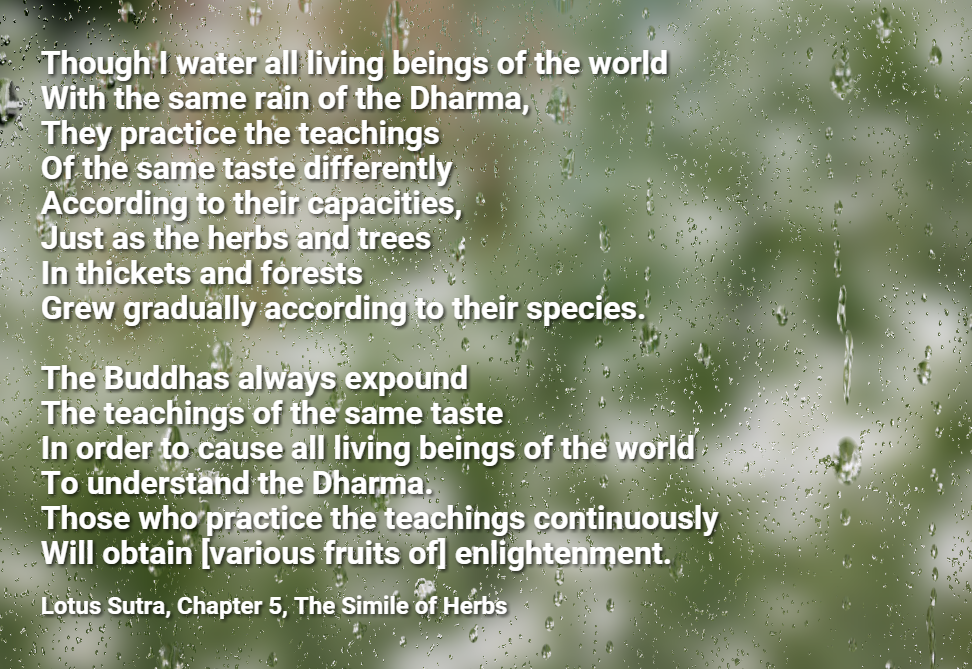
It is not the rain that is different; it is the plants:

Though I water all living beings of the world
With the same rain of the Dharma,
They practice the teachings
Of the same taste differently
According to their capacities,
Just as the herbs and trees
In thickets and forests
Grew gradually according to their species.