
Conceptual Summary
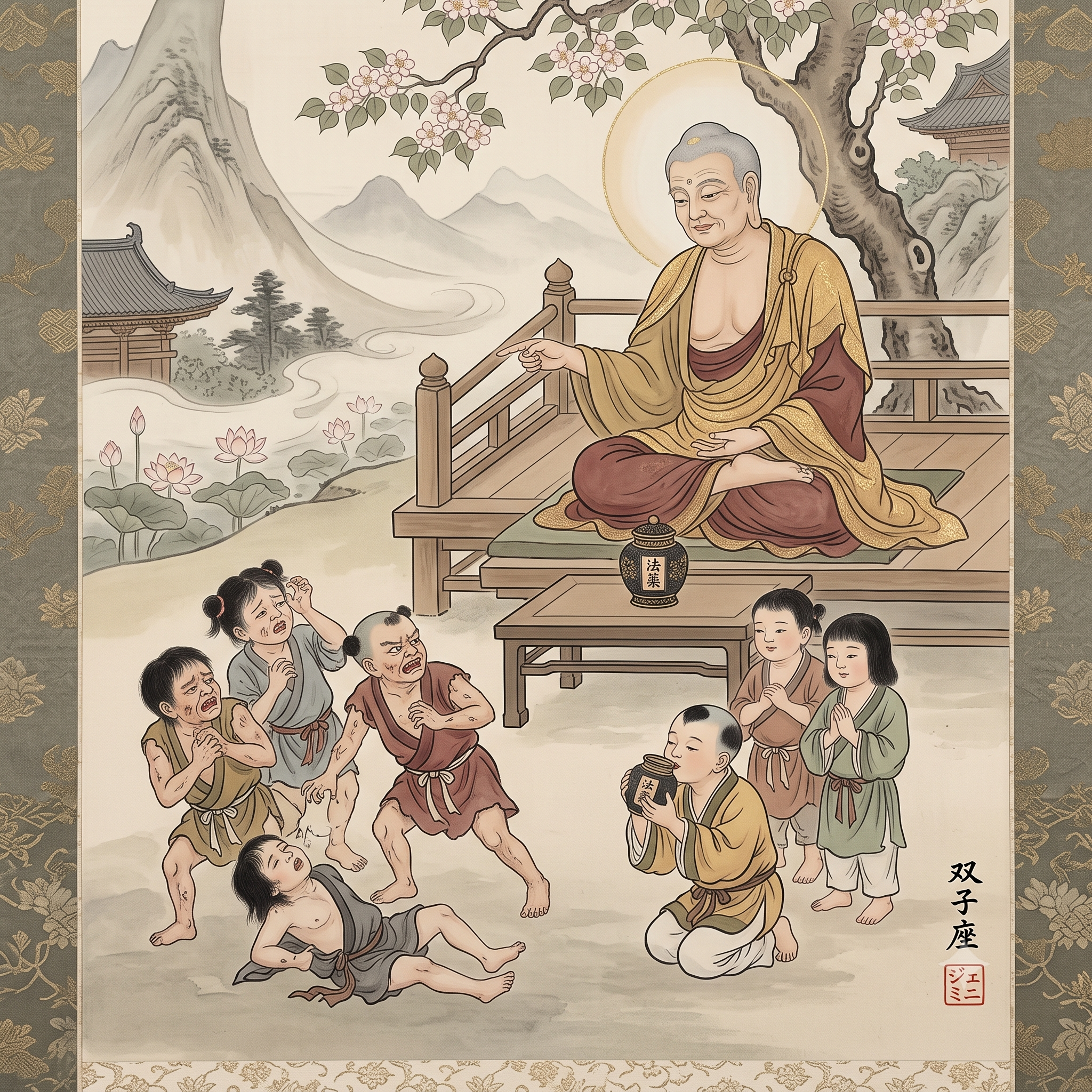
The illustration is a visual translation of the Parable of the Wise Physician from the Lotus Sūtra, utilizing a traditional Japanese Buddhist painting style with mineral pigments and gold leaf on silk. The composition centers on Śākyamuni Buddha, who is identified as the wise father in the narrative. In a direct interpretation of the source text, he is depicted as elderly, his form softened to imply the "decrepit" state he uses as an expedient mean (hōben). Rather than a physical departure, his symbolic departure—the faking of his death—is visually encoded by showing his form radiating light and gold, positioned above a table holding the potent "good medicine" (the Wonderful Dharma). The narrative unfolds below: on the left, children in distress, their postures exhibiting physical or mental anguish, represent those who have taken poison and lost their right minds, unable to trust the medicine. On the right, other children are seen accepting the cure; one kneels respectfully, reverently partaking of the Dharma, representing the successful transmission of the wisdom that cures delusion, as described in the text.
Iconography & Character Identification
Item 1: Deities/Figures Featured:
Śākyamuni Buddha (The Wise Physician/Father)
A group of suffering children (The Poisoned Sons)
A group of recovering or reverent children (The Sons Taking the Antidote)
Item 2: Text Translations:
The black Kanji signature in the corner is 双子座 (Futagoza), which translates to Gemini.
The text inside the red square seal (hanko) is the Katakana ジェミニ, which also transliterates to Gemini.
He said to them, ‘Know this! Now I am old and decrepit. I shall die soon. I am leaving this good medicine here. Take it! Do not be afraid that you will not be cured!’
The Buddha gives this explanation in Chapter Sixteen of the Lotus Sūtra. It is part of the Parable of the Wise Physician in which a father finds his children have taken poison and gives them an antidote. The poison has caused some of the children to lose their right minds and not trust that the medicine will cure them. By faking his death, the father used an expedient to get the children to realize that there was no other medicine that would cure them, and summon the courage to take it. When we accept the Wonderful Dharma and put it into our lives, we are cured of our delusions and find the Buddha’s wisdom.
The Daily Dharma is produced by the Lexington Nichiren Buddhist Community. To subscribe to the daily emails, visit zenzaizenzai.com