
The Sutra of Queen Śrimālā of the Lion’s Roar, p21At that time Queen Śrimālā said to the Buddha, “Having received the Buddha’s power, I will now explain the great vow which is controlled [by the principle of the True Dharma], being the truth without error.”
The Buddha said to Śrimālā, “I permit you to explain as you wish.”
Śrimālā said to the Buddha, “The bodhisattva vows, which are as numerous as the sands of the Ganges River, are all contained in the one great vow that is called ‘acceptance of the True Dharma.’ Acceptance of the True Dharma truly is the great vow.”
The Buddha praised Śrimālā: “Excellent! Excellent! Your wisdom (prajña) and skillful means (upāya) are most profound and subtle! You have already, for a long time, increased in virtue. In the future, living beings who develop such virtue will be able to understand you. Your explanation of the acceptance of the True Dharma is that which the Buddhas of the past, present, and future have explained, now explain, and will explain. Having realized supreme, complete enlightenment (anuttarā samyaksaṃbodhi), I also speak of this acceptance of the True Dharma. I explain that acceptance of the True Dharma has merits that cannot be limited. The Tathāgata’s wisdom and eloquence also are without limits. Why? Because in this acceptance of the True Dharma there are great merits and great benefits.”
All posts by John Hughes
Daily Dharma – Sept. 4, 2024
The Buddha possesses 32 marks of physical excellence, all of which belong to the category of matter. The Brahma’s voice, pure and immaculate voice of the Buddha, however is invisible. Therefore it is impossible for us to depict it in pictures or statues.
Nichiren wrote this passage in his Treatise on Opening the Eyes of Buddhist Images, Wooden Statues or Portraits (Mokue Nizō Kaigen no Koto). The statues, portraits and other images of the Buddha and other protective deities which we use in our practice are not meant to be idols. They are living examples of the perfections to which we aspire and from which we draw strength. The ceremony in which we “Open the Eyes” of an Omandala or anything else we use in our practice reminds us that everything around us has life. When we hear the Buddha’s voice from them, leading us to enlightenment, then we learn how to improve the world for ourselves and all beings.
The Daily Dharma is produced by the Lexington Nichiren Buddhist Community. To subscribe to the daily emails, visit zenzaizenzai.com
Day 32
Day 32 covers Chapter 28, The Encouragement of Universal-Sage Bodhisattva, closing the Eighth Volume of the Sutra of the Lotus Flower of the Wonderful Dharma.

Having last month considered the Buddha’s reply to Universal-Sage Bodhisattva, we consider Universal-Sage Bodhisattva’s vow.
Thereupon Universal-Sage Bodhisattva said to the Buddha:
“World-Honored One! If anyone keeps this sūtra in the defiled world in the later five hundred years after [your extinction], I will protect him so that he may be free from any trouble, that he may be peaceful, and that no one may take advantage [of his weak points]. Mara, his sons, his daughters, his subjects, his attendants, yakṣas, rākṣasas, kumbhāṇḍas, piśācakas, kṛtyas, pūtanas, vetādas or other living beings who trouble men shall not take advantage [of his weak points]. If anyone keeps, reads and recites this sūtra while he walks or stands, I will mount a kingly white elephant with six tusks, go to him together with great Bodhisattvas, show myself to him, make offerings to him, protect him, and comfort him, because I wish to make offerings to the Sūtra of the Lotus Flower of the Wonderful Dharma. If he sits and thinks over this sūtra, I also will mount a kingly white elephant and appear before him. If he forgets a phrase or a gāthā of the Sūtra of the Lotus Flower of the Wonderful Dharma, I will remind him of it, and read and recite it with him so that he may be able to understand it. Anyone who keeps, reads and recites the Sūtra of the Lotus Flower of the Wonderful Dharma [after your extinction], will be able to see me with such joy that he will make more efforts. Because he sees me, he will be able to obtain samadhis and a set of dhārāṇis. The set of dhārāṇis will be the dhārāṇis by which he can memorize repetitions of teachings, the dhārāṇis by which he can memorize hundreds of thousands of billions of repetitions of teachings, and the dhārāṇis by which he can understand the expediency of the voice of the Dharma.
The Daily Dharma offers this:
Thereupon Universal-Sage Bodhisattva said to the Buddha:
“World-Honored One! If anyone keeps this sūtra in the defiled world in the later five hundred years after [your extinction], I will protect him so that he may be free from any trouble, that he may be peaceful, and that no one may take advantage [of his weak points].”
Universal-Sage Bodhisattva (Fugen, Samantabhadra) makes this vow to the Buddha in Chapter Twenty-Eight of the Lotus Sutra. In this world of conflict, it can seem like very few people are practicing the Buddha Dharma with us. Nichiren compared those beings alive in this world of conflict to the amount of soil in the whole earth, while those who keep and practice the Lotus Sūtra are like the dirt under a fingernail. The vow of Universal-Sage reminds us that innumerable beings support our practice and that in turn, we support them with our practice.
The Daily Dharma is produced by the Lexington Nichiren Buddhist Community. To subscribe to the daily emails, visit zenzaizenzai.com
Śrimālā: The Ten Ordination Vows and Three Great Vows
The Sutra of Queen Śrimālā of the Lion’s Roar, p15-19At that time Śrimālā, having received the [Buddha’s] prediction, respectfully arose to take the ten major ordination vows.
“O Lord, from now until I am enlightened:
1) “I will not transgress the discipline that I have received.
2) “I will have no disrespect toward the venerable elders.
3) “I will not hate living beings.
4) “I will not be jealous of others with regard to either their physical appearance or their possessions.
5) “I will not be stingy although I have little sustenance. “O Lord, from now until I am enlightened:
6) “I will not accumulate property for my own benefit. Whatever I receive will be used to assist living beings who are poor and suffering.
7) “I will practice the four all-embracing acts (giving, kind speech, benefiting others, and cooperation toward leading all beings to virtuous deeds) for all living beings, and not for myself. I accept all living beings without lust, without satiation, and without prejudice.
8) “When I see living beings who are lonely, imprisoned, ill, and afflicted by various misfortunes and hardships, I will never forsake them, even for a moment, for I must bring them peace. Through my good deeds I will bring them benefits and liberate them from their pain. Only then will I leave them.
9) “When I see those who hunt or domesticate animals, slaughter, or commit other such offenses against the precepts, I will never forsake them. When I obtain this power [to teach all beings], I will restrain those who should be restrained and assist those who should be assisted wherever I see such living beings. Why? Because by restraining and assisting them, one causes the eternal continuation of the Dharma. If the Dharma continues eternally, gods and humans shall flourish, and the evil destinies shall diminish in number. Then the wheel of the Dharma that is turned by the Tathāgata will again be turned. Because I see these benefits I will save, and never quit [teaching living beings].
“O Lord, from now until I am enlightened:
10) “I accept the True Dharma, never forgetting it. Why? Because those who forget the Dharma forget the Mahayana. Those who forget the Mahayana forget the perfections (pāramitās). Those who forget the perfections do not aspire toward the Mahayana. If the bodhisattvas are not committed to the Mahayana, they cannot have the aspiration to accept the True Dharma. Acting according to their pleasure, they will not be able to transcend the level of common people.
“Because I have seen, in this way, the immeasurably great errors [of humans] and have seen the immeasurable merits of the bodhisattvas, those great beings (mahāsattvas) who will accept the True Dharma, I will accept these great ordination vows.
“O Lord of the Dharma manifested before me, you are my witness. Even though the Lord Buddha presently witnessed [my testimony], living beings’ virtuous deeds are superficial. Some of them are skeptical and extremely difficult to save through these ten ordination vows. They engage in immoral activities for long periods of time and are unhappy. In order to bring peace to them, I now declare, in your presence, that my vows are sincere.
“If I receive these ten major ordination vows and practice them as I have stated them, by [the power of] these true words, heavenly flowers will rain down and divine music will ring out upon this assembly. ”
Just as Śrimālā said these words, a shower of heavenly flowers poured from the sky and divine music rang out: “It is so! It is so! What you have said is true, not false.” Having seen these wondrous flowers and having heard this music, the entire assembly no longer was skeptical, rejoicing immeasurably and exclaiming, “We wish to stay with Queen Śrimālā and together we would like to join in practice with her. ”
The Buddha predicted to all that their wish [to stay with Queen Śrimālā] would be fulfilled.
At that time Śrimālā again, in the presence of the Buddha, professed the three great vows:
“By the power of my earnest aspiration, may I bring peace to innumerable and unlimited living beings. By my virtuous deeds, throughout all rebirths may I attain the wisdom of the True Dharma.” This is called the first great vow.
“Having attained the wisdom of the True Dharma, for the sake of all living beings, may I explain [the Dharma] without wearying.” This is called the second great vow.
“In accepting the True Dharma, may I abandon body, life, and wealth and uphold the True Dharma.” This is called the third great vow.
At that time the Lord prophesied to Śrimālā, “With reference to the three great vows, just as all forms are contained in space, so likewise the bodhisattva vows, which are as numerous as the sands of the Ganges River, are all contained in these three great vows. These three vows are the truth and are extensive.”
Daily Dharma – Sept. 3, 2024
Good men! I think that the Buddha, the World-Honored One, wishes to expound a great teaching, to send the rain of a great teaching, to blow the conch-shell horn of a great teaching, to beat the drum of a great teaching, and to explain the meaning of a great teaching.
Mañjuśrī declares this to Maitreya and all others gathered to hear the Buddha teach in Chapter One of the Lotus Sūtra. The Buddha had just produced the light from between his eyebrows illuminating the worlds of the ten directions, a sight none but Mañjuśrī had experienced. The great teaching the Buddha was about to expound is the Lotus Sutra. This statement awakens our interest and shows us how to listen to this teaching, as if it were a great cooling rain or the loud call of a conch-shell or drum.
The Daily Dharma is produced by the Lexington Nichiren Buddhist Community. To subscribe to the daily emails, visit zenzaizenzai.com
Day 31
Day 31 covers Chapter 27, King Wonderful-Adornment as the Previous Life of a Bodhisattva.
Having last month considered King Wonderful-Adornment; his wife, Pure-Virtue; and their two sons, we consider the sons’ request and their mother’s reply.
“Thereupon that Buddha expounded the Sūtra of the Lotus Flower of the Wonderful Dharma, wishing to lead King Wonderful-Adornment also out of his compassion towards all living beings. The two sons, Pure-Store and Pure-Eyes, came to their mother, joined their ten fingers and palms together, and said, ‘Mother! Go to Cloud-Thunderpeal-Star-King-Flower-Wisdom Buddha! We also will go to attend on him, approach him, make offerings to him, and bow to him because he is expounding the Sūtra of the Lotus Flower of the Wonderful Dharma to all gods and men. Hear and receive [the sūtra]!’
“The mother said to them, ‘[Yes, I will. But] your father believes in heresy. He is deeply attached to the teachings of brahmanas. Go and tell him to allow us to go [to that Buddha]!’
The Daily Dharma offers this:
The two sons, Pure-Store and Pure-Eyes, came to their mother, joined their ten fingers and palms together, and said, ‘Mother! Go to Cloud Thunderpeal-Star-King-Flower-Wisdom Buddha! We also will go to attend on him, approach him, make offerings to him, and bow to him because he is expounding the Sūtra of the Lotus Flower of the Wonderful Dharma to all gods and men.
The Buddha tells the story of King Wonderful-Adornment in Chapter Twenty-Seven of the Lotus Sūtra. The two sons chose to be born at a time when Cloud-Thunderpeal-Star-King-Flower-Wisdom Buddha was alive and led their parents to follow that Buddha and learn the Wonderful Dharma from him. They overcame their father’s attachment to wrong views, not by arguing against those views, but by demonstrating the wonders that come from the Buddha’s great teaching. This shows how when we as Bodhisattvas live this difficult teaching we lead others to it.
The Daily Dharma is produced by the Lexington Nichiren Buddhist Community. To subscribe to the daily emails, visit zenzaizenzai.com
An Outline of Śrimālādevi Sūtra
The Buddhist Feminine Ideal, p105-106Four factors were developed in the Tathāgatagarbha Sūtra and the Pu tseng pu chien ching related to living beings and the Tathāgatagarbha:
- The ignorance of living beings obfuscates the knowledge of Tathāgatagarbha.
- The nature of living beings is identical to that of the Buddha.
- The ordinary monk also cannot understand the Tathāgatagarbha because he misinterprets both the nature of Emptiness and of Nirvāṇa.
- The Bodhisattva is the essential means by which living beings are instructed in the profound teaching of the Tathāgatagarbha.
These four factors approximate the first half of the text of the Śrimālādevi Sūtra in which the Bodhisattva, in his relationship with the true Dharma, is able to assist and convert all suffering and ignorant beings. …
The five factors which are an analysis of the Tathāgatagarbha per se, developed in the Tathāgatagarbha Sūtra and Pu tseng pu chien ching and expanded in the Śrimālādevi Sūtra are the following:
- The nature and wisdom of the Tathāgata are the Tathāgatagarbha.
- The Dharma Body extrinsically covered by defilement is the Tathāgatagarbha.
- The merits and qualities of the Buddha which are complete in the Tathāgatagarbha are not different from, severed from, nor separate from the nature of the Dharma.
- The Tathāgatagarbha is neither produced nor destroyed.
- The Tathāgatagarbha is permanent, eternal, pure, and immutable.
These five factors approximate the last half of the text in which the Tathāgatagarbha is described both from the dimension of the supreme and absolute knowledge of the Buddha and from the phenomenal and conventional level of living beings who must be guided by the Boddhisattva.
Daily Dharma – Sept. 2, 2024
The merits of the [fiftieth] person
[Who hears this sūtra] are immeasurable.
Needless to say, so are the merits of the first person
Who rejoices at hearing it in the congregation.
The Buddha sings these verses to Maitreya Bodhisattva in Chapter Eighteen of the Lotus Sutra. This chapter includes a story of a person who hears the Wonderful Dharma, then explains it to the best of their ability to someone else. In this way there is a chain of fifty people who hear versions of this teaching modified by the capacities of those transmitting it. The effectiveness of this teaching does not depend on who delivers it. No matter what our capacity, any of us can teach the Lotus Sutra and practice it in our lives.
The Daily Dharma is produced by the Lexington Nichiren Buddhist Community. To subscribe to the daily emails, visit zenzaizenzai.com
Day 30
Day 30 covers all of Chapter 26, Dhāraṇīs
Having last month considered the Dhāraṇīs offered by Brave-In-Giving Bodhisattva, we consider the Dhāraṇīs offered by Vaiśravaṇa Heavenly-King.
Thereupon Vaiśravaṇa Heavenly-King, the Protector of the World, said to the Buddha, “World-Honored One! I also will utter dhārānis in order to protect this teacher of the Dharma out of my compassion towards all living beings.”
Then he uttered spells, “Ari (1), nari (2), tonari (3), anaro (4), nabi (5), kunabi (6).”
[He said to the Buddha:]
“World-Honored One! I will protect this teacher of the Dharma with these divine spells. I also will protect the person who keeps this sūtra so that he may have no trouble within a hundred yojanas’ distance [from here].”
The Sutra of Queen Śrimālā of the Lion’s Roar
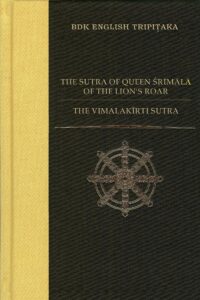
The Sutra of Queen Śrimālā of the Lion’s Roar (Śrimālādevisimhanāda-sūtra) is one of three texts brought to Japan in 552 CE from Paikche, a kingdom in Korea. As explained in The Essentials of Buddhist Philosophy:
The Essentials of Buddhist Philosophy, p17In 594 the Prince Regent, Shōtoku Taishi (574-622) declared Buddhism the state religion.
Buddhism at this time was quite devoid of the distinction of sects or schools, although the difference of Mahayana and Hinayana was clearly recognized. The Prince himself strictly adhered to Mahayana and wrote commentaries upon three Mahayana texts. The fame of these excellent annotations spread abroad, and one of them was chosen as a subject of commentaries by a Chinese savant.
The particular type of Mahayana that was adopted by the Prince may be seen from a consideration of the texts which were chosen. The first is the Lotus of the Good Law, a text devoted to the Ekayāna (One Vehicle) doctrine, indicating the idea of the good law. The second is the Discourse on the Ultimate Truth by Vimalakirti, a lay Bodhisattva of Vaisali, while the third is the Book of the Earnest Resolve by Srimala, a lady Bodhisattva, the Queen of Ayodhya. The central idea of this non-sectarian period was the doctrine of the Great Vehicle (Mahayana) as expressed in these three texts. This idea has remained the dominating feature of Buddhism throughout its history in Japan.
The Sutra of Queen Śrimālā of the Lion’s Roar was translated into English for the BDK English Tripiṭaka by Diana Mary Paul. In her Translator’s Introduction, she writes:
The Sutra of Queen Śrimālā of the Lion’s Roar, p5-7The story of Queen Śrimālā has a simple and beautiful theme, full of lush imagery and metaphors. The bodhisattva is the essential agent through whom living beings are instructed in the profound teaching of the tathāgatagarbha (“womb of the Buddha”). A future Buddha who is still embracing the teachings and instructing others, Queen Śrimālā becomes a bodhisattva who explains the doctrine of the tathāgatagarbha in the presence of the Buddha, after her parents send her a letter requesting that she study the teaching (Dharma). Awakening to the thought of enlightenment (bodhicitta), meditating upon the Buddha, she visualizes him and expresses the wish to follow the bodhisattva path. Receiving the prediction of her future Buddhahood from the Buddha, she enters the path of the True Dharma and thus begins her bodhisattva practice.
Queen Śrimālā, who had the “lion’s roar “—or eloquence—of a Buddha, first converts the women of her kingdom, then her husband, a non-Buddhist, and finally the men. Śrimālā is praised for her intelligence and compassion, not for her beauty or wealth, which are implicit. She is proficient in explaining the Dharma and is charismatic, as are all the bodhisattvas throughout Buddhist literature. Queen Śrimālā describes the True Dharma using four metaphors: 1) the great cloud, which is the source of all good merits pouring forth on living beings; 2) the great waters, which are the source for creating all good meritorious acts; 3) the great earth, which carries all things just as the True Dharma supports all living things; and 4) the four jewel storehouses, which are the four types of instructions that living beings accept and embrace.
The text raises the question of the possibility of female Buddhas. This question had continually vexed Buddhist scholars and commentators, who attempted to come to terms with the possibility of a relationship between the notion of the ultimate spiritual perfection or Buddhahood and the feminine. Such a relationship was viewed with ambivalence. This question was raised only by Mahayana Buddhists, particularly those who proclaimed the one path to universal Buddhahood. For these Buddhists, all men and women equally had the nature of the Buddha. If women were truly capable of having Buddha-nature in this lifetime without denying their female gender, this would implicitly indicate that women were not biologically determined as religiously, psychologically, and physically inferior to men.
One popular theme in Mahayana Buddhist texts had been the teaching of transformation from female to male, providing a means, both literary and spiritual, for women to become bodhisattvas and Buddhas. Other texts and commentaries suggest that there is no need to undergo a gender change through either vowing to despise the female nature or through rebirth as a male after death as a female.
The controversy that arose among scholars concerning Queen Śrimālā’s level of spiritual attainment may reflect continual controversy among Buddhists with regard to the bodhisattva ideal and the image of Buddhahood as female.
The entire tone of the text, in which the bodhisattva is the supporter, acceptor, and compassionate Dharma mother, suggests female imagery. The question of whether or not women were ever recognized as potential or imminent Buddhas remains unanswered.
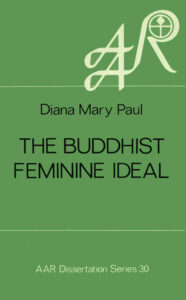 In 1974, Diana Mary Paul published her PhD dissertation at the University of Wisconsin-Madison. This in turn was reprinted as Number 30 in the American Academy of Religion Dissertation Series edited by H. Ganse Little Jr. and published in 1980 under the title, The Buddhist Feminine Ideal.
In reading this sūtra and Diana Mary Paul’s thesis, I was impressed by the sutra’s important lessons emphasizing that Bodhisattvas are Bodhisattvas not just for themselves but for everyone.
Over the next several days I will be publishing quotes from the sūtra and the thesis that illustrate this point. For Fall Higan, I will be using Queen Śrimālā to illustrate the Six Perfections.