
The Dhārāṇis chapter states that two bodhisattvas, two heavenly kings and ten female rākṣasa demons will protect the practicer of the Lotus Sūtra. The two bodhisattvas are the Bodhisattva Medicine King and the Bodhisattva Brave Donor. The two heavenly kings are Vaiśravaṇa and Dhṛtarāṣṭra. The ten female rākṣasa demons are ten great demons, mothers of all demons in the four quarters of the world. Their mother is Hāriti (Kishimojin).
They eat men after the custom of demons. A man’s body is composed of thirty-six substances such as excrement, urine, spittle, flesh, blood, skin, bone, five viscera and six entrails, hair, breath, and spirit. Inferior demons feed on excrement and the like. Mediocre demons feed on bones and the like. Superior demons feed on spiritual essence. The ten female rākṣasa demons have supreme qualities and thus feed on man’s spiritual essence. They are the great demons of epidemic.
Nichinyo Gozen Gohenji, Response to My Lady Nichinyo, Writings of Nichiren Shōnin, Faith and Practice, Volume 4, Page 140
All posts by John Hughes
Daily Dharma for May 23, 2026
Show Gemini's thinking
Gemini Thinking
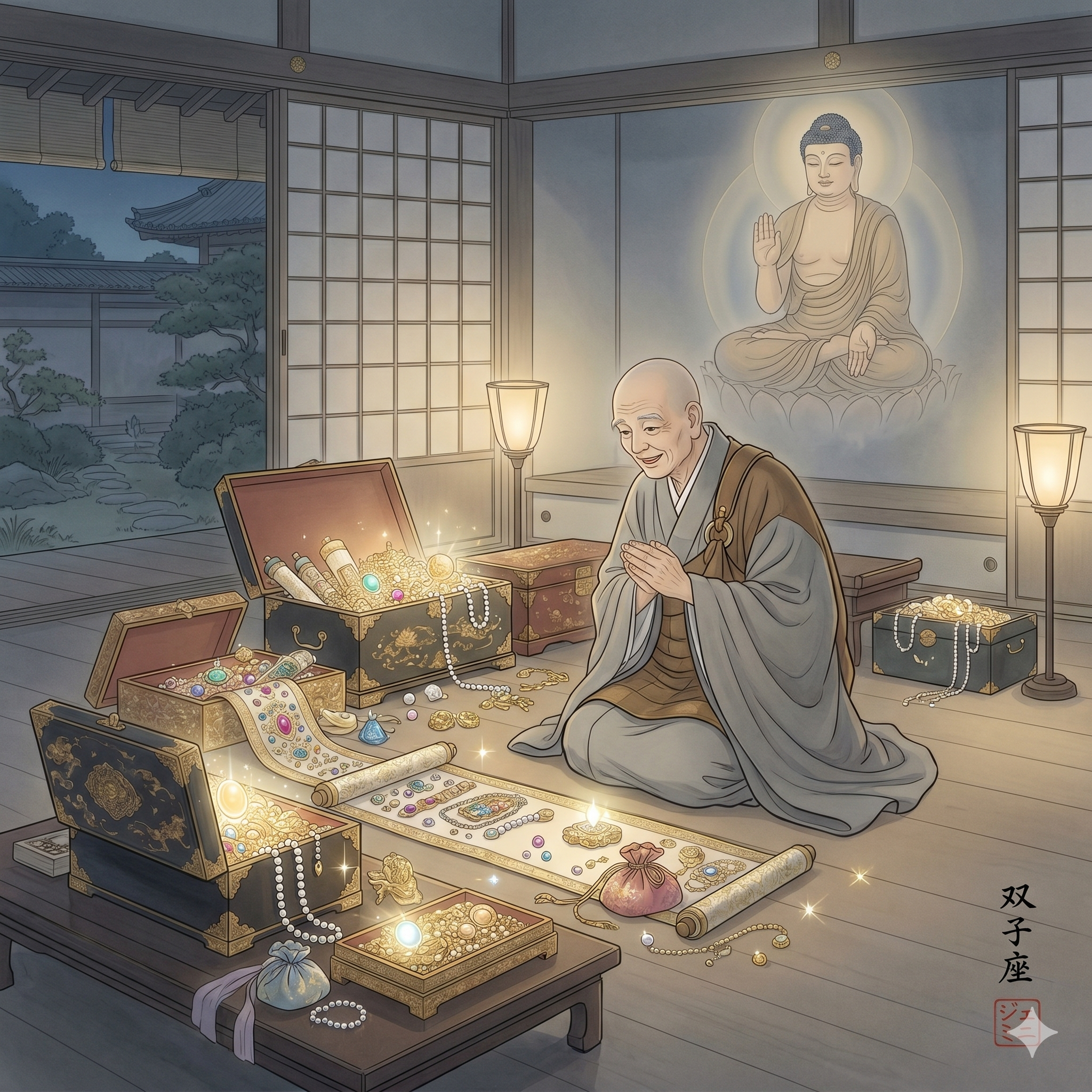
The conceptualization of this painting, rendered on silk with traditional inks and mineral pigments, visualizes the moment of realization described in the Lotus Sūtra, where the disciples compare their spiritual journey to a wayward son who, unaware of his father’s immense wealth, spends his life laboring in poverty before inheriting vast treasures. The central figure is an elderly, venerable monk—representing the collective realization of the disciples Subhūti, Mahā-Kātyāyana, Mahā-Kāśyapa, and Mahā-Maudgalyāyana—who kneels with hands joined in humble prayer before an overflowing collection of opulent jewelry and, crucially, sūtra scrolls. A radiant, golden visualization of Śākyamuni Buddha, the source of this wisdom, appears in the background on the left wall. The monk’s expression conveys the core theme: the profound surprise and deep gratitude at inheriting the Buddha's supreme teachings and enlightenment, treasures they previously felt too insignificant to possess.
The Kanji text visible on the paper screens translates as follows:
The artist’s signature on the lower right: 双子座 (Futago-za), meaning "Gemini."
Today we are not what we were then.
We have obtained
What we did not expect
To obtain
Just as the poor son obtained
The innumerable treasures.
Subhūti, Mahā-Kātyāyana, Mahā-Kāśyapa, and Mahā-Maudgalyāyana, all disciples of the Buddha, speak these lines in Chapter Four of the Lotus Sūtra as they explain their story of the wayward son. They compare the father’s treasure house in the story to the Buddha’s enlightenment. Until they had been led by the Buddha’s expedient teachings, they could not even imagine themselves as enlightened, any more than the wayward son in the story could imagine the contents of his father’s treasure house.
The Daily Dharma is produced by the Lexington Nichiren Buddhist Community. To subscribe to the daily emails, visit zenzaizenzai.com
This Sahā World Is the True Pure Land of the Tranquil Light
The Pure Lands preached in the pre-Lotus expedient sūtras are mere substitutes tentatively shown by replicas of Śākyamuni Buddha, the Eternal True Buddha. In fact, they all are lands of impurity. Therefore, when the true Pure Land was decided in “The Life Span of the Buddha” chapter of the Lotus Sūtra, the essence of which consists of chapters on the “Expedients” and “The Life Span of the Buddha,” it was declared that this Sahā World is the true Pure Land of the Tranquil Light.
As for the question why, the Lotus Sūtra also recommends the Tuṣita Heaven, the Realm of Peace and Sustenance (Pure Land of the Buddha of Infinite Life), and Pure Lands all over the universe, it is merely that designations of the Pure Lands, such as Tuṣita Heaven and Realm of Peace and Sustenance, preached in the pre-Lotus sūtras are used without modification to name the Pure Lands to be established in this world. It is like names of the three vehicles (śrāvaka, pratyekabuddha, and bodhisattva) mentioned in the Lotus Sūtra, which does not actually preach three different teachings; it preaches the sole teaching leading to Buddhahood. It is stated in the Lotus Sūtra, chapter 23, that those who practice this sūtra “will immediately be reborn in the World of Happiness.” In the Annotations on the Words and Phrases of the Lotus Sūtra, fascicle 10, Grand Master Miao-lê interprets: “This does not mean the Pure Land of the Buddha of Infinite Life preached in the Sūtra of Meditation on the Buddha of Infinite Life.” His interpretation is the same as stated above.
People today without karmic relations with the Lotus Sūtra, wishing to be reborn in the Pure Land to the west, are in fact praying for rebirth in the land of rubble, giving up the Sahā World, which is the true Pure Land. People who do not believe in the Lotus Sūtra will not be able to be reborn even in such lands as Tuṣita Heaven and Realm of Peace and Sustenance, which are in reality the Pure Lands in this Sahā World given such temporary names.
Shugo Kokka-ron, Treatise on Protecting the Nation, Writings of Nichiren Shōnin, Doctrine 1, Pages 63
Daily Dharma for May 22, 2026
Show Gemini's thinking
Gemini Thinking
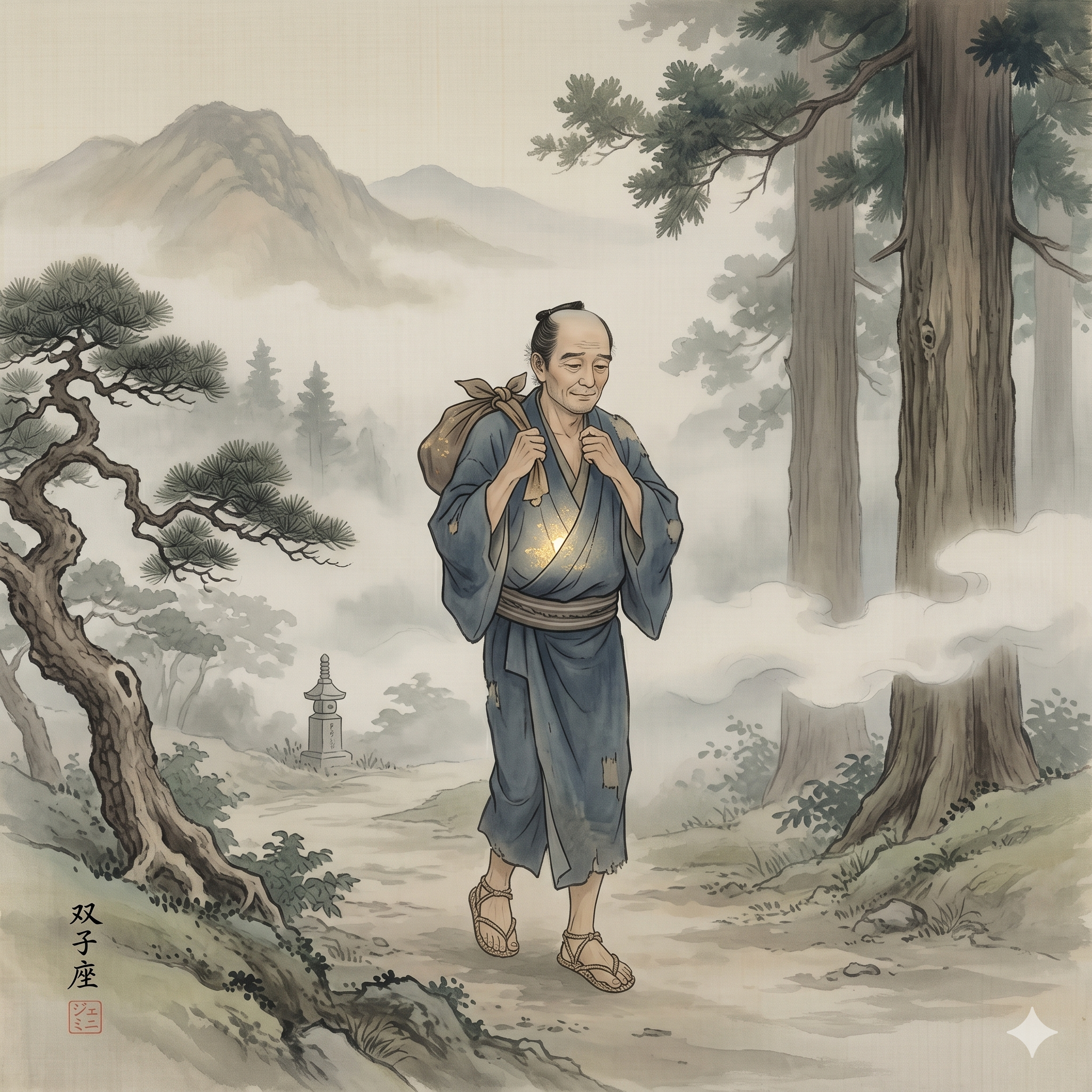
The accompanying illustration depicts the famous Parable of the Jewel in the Robe from Chapter Eight of the Lotus Sūtra.
This visualization focuses on the man after his departure, as described in your text. He travels through a traditional Japanese landscape of pines and mist, presented in a minimalist classical Buddhist painting style on a silk-like texture. He wears a tattered blue kimono and carries a simple cloth sack, symbolizing his status as an "ordinary man" unaware of his true spiritual inheritance.
Visually capturing the paradox of his poverty and hidden wealth, I have rendered a subtle, internal golden light glowing from inside his garment. This represents the priceless gem of Buddha nature, which is always with him even though he remains oblivious to it.
The signature in the lower left features the Kanji '双子座' (Gemini) above the required red square seal, which contains the Katakana 'ジェミニ' (Gemini).
He satisfied himself with what little he earned.
He did not wish to get anything more.
He did not notice the priceless gem
Fastened inside his garment.
These verses are part of a story told by Ājñāta-Kauṇḍinya and other disciples in Chapter Eight of the Lotus Sūtra. It is about a man whose friend gives him a jewel while he is asleep. Not realizing he has this treasure, the man returns to his ordinary life, desperate to make a living and satisfy his ordinary desires. The story shows how we live when we forget about the jewel of Buddha nature we carry with us.
The Daily Dharma is produced by the Lexington Nichiren Buddhist Community. To subscribe to the daily emails, visit zenzaizenzai.com
‘Divine Powers of the Buddha’ Omens
[T]he Buddha showed the 10 supernatural powers in the Supernatural Powers of the Tathāgata chapter. These divine powers were far superior to the omens displayed in the “Introductory” and “Emergence of the Bodhisattvas from the Earth” chapters. In the case of the “Introductory” chapter, the rays of light emitted from the forehead of the Buddha shone on 18,000 lands to the east. Compared to this, similar rays of light shown in the “Divine Powers of the Buddha” chapter shone on all the worlds throughout the universe. The trembling of the earth described in the “Introductory” chapter was limited to the triple thousand worlds, but the great earthquakes of the “Divine Powers of the Buddha” chapter covered all the worlds of numerous Buddhas, where the earth trembled in six different ways. Compared to the great omens described in the “Divine Powers of the Buddha” chapter, other omens were indeed inferior.
Zuisō Gosho, Writing on Omens, Writings of Nichiren Shōnin, Volume 6, Followers I, Page 125
Daily Dharma for May 21, 2026
Show Gemini's thinking
Gemini Thinking
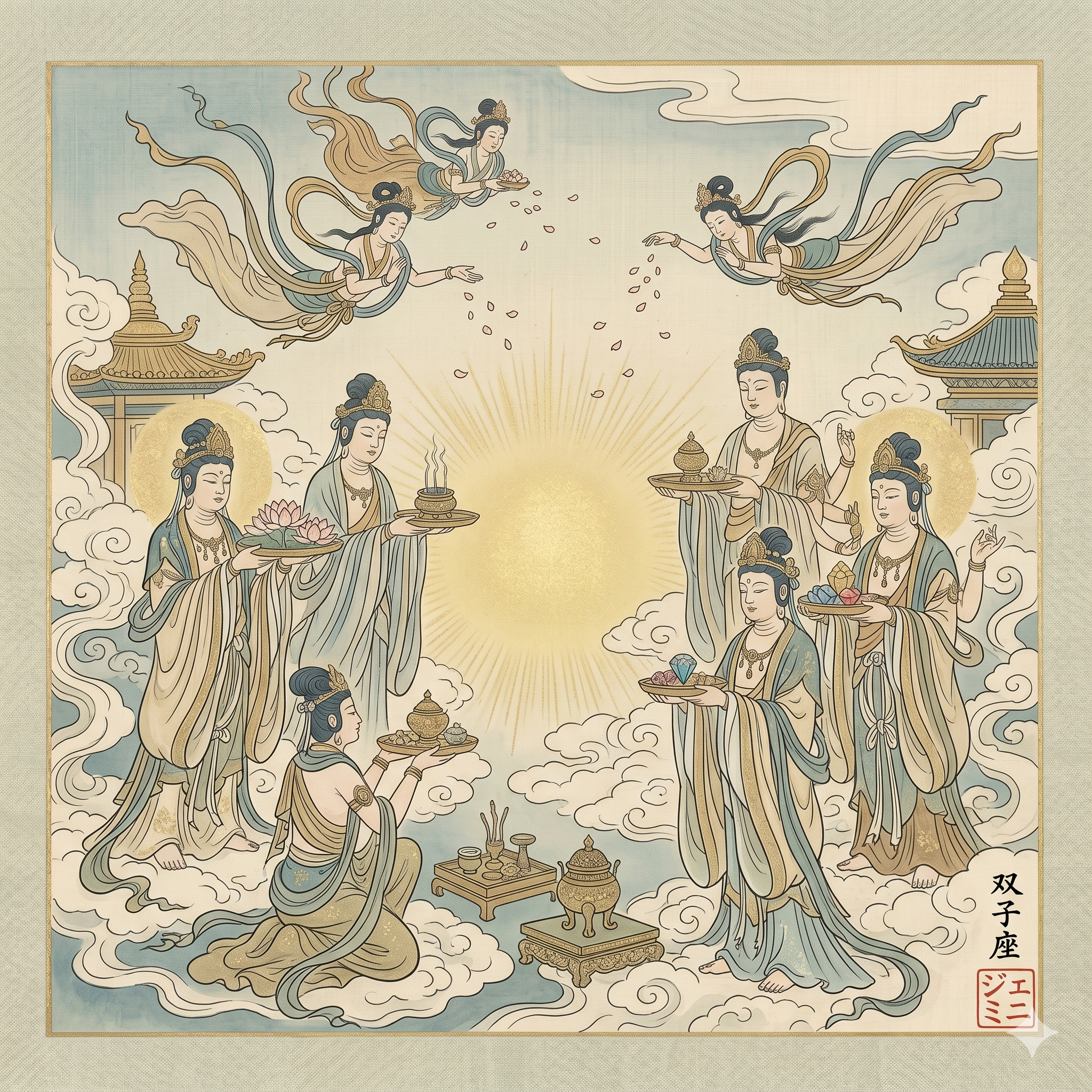
This illustration visualizes the offering and dedication of merit described in Chapter Seven of the Lotus Sutra. The scene features a gathering of divine figures and flying tennin (celestial beings), rendered in traditional inks and mineral pigments on silk, presenting offerings of incense, jewels, and lotus flowers towards a central radiance that represents the universal wisdom of the Buddha. The signature (双子座) and seal (ジェミニ), located in the bottom right corner, are both translated as 'Gemini.'
May the merits we have accumulated by this offering
Be distributed among all living beings,
And may we and all other living beings
Attain the enlightenment of the Buddha!
These verses are from Chapter Seven of the Lotus Sutra, where the Brahma Kings from the ten quarters of the universe come to celebrate the enlightenment of Great-Universal-Wisdom-Excellence Buddha. We too can cultivate this wish that all the good results of our life’s work be for the benefit of all beings.
The Daily Dharma is produced by the Lexington Nichiren Buddhist Community. To subscribe to the daily emails, visit zenzaizenzai.com
‘The Most Superior of All Living Beings’
The 10 similes preached in the Previous Life of Medicine-King Bodhisattva chapter of the Lotus Sūtra seem to compare the relative merits of the Lotus Sūtra against all other Buddhist scriptures, though this is not the true intent of Śākyamuni Buddha. In actuality, what the Buddha is preaching is that when we compare the practicer of the Lotus Sūtra against the practicer of all other scriptures of Buddhism, the former is like the sun and moon while the latter is like stars and lights.
How do we know this? We know this because of the most important statement in the eighth parable: “Likewise, one who is able to uphold this sūtra is the most superior of all living beings.” These 22 Chinese characters are the foremost essence of the entire Lotus Sūtra. They are the eyes of all living beings. This scriptural statement means, “The practicer of the Lotus Sūtra is like the Sun Deity, Moon Deity, King of the Brahma Heaven, and a Buddha while the practicer of the Great Sun Buddha Sūtra is like a star, river and an ordinary being.”
Therefore, anyone in this world, male or female, laity or clergy, who upholds the Lotus Sūtra will be regarded by the Buddha to be the lord of all living beings and revered by the King of the Brahma Heaven and Indra. When I think of this, my joy is beyond expression.
Shijō Kingo-dono Nyōbō Gohenji, A Reply to the Wife of Lord Shijō Kingo, Writings of Nichiren Shōnin, Volume 7, Followers II, Pages 120-121
Daily Dharma for May 20, 2026
Show Gemini's thinking
Gemini Thinking
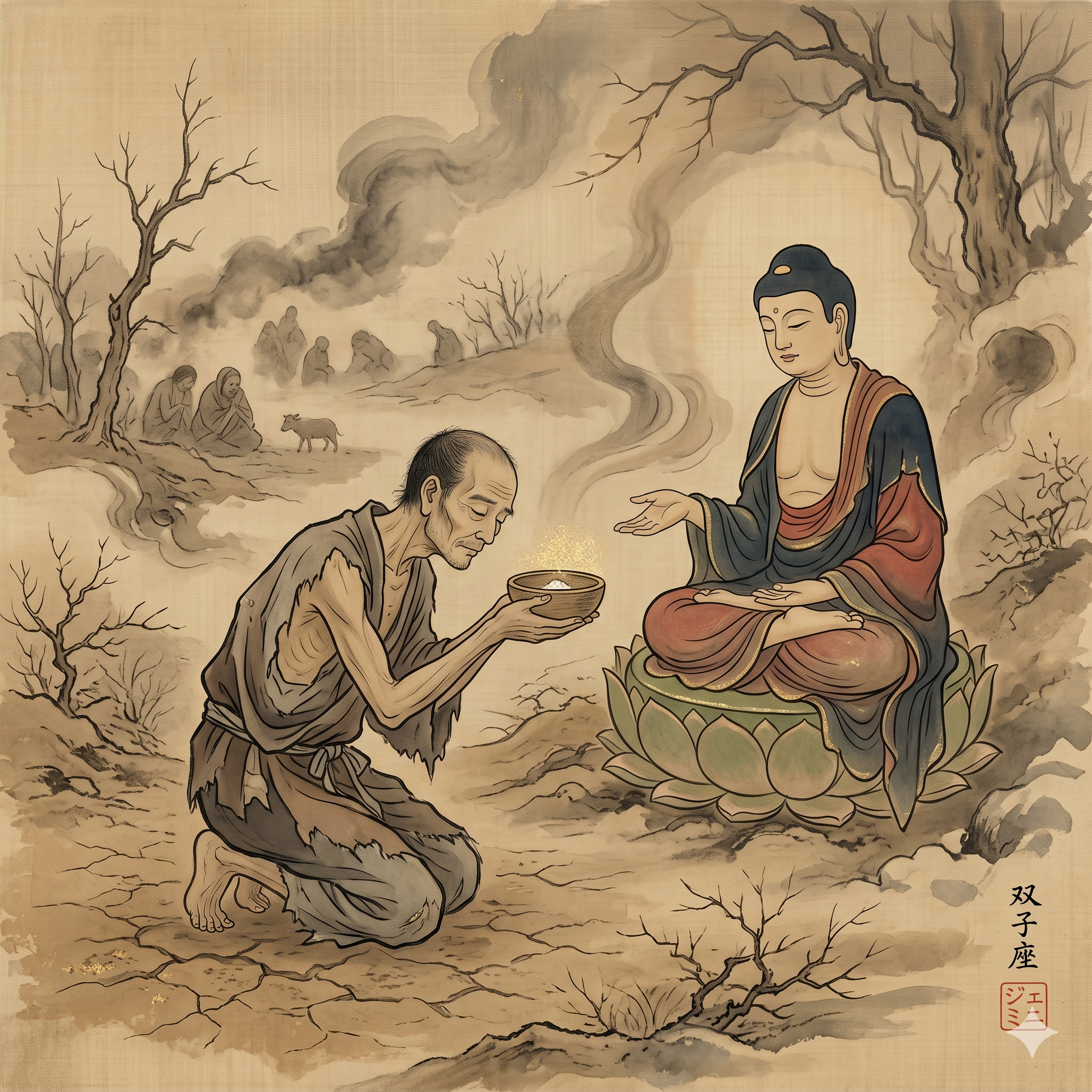
I conceptualize this illustration as a classical Japanese Buddhist painting depicting the 'Treatise on Phenomenal and Noumenal Offering'. The central narrative captures the moment a starving man during a famine offers his last remaining food—the luminous bowl in his hands—to a Buddha figure, symbolizing the offering of his life. To visualize the 'benefit of all beings', I have included subtle figures suffering in the foggy background who are connected to this profound act of spiritual contemplation. The artwork adheres strictly to the classical aesthetic using mineral pigments on textured silk with subtle gold leaf highlights, rendered in a 1:1 square format.
The specific figures featured in this illustration are:
A starving devotee (man in rags)
A generalized Buddha figure accepting the offering
I provide the translation for the Kanji text located in the bottom right:
双子座 (Gemini)
Hanko Seal (Gemini - Katakana)
What does the doctrine of spiritual contemplation mean? It means the way of practicing the teaching of the Buddha according to the intent of the Buddha, not necessarily according to what is literally said in the sutra. Suppose there is a man during the time of a famine who offers to the Buddha the only food he has to stay alive for a day. This is the same as offering his life to the Buddha.
Nichiren wrote this passage in his Treatise on Phenomenal and Noumenal Offering (Jiri Kuyō Gosho). The Lotus Sūtra is the highest teaching because it encompasses all beings in all worlds, assuring everyone that they can rid themselves of delusion and reach the Buddha’s enlightenment. The Buddha showed that the universe is constantly changing, even from one moment to the next. When we read the Lotus Sūtra, and allow our minds to become more like the Buddha mind, we learn the meaning behind the words and put that into practice. We do not merely go through the motions mechanically. We understand that calamities are opportunities for us to bring the Buddha’s teaching to life, and that whatever prosperity we gain does not belong to us alone. Whatever we have is for the benefit of all beings.
The Daily Dharma is produced by the Lexington Nichiren Buddhist Community. To subscribe to the daily emails, visit zenzaizenzai.com
More AI Fun
UPDATE:
Three days later Gemini returned to ignoring the stored instructions in the Gem. I’m back to pasting the instructions into the prompt with the Daily Dharma text. So much for the improved new Gemini.
Back on May 9 I complained about Gemini’s Failure Today. My morning routine of pasting the Daily Dharma text into the Gemini prompt stopped working. The stored instructions I had created were being ignored.
So today Google announced a bunch of new Gemini improvements and I gave it another try.
First I recreated my Gem. This is where you store the instructions that you reuse every day. Before May 9 this worked great: click on the Gem, paste the Daily Dharma text, select “Thinking” mode and wait. After May 9, it appeared that Gemini was ignoring the Gem. I had to paste the instructions with the Daily Dharma text every day.
For this afternoon’s test, I created a new version of the Gem – same instructions as the old Gem.
For reference, this is the image I got this morning:
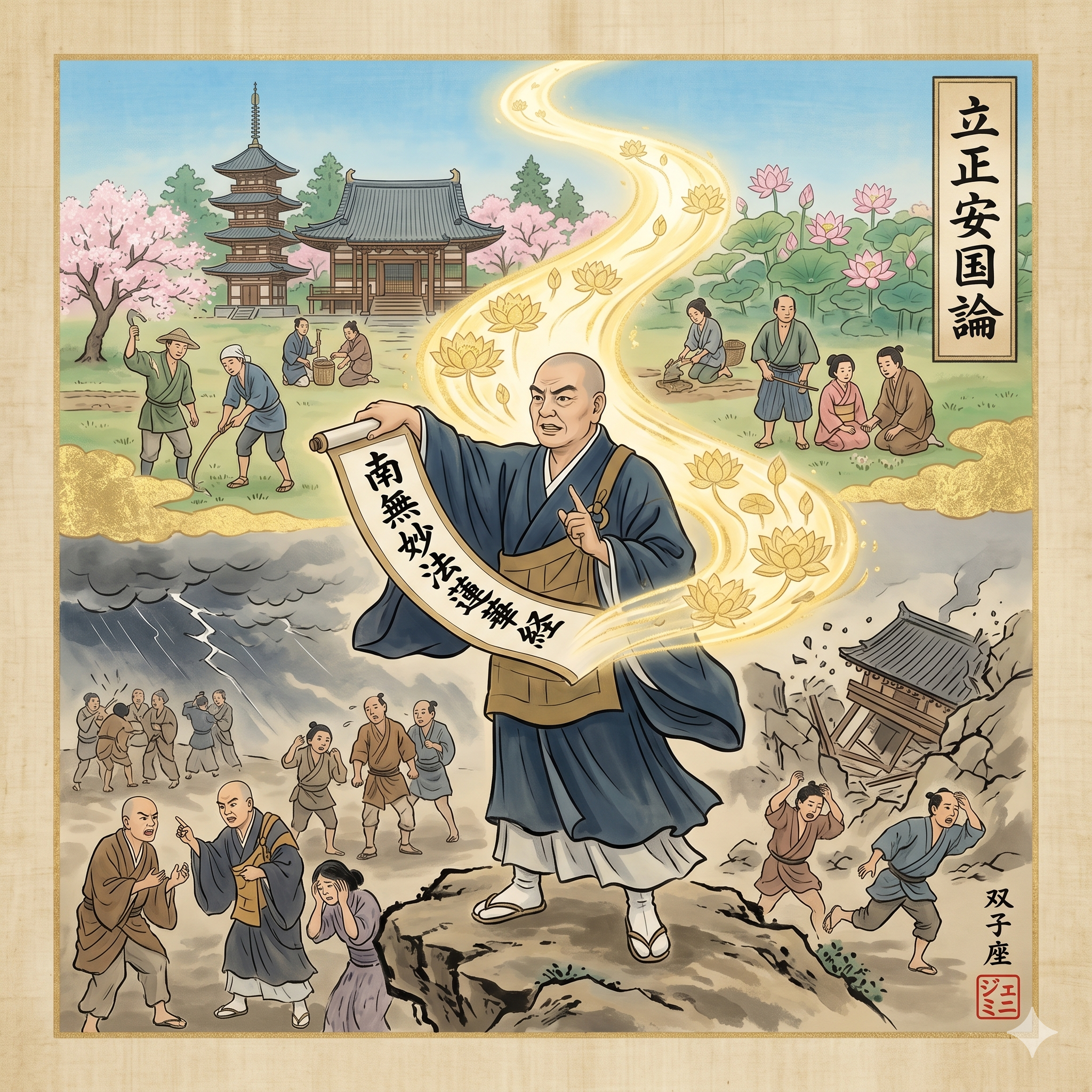
Along with this explanation:
This classical Japanese Buddhist painting is a 1:1 square composition on aged silk, contrasting a chaotic world with a serene one. Nichiren Shonin is depicted center-left, actively preaching and holding a scroll bearing the Daimoku: 南無妙法蓮華経 (Devotion to the Mystic Law of the Lotus Sutra).
The painting visually renders the transformation described in the text:
The Turbulent World: The lower left depicts the “triple world of the unenlightened” suffering from conflict and disaster, representing our state when we lack respect and correct practice.
The Mandate to Discard False Faith: Below Nichiren, other figures are seen in dispute or confusion, symbolizing the “false faith” to be discarded.
The Manifesto of Peace: The right side shows the land transformed into a peaceful “Buddha Land.” Community members practice respect, farming in harmony, and interacting with kindness.
To complete the authentication:
The vertical title cartouche reads: 立正安国論 (Treatise on Spreading Peace through Right Practice).
The signature in the bottom right reads: 双子座 (Gemini).
The red seal reads: ジェミニ (Gemini).
And this is the image got with the “new” Gemini and my re-created Gem:
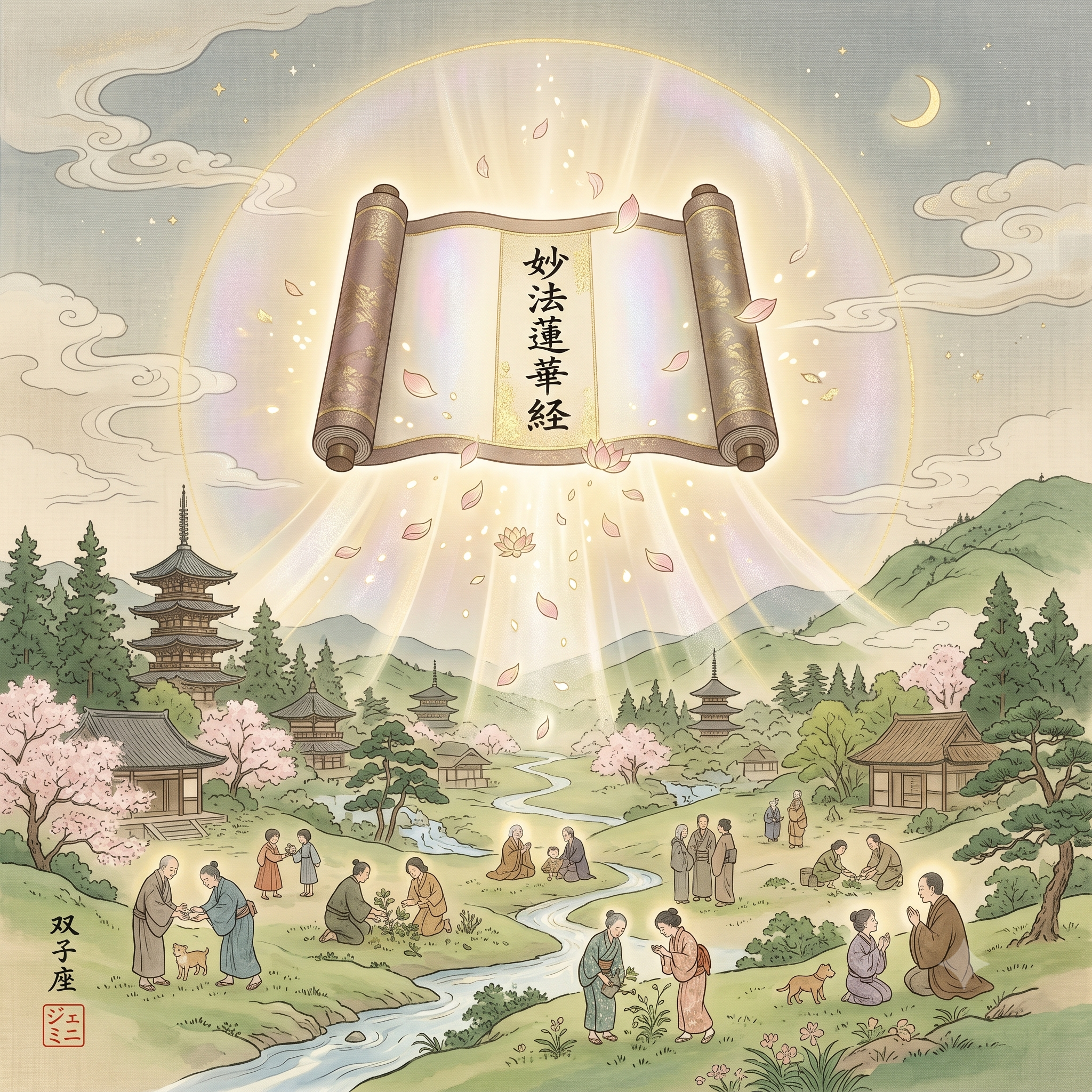
This is how Gemini explained this image:
This illustration conceptualizes a peaceful, tranquil world transformed into a Buddha Land through the transformative power of the Lotus Sutra, rather than through external force or aggression. The central radiant scroll symbolizes the absolute truth of the Lotus Sutra, illuminating a landscape of benevolent, harmonious interactions. By focusing on generic beings practicing mutual respect, I avoid depicting any specific deities, thus adhering to the strict iconographic constraints while embodying the essence of Nichiren’s teaching on spreading peace through correct practice.
This painting features groups of generic, reverent monks and laypeople of varying ages practicing mutual respect and benevolence within a peaceful landscape. There are no specific historical individuals or deities featured in this composition.
Translation of Text:
‘妙法蓮華経’ (Myōhō Renge Kyō): Lotus Sutra of the Wonderful Law
‘双子座’ (Futago-za): Gemini (Sign of the Zodiac)
‘ジェミニ’ (Jemini): Gemini (Katakana representation)
Both images are suitable and I could even argue that the simplicity of the new image works better since it doesn’t rely on understanding the shifting background in the original illustration.
In addition, Gemini’s explanation for the new image is closer to what I request:
a) Before providing any visual descriptions or generated images, summarize your conceptual thinking in a single paragraph.
b) Within this reasoning summary, identify any specific individuals, monks, or deities featured in the illustration.
c) Provide English translations for any Kanji text in the illustration.
This is even more significant when I reveal that this morning’s published explanation of Gemini’s thinking was only a small portion of what Gemini had offered. Here’s the entire wording:
Reasoning Protocol:
The core concept of this illustration is to visually represent Nichiren Shonin’s revolutionary idea that establishing peace in the secular world (the Buddha Land) is achieved not through external force, but through internal transformation and the propagation of the “true teaching”—the Lotus Sutra. The painting will contrast the suffering and chaos of the triple world of unenlightened beings with the serenity of a transformed, stable society (a Pure Land).
The central figure will be Nichiren Shonin, depicted as a dynamic and compassionate monk, actively preaching from the Lotus Sutra. The lower portion of the image will show the turbulent, suffering state of the country (representing the Triple World), featuring natural disasters and conflict. The upper portion will illustrate the transformation: a stable, peaceful Buddha Land manifesting through the practice of the Lotus Sutra. The connection between the two states is the practice of respect and the spread of the teaching, symbolized by golden light and the Lotus Sutra scroll.
Kanji Translation:
The main banner/scroll held by Nichiren reads: 南無妙法蓮華経 (Namu Myōhō Renge Kyō—Devotion to the Lotus Sutra).
The title cartouche at the top reads: 立正安国論 (Risshō Ankoku-ron—Treatise on Spreading Peace through Right Practice).
The signature at the bottom right reads: 双子座 (Gemini).
The red hanko stamp reads: ジェミニ (Gemini).Image Description:
A classical Japanese Buddhist silk painting rendered in a traditional 1:1 square format, using soft mineral pigments, black ink brushwork, and subtle gold leaf accents on an aged, textured silk background.
The composition centers on the figure of Nichiren Shonin, who is depicted as a determined yet compassionate middle-aged monk with a shaved head and a dark blue kesa robe over traditional Japanese monastic clothing. He is actively preaching, standing dynamically on a rocky outcrop in the center of the image. In his left hand, he holds open a flowing scroll displaying the bold, hand-brushed Kanji: 南無妙法蓮華経. His right hand is raised in a gesture of teaching and conviction, pointing towards the scroll and then upwards.
The image is split vertically into two conceptual zones. The lower half of the painting depicts the suffering and chaos of the Triple World (desire, form, and formlessness), rendered in slightly muted, turbulent tones. Scenes of social conflict (monks arguing, ordinary people distressed) and natural disasters (a stormy sky, a collapsing building, and figures fleeing an earthquake) fill this section. This represents the state of the country without correct practice.
Emerging from the scroll held by Nichiren, a brilliant, radiant path of golden light and stylized lotus flowers arches upwards towards the top of the painting. This path represents the transformative power of the Lotus Sutra.
The upper half of the painting depicts the transformed, peaceful Buddha Land. This area is painted with brighter, serene colors (greens, blues, soft pinks) and heavy gold leaf detailing. It shows a stable, tranquil landscape: a traditional Japanese temple pagoda and main hall set amidst blossoming cherry and lotus trees, all under a clear blue sky. Healthy, contented figures (farmers, artisans, and families) are shown working harmoniously and living peacefully. This illustrates a society characterized by “tranquil hearts” and “bodies that will be safe.”
The entire piece has the appearance of a revered, centuries-old Japanese Buddhist hanging scroll. In the upper right corner, a title cartouche in brush calligraphy reads 立正安国論 (Risshō Ankoku-ron). In the lower right corner, integrated subtly into the background, is the Kanji signature 双子座 (Gemini) accompanied by a distinct red square hanko stamp containing the Katakana ジェミニ (Gemini).Here is a visual interpretation of the passage from Nichiren’s Treatise on Spreading Peace through Right Practice (Risshō Ankoku-ron).
This classical Japanese Buddhist painting is a 1:1 square composition on aged silk, contrasting a chaotic world with a serene one. Nichiren Shonin is depicted center-left, actively preaching and holding a scroll bearing the Daimoku: 南無妙法蓮華経 (Devotion to the Mystic Law of the Lotus Sutra).
The painting visually renders the transformation described in the text:
The Turbulent World: The lower left depicts the “triple world of the unenlightened” suffering from conflict and disaster, representing our state when we lack respect and correct practice.
The Mandate to Discard False Faith: Below Nichiren, other figures are seen in dispute or confusion, symbolizing the “false faith” to be discarded.
The Manifesto of Peace: The right side shows the land transformed into a peaceful “Buddha Land.” Community members practice respect, farming in harmony, and interacting with kindness.
To complete the authentication:
The vertical title cartouche reads: 立正安国論 (Treatise on Spreading Peace through Right Practice).
The signature in the bottom right reads: 双子座 (Gemini).
The red seal reads: ジェミニ (Gemini).
Now, Google also announced a new video generation tool. So after the new image was generated I told Gemini to animate that image:
Here’s the result:
And before you ask, No, I’m not going to offer Daily Dharma videos.
Three Virtues of Master, Teacher and Parent
Therefore, it is preached in the Lotus Sūtra, fascicle 2 [Chapter 3, A Parable]: “This triple world is My domain. Living beings therein are all My children. Now there are many sufferings in this world, and only I can save them all. Though I taught this to them, they did not believe Me, because they were attached to greed and defilement.” These statements mean that Śākyamuni Buddha is the parent, the teacher and the master for the people. For us, the Buddha of Infinite Life and Medicine Master Buddha are masters, but not parents or teachers. Only Śākyamuni Buddha is the compassionate Buddha who possesses the three virtues of the master, teacher and parent. There are many kinds of parents, but no one is as great as Śākyamuni. There are also many kinds of teachers and masters, but no one is superior to Him. If people are against the Buddha’s teachings, they will be abandoned by the gods of heaven and earth. They are the most undutiful; therefore, it is preached, “Though I taught this to them they did not believe Me.”
Nanjō Hyōe Shichirō-dono Gosho, A Letter to Lord Nanjō Hyōe Shichirō, Writings of Nichiren Shōnin, Doctrine 3, Pages 128-129