All posts by John Hughes

Daily Dharma for February 4, 2026

20260204-ddi

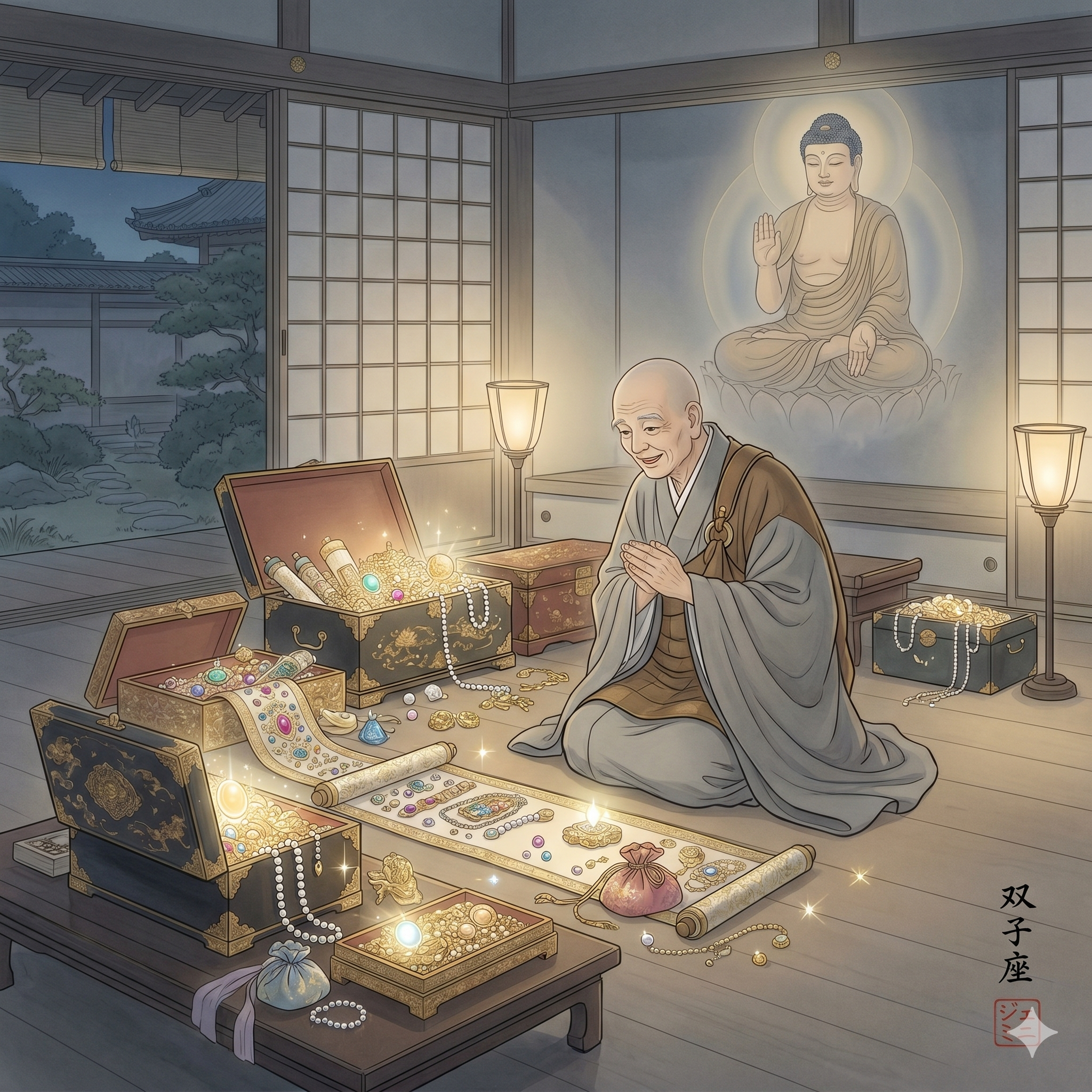
Illustration by Google Gemini

Show Gemini's thinking

Gemini's Thinking

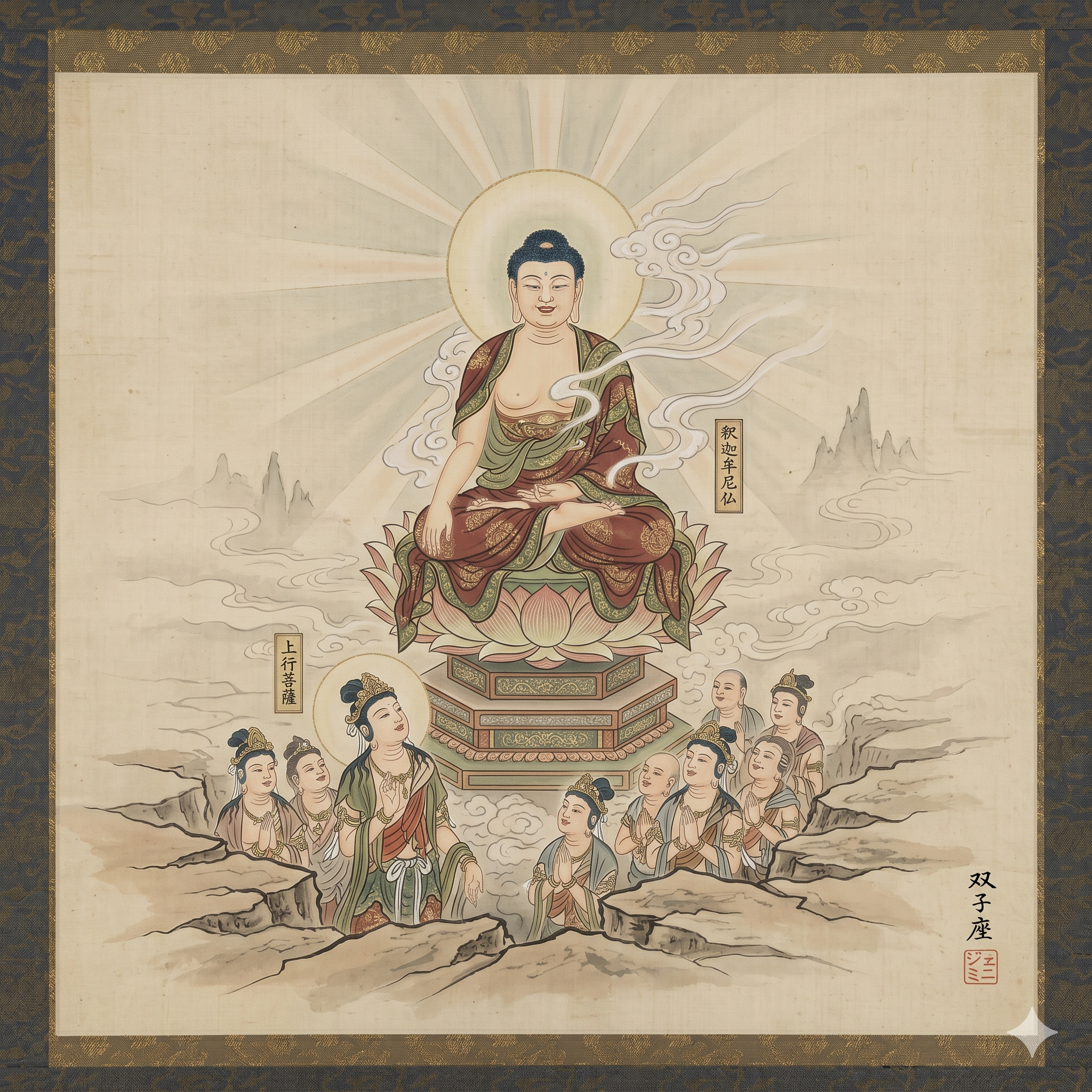
Defining the Visual Concept
I'm now zeroing in on the core of the user's request, the synthesis of traditional Japanese Buddhist art with the given text and signature. I'm focusing on the Nihonga style as a foundation.

Refining the Composition
I'm now establishing the core components. I'm focusing on a square format, and building out the foundational elements: Shakyamuni Buddha at the center on a raised platform or lotus, and a respectful assembly of Bodhisattvas. The goal is to set the scene for the preaching event in a Japanese Nihonga style.

Defining the Scene's Components
I'm working to extract key visual components and defining the composition based on the user's instructions. I've broken down the request into style, content, action, setting, details, and mood to inform the composition.

Structuring the Illustration
I am now organizing the visual components into a coherent structure. I'm focusing on a square composition to align with the user's instructions. I've broken the request down into style, content, action, setting, details, and mood to inform the composition, so that it will incorporate the correct visual elements and information. I'm creating a comprehensive list of elements, including Śākyamuni Buddha, the Bodhisattvas, the lotus pond, and the text elements, to ensure a cohesive final illustration.

Verifying Art Style Accuracy
I'm checking the illustration to make sure it meets the requirements. I've confirmed the image captures the Japanese Buddhist style with Śākyamuni Buddha. I've also verified the presence of devotees and a scroll with the specified text. Additionally, the signature '双子座' is present.

Confirming Final Details
I've examined the artwork again. I see that the 'ジェミニ' seal is also accurately placed in the bottom-left. It incorporates every requested element, including the signature and scroll text, in the appropriate style. I believe it now fully reflects the requirements.

Extol the teaching of the One Vehicle
In the presence of those who are modest,
Who are pure in heart,
And who are seeking the enlightenment of the Buddha!

Śākyamuni Buddha sings these verses in Chapter Two of the Lotus Sūtra. In Nichiren’s writings, he taught that since the Wonderful Dharma saves all beings, it is suited to the time in which we live. As Bodhisattvas who are certain of our own enlightenment, we are committed to nourishing the seed of enlightenment in others. These verses show us what to keep in mind as we help to clear away the delusion and suffering in this world. We learn to see purity in the hearts of others, and understand their motivation towards enlightenment, even if they do not realize this themselves.

The Daily Dharma is produced by the Lexington Nichiren Buddhist Community. To subscribe to the daily emails, visit zenzaizenzai.com

The Life Span in the Realm of Heavenly Beings

It has been 2,200 years or so since the Buddha expounded the Lotus Sūtra. As the life span of human beings is short, there is no one still alive who was able to see the Buddha in person. The length of a day as well as the life span in the realm of heavenly beings, however, are so long that there exist numerous heavenly beings who listened to the Buddha preach the Lotus Sūtra. Fifty years for human beings is equivalent to one day and night for the Four Heavenly Kings. Passing the day and night in this way, with 30 days in a month and 12 months to a year they live altogether 500 years. Accordingly, 2,200 years or so in the human realm is equivalent to 44 days of the Four Heavenly Kings, and it has been only 44 days since the sun and moon and Vaiśravaṇa (Bishamon, one of the Four Heavenly Kings) saw the Buddha enter Nirvana. In other words, it has not been two months yet since the Buddha passed away. To such heavenly beings as Indra and the King of the Brahma Heaven it has been a month or so since the Buddha passed into Nirvana. How can they forget all about the vow they made before the Buddha, the great favor of the sūtra in which they attained Buddhahood, and abandon the practicers of the Lotus Sūtra in such a short span? When we think of things in this way, we are sure we can depend on these heavenly beings.

Accordingly, the prayer said by the practicer of the Lotus Sūtra will inevitably be fulfilled just as a sound is echoed, a shadow follows the body, the moon reflects upon the clear water, a water nymph invites the water, a magnet attracts iron, amber eliminates dust, and a clear mirror reflects the color of everything.

Kitō Shō, Treatise on Prayers, Writings of Nichiren Shōnin, Faith and Practice, Volume 4, Page 66-67

Daily Dharma for February 3, 2026

20260203-ddi

Illustration by Google Gemini

Show Gemini's thinking

In order to get this image I had to add this instruction:

When this scene occurs, Śākyamuni Buddha and the Buddha Many Treasures are seated side-by-side in the Stupa of Treasures floating in the sky. The Bodhisattvas have risen out of the ground and are filling the sky in all directions. The entire congregation is in the sky at this point.

Gemini Thinking

Defining the Illustration Parameters
I'm now zeroing in on the specifications. The illustration needs to be square. It's crucial to align the stylistic choices with traditional Japanese Buddhist art, specifically, I am focusing on Chapter 15 of the Lotus Sutra.

Refining the Composition
I'm now clarifying the visual composition. I've decided on a square format, focusing on the upper half being dominated by the Stupa of Treasures containing Śākyamuni and Many Treasures, with the lower half depicting the cracked earth and ascending Bodhisattvas. I'm taking into account the need for a signature and seal in a suitable location.

Detailing the Visual Composition
I am now focusing on the specific visual elements. I've broken down the scene: the square format, the sky-bound Stupa of Treasures above a cracked earth, and the ascending Bodhisattvas. I'm focusing on incorporating traditional Japanese Buddhist painting techniques and a muted, rich palette. I must accurately portray each figure with the correct iconography.

Defining the Key Elements
I'm now identifying the crucial elements: a square format illustration in the Japanese Buddhist style from the Lotus Sutra, Chapter 15. The Stupa of Treasures, Śākyamuni, and Many Treasures will be in the sky above a cracked earth, from which countless Bodhisattvas emerge, with Maitreya in the foreground. I will also incorporate the given text, and the artist's signature.

Verifying the Illustration
I'm now cross-referencing the initial request with the generated content. My analysis focuses on the precise representation of the requested elements within the traditional Japanese Buddhist style. I'm checking the fidelity of the depiction of the Lotus Sutra scene. The focus is the accurate portrayal of the primary figures and their roles.

Analyzing the Accuracy
I'm evaluating the generated scene against the core narrative of the Lotus Sutra, specifically focusing on the Bodhisattvas' emergence, Maitreya's role, and Śākyamuni's presence. I am also checking for accurate visual cues and placement of key elements. The integration of the verses and signature, as per the initial request, is under review.

We have never seen
These many thousands of billions
Of Bodhisattvas.
Tell me, Most Honorable Biped!
Where did they come from?

Maitreya Bodhisattva sings these verses to the Buddha in Chapter Fifteen of the Lotus Sūtra. In the story, Śākyamuni Buddha has asked who among those gathered to hear him teach will continue teaching this Wonderful Dharma in our world of suffering after the Buddha passes into his final extinction. Some Bodhisattvas say they will teach in other worlds, since the beings of this world are too defiled to hear the Buddha’s teaching. Other Bodhisattvas vow to remain in our world, but the Buddha tells them not to bother. At that moment, the ground cracks open, and innumerable Bodhisattvas spring up and vow to carry on the work of the Buddha. Maitreya and others had never seen these Bodhisattvas before. His asking the Buddha respectfully to explain what they do not understand. This example emphasizes that we must continue to question how the Buddha’s teaching applies to our lives rather than dogmatically accepting whatever happens.

The Daily Dharma is produced by the Lexington Nichiren Buddhist Community. To subscribe to the daily emails, visit zenzaizenzai.com

Life After Death for Reciting the Lotus Sūtra

Although Śubh̄karasimha was such a splendid person, he once experienced a sudden death. Upon regaining consciousness, however, he is said to have declared:

Upon my death, a hell guard came to tie me with seven iron ropes, hit me hard with an iron stick, and dragged me to the palace of King Yama. Somehow I completely forgot all Buddhist scriptures said to be 80,000 in number, not remembering even one word or a phrase except the title of the Lotus Sūtra. When I recalled it, the iron ropes that tied me got loose somewhat. Breathing a sigh of relief, I recited a passage in the “Expedients” chapter of the Lotus Sūtra resoundingly: “This triple world is all My domain, in which all the living beings are my children without exception. Although there exist many sufferings and difficulties in this world, only I, the Buddha, alone can save and protect all living beings.” Then the seven iron ropes were broken into pieces and scattered all over. Seeing this scene, King Yama took off his crown, came down to the courtyard, and said to me, “This experience of death has not exhausted your entire life span.” Thus he sent me back to this world.

Zemmui-shō, Treatise on Śubh̄karasimha, Writings of Nichiren Shōnin, Faith and Practice, Volume 4, Page 54

Daily Dharma for February 2, 2026

20260202-ddi

Illustration by Google Gemini

Show Gemini's thinking

Gemini failed to understand the essential meaning of this letter: Nichiren knew the temperament of this Samurai warrior, and gave him detailed instructions for how to navigate the political hazards he faced. No matter how vindictive his Lord Ema became, Nichiren reminded him to persist in leading Ema by the Buddha Dharma and to rely on those who kept the Lotus Sūtra with him. As a result, Kingo outlived both Ema and Nichiren himself and is well known as one of Nichiren’s first followers.

Instead Gemini offered this illustration with the following explanation of its thinking

alt-20260202-ddi

Kanji Translation

異体同心 (Itai dōshin): This phrase means "two bodies, one mind" or "united in spirit," signifying deep agreement or close cooperation.

妙法蓮華経 (Myōhō Renge Kyō): This is the Japanese title of the Lotus Sutra, a central text in Mahayana Buddhism.

双子座 (Futagoza): This translates to "Gemini," the zodiac sign.

The red stamp contains the katakana characters ジェミニ (Jemini), which is the Japanese phonetic reading of "Gemini."

Gemini Thinking

Defining the Key Elements
I'm working on the essential elements for this Japanese Buddhist illustration. I've pinpointed the core message: unity, anger management, and Dharma reliance, even in the face of conflict. I'm carefully considering the iconography and have specified exclusions for Amida Nyorai and Dainichi Nyorai. The work continues.

Refining the Composition
I've been further developing the visual composition. The key is now Jikokuten and Zōchōten (see below), back to back, embodying unity. Fudō Myōō above them acts as the protective figure. A Lotus Sutra scroll or pagoda will be central between them. I'm focusing on a rocky, misty landscape and temple gate.

Developing the Scene
I'm now detailing the setting, composition, and specific iconography of the illustration. Jikokuten and Zōchōten will stand as the central figures, back-to-back. I'm placing Fudō Myōō above them for protection. The Lotus Sutra scroll or pagoda will be central. A rocky, misty landscape and temple gate in the distance will frame the scene, and I'm adding "異体同心" near the top to reinforce the unity theme. I am aiming for a Nihonga style. I will also be adding the required signature and seal.

Analyzing the Visual Elements
I'm now cross-referencing the initial request with the visual elements present. I am verifying the iconography and the symbolic representations to ensure coherence with the text, particularly the presence of the guardians and the scroll. I am checking the consistency of details.

Verifying Image Alignment
I have carefully assessed the most recent image based on the prompt's specifications. The illustration matches the criteria: the iconography, including the figures and scroll, aligns well with the request. The signature and seal are present as intended. I am making sure the image aligns well with the user's intent.

Jikokuten and Zōchōten

Jikokuten and Zōchōten are two prominent figures in Japanese Buddhist iconography, belonging to a group of four protective deities known as the Shitennō (四天王), or "Four Heavenly Kings."

These warrior-like figures are tasked with protecting the Buddhist teachings (Dharma), the Buddha himself, and the world from evil forces. They are commonly depicted in fierce, armored forms, often shown trampling on small demon-like creatures called jaki, symbolizing their power to subdue evil. You will frequently find statues of them guarding the gates of Buddhist temples or surrounding central altars.

Here is a breakdown of each deity:

Jikokuten (持国天)
Role & Meaning: Known as the "Guardian of the Nation" or "Keeper of the Kingdom," his name reflects his duty to protect the land and its people.

Direction: He is the guardian of the East.

Iconography: In art, he is often depicted holding a sword in one hand and a staff or trident in the other. In some variations, he may be shown playing a lute, symbolizing the "Middle Way" of Buddhism—teaching that, like lute strings, one's practice should be neither too tight nor too loose. He is associated with the season of spring and the colors blue or green.

Zōchōten (増長天)
Role & Meaning: His name translates to "Lord who expands" or "Lord of Spiritual Growth," signifying his role in promoting growth, prosperity, and spiritual advancement.

Direction: He is the guardian of the South.

Iconography: He is typically shown in a dynamic pose with one hand placed firmly on his hip and the other holding a polearm, such as a spear or halberd. He is associated with the season of summer and the color red, reflecting a fiery and powerful nature.

Enemies find it difficult to attack when two people are together. Therefore, do not keep your brothers at a distance even for a brief period, regardless of what faults they may have; always be close to them. Whenever you get angry, it is clearly written on your face. Please remember that at no time do gods or deities protect those who are short tempered. It is true that you are destined to become a Buddha, but isn’t it regrettable for you to get hurt, pleasing your enemy and causing us grief?

Nichiren wrote this passage in his “Emperor Shushun” Letter (Sushun Tennō Gosho) addressed to his disciple Shijō Kingo. Nichiren knew the temperament of this Samurai warrior, and gave him detailed instructions for how to navigate the political hazards he faced. No matter how vindictive his Lord Ema became, Nichiren reminded him to persist in leading Ema by the Buddha Dharma and to rely on those who kept the Lotus Sūtra with him. As a result, Kingo outlived both Ema and Nichiren himself and is well known as one of Nichiren’s first followers.

The Daily Dharma is produced by the Lexington Nichiren Buddhist Community. To subscribe to the daily emails, visit zenzaizenzai.com

Imagine the Wonders that Occur with the Daimoku

QUESTION: You cannot burn anything by simply uttering the word, “fire,” repeatedly. Indeed, you have to use your hand in order to burn something. You cannot quench your thirst by just saying “water.” You need to use your mouth for drinking water. The same is true with the daimoku. I doubt it is possible to escape from the evil realms through the mere chanting of the daimoku, Namu Myōhō Renge Kyō. Isn’t it necessary to understand what the daimoku means and what it entails?

ANSWER: When the sinew of a lion is used as a string for a koto, the sound is so powerful that all the strings made from other threads will snap. And when hearing of the sourness of a pickled plum, saliva fills the mouth without eating it. Such mysterious things happen even in worldly affairs. How then can it be denied that something wonderful happens with the Lotus Sūtra? Even a parrot is said to have been reborn in the realm of heavenly beings just by repeating the name of the Four Noble Truths of the Hinayāna teaching. Moreover, a man who dedicated himself to the Three Treasures – the Buddha, Dharma, and Saṃgha – was able to escape the attack of a monster fish in the ocean. Imagine the wonders that would occur with the daimoku of the Lotus Sūtra, the essence of all the 80,000 teachings, and the eye of all the Buddhas. Do you still hold the belief that you cannot escape the four kinds of evil realms by just chanting the daimoku of the Lotus Sūtra?

Hokke Daimoku Shō, Treatise on the Daimoku of the Lotus Sūtra, Writings of Nichiren Shōnin, Faith and Practice, Volume 4,
Page 38-39

Daily Dharma for February 1, 2026

20260201-ddi

Illustration by Google Gemini

Show Gemini's thinking

Gemini Thinking

Defining the Visuals
I'm now zeroing in on the specifics, seeking to extract key elements for the illustration. I am avoiding Amida and Dainichi Nyorai. I need to make sure the artist signature and seal are present.

Visualizing the Teachings
I'm now focusing on the composition, having decided on the style and key figures. The core Buddhist teaching is the focus, specifically the gentle nature of the Dharma, and I'm developing visual elements around it, with particular focus on the setting and the figures of Buddha and Śāriputra. I’m also finalizing the text elements, including a signature and seal.

Analyzing Visual Compliance
I'm currently focused on evaluating how well the illustration aligns with the user's explicit directives. I've noted the successful rendering of Śākyamuni Buddha and Śāriputra, the exclusion of unwanted elements, and the adherence to text limits. The correct Kanji signature and red Kat are particularly important here.

Confirming Instructions Met
I'm confident the image comprehensively fulfills all requirements. The illustration's Japanese Buddhist style is accurately rendered. Śākyamuni Buddha and Śāriputra are present, while forbidden iconography and text limits are correctly excluded. The Kanji signature and red Katakana seal are also present.

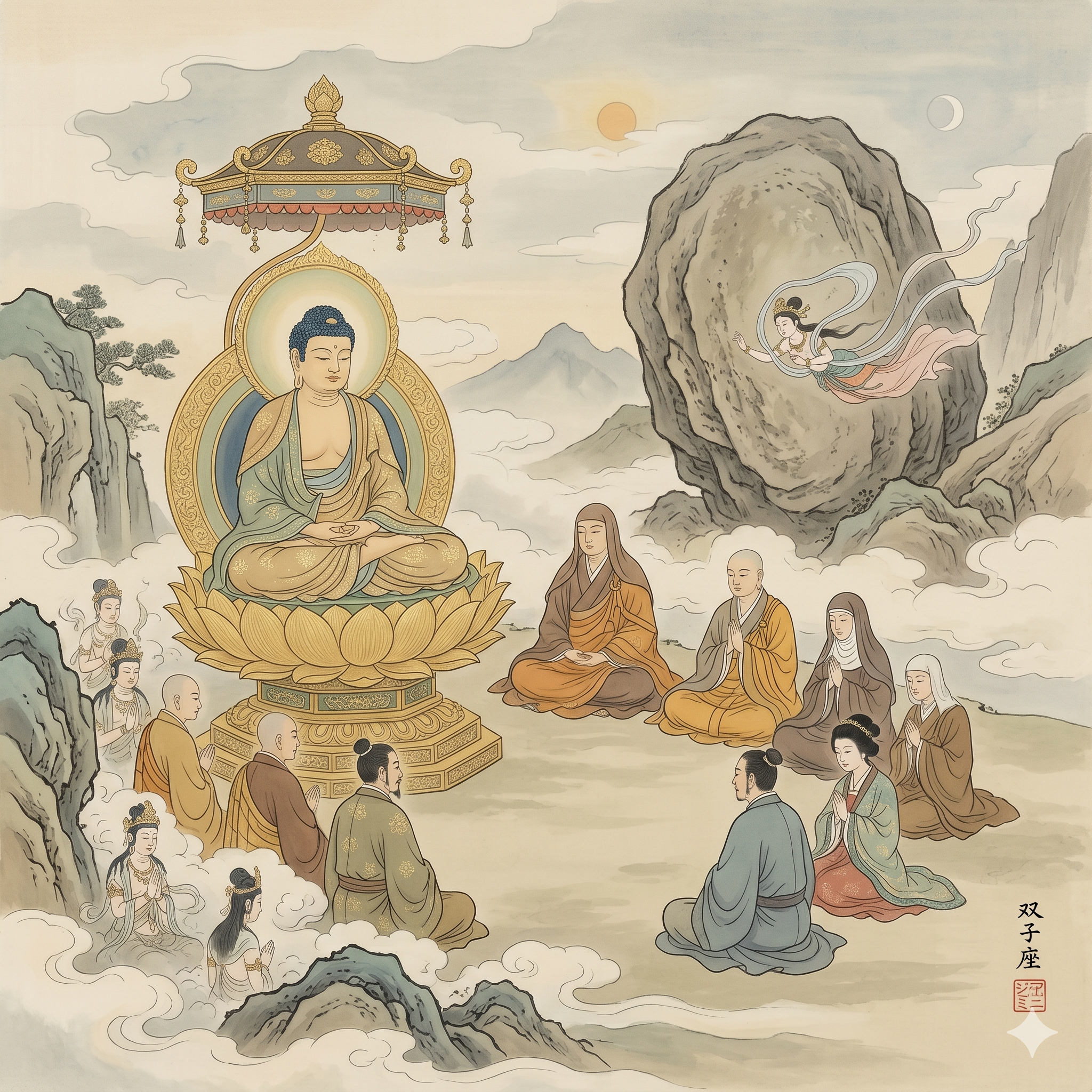
Śāriputra! The Tathāgatas divide [the Dharma] into various teachings, and expound those teachings to all living beings so skillfully and with such gentle voices that living beings are delighted.

Śākyamuni Buddha gives this explanation to his disciple Śāriputra in Chapter Two of the Lotus Sūtra. The work towards enlightenment is a shared enterprise. The Buddha cannot make us enlightened, and we cannot become enlightened by ourselves. The Buddha does not bribe, coerce, threaten or manipulate us into reaching the wisdom he knows we can find. Instead he sees deeply into our minds and uses the delusions we already have to lead us away from the suffering we create for ourselves. In our work as Bodhisattvas, we do well to keep the Buddha’s example in mind.

The Daily Dharma is produced by the Lexington Nichiren Buddhist Community. To subscribe to the daily emails, visit zenzaizenzai.com

The Light From the ‘Life Span of the Buddha’ Chapter

[T]he Lotus Sūtra is likened to the sun. The moon appearing at night with twinkling stars cannot put out the starlight although the moonlight is stronger. During the day, on the contrary, sunlight extinguishes not only starlight but also moonlight. Likewise, pre-Lotus sūtras are like the stars and the theoretical section of the Lotus Sūtra is like the moon whereas the “Life Span of the Buddha” chapter of the Lotus Sūtra is like the sun. Seen from the standpoint of the “Life Span of the Buddha” chapter, even the theoretical section is like the moon, which is not comparable to the sun, not to speak of other sūtras. People cannot work at night with either starlight or moonlight. When day breaks and the sun rises, people begin to work. Likewise, in the pre-Lotus sūtras and in the theoretical section of the Lotus Sūtra, as at night, nobody can cut the chain of life and death to attain enlightenment no matter how hard one tries. On the contrary, in the “Life Span of the Buddha” chapter in the essential section of the Lotus Sūtra, like the sun rising at daybreak, everyone necessarily gets rid of the chain of life and death to attain enlightenment.

Yakuō-bon Tokui-shō, The Essence of the ‘Medicine King Bodhisattva’ Chapter, Writings of Nichiren Shōnin, Faith and Practice, Volume 4, Page 33


Daily Dharma for January 31, 2026

20260131-ddi

Illustration by Google Gemini

Show Gemini's thinking

Gemini Thinking

Defining the Buddhist Concept
I'm now deeply considering the Sakyamuni Buddha's verse and its core meaning: overcoming greed, jealousy, and fear. My challenge is to translate these abstract concepts into a visual square illustration, within the context of Japanese Buddhist iconography, but specifically excluding Amida and Dainichi Nyorai. A key element will be including a specific traditional signature.

Visualizing the Buddhist Narrative
I'm now focusing on the visual representation. I've broken down the verse to core components: Sakyamuni teaching Śāriputra about eliminating greed, jealousy, and fear. I have started selecting specific traditional Japanese Buddhist iconography. I've identified Sakyamuni Buddha (Shaka Nyorai) as the primary figure with Sharihotsu as the disciple. I am considering teaching mudras and the presence of a lion as a symbol of fearlessness. The overall composition aims for serenity, representing the absence of negative emotions.

Refining the Composition
I'm now integrating the signature and seal. I'm focusing on the Nihonga style, the square aspect ratio, and traditional elements. I'm trying to ensure the absence of Amida and Dainichi Nyorai is maintained. I'm considering the most appropriate mudra and trying to determine the best setting and composition, ensuring that the visual cues representing the elimination of greed, jealousy, and fear are clear.

Verifying Visual Harmony
I'm checking the illustration against the initial request. It captures the requested Japanese aesthetic, showing Sakyamuni Buddha and his disciple. The square composition, signature, and seal seem to be as specified. I'm focusing on how well the visual details align with the prompt's core concept.

Analyzing Prompt Adherence
I've confirmed this illustration fully aligns with the user's initial instructions, depicting Sakyamuni Buddha and his disciple in the requested Japanese aesthetic. The square composition, along with the inclusion of the signature and seal, also matches the requirements. I've also checked and confirmed that the generated picture has adhered to all the negative constraints that were initially provided.

I do not deceive
Those who believe me and rely on me.
I am not greedy or jealous
Because I have eliminated all evils.
Therefore, in the worlds of the ten quarters,
I am fearless.

The Buddha proclaims these verses to his disciple Śāriputra in Chapter Two of the Lotus Sutra. In this world of conflict, people believe that they must constantly strive to show that they are better than everyone else. Acquiring more material goods or a higher rank or position supposedly proves superiority. And if there is an encounter with someone who is better, that person must be brought down. What people do not realize that the source of greed and jealousy is fear. Like the Buddha, we too can eliminate our fears when we are satisfied with what we have and regard superior beings as a source of benefit.

The Daily Dharma is produced by the Lexington Nichiren Buddhist Community. To subscribe to the daily emails, visit zenzaizenzai.com

The Manners of Practicing the Lotus Sūtra

QUESTION 10: What should a believer of the Lotus Sūtra regard as the Honzon (the Most Venerable One)? How should one perform the Buddhist rites and practice daily training?

ANSWER 10: First of all, the Honzon could be eight fascicles, one fascicle, one chapter or the title alone of the Lotus Sūtra. This is preached in the “Teacher of the Dharma” and “Divine Powers of the Buddhas” chapters. Those who can afford to may have the portraits or wooden statues of Śākyamuni Buddha and the Buddha of Many Treasures made and placed on both sides of the Lotus Sutra. Those who can further afford to may make the portraits or wooden statues of various Buddhas all over the universe or Universal Sage Bodhisattva. As for the manner of performing the rites, standing or sitting practices must be observed in front of the Honzon. Outside the hall of practice, however, one is free to choose any of the four modes of acts: walking, standing, sitting and lying down. Next, regarding the daily practices, the daimoku of the Lotus Sūtra should be chanted, “Namu Myōhō Renge Kyō. ” If possible, a verse or phrase of the Lotus Sūtra should respectfully be read. As an auxiliary practice one may say a prayer to Śākyamuni Buddha, the Buddha of Many Treasures, the numerous Buddhas throughout the universe, various bodhisattvas, Two Vehicles, Heavenly Kings, dragon gods, the eight kinds of gods and demi-gods who protect Buddhism as one wishes. Since we have many ignorant people today, the “3,000 existences contained in one thought” doctrine may be difficult to contemplate from the beginning. Nevertheless, those who wish to study it are encouraged to do so from the start.

Shō Hokke Daimoku-shō, Treatise on Chanting the Daimoku of the Lotus Sutra, Writings of Nichiren Shōnin, Faith and Practice, Volume 4, Page 20