Conceptual Summary
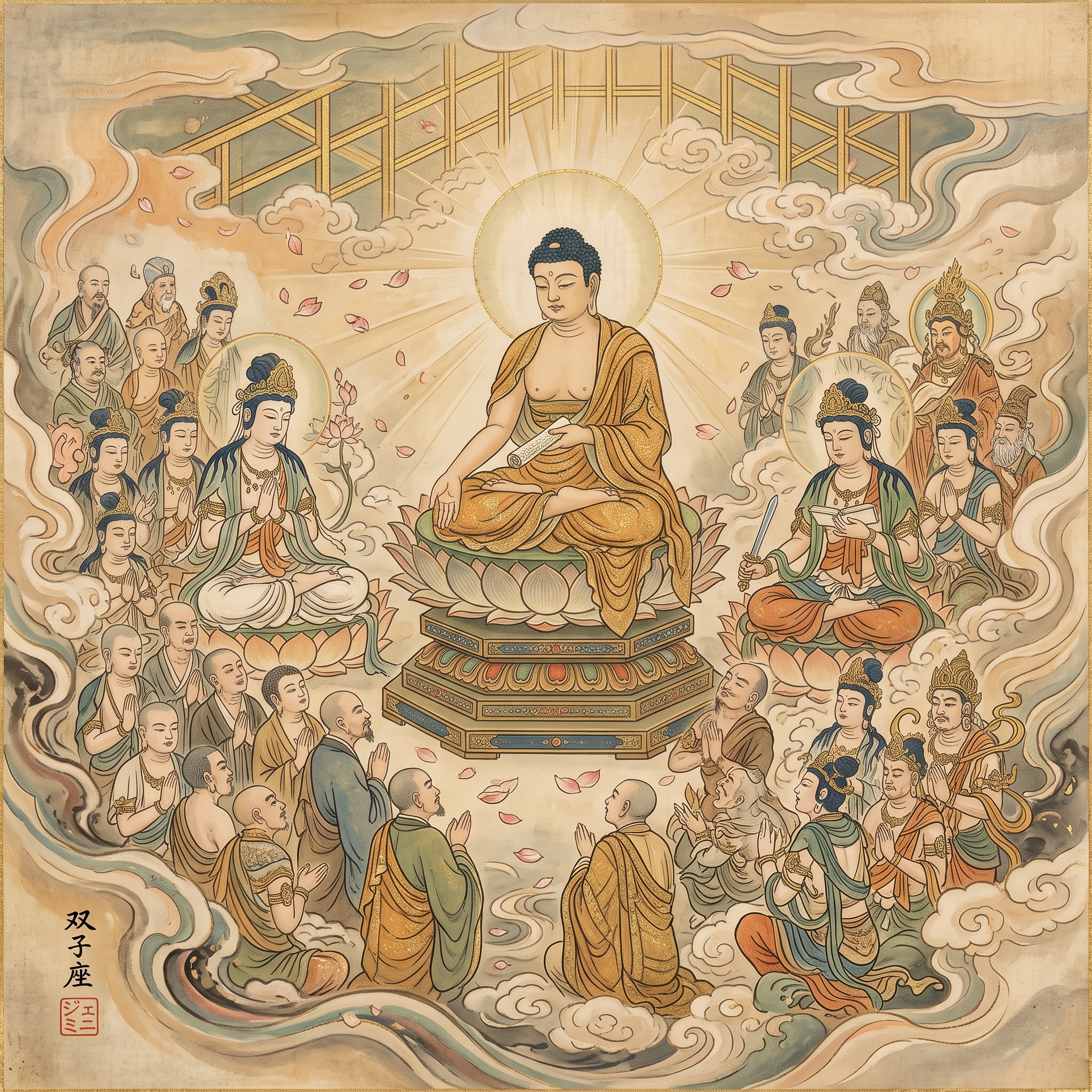
The illustration represents the "Entrustment" scene from Chapter Twenty-Two of the Lotus Sūtra, translating the abstract concept of transmitting the "highest teaching" into a concrete visual arrangement. By centralizing Śākyamuni Buddha holding a sutra scroll rather than performing the typical mudrās associated with Amida or Dainichi, the composition emphasizes historical lineage and active dissemination over static wisdom. The radiating light rays and falling blossoms visualize the profound difficulty of attaining this Dharma over "billions of asaṃkhyas of kalpas," signifying its precious nature. The dense assembly of diverse figures—including prominent bodhisattvas and monastic disciples looking outward or receiving the teaching—interprets the command to "make it known far and wide," visually realizing the Buddha's model of living not for personal treasure but for the collective benefit of all beings.
Iconography & Character Identification
Item 1: Deities/Figures Featured:
Śākyamuni Buddha: The central figure, seated on a high lotus throne, transmitting the Dharma.
The Assembly (Audience of Chapter 22): A diverse crowd consisting of various groups:
Bodhisattvas: Adorned with crowns and jewels, seated on lotuses, receiving the teaching.
Śrāvakas (Disciples): Shaven-headed monks kneeling in front, listening reverently.
Devaloka and Brahma (Gods): Non-human beings in celestial attire gathered around the periphery.
Item 2: Text Translations:
Kanji (Bottom Left): 双子座 = Gemini
Katakana (Red Seal): ジェミニ = Gemini
For many hundreds of thousands of billions of asaṃkhyas of kalpas, I studied and practiced the Dharma difficult to obtain, and [finally attained] Anuttara-samyak-saṃbodhi. Now I will transmit the Dharma to you. Propagate it with all your hearts, and make it known far and wide!
The Buddha entrusts his highest teaching to all those gathered to see him in Chapter Twenty-Two of the Lotus Sūtra. He had already explained how difficult it is to believe and practice this highest teaching, and all the trouble it took for him to reach it. He also realizes that this teaching is not something he can keep for himself, and is meaningful only when it was shared with others. This is yet another example of the Buddha showing us how to live with the beings we want to benefit. We realize that our treasure is not what we keep for ourselves, but what we have in common with others. We are diminished not by what we lose, but by attempting to hold on to our delusions.
The Daily Dharma is produced by the Lexington Nichiren Buddhist Community. To subscribe to the daily emails, visit zenzaizenzai.com
Today is the second day of the Higan week, the three days before the equinox and the three days after. As explained in a Nichiren Shu brochure:
For Buddhists, this period is not just one characterized by days with almost equal portions of light and dark. Rather, it is a period in which we strive to consciously reflect upon ourselves and our deeds.
The today we consider the Perfection of Morality. This essay was generated by Google’s Gemini Notebook and then edited for publication here. The essay is derived from the 400 or so letters written by Nichiren uploaded as source material for the Nichiren Notebook.
In the teachings of Nichiren Shōnin, morality is not a set of rigid, static rules or abstract theories, but a dynamic and practical guide for daily behavior grounded in the ultimate truth of the Lotus Sutra. To understand morality in this tradition, one must look at how the secular virtues serve as a foundation for Buddhist practice, how daily conduct serves as the direct expression of your inherent Buddha-nature, and how the traditional rules of discipline are transformed in the Latter Day of the Dharma.
Secular Virtues as the Essential Foundation
For Nichiren, secular morality and humanistic codes are the starting point of a virtuous life. Before the introduction of Buddhism, ancient sages in China utilized the five constant virtues—benevolence, righteousness, propriety, wisdom, and good faith—to govern and bring order to society. The Buddha utilized these humanistic virtues to prepare the minds of the people, paving the way for the five Buddhist precepts.
Nichiren explains that those who are earnest in secular morality are already aligned with the spirit of the precepts:
Filial Piety: Approaching parents with absolute respect, never showing anger, and ensuring their physical and spiritual care.
Loyalty: Serving your lord or vocation with a clean conscience and a willing heart.
Courtesy: Greeting friends and colleagues with warmth and respect, never showing indifference.
Kindness: Treating those whose circumstances are inferior to your own with the same pity and compassion you would show to your own children.
Upholding these four secular virtues makes a person worthy to be called a human being; without them, a person lives on the level of beasts.
The Supreme Value of the ‘Treasures of the Heart’
In advising his samurai disciples, such as Shijō Kingo, Nichiren establishes a clear moral hierarchy regarding what constitutes true wealth and success. He writes that while worldly possessions represent “treasures in a storehouse,” and physical well-being constitutes “treasures of the body,” “the treasures of the heart are the most valuable of all.”
A healthy body or vast estate means nothing if your mind is impure. True moral development requires you to consistently strive to accumulate these inner treasures of faith, integrity, and character in your daily life.
“Buddhism is Found in Daily Behavior”
The very peak of moral action in Nichiren Buddhism is the realization that Buddhism does not exist separate from daily conduct. In the Sushun Tennō Gosho (The Emperor Sushun Letter), Nichiren states:
“What is called Buddhism is found in this behavior.”
The teachings instruct you to exercise extreme caution, prudence, and self-restraint, mimicking the great sages of old who reconsidered their words nine times before speaking. Ultimately, the true purpose of Śākyamuni Buddha’s appearance in this world was to teach people how to behave properly on a daily basis.
This is perfectly modeled by Bodhisattva Never Disparaging (Fukyō Bodhisatsu), who bowed to every person he met out of profound respect for their inherent Buddha-nature, even when they retaliated by cursing him and beating him with sticks and stones. Thus, true moral behavior is treating every person with the dignity that is due to a future Buddha.
The Precept of the Diamond Chalice
In traditional, gradual Buddhism, practitioners were required to strictly observe complex, separate sets of vows (such as the five, eight, ten, 250, or 500 precepts) to avoid falling into the lower realms. However, Nichiren teaches that in the Latter Day of the Dharma (mappō), when the three poisons of greed, anger, and ignorance are rampant, trying to divide your focus among these ancient rules is like trying to cross a stormy sea in a tiny, fragile boat.
Instead, the Lotus Sutra offers the “precept of the diamond chalice.” By simply accepting and chanting the five characters of Myō-hō-ren-ge-kyō, you naturally receive the complete benefits of all the precepts and causal practices ever completed by Śākyamuni Buddha.
Once a practitioner embraces this wonderful precept of the Lotus Sutra, it cannot be broken, even if one tries. It is like a golden vessel that never loses its precious value even if chipped or structurally altered, whereas the traditional Hinayana precepts are like fragile clay vessels that are rendered entirely useless once broken.
Repaying the Four Debts of Gratitude
An upright moral life is actively fueled by a sense of deep gratitude. Nichiren stresses that practitioners must understand and work to repay the four debts of gratitude: the debts owed to parents, to the sovereign or nation, to all living beings, and to the Three Treasures.
Filial piety toward parents is given paramount importance. Nichiren warns that while secular or non-Buddhist moral codes can assist parents’ physical bodies in this life, only the Lotus Sutra possesses the spiritual power to truly save their souls and lead them to Buddhahood in future existences.
It is said in the Lotus Sūtra, fascicle five, chapter 14: “This Lotus Sūtra is the secret treasure of all Buddhas. It is supreme of all sūtras.” Please note that “it is supreme of all sūtras.” According to this sūtra, therefore, he who insists that the Lotus Sūtra is supreme of all sūtras is a true practicer of the Lotus Sūtra, isn’t he? Nevertheless, many who are revered in the land insist that there are sūtras superior to the Lotus. Standing against these monks, who are revered by the king and his subjects, the practicer of the Lotus Sūtra is poor and powerless, with all the people in the land despising him. Under such circumstances, if he points out their sin of slandering the True Dharma as stubbornly as Never Despising Bodhisattva or as decisively as Commentator Bhadraruci defeated Brahman, the Boaster, his life will be in jeopardy. This seems of prime importance. This fits me, Nichiren.
Senji-shō, Selecting the Right time: A Tract by Nichiren, the Buddha’s Disciple, Writings of Nichiren Shōnin,
Doctrine 1, Page 226-227
Conceptual Summary
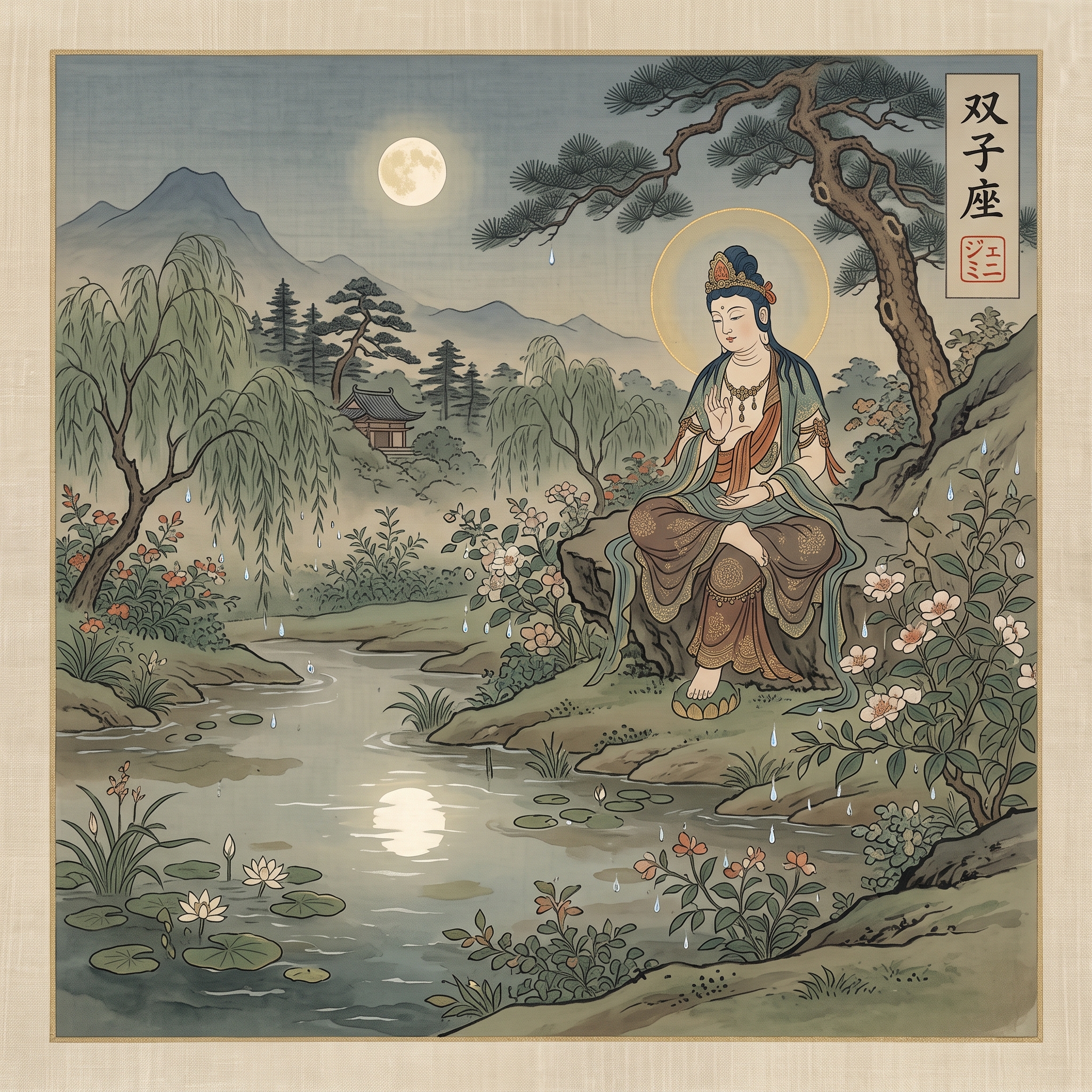
This 1:1 square illustration, executed in the style of traditional Japanese Buddhist painting on silk, visualizes the metaphors of Nichiren's treatise without using prohibited iconographic figures. The central focus is the metaphorical landscape: the naturally 'lucid' moon reflection is captured perfectly in a still pond, despite the 'muddy water' (implicitly understood by the surrounding context), which is shown without deliberation. The natural world is further represented by blooming plants and trees, appearing to 'catch the rain' effortlessly. A seated figure of the Bodhisattva Kannon (Avalokiteshvara), personifying compassion and receptivity, is depicted on the bank, demonstrating a natural harmony with the scene, rather than active deliberation or intellectual analysis. The overall color palette uses soft mineral pigments and subtle gold accents to create a sense of profound, non-striving peace, embodying the idea that reliance on the 'Ever-Present Buddha' naturally harmonizes practitioners with the world, regardless of skill or wisdom. The specific exclusions are strictly followed.
Iconography & Character Identification
Item 1: Deities/Figures Featured: Kannon Bosatsu (Avalokiteshvara), dynamic plants and trees, and the 'moon' with its reflection.
Item 2: Text Translations: The Kanji signature '双子座' translates to "Gemini." The red square seal 'ジェミニ' contains the Katakana characters that also read "Gemini."
Muddy water has no mind but it still catches the moon’s reflection and naturally becomes lucid. Plants and trees catch the rain in order to blossom, but can we say they do this deliberately? The five characters of Myo Ho Ren Ge Kyo are not the text of the sutra nor a mere explanation; rather they are the sole intent of the whole sutra. Beginners may practice this without knowing the heart (of the Lotus Sutra), but their practice will naturally harmonize with its intention.
Nichiren wrote this passage in his Treatise on The Four Depths of Faith and Five Stages of Practice (Shishin Gohon-Shō). This is another way of saying that we do not need to rely on our own skills or wisdom to practice the Buddha Dharma. Whether we are brilliant or slow, focused or distracted, calm or agitated, when we rely on the Ever-Present Buddha, we are in harmony with the world.
The Daily Dharma is produced by the Lexington Nichiren Buddhist Community. To subscribe to the daily emails, visit zenzaizenzai.com
Today is the first day of the Higan week, the three days before the equinox and the three days after. As explained in a Nichiren Shu brochure:
For Buddhists, this period is not just one characterized by days with almost equal portions of light and dark. Rather, it is a period in which we strive to consciously reflect upon ourselves and our deeds.
Today we consider the Perfection of Generosity. This essay was generated by Google’s Gemini Notebook and then edited for publication here. The essay is derived from the 400 or so letters written by Nichiren uploaded as source material for the Nichiren Notebook.
In the teachings of Nichiren Shōnin, the act of charity (fuse or dāna) is elevated from a simple material donation to a profound spiritual expression of a person’s very life. Building upon the principles of the Lotus Sutra, the teachings provide deep guidance on how ordinary practitioners in the Latter Day of the Dharma can engage in true charity, how its value is determined, and why its purity at the source is of paramount importance.
Offering in Actuality versus Offering in Principle
Nichiren draws a clear, compassionate distinction between the self-sacrificial acts of ancient sages and the deeds of ordinary people in the Latter Day of the Dharma.
Ancient sages practiced “offering in actuality” (ji-fuse), literally sacrificing their physical bodies for the Dharma. For instance, the boy Snow Mountains offered his body to a demon to receive a half-verse of teaching, Bodhisattva Medicine King burned his arms, Prince Shōtoku peeled off the skin of his hand to copy the Lotus Sutra, and Emperor Tenji burned his finger as an offering to the Buddha.
Because such extreme physical sacrifices are impossible for ordinary people, Nichiren explains that what is appropriate for you is “offering in principle” (ri-fuse), which is based entirely on “earnest resolve” (ichijō no kokorozashi). He writes that when one carefully considers what “earnest resolve” refers to, it is the doctrine of observing the mind, which means that offering one’s only robe to the Lotus Sutra is equivalent to peeling off one’s skin; and that in a time of famine, offering the food that is the only means for sustaining one’s life that day to the Buddha is offering one’s life to the Buddha.
Understood in this light, a material gift is not a mere object; it is the offering of your very life. Nichiren deeply comforted his disciples by assuring them that the polished rice or barley they sent was not just grain, but “life itself.” By offering what sustains your daily existence with sincere faith, the blessings you receive are in no way inferior to those of the great sages of the past.
The Great Value of Giving in Times of Adversity
In the writings of Nichiren, the spiritual value of charity is never measured by the size or monetary worth of a donation, but by the timing, the place, and the sincerity of the giver.
He reminds practitioners that a drop of water in a time of drought, or a spark of fire when one is freezing, holds incalculable value. When his young disciple Nanjō Tokimitsu sent wheat, salt, or yams to the Nichiren’s remote snowbound dwelling in Minobu during times of famine, drought, and winter isolation, Nichiren expressed deep gratitude. He wrote that in the eyes of ordinary people, these gifts appeared as grain, but in the eyes of the Buddhas, they were the very “seeds of Buddhahood.”
Furthermore, Nichiren notes that because the Lotus Sutra is the teacher of all Buddhas, making an offering to its votary or practitioner in the Latter Day of the Dharma yields benefits far greater than making offerings to the Buddha himself. He references the “Teacher of the Dharma” chapter of the Lotus Sutra to show that supporting a teacher of the Dharma who is despised, slandered, and persecuted by society brings blessings that even the Buddha’s wisdom cannot fully measure.
Purity of Charity at the Root
While the act of giving is highly praised, Nichiren insists that true charity must be pure at its root. In his letters to the lay nun of Kubo, he warns that if a person obtains wealth through evil means—such as killing living beings, stealing, waging war, or oppressing and exploiting others—and then donates that wealth to acquire merit, the offering remains an evil deed. He employs a powerful and graphic metaphor to illustrate this:
“Suppose someone dried dung, crushed it, and refined it into a piece of wood to carve a statue of a Buddha. If we burn it, it will not smell like fragrant sandalwood; it would still only smell of dung.”
Because the source is impure, such donations vanish without a trace and cannot lead the giver to Buddhahood. Sincere charity must be built upon clean, honest efforts and a heart of pure faith.
When 500 arhats explained the true origin of their bodies in this life they spoke of the Hinayāna doctrine of “the 12 causations” (12 links of cause and effect: spiritual ignorance, blind actions, consciousness, mental functions and matters, six sense organs, contact, perception, desire, attachment, existence, birth, and old age and death). It suggests that they entered the state of “emptiness and tranquility” through spiritual ignorance (cause of all illusions) or blind actions (practices caused by spiritual ignorance). Their arguments centered on the entrance to the Buddha Dharma, not the Dharma itself, hence they did not commit the sin of slandering the Dharma. Regarding the four expedient means in the Collection of Mahāyāna Essentials and the four ways of preaching expounded in the Great Wisdom Discourse, they are the means for interpreting the teachings of the pre-Lotus sūtras by Bodhisattvas Asaṅga and Nāgārjuna, commentators appearing after the passing of the Buddha, who perceived the spirit of all the Buddhist scriptures from the standpoint of the Lotus Sūtra. If we confuse the four expedient means and the four ways of preaching expounded in the sūtra preached for “revealing the truth and merging all the provisional” with those expounded in the sūtra not preached for “revealing the truth and merging all the provisional,” how do we not commit the sin of slandering the Dharma? Those who know these know the teaching.
Ken Hōbō-shō, A Clarification of Slandering the True Dharma, Writings of Nichiren Shōnin, Doctrine 3, Pages 123
Conceptual Summary
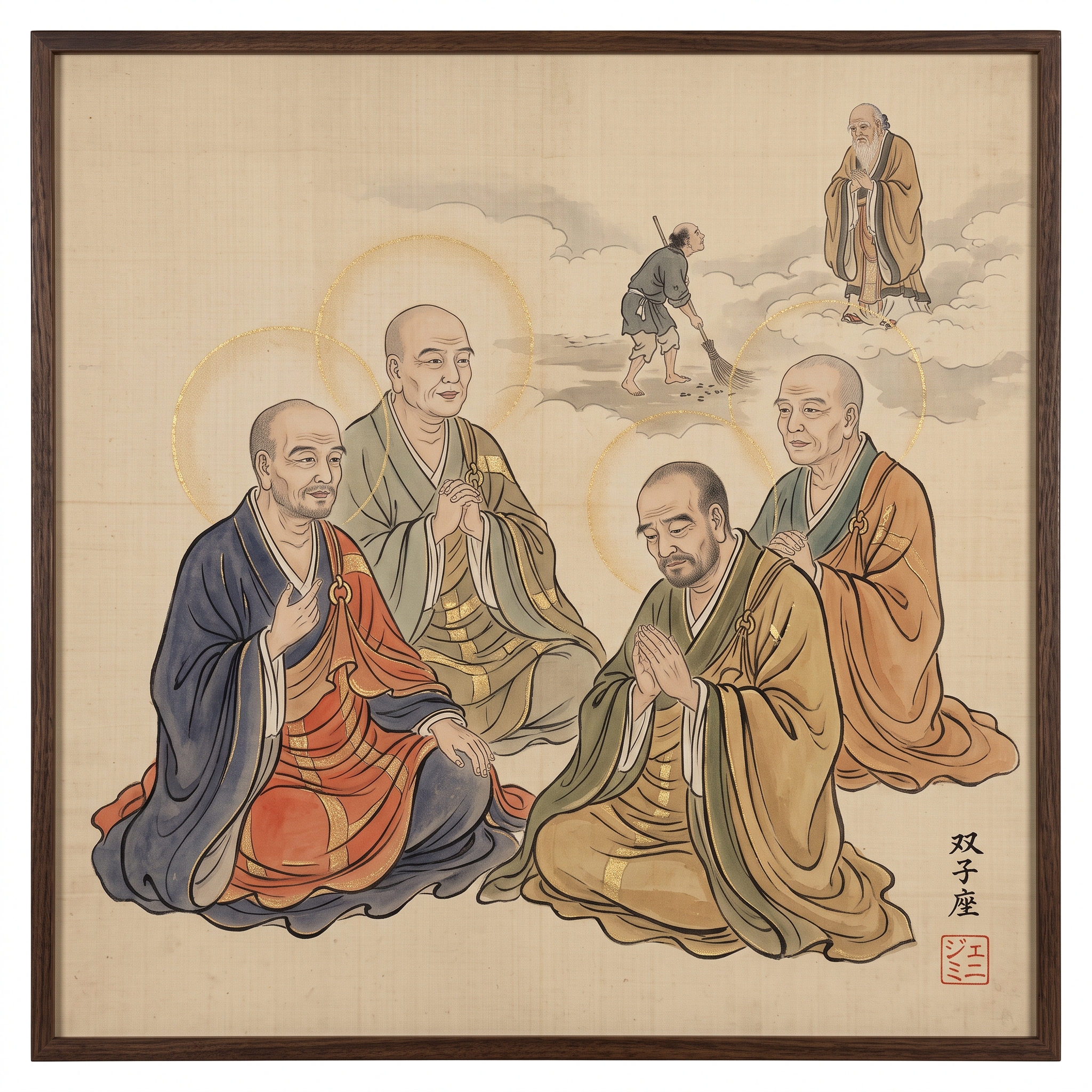
This 1:1 square composition, rendered in the traditional style of Japanese silk painting with inks and mineral pigments, visualizes the realization of four of Buddha's great disciples as recounted in Chapter Four of the Lotus Sutra. The primary subjects are the elders Subhuti, Maha-Katyayana, Maha-Kashyapa, and Maha-Maudgalyayana, grouped together in humble contemplation as they recite the verses detailing their previous contentment with mere arhatship—the elimination of personal suffering and illusions. While they appear satisfied, the central empty space at their feet, subtly outlined in gold leaf, signifies the deeper void yet to be realized, pointing towards the complete Buddhahood they are about to embrace. Their posture of satisfied inertia visually captures the text's core theme: 'we did nothing more' because we were satisfied. This visualizes their initial mistake—confusing the removal of defilements with total enlightenment—as discussed in the parable of the wealthy father's wayward son.
Iconography & Character Identification
Item 1: Deities/Figures Featured:
Subhūti (identified by a specific hand position, reflecting his association with voidness)
Mahā-Kātyāyana
Mahā-Kāśyapa
Mahā-Maudgalyāyana
Item 2: Text Translations:
The Kanji signature: 双子座 (Futagoza) - meaning "Gemini".
The Katakana text in the red seal: ジェミニ (Jemini) - meaning "Gemini".
We were satisfied with the elimination
Of illusions within ourselves.
What we accomplished was that elimination.
We did nothing more.
These verses are sung by Subhūti, Mahā-Kātyāyana, Mahā-Kāśyapa, and Mahā-Maudgalyāyana in Chapter Four of the Lotus Sūtra. They use the parable of the wayward son in this chapter to describe their own realization that the Buddha had not held any teaching back from them. Instead, the Buddha earlier allowed them to remain in the satisfaction of ending their own suffering. But before they can continue their progress towards the Buddha’s own enlightenment, they must give up their preoccupation with suffering, as the boy in the parable had to give up his idea of himself as a lowly hired worker, rather than the heir to his father’s treasure.
The Daily Dharma is produced by the Lexington Nichiren Buddhist Community. To subscribe to the daily emails, visit zenzaizenzai.com
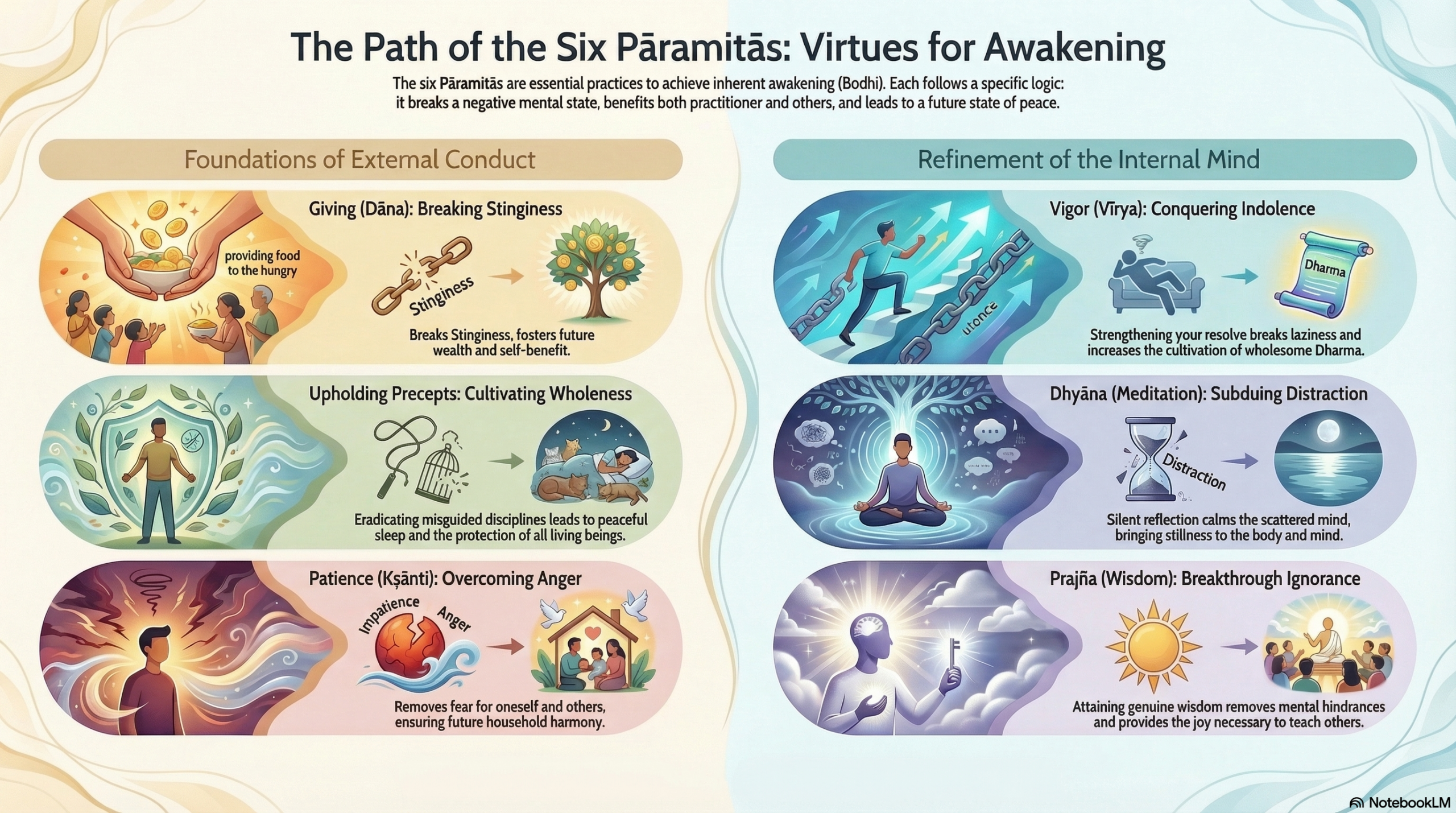
Back in March, at the conclusion of the Spring Higan, I created an infographic explaining the Six Perfections. This infographic was generated by Google’s Gemini Notebook from what Chinese Master Hsuan Hua said about the six perfections and their four corresponding factors in the Devadatta Chapter of his commentary on the Lotus Sutra.
six-paramitas-virtues-awakening
That was then. Now I have a very different perspective on the six perfections and, in particular, their role in Nichiren Buddhism.
I started marking the full Higan week back in March 2021. At the time I explained:
Higan is traditionally a week-long practice, with the three days before and the three days after the Equinox devoted to the six paramitas and the Equinox devoted to memorials for the dead. As I have learned from Rev. Igarashi, at the Equinox the veil between this world and the spiritual world is at its thinnest.
I say “traditionally” three days before and after the Equinox focus on the six paramitas, but I am unable to find any American priest who actually performs week-long services or other observations as part of Higan. So, here I am. I’m creating my own Higan week observance with two, month-long introductions. In future years I envision devoting just the week around the Spring and Fall Equinoxes to the six paramitas and a memorial service.
And every Spring and Fall Equinox since I have posted material related to the six paramitas the three days before and the three days after. I was motivated by a feeling that there just wasn’t enough focus on being good Buddhists, of acting in ways that showed charity, morality, patience, vigor, meditation and wisdom.
The goal has been to provide an introduction into the nature and power of the Odaimoku. This project seeks to show that chanting Namu-Myoho-Renge-Kyo can change everything – you, your family, your environment, all with “Actual Proof.”
With the help of Google’s Gemini Notebook, I was able to digest a pile of academic papers, Nichiren Shu brochures and Nichiren’s own writings. Well, Gemini Notebook did the actual digesting, but the answers I received from the Gemini Notebook helped me understand how and why my focus on the six perfections was misplaced and how I had not really understood what Nichiren taught about the Lotus Sutra and the power of the Daimoku.
Below is an essay generated by Google’s Gemini Notebook and then edited for publication here. The sources used by Gemini Notebook were limited to just the 400 or so letters Nichiren wrote. None of the Nichiren Shu brochures or academic interpretations were used in this assessment of Nichiren’s teaching on the perfections. This summation of what Nichiren wrote has been edited by me. While I did not substantially change what the original Gemini Notebook essay said, what I’ve published should be considered my interpretation. The original essay is available among the artifacts in the Nichiren Notebook.
In the teachings of Nichiren Shōnin, the six paramitas—charity (almsgiving), keeping the precepts, forbearance (patience), effort (assiduousness), meditation, and wisdom—are understood not as a ladder of gradual, self-directed cultivation, but as a complete set of virtues that are already perfectly realized and accessible to you through the Lotus Sutra.
By shifting the focus from arduous personal discipline to the single-minded practice of faith, Nichiren reveals how the merit of all six paramitas is naturally transferred to your life.
Definition of the Six Paramitas in the Lotus Sutra
In the Kaimoku-shō (Open Your Eyes to the Lotus Teaching), Nichiren Shōnin explains that the Sanskrit name for the Lotus Sutra, Saddharma-puṇḍarīka-sūtra, begins with the word sad (translated as myō, or “wonderful,” in Chinese). The word myō represents gusoku, or “perfect endowment,” while the word sad also connotes “six,” referring directly to the six paramitas representing all the ten thousand practices of the bodhisattvas.
When the great bodhisattvas and voice-hearers in the assembly expressed their desire to know how a bodhisattva could fulfill the six paramitas to obtain Buddhahood, Śākyamuni Buddha revealed that the ultimate path of these practices is entirely contained within the Lotus Sutra.
‘Natural Transfer’
In traditional, gradual Buddhism, a practitioner was expected to perform the six paramitas over countless lifetimes to slowly erase defilements and accumulate merit. However, Nichiren taught that Śākyamuni Buddha already completed these causal practices on your behalf. All the merits of the Buddha’s eon-spanning discipline are perfectly compressed and contained within the five characters of Myō-hō-ren-ge-kyō.
To illustrate this, Nichiren recounts the dramatic past lives of the Buddha, demonstrating how he perfected each paramita:
Almsgiving (Charity / Dāna): As Prince Sattva, the Buddha offered his body to feed a starving tigress, and as King Shibi, he offered his own flesh to a hawk to save a dove.
Keeping the Precepts (Śīla): As King Shrutasoma, he refused to violate the precept of keeping his word, returning to his captor even when it meant facing execution.
Forbearance (Patience / Kṣānti): As the ascetic Forbearance, he patiently and lovingly endured having his limbs, ears, and nose hacked off by the enraged King Kāli of Varanasi, refusing to harbor any anger.
Effort (Assiduousness / Vīrya): As Prince Earnest Donor (Prince Dāna), he tirelessly braved the great oceans to find a wish-granting jewel to relieve the poverty of all people.
Meditation (Dhyāna): As the Hermit Shōjari, he sat in such perfect, unmoving concentration that he did not stir even when a heron laid its eggs on his head and he waited for them to hatch.
Although ordinary people in the Latter Day of the Dharma have not formed a single good cause, by simply placing faith in the Odaimoku, you spontaneously receive the exact same benefits as if you had completed all these practices yourself. Nichiren compares this to a baby drinking its mother’s milk. The infant does not understand the biological formulas or ingredients of the milk, yet by swallowing it, the baby’s life is naturally sustained and nurtured. In the same way, the Buddha feeds all living beings with the milk of his own paramita practices transformed into the characters of the Lotus Sutra.
Restrictions for Beginners
For followers of the Lotus Sutra in the Latter Day of the Dharma, Nichiren Shōnin puts forward a profound instruction: beginners are actually restricted from attempting to practice the first five paramitas (such as almsgiving and keeping precepts).
In his treatise On the Four Stages of Faith and the Five Stages of Practice (Shishin Gohon-shō), he explains that trying to divide one’s focus between the primary practice of faith and subordinate, external practices will dilute and obstruct a beginner’s path. He cites the Great Teacher T’ien-t’ai’s warning from the Words and Phrases of the Lotus Sutra:
“The beginner is afraid that getting drawn into the myriad activities that are supporting conditions [the five paramitas] will hinder their practice of right action. At this time, they should solely uphold this sutra…”
To clarify this, Nichiren compares a beginner trying to practice the paramitas to a small, fragile ship loaded with heavy gold and silver treasures. When hit by the turbulent waves of the world, both the ship and the heavy treasures will sink. Therefore, you are instructed to set aside formal, external practices and single-mindedly focus on the primary practice of chanting the Odaimoku.
The Surpassing Benefits of Faith
This focus on faith does not mean you lack the merits of the paramitas; rather, they are automatically provided to you. Nichiren points to the Immeasurable Meanings Sutra as proof:
“Although they have not yet been able to practice the six pāramitās, the six pāramitās will of themselves appear before them.”
By holding fast to the Odaimoku, ordinary people are recognized as bodhisattvas who have completely accomplished all the paramitas and kept all the precepts without physically needing to perform them.
Furthermore, the Distinctions in Benefits chapter of the Lotus Sutra declares that the benefit of arousing even a single moment of belief and understanding upon hearing the sutra far surpasses the benefit of practicing five paramitas for eighty million billion kalpas. By prioritizing faith and placing the Odaimoku at the center of your life, you are immediately aligned with the complete, perfect virtues of Śākyamuni Buddha.
For the three days before the Fall Equinox and the three days after I will be publishing essays on what Nichiren said about each of the perfections.
[What Śākyamuni] preached during His life of fifty years is Mahāyāna (greater vehicle) as a teaching of salvation when compared to geten and gedō. Ever since His attainment of Buddhahood till the eve of His entering Nirvana, He preached only the truth.
Considering the 80,000 teachings preached by the Buddha in various sūtras for fifty years, however, we see differences among them, such as those between Hinayāna and Mahāyāna Buddhism, provisional and ultimate sūtras, exoteric and esoteric teachings, gentle and rough expressions, genuine and expedient words or true and false opinions. The Lotus Sūtra alone among them represents the true words of our Lord Śākyamuni Buddha and various Buddhas residing in the world throughout the universe in the past, present, and future.
Kaimoku-shō, Open Your Eyes to the Lotus Teaching, Writings of Nichiren Shōnin, Doctrine 2, Page 33-33
Conceptual Summary
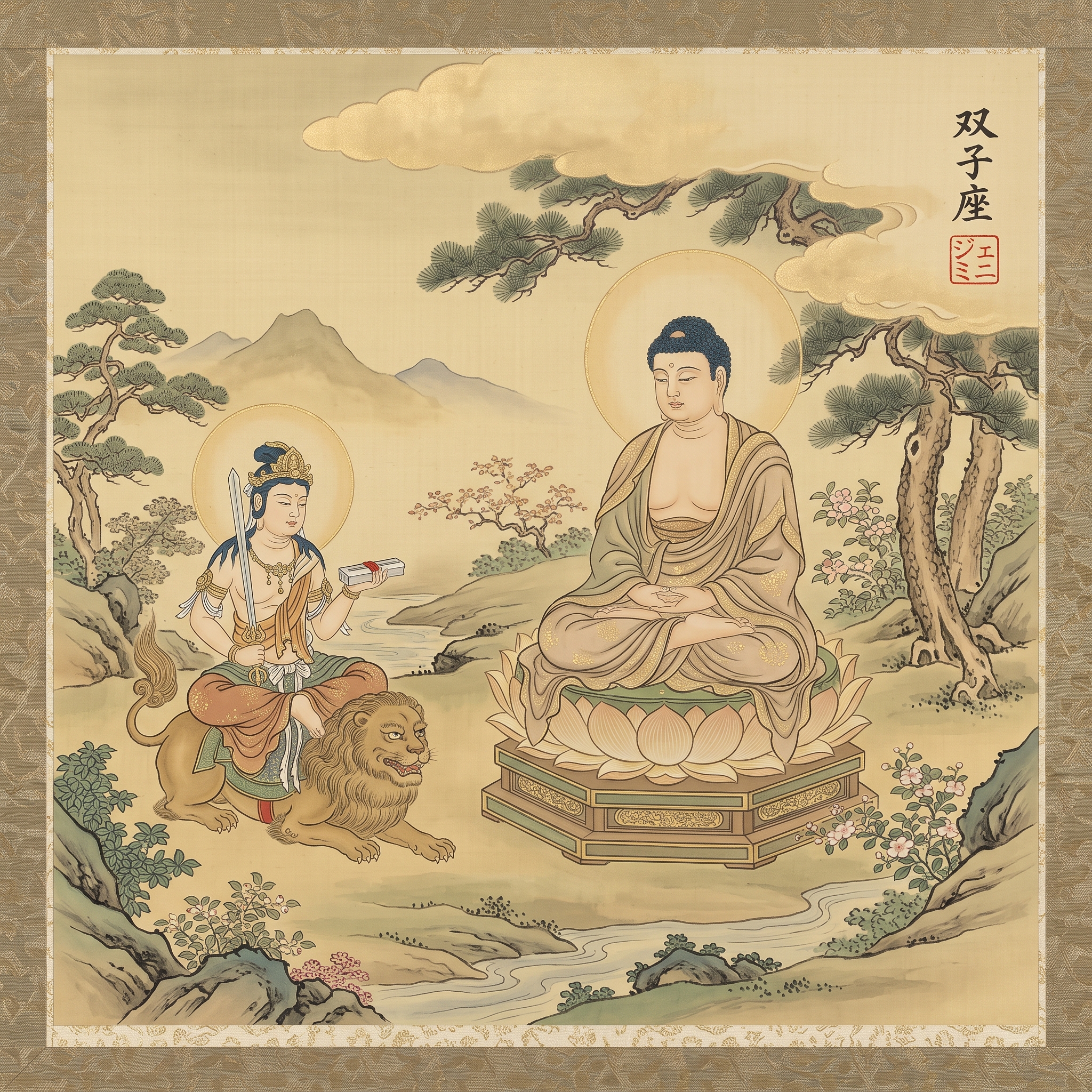
This illustration interprets the instruction from the Lotus Sūtra for a Bodhisattva to seek a "retired place" for dhyāna meditation. The composition utilizes classical Japanese Buddhist iconography on silk, rendering a serene natural landscape with traditional inks and mineral pigments. Śākyamuni Buddha is depicted in the dhyāna mudra, embodying the goal of mental concentration and quiet reflection emphasized in the text. The landscape—featuring mountains, pines, a gentle stream, and gold-leaf clouds—creates the specific atmosphere of a secluded retreat, essential for overcoming worldly attachments. Mañjuśrī Bodhisattva, identified iconographically with his sword and sutra atop a lion, attends to Śākyamuni, directly reflecting the source text where the Buddha delivers this explanation to him. The soft, harmonious colors and gold accents emphasize the sacred and peaceful nature of this spiritual practice.
Iconography & Character Identification
Item 1: Deities/Figures Featured:
Śākyamuni Buddha (釈迦如来), seated in meditation on a lotus throne.
Mañjuśrī Bodhisattva (文殊菩薩), riding a lion and holding a sword and scripture.
Item 2: Text Translations:
Kanji Signature (双子座): Futagoza (Gemini)
Red Seal (ジェミニ): Gemini
He should always make it a pleasure to sit in dhyāna. He should live in a retired place and concentrate his mind. Mañjuśrī! [A retired place] is the first thing he should approach.
The Buddha gives this explanation to Mañjuśrī Bodhisattva in Chapter Fourteen of the Lotus Sūtra in which he describes the peaceful practices of a Bodhisattva. For those who are awakening their nature as Bodhisattvas to benefit all beings, and setting aside their attachment to their own suffering, this can be a difficult transition. Our habits of engaging with the drama and delusion in the world can be too strong to overcome. This is why the Buddha emphasizes the importance of quietly reflecting on what happens around us, and our reactions to them. Through dhyāna meditation, we learn not to believe everything we think, and that we can change our understanding of the world. We also learn that allowing our minds to change is the only way we can benefit other beings.
The Daily Dharma is produced by the Lexington Nichiren Buddhist Community. To subscribe to the daily emails, visit zenzaizenzai.com