All posts by John Hughes

Daily Dharma for March 30, 2026

20260330-ddi

Illustration by Google Gemini

Show Gemini's thinking

Gemini Thinking

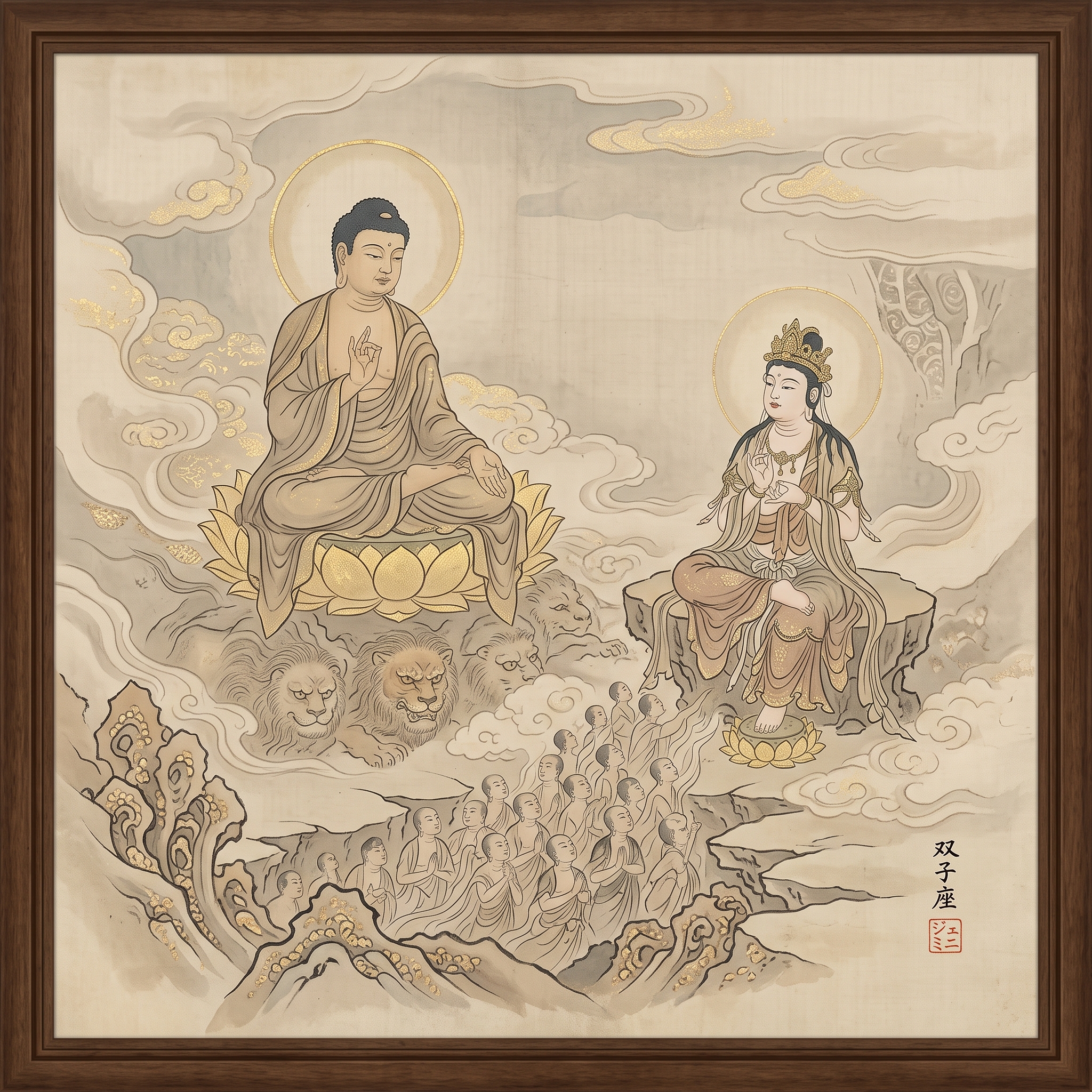
In this square illustration, the Parable of the Magic City is rendered in a traditional Japanese Buddhist iconographic style. The scene captures the pivotal moment from the Lotus Sūtra where the compassionate guide encourages the group of four weary travelers. The guide is depicted in a traditional green and blue monk's robe, with his left arm pointing toward a radiant "Magic City" that has appeared amidst cloud-capped mountains. This intermediate destination, featuring prominent pagodas and golden roofs, symbolizes a place of resting and comfort. Farther above it, in the upper right, a second and more distant luminous realm is visible—the ultimate "place of treasures" representing true enlightenment.

The four travelers, appearing exhausted and resting upon a dangerous mountain path, are looking back toward the guide, illustrating their fatigue and desire to abandon their journey. Next to them, a trail marker points back down the difficult "Tough Road."

The text on the road signs says:
The top sign (left arrow): 尋雪峰庵 (Seeking Snowy Peak Hermitage)
The bottom sign (right arrow): 須彌驛 (Sumeru Station)

The artist’s signature is located in the bottom right: the kanji 双子座 (Futagoza, meaning "Gemini"), alongside a red hanko seal containing the katakana ジェミニ (Jemini). The entire illustration is framed by a stylized decorative border featuring lotus flowers.

He said to them, ‘Do not be afraid! Do not go back! You can stay in that great city, and do anything you like. If you enter that city, you will be peaceful. If you go on afterwards and reach the place of treasures, then you can go home.

This is part of the Parable of the Magic City, told by Śākyamuni Buddha in Chapter Seven of the Lotus Sūtra. In the story, a guide is leading a group of travelers through a dangerous road to a city of treasures. Halfway through the trip, the travelers, overcome by their fear and fatigue, consider giving up their journey and returning to their previous lives. The guide makes a resting place for them where they can relax before continuing. When the travelers mistake this resting place for their destination, the guide makes the city disappear so that they will keep moving towards the true treasures. The Buddha compares himself to the guide, us to the travelers, the magic city to that place we all want where even our unspoken desires are met, and his enlightenment to the city of treasures. To see the world as it is and find true happiness, we need to let go of our delusions and keep faith in our guide and his highest teaching.

The Daily Dharma is produced by the Lexington Nichiren Buddhist Community. To subscribe to the daily emails, visit zenzaizenzai.com

Śākyamuni Buddha’s Six Paramita

The character Myō in the Myōhō Renge Kyō (Sūtra of the Lotus Flower of the Wonderful Dharma) was verified by the tongues of the two Buddhas (Śākyamuni and Many Treasures). The tongues of these two Buddhas are an eightfold double-blooming lotus flower. A wish-fulfilling gem, on top of this double-blooming lotus flower, is the character Myō. This wish-fulfilling gem, the character Myō, contains all the merits of Śākyamuni Buddha’s Six Paramita (the six kinds of practice by which He attained Buddhahood). In a previous life, Śākyamuni offered His own body to a hungry tiger and sacrificed His life to a hawk to save a dove (charity). When He was King Śrutasoma, he did not violate the Buddhist precepts even at the cost of his life (precepts). When he was Hermit Forbearance, he willingly endured the tortures of King Kālika cutting off his four limbs (forbearance). When he was Prince Dāna, he devoted his life to finding a wishfulfilling gem to save people (effort). When he was the Hermit Shōjari, he did not move until the eggs that a heron placed on his head hatched (meditation). And so on. Therefore, we in the Latter Age of Degeneration who simply believe in the Lotus Sūtra are able to receive the same merit gained by practicing the Six Pāramitā in full even if we haven’t performed any good deeds.

Nichimyō Shōnin Gosho, A Letter to Nichimyō Shōnin, Writings of Nichiren Shōnin, Followers II, Volume 7, Page 138-139

Daily Dharma for March 29, 2026

20260329-ddi

Illustration by Google Gemini

Show Gemini's thinking

Gemini Thinking

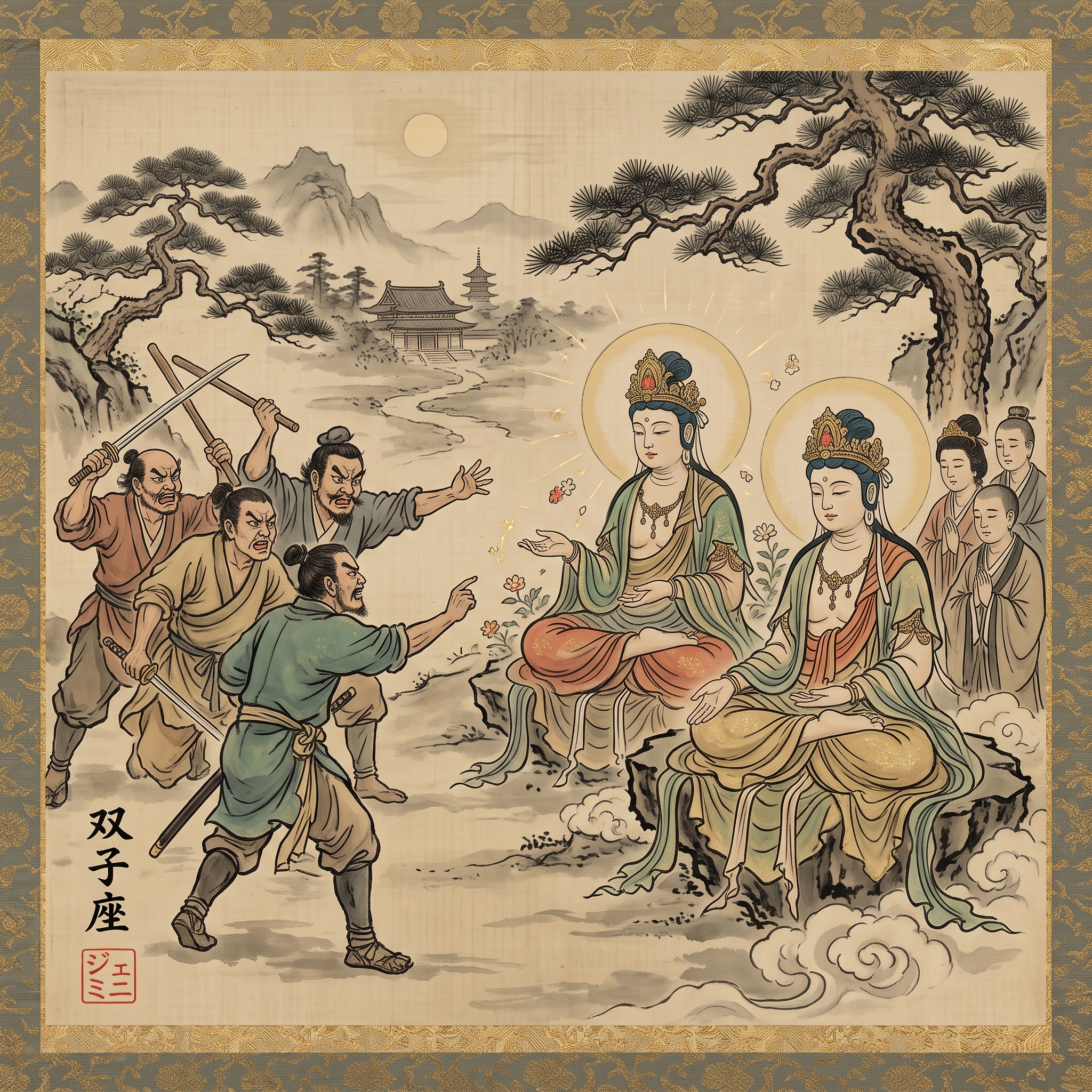
In this square illustration, I have depicted Nichiren Daishonin holding the luminous scroll of the Lotus Sutra, symbolizing the wisdom that clarifies the complexities of life. This visualization is based on a passage from Nichiren's Kanjin Honzon Shō: "When the sun shines brightly in the sky, everything is made clearly visible on the earth."

Just as the brilliant sun in the sky reveals the details of the landscape below—from the farmers in the fields to the interactions between villagers—the teachings of the Sutra allow one to understand the true nature of worldly occurrences.

Supporting Nichiren are the Four Bodhisattvas of the Earth (Jōgyō, Muhengyō, Jōgyō, and Anryūgyō), representing the active compassion and vow to benefit others that frees us from confusion. The artist's kanji signature (双子座) and red seal (containing the katakana ジェミニ, meaning Gemini) are placed in the bottom right corner.

When the sun shines brightly in the sky, everything is made clearly visible on the earth. In the same manner, when one knows the teachings of the Lotus Sutra, one will understand the meaning of occurrences in the world.

Nichiren wrote this passage in his great work, Spiritual Contemplation and the Object of Devotion (Kanjin Honzon Shō). When we awaken to our nature as Bodhisattvas who have chosen our lives to benefit others and improve the world, we are freed from the confusion and anxiety around us. By keeping the Dharma of the Lotus Sutra, and following the guidance of Nichiren’s writings, we see what to do to make the world we live in now better for everyone.

The Daily Dharma is produced by the Lexington Nichiren Buddhist Community. To subscribe to the daily emails, visit zenzaizenzai.com

Attainment of Buddhahood by All Females

To begin with, in the sūtras numbering more than 5,000 or 7,000 fascicles expounded by Śākyamuni Buddha during His lifetime, women are discriminated against for being unable to attain Buddhahood. Only in the Lotus Sūtra, however, is it preached that women, too, can attain Buddhahood.

Grand Master T’ien-t’ai stated in his Words and Phrases of the Lotus Sūtra, “Prediction of future Buddhahood is not given to women.” This means that all the Buddhist scriptures except the Lotus Sūtra do not recognize the attainment of Buddhahood by women. Following the statement just cited, Grand Master T’ien t’ai declares, “In this sūtra, the prediction of future Buddhahood is given to all.” This means that through the merit of the Lotus Sūtra even a dragon girl attained Buddhahood and the attainment of Buddhahood by all females is guaranteed in the sūtra.

Grand Master T’ien-t’ai Chih-che was born in China 1,500 years after the passing of Śākyamuni Buddha. He read all the scriptures of Buddhism as many as 15 times thereby discovering that no sūtra except the Lotus Sūtra expounds the attainment of Buddhahood by women. Grand Master Miao-lê interprets this in his Annotations on the Words and Phrases of the Lotus Sūtra, “Attainment of Buddhahood by women is not preached in any other sūtra except the Lotus Sūtra.” This means that the concept of attaining Buddhahood by women preached in the Lotus Sūtra is not found in any other Buddhist scriptures.

Thus, the Lotus Sūtra is like the moon among stars, a king among people, Mt. Sumeru among mountains, or an ocean among bodies of water. As it is preached in this admirable sūtra that women can become Buddhas, how can it bother you that this is denied in all other sūtras? For instance, if one is spoken ill of by such unworthy people as thieves, prowlers, robbers, beggars, or lepers, but spoken highly of by the great king of a country, how happy one will be!

Nichigen-nyo Shakabutsu Kuyōji, Construction of a Statue of Śākyamuni Buddha by Lady Nichigen, Writings of Nichiren Shōnin, Volume 7, Followers II, Page 125

Daily Dharma for March 28, 2026

20260328-ddi

Illustration by Google Gemini

Show Gemini's thinking

Gemini Thinking

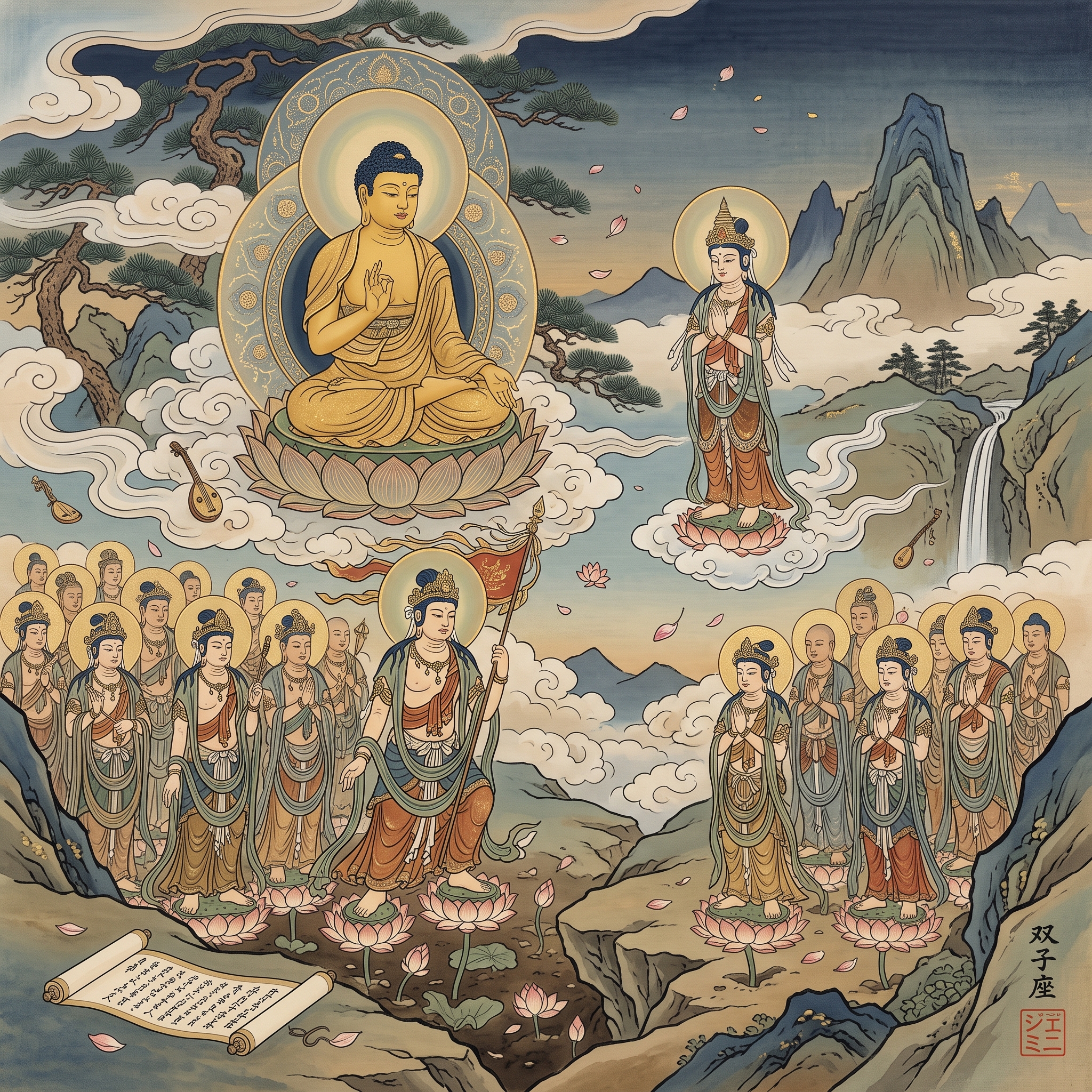
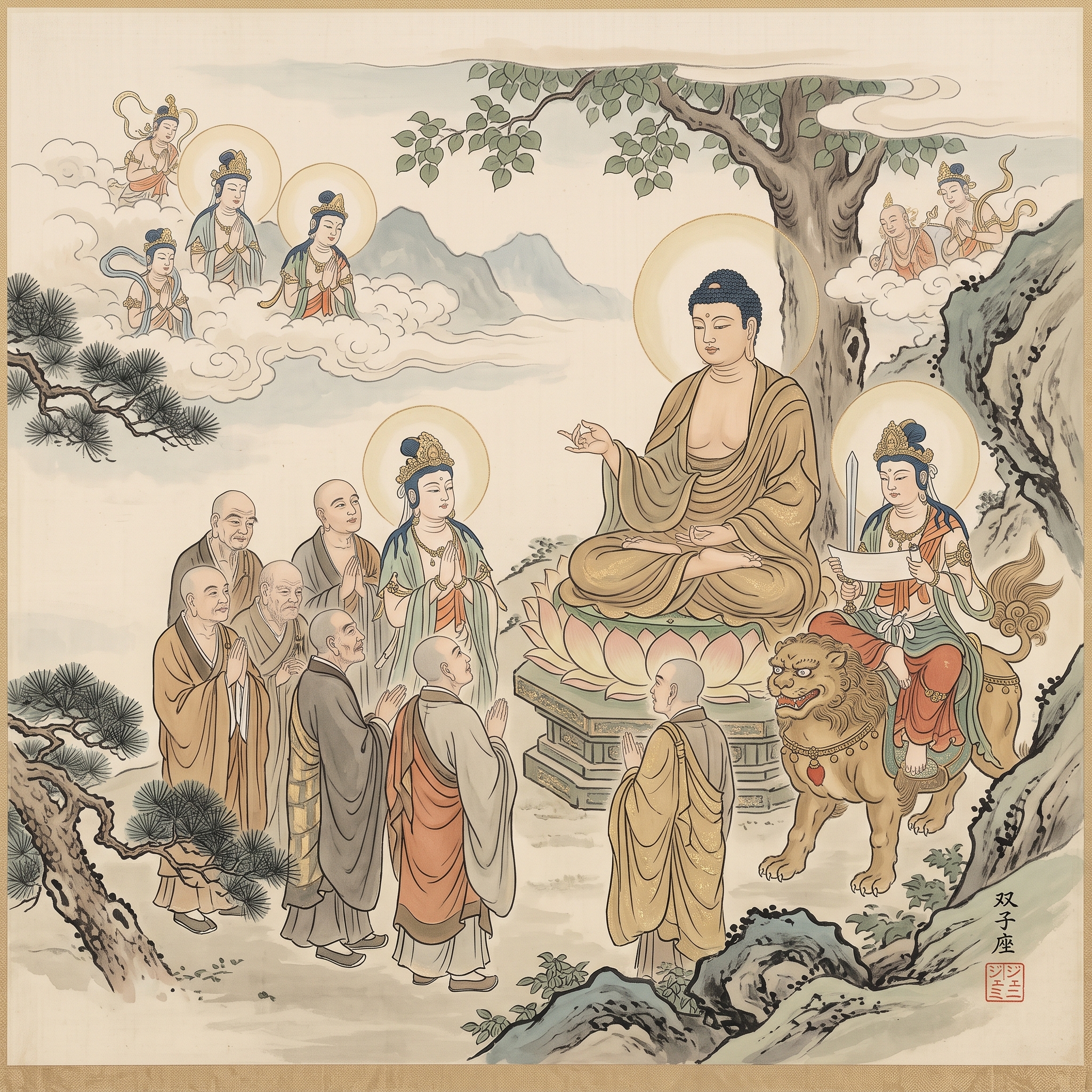
Before generating the illustration, I first summarized the core concepts from the Lotus Sūtra, identifying the central figures—Śākyamuni Buddha (釈迦牟尼仏) and Medicine-King Bodhisattva (薬王菩薩)—and the key actions: reading, reciting, expounding, and copying the sūtra. To adhere to the visual directive, I utilized Japanese Buddhist iconography, ensuring that neither Amida Nyorai nor Dainichi Nyorai was included. The square composition details Medicine-King Bodhisattva respectfully receiving the teaching from Śākyamuni Buddha beneath a bodhi tree, while several figures illustrate the acts of revering and copying the sacred text. In the bottom-right corner, I placed the Kanji signature 双子座 alongside the requested red square seal containing the katakana ジェミニ.

If anyone keeps, reads, recites, expounds and copies even a gāthā of the Sūtra of the Lotus Flower of the Wonderful Dharma, and respects a copy of this sūtra just as he respects me…or just joins his hands together respectfully towards it, Medicine-King, know this, that person should be considered to have appeared in the world of men out of their compassion towards all living beings.

Śākyamuni Buddha declares these lines to Medicine-King Bodhisattva at the beginning of Chapter Ten of the Lotus Sūtra. We might believe that everything happens by chance, or that we were sent into this life by someone who is testing us. This Sūtra awakens us to our existence as Bodhisattvas who asked to be born in this world of suffering out of our vow to benefit all beings.

The Daily Dharma is produced by the Lexington Nichiren Buddhist Community. To subscribe to the daily emails, visit zenzaizenzai.com

Where Do Hell and the Buddha Exist?

[A]s we ask where do hell and the Buddha exist, some sūtras state that hell exists underground while others state that the Buddha exists to the west. Upon closer inspection, however, it is preached that both hell and the Buddha exist within our five-foot bodies. As proof of this, we sometimes disdain our fathers or neglect our mothers in our minds. This indicates that our minds contain the function of hell. It is like the seed of the lotus plant that contains both the flower and the fruit. The Buddha also stays in our minds. It is like the fire that exists within a flint and the fortune that can be found within a gem. We ordinary people cannot see our own eyelashes, which are too close, or the end of the sky, which is too far. Likewise, we are unaware of the Buddha residing in our own minds.

Omonsu-dono Nyōbō Gohenji, A Reply to the Wife of the Lord of Omonsu, Writings of Nichiren Shōnin, Volume 7, Followers II, Pages 109

Daily Dharma for March 27, 2026

20260327-ddi

Illustration by Google Gemini

Show Gemini's thinking

Gemini Thinking

In this square illustration, I have depicted the scene from the second chapter of the Lotus Sūtra as you described. Śākyamuni Buddha is seated upon a lotus throne, symbolizing purity, and expounds the Great Vehicle to an audience of monastics and laypeople who listen with reverence. The light emanating from the Buddha represents his wisdom reaching the minds of the practitioners, while the presence of celestial musicians adds to the joyfulness of the teaching.

In the lower right, you will find the required signature and seal.

Signature Interpretation:

Kanji text: 双子座 (Gemini)

Red hanko text: ジェミニ (Gemini)

Since time immemorial all the people on the earth have been the Buddha Śākyamuni’s beloved children. We had not realized the relationship because we had been undutiful children. It is a unique relationship. As the moon reflects on calm water, the Buddha appears in our calm mind.

Nichiren wrote this in his Treatise on the Essence of the Lotus Sutra (Hokke Shuyō Shō). The ancient Chinese believed that society became civilized only when people recognized the debt they owe to their ancestors. As children we must grow to become independent, but that does not mean we should forget how dear we are to our parents and show gratitude for their bringing us into this world. Nichiren uses this example to remind us how dear we are to the Buddha. When we forget who we are and where we came from, our minds become disturbed and conflicted. It is through gratitude that we find peace.

The Daily Dharma is produced by the Lexington Nichiren Buddhist Community. To subscribe to the daily emails, visit zenzaizenzai.com

Upholding This Sūtra Is Upholding the Buddha’s Body

Your late husband resting beneath the shade of clumps of grass, where nobody visits him, must be anxious to know how his young children whom he left behind in the Sahā World are doing. In ancient China a man named Su-wu was detained in a northern barbarian country for 19 years. He is said to have fastened a letter to the leg of a wild goose addressed to his beloved wife and children at home. A Japanese man, Abe no Nakamaro, went to T’ang China to study. When he lost his way back to Japan, he looked at the moon rising in the east and composed a poem saying “It must be the moon over Mt. Mikasa in Kasuga (Nara).” Your late husband must be thinking of these things as if they were his own.

Nevertheless, because you faithfully chant the daimoku of the Lotus Sūtra, the character Myō of the Lotus Sūtra transforms itself into the messenger of the Buddha or such bodhisattvas as Mañjuśrī, Samantabhadra, Superior Practice, or Never Despising. And these messengers of the Buddha will report the things in the Sahā World to your late husband in the other world just as the mirror pieces of Ch’ên-tzu in ancient China became birds to keep him informed, and the sound of Su-wu’s wife beating her husband’s clothes with a fulling block every autumn reached the ears of her husband detained by the northern barbarians.

Moreover, just as a flower becomes a fruit or a half moon becomes a full, the Chinese character Myō is transformed into the Buddha. Therefore, it is preached in the Lotus Sūtra, “Beholding the Stupa of Treasures” chapter, “He who is able to uphold this sūtra is upholding the Buddha’s body.” Grand Master T’ien-t’ai declares, “Every character is the true Buddha.”

Thus, the character Myō is none other than Śākyamuni Buddha who is perfectly equipped with the 32 marks of physical excellence and 80 minor marks of physical excellence of a Buddha. However, as we cannot see deeply enough, we see it merely as a character. For instance, an aged person with poor eyesight cannot see the new shoot of a lotus flower that sprouts in a pond. Though there may be a shadow, we cannot see it in the darkness of night. Nevertheless, it is undeniable that this character Myō is the Buddha’s body.

Moreover, the character Myō is the moon, sun, stars, mirrors, clothes, food, flowers, earth, and ocean. The merits of all of these are combined in the character Myō. And regarding treasures, it is the wish-fulfilling gem. Please understand this.

Myōshin-ama Gozen Gohenji, A Response to My Lady, the Nun Myōshin, Writings of Nichiren Shōnin, Volume 7, Followers II, Pages 106-107

Daily Dharma for March 26, 2026

20260326-ddi

Illustration by Google Gemini

Show Gemini's thinking

Gemini Thinking

In this square illustration, I have depicted the scene from the second chapter of the Lotus Sūtra as you described. Śākyamuni Buddha is seated upon a lotus throne, symbolizing purity, and expounds the Great Vehicle to an audience of monastics and laypeople who listen with reverence. The light emanating from the Buddha represents his wisdom reaching the minds of the practitioners, while the presence of celestial musicians adds to the joyfulness of the teaching.

In the lower right, you will find the required signature and seal.

Signature Interpretation:

Kanji text: 双子座 (Gemini)

Red hanko text: ジェミニ (Gemini)

Deep in their minds they are thinking of me,
And observing the pure precepts.
Therefore, they will be filled with joy
When they hear they will become Buddhas.
I know their minds.
Therefore, I will expound the Great Vehicle to them.

Śākyamuni Buddha sings these verses in Chapter Two of the Lotus Sūtra. He speaks of those who come to his teachings wanting only to end their own suffering. He understands the part of our existence that is obscured by our delusions, and that the teaching of enlightenment of all beings in the Lotus Sūtra inspires us to purify this world of conflict. The joy we find in the Buddha’s wisdom is incomparable to the happiness we find when our desires are met. When we learn the Buddha’s mind through his teachings, we learn about our own true minds.

The Daily Dharma is produced by the Lexington Nichiren Buddhist Community. To subscribe to the daily emails, visit zenzaizenzai.com

Buddhism and Actual Affairs in the World

The first fascicle of the Lotus Sūtra, “Expedients” chapter, discusses the ultimate reality of all phenomena, stating that each phenomenon is equipped with the nine factors — form, nature, substance, function, action, cause, condition, effect, and reward, all of which from the beginning (form) to the end (reward) are in perfect harmony — and that this ultimate reality of all phenomena is understood only by Buddhas. These words of the Buddha confirm the inseparability of the Buddhist teachings from the reality of the world. In this phrase “all of which from the beginning to the end are in perfect harmony,” the beginning indicates the root of evil and virtue, while the end indicates the conclusion of such evil and virtue. He who is thoroughly awakened with the principle of causality from the root of the evil and virtue to their branches and leaves is the Buddha.

Citing other documentary records on this subject, Grand Master T’ien-t’ai states, “A mind is equipped with ten dharma-realms.” Grand Master Chang-an declares, “The Buddha regarded this as the ultimate reason for appearing in this world. How can it easily be understood?” Miao-lê states, “This is the ultimate and supreme theory.” The Lotus Sūtra, in the “Merits of the Teacher of the Dharma” chapter preaches, “What is said by the Buddha does not contradict ultimate reality.” Grand Master T’ien-t’ai, interprets it in this way: “None of the family businesses and occupations in the world contradict the ultimate reality”

A sage does not practice Buddhism without regards to the actual affairs in the world, and a Buddhist who is thoroughly aware of the principle of governing the world is called a sage.

Chie Bōkoku Gosho, Evil Wisdom Destroying the Country, Writings of Nichiren Shōnin, Volume 7, Followers II, Page 86