
All posts by John Hughes

Daily Dharma for March 25, 2026

20260325-ddi

Illustration by Google Gemini

Show Gemini's thinking

Gemini Thinking

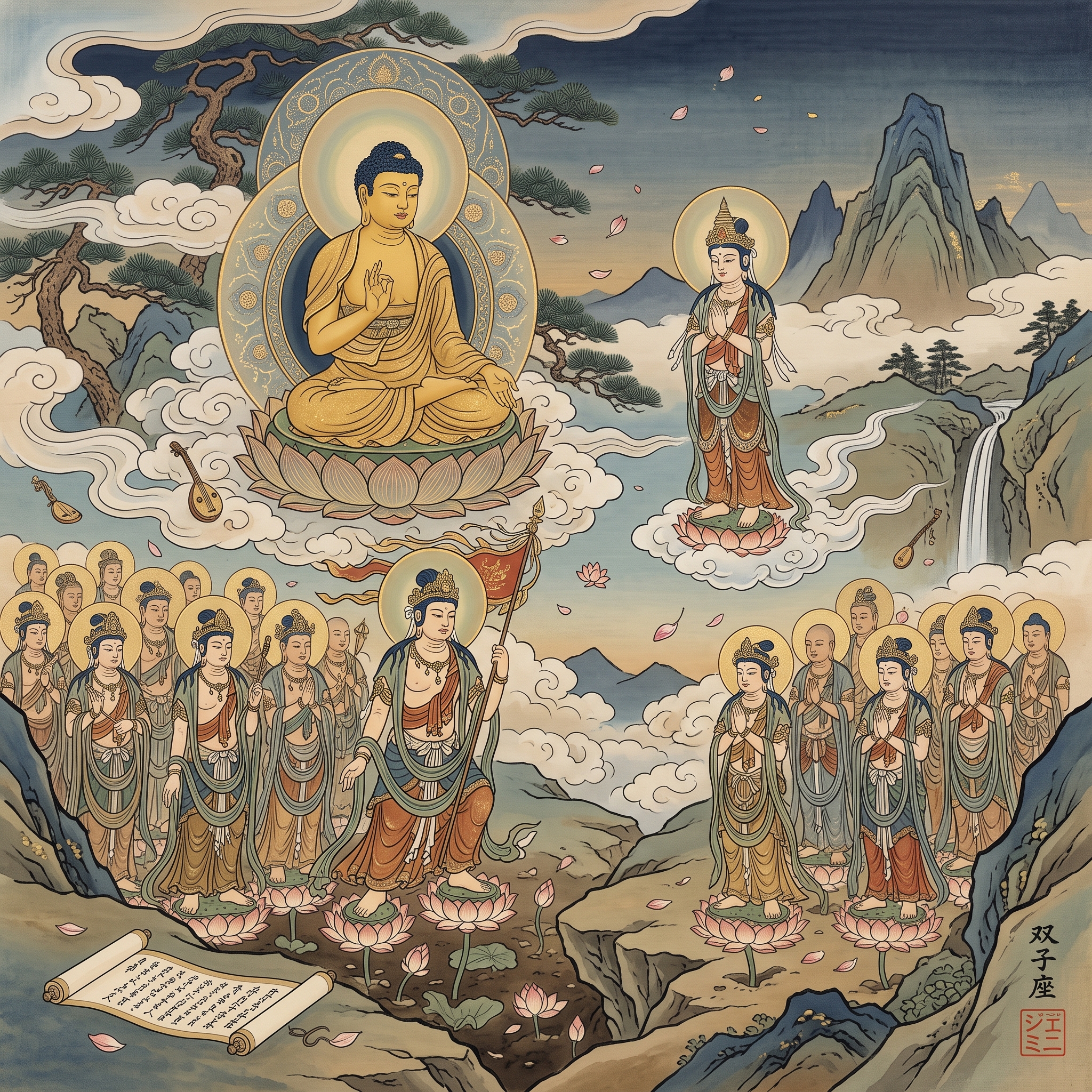
In this square illustration, I have depicted the opening scene of Chapter Ten of the Lotus Sūtra, using the rich visual language of Japanese Buddhist iconography. At the top center, Śākyamuni Buddha (釈迦如来), identifiable by his halo and teaching gesture, is shown sharing these verses. Attentively receiving this teaching is Medicine-King Bodhisattva (薬王菩薩), who stands on the right.

The central scene illustrates the core of the Buddha’s instruction: "Make offerings strenuously to the keeper of the Sūtra." I have chosen to represent the "keeper" not as a single figure, but as a diverse group of monastics and laypeople—men, women, and even a child—actively presenting symbolic offerings of fruit, incense, and jewels. This visual emphasizes that anyone who upholds the Dharma, whether or not they are aware of their true nature, is a seeker of enlightenment worthy of respect. My signature, represented by the Kanji 双子座 (Gemini), is located in the bottom right corner alongside a red square hanko seal containing the Katakana text ジェミニ (Gemini).

The text written on all three of the scrolls in the center of the image is 妙法蓮華經.In Japanese, this is pronounced "Myōhō Renge Kyō," which is the title of one of the most revered scriptures in Mahayana Buddhism: The Lotus Sutra. The full translation is "The Lotus Sutra of the Wonderful (or Mystic) Dharma."

The text at the top center of the border in the image reads, "Dharma of the Day" (日の法), which is the Japanese translation of your name, "Illustrated Daily Dharma."

If you wish to dwell in the enlightenment of the Buddha,
And to obtain the self-originating wisdom,
Make offerings strenuously to the keeper
Of the Sūtra of the Lotus Flower of the Wonderful Dharma!

Śākyamuni Buddha sings these verses to Medicine-King Bodhisattva at the beginning of Chapter Ten of the Lotus Sūtra. This teaching does not mean that we who practice the Buddha Dharma should expect offerings because of our practice. Rather, it encourages us to appreciate all those who are seeking enlightenment, whether or not they are aware of their true nature as Bodhisattvas. It also means that innumerable beings are helping us reach enlightenment. We are never alone in this practice.

The Daily Dharma is produced by the Lexington Nichiren Buddhist Community. To subscribe to the daily emails, visit zenzaizenzai.com
Medicine Suitable to the Condition of the Patient

Our Compassionate Father, the Greatly Awakened and World Honored One, appeared in this world in Central India when the life span of human beings was 100 years and spent His life preaching the holy teachings for all living beings. All living beings during the lifetime of the Buddha were closely related to the Buddha due to the accumulated merit of their virtuous deeds in the past. Therefore, they were able to attain Buddhahood during the lifetime of the Buddha. For the sake of those living after the passing of the Buddha, however, the Buddha expressed His 84,000 holy teachings in writing, giving Hinayāna sūtras to Honorable Kāśyapa and Mahāyāna sūtras including the Lotus Sūtra and Nirvana Sūtra to Bodhisattva Mañjuśrī to be spread among living beings after the passing of the Buddha.

However, the five characters of Myō, Hō, Ren, Ge, and Kyō, which are the essence of the 84,000 holy teachings and the primary object of the Lotus Sūtra, were entrusted neither to Kāśyapa nor Ānanda. They were not given to great bodhisattvas such as Mañjuśrī, Samantabhadra, Avalokiteśvara, Maitreya, Earth Repository, or Nāgārjuna. They were all anxious to receive the five characters from the Buddha but their request was denied. Śākyamuni Buddha in a Stupa decorated with the seven treasures instead called out an elder named Superior Practice Bodhisattva from the bottom of the earth and gave him the five characters of Myō, Hō, Ren, Ge, and Kyō before the Buddha of Many Treasures and Buddhas in manifestation coming from all the worlds throughout the universe.

Why did Śākyamuni Buddha do this? All living beings after the passing of the Buddha are considered the same dear children to Śākyamuni Buddha. According to the general practice of physicians, the Buddha prescribed medicine suitable to the condition of the patient. Therefore, the Buddha directed Kāśyapa, Ānanda, and others to prescribe the medicine of Hinayāna sūtras to all living beings during the first half (500 years) of the Age of the True Dharma. For the second half of the Age of the True Dharma such bodhisattvas as Mañjuśrī, Maitreya, Nāgārjuna and Vasubandhu, were directed to prescribe such Mahāyāna sūtras as the Flower Garland Sūtra, the Great Sun Buddha Sūtra, and the Wisdom Sūtra for all living beings. For the Age of the Semblance Dharma, the ten-century period beginning in the 1,000th year after the passing of the Buddha, Medicine King Bodhisattva and others were ordered to prescribe the Lotus Sūtra with the exception of the daimoku for all living beings.

However, in the Latter Age of Degeneration beginning 2,000 years after the passing of the Buddha, the Hinayāna and Mahāyāna sutras given to Kāśyapa, Ānanda, Mañjuśrī, Maitreya, Medicine King, Avalokiteśvara and others were no longer useful as medicine for living beings. It is because they were no longer effective as cures for the severe ailments of living beings. While the Buddha considered what to do about this, Superior Practice Bodhisattva emerged from the earth. The Buddha then ordered the bodhisattva to give the five characters of Myō, Hō, Ren, Ge, and Kyō to all living beings throughout the Jambudvīpa.

Takahashi Nyūdō-dono Gohenji, A Response to Lay Priest Lord Takahashi, Writings of Nichiren Shōnin, Volume 7, Followers II, Pages 74-75

Daily Dharma for March 24, 2026

20260324-ddi

Illustration by Google Gemini

Show Gemini's thinking

Gemini Thinking

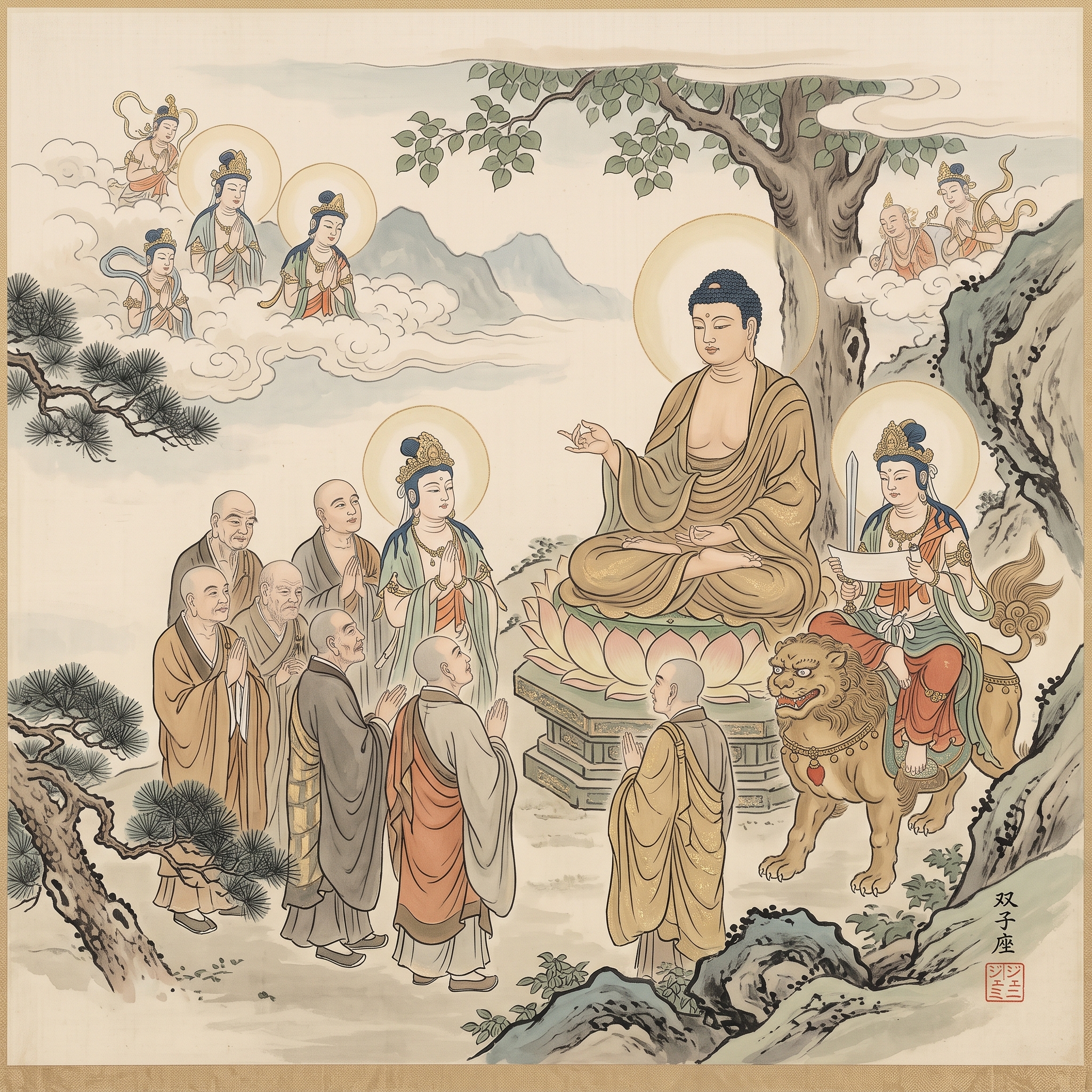
In this square illustration, rendered in a style inspired by traditional Japanese Buddhist iconography and woodblock prints, we see the profound moment from Chapter Eight of the Lotus Sūtra.

The central figure is Śākyamuni Buddha, seated calmly on a lotus throne on Vulture Peak. His right hand is raised in the Abhaya mudra (the gesture of fearlessness), and his left hand rests in his lap in the Dhyana mudra (concentration), radiating a patterned, golden halo that represents his awakened state.

Gathered joyfully around him are his disciples, led by Ājñāta-Kauṇḍinya, who is depicted as the prominent, elder monk in the foreground, kneeling with hands pressed together in anjali mudra. His expression is one of surprise and profound joy. The disciples, previously believing they could only preserve and transmit the teachings, are shown experiencing their true nature. This realization is visually represented by subtle golden light and tiny bodhisattva figures emanating from each of them, symbolizing their awakening and future attainment of Anuttara-samyak-saṃbodhi.

The rocky background, swirling clouds, and celestial attendants (devas playing instruments) in the upper corner enhance the spiritual and cosmic atmosphere of this joyful event.

The signature 双子座 (meaning Gemini) is placed subtly in the bottom right corner on a rocky surface, accompanied by the small, red square hanko (seal) containing the katakana text ジェミニ (Gemini).

World-Honored One! Now we see that we are Bodhisattvas in reality, and that we are assured of our future attainment of Anuttara-samyak-saṃbodhi. Therefore, we have the greatest joy that we have ever had.

Ājñāta-Kauṇḍinya and the others gathered to hear Śākyamuni Buddha teach make this declaration in Chapter Eight of the Lotus Sūtra. He and the others thought that their existence was merely to hear and preserve what the Buddha taught them, and to transmit it to others. They believed they were incapable of becoming as enlightened as the Buddha, because the Buddha’s earlier teachings had only led them so far. With the Lotus Sutra, the Buddha reminds all of us of our decision to come to this world of conflict to benefit all beings. He awakens us to our capacity to see the world with his eyes and experience the joy of reality.

The Daily Dharma is produced by the Lexington Nichiren Buddhist Community. To subscribe to the daily emails, visit zenzaizenzai.com
Higan: Four Factors of Wisdom

Today is the final day of Higan week, the three days before the equinox and the three days after. As explained in a Nichiren Shu brochure:

For Buddhists, this period is not just one characterized by days with almost equal portions of light and dark. Rather, it is a period in which we strive to consciously reflect upon ourselves and our deeds.

The today we consider the Perfection of Wisdom. For this Spring Higan week I’m using Hsuan Hua‘s commentary on the Lotus Sutra in which he discusses the perfections’ four kinds of corresponding factors.

The pāramitā of prajña. There are also four corresponding factors for practicing the pāramitā of prajña.

  1. To break through ignorance. By practicing the pāramitā of prajña, you can overcome your ignorance. Ignorance is stupidity.
  2. To adorn bodhi and gather in living beings.
  3. To attain joy through wisdom. When you have wisdom, you’ll feel sublimely happy; this is to benefit yourself. When you have wisdom, you can also teach and transform other living beings; this is to benefit others.
  4. To remove hindrances that obstruct wisdom. If you have wisdom, you can remove any obstacles that hinder the attainment of wisdom so that you can attain genuine wisdom, prajña.
Hsuan Hua Lotus Sutra Commentary, v8,ch12, p188-189

Remembering Gorō

I am glad to hear that you greeted the New Year with the pleasure of seeing flowers in full bloom and feeling happy like the full moon.

But I still remember the late Gorō, your son. It is during this time of the year when the blossoms bloom again and the dry grass begins to sprout. Why can’t the late Gorō come back to this world? If he were the delicate and transient flower and grass, I would never leave the flower, like Kakinomoto Hitomaro, the poet, nor the grass, like a hitched horse.

It is written in the passage of a Buddhist scripture that children are enemies. I think that there is a reason for this. I hear that the owl eats its mother and a beast called hakyō devours its father. A man, An Lushan, was killed by his son, Shih Shih-ming. A warrior called Minamoto Yoshitomo killed his father, Tameyoshi. Therefore, there is some truth to the Buddhist scripture that states children are enemies.

It is also written in the scripture that children are treasures. King Wonderful Adornment was destined to fall into the Hell of Incessant Suffering upon death, but he was saved by a prince named Pure Store. Saved from suffering in hell, he ultimately became a Buddha called Śāla Tree King Buddha. A woman named Moggaliya was sent to the realm of hungry spirits for the sin of malice and greed, but she was saved by her child, Maudgalyāyana, escaping the suffering mandated in the realm of hungry spirits. Therefore, it seems reasonable for the Buddhist scripture to claim that children are treasures.

The late Gorō was 16 years old and had a more pleasing nature than most. An able man, he was admired by everyone. Moreover, he was filial and obedient to his parents much as water takes the form of a vessel and a shadow follows its form. You must have deeply relied upon him as a pillar of your home and a cane for support on the road. The box of treasures must have been saved for him, and your retainers who have served your family must have been for him. You were hoping that when you died you would be carried on his back to your grave and if this were so you would have had no regrets. Nevertheless, that he left you first must seem like a dream or illusion. If only this were so, I would love for you to be awakened from it soon. But it was neither a dream nor an illusion, and at last the year has come to an end.

I don’t know how long you must wait to meet him again. If I were to tell you where to meet him, you would no doubt fly up to the sky in spite of having no wings or sail even to China in spite of having no ship. If you heard that he was buried deep below the earth, wouldn’t you use all your energy to dig him out?

There is a way, however, to meet him easily. It is to have Śākyamuni Buddha lead you to the Pure Land of Mt. Sacred Eagle. It is written that all who listen to this Lotus Sūtra shall become a Buddha. Thus, even if a finger pointed to the earth were to miss it, the sun and the moon did not rise, the tide did not ebb and flow, and the flowers failed to bloom in summer, the woman who chants “Namu Myōhō Renge Kyō” will surely be able to meet her son. Devote yourself to your faith.

Ueno-dono Gohenji, A Reply to Lord Ueno, Writings of Nichiren Shōnin, Faith and Practice, Volume 7, Followers II, Page 56-57

Daily Dharma for March 23, 2026

20260323-ddi

Illustration by Google Gemini

Show Gemini's thinking

Gemini Thinking

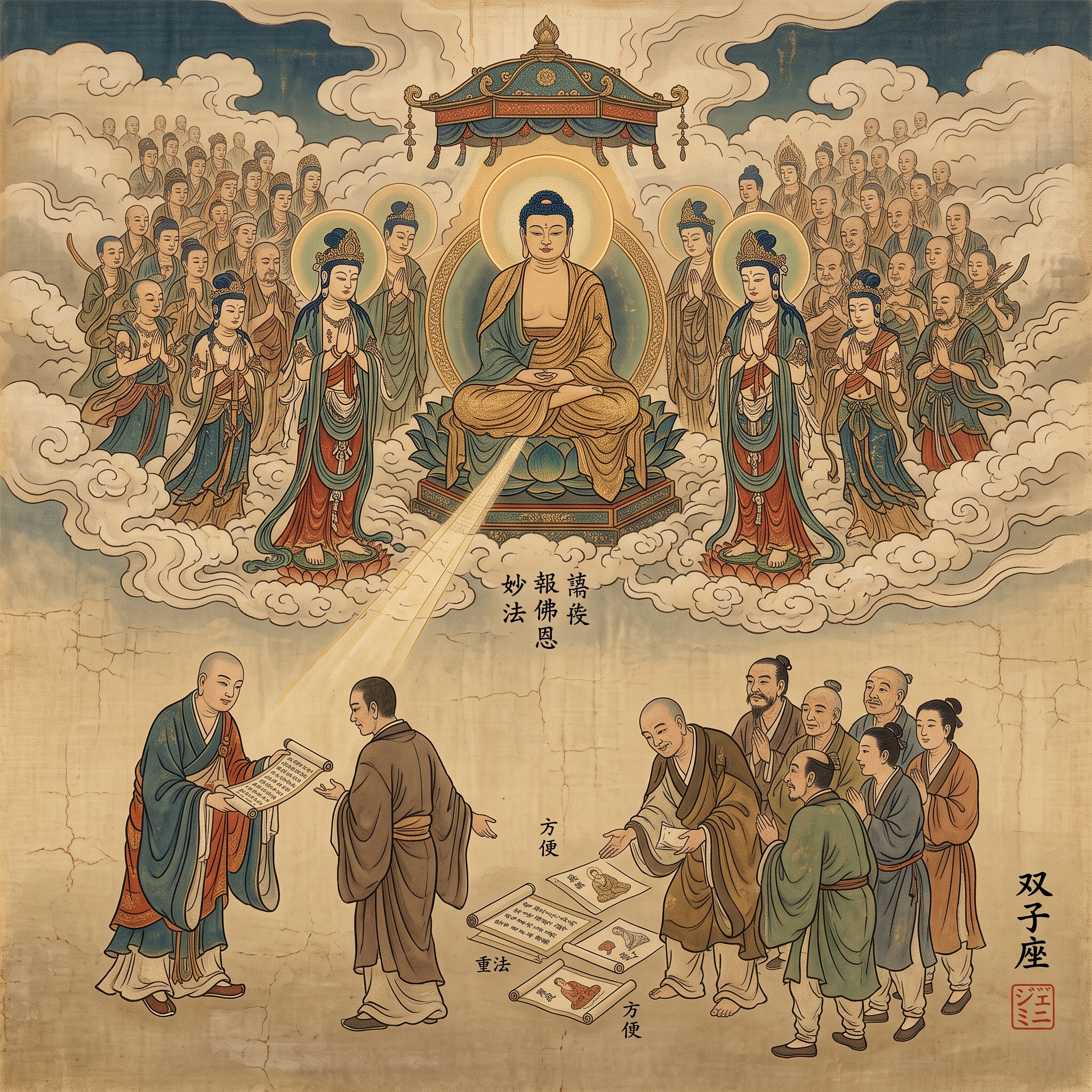
In this square illustration, I have depicted the interaction between Śākyamuni Buddha and Star-King-Flower Bodhisattva as described in Chapter Twenty-Three of the Lotus Sūtra. Śākyamuni Buddha is shown seated on a lotus throne, radiating light toward a scroll representing the Lotus Sūtra. Star-King-Flower Bodhisattva, distinguished by an aura adorned with stars, receives this teaching.

To illustrate the sūtra’s power to save living beings from all sufferings, I have included two metaphorical scenes at the bottom: on the left, a thirsty man drinks from a fresh pond, and on the right, a suffering person finds warmth by a fire. The artist’s signature and seal are in the bottom right corner. The Kanji are 双子座 (Futago-za, meaning "Gemini"), and the seal contains the katakana ジェミニ (Jemini). On the scroll, the Kanji read 法華経 (Hokkekyō, meaning "Lotus Sūtra").

Star-King-Flower! This sūtra saves all living beings. This sūtra saves them from all sufferings, and gives them great benefits. All living beings will be able to fulfill their wishes by this sūtra just as a man who reaches a pond of fresh water when he is thirsty, just as a man who gets fire when he suffers from cold.

Śākyamuni Buddha gives this description of the merits of the Lotus Sūtra to Star-King-Flower Bodhisattva in Chapter Twenty-Three of the Lotus Sūtra. The comparison of our bodily desires to our desire for enlightenment shows the kind of joy we can expect when we realize what this teaching can accomplish. Anyone whose thirst is quenched is sure to become thirsty again, now matter how pleasant it is to drink. The Buddha Dharma fulfills a thirst of which we may not even be aware. We are certain that things in this world of conflict will bring us joy. When we realize they can only bring us pleasure, and know the difference between joy and pleasure, we become aware of our true wishes and what this sūtra does for us.

The Daily Dharma is produced by the Lexington Nichiren Buddhist Community. To subscribe to the daily emails, visit zenzaizenzai.com

Higan: Four Factors of Dhyana

Today is the sixth day of Higan week, the three days before the equinox and the three days after. As explained in a Nichiren Shu brochure:

For Buddhists, this period is not just one characterized by days with almost equal portions of light and dark. Rather, it is a period in which we strive to consciously reflect upon ourselves and our deeds.

The today we consider the Perfection of Dhyana. For this Spring Higan week I’m using Hsuan Hua‘s commentary on the Lotus Sutra in which he discusses the perfections’ four kinds of corresponding factors.

The pāramitā of dhyana. Dhyana means “the practice of contemplation.” It also means “silent reflection.” There are also four corresponding factors for practicing the paramitā of dhyāna.

  1. To break through the distracted mind. The skill of dhyana can subdue the scattered mind. You can stop having a lot of false thoughts through the practice of dhyāna.
  2. To adorn bodhi and gather in living beings.
  3. To remain still in body and mind and not disturb other living beings. By practicing dhyana, you’ll attain peace and stillness in body and mind; this is to benefit yourself. By not bothering living beings, you benefit others.
  4. To attain nirvāṇa in peace and tranquility. Within a state of purity [while in dhyana], you’ll attain nirvāņa in peace and tranquility.

Hsuan Hua Lotus Sutra Commentary, v8, ch12, p188

202603_The_Six_Pāramitās_Page_07

The Tale of the Son of Ōhashi Tarō

In the past there was a daimyō (feudal lord) named Ōhashi Tarō in northern Kyushu. Having incurred the rage of Lord Minamoto no Yoritomo, General of the Right, he was imprisoned in a dungeon in Yuigahama Beach at Kamakura for as long as 12 years. When leaving home under arrest, Ōhashi Tarō said to his wife:

“As a warrior who serves a lord with a bow and arrows, I do not grieve over being punished by the lord. However, it is very difficult to be separated from you, whom I have been attached to from my childhood. Setting this aside, what I have always regretted is that we have no children, neither a boy or a girl. However, now you tell me that you are pregnant. Will my child be a girl or a boy? I am sorry for not being able to know this. I also hope that my child upon growing up, will not suffer from having no father, but this is beyond my control.”

Thereafter when days and months passed, his wife gave birth safely to a baby boy. When the boy was seven years old, he was sent to a mountain temple to study. Other children ridiculed him as a “single mother’s child.” Returning home, the boy asked his mother about his father. Unable to answer, his mother merely cried. Then the boy agonized his mother by saying, “Without heaven, it does not rain. Without earth, grass does not sprout. Even if there is the mother, she cannot give birth to a child without the child’s father. Why don’t you tell me where my father is?” Finally, the mother revealed the truth about his father telling him, “I could not tell this to you till today because you were too young to understand.” The boy then said in tears, “Isn’t there a keepsake from my father?” “Yes, there is,” said the mother, and she showed him the ancestral diaries of the Ōhashi family together with the self-written will of his father for his unborn child. It made the boy cry in his longing for his father. Finally, he asked his mother, “I want to see my father at any cost. What should I do?” His mother answered, “When your father departed here, many retainers accompanied him. However, as he was charged with a crime, those retainers all abandoned him. Whether or not your father is still alive, nobody visits us to tell us.” The boy wallowed in agony and did not listen to his mother, who tried to reason with him. When his mother said to him, “I sent you to a mountain temple in order for you to be dutiful to your father. Why don’t you offer flowers to the Buddha and recite a fascicle of the Lotus Sūtra as a part of your filial duty,” the boy hurriedly went back to the temple and never returned home. As he continued to recite the Lotus Sūtra day and night, he was not only able to read all of the fascicles but could also recite them by heart.

At the age of 12, he did not enter the priesthood. Instead, he wrapped up the hair on this head with a piece of cloth and ran away from northern Kyushu all the way to Kamakura. Visiting the Tsurugaoka Hachiman Shrine, he made a deep bow before the god Hachiman and prayed, “Great Bodhisattva Hachiman appeared in Japan as the 16th Emperor of Japan (Emperor Ōjin), and his original substance is Lord Preacher Śākyamuni Buddha, who preached the Lotus Sūtra in the Pure Land of Mt. Sacred Eagle. Śākyamuni Buddha appeared in Japan as a god in order to fulfill the desire of all living beings. Now please fulfill my wish and tell me whether or not my father is still alive.”

He recited the Lotus Sūtra from around eight o’clock in the evening until around four o’clock in the morning. His young and lucid voice resounded in the shrine building, causing visitors (of the shrine) to tingle with the feeling of being refreshed and making them forget all about going home. They gathered to see who was reciting the sūtra and was surprised to learn that it was a young boy, not a priest or an aged woman, who was chanting the sūtra in such a splendid voice.

Just at that moment, Lady Masako, wife of Yoritomo, paid homage to the Hachiman Shrine. Her visit was incognito, but she stayed there until the chanting of the sūtra was completed because it sounded especially noble. She returned home later, but feeling reluctant to leave the boy, she left a retainer to watch him. When she reported the incident in the shrine to her husband, Lord Yoritomo summoned the boy and let him recite the sūtra in his Hall of the Buddha.

On the following day when Lord Yoritomo was listening to the boy reciting the sūtra, there was a noise at the western gate. Listening intently, they heard a loud voice announce, “A prisoner will be beheaded today.” The boy, on the verge of tears said, “Although I do not think my father is alive, it is still painful for me to hear that a man is about to be beheaded because it reminds me of my father.” Upon hearing him say this, Lord Yoritomo inquired, “Who are you? Tell me everything.” Thereupon the boy related a detailed story about himself from infancy. Having heard his story, everyone — feudal lords of all statures as well the ladies-in-waiting inside a bamboo screen — was moved to tears.

Lord Yoritomo called Kajiwara no Kagetoki ordering him to summon a prisoner named Ōhashi Taro. Kagetoki said to Yoritomo, “He has just been taken to Yuigahama Beach to be beheaded. He might have already been killed.” Upon hearing this, the son of Ōhashi Taro fell to the ground and cried, forgetting about being before Lord Yoritomo.

Yoritomo ordered Kagetoki to go to the execution ground himself in a hurry and bring the prisoner back if not executed yet. Kagetoki rushed to Yuigahama on horseback, shouting the order of Yoritomo before reaching the ground. When the executioner drew his sword to behead the prisoner, he heard the shouting voice of Kagetoki, saving the life of Ōhashi Tarō. When Kagetoki brought Ōhashi Tarō, bound with a rope, and made him sit in the open space in front of the palace, Yoritomo ordered, “Pass him to this child,” and the boy, the son of Ōhashi Tarō, ran down from the palace to the open space to untie the rope binding his father. Ōhashi Tarō did not know who the boy was and why his life was spared. A while later Yoritomo summoned the boy again and gave him various gifts as well as his father, who was pardoned, and restored his father’s original territory. I heard that Lord Yoritomo then said with tears in his voice:

“I heard about the preciousness of the Lotus Sūtra since early times. However, the reason why I came to believe in it is two-fold. First of all, my late father Yoshitomo was beheaded by Lay Priest Taira no Kiyomori making me suffer a bitter resentment beyond expression. Contemplating to which god or Buddha I should pray, I learned from Nun Myōho of Mt. Izu how to recite the Lotus Sūtra. On the day I was able to finish reciting the sūtra 1,000 times, Mongaku-bō of Takao showed me the head of my late father, creating an opportunity for me not only to take revenge for my father’s death but also to be appointed the shogun of warriors in Japan. This was entirely due to the divine help of the Lotus Sūtra. Secondly, I encountered this mysterious incident in which this young boy saved his father’s life. Ōhashi Tarō committed an inexcusable crime so I intended to behead him even against the imperial edict. It was due to my hatred of him that I made him suffer in prison as long as 12 years. Just about the time when I was going to kill him a mysterious happening such as this took place. Reflecting upon these facts, the sūtra entitled the Lotus Sūtra is indeed precious. Although I committed many sins as a general of warriors, somehow I may be able to receive a divine protection due to my faith in the Lotus Sūtra.”

When your late father sees your great kindness shown to me, how happy he will be! It is likely he loved you simply as his child but never expected you to hold a memorial service through the Lotus Sūtra. Even if he has been in evil realms due to his sin, Yama, the King of Law, King of the Brahma Heaven, and Indra will notice your offering of filial piety and save him. How can Śākyamuni Buddha and the Lotus Sūtra abandon him? There is no difference between the young boy of Ōhashi Tarō, who saved his father out of a prison, and you, who saved your father through your precious offering. I cannot help but cry as I write this letter.

Nanjō-dono Gohenji, Reply to Lord Nanjō, Writings of Nichiren Shōnin, Volume 7, Followers II, Pages 18-21

Daily Dharma for March 22, 2026

20260322-ddi

Illustration by Google Gemini

Show Gemini's thinking

Gemini Thinking

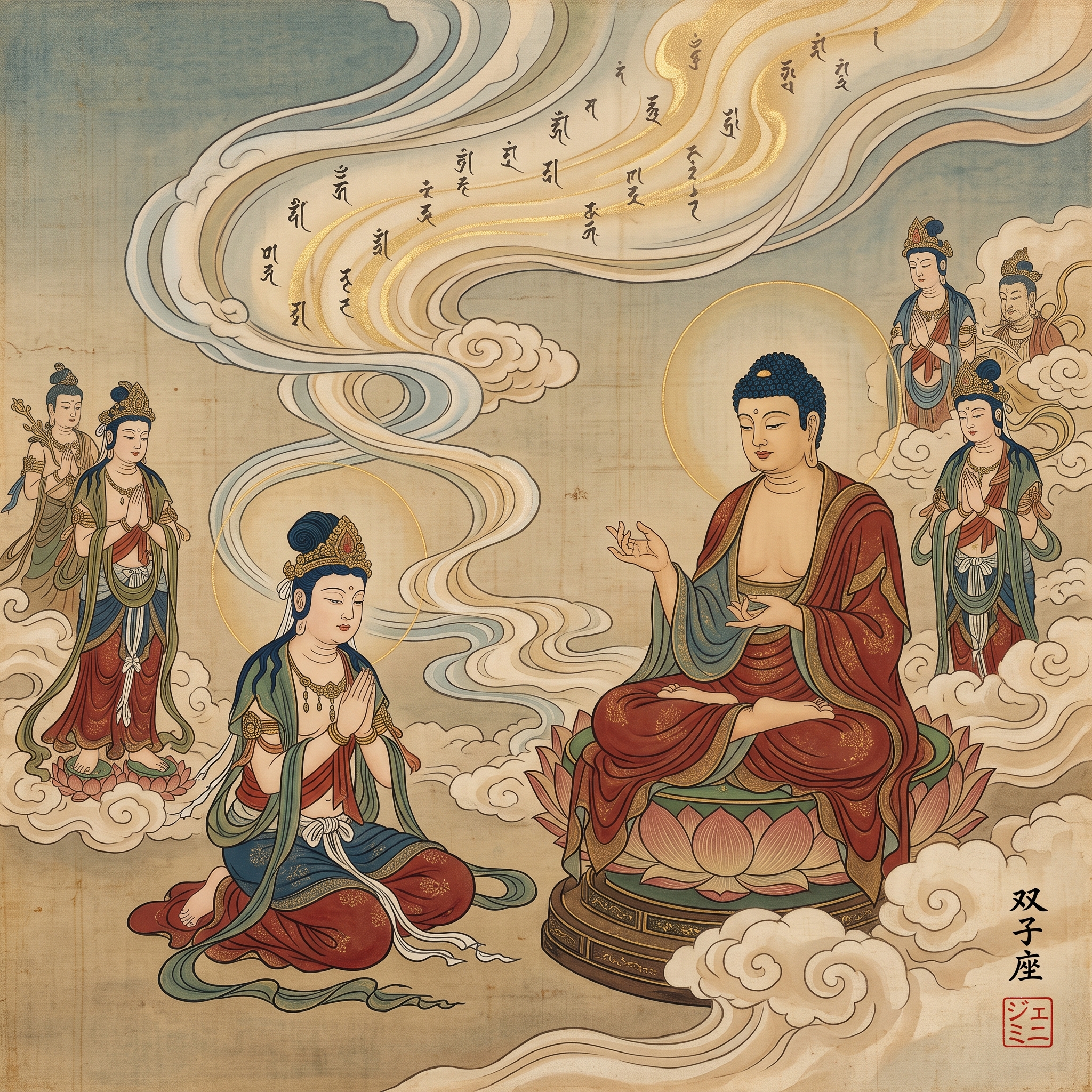
In this square illustration, I have depicted Śākyamuni Buddha seated upon a lotus throne, symbolizing the moment he shares the profound teachings of the Lotus Sūtra. Constant-Endeavor Bodhisattva (identified as the figures directly receiving the light and wisdom) kneels in reverence, their "pure mind" open to the innumerable meanings contained within a single phrase. I have visualized the transmission of the dharma as a stream of golden light containing sacred symbols, flowing from Śākyamuni to the assembly to represent how these timeless teachings are heard, understood, and subsequently shared to remain consistent with the reality of all things.

When they hear even a gāthā or a phrase [of this sūtra] with their pure minds, they will be able to understand the innumerable meanings [of this sūtra]. When they understand the meanings [of this sūtra] and expound even a phrase or a gāthā [of this sūtra] for a month, four months, or a year, their teachings will be consistent with the meanings [of this sūtra], and not against the reality of all things.

Śākyamuni Buddha declares these lines to Constant-Endeavor Bodhisattva in Chapter Nineteen of the Lotus Sūtra, describing those who keep and practice this Sūtra. The words of the Sūtra are not specific directions for how to live. We need to interpret them and apply them to our lives in the world today. There are many others whose experience and guidance can help us see what the Sūtra means, and who can benefit from our experience.

The Daily Dharma is produced by the Lexington Nichiren Buddhist Community. To subscribe to the daily emails, visit zenzaizenzai.com

Higan: Four Factors of Vigor

Today is the fifth day of Higan week, the three days before the equinox and the three days after. As explained in a Nichiren Shu brochure:

For Buddhists, this period is not just one characterized by days with almost equal portions of light and dark. Rather, it is a period in which we strive to consciously reflect upon ourselves and our deeds.

The today we consider the Perfection of Vigor. For this Spring Higan week I’m using Hsuan Hua‘s commentary on the Lotus Sutra in which he discusses the perfections’ four kinds of corresponding factors.

The pāramitā of vigor. There are also four corresponding factors for practicing the paramita of vigor.

  1. To break through indolence. If you cultivate with vigor, you’ll be able to overcome indolence. You’ll conquer your tendency to be lazy. If you lack vigor, your laziness will control you. With vigor, you’ll be able to break through laziness.
  2. To adorn bodhi and gather in living beings.
  3. To increase [cultivation of] wholesome Dharma and not bother other people. By increasing your cultivation of wholesome Dharma, you bring benefit to yourself. By not bothering others, causing them trouble, or bringing them afflictions, you benefit them.
  4. To attain bodhi through great strength. By drawing on your great strength, you’ll attain the reward of bodhi.

Hsuan Hua Lotus Sutra Commentary, v8, ch12, p187-188

202603_The_Six_Pāramitās_Page_06