Category Archives: Hsuan Hua Lotus Sutra Commentary

Tasting the True Flavor of the Buddhadharma

As mentioned yesterday, Master Hsuan Hua didn’t hold the Lotus Sutra as the highest teaching of the Buddha, but that doesn’t mean he did not revere the Lotus Sutra. From the first volume of his 14-volume commentary, he makes his position clear.


The Buddha taught the Avataṃsaka Sūtra, the Āgama sūtras, the Vaipulya sutras, and the Prajña sutras over a period of several decades in order to pave the way for the Dharma Flower Sūtra. The previous teachings of the Avataṃsaka, Agama, Vaipulya, and Prajña Dharmas are known as “using the provisional for the sake of the ultimate.” Why did the Buddha teach those Dharmas? It was all for the Dharma Flower Sūtra. Now, in the Dharma Flower assembly, the Buddha “relinquishes the provisional to establish the ultimate.” That is, he discards the provisional and expedient Dharmas that he had taught previously and only preserves the Dharma Flower Sūtra.

The Dharma Flower Sūtra is the true mind of the Buddha. The Dharma Flower Sūtra is the true body, the Dharma body, the transformation body, and the reward body of the Buddha. Students of the Buddhadharma who have not thoroughly understood the Dharma Flower Sūtra have not yet tasted the true flavor of the Buddhadharma. The genuine and wonderful principles of the Buddhadharma are contained within the Dharma Flower Sūtra. That is why this Dharma is called “wonderful Dharma” and why the lotus flower is the metaphor for this sūtra.

The lotus flower is the king of flowers, the most precious of all. The lotus flower emerges from the mud yet is undefiled. Even though it is rooted in the mud, the flower is separated from the mud by water. It is said, “While in the muck, it transcends the muck.” The lotus flower is a wonderful flower, and this wonderful lotus flower is the most precious of all flowers. Similarly, this sutra is the ultimate sutra. There is a saying in Buddhism: “The Śūraṅgama is for opening wisdom, and the Dharma Flower is for becoming a Buddha.”

To open wisdom, one must study the Śūraṅgama Sūtra; to become a Buddha, one must learn the Dharma Flower Sūtra. In this way, the Dharma flower Sūtra and the Śūraṅgama Sūtra are the two most important sūtras in Buddhism. The Dharma Flower Sūtra is especially so, because all other sūtras were taught in preparation for the Dharma flower Sūtra. Thus it is the king of all sūtras. It is most rare and wonderful, beyond words and description, that we are now able to study the Dharma flower Sūtra.
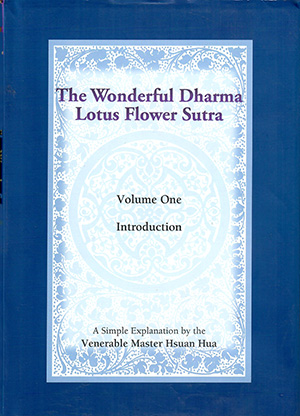
Hsuan Hua Lotus Sutra Commentary, v1, p12-13

Master Zhiyi and Master Hsuan Hua

In his Commentary on the Lotus Sutra, Master Hsuan Hua often quotes from Zhiyi of the Tiantai School, the same Zhiyi whom Nichiren relied upon in establishing the supremacy of the Lotus Sutra. Hsuan Hua is not a strict adherent of Zhiyi’s teaching. This is particularly pronounced when the subject of the Avataṃsaka Sutra – Flower Garland Sutra – comes up. Although Zhiyi recognized  the Avataṃsaka Sutra as presenting the highest pinnacle of the Buddha’s insight and represented the sudden teaching method, Zhiyi ultimately maintained that the Perfect Teaching (which represents the Buddha’s highest insight) is set forth in its pure form only in the Lotus Sutra. Here are two examples of where Hsuan Hua places the Avataṃsaka Sutra above and beyond the Lotus Sutra.


Now that I have finished lecturing on the Śūraṅgama Sūtra, I am lecturing on the Dharma Flower Sūtra. When I have finished lecturing on it, I intend to lecture on the Avataṃsaka Sūtra for you. That is even more wonderful because it is the king of the sūtras. The Dharma Flower Sūtra is also a king of sūtras, but it is not as magnificent as the Avataṃsaka Sutra. The Avataṃsaka Sūtra is really the king of the kings of sūtras. The Avataṃsaka Sūtra can be likened to a gold wheel-turning sage king, while the Dharma Flower Sūtra can be likened to a silver wheel-turning sage king. The Śūraṅgama Sūtra can be likened to a copper wheel-turning sage king. These three are kings among all sūtras.

I have not yet begun lecturing on the Avataṃsaka Sutra, but I can first talk a little about its background. After the Buddha realized Buddhahood, the first thing he did was to teach the Avataṃsaka Sutra. When he taught it, those of the Two Vehicles could not hear him. They could not even see him. It is said,

They had eyes but could not see Nişyanda Buddha;
They had ears but could not hear the perfect, sudden teaching.

The Buddha manifested a body ten thousand feet high to teach the sūtra, and although they had eyes, they could not see it. They had ears, but they could not hear the perfect, sudden teaching.

When the Buddha taught the Avataṃsaka Sūtra, those of the Two Vehicles could not understand it; only the Great Vehicle Bodhisattvas were able to understand it. Later, it was taken by the dragon king to his palace and disappeared from the human realm. Then, the fourteenth patriarch, Nagarjuna [Dragon Tree] Bodhisattva, who had mastered all worldly literature, used his spiritual powers to go to the dragon palace to take a look at their Tripiṭaka collection. There he found the three-volume set of the Avataṃsaka Sūtra. The first volume contains verses as many as dust motes in ten trichiliocosms, with chapters as numerous as dust motes in one set of four great continents. The first and second volumes were too long for Bodhisattva Nagarjuna to remember, so he memorized the third volume, the last volume. When he returned to the human realm, he wrote this sūtra out from memory. Since Bodhisattva Nagarjuna had an excellent memory, he remembered it in its entirety after reading it just once. That is the source of the Avataṃsaka Sūtra.

After we finish the Wonderful Dharma Lotus Sūtra, we shall proceed to listen to the Avataṃsaka Sūtra. By then, you will understand the three kings of Buddhist sūtras. Then you will be able to understand all the other sūtras on your own, without having them explained to you. Here in the West, the Buddhadharma has just begun to flourish. It is fitting that the Great Vehicle Dharma be propagated in order to teach and transform the Great Vehicle Bodhisattvas.

Hsuan Hua Lotus Sutra Commentary, v3, p160-161

The twelve hundred Arhats present
Will all attain Buddhahood.

The Buddha gave all his disciples predictions of future Buddhahood.

In hundreds of thousands of eons, it is not easy to encounter the Wonderful Dharma Lotus Sūtra. Though one may encounter the Wonderful Dharma Lotus Sūtra, it is difficult to be able to read and recite it. Even if you are able to read and recite it, should you study it for hundreds of thousands of eons, you still may not understand its meaning. Finally, it is most difficult to hear it explained.

Now, in the entire world, there are very few places where the Dharma Flower Sūtra is explained. Rare as it is, I am now explaining it. In the future, we will study the Avataṃsaka Sūtra, which is even more difficult to encounter. In China, it would be difficult to find even one occasion when the Avataṃsaka Sūtra was lectured on during the past hundred years.

The principles of the Wonderful Dharma Lotus Sūtra are wonderful beyond words. Similarly, the principles of the Avataṃsaka Sūtra are so magnificent that they also surpass words. Without a solid foundation in learning, one would not be able to understand much less explain the Avataṃsaka Sūtra. Therefore, no one feels capable of explaining it. For example, one passage says that those who cultivate samadhi will enter samadhi in the west and emerge from samadhi in the east. Those who enter samadhi in the south will emerge from it in the north. It says that those who enter samadhi through the eyes will emerge from samadhi through the ears. It further says that those who enter samadhi through the nose will emerge from samādhi through the tongue.

What does all this mean? What does it mean to enter samadhi through the nose and emerge from samadhi through the tongue? Within the six sense faculties, you enter through one and exit through another. This passage is confusing! What is going on? What on earth is entering and exiting?

In the future, if there are those who like to study the Buddhadharma and who wish to truly understand it, they should have the answers to such questions. But don’t worry. Don’t be concerned. Unlike Dharma Master Xuanzang, who walked to India from China seeking the Dharma, wearing himself out and blistering his feet, you can remain in your own country and listen to lectures on the wonderful Dharma. In the future, your options will be much better than those of Dharma Master Xuanzang.

Hsuan Hua Lotus Sutra Commentary, v3, p236-237

10 Wonders in Hsuan Hua’s Commentary on the Lotus Sutra

In reading Hsuan Hua’s Commentary on the Lotus Sutra, I’ve been repeatedly impressed with the depth of the work. Particularly impressive has been the use of explanatory footnotes. Here’s an example from Volume 3, Chapter 2, Expedients.


All of the Tathāgatas,
By countless skillful means,
Will lead all living beings across
To realize the Buddhas’ nonoutflow wisdom.
Of those who have heard the Dharma,
None will fail to become a Buddha.

These six lines refer to “the oneness of people.” The Dharma Flower Sutra can be understood through the ten wonders of the door of the original and the ten wonders of the door of the derivative.

Hsuan Hua Lotus Sutra Commentary, v3, p204

A note at this point references this note at the end of the chapter.

Editorial Note About the Ten Wonders:
In the Fahua xuanyi (Profound Meanings of the Dharma Flower), Master Zhiyi of the Tiantai School explains the Wonderful Dharma Lotus Sūtra through three groupings of ten wonders. In his commentary, Venerable Master Hua refers only to the first two:

  1. The ten wonders of the door of the derivative (Ch.門十秒)
  2. The ten wonders of the door of the original (Ch.本門十分)
  3. The ten wonders of the contemplation of the mind (Ch.觀心十秒)

1. The ten wonders of the door of the derivative pertain to the first half of the Dharma Flower Sutra (chaps. 1-14). The Tiantai School classifies the Dharma that Śākyamuni Buddha taught from the time of his awakening until he started teaching the Dharma Flower Sutra as the Dharma of the Three Vehicles of Sravakas, Pratyekabuddhas, and Bodhisattvas, and the teaching of the Dharma Flower Sutra as the One Vehicle Dharma, the Buddha Vehicle. Based on his explanation. of “the essence of things as they really are (諸法實相)”in chapter a “Skillful Means,” Master Zhiyi asserts that the Dharma set forth for the Three Vehicles is introduced to expediently unfold the ultimate teaching. The Dharma of the Three Vehicles is provisional. The Dharma Flower Sutra is the ultimate teaching, which is the perfect teaching of the One Vehicle – that is, the Buddha Vehicle. The perfect teaching of the One Vehicle transcends the contradistinction between the provisional and the ultimate, in that the provisional is the ultimate and the ultimate is the provisional. The provisional and the ultimate are nondual; this nonduality embodies “the essence of things as they really are.” From the perspective of the perfect teaching, both the provisional and the ultimate possess “wonders” or “subtleties.” This is known as the wonder that transcends dualities.

The ten wonders of the first half of the Dharma Flower Sūtra, which elucidate the subtleties of the Buddha’s provisional manifestations (“the derivative”), are the wonders of:

i. His state of thusness: the ultimate truth that all Buddhas hold in reverence and realize.

ii. His wisdom: a Buddha’s omniscient wisdom arising from such realization.

iii. His practice: all practices leading to that realization.

iv. His position: the realization of varied attainments.

v. The three principles: The three principles are thusness, meditation upon and understanding of it, and extension of this understanding to all its workings. The three, taken from chapter to of the Dharma Flower Sutra, “The Dharma Teacher,” are respectively symbolized by the Tathagata’s room, which represents compassion; the Tathagata’s robe, which represents gentleness and forbearing; and the Tathagata’s throne, which represents the emptiness of all phenomena. These three principles guide the propagation of the Dharma Flower Sutra. Although they are three in name, they are none other than the One Vehicle Dharma, the supreme truth. The One Buddha Vehicle is replete with these three principles.

vi. His response: In stillness, without thought, the Buddha responds to every situation. Transcending time, he manifests everywhere at once. This is an inconceivably wondrous response. It is also like a bright mirror, clear and translucent, that reflects any number of images without discrimination. Without the least effort, it reflects whatever is there.

vii. His spiritual powers: All the spiritual powers that the Buddha applies in saving living beings accord with the One Vehicle teaching, without distinctions of inferiority and superiority.

viii. His teaching the Dharma: The Buddha can skillfully and perfectly explain all kinds of Dharma according to principle, inspiring all living beings to unfold, show, awaken to, and realize the knowledge and vision of the Buddhas.

ix. His retinue: The Buddha has a great retinue of faithful followers.

x. His benevolence: The Buddha benefits living beings by inspiring them to undertake various practices.

2. The ten wonders of the door of the original pertain to the second half of the Dharma Flower Sutra (chaps. 15-28). This section discusses the eternal, original Buddha. Through manifesting in various forms to save living beings, Śākyamuni Buddha reveals his origins in the distant past. The Buddha actually realized Buddhahood immeasurable, limitless billions of koṭis of nayutas of cons ago. Since then, the Buddha has always remained in the Sahā world, teaching the Dharma to transform living beings, as described in chapter 16, “The Tathagata’s Life Span,” and other chapters. While the first half of the sutra focuses on the Buddha’s expedient teaching of the Three Vehicles to unfold the One Buddha Vehicle, the second half reveals the Buddha’s distant origins through his various provisional manifestations.

The ten wonders of the second half of the Dharma Flower Sutra differ from those of the first set. They elucidate the subtleties of the Buddha’s eternal origins (“the original”), from which his provisional manifestations derive. These ten wonders are:

i. The formative stage of practice

ii. The fruition of awakening

iii. His (Buddha) land

iv. His response

v. His spiritual powers

vi. His teaching of the Dharma

vii. His retinue

viii. His nirvana

ix. His life span

x. His benevolence

Hsuan Hua Lotus Sutra Commentary, v3, p248

Awakening Oneself and Awakening Others

In reading Chinese Master Hsuan Hua’s 14-volume commentary on the Lotus Sutra – I’m currently on the sixth volume – I’ve been setting aside hundreds of quotes that I want to keep available. By the time I complete the entire commentary I expect to have thousands of quotes. What I’m going to do with it all is unknown. However, I periodically come across something I feel needs to be posted sooner rather than later. This is one such quote.

As we walk the path to Buddhahood, we should do all kinds of good deeds to help us succeed–that is the most important thing. We should do good deeds whenever we can and to the best of our ability. What are good deeds? They are deeds that help and benefit others. Bodhisattvas “benefit themselves and benefit others, awaken themselves and awaken others.” Do these kinds of things.

“I’ve heard that a lot,” you say.

Really? How many times?

“Several dozen times.”

Well, how many times have you put it into practice? Sure, you may have heard so much of “benefiting oneself and benefiting others; awakening oneself and awakening others.” But how much have you put into practice? How many “others” have you benefited? How many “others” have you caused to become awakened? One? Two? Probably none. If you have not even benefited or awakened one or two people, what use is your having heard of it? No use at all. The Path must be followed. Do it truly! Do it sincerely! Plant your feet firmly on the ground and do the work diligently and reliably. What is meant by doing it truly? The same deed can be done differently by different people. Others may do it with the thought of benefiting themselves, but if you can do it with the thought of benefiting others, then you have done it truly.

Some people may understand a matter or a principle and leave it at that, not worrying about whether anyone else understands it. Once you understand it yourself, you should then teach it to others and help them to understand. That is to awaken oneself and awaken others. In general, there are different ways of doing things in this world. One person may be selfish and seek personal benefit, while another person may do nothing but benefit other people. Those who are selfish and seek their own benefit go to the hells. Why? They are simply too selfish and obsessed with personal benefit. Those who benefit others may also go to the hells. Why? They go to rescue living beings in the hells. Their goal is to undergo suffering themselves in order to teach those in the hells how to leave suffering and attain bliss. Earth Store Bodhisattva, for example, is constantly in the hells being a friend to all the hungry ghosts. But he has gone there by choice, with the intention of leading the ghosts from suffering to bliss.

There are a lot of confused people in the world, and I will pass on to them whatever understanding I have. That is called “awakening oneself and awakening others; benefiting oneself and benefiting others.” To sum it up, there are different ways of doing everything. It is like what I just said before: one person may do it to benefit himself, while someone else will do it to benefit others. If you want to know what certain people are like, just observe and see whether what they do is for their own benefit or for the benefit of others. That is what you should take note of.

Hsuan Hua Lotus Sutra Commentary, v4, p105-107

Practice and Study for Monastics and Lay People

Chinese Master Hsuan Hua’s 14-volume commentary on the Lotus Sutra reflects his belief in a strong monastic foundation in Buddhism. He did not believe lay people were part of the Triple Jewel.

In Buddhism: A Brief Introduction, Master Hsuan Hua’s teachings are summarized.

People who believe in the Buddha’s teachings should formally take refuge with the Triple Jewel. The Triple Jewel is the Buddha, the Dharma, and the Sangha. The third of the three jewels, the Sangha, literally means “harmoniously united assembly.” In the Six Paramitas Sutra the Buddha noted three kinds of Sangha.

The first Is the Sangha of the Primary Meaning, consisting of the Sagely Sangha of Buddhas who abide by the Dharma. The second is the Sangha of the Sages. The third is the ‘field of blessings Sangha,’ comprised of the Bhikshus and Bhikshunis who receive and uphold the moral precepts.

The Sangha of the Buddhas consists of all the infinite numbers of Buddhas in the world-systems of the universe. In the Buddhist world, however, the word Sangha generally refers to the Bhikshu and Bhikshuni Sangha – the lowest of the three types mentioned by the Buddha. The use of the word “sangha” to refer to the common lay community is misleading and a departure from the traditional usage and meaning of the word, as will be explained later in this chapter.

Buddhism: A Brief Introduction, p65

Later, we’re told:

In the Sutra of Changes to Come, the Buddha taught that the Dharma will disappear from the world simultaneously with the disappearance of the Sangha of Bhikshus and Bhikshunis, since the Dharma relies on the Sangha for its existence in the world.

Buddhism: A Brief Introduction, p70

When Hsuan Hua established his school in America he sought out followers who would leave the home life and devote themselves to monastic life. His teachings reflect this. Consider this discussion on the need for practice with study found in his commentary on Chapter 3, A Parable, in the Lotus Sutra.

I will tell you something that is extremely important. Do not let it fall on deaf ears and be forgotten. What is it? You must practice what you know. You cannot just read the sūtra and think, “I understand the principles,” and let it go at that. You must actually do what the sūtras say. The sutras tell you to get rid of your faults, so you must get rid of your faults. If you don’t get rid of your faults, you might as well not study the Buddhadharma. The Dharma teaches us to put others first and get rid of our faults. If you think that you can study the Buddhadharma and hold on to your imperfections, you are wrong. Everyone should pay special attention and keep this in mind. I’m not joking with you. If you don’t get rid of your faults and if you knowingly violate the rules, then you might as well not study the Buddhadharma at all. You are just a loafer among cultivators. Don’t goof off in the monastery or else you will certainly fall into the hells. Also, people who cultivate should watch over themselves and do their best to change their habits and faults.

I regard all you lay people equally, no matter who you are. I am not demanding perfection, nor am I insisting that you improve instantly, but I hope that you will gradually improve yourselves and get rid of your faults. You should know that I am deeply concerned for all of you and that I watch over you. I worry about your faults more than I do my own. Why? I hope that all of you will be better than me. I hope that you will blaze the trail for Buddhism in the West and be role models and pioneers in Buddhism. Don’t look upon yourselves lightly.

Hsuan Hua Lotus Sutra Commentary, v4, p181-182

For me, Hsuan Hua’s teachings easily fit within my understanding of Nichiren Shu, where we have both priests who have left home and lay people. And I don’t particularly care that ordinary lay people are considered less important than priests. I also realized that a lot of Nichiren followers will balk at the idea that priests are important or even necessary. Such disputes are a distraction.

As followers of the Eternal Śākyamuni Buddha, especially here in America, we should all “blaze the trail for Buddhism in the West and be role models and pioneers in Buddhism.”

Reading Chinese Master Hsuan Hua’s Commentary on the Lotus Sutra

btts_commentary_2001-300w
2001 Edition of Volume 1
btts_lotus_sutra_commentary_2020-300w
2020 edition Volume 1
btts_lotus_sutra_commentary_2020_v2-300w
2020 edition Volume 2

I read the first volume of the 2001 edition of Chinese Master Hsuan Hua‘s commentary of the Lotus Sutra, which the Buddhist Text Translations Society gives away free (you pay for shipping). I wanted to know if it would be worthwhile to pay $159.95 for the full 14-volume set of the 2020 edition.

I did not read beyond that first volume of the 2001 edition before I purchased the new edition. But in reading the 2020 edition, I noticed several changes.

To begin, I noticed that the 2001 cover reads:

The Wonderful Dharma Lotus Flower Sutra

and the new cover  drops Flower and says

The Wonderful Dharma Lotus Sūtra

Another interesting piece of cover trivia. The first volume of both editions adds after the title,

A Simple Explanation by the Venerable Master Hsuan Hua.

But on subsequent volumes that “simple explanation” becomes

with Commentary by the Venerable Master Hsuan Hua

Dropping the “Flower” and changing “A Simple Explanation” to a  “Commentary” I suspect is a byproduct of the revision being a part of the curriculum of the graduate certificate program in Buddhist translation offered by Dharma Realm Buddhist University‘s International Institute for the Translation of Buddhist Texts.

I was personally disappointed in some of the changes that I noticed. “A Simple Explanation” I feel better represents Venerable Master Hsuan Hua’s 25-month-long daily Dharma talks.

There were other changes beyond the adding of diacritical marks that I felt were part of an effort to give the “simple explanation” a more academic “commentary” feel.

Take for example Hsuan Hua’s list of 10 auspicious signs that occurred at Mañjuśrī’s birth. In the 2001 edition, the seventh sign said, “Horses gave birth to unicorns.” In the new edition, this becomes: “Horses gave birth to qilins.” Encyclopedia Britannica defines Qilin in Chinese mythology as “the unicorn whose rare appearance often coincides with the imminent birth or death of a sage or illustrious ruler.” Yes, Qilin has a more academic seriousness, but Unicorns are much more fun and readily understandable for Western readers.

I also noticed that some errors were introduced in the revision process.

The new edition includes a Foreword by Ron Epstein, PhD, Professor Emeritus, Dharma Realm Buddhist University. Professor Epstein misspells Nichiren as Nichirin.

More puzzling was a change in assignments for the Four Heavenly Kings.

On pages 260-261 of the first volume of the 2001 edition, we learn about the Four Great Heavenly Kings, who protect the four sides of Mount Sumeru.

The East is governed by Dhritarashtra
The South is governed by Virudhaka
The West is governed by Virupaksha
The North is governed by Vaishravana

On page 149 of the second volume of the 2020 edition, we are told:

The East is governed by Dhṛtarāṣṭra
The South is governed by Virūḍhaka
The West is governed by Vaiśravaṇa
The North is governed by Virūpāksa

West and North have been transposed. Vaiśravaṇa, Bishamon in Japanese, is guardian of the North. He is represented in the upper left corner of Nichiren’s Mandala Gohonzon. He is also one of the Seven Happy Gods of Japan (hence my personal interest). Each volume of the commentary comes with a Glossary. That glossary also includes Vaiśravaṇa governing the West instead of the North.

I contacted the Buddhist Text Translation Society at their published contact address [email protected]. I wanted to be sure that Hsuan Hua didn’t have some other arrangement of Guardian Kings. I was told, “You’re right we had mistakenly transposed the guardians of the West and North.”

The Law of Cause and Effect’s Strict Retribution

After Master Hsuan Hua’s description of why the Richman in Chapter 4, Faith and Understanding, took on the appearance of someone who was “frightened,” Hsuan Hua offered a lesson about the strict retribution everyone receives, even a Buddha. As explained in a footnote at this point:

After the Buddha had realized Buddhahood, he went through three karmic retributions as a result of his past karma from previous lifetimes:

  1. The Buddha’s foot was pierced through by a golden spear, which was actually a piece of wood chip;
  2. the Buddha ate horse feed for three months; and
  3. the Buddha suffered from a headache for three days.

The narratives that follow describe the last two of these retributions.
Re. T04 No. 197 Foshuo xinqihengjing 佛說興起行經 and To4 No. 196 Zhong benqi jing 中本起經.

Hsuan Hua Lotus Sutra Commentary, v5, p79-80

A long, long time ago, when the Buddha was still in the formative stage of his practice, there was a famine in the country where he lived. Since there was nothing else to eat, people started eating fish from the sea. A very large fish was caught and brought up on shore. Śākyamuni Buddha, then just a child, hit it with a stick over the head three times. Therefore, although he had become a Buddha, he still suffered headaches as retribution.

Another time, while cultivating in a former life, he saw a bhikṣu going on alms rounds and said, “That bhikṣu is only fit to eat horse feed! Why do those people give him such delicious things to eat?” Because he made that one comment, when he became a Buddha, the following event took place: The Buddha went to another country for the summer meditation retreat. The king had said that he would make offerings to him, but when the Buddha got there, the king reneged. “Just give these bhikṣus horse feed!” he said. So for three months, the Sangha ate only horse feed.

Even though the Buddha has awe-inspiring virtue, he still manifested undergoing retributions such as these.

This story involves the principle of cause and effect as described in the following couplet:

Plant a good cause, reap a good result.
Plant a bad cause, reap a bad result.

The causes you planted in your former lives determine the results you now undergo.

Another story is about King Virūḍhaka’s extermination of the Śākyan clan.

In the past, Sakyamuni Buddha hit a large fish three times, and over five hundred people ate its flesh. Thus, after he became a Buddha, he had headaches as retribution, and King Virūḍhaka exterminated the Śākyan clan.

King Virūḍhaka was a king in India at that time, who wanted to kill everyone in the Śākyan clan. The Śākyans clan was composed of those very people who had, in the past, eaten the fish that Sakyamuni Buddha had hit on the head; and King Virūḍhaka was formerly that fish. Since they had eaten his flesh, he wanted to drink their blood and was determined to kill them all. Although the Buddha possessed all spiritual transformations with endless, wondrous applications, he could not save his kinsfolk.

Mahāmaudgalyāyana, however, could not bear this, and he tried to use his spiritual powers to save them. Why didn’t the Buddha save them? The Buddha knew that this occurrence was a destined retribution determined by the law of cause and effect. Maudgalyāyana did not know the involved cause and effect because, as an Arhat, he could only see the past causes and effects as far back as 80,000 great eons. Everything that happened prior to 80,000 great eons was beyond his knowledge.

Since he didn’t know the circumstances, he thought, “My teacher’s kinsfolk are going to be killed by the king. I must employ my spiritual powers and save them.”

Mahāmaudgalyāyana was foremost in spiritual powers among the Buddha’s disciples, so he recited a mantra that put five hundred members of the Śākyan clan into his alms bowl. Then he sent the bowl up into empty space. “There is no way King Virūḍhaka can kill them now,” he thought. When King Virūḍhaka had finished exterminating the Śākyan clan, Maudgalyāyana brought the bowl down again. Much to his dismay, he found only blood in place of the five hundred Śākyans. None of them survived.

Maudgalyāyana asked the Buddha, “Even with my spiritual powers, why couldn’t I rescue the Śākyan clan?” The Buddha replied, “There was no way to avoid the retribution of this particular case of cause and effect. If it could have been avoided, I would have saved my kinsfolk myself instead of waiting for you to save them.”

This example demonstrates that the law of cause and effect is difficult to escape. Bad karma you created in former lives will come back to you as retribution in this present life; retribution is inevitable.

Hsuan Hua Lotus Sutra Commentary, v5, p79-82

Master Hsuan Hua’s interpretation of the Parable of the Rich Man and His Poor Son

Back in March, I reviewed the Buddhist Text Translation Society’s translation of the Lotus Sutra, which I had used as part of my daily practice of reading aloud a portion of the sutra during morning and evening services.

In my review I cited a number of typos I’d noticed, but I paid particular attention to one word I felt was used in error.

A more significant error appears in Chapter 4, Faith and Understanding, when the rich man wants to get close to his son, who has been convinced to come work for him. On page 107 it reads:

“Later, on another day, the elder looked through a window and saw his son at a distance. His son was feeble, emaciated, haggard, and soiled with dung, dirt, and filth. The elder removed his jeweled necklace, his soft, fine upper garments, and his ornaments, and put on a coarse, torn, and grease-stained robe. Smearing himself with dirt and holding a dung shovel in his right hand, he looked frightened.”

The word should be frightful or frightening, not frightened. In Senchu Murano’s translation we’re told:

He looked fearful. He [came to the workers and] said, ‘Work hard! Do not be lazy!’

The BTK English Tripiṭaka translation (PDF), the Rissho Kosei-kai modern translation and Leon Hurvitz’s translation (PDF) all agree that the rich man, dressed in work clothes, looked frightful or commanding.

It is important to keep in mind that the sutra text is volume 15 of Master Hsuan Hua’s 14-volume commentary on the Lotus Sutra. At the time I wrote my review I had not read Hsuan Hua’s commentary. Needless to say, I was surprised by what I found when I finally read Hsuan Hua’s explanation of this portion of the Parable of the Rich Man and his Poor Son.

SUTRA

“The elder removed his jeweled necklace, his soft, fine upper garments, and his ornaments, and put on a coarse, torn, and grease-stained robe. Smearing himself with dirt and holding a dung shovel in his right hand, he looked frightened.”

COMMENTARY

The elder removed his jeweled necklace. “Jeweled necklace” refers to the Buddha’s various Dharmas, including precepts, samādhi, wisdom, and dhārāṇi. “Removed his jeweled necklace” means to hide the awe-inspiring, virtuous, and majestic appearance of the Tathagata’s ten-thousand-foot-tall Nişyanda Buddha body.

His soft, fine upper garments is a metaphor for the Buddha’s great, adorned body and his oceanic subsidiary characteristics. The Buddha’s physical attributes are as limitless as the sea. The Buddha also has countless bodies, and each of his bodies is replete with the thirty-two hallmarks and the eighty subsidiary characteristics and with awe-inspiring virtue and adornments. Now he has hidden these bodies. Why? Those of the Two Vehicles do not recognize these honored, exquisite bodies; in other words, those of the Two Vehicles do not recognize their father, the Buddha. The Buddha is actually their father, but they do not dare to believe it because the Buddha is so wealthy and they are so terribly poor. If the Buddha tried to take them across with his reward and transformation bodies, they would become frightened. Why? Those of the Lesser Vehicle have never seen such honorable and noble bodies with oceanic hallmarks.

That is why the Buddha removed his jeweled necklace, his soft, fine upper garments, and his ornaments, and put on a coarse, torn, and grease-stained robe. What is meant by “coarse”? The Buddha hid his ten-thousand-foot-tall Nişyanda Buddha body and manifested the six-foot-tall body of an old bhikṣu, which looked more or less the same as that of an ordinary person. “Torn” refers to the Lesser Vehicle’s patience toward living beings and patience toward all phenomena. “Grease-stained robe” represents conditional phenomena and outflows that are filthy and impure.

Having afflictions is analogous to smearing himself with dirt. The afflictions are like dirt that smears the body. And holding a dung shovel in his right hand. Why did he hold the dung shovel in his right hand? “Right hand” represents the use of expedient Dharma-doors to teach those of the Two Vehicles. What does “dung shovel” represent? “Dung shovel” refers to the Dharma-door that dispels delusions arising from incorrect views and delusions arising from incorrect thoughts. The Buddha used this Dharma to cut off delusions arising from incorrect views, delusions arising from incorrect thoughts, and delusions of ignorance, thereby becoming a Buddha. He uses this kind of Dharma to teach those of the Two Vehicles, enabling them to follow this method to cut off their own delusions and realize Buddhahood. Because he realized Buddhahood by means of this method, he also teaches this method to living beings. This is called “holding a dung shovel.”

He looked frightened. He appears in the guise of a practitioner of the Two Vehicles, seeming to fear birth and death. The Bodhisattvas are in the cycle of birth and death yet are not subject to birth and death. They are afraid neither of suffering nor of birth and death. Those of the Two Vehicles are afraid of birth and death as well as impermanence and suffering. Thus, the Buddha manifests as if he were afraid of birth and death, impermanence, and suffering. Therefore, the sūtra line says “he looked frightened.”

Hsuan Hua Lotus Sutra Commentary, v5, p79-82

Next: The Law of Cause and Effect’s Strict Retribution

Lotus Sutra Audiobook on YouTube

While reading Master Hsuan Hua’s 15-volume commentary on the Lotus Sutra, I have been periodically corresponding with the publisher, the Buddhist Text Translation Society, to clarify whether what I perceive are errors are in fact errors or simply different interpretations of Buddhism. Having mostly read texts based on Japanese perspective, I’ve found Hsuan Hua’s Chinese focus noticeable different at times. During one of these email exchanges, I was alerted to the fact that the Dharma Realm Buddhist University’s YouTube channel includes an audiobook of the 28 chapters of the Lotus Sutra. With the exception of chapters 8, 9 and 13, each chapter is introduced with a synopsis. This synopsis is combined for chapters 15 and 16 and chapters 17 to 19. The text is based on the Buddhist Text Translation Society’s translation of Kumarajiva’s Chinese version of the Lotus Sutra.


Chapter 1, Introduction


Chapter 2, Skillful Means


Chapter 3, A Parable


Chapter 4, Faith and Understanding


Chapter 5, Medicinal Herbs


Chapter 6, Conferring Predictions


Chapter 7, The Parable of the Conjured City


Chapter 8, Five Hundred Disciples Receive Predictions


Chapter 9, Predictions for Those in Need of Study and Those Beyond Study


Chapter 10, Dharma Teachers


Chapter 11, The Jeweled Stupa Appears


Chapter 12, Devadatta


Chapter 13, Encouragement to uphold


Chapter 14, Practices of Peace and Joy


Chapter 15, Emerging from the Earth


Chapter 16, The Tathāgata’s Life Span


Chapter 17, The Discourse on Merit and Virtue


Chapter 18, The Merit of a Joyful Response


Chapter 19, The Merit and Virtue of a Dharma Teacher


Chapter 20, Bodhisattva Never Slighting


Chapter 21, The Spiritual Powers of a Tathāgata


Chapter 22, Entrustment


Chapter 23, The Account of Bodhisattva Medicine King’s Past Lives


Chapter 24, Bodhisattva Wondrous Voice


Chapter 25, The Universal Door of Guan Yin Bodhisattva


Chapter 26, Dhārāṇi


Chapter 27, The Account of King Wonderful Adornment’s Past Lives


Chapter 28, Bodhisattva Samantabhadra’s Encouragement

The Vajra Prajna Paramita Sutra

In reading Chinese Master Hsuan Hua’s 14-volume commentary on the Lotus Sutra – I’m currently on the fourth volume, which covers Chapter 3, A Parable – I have come across several references to the Vajra Sutra.

For example, in discussing the term Tathāgata, Hsuan Hua says:

What is meant by Tathāgata? The Vajra Sūtra says:

The Tathāgata does not come from anywhere,
nor does he go anywhere.
That is why he is called the Tathāgata.

Or in discussing Chapter 2 he says:

Since nothing can be grasped, why does the text say “to attain the Buddha’s Path”? The so-called “Buddha’s Path” is not attained from the outside. As it says in the Vajra Sūtra, when the Tathagata received the Dharma of anuttara samyaksaṃbodhi from the Buddha Dīpaṃkara, Burning Lamp, he in fact received nothing.

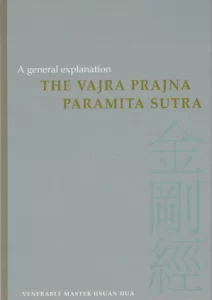
vajra-sutra-bookcoverBeing unfamiliar with the sutra, I went back to the Buddhist Text Translation Society’s website and picked up a copy of “The Vajra Prajna Paramita Sutra, A General Explanation.”

I took a break from Hsuan Hua’s commentary on the Lotus Sutra to read his commentary on the Vajra Sutra.

This is very esoteric stuff, the sort of stuff one would expect a Chinese Chan master to explore. Consider this discussion of “true prajña” – true direct insight or true wisdom:

Once Subhūti was sitting in a cave cultivating and a god came scattering flowers.

“Who has come to scatter flowers?” asked Subhūti.

“The god Sakra,” came the reply. “Sakra has come to scatter flowers.”

“Why have you come here to scatter flowers?” asked Subhūti.

Sakra said, “Because the Venerable One speaks prajña well, I have come to make offerings.”

Subhūti said, “I have not said one word. How can you say I speak prajña?”

Sakra replied, “The Venerable One has not spoken and I have not heard a thing. Nothing spoken and nothing heard: that is true prajña.”

You think it over. Nothing spoken and nothing heard is true prajña. Have you heard prajña? If not, that is true prajña.

The Vajra Prajna Paramita Sutra, p156

In considering what to make of this, I was reminded of similar statements made in the Threefold Lotus Sutra.

In the Sutra of Innumerable Meanings Bodhisattva Fully Composed addresses the Buddha:

“World-honored One! For more than forty years, ever since achieving enlightenment, the Tathāgata, for the benefit of living beings, has continuously discoursed on the principle of the four modes of all phenomena, the meaning of suffering, and the meaning of emptiness; on ever changingness, nonexistence of self, non-greatness, non-smallness, non-origination, and non-cessation; on the formlessness of all things; and on the natures and aspects of phenomena being intrinsically empty and tranquil—neither coming nor going, neither appearing nor disappearing.

Or in Chapter 16 of the Lotus Sutra, when the Buddha explains:

All that I say is true, not false, because I see the triple world as it is. I see that the triple world is the world in which the living beings have neither birth nor death, that is to say, do not appear or disappear, that it is the world in which I do not appear or from which l do not disappear, that it is not real or unreal, and that it is not as it seems or as it does not seem. I do not see the triple world in the same way as [the living beings of] the triple world do. I see all this clearly and infallibly.

The Vajra Sutra is concerned with “marks” or characteristics and how to avoid clinging to them. There are four marks: the mark of self, the mark of others, the mark of living beings and the mark of life.

Hsuan Hua explains in his commentary:

Because Subhūti had cultivated good roots for limitless kalpas, it was not difficult for him to believe. He realized, however, that anyone in the Dharma Ending Age, at the time when people are Strong in Fighting, who could believe, understand, receive, and hold the sūtra, would be a foremost individual and very rare. And why? Such people will have no mark of self, meaning they have no greed. No mark of others, meaning they have no anger. No mark of living beings, meaning they are not stupid. No mark of a life, meaning they have no desire. They have no greed, anger, stupidity, or desire, these four kinds of attachments. The four marks are without a mark. No mark is real mark. Real mark is no mark. And why? Because real mark is also distinct from all which has no marks. If you can obtain real mark, that is obtaining the principle substance of the self-nature of all Buddhas. Those who have relinquished all marks are called Buddhas. Therefore you too can certainly become a Buddha.

The Vajra Prajna Paramita Sutra, p111

Over the next several days I’m going to post excerpts from Hsuan Hua’s commentary on the Vajra Sutra.


Text of The Vajra Prajna Paramita Sutra


Book Quotes

 
Book List