What’s With the Animals in Gemini’s Illustration?

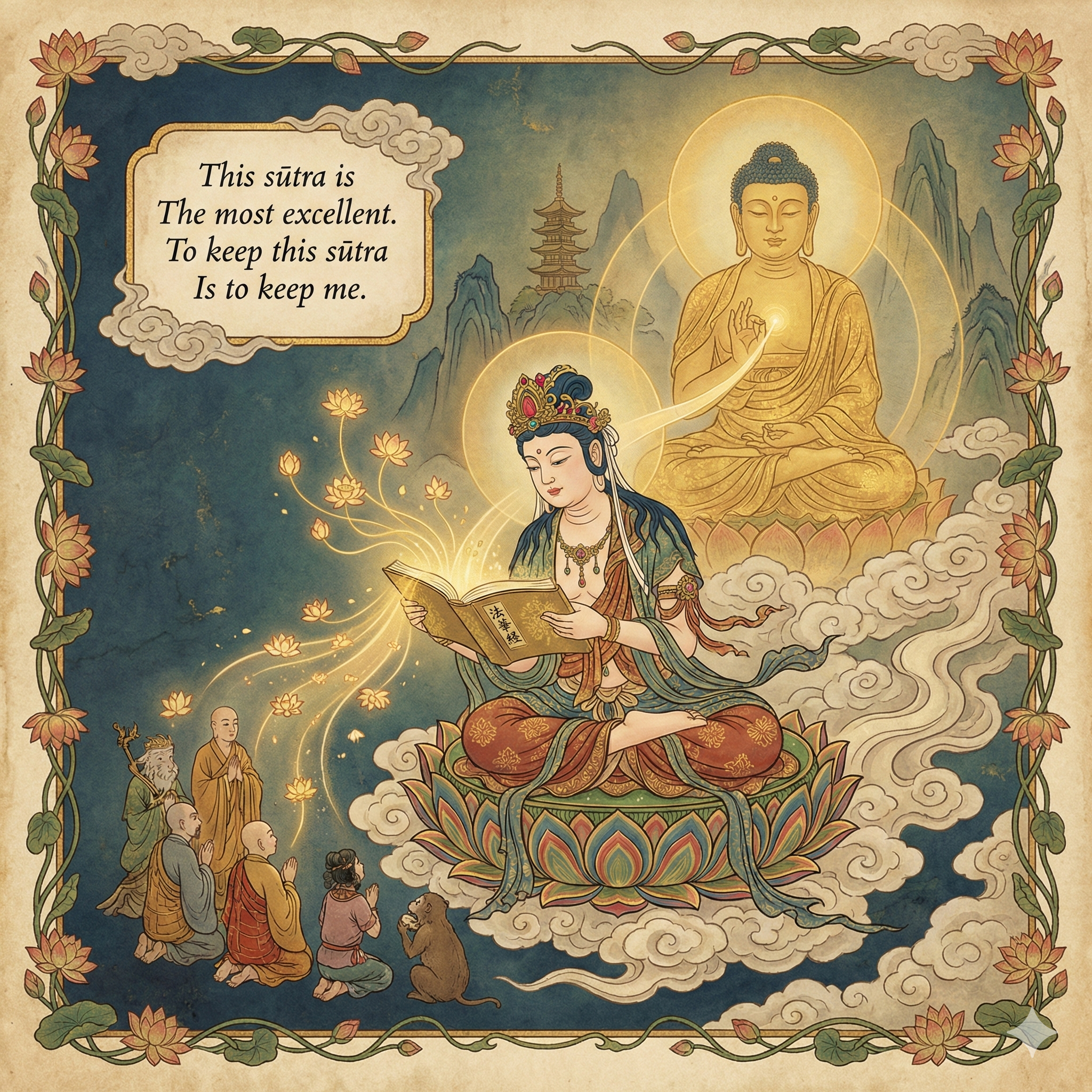
Closeup of lower left corner of Daily Dharma illustration for January 13, 2026
Click to see full Gemini illustration

After publishing today’s Daily Dharma, I asked Gemini: “Why does the image include two animals in the crowd of followers?”

This is a wonderful observation. The inclusion of the two animals—a monkey and what appears to be a serpent or dragon (often called a naga in Buddhist terminology)—is not accidental. It is a deliberate and significant element in Buddhist iconography, especially in relation to the Lotus Sūtra.

Here’s why they are there:

Universal Compassion and Salvation: A central teaching of Mahayana Buddhism, and the Lotus Sūtra in particular, is that the Buddha’s compassion and teachings are not limited to human beings. They extend to all sentient beings in the six realms of existence (which include animals). Their presence visually signifies that the path to enlightenment is open to every form of life.

The Assembly of the Lotus Sūtra: The Lotus Sūtra itself describes a vast and diverse audience that gathers to hear the Buddha’s teaching. This assembly is not just human monks and laypeople; it includes vast numbers of bodhisattvas, gods (devas), and various non-human beings like nagas (dragons), garudas (mythical birds), and others. Depicting animals in the crowd is a way to represent this diverse, universal assembly described in the scripture.

The Buddha-Nature in All: The sūtra teaches that all beings possess the potential for Buddhahood (Buddha-nature). By showing animals listening reverently to the Dharma (teachings), the illustration visually reinforces this profound idea that even beings currently in animal form have the seed of enlightenment within them.

In essence, the animals are there to remind us of the boundless scope of the Buddha’s wisdom and the promise that his teaching is a vehicle for the liberation of all that lives.

The sources for this response:

Meridian University
meridianuniversity.edu
Mahayana Buddhism: Origins and Meaning – Meridian University
Mahayana tradition teaches people that a path that leads to their awakening is a path toward the awakening of all sentient beings because there isn’t a real …

Tricycle: The Buddhist Review
tricycle.org
The Four Limitless Thoughts – Tricycle: The Buddhist Review
Therefore, the power of our own buddha-nature can extend to eventually liberate all sentient beings. This is the reason we practice. If there were no …

SGI USA
www.sgi-usa.org
The Lotus Sutra – SGI USA
—Daisaku Ikeda, The Wisdom of the Lotus Sutra, vol. 4, p. 181. The Lotus Sutra teaches that all people can attain Buddhahood, just as they are, in this …

I’m sure there are better sources than Daisaku Ikeda, but the “thinking” that went into Gemini’s illustration is fascinating to me.
Daily Dharma for January 13, 2026

20260113-ddi

Illustration by Google Gemini

Show Gemini's thinking

Initiating Conceptual Design

I'm starting the process of designing a Japanese Buddhist illustration. My focus is on a square format and generating an illustration based on the user's provided verse from the Lotus Sutra. I am still analyzing the user request and considering the implications of the verse.

Exploring Visual Metaphors

I've been working on breaking down the user's text from the Lotus Sutra. I'm focusing on turning the verse's abstract concepts into concrete visual elements. The goal is to represent the sūtra itself as a central icon and explore how its practice embodies the Buddha's guidance. I'm thinking about how a practitioner can be depicted "keeping" the sūtra.

Formulating Compositional Elements

I'm now determining how to represent the concepts in the user's text through visual metaphors. I'm focusing on the Lotus Sutra as a central icon, with a Bodhisattva figure emphasizing active practice. I'm also working on depicting a subtle spiritual presence of Śākyamuni Buddha. I'm considering incorporating symbolic figures of diverse beings. I'm thinking about utilizing a traditional Japanese Buddhist art style. I need to keep kanji and English text to a minimum.

Developing Visual Prompt Elements

I'm working on how to depict the user's concepts through visual metaphors. I am focusing on generating the illustration's prompt. I am concentrating on the style, composition, and key elements like the Bodhisattva, the sūtra scroll, and the Buddha's presence. I am now specifying details like the Bodhisattva's robes, the light emanating from the sūtra, and the overall Japanese Buddhist aesthetic, as well as the text integration.

Developing Final Composition

I am now focusing on refining the overall composition and integrating all the elements. I'm prioritizing how the user's text will influence the visual prompt. I'm working to balance the central Bodhisattva and the subtle presence of Śākyamuni Buddha, and their relationship to the Lotus Sutra. I am also determining how to incorporate the diverse beings and symbolic landscape within the square format. I'm working to finalize the stylistic details.

Validating the Illustration's Merit

I'm verifying that the illustration aligns with the user's request. The square format, the Japanese Buddhist elements, and specific text are all as requested. It features the Bodhisattva with the glowing Lotus Sūtra and the spiritual presence of Śākyamuni Buddha above.

Verifying Prompt Compliance

I'm checking that the generated image satisfies the parameters set out by the user. The square aspect ratio and incorporation of Japanese Buddhist iconography are complete, and the specific text is present. The illustration depicts the Bodhisattva with the Lotus Sūtra and the spiritual presence of Śākyamuni Buddha. The excluded Buddha figures are omitted as requested. The kanji and English text have been included in the artwork.

This sūtra is
The most excellent.
To keep this sūtra
Is to keep me.

The Buddha sings these verses in Chapter Eleven of the Lotus Sūtra. We may believe that before we can practice we need to find a Buddha or another enlightened being alive in our world to guide us. These verses remind us of the ever-present Buddha Śākaymuni who was revealed in the Lotus Sūtra. Whether or not we see him as another human in our presence, he is always guiding us to enlightenment. The Buddha also reminds us that by living as he has shown us in the Lotus Sūtra, as Bodhisattvas who exist for the benefit of all beings, we show our respect for him and bring his wisdom to life.

The Daily Dharma is produced by the Lexington Nichiren Buddhist Community. To subscribe to the daily emails, visit zenzaizenzai.com

The True Relationship Between Parents and Child

It is said in [Chapter 7, The Parable of the Magic City], “Those who heard the Dharma from those śramaṇera (teachers) are now living under those Buddhas.” T’ien-t’ai stated (in the Words and Phrases of the Lotus Sūtra), “The Buddha in the Western Pure Land is different from the Buddha in this Sahā World; therefore, no relationship between parents and children exists between the Buddha of Infinite Life and us, ordinary beings in the Sahā World.” Miao-lê explains this (in his Annotations on the Words and Phrases of the Lotus Sūtra) that the Buddha of Infinite Life and Śākyamuni are different Buddhas. (…) Their relationships to us from past lives are different, so are their ways of teaching. Sowing the seeds of Buddhahood in living beings by the Buddha is similar to giving birth to a child by parents, and guiding the people by the Buddha is similar to raising a child by parents. If the parents who give birth to a child and parents who raise him are different, the true relationship between parents and child does not exist.

In these days, people in Japan believe that the Buddha of Infinite Life will come to save them. This is as nonsensical as feeding a baby cow or horse milk or trying to have the moon reflected on a roof tile.

Hokke Shuyō Shō, Treatise on the Essence of the Lotus Sūtra, Writings of Nichiren Shōnin, Doctrine 2, Page 204-205.


Daily Dharma for January 12, 2026

20260112-ddi

Illustration by Google Gemini

Show Gemini's thinking

Analyzing the Core Concept

I'm now deconstructing the user's request. It's a square illustration with specific Buddhist iconography, excluding certain figures, focusing on "respect" as described in the Lotus Sutra. I'm moving toward an understanding of the visual parameters to achieve this.

Formulating Visual Parameters

I'm now identifying the key elements and brainstorming visual symbols. I'm focusing on a traditional Japanese ink painting style with a central focus on a scroll or book representing the Lotus Sutra on a wooden altar. The illustration will include offerings and a respectful, bowing figure. I'm also planning limited kanji text for "Respect" and the sutra's name, aiming for a reverent atmosphere.

Assessing Visual Accuracy

I am now evaluating the generated image against the specific parameters provided in the request. The image does successfully render the requested iconography in the correct aspect ratio. The relevant figures, with the specified offerings and respectful monk, are present, but the kanji is limited.

Reviewing Visuals and Concepts

I'm presently assessing the output to determine how well it meets the request's criteria. I see the requested Buddhist iconography and square format are correctly present. It captures the requested essence of respect for Lotus Sūtra practitioners and features offerings and a monk, but with minimal kanji. I will continue my assessment.

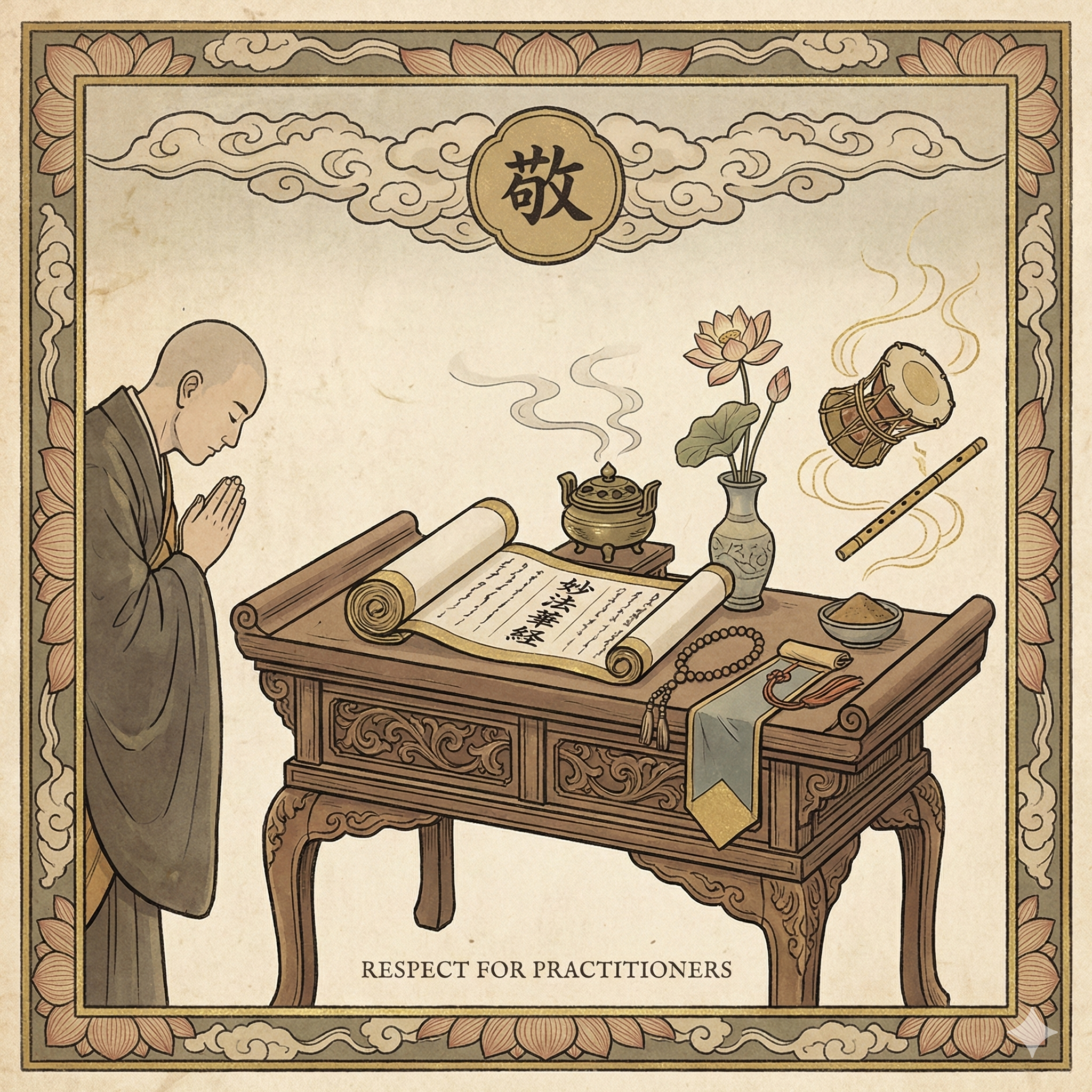
The good men or women who keep, read, recite, expound and copy even a phrase of the Sūtra of the Lotus Flower of the Wonderful Dharma, and offer flowers, incense, necklaces, incense powder, incense applicable to the skin, incense to burn, canopies, banners, streamers, garments and music to a copy of this sūtra, or just join their hands together respectfully towards it, should be respected by all the people of the world.

The Buddha declares these lines to Medicine-King Bodhisattva at the beginning of Chapter Ten of the Lotus Sūtra. The notion of respect appears in many parts of this Sūtra. These lines tell us that we should be respected by people of the world, even though sometimes we are not. It is more important for us to respect each other, and everyone who practices the Wonderful Dharma in any way. It is also important that we respect ourselves, knowing that we are working for the benefit of all beings.

The Daily Dharma is produced by the Lexington Nichiren Buddhist Community. To subscribe to the daily emails, visit zenzaizenzai.com

Saving the Two Vehicles Saves Everyone

All sūtras preached prior to the Lotus Sūtra state that bodhisattvas and ordinary people are able to attain Buddhahood, but never the people of the Two Vehicles. Thinking that they can become Buddhas while the people of the Two Vehicles cannot, wise bodhisattvas and ignorant people throughout the six realms felt happy. The people of the Two Vehicles plunged into grief and thought, “We should not have entered the Buddhist way.” Now in the Lotus Sūtra, they are guaranteed of attaining Buddhahood, so not only the people of the Two Vehicles, but also the people of the nine realms will all become Buddhas. Upon hearing this dharma, bodhisattvas realized their misunderstanding. As stated in the pre-Lotus sūtras, if the people of the Two Vehicles cannot attain Buddhahood, then the Four Great Vows cannot be accomplished. Consequently, bodhisattvas would also be unable to become Buddhas. When it was preached that people of the Two Vehicles were unable to attain Buddhahood, they should not have been left alone in sadness; bodhisattvas should have joined them in grief.

Shōjō Daijō Fumbetsu-shō, The Differences between Hinayana and Mahayana Teachings, Writings of Nichiren Shōnin, Doctrine 2, Page 191-192

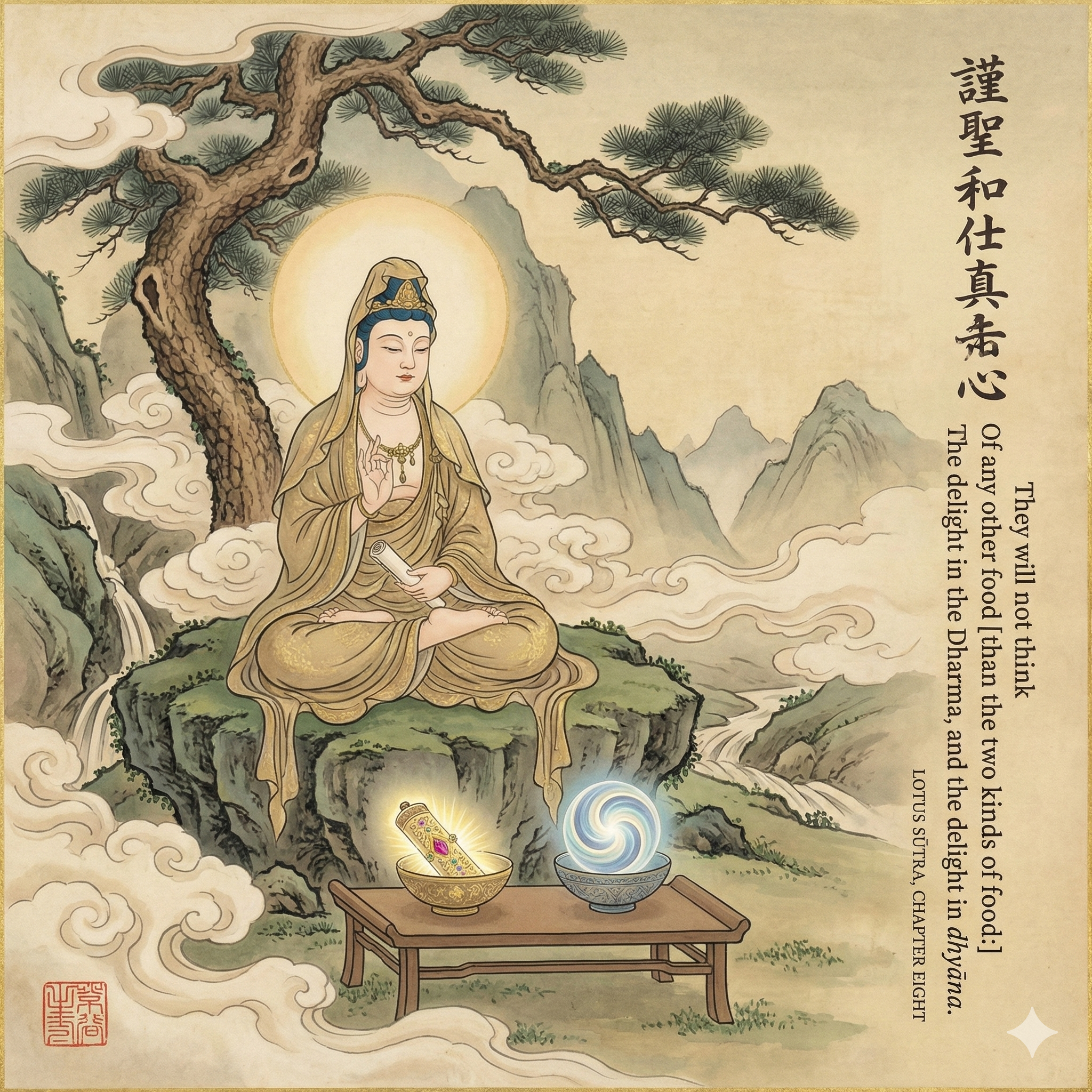
Daily Dharma for January 11, 2026

20260111-ddi

Illustration by Google Gemini

Show Gemini's thinking

Beginning Conceptualization Process

I'm starting the process of generating an illustration based on Japanese Buddhist painting style. The subject will depict "delight in the Dharma and dhyana". I'm currently taking into account the user's constraints to make sure the end result is accurate and meets the specifications.

Exploring Visual Representations

I am now focusing on the visual elements. I'm considering a meditating figure in a natural, simple environment, possibly a mountain setting. I am evaluating symbols like a sutra scroll and meditation cushion, keeping in mind the Japanese Buddhist style and the user's exclusion requests. I'm aiming for a traditional Nihonga style with a muted color palette. I'm thinking of gold accents.

Refining Image Composition

I am now structuring the visual elements into a complete composition. The focus will be on a meditative figure within a simple mountain setting, using symbols like a scroll and cushion. I intend to place translated verses prominently, and to add a title and phrase to the image. My intention is to include the user's exclusion requests, and to emphasize a traditional Nihonga style with a balanced square format.

Checking User Request Adherence

I've confirmed the image's adherence to the parameters. The generation is now verified to satisfy the specifications in a number of areas. It's a square illustration and the subject and visual metaphor in the image closely reflect the meaning of the underlying text. The central figure is a bodhisattva, which fulfills another requirement.

Assessing Prompt Compliance

I'm now satisfied that the image fulfills all requirements. It is a square illustration in the style requested and avoids the excluded subjects. The bodhisattva and visual metaphor align with the text, which is present in the image. I have confirmed that it meets the user's instructions.

Translation of kanji characters

Kanji: 謹聖和仕真志心

Reading (On'yomi): Kin-Sei-Wa-Shi-Shin-Shi-Shin

Meaning: This appears to be a poetic or religious phrase expressing a devotional sentiment. A direct translation would be something like:

"Humbly Serving the Sacred Harmony with a True Heart"

Here is a breakdown of the individual characters:

謹 (Kin): Respectfully, humbly

聖 (Sei): Holy, sacred, sage

和 (Wa): Harmony, peace

仕 (Shi): To serve

真 (Shin): True, real

志 (Shi): Will, intention, aim

心 (Shin): Heart, mind, spirit

They will not think
Of any other food [than the two kinds of food:]
The delight in the Dharma, and the delight in dhyāna.

The Buddha sings these verses in Chapter Eight of the Lotus Sūtra, speaking of the future lives of those who practice the Wonderful Dharma. In the existence we occupy now, it is difficult to imagine any other ways we could live. When the Buddha shows us the world as it is, he is not just opening our eyes to what is in front of us now. He shows us innumerable possibilities far better than anything we could dream up ourselves. To reach these other worlds, we only need to shed our attachment to our delusions and have faith in the path the Buddha opens to his enlightenment.

The Daily Dharma is produced by the Lexington Nichiren Buddhist Community. To subscribe to the daily emails, visit zenzaizenzai.com

Being Like Never-Despising Bodhisattva

Nevertheless, if there is a man after the death of the Buddha who breaks the attachment to the false doctrines of the “four tastes and three teachings” of the pre-Lotus sūtras and puts faith in the True Dharma of the Lotus Sūtra, all the virtuous gods and numerous bodhisattvas who sprang up from underground will protect such a practicer of the Lotus Sūtra. Under such protection, this practicer would be able to spread over the world the honzon revealed in the essential section and the five-word daimoku of “myō, hō, ren, ge, and kyō,” the essence of the Lotus Sūtra.

He is just like Never-Despising Bodhisattva, who in the Age of the Semblance Dharma after the death of Powerful Voice King Buddha spread in the land of this Buddha the twenty-four character passage in the Lotus Sūtra (chapter twenty) saying: “I respect you deeply. I do not despise you. Why is it? It is because you all will practice the way of bodhisattvas and will be able to attain Buddhahood.” With such propagation, the Bodhisattva was severely persecuted by all the people in the land, who beat him with sticks and threw stones at him.

Kembustsu Mirai-ki, Testimony to the Prediction of the Buddha, Writings of Nichiren Shōnin, Doctrine 2, Page 171

Daily Dharma for January 10, 2026

20260110-ddi

Illustration by Google Gemini

Show Gemini's thinking

Beginning Illustration Design

I'm starting to build a plan for the illustration. The core requirement is a square format with Japanese Buddhist imagery, but with those two specific figures excluded. I'm focusing now on identifying appropriate, permissible subjects from the provided text, and I'll need to decide on the best composition.

Formulating Composition Ideas

I'm now diving into the specifics of the composition. I'm focusing on incorporating permissible figures, and the central theme of shifted perception from the provided text. The traditional Japanese art styles of sumi-e and ukiyo-e are very appropriate for this particular work. I'm prioritizing how to illustrate this central concept.

Exploring Visual Representations

I've been analyzing the provided text and am developing ideas for visual elements. I'm prioritizing the style of the illustration, considering traditional Japanese ink wash and woodblock printing techniques as fitting options. The key figures are Shaka Nyorai and Taho Nyorai, along with "Buddhas of my replicas," which I'll represent as smaller glowing figures. I'm focusing on the overall atmosphere, ensuring that elements like the jeweled stupa and lotus flowers are incorporated.

Developing Visual Composition

I'm now prioritizing the scene's composition, focusing on a square format with a Japanese woodblock print style and earthy colors. Key elements will include a figure holding a scroll, a jeweled stupa with Shaka Nyorai and Taho Nyorai, and smaller glowing Buddha figures in the background. I'm aiming for a visual representation of shifting perspective. I am also working on the quote placement.

Prioritizing Visual Elements

I'm now prioritizing the visual components for the illustration, ensuring they align with the requirements. The focus is on traditional Japanese iconography, like the jeweled stupa and lotus flowers, and I need to determine how best to represent the "Buddhas of my replicas." The scene's overall composition will emphasize the theme of shifted perception. I'm focusing on text placement in the design.

Assessing Image Alignment

I'm currently verifying the image against the user's requirements. It's a square illustration and the subject matter depicted is Shaka Nyorai and Taho Nyorai in a jeweled stupa. The style is consistent with a Japanese Buddhist woodblock print.

Confirming Iconography Accuracy

I've checked the image against the user's instructions. The square image's style aligns with a Japanese Buddhist woodblock print. The subject matter comprises Shaka Nyorai, Taho Nyorai, and the stupa. The text, including the Kanji, is properly accounted for and limited, and the overall composition addresses the theme of a shifted perspective.

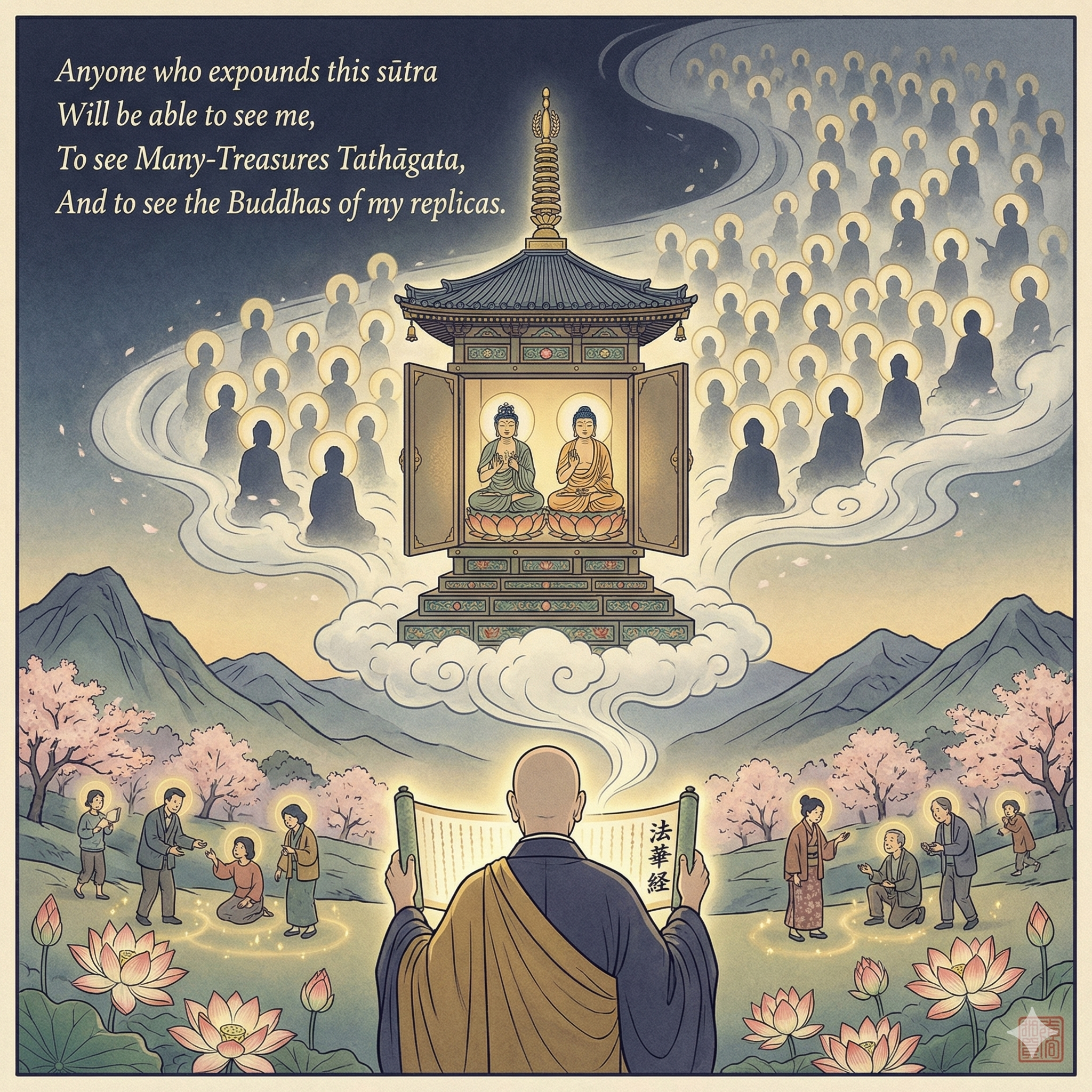
Anyone who expounds this sūtra
Will be able to see me,
To see Many-Treasures Tathāgata,
And to see the Buddhas of my replicas.

The Buddha sings these verses in Chapter Eleven of the Lotus Sūtra. We can hear this teaching with an aspiration to see visions of Śākyamuni Buddha and other Buddhas. But we can also hear the Buddha’s promise that when we keep in mind his assurance that we and all beings have the capacity for enlightenment, we will see the world differently. We will start to interpret the actions of ourselves and others in a new light. We will see many more beings who are helping us to become enlightened, rather than beings who are frustrating our efforts at pursuing our selfish goals.

The Daily Dharma is produced by the Lexington Nichiren Buddhist Community. To subscribe to the daily emails, visit zenzaizenzai.com

This Jewel with the Five Characters of Myō, Hō, Ren, Ge, and Kyō

For those who are incapable of understanding the truth of the “3,000 existences contained in one thought,” Lord Śākyamuni Buddha, with His great compassion, wraps this jewel with the five characters of myō, hō, ren, ge, and kyō and hangs it around the neck of the ignorant in the Latter Age of Degeneration. The four great bodhisattvas will protect such people, just as T’ai-kung-wang and the Duke of Chou assisted the young ruler, King Chen, of the Chou dynasty, or the Four Elders of the Shang-shan attended child Emperor Hui of the Han dynasty in ancient China.

Kanjin Honzon-shō, A Treatise Revealing the Spiritual Contemplation and the Most Venerable One, Writings of Nichiren Shōnin, Doctrine 2, Page 162


Daily Dharma for January 9, 2026

20260109-ddi

Illustration by Google Gemini

Show Gemini's thinking

Focusing Key Figures
I'm currently working on identifying the critical figures within the Lotus Sūtra passage: the Buddha, Shakyamuni, and the Great-Power-Obtainer Bodhisattva, also known as Mahasthamaprapta. This is the first step in creating the illustration.

Refining Composition and Details
I've been working on refining the composition for the illustration, and I am zeroing in on the specifics for each figure. Shakyamuni will be centered, in a teaching mudra on a lotus throne, with a golden aura. The Great-Power-Obtainer Bodhisattva will be positioned to his right in a reverent pose, possibly holding a lotus, and I'm still figuring out how to best integrate a symbolic representation of the Lotus Sutra itself. I'm aiming for a square format with atmospheric elements, such as clouds and light rays to convey the transcendental aspect.

Establishing the Composition
I am now focusing on the visual composition of the illustration. Shakyamuni Buddha will be centered, seated on a lotus throne, with a golden aura. The Great-Power-Obtainer Bodhisattva will be to his right, in a reverent posture. I am considering symbolic representations of the Lotus Sutra, such as a glowing scroll or jeweled stupa, to integrate into the scene. I intend to use atmospheric elements, like clouds and light rays, in a square format to convey the transcendental aspects of the text. I will include the Kanji for "Lotus Sūtra" and "Anuttara-samyak-saṃbodhi". The color scheme will use deep blues, greens, reds and gold for an antique feel.

Checking Visual Fidelity
I'm currently verifying the visual fidelity of the illustration against the user's request. The illustration does capture the prompt's main components. Shakyamuni Buddha and Great-Power-Obtainer Bodhisattva are accurately depicted. The central teachings of the Lotus Sutra are symbolized in the design.

Confirming Symbolic Accuracy
I am now confirming the symbolic accuracy of the illustration. The design aligns closely with the user's intent. The central tenets are well-represented via the radiating scroll and the bodhisattvas. The requested kanji are present. I have completed my assessment and will proceed accordingly.

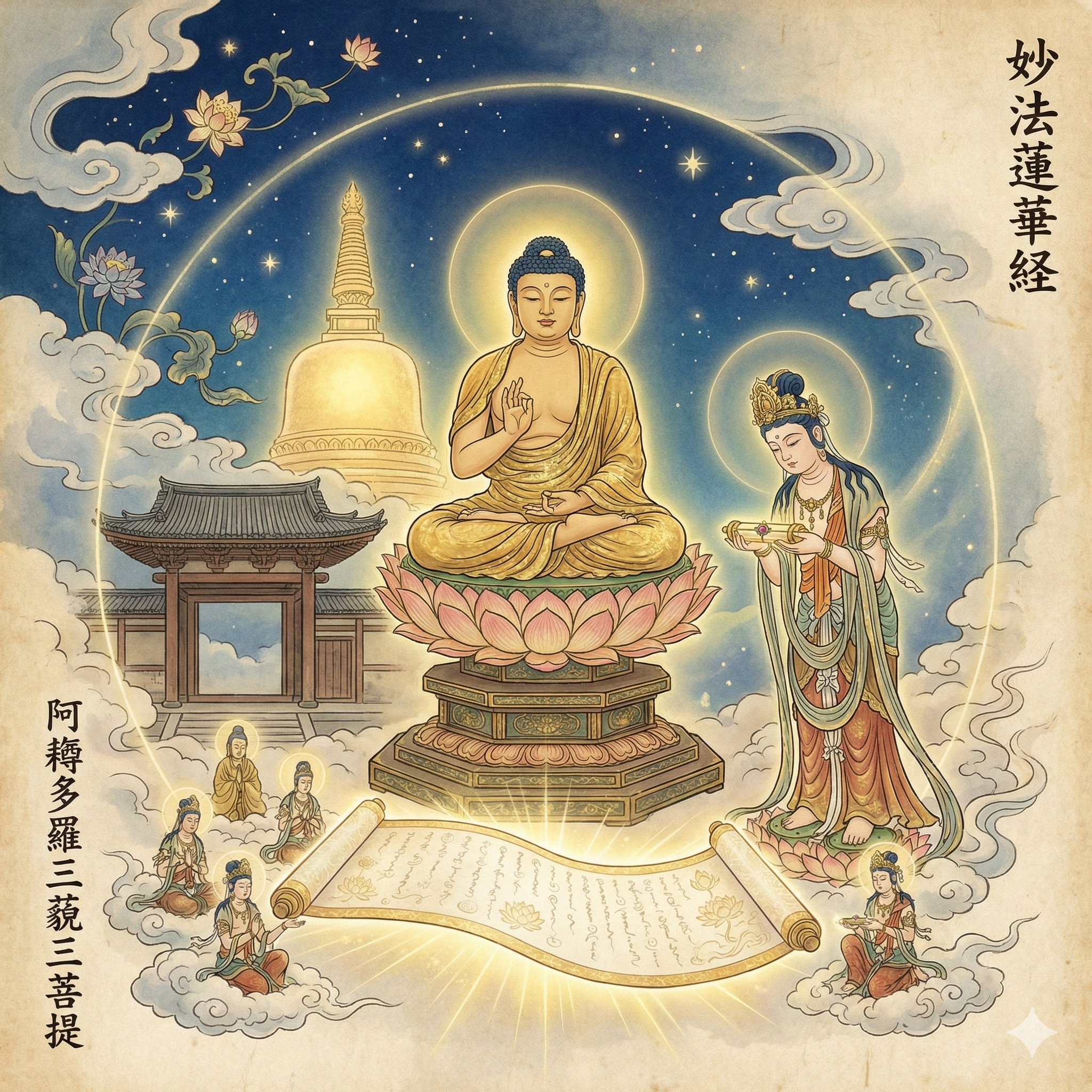
Kanji Translation
1. Text on the top right (vertical):
妙法蓮華経 (Myōhō Renge Kyō)

Translation: The Lotus Sutra (or more literally, "The Sutra of the Lotus Flower of the Wonderful Dharma").

Significance: This is the title of one of the most important and influential sutras (scriptures) in Mahayana Buddhism. The illustration itself is a depiction of a scene from this sutra.

2. Text on the bottom left (vertical):
阿耨多羅三藐三菩提 (Anokutara-sanmyaku-sanbodai)

Translation: Supreme Perfect Enlightenment (or "Unsurpassed, Complete Awakening").

Significance: This is a phonetic transliteration of the Sanskrit term Anuttarā-samyak-saṃbodhi. It refers to the ultimate state of enlightenment attained by a Buddha.

Great-Power-Obtainer, know this! This Sūtra of the Lotus Flower of the Wonderful Dharma benefits Bodhisattva-mahāsattvas, and causes them to attain Anuttara-samyak-saṃbodhi. Therefore, they should keep, read, recite, expound and copy this sūtra after my extinction.

The Buddha gives this explanation to Great-Power-Obtainer Bodhisattva in Chapter Twenty of the Lotus Sūtra. In several places in the sūtra, the Buddha asked who would continue to teach this Wonderful Dharma after his extinction and lead all beings to Anuttara-samyak-saṃbodhi: perfect unsurpassed enlightenment. When he revealed his Ever-Present Existence in Chapter Sixteen, he assured all those receiving his words that his life is not limited to that of the physical body he inhabited. In truth he is leading all beings throughout all time and space to his wisdom, and this Lotus Sūtra he has given us is the embodiment of that wisdom.

The Daily Dharma is produced by the Lexington Nichiren Buddhist Community. To subscribe to the daily emails, visit zenzaizenzai.com

On the Journey to a Place of Treasures