
Category Archives: WONS

Day 8 of 100

“The Life Span of the Buddha” chapter says: “Having taken poison, some had lost their senses while others had not. … Seeing this excellent medicine with color and scent both good, those who had not lost their senses took it and recovered from their illness.” This refers to those who received the seed of Buddhahood in the eternal past as preached in “The Life Span of the Buddha,” those who had the opportunity to establish a connection with Buddhist dharma at the time of Great Universal Wisdom Buddha as revealed in the seventh chapter on “The Parable of a Magic City,” and all those bodhisattvas, Two Vehicles (Śrāvakas and Pratyekabuddha), men and gods who received the teaching of the Buddha in the pre-Lotus sūtraas well as the theoretical section of the Lotus Sūtra attain Buddhahood in the preaching of the essential section. It is said in the same chapter:

‘The remainder who had lost their senses were happy to see their father come back and requested him to cure their illness, but they refused to take the medicine their father offered them. Why did they not take it? It was because they had been affected by poison, causing them to lose their senses and think this excellent medicine, in both color and scent, not good at all. …

“Now I have to devise an expedient means so that they may take this medicine,” thought the father. “Now I will leave this excellent medicine here with you. You should take it without worrying about its effectiveness,” instructed the father to his children and he again went abroad. Then he sent a messenger back to his children, telling them that their father had passed away.’

The seventeenth chapter, “Variety of the Merits,” in the essential section of the Lotus Sūtra states, “In the evil age of the latter dharma…,” indicating that the teaching was for the Latter Age of Degeneration.

Kanjin Honzon-shō, A Treatise Revealing the Spiritual Contemplation and the Most Venerable One, Writings of Nichiren Shōnin, Doctrine 2, Page 156.

I’m both fascinated and chagrined by this revelation that as a member of the Latter Age of Degeneration I’m not among the three groups that did not lose their mind:

  • those who received the seed of Buddhahood in the eternal past as preached in “The Life Span of the Buddha,”
  • those who had the opportunity to establish a connection with Buddhist dharma at the time of Great Universal Wisdom Buddha as revealed in the seventh chapter on “The Parable of a Magic City,”
  • and all those bodhisattvas, Two Vehicles (Śrāvakas and Pratyekabuddha), men and gods who received the teaching of the Buddha in the pre-Lotus sūtras as well as the theoretical section of the Lotus Sūtra attain Buddhahood in the preaching of the essential section.

But I suppose imagining myself as having been exposed to the Lotus Sūtra in life after life since the remotest past begs the question of why exactly it never took. How dumb or perverted would I need to be for it to take literally forever for me to realize Na Mu Myo Ho Ren Ge Kyo?

100 Days of Study
Day 7 of 100

Finally, let us try to answer your first question (1) whether or not vast virtue of Lord Śākyamuni Buddha exists in our minds. The Sūtra of Infinite Meaning (Muryōgi-kyō), which is regarded as an introductory teaching to the Lotus Sūtra, explains how we attain Buddhahood:

“Suppose there was a prince just born to a king and his queen. Growing up day by day, month by month, year by year, the new prince has reached the age of seven. Though unable to attend the affairs of state, he is respected by his father’s subjects and befriended by children of great kings. He is loved by his royal parents, who find it most enjoyable to chat with him constantly. Why is this? It is because the prince is still young. My good people, he who upholds this Lotus Sūtra is just like this prince. His father is Buddhas; and his mother, this sūtra. Just as the prince was born to the king and his queen, Buddhas and this sūtra are united in one to give birth to the bodhisattva, upholder of this sutra. Suppose, having listened to the Lotus Sūtra, he reads a phrase or a verse of it, or reads it once, twice, ten, one hundred, one thousand, ten thousand times, or one trillion times the grains of sand of the Ganges River—unlimited and infinite number of times. Even if he had not yet obtained the ultimate truth, he would be respected by all the four groups of Buddhists (monks, nuns, laymen, and laywomen) and the eight kinds of gods and semi-gods, protectors of Buddhism. Accompanied by great bodhisattvas, he would always be protected and cared for by Buddhas and completely surrounded by their benevolence. It is because he is a beginner on the way to Buddhahood.”

Then, we come across the following passage in the Sūtra of Meditation on the Universal Sage Bodhisattva (Kan Fugen Bosatsu Gyōbō-kyō), considered to be the conclusion of the Lotus Sūtra: “This Mahayana Sūtra of the Lotus Flower of the Wonderful Dharma is the treasure house of all the Buddhas and the eyes of all the Buddhas in all the worlds in the universe in the past, present, and future. It is the seed of Buddhahood giving birth to all the Buddhas in the past, present as well as future. You must put the Mahayana teaching into practice lest the seed of Buddhahood be extinguished.” And also: “This Mahayana sūtra is the eyes of all the Buddhas. It is by means of this Lotus Sūtra that all the Buddhas reach the stage of having Five Eyes. The Buddha with three bodies (Dharma Body, Reward Body, and Accommodative Body) was born from this sūtra. This sūtra is the great seal of enlightenment impressed upon the sea of Nirvana, from which the Buddha with three pure bodies was born. The triple-bodied Buddha, therefore, is the source of happiness for men and gods alike.”

Kanjin Honzon-shō, A Treatise Revealing the Spiritual Contemplation and the Most Venerable One, Writings of Nichiren Shōnin, Doctrine 2, Page 143-144.

This concludes the first of what will be a little more than 14 weeks of study and I am thoroughly enjoying this. I’ve read the writings of Nichiren twice before, but reading today with my daily practice of daily reading a portion of the Lotus Sūtra has enhanced my understanding in ways I had not expected.

100 Days of Study

Day 6 of 100

Note: Nichiren writes: “[W]e do not see how our mind contains ten realms, 100 realms, 1,000 aspects, and 3,000 modes of existence, unless we see our reflection in the clear mirror of the Lotus Sūtra and writings of Grand Master T’ien-t’ai such as Great Concentration and Insight.” Nichiren then specifies where in the Sūtra we find the explanation.

QUESTION (13): Which parts of the Lotus Sutra are you referring to? How about T’ien-t’ai’s explanation of them?

ANSWER: The second “Expedients” chapter of the Lotus Sutra (fascicle 1) states that the purpose of the Buddhas appearing in the worlds was “to cause all living beings to open the gate to the insight of the Buddha.” This means that of the nine of the ten realms of living beings (excepting the realm of Buddhas), each embraces the realm of Buddhas. In the sixteenth chapter, “The Life Span of the Buddha,” the sutra also declares: “As I said before, it is immeasurably long since I, Śākyamuni Buddha, obtained Buddhahood. My life spans an innumerably and incalculably long period of time. Nevertheless, I am always here and I shall never pass away. Good men! The duration of my life, which I obtained by practicing the way of bodhisattvas, has not yet expired. It will last twice as long as the length of time as stated above.” This passage also shows that the nine realms are included in the realm of Buddhas.

The following passages in the Lotus Sutra also show that the ten realms of living beings embrace one another. It is said in the twelfth chapter, “Devadatta,” that after an incalculably long period of time, Devadatta will be a Buddha called “Heavenly King.” This shows the realm of Buddhas included in the realms of hells as it says that even a man as wicked as Devadatta, who had tried to kill the Buddha and had gone to hell, will be able to become a Buddha.

In the twenty-sixth chapter on the “Mystic Phrases,” the Buddha praises the ten female rāksasas demons such as Lambā saying, “Your merits will be immeasurable even when you protect the person who keeps only the name of the Lotus Sutra.” Since even these rāksasas demons in the realm of hungry spirits protect the practicer of the Lotus Sūtra, the ten realms, from hells up to the realm of Buddhas, are comprised in the realm of hungry spirits.

The “Devadatta” chapter states also that a daughter of a dragon king attained perfect enlightenment, proving the existence of the ten realms in the realm of beasts.

The tenth chapter, “The Teacher of the Dharma,” says that even a semi-god like Asura King Balin (a king of asura demons mentioned in the first “Introduction” chapter) will obtain Buddhahood if he rejoices for a moment at hearing a verse or a phrase of the Lotus Sutra. This shows that the ten realms are contained in the realm of asura demons.

It is stated in the second “Expedients” chapter: “Those who carve an image of the Buddha with proper physical characteristics in His honor have already attained the enlightenment of the Buddha,” showing that the realm of man includes the ten realms in it.

Then in the first “Introduction” and the third “A Parable” chapters, various gods such as the great King of the Brahma Heaven declare, “we also shall be able to become Buddhas,” proving that the ten realms are contained in the realm of gods.

In the third chapter, the Buddha assures Śāriputra, the wisest of His Śrāvaka disciples, that he will also attain Buddhahood in future life and will be called “Kekō (Flower Light) Buddha.” This confirms the existence of the ten realms in the realm of Śrāvaka.

The second chapter states that those monks and nuns who sought emancipation through the way of pratyekabuddha (without guidance of teachers by observing the principle of cause and effect) pressed their hands together in respect, wishing to hear the Perfect Way. This affirms the existence of the ten realms in the realm of pratyekabuddha.

It is written in the twenty-first chapter, “Divine Powers of the Buddha,” that bodhisattvas as numerous as particles of dust of 1,000 worlds, who had sprung up from underground, beseeched the Buddha for this true, pure, and great dharma, namely the Lotus Sutra. This verifies the existence of the ten realms in the realm of bodhisattvas.

Finally in the sixteenth chapter, the Buddha sometimes appears as a Buddha in the realm of Buddhas but at other times appears as some of the others who reside in the other nine realms. This indicates that the ten realms are included in the realm of Buddhas.

Kanjin Honzon-shō, A Treatise Revealing the Spiritual Contemplation and the Most Venerable One, Writings of Nichiren Shōnin, Doctrine 2, Page 132-133.

I’ve understood for some time that the “3,000 existences contained in one thought” was not explicitly mentioned in the Lotus Sūtra but was instead written “between the lines.” With this lengthy excerpt I see the lines between which I should look.

100 Days of Study

Day 5 of 100

Now, two ways of propagation, the persuasive and aggressive, are incompatible with each other just as water and fire are. The fire dislikes the water, and the water hates the fire. Those who prefer the persuasive tend to laugh at those who practice the aggressive and vice versa. So, when the land is full of evil and ignorant people, the persuasive means should take precedence as preached in the “Peaceful Practices” (14th) chapter of the Lotus Sutra. However, when there are many cunning slanderers of the True Dharma, the aggressive means should take precedence as preached in the “Never-Despising Bodhisattva” (20th) chapter.

It is the same as using cold water when it is hot and fire when it is cold. Plants and trees are followers of the sun, so they dislike the cold moon. Bodies of water are followers of the moon, so they lose their true nature when it is hot. As there are lands of evil men as well as those of slanderers of the True Dharma in this Latter Age of Degeneration, there should be both aggressive and persuasive means of spreading the True Dharma.

Kaimoku-shō, Open Your Eyes to the Lotus Teaching, Writings of Nichiren Shōnin, Doctrine 2, Page 111

I find it amusing that, in his next letter, Nichiren wrote Toki Jonin: “I wrote a little about the teaching of the Buddha and gave it to the messenger of Lord Shijō Kingo the other day.” I just can’t imagine anyone describing Kaimoku-shō as “a little” anything.

Having concluded Kaimoku-shō, I want to include some of the Notes that follow for future reference.

Kalpa is a Sanskrit term meaning an immeasurably long period of time, said to be the period required to erupt)’ a city full of poppy seeds by taking away one every three years, or for an angel to wear away a ten-mile-cubic stone by touching it with her robe once every three years.

It is believed that the world goes through four kalpa (periods) of construction, continuance, destruction, and emptiness, each of which consists of 20 small kalpas. The average human longevity in a small kalpa increases by a year per century from 10 years until it reaches the maximum human longevity of 84,000 years. After it reaches the maximum human longevity, the human life grows shorter by a year per century until it reaches the minimum average human longevity of 10 years. This is repeated 20 times within a kalpa.

Eight Winds refer to the eight elements which arouse one’s love and hate: profit, sorrow, slander, fame, praise, censure, pain, and pleasure.

100 Days of Study

Day 4 of 100

Leaving aside this question, I will write this for my followers. Others will not believe in me and go to hell for slandering the True Dharma, which would in turn cause them to obtain Buddhahood. It is possible to know the salinity of the ocean by tasting one drop of water, and the advent of spring by seeing a flower bloom. In the same way without sailing thousands of miles over to Sung China, without spending as long as three years as Fa-hsien did to visit Mt. Sacred Eagle, without entering the Dragon Palace as Nāgārjuna did, without visiting Bodhisattva Maitreya as Asaṅga did, or without attending the “three meetings at two places for lectures on the Lotus Sutra (two on Mt. Sacred Eagle and one up in the sky) you will be able to perceive the relative merits of all the sutras preached by the Buddha during His lifetime by reading this writing of mine.

Kaimoku-shō, Open Your Eyes to the Lotus Teaching, Writings of Nichiren Shōnin, Doctrine 2, Page 89

When I read “Others will not believe in me and go to hell for slandering the True Dharma, which would in turn cause them to obtain Buddhahood,” I was reminded of Bodhisattva Never Despise.

In Chapter 20, Śākyamuni says about those who abused Bodhisattva Never Despise:

“Great-Power-Obtainer! The four kinds of devotees: the bhikṣus, bhikṣunīs, upāsakās, and upāsikās at that time failed to meet the Buddha, hear the Dharma, and see the Saṃgha for twenty thousand million kalpas because they abused me with anger. They suffered much in the Avici Hell for one thousand kalpas. Having expiated their sin in this way, they met [me, who was] Never-Despising Bodhisattva again, and were led into the Way to Anuttara-samyak-saṃbodhi.

“Great-Power-Obtainer! What do you think of this? The four kinds of devotees who always abused [me, who was] that Bodhisattva at that time are now present here in this congregation in the persons of the five hundred Bodhisattvas including Bhadrapala, the five hundred bhikṣunīs including Lion-Moon, and the five hundred upāsakās including Thinking-Of-Buddha. Now they do not falter in seeking Anuttara-samyak-saṃbodhi.

I ponder the idea: Could I have been a slanderer of the True Dharma in Nichiren’s day? Is that the source of my fortune to meet the True Dharma in this lifetime?

100 Days of Study

Day 3 of 100

The Miao-fa lien-hua-ching is a Chinese designation for the Lotus Sutra, which is called the Saddharma-pundarīka-sūtra in India. Tripitaka Master Subhākarasimha’s mantras representing the gist of the Lotus Sutra are as follows: “I put my faith in the everywhere-penetrating Buddha, the three-bodied Buddha. When one attains Buddha Wisdom, which is opened and revealed to all the people, he will, like the crisp-clear sky, be able to get rid of all delusions and evil passions, accept the teaching of the Sutra of the Wonderful Dharma and live with joy, firmly upholding the teaching.”

These mantras representing the gist of the Lotus Sutra came from an iron Stupa in Southern India. The Satsuri-daruma among them means the True Dharma, while “satsu” means shō (true) or myō (wonderful). Therefore, the Lotus Sutra is called either the Sūtra of the Lotus Flowers of the True Dharma or the Sūtra of the Lotus Flowers of the Wonderful Dharma. Placing the two words of na and mu in front of the latter, we get Namu Myōhō Renge-kyō (I put my faith in the Sutra of the Lotus Flowers of the Wonderful Dharma).

Kaimoku-shō, Open Your Eyes to the Lotus Teaching, Writings of Nichiren Shōnin, Doctrine 2, Page 67

Working my way through Kaimoku-shō I am humbled. My goal of reading all of Nichiren’s letters in 100 days of study could just as easily have been 100 days of study of Kaimoku-shō. An idea for a future 100 days.

100 Days of Study

Day 2 of 100

But now, it has been over 200 years since the beginning of the Latter Age of Degeneration. I have not been allowed to meet opponents in debate; instead I have been banished with my life in jeopardy. It proves that the warning in the Lotus Sutra about much hatred and jealousy after the death of the Buddha is not an empty threat. It also proves that we are in the beginning of endless warfare and in a decadent world of corruption where unreasonableness takes precedence over reason.

Therefore, although my comprehension of the Lotus Sutra is not worthy even one ten millionth of that of T’ien-t’ai and Dengyō, I dare say that my endurance on its behalf and compassion for the people are beyond these masters. I am sure that I deserve to receive heavenly protection, but there is not even a shred of it. Instead I have been condemned to heavier and heavier penalties. Looking back in this light, I wonder whether or not I am a practicer of the Lotus Sutra and whether or not various gods and deities have left this land.

However, if only I, Nichiren, had not been born in this country, the twenty-line verse of the thirteenth chapter, “The Encouragement for Upholding This Sutra,” in the fifth fascicle of the Lotus Sutra would be empty words and the Buddha would almost be a great liar. Those uncountable number of bodhisattvas, who made the vow to uphold the Lotus Sutra, would be accused of committing the same sin of lying as Devadatta did. The verse says, “Ignorant people will speak ill of us, abuse us, and threaten us with swords or sticks.”

In the world today, is there any Buddhist priest other than me, Nichiren, who is spoken ill of, abused, and threatened with swords or sticks on account of the Lotus Sutra?

Kaimoku-shō, Open Your Eyes to the Lotus Teaching, Writings of Nichiren Shōnin, Doctrine 2, Pages 56-57

I want to underscore here Nichiren’s “compassion for the people.” There is no ulterior motive.

100 Days of Study

Day 1 of 100

Ignorant of the past and future [these Four Chinese] sages cannot help in the future lives of their parents, rulers and teachers. Not knowing what they owe to them in the past, they cannot be considered truly holy and wise. This is why Confucius said, “Truly wise and holy men do not exist in China, but in the land to the west, there is a man called Buddha. He is a true sage.”

Confucius thus indicated Confucianism, which is non-Buddhist (geten), to be the first step toward Buddhism. It would be easier, Confucius knew, for the people to understand the fundamental Buddhist teachings of commandments, meditation, and wisdom if they first learned the fundamental Confucian concepts of rituals and music.

He therefore taught the kings’ subjects to be loyal to their rulers, children to be devoted to their parents, and students to respect their teachers. Grand Master Miao-lê therefore declared in his Annotations on the Great Concentration and Insight: “The dissemination of Buddhism in China indeed depended on Confucianism. Buddhism found its way by following on the heels of the rituals and music of Confucianism.”

Kaimoku-shō, Open Your Eyes to the Lotus Teaching, Writings of Nichiren Shōnin, Doctrine 2, Pages 32-33

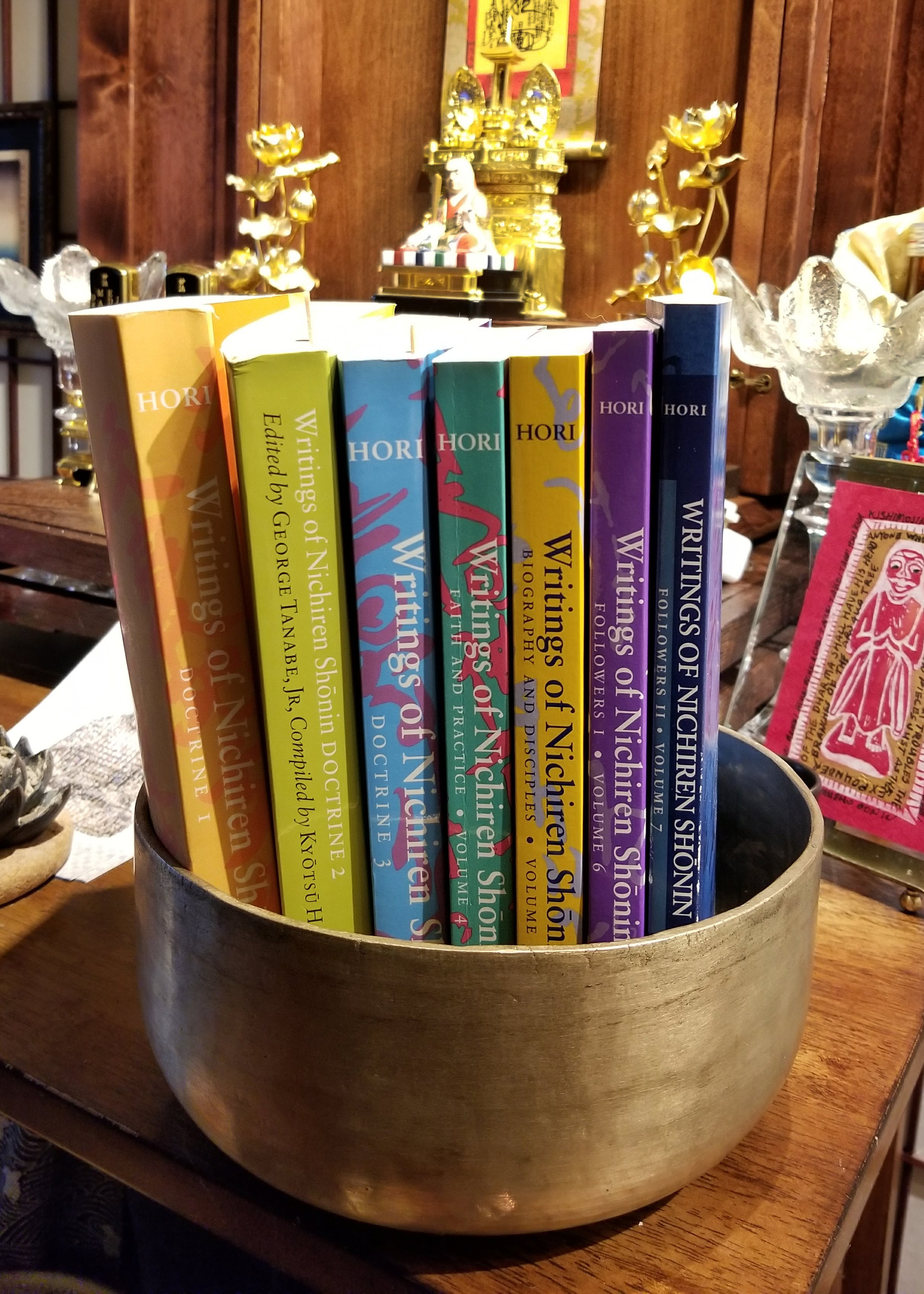
For the next 100 days I will follow this format: A quote from something I’ve read that day accompanied with something pithy from me. I hope to devote a minimum of an hour a day to reading the seven volumes of the official Nichiren Shū collection of Nichiren’s writings. I’m starting in Doctrine 2 (the book titles shift to “volume” after Doctrine 3) since I read Doctrine 1 last July. I don’t think I’ll make it through the six remaining books in 100 days, but if I do I’ll return to Doctrine 1.

I’m not a quick reader and my progress will be slowed by copying of quotes that I’ll start publishing daily after I finish this 100-day adventure. Again, the purpose, as with all of the quotes on this site, is to remind me and to provide a means of recalling what I’ve forgotten.

100 Days of Study

100 Days of Study

Nichiren VolumnsOver the past few months I’ve been reading books about Bodhisattvas and the Six Perfections from Zen authors, books on the basics of Buddhism and introductions to the Lotus Sutra by authors outside Nichiren Shu. On my to-read pile are books on T’ien-Tai philosophy and the Establishment of the Japanese Tendai School, two volumes of dharma talks by the Most Venerable Nichidatsu Fujii and, for good measure, the Vimalakirti Sutra.

This is all part of my effort to follow Nichiren’s admonition: “Strive to carry out the two ways of practice and learning. Without practice and learning, Buddhism will cease to exist.” (Shohō Jissō Shō, Writings of Nichiren Shōnin, Volume 4 p.79)

But I realize I need to circle back and ensure my foundation in Nichiren Buddhism is sound. I’m reading the Lotus Sutra daily but I haven’t re-read Nichiren’s letters recently.

Today, March 1, I’m starting a 100-day study of Nichiren’s writings that will continue daily through June 9.

I would like to think that I do this in the spirit of “The Best Way for Recompensing Indebtedness,” which comes from Nichiren’s essay on gratitude:

“What is the best way for Buddhists to express their gratitude for the unfathomable kindness that they have received? Mastering Buddhism completely and to be sagacious is the way. How can anyone guide blind persons across a bridge, if he himself is blind? How can a captain, who does not know the direction of the wind, sail his ship to transport many merchants to a mountain of treasure?”

At this point I need to confess that I actually started this on Feb. 26. I’m sort of rounding up so I can start at the beginning of the month. Who starts stuff at the end of the month?

The need for my study was actually underlined for me when I was reading Jisshō-shō — A Treatise on the Ten Chapters of the Great Concentration and Insight — written in Kamakura in 1271.

Nichiren writes:

“Non-Buddhist religions in India claimed that this world was eternal, joyful, free and pure. On the contrary, the Buddha insisted that this world was impermanent, painful, empty and egoless in order to destroy their superficial views. The Two Vehicles (two kinds of Buddhist known as śrāvaka and pratyekabuddha) were stuck to the principle of emptiness preached by the Buddha and could not grasp the idea of eternity in Mahayana Buddhism. The Buddha, therefore, reproached them saying that even the five rebellious sins and evil passions could be a cause of enlightenment, but their inflexible belief in emptiness will never lead them to Buddhahood.” (Writings of Nichiren Shonin, Doctrine 2, Page 5.)

Having just finished two Zen-focused books explaining emptiness, I’m intrigued by Nichiren’s “idea of eternity in Mahayana Buddhism.” What is that? Is there something more than Chapter 16’s assurance that Śākyamuni’s lifespan is immeasurable – not eternal but immeasurable?

Realization of Buddhahood

KANJIN HONZON SHO

The Saha-world is the world of the Original Buddha and is the eternal Pure Land, which is free from the three calamities and the four kalpa. In this eternal world, the Buddha never disappeared in the past, nor is He to appear in the future. In consequence, all living beings under the Buddha in the Saha-world are one with Him and eternal. It is because those who believe in the Lotus Sutra, live in the land where they have united themselves with the Buddha and attained the truth of “the three thousand existences in one thought.”

(Background : April 25, 1273, 51 years old, at Sado, Showa Teihon, p.712)

Explanatory note

The world of the Original Buddha Sakyamuni is permanently peaceful and blissful without the traumas of birth and death. Contrarily, in the Saha-world of human beings, there are various sufferings and anxieties caused by three calamities of fire, flood, and storms; and the four types of transitions (Four kalpa): origination, duration, destruction, and annihilation.

In fact, in the realm of the Original Buddha, all existences are absolutely pure and tranquil. The Buddha himself with all other existences has never disappeared in the past nor will He appear in the future. The Buddha and all His disciples are equally enlightened by the glory of the sacred power of Odaimoku.

All beings have already been saved by the Original Buddha and are identified as one with the Buddha.

Despite the Buddha-land being perfect and beautiful, many people still have perverted views in which everything is still burning by the fire of illusions.

Nichiren Daishonin has found truth in the Lotus Sutra which is neither extreme idealism nor extreme realism. According to his teaching, the Buddha-land is not different from the human world. This land is the Buddha-land because it is where the Buddha is expounding the Lotus Sutra.

We, human beings, are the real disciples of the Original Buddha Sakyamuni, and had been taught by Him and have accomplished the Supreme Enlightenment.

This is the sacred relationship between the Original Buddha and the human beings in the Latter Age of the Declining Law. While we believe in the Lotus Sutra and recite Odaimoku, we can recognize our own existence and be able to realize our own divine Buddhahood.

Rev. Syaku

Phrase A Day