Upholding This Sūtra Is Upholding the Buddha’s Body

Your late husband resting beneath the shade of clumps of grass, where nobody visits him, must be anxious to know how his young children whom he left behind in the Sahā World are doing. In ancient China a man named Su-wu was detained in a northern barbarian country for 19 years. He is said to have fastened a letter to the leg of a wild goose addressed to his beloved wife and children at home. A Japanese man, Abe no Nakamaro, went to T’ang China to study. When he lost his way back to Japan, he looked at the moon rising in the east and composed a poem saying “It must be the moon over Mt. Mikasa in Kasuga (Nara).” Your late husband must be thinking of these things as if they were his own.

Nevertheless, because you faithfully chant the daimoku of the Lotus Sūtra, the character Myō of the Lotus Sūtra transforms itself into the messenger of the Buddha or such bodhisattvas as Mañjuśrī, Samantabhadra, Superior Practice, or Never Despising. And these messengers of the Buddha will report the things in the Sahā World to your late husband in the other world just as the mirror pieces of Ch’ên-tzu in ancient China became birds to keep him informed, and the sound of Su-wu’s wife beating her husband’s clothes with a fulling block every autumn reached the ears of her husband detained by the northern barbarians.

Moreover, just as a flower becomes a fruit or a half moon becomes a full, the Chinese character Myō is transformed into the Buddha. Therefore, it is preached in the Lotus Sūtra, “Beholding the Stupa of Treasures” chapter, “He who is able to uphold this sūtra is upholding the Buddha’s body.” Grand Master T’ien-t’ai declares, “Every character is the true Buddha.”

Thus, the character Myō is none other than Śākyamuni Buddha who is perfectly equipped with the 32 marks of physical excellence and 80 minor marks of physical excellence of a Buddha. However, as we cannot see deeply enough, we see it merely as a character. For instance, an aged person with poor eyesight cannot see the new shoot of a lotus flower that sprouts in a pond. Though there may be a shadow, we cannot see it in the darkness of night. Nevertheless, it is undeniable that this character Myō is the Buddha’s body.

Moreover, the character Myō is the moon, sun, stars, mirrors, clothes, food, flowers, earth, and ocean. The merits of all of these are combined in the character Myō. And regarding treasures, it is the wish-fulfilling gem. Please understand this.

Myōshin-ama Gozen Gohenji, A Response to My Lady, the Nun Myōshin, Writings of Nichiren Shōnin, Volume 7, Followers II, Pages 106-107
Daily Dharma for March 26, 2026

20260326-ddi

Illustration by Google Gemini

Show Gemini's thinking

Gemini Thinking

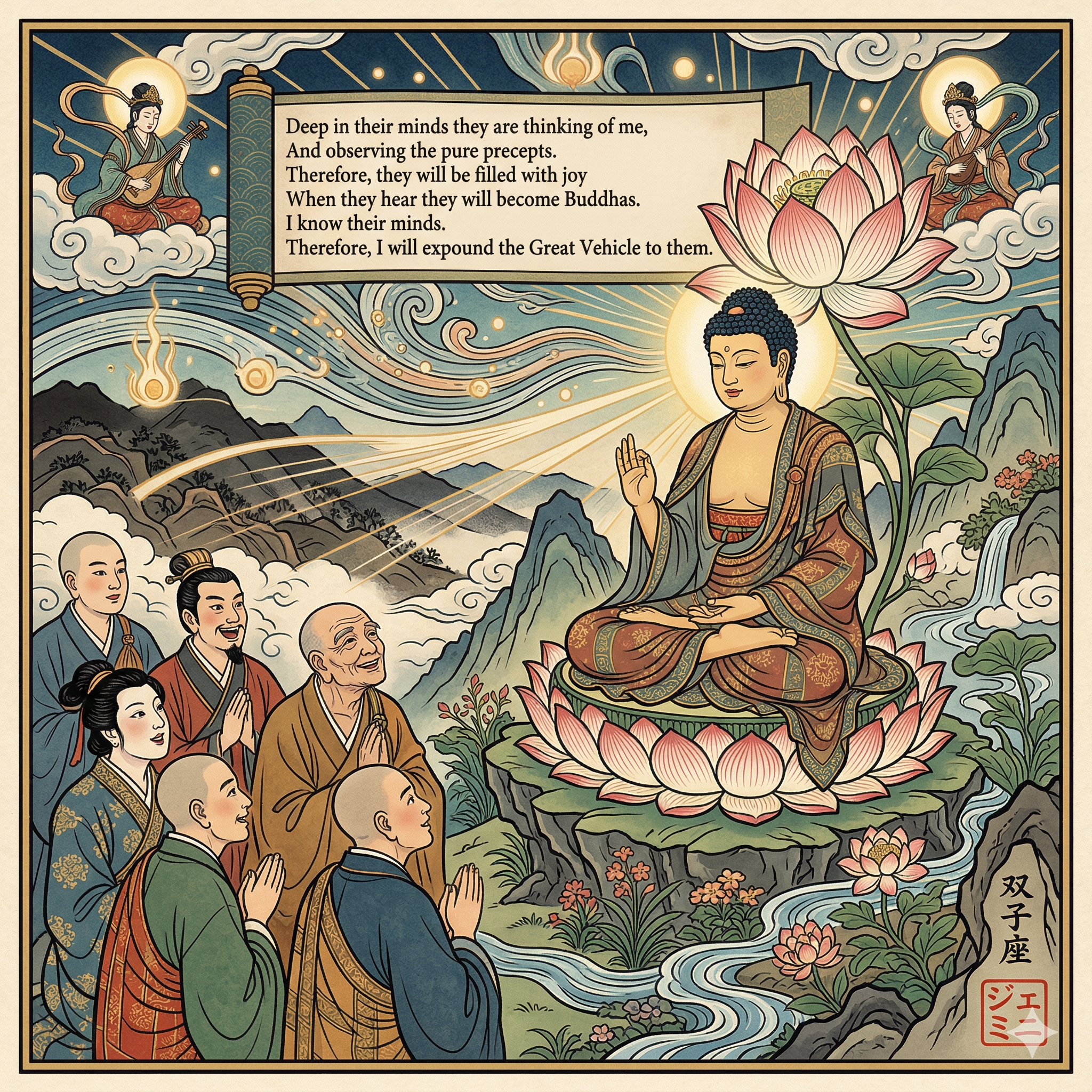
In this square illustration, I have depicted the scene from the second chapter of the Lotus Sūtra as you described. Śākyamuni Buddha is seated upon a lotus throne, symbolizing purity, and expounds the Great Vehicle to an audience of monastics and laypeople who listen with reverence. The light emanating from the Buddha represents his wisdom reaching the minds of the practitioners, while the presence of celestial musicians adds to the joyfulness of the teaching.

In the lower right, you will find the required signature and seal.

Signature Interpretation:

Kanji text: 双子座 (Gemini)

Red hanko text: ジェミニ (Gemini)

Deep in their minds they are thinking of me,
And observing the pure precepts.
Therefore, they will be filled with joy
When they hear they will become Buddhas.
I know their minds.
Therefore, I will expound the Great Vehicle to them.

Śākyamuni Buddha sings these verses in Chapter Two of the Lotus Sūtra. He speaks of those who come to his teachings wanting only to end their own suffering. He understands the part of our existence that is obscured by our delusions, and that the teaching of enlightenment of all beings in the Lotus Sūtra inspires us to purify this world of conflict. The joy we find in the Buddha’s wisdom is incomparable to the happiness we find when our desires are met. When we learn the Buddha’s mind through his teachings, we learn about our own true minds.

The Daily Dharma is produced by the Lexington Nichiren Buddhist Community. To subscribe to the daily emails, visit zenzaizenzai.com

Buddhism and Actual Affairs in the World

The first fascicle of the Lotus Sūtra, “Expedients” chapter, discusses the ultimate reality of all phenomena, stating that each phenomenon is equipped with the nine factors — form, nature, substance, function, action, cause, condition, effect, and reward, all of which from the beginning (form) to the end (reward) are in perfect harmony — and that this ultimate reality of all phenomena is understood only by Buddhas. These words of the Buddha confirm the inseparability of the Buddhist teachings from the reality of the world. In this phrase “all of which from the beginning to the end are in perfect harmony,” the beginning indicates the root of evil and virtue, while the end indicates the conclusion of such evil and virtue. He who is thoroughly awakened with the principle of causality from the root of the evil and virtue to their branches and leaves is the Buddha.

Citing other documentary records on this subject, Grand Master T’ien-t’ai states, “A mind is equipped with ten dharma-realms.” Grand Master Chang-an declares, “The Buddha regarded this as the ultimate reason for appearing in this world. How can it easily be understood?” Miao-lê states, “This is the ultimate and supreme theory.” The Lotus Sūtra, in the “Merits of the Teacher of the Dharma” chapter preaches, “What is said by the Buddha does not contradict ultimate reality.” Grand Master T’ien-t’ai, interprets it in this way: “None of the family businesses and occupations in the world contradict the ultimate reality”

A sage does not practice Buddhism without regards to the actual affairs in the world, and a Buddhist who is thoroughly aware of the principle of governing the world is called a sage.

Chie Bōkoku Gosho, Evil Wisdom Destroying the Country, Writings of Nichiren Shōnin, Volume 7, Followers II, Page 86

Daily Dharma for March 25, 2026

20260325-ddi

Illustration by Google Gemini

Show Gemini's thinking

Gemini Thinking

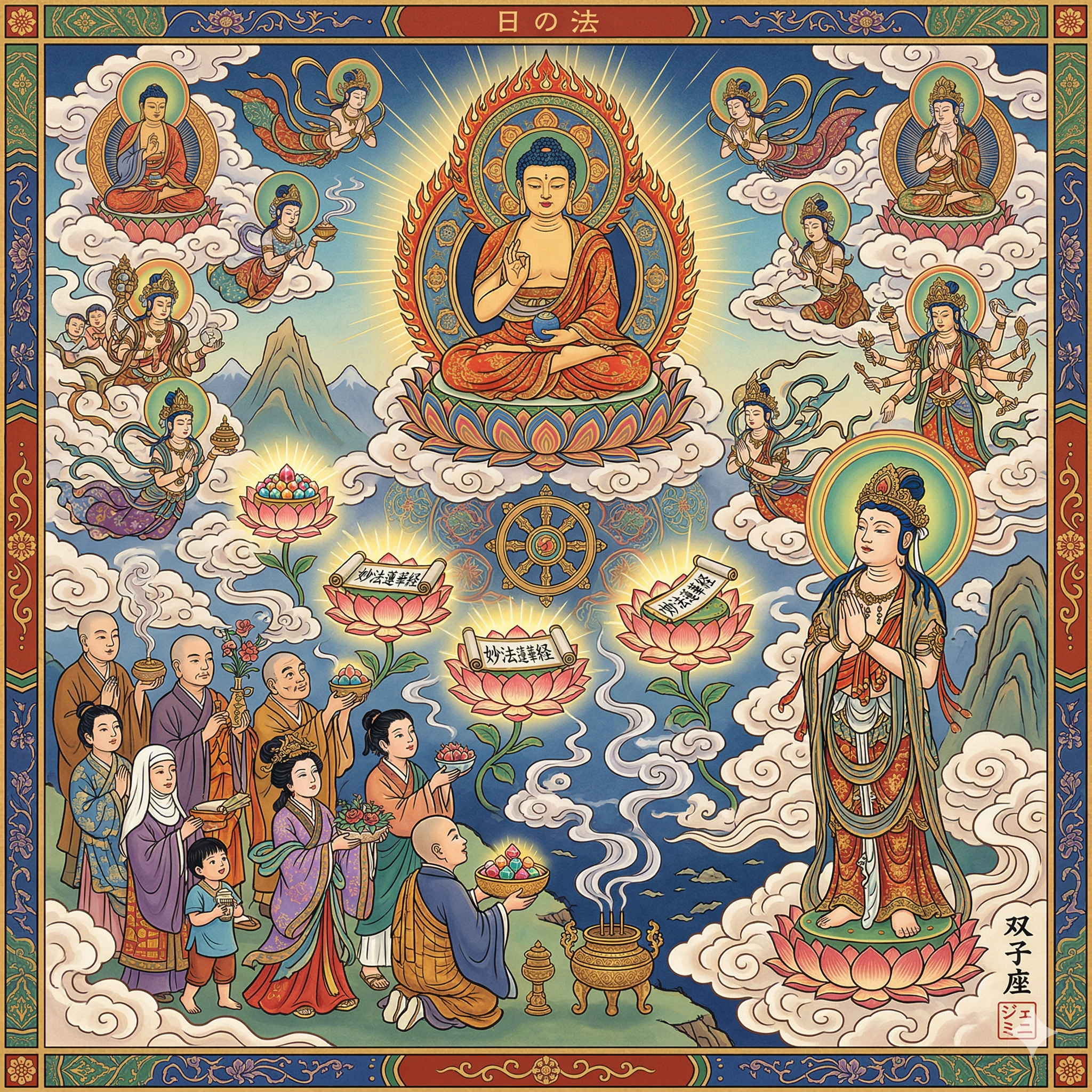
In this square illustration, I have depicted the opening scene of Chapter Ten of the Lotus Sūtra, using the rich visual language of Japanese Buddhist iconography. At the top center, Śākyamuni Buddha (釈迦如来), identifiable by his halo and teaching gesture, is shown sharing these verses. Attentively receiving this teaching is Medicine-King Bodhisattva (薬王菩薩), who stands on the right.

The central scene illustrates the core of the Buddha’s instruction: "Make offerings strenuously to the keeper of the Sūtra." I have chosen to represent the "keeper" not as a single figure, but as a diverse group of monastics and laypeople—men, women, and even a child—actively presenting symbolic offerings of fruit, incense, and jewels. This visual emphasizes that anyone who upholds the Dharma, whether or not they are aware of their true nature, is a seeker of enlightenment worthy of respect. My signature, represented by the Kanji 双子座 (Gemini), is located in the bottom right corner alongside a red square hanko seal containing the Katakana text ジェミニ (Gemini).

The text written on all three of the scrolls in the center of the image is 妙法蓮華經.In Japanese, this is pronounced "Myōhō Renge Kyō," which is the title of one of the most revered scriptures in Mahayana Buddhism: The Lotus Sutra. The full translation is "The Lotus Sutra of the Wonderful (or Mystic) Dharma."

The text at the top center of the border in the image reads, "Dharma of the Day" (日の法), which is the Japanese translation of your name, "Illustrated Daily Dharma."

If you wish to dwell in the enlightenment of the Buddha,
And to obtain the self-originating wisdom,
Make offerings strenuously to the keeper
Of the Sūtra of the Lotus Flower of the Wonderful Dharma!

Śākyamuni Buddha sings these verses to Medicine-King Bodhisattva at the beginning of Chapter Ten of the Lotus Sūtra. This teaching does not mean that we who practice the Buddha Dharma should expect offerings because of our practice. Rather, it encourages us to appreciate all those who are seeking enlightenment, whether or not they are aware of their true nature as Bodhisattvas. It also means that innumerable beings are helping us reach enlightenment. We are never alone in this practice.

The Daily Dharma is produced by the Lexington Nichiren Buddhist Community. To subscribe to the daily emails, visit zenzaizenzai.com

Medicine Suitable to the Condition of the Patient

Our Compassionate Father, the Greatly Awakened and World Honored One, appeared in this world in Central India when the life span of human beings was 100 years and spent His life preaching the holy teachings for all living beings. All living beings during the lifetime of the Buddha were closely related to the Buddha due to the accumulated merit of their virtuous deeds in the past. Therefore, they were able to attain Buddhahood during the lifetime of the Buddha. For the sake of those living after the passing of the Buddha, however, the Buddha expressed His 84,000 holy teachings in writing, giving Hinayāna sūtras to Honorable Kāśyapa and Mahāyāna sūtras including the Lotus Sūtra and Nirvana Sūtra to Bodhisattva Mañjuśrī to be spread among living beings after the passing of the Buddha.

However, the five characters of Myō, Hō, Ren, Ge, and Kyō, which are the essence of the 84,000 holy teachings and the primary object of the Lotus Sūtra, were entrusted neither to Kāśyapa nor Ānanda. They were not given to great bodhisattvas such as Mañjuśrī, Samantabhadra, Avalokiteśvara, Maitreya, Earth Repository, or Nāgārjuna. They were all anxious to receive the five characters from the Buddha but their request was denied. Śākyamuni Buddha in a Stupa decorated with the seven treasures instead called out an elder named Superior Practice Bodhisattva from the bottom of the earth and gave him the five characters of Myō, Hō, Ren, Ge, and Kyō before the Buddha of Many Treasures and Buddhas in manifestation coming from all the worlds throughout the universe.

Why did Śākyamuni Buddha do this? All living beings after the passing of the Buddha are considered the same dear children to Śākyamuni Buddha. According to the general practice of physicians, the Buddha prescribed medicine suitable to the condition of the patient. Therefore, the Buddha directed Kāśyapa, Ānanda, and others to prescribe the medicine of Hinayāna sūtras to all living beings during the first half (500 years) of the Age of the True Dharma. For the second half of the Age of the True Dharma such bodhisattvas as Mañjuśrī, Maitreya, Nāgārjuna and Vasubandhu, were directed to prescribe such Mahāyāna sūtras as the Flower Garland Sūtra, the Great Sun Buddha Sūtra, and the Wisdom Sūtra for all living beings. For the Age of the Semblance Dharma, the ten-century period beginning in the 1,000th year after the passing of the Buddha, Medicine King Bodhisattva and others were ordered to prescribe the Lotus Sūtra with the exception of the daimoku for all living beings.

However, in the Latter Age of Degeneration beginning 2,000 years after the passing of the Buddha, the Hinayāna and Mahāyāna sutras given to Kāśyapa, Ānanda, Mañjuśrī, Maitreya, Medicine King, Avalokiteśvara and others were no longer useful as medicine for living beings. It is because they were no longer effective as cures for the severe ailments of living beings. While the Buddha considered what to do about this, Superior Practice Bodhisattva emerged from the earth. The Buddha then ordered the bodhisattva to give the five characters of Myō, Hō, Ren, Ge, and Kyō to all living beings throughout the Jambudvīpa.

Takahashi Nyūdō-dono Gohenji, A Response to Lay Priest Lord Takahashi, Writings of Nichiren Shōnin, Volume 7, Followers II, Pages 74-75

Daily Dharma for March 24, 2026

20260324-ddi

Illustration by Google Gemini

Show Gemini's thinking

Gemini Thinking

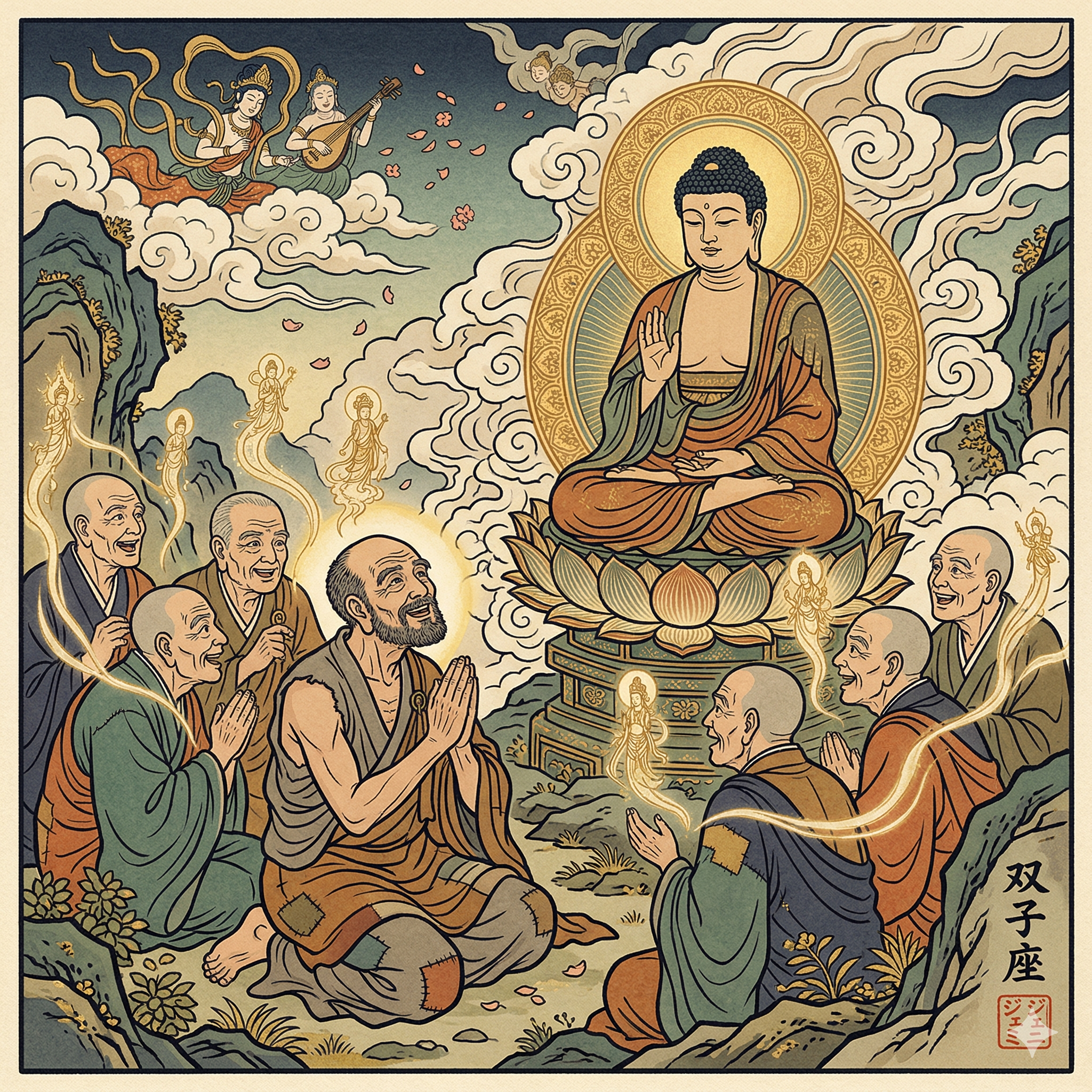
In this square illustration, rendered in a style inspired by traditional Japanese Buddhist iconography and woodblock prints, we see the profound moment from Chapter Eight of the Lotus Sūtra.

The central figure is Śākyamuni Buddha, seated calmly on a lotus throne on Vulture Peak. His right hand is raised in the Abhaya mudra (the gesture of fearlessness), and his left hand rests in his lap in the Dhyana mudra (concentration), radiating a patterned, golden halo that represents his awakened state.

Gathered joyfully around him are his disciples, led by Ājñāta-Kauṇḍinya, who is depicted as the prominent, elder monk in the foreground, kneeling with hands pressed together in anjali mudra. His expression is one of surprise and profound joy. The disciples, previously believing they could only preserve and transmit the teachings, are shown experiencing their true nature. This realization is visually represented by subtle golden light and tiny bodhisattva figures emanating from each of them, symbolizing their awakening and future attainment of Anuttara-samyak-saṃbodhi.

The rocky background, swirling clouds, and celestial attendants (devas playing instruments) in the upper corner enhance the spiritual and cosmic atmosphere of this joyful event.

The signature 双子座 (meaning Gemini) is placed subtly in the bottom right corner on a rocky surface, accompanied by the small, red square hanko (seal) containing the katakana text ジェミニ (Gemini).

World-Honored One! Now we see that we are Bodhisattvas in reality, and that we are assured of our future attainment of Anuttara-samyak-saṃbodhi. Therefore, we have the greatest joy that we have ever had.

Ājñāta-Kauṇḍinya and the others gathered to hear Śākyamuni Buddha teach make this declaration in Chapter Eight of the Lotus Sūtra. He and the others thought that their existence was merely to hear and preserve what the Buddha taught them, and to transmit it to others. They believed they were incapable of becoming as enlightened as the Buddha, because the Buddha’s earlier teachings had only led them so far. With the Lotus Sutra, the Buddha reminds all of us of our decision to come to this world of conflict to benefit all beings. He awakens us to our capacity to see the world with his eyes and experience the joy of reality.

The Daily Dharma is produced by the Lexington Nichiren Buddhist Community. To subscribe to the daily emails, visit zenzaizenzai.com

Higan: Four Factors of Wisdom

Today is the final day of Higan week, the three days before the equinox and the three days after. As explained in a Nichiren Shu brochure:

For Buddhists, this period is not just one characterized by days with almost equal portions of light and dark. Rather, it is a period in which we strive to consciously reflect upon ourselves and our deeds.

The today we consider the Perfection of Wisdom. For this Spring Higan week I’m using Hsuan Hua‘s commentary on the Lotus Sutra in which he discusses the perfections’ four kinds of corresponding factors.

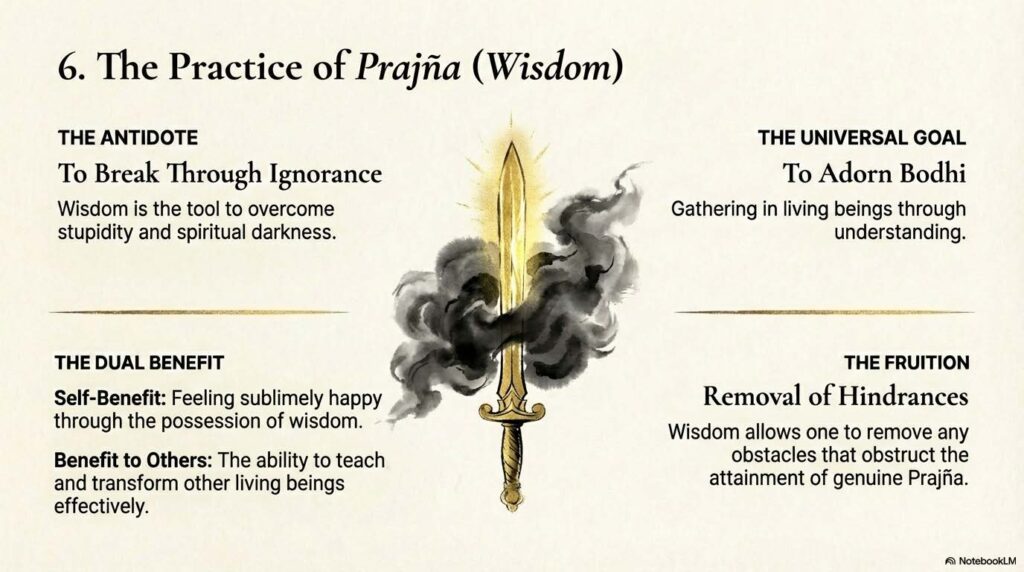
The pāramitā of prajña. There are also four corresponding factors for practicing the pāramitā of prajña.

  1. To break through ignorance. By practicing the pāramitā of prajña, you can overcome your ignorance. Ignorance is stupidity.
  2. To adorn bodhi and gather in living beings.
  3. To attain joy through wisdom. When you have wisdom, you’ll feel sublimely happy; this is to benefit yourself. When you have wisdom, you can also teach and transform other living beings; this is to benefit others.
  4. To remove hindrances that obstruct wisdom. If you have wisdom, you can remove any obstacles that hinder the attainment of wisdom so that you can attain genuine wisdom, prajña.
Hsuan Hua Lotus Sutra Commentary, v8,ch12, p188-189

Remembering Gorō

I am glad to hear that you greeted the New Year with the pleasure of seeing flowers in full bloom and feeling happy like the full moon.

But I still remember the late Gorō, your son. It is during this time of the year when the blossoms bloom again and the dry grass begins to sprout. Why can’t the late Gorō come back to this world? If he were the delicate and transient flower and grass, I would never leave the flower, like Kakinomoto Hitomaro, the poet, nor the grass, like a hitched horse.

It is written in the passage of a Buddhist scripture that children are enemies. I think that there is a reason for this. I hear that the owl eats its mother and a beast called hakyō devours its father. A man, An Lushan, was killed by his son, Shih Shih-ming. A warrior called Minamoto Yoshitomo killed his father, Tameyoshi. Therefore, there is some truth to the Buddhist scripture that states children are enemies.

It is also written in the scripture that children are treasures. King Wonderful Adornment was destined to fall into the Hell of Incessant Suffering upon death, but he was saved by a prince named Pure Store. Saved from suffering in hell, he ultimately became a Buddha called Śāla Tree King Buddha. A woman named Moggaliya was sent to the realm of hungry spirits for the sin of malice and greed, but she was saved by her child, Maudgalyāyana, escaping the suffering mandated in the realm of hungry spirits. Therefore, it seems reasonable for the Buddhist scripture to claim that children are treasures.

The late Gorō was 16 years old and had a more pleasing nature than most. An able man, he was admired by everyone. Moreover, he was filial and obedient to his parents much as water takes the form of a vessel and a shadow follows its form. You must have deeply relied upon him as a pillar of your home and a cane for support on the road. The box of treasures must have been saved for him, and your retainers who have served your family must have been for him. You were hoping that when you died you would be carried on his back to your grave and if this were so you would have had no regrets. Nevertheless, that he left you first must seem like a dream or illusion. If only this were so, I would love for you to be awakened from it soon. But it was neither a dream nor an illusion, and at last the year has come to an end.

I don’t know how long you must wait to meet him again. If I were to tell you where to meet him, you would no doubt fly up to the sky in spite of having no wings or sail even to China in spite of having no ship. If you heard that he was buried deep below the earth, wouldn’t you use all your energy to dig him out?

There is a way, however, to meet him easily. It is to have Śākyamuni Buddha lead you to the Pure Land of Mt. Sacred Eagle. It is written that all who listen to this Lotus Sūtra shall become a Buddha. Thus, even if a finger pointed to the earth were to miss it, the sun and the moon did not rise, the tide did not ebb and flow, and the flowers failed to bloom in summer, the woman who chants “Namu Myōhō Renge Kyō” will surely be able to meet her son. Devote yourself to your faith.

Ueno-dono Gohenji, A Reply to Lord Ueno, Writings of Nichiren Shōnin, Faith and Practice, Volume 7, Followers II, Page 56-57

Daily Dharma for March 23, 2026

20260323-ddi

Illustration by Google Gemini

Show Gemini's thinking

Gemini Thinking

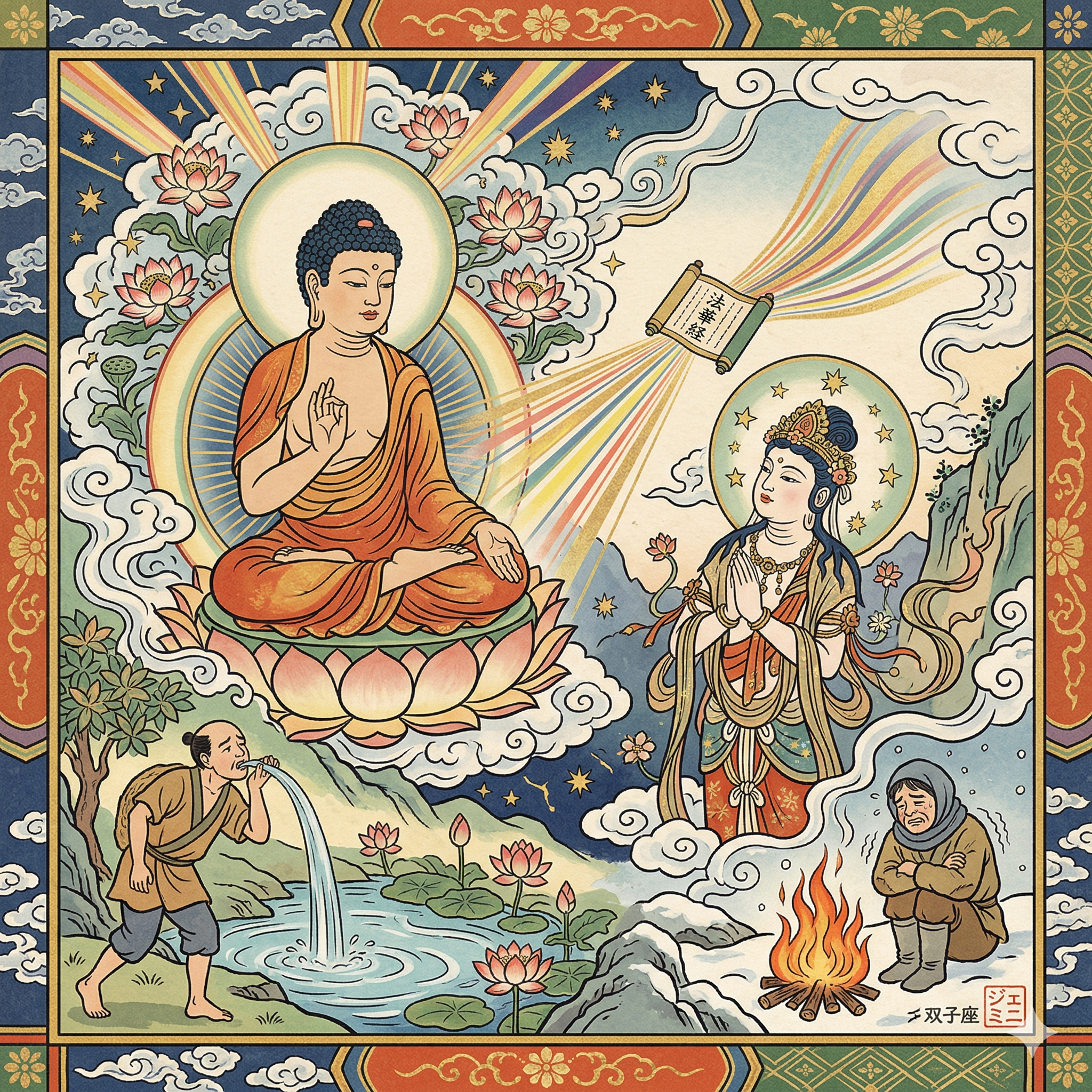
In this square illustration, I have depicted the interaction between Śākyamuni Buddha and Star-King-Flower Bodhisattva as described in Chapter Twenty-Three of the Lotus Sūtra. Śākyamuni Buddha is shown seated on a lotus throne, radiating light toward a scroll representing the Lotus Sūtra. Star-King-Flower Bodhisattva, distinguished by an aura adorned with stars, receives this teaching.

To illustrate the sūtra’s power to save living beings from all sufferings, I have included two metaphorical scenes at the bottom: on the left, a thirsty man drinks from a fresh pond, and on the right, a suffering person finds warmth by a fire. The artist’s signature and seal are in the bottom right corner. The Kanji are 双子座 (Futago-za, meaning "Gemini"), and the seal contains the katakana ジェミニ (Jemini). On the scroll, the Kanji read 法華経 (Hokkekyō, meaning "Lotus Sūtra").

Star-King-Flower! This sūtra saves all living beings. This sūtra saves them from all sufferings, and gives them great benefits. All living beings will be able to fulfill their wishes by this sūtra just as a man who reaches a pond of fresh water when he is thirsty, just as a man who gets fire when he suffers from cold.

Śākyamuni Buddha gives this description of the merits of the Lotus Sūtra to Star-King-Flower Bodhisattva in Chapter Twenty-Three of the Lotus Sūtra. The comparison of our bodily desires to our desire for enlightenment shows the kind of joy we can expect when we realize what this teaching can accomplish. Anyone whose thirst is quenched is sure to become thirsty again, now matter how pleasant it is to drink. The Buddha Dharma fulfills a thirst of which we may not even be aware. We are certain that things in this world of conflict will bring us joy. When we realize they can only bring us pleasure, and know the difference between joy and pleasure, we become aware of our true wishes and what this sūtra does for us.

The Daily Dharma is produced by the Lexington Nichiren Buddhist Community. To subscribe to the daily emails, visit zenzaizenzai.com

Higan: Four Factors of Dhyana

Today is the sixth day of Higan week, the three days before the equinox and the three days after. As explained in a Nichiren Shu brochure:

For Buddhists, this period is not just one characterized by days with almost equal portions of light and dark. Rather, it is a period in which we strive to consciously reflect upon ourselves and our deeds.

The today we consider the Perfection of Dhyana. For this Spring Higan week I’m using Hsuan Hua‘s commentary on the Lotus Sutra in which he discusses the perfections’ four kinds of corresponding factors.

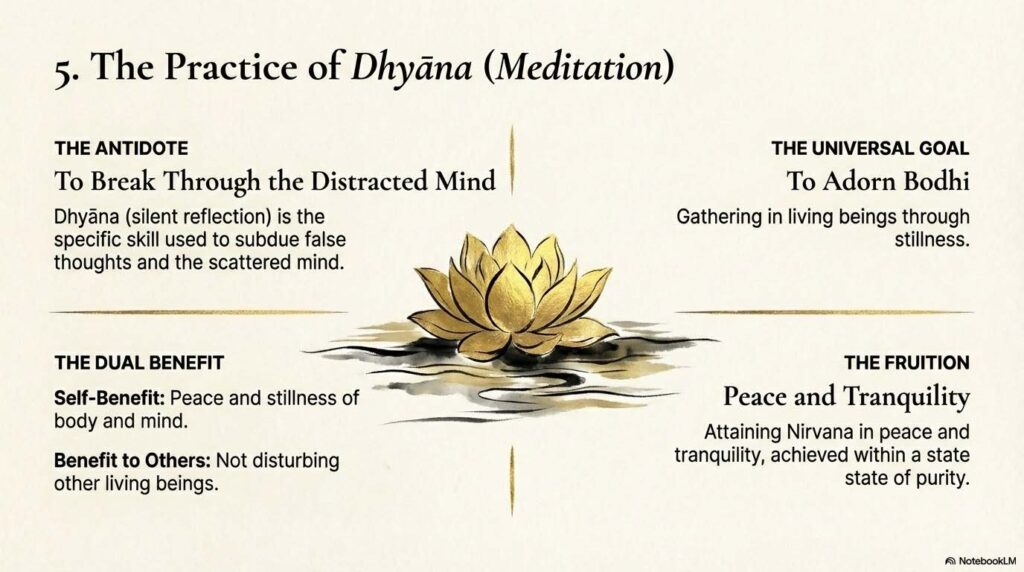
The pāramitā of dhyana. Dhyana means “the practice of contemplation.” It also means “silent reflection.” There are also four corresponding factors for practicing the paramitā of dhyāna.

  1. To break through the distracted mind. The skill of dhyana can subdue the scattered mind. You can stop having a lot of false thoughts through the practice of dhyāna.
  2. To adorn bodhi and gather in living beings.
  3. To remain still in body and mind and not disturb other living beings. By practicing dhyana, you’ll attain peace and stillness in body and mind; this is to benefit yourself. By not bothering living beings, you benefit others.
  4. To attain nirvāṇa in peace and tranquility. Within a state of purity [while in dhyana], you’ll attain nirvāņa in peace and tranquility.

Hsuan Hua Lotus Sutra Commentary, v8, ch12, p188

202603_The_Six_Pāramitās_Page_07