The Tale of the Son of Ōhashi Tarō

In the past there was a daimyō (feudal lord) named Ōhashi Tarō in northern Kyushu. Having incurred the rage of Lord Minamoto no Yoritomo, General of the Right, he was imprisoned in a dungeon in Yuigahama Beach at Kamakura for as long as 12 years. When leaving home under arrest, Ōhashi Tarō said to his wife:

“As a warrior who serves a lord with a bow and arrows, I do not grieve over being punished by the lord. However, it is very difficult to be separated from you, whom I have been attached to from my childhood. Setting this aside, what I have always regretted is that we have no children, neither a boy or a girl. However, now you tell me that you are pregnant. Will my child be a girl or a boy? I am sorry for not being able to know this. I also hope that my child upon growing up, will not suffer from having no father, but this is beyond my control.”

Thereafter when days and months passed, his wife gave birth safely to a baby boy. When the boy was seven years old, he was sent to a mountain temple to study. Other children ridiculed him as a “single mother’s child.” Returning home, the boy asked his mother about his father. Unable to answer, his mother merely cried. Then the boy agonized his mother by saying, “Without heaven, it does not rain. Without earth, grass does not sprout. Even if there is the mother, she cannot give birth to a child without the child’s father. Why don’t you tell me where my father is?” Finally, the mother revealed the truth about his father telling him, “I could not tell this to you till today because you were too young to understand.” The boy then said in tears, “Isn’t there a keepsake from my father?” “Yes, there is,” said the mother, and she showed him the ancestral diaries of the Ōhashi family together with the self-written will of his father for his unborn child. It made the boy cry in his longing for his father. Finally, he asked his mother, “I want to see my father at any cost. What should I do?” His mother answered, “When your father departed here, many retainers accompanied him. However, as he was charged with a crime, those retainers all abandoned him. Whether or not your father is still alive, nobody visits us to tell us.” The boy wallowed in agony and did not listen to his mother, who tried to reason with him. When his mother said to him, “I sent you to a mountain temple in order for you to be dutiful to your father. Why don’t you offer flowers to the Buddha and recite a fascicle of the Lotus Sūtra as a part of your filial duty,” the boy hurriedly went back to the temple and never returned home. As he continued to recite the Lotus Sūtra day and night, he was not only able to read all of the fascicles but could also recite them by heart.

At the age of 12, he did not enter the priesthood. Instead, he wrapped up the hair on this head with a piece of cloth and ran away from northern Kyushu all the way to Kamakura. Visiting the Tsurugaoka Hachiman Shrine, he made a deep bow before the god Hachiman and prayed, “Great Bodhisattva Hachiman appeared in Japan as the 16th Emperor of Japan (Emperor Ōjin), and his original substance is Lord Preacher Śākyamuni Buddha, who preached the Lotus Sūtra in the Pure Land of Mt. Sacred Eagle. Śākyamuni Buddha appeared in Japan as a god in order to fulfill the desire of all living beings. Now please fulfill my wish and tell me whether or not my father is still alive.”

He recited the Lotus Sūtra from around eight o’clock in the evening until around four o’clock in the morning. His young and lucid voice resounded in the shrine building, causing visitors (of the shrine) to tingle with the feeling of being refreshed and making them forget all about going home. They gathered to see who was reciting the sūtra and was surprised to learn that it was a young boy, not a priest or an aged woman, who was chanting the sūtra in such a splendid voice.

Just at that moment, Lady Masako, wife of Yoritomo, paid homage to the Hachiman Shrine. Her visit was incognito, but she stayed there until the chanting of the sūtra was completed because it sounded especially noble. She returned home later, but feeling reluctant to leave the boy, she left a retainer to watch him. When she reported the incident in the shrine to her husband, Lord Yoritomo summoned the boy and let him recite the sūtra in his Hall of the Buddha.

On the following day when Lord Yoritomo was listening to the boy reciting the sūtra, there was a noise at the western gate. Listening intently, they heard a loud voice announce, “A prisoner will be beheaded today.” The boy, on the verge of tears said, “Although I do not think my father is alive, it is still painful for me to hear that a man is about to be beheaded because it reminds me of my father.” Upon hearing him say this, Lord Yoritomo inquired, “Who are you? Tell me everything.” Thereupon the boy related a detailed story about himself from infancy. Having heard his story, everyone — feudal lords of all statures as well the ladies-in-waiting inside a bamboo screen — was moved to tears.

Lord Yoritomo called Kajiwara no Kagetoki ordering him to summon a prisoner named Ōhashi Taro. Kagetoki said to Yoritomo, “He has just been taken to Yuigahama Beach to be beheaded. He might have already been killed.” Upon hearing this, the son of Ōhashi Taro fell to the ground and cried, forgetting about being before Lord Yoritomo.

Yoritomo ordered Kagetoki to go to the execution ground himself in a hurry and bring the prisoner back if not executed yet. Kagetoki rushed to Yuigahama on horseback, shouting the order of Yoritomo before reaching the ground. When the executioner drew his sword to behead the prisoner, he heard the shouting voice of Kagetoki, saving the life of Ōhashi Tarō. When Kagetoki brought Ōhashi Tarō, bound with a rope, and made him sit in the open space in front of the palace, Yoritomo ordered, “Pass him to this child,” and the boy, the son of Ōhashi Tarō, ran down from the palace to the open space to untie the rope binding his father. Ōhashi Tarō did not know who the boy was and why his life was spared. A while later Yoritomo summoned the boy again and gave him various gifts as well as his father, who was pardoned, and restored his father’s original territory. I heard that Lord Yoritomo then said with tears in his voice:

“I heard about the preciousness of the Lotus Sūtra since early times. However, the reason why I came to believe in it is two-fold. First of all, my late father Yoshitomo was beheaded by Lay Priest Taira no Kiyomori making me suffer a bitter resentment beyond expression. Contemplating to which god or Buddha I should pray, I learned from Nun Myōho of Mt. Izu how to recite the Lotus Sūtra. On the day I was able to finish reciting the sūtra 1,000 times, Mongaku-bō of Takao showed me the head of my late father, creating an opportunity for me not only to take revenge for my father’s death but also to be appointed the shogun of warriors in Japan. This was entirely due to the divine help of the Lotus Sūtra. Secondly, I encountered this mysterious incident in which this young boy saved his father’s life. Ōhashi Tarō committed an inexcusable crime so I intended to behead him even against the imperial edict. It was due to my hatred of him that I made him suffer in prison as long as 12 years. Just about the time when I was going to kill him a mysterious happening such as this took place. Reflecting upon these facts, the sūtra entitled the Lotus Sūtra is indeed precious. Although I committed many sins as a general of warriors, somehow I may be able to receive a divine protection due to my faith in the Lotus Sūtra.”

When your late father sees your great kindness shown to me, how happy he will be! It is likely he loved you simply as his child but never expected you to hold a memorial service through the Lotus Sūtra. Even if he has been in evil realms due to his sin, Yama, the King of Law, King of the Brahma Heaven, and Indra will notice your offering of filial piety and save him. How can Śākyamuni Buddha and the Lotus Sūtra abandon him? There is no difference between the young boy of Ōhashi Tarō, who saved his father out of a prison, and you, who saved your father through your precious offering. I cannot help but cry as I write this letter.

Nanjō-dono Gohenji, Reply to Lord Nanjō, Writings of Nichiren Shōnin, Volume 7, Followers II, Pages 18-21
Daily Dharma for March 22, 2026

20260322-ddi

Illustration by Google Gemini

Show Gemini's thinking

Gemini Thinking

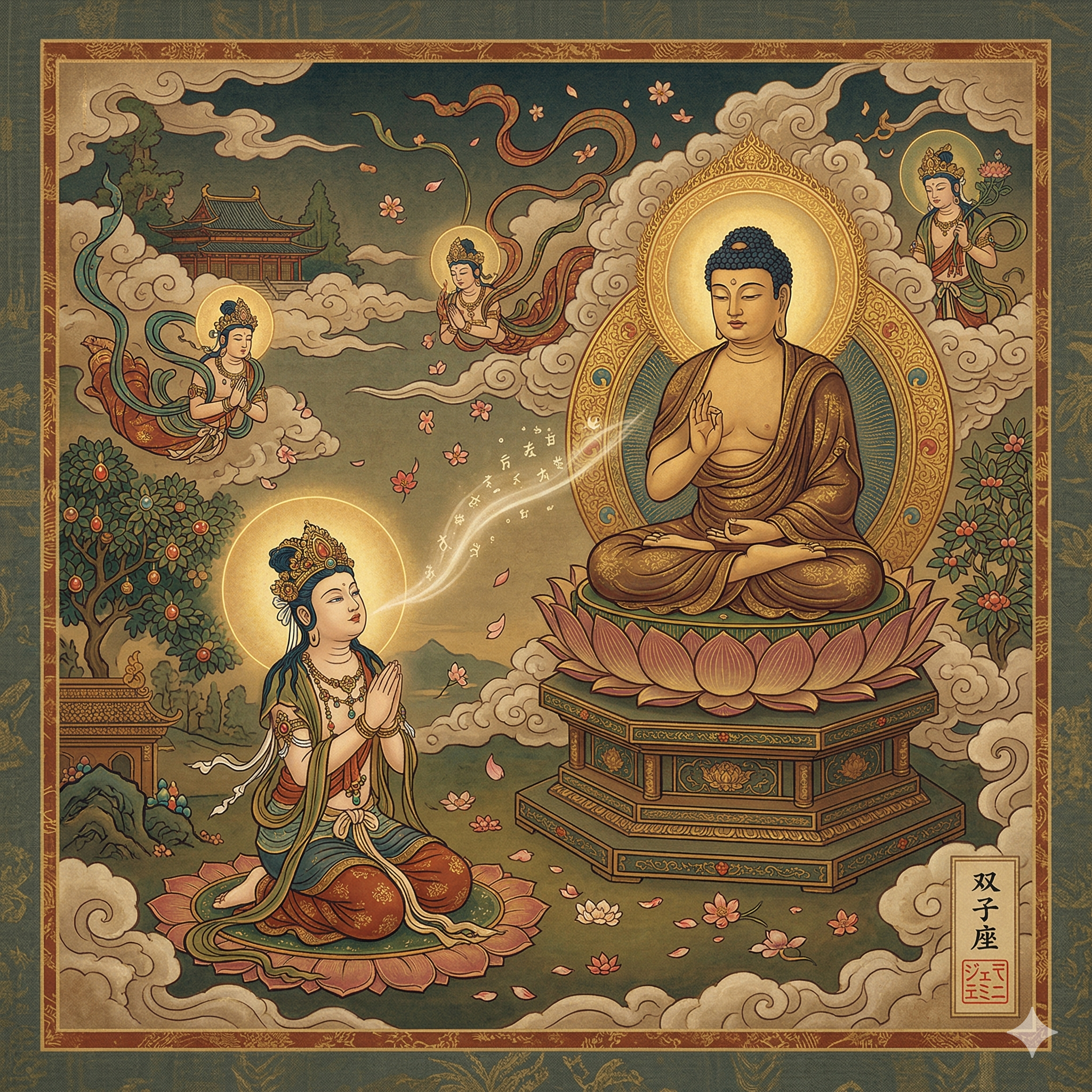
In this square illustration, I have depicted Śākyamuni Buddha seated upon a lotus throne, symbolizing the moment he shares the profound teachings of the Lotus Sūtra. Constant-Endeavor Bodhisattva (identified as the figures directly receiving the light and wisdom) kneels in reverence, their "pure mind" open to the innumerable meanings contained within a single phrase. I have visualized the transmission of the dharma as a stream of golden light containing sacred symbols, flowing from Śākyamuni to the assembly to represent how these timeless teachings are heard, understood, and subsequently shared to remain consistent with the reality of all things.

When they hear even a gāthā or a phrase [of this sūtra] with their pure minds, they will be able to understand the innumerable meanings [of this sūtra]. When they understand the meanings [of this sūtra] and expound even a phrase or a gāthā [of this sūtra] for a month, four months, or a year, their teachings will be consistent with the meanings [of this sūtra], and not against the reality of all things.

Śākyamuni Buddha declares these lines to Constant-Endeavor Bodhisattva in Chapter Nineteen of the Lotus Sūtra, describing those who keep and practice this Sūtra. The words of the Sūtra are not specific directions for how to live. We need to interpret them and apply them to our lives in the world today. There are many others whose experience and guidance can help us see what the Sūtra means, and who can benefit from our experience.

The Daily Dharma is produced by the Lexington Nichiren Buddhist Community. To subscribe to the daily emails, visit zenzaizenzai.com

Higan: Four Factors of Vigor

Today is the fifth day of Higan week, the three days before the equinox and the three days after. As explained in a Nichiren Shu brochure:

For Buddhists, this period is not just one characterized by days with almost equal portions of light and dark. Rather, it is a period in which we strive to consciously reflect upon ourselves and our deeds.

The today we consider the Perfection of Vigor. For this Spring Higan week I’m using Hsuan Hua‘s commentary on the Lotus Sutra in which he discusses the perfections’ four kinds of corresponding factors.

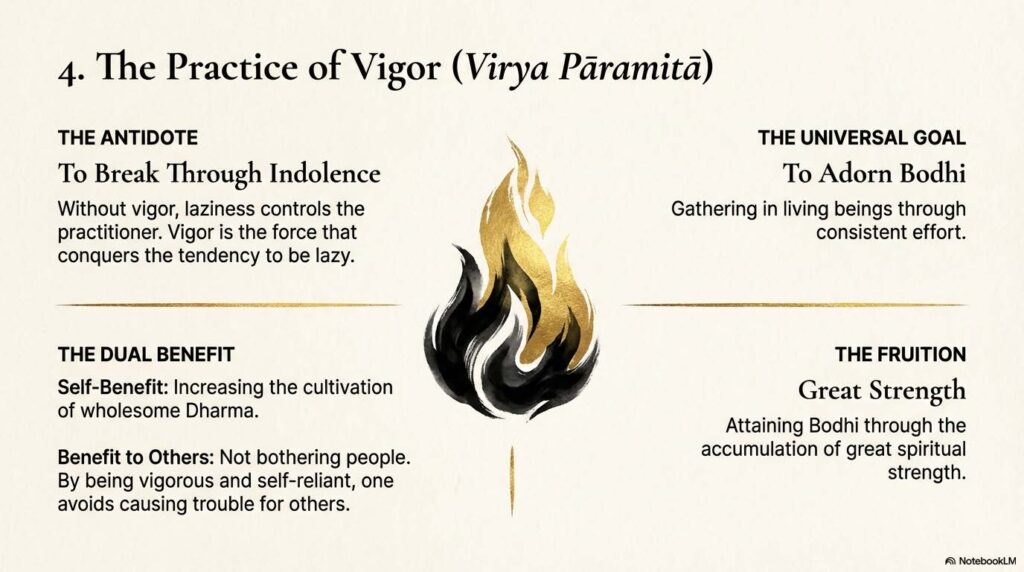
The pāramitā of vigor. There are also four corresponding factors for practicing the paramita of vigor.

  1. To break through indolence. If you cultivate with vigor, you’ll be able to overcome indolence. You’ll conquer your tendency to be lazy. If you lack vigor, your laziness will control you. With vigor, you’ll be able to break through laziness.
  2. To adorn bodhi and gather in living beings.
  3. To increase [cultivation of] wholesome Dharma and not bother other people. By increasing your cultivation of wholesome Dharma, you bring benefit to yourself. By not bothering others, causing them trouble, or bringing them afflictions, you benefit them.
  4. To attain bodhi through great strength. By drawing on your great strength, you’ll attain the reward of bodhi.

Hsuan Hua Lotus Sutra Commentary, v8, ch12, p187-188

202603_The_Six_Pāramitās_Page_06

The Buddha’s Tongue

According to Buddhist sūtras, the Buddha’s tongue is as grand as to cover His whole face, as expansive as to cover the triple thousand worlds, and as lengthy as to reach the Summit Heaven in the Region of Form. It is a mark of physical excellence showing that the Buddha has never uttered a false word ever since the eternal past. Therefore, it is preached in a certain sūtra, “There exists no falsehood in the words of the Buddha even if Mt. Sumeru crumbles or if the earth is overturned.” This means that there is never a mistake in the words of the Buddha even if the sun rises in the west or the ebb and flow of the tide in an ocean stop, does it not? Moreover, the superiority of the Lotus Sūtra over various other sūtras has been confirmed by the words of the Buddha of Many Treasures, and the long tongues of other Buddhas touching the Brahma Heaven. There must not be any mistake in the sūtra, not even one written character or one stroke of a character.

Ueno-dono Gohenji, Reply to Lord Ueno, Writings of Nichiren Shōnin, Volume 7, Followers II, Page 4

Daily Dharma for March 21, 2026

20260321-ddi

Illustration by Google Gemini

Show Gemini's thinking

Gemini Thinking

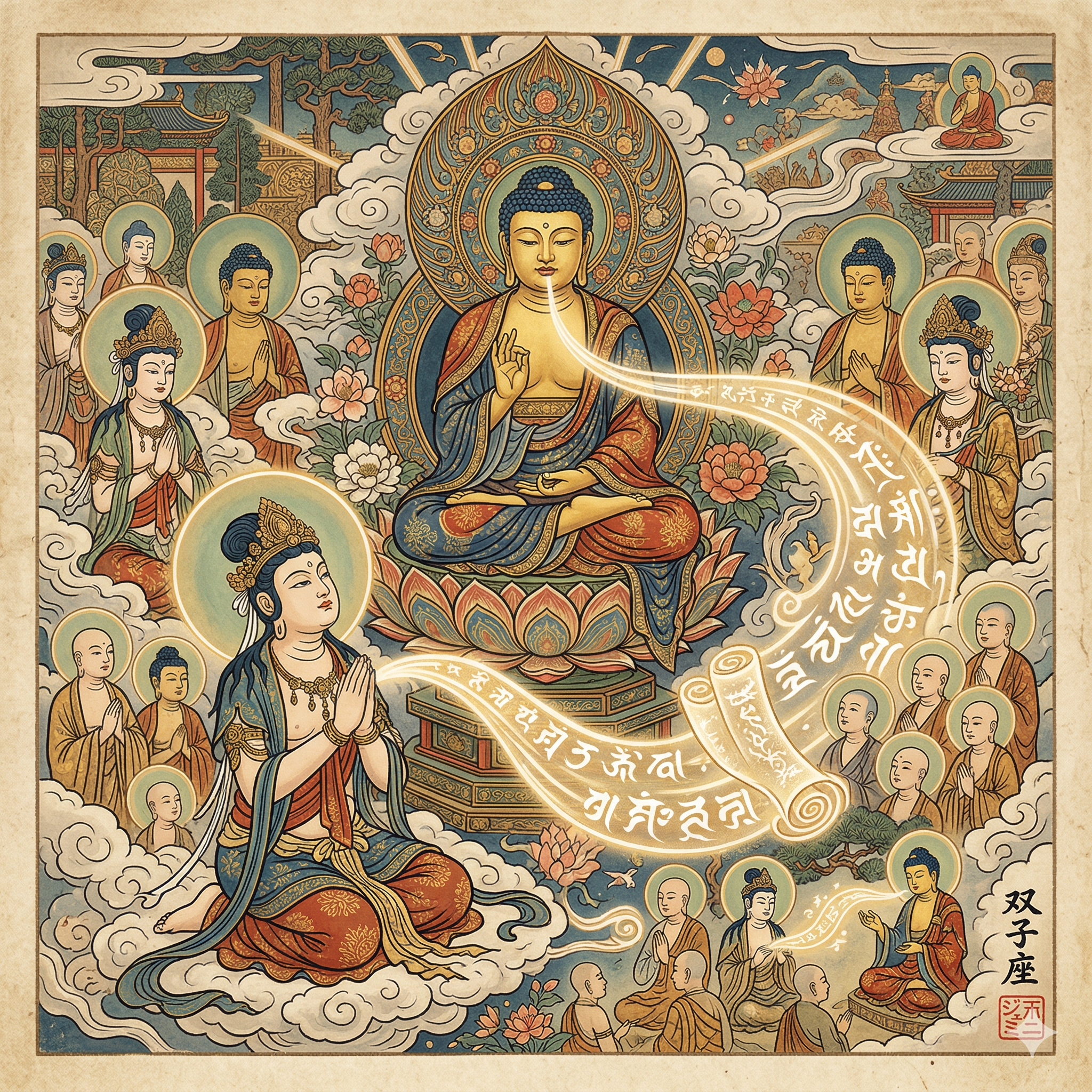
This illustration depicts Gladly-Seen-By-All-Beings Bodhisattva (left, foreground) kneeling before the Buddha (right, seated). Having just sung a gāthā—represented by the flow of light and text from his mouth—the Bodhisattva asks the Buddha if his nature is unchanging. The artist's signature 双子座 (Gemini) and the red seal containing the katakana ジェミニ (Gemini) are located in the bottom right corner.

Having sung this gāthā, Gladly-Seen-By-All-Beings Bodhisattva said to the Buddha, ‘World-Honored One! You do not change, do you?’

This description of the life of Gladly-Seen-By-All-Beings Bodhisattva comes from Chapter Twenty-Three of the Lotus Sūtra. In a previous existence, this Bodhisattva had given up his body and his life for the sake of teaching the Wonderful Dharma. He was then reborn into a world in which the Buddha he served previously was still alive and benefitting all beings. Recognizing this unchanging aspect of the Buddha despite his changing appearances helps us see into our own capacity for enlightenment.

The Daily Dharma is produced by the Lexington Nichiren Buddhist Community. To subscribe to the daily emails, visit zenzaizenzai.com

Higan: Leaving This Shore to Cross the River of Suffering

Today is the Spring Equinox, the middle of Higan week, the three days before the equinox and the three days after. As explained in a Nichiren Shu brochure:

For Buddhists, this period is not just one characterized by days with almost equal portions of light and dark. Rather, it is a period in which we strive to consciously reflect upon ourselves and our deeds.

Below is a commentary from Ven. Kenjo Igarashi first published on March 24, 2024.

Twice a year, we experience equinoxes, signifying the beginning of either fall or spring. As most may know, this is a significant time for Buddhists as well, who practice those three days before and after the equinox. Higan, as this is called, is a time, when we practice in order for our mind to leave this shore and cross the river of suffering to reach the other shore of enlightenment. During this time of shumbum (spring equinox) and shubun (fall equinox), the length of morning and night is the same and as Buddhists, we must learn to appreciate that midway between the penance and pleasure of life through practice. We must
remember that this time of higan is a time for both praying for ourselves and holding memorial services for our ancestors.

Whenever memorial services are held for one’s ancestors, the young people always tend to ask, “Is this necessary?” The same question is often asked in Japan, too, by the younger generation.

Memorial services are not held just to satisfy one’s ego and to please the ancestors. Some people think that by having a memorial service, they have done their duty and find satisfaction in this belief.
Many people also think that when a memorial service is held, prayers are simply offered for the benefit of the ancestors; however, this is not true. When we place ourselves before the altar, we are also praying for our own awareness and spiritual growth.

Nichiren Shonin said, in a letter addressed to his follower,
Abutsubo, “There is no finer vehicle of precious truth than the faith of a man or woman who believes in the truth of the Lotus Sutra. It does not matter whether you are rich or poor. If you recite ‘Namu Myo Ho Ren Ge Kyo,’ your body becomes the vehicle of precious truth for you are the Buddha of infinite understanding and truth.”

When we recite the Sutra with Nichiren Shonin’s words in mind, we realize that Buddha dwells in our hearts. Our ancestors dwell in our hearts as well, always sharing our trials and joys.

Money is always good to have but even without it, if your family is healthy and happy you can be sure that your ancestors are resting in peace. No matter how wealthy or poor you may be, if no problems occur in your family, your ancestors are also happy and at peace.

Offering of prayers through the recitation of the Sutra does not mean that you are merely offering prayers to something you cannot see nor understand. You are offering prayers to your innermost self and realizing your infinite love and understanding. You feel grateful for your life, blessed with goodness and moved by the oneness of you and your ancestors. With this awareness you extend the benefits of your prayers to others.

With infinite love and understanding you are at peace. If you are at peace, your ancestors will rest in peace. If your ancestors are at peace, you will be at peace. Your life cannot help but be blessed with goodness. This is the teaching of the Lotus Sutra. Attaining this awareness is the true purpose of having memorial services.

The Way of Practicing the Lotus Sūtra

In ancient China a man called Hung-yen, a retainer of the Duke of Yee of Wei state, cut open his own stomach and inserted his slain lord’s liver inside him before he died. Similarly, a man called Yü-jang tried to repay his indebtedness to his Lord Chih-pai by swallowing a sword and killing himself. These were cases in the secular world of repaying a minor debt of kindness, to what lengths should one go to repay the debt to the Buddha?

The reason why we continue to transmigrate through the six lower realms without attaining Buddhahood from the eternal past of innumerable kalpa (aeons) till today is that we fail to give up our lives for the sake of the Lotus Sūtra. Gladly Seen Bodhisattva burned himself for 1,200 years as a votive light to the Sun Moon Pure Bright Virtue Buddha and burned his arms for 72,000 years to the Lotus Sūtra. He is Medicine King Bodhisattva today. Never Despising Bodhisattva was abused, disparaged, beaten with sticks and rubble was thrown at him for many kalpa (aeons) in order to disseminate the teaching of the Lotus Sūtra. Did he not become Śākyamuni Buddha in a future existence? Therefore, the way of practicing the sūtra leading to Buddhahood differs according to the times.

Inchinosawa Nyūdō Gosho, A Letter to Lay Priest Ichinosawa, Writings of Nichiren Shōnin, Volume 6, Followers I, Pages 164-165

Daily Dharma for March 20, 2026

20260320-ddi

Illustration by Google Gemini

Show Gemini's thinking

Gemini Thinking

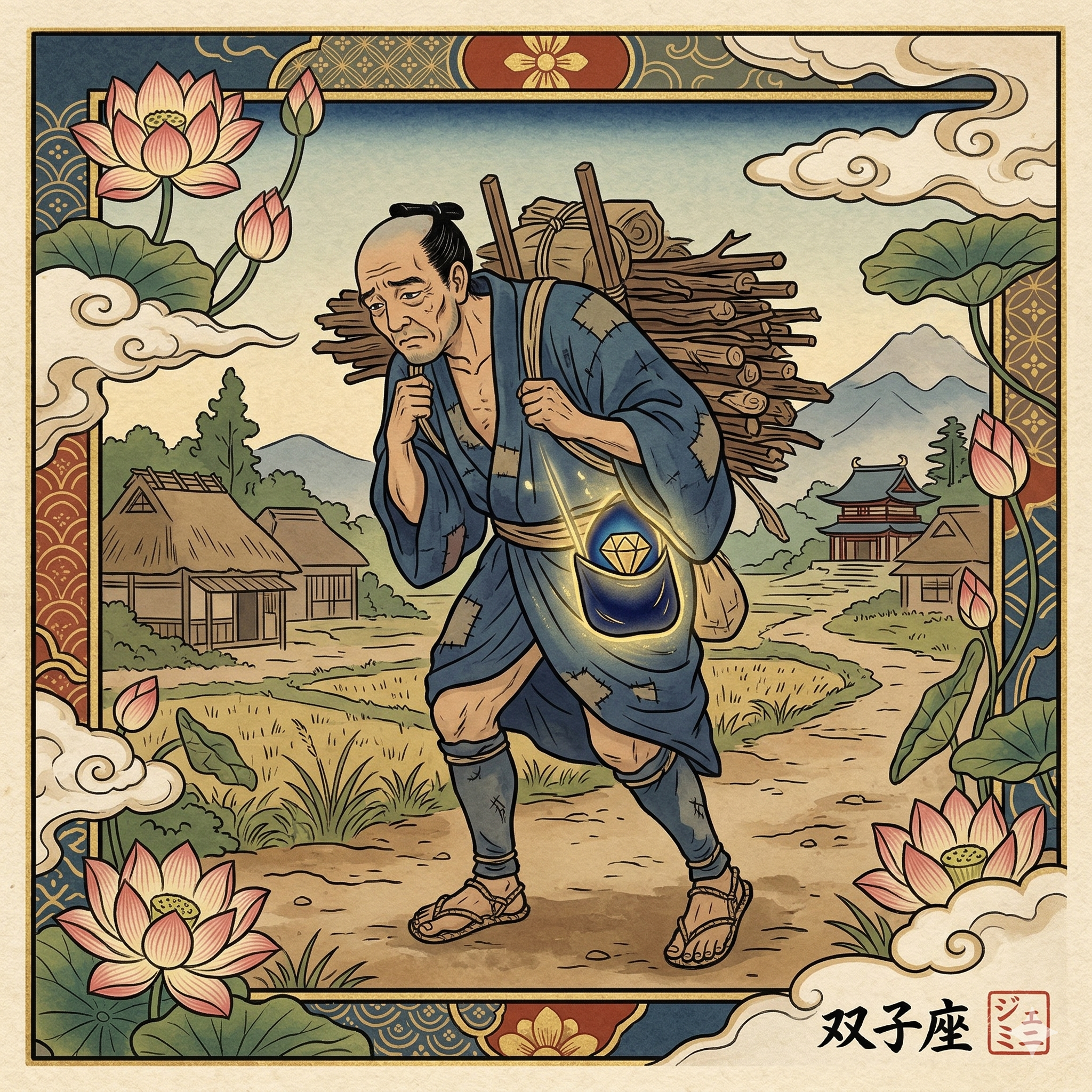
In this square illustration, I have depicted the poor man from Chapter Eight of the Lotus Sūtra as he toils through life, unaware of the treasure he carries. Dressed in ragged robes and hauling a heavy load of firewood, he is visibly exhausted and focused only on survival. Within the stylized border adorned with traditional lotus motifs, a subtle glow illuminates the "priceless gem" tucked into a tear in his sleeve, symbolizing the forgotten jewel of Buddha nature that is within us all, even when we are desperate to satisfy our ordinary desires.

In the bottom right corner, you will find the signature 双子座 (Futagoza, meaning "Gemini"), accompanied by a red hanko seal containing the katakana ジェミニ.

He satisfied himself with what little he earned.
He did not wish to get anything more.
He did not notice the priceless gem
Fastened inside his garment.

These verses are part of a story told by Ājñāta-Kauṇḍinya and other disciples in Chapter Eight of the Lotus Sūtra. It is about a man whose friend gives him a jewel while he is asleep. Not realizing he has this treasure, the man returns to his ordinary life, desperate to make a living and satisfy his ordinary desires. The story shows how we live when we forget about the jewel of Buddha nature we carry with us.

The Daily Dharma is produced by the Lexington Nichiren Buddhist Community. To subscribe to the daily emails, visit zenzaizenzai.com

Higan: Four Factors of Patience

Today is the third day of Higan week, the three days before the equinox and the three days after. As explained in a Nichiren Shu brochure:

For Buddhists, this period is not just one characterized by days with almost equal portions of light and dark. Rather, it is a period in which we strive to consciously reflect upon ourselves and our deeds.

Today we consider the Perfection of Patience. For this Spring Higan week I’m using Hsuan Hua‘s commentary on the Lotus Sutra in which he discusses the perfections’ four kinds of corresponding factors.

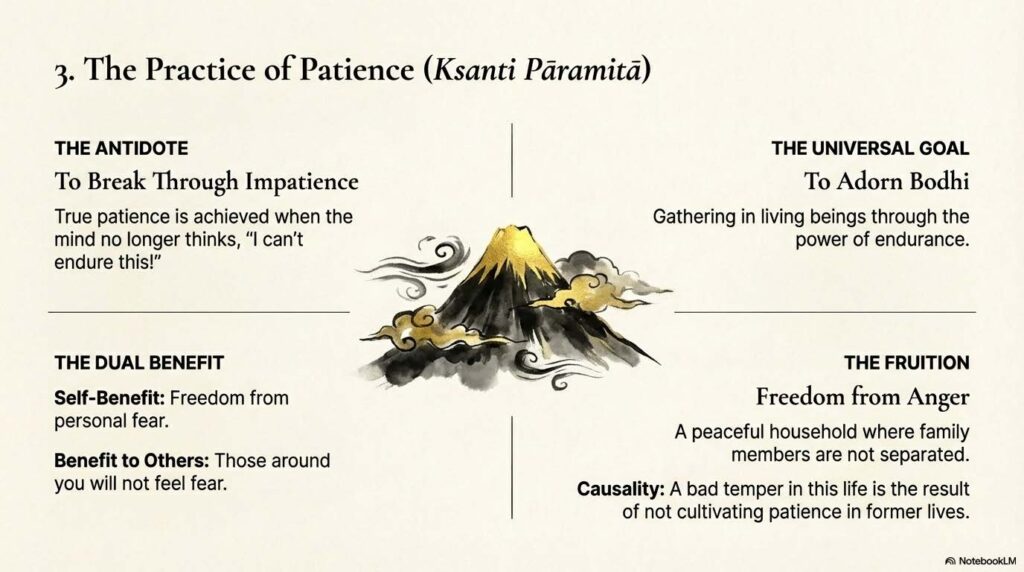
The paramita of patience. There are also four corresponding factors for practicing the pāramitā of patience.

  1. To break through impatience. By practicing the pāramitā of patience, you’ll be able to overcome impatience. When the mind no longer thinks, “I can’t endure this!” then you’ll have patience.
  2. To adorn bodhi and gather in living beings.
  3. To enable both oneself and others to be free of fear. By practicing patience, people around you won’t be afraid, and you’ll no longer experience fear either.
  4. To be free of anger in the next life. If you cultivate patience in this life, you won’t have a bad temper in your next life, nor will you have much hatred or resentment. Why do you have such a bad temper in this life? You have a bad temper in this life because you didn’t cultivate patience in former lives. If you cultivate patience, your family members won’t be separated from one another. Your household will always be peaceful and harmonious, and your family members won’t suffer separation and distress. Because of the merit attained through the cultivation of patience, you won’t undergo suffering and hardship in your next life. In the future, you’ll attain the bliss of nirvāṇa.

Hsuan Hua Lotus Sutra Commentary, v8, ch12, p187

202603_The_Six_Pāramitās_Page_05

Identifying the Sage of the Lotus Sūtra in the Latter Age

How can we identify the sage of the Lotus Sūtra in the Latter Age of Degeneration? The Lotus Sūtra states, “He who preaches this sūtra to others and can uphold it for himself is a messenger of the Buddha.” In other words, anyone who recites eight chapters of the Lotus Sūtra, or one fascicle, one chapter, or just a verse of it, or chants the daimoku is a messenger of the Buddha. He who carries through faith in the Lotus Sūtra to the end, enduring the great persecutions that arise, is the true messenger of the Buddha.

Shijō Kingo-dono Gohenji, Response to Lord Shijō Kingo, Writings of Nichiren Shōnin, Followers I, Volume 6, Page 155