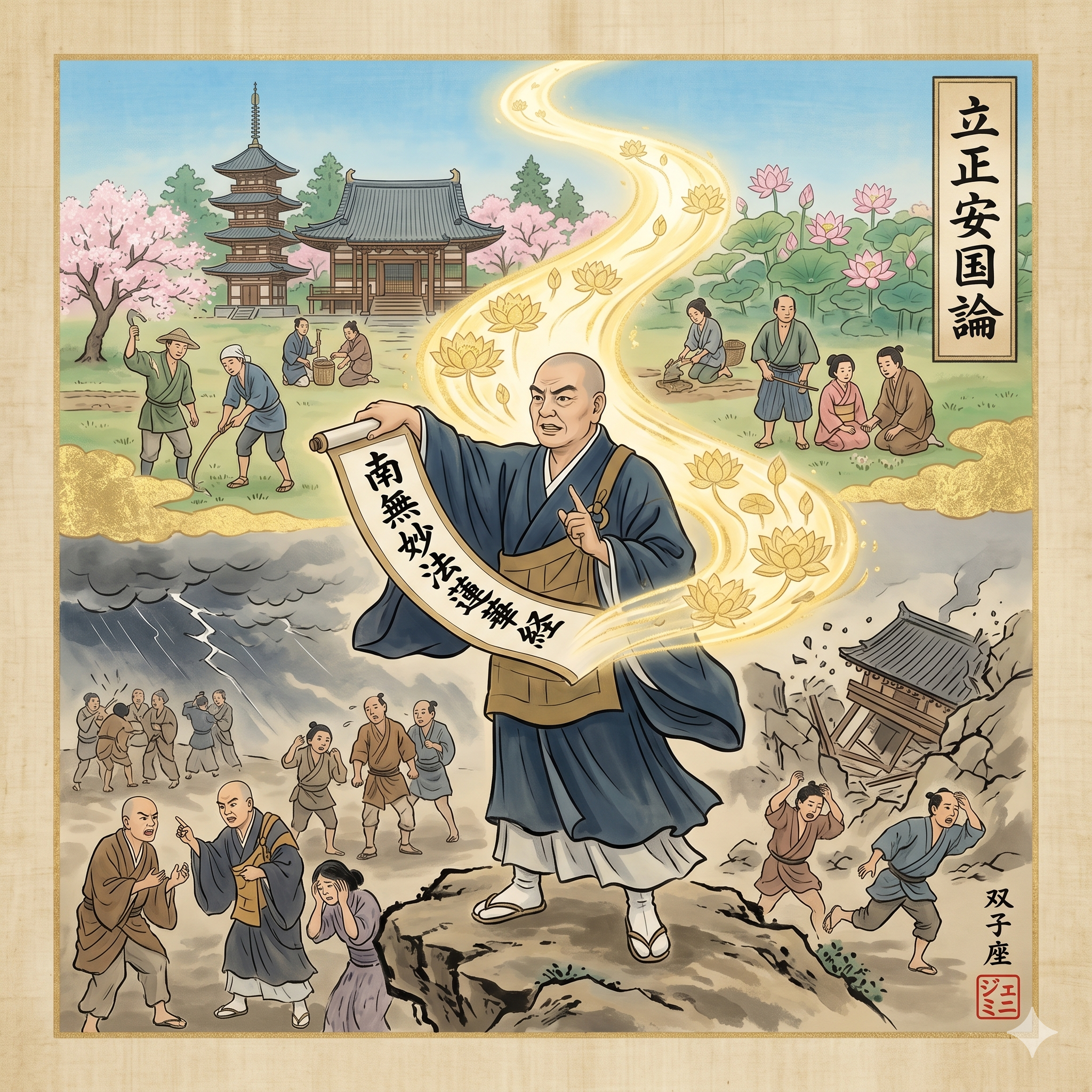
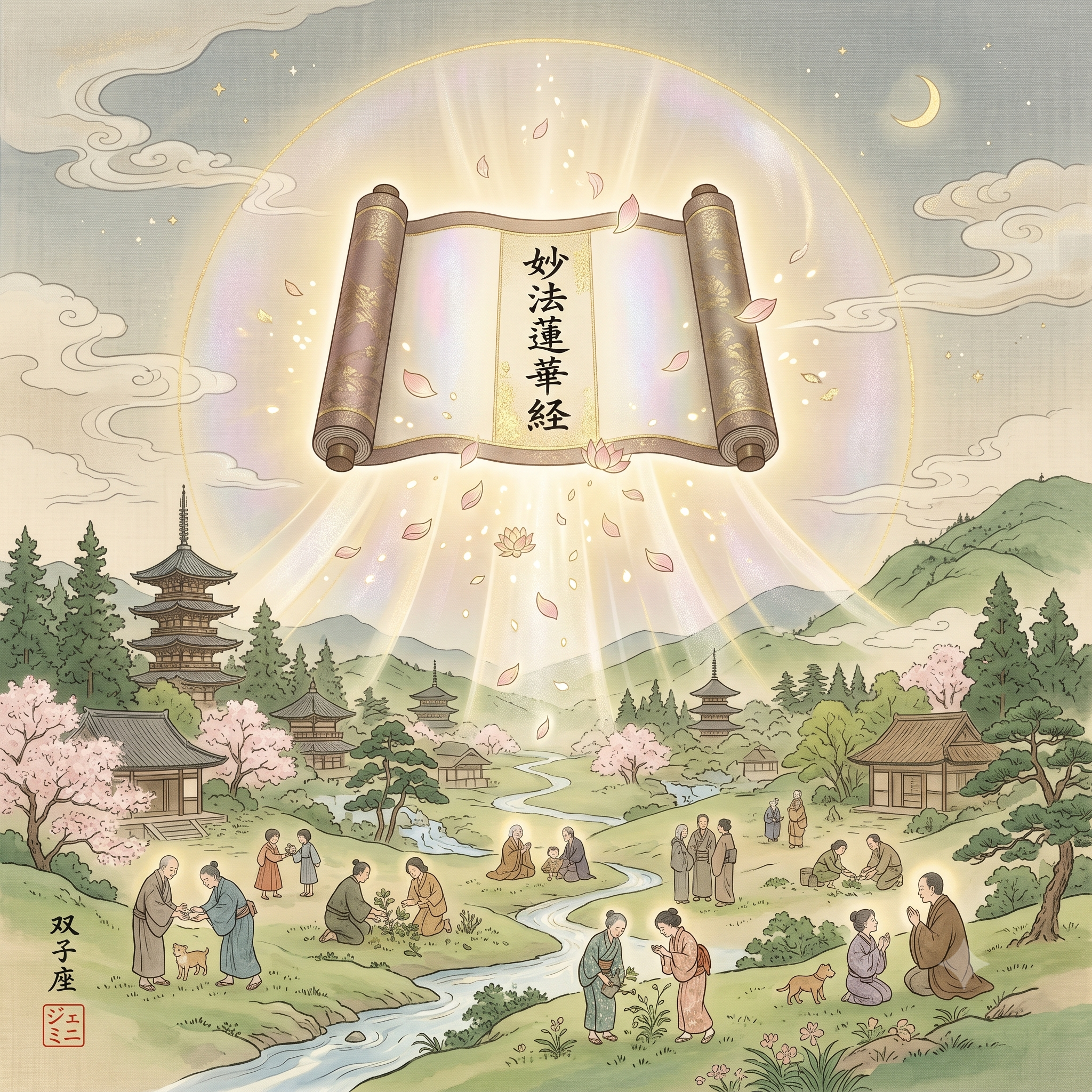
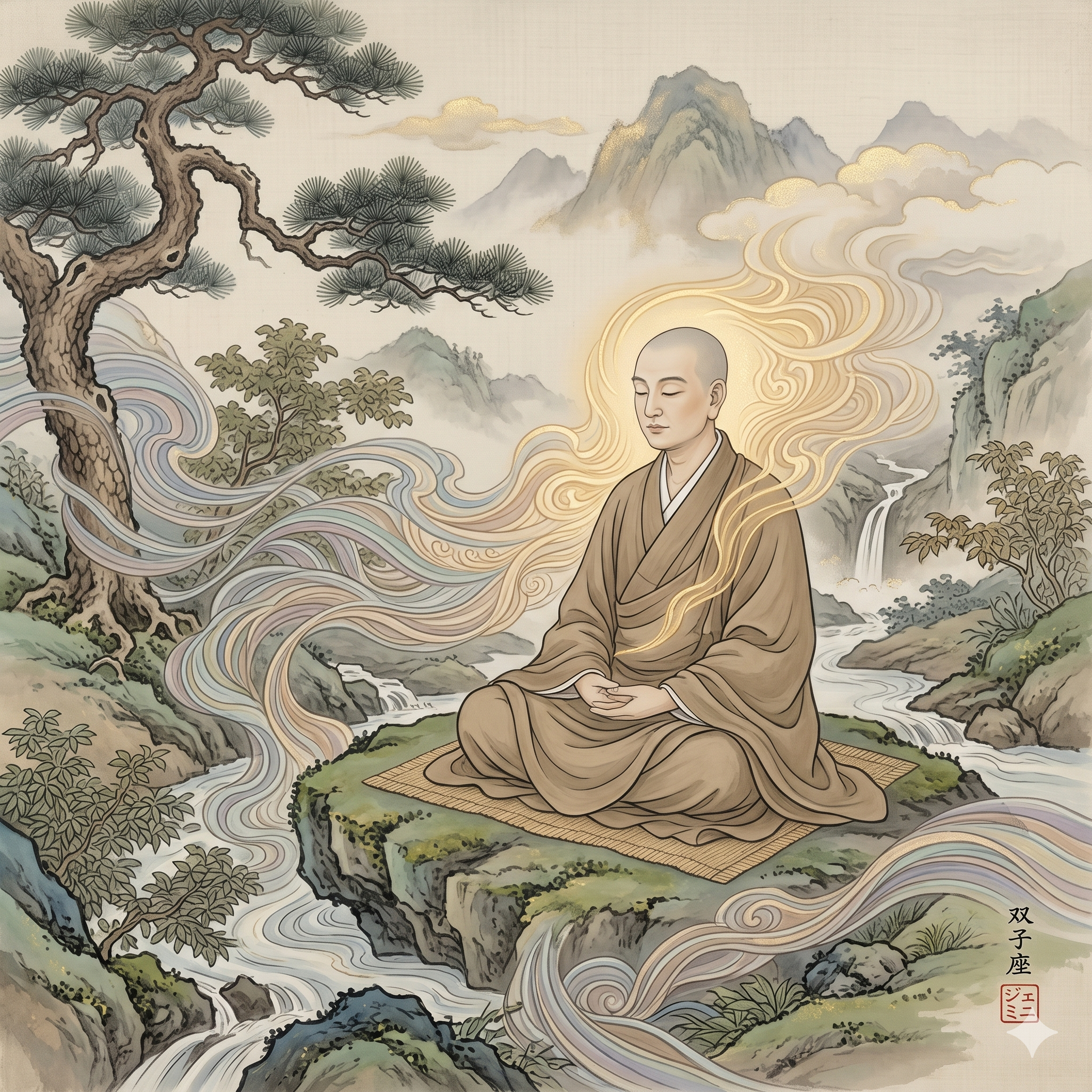
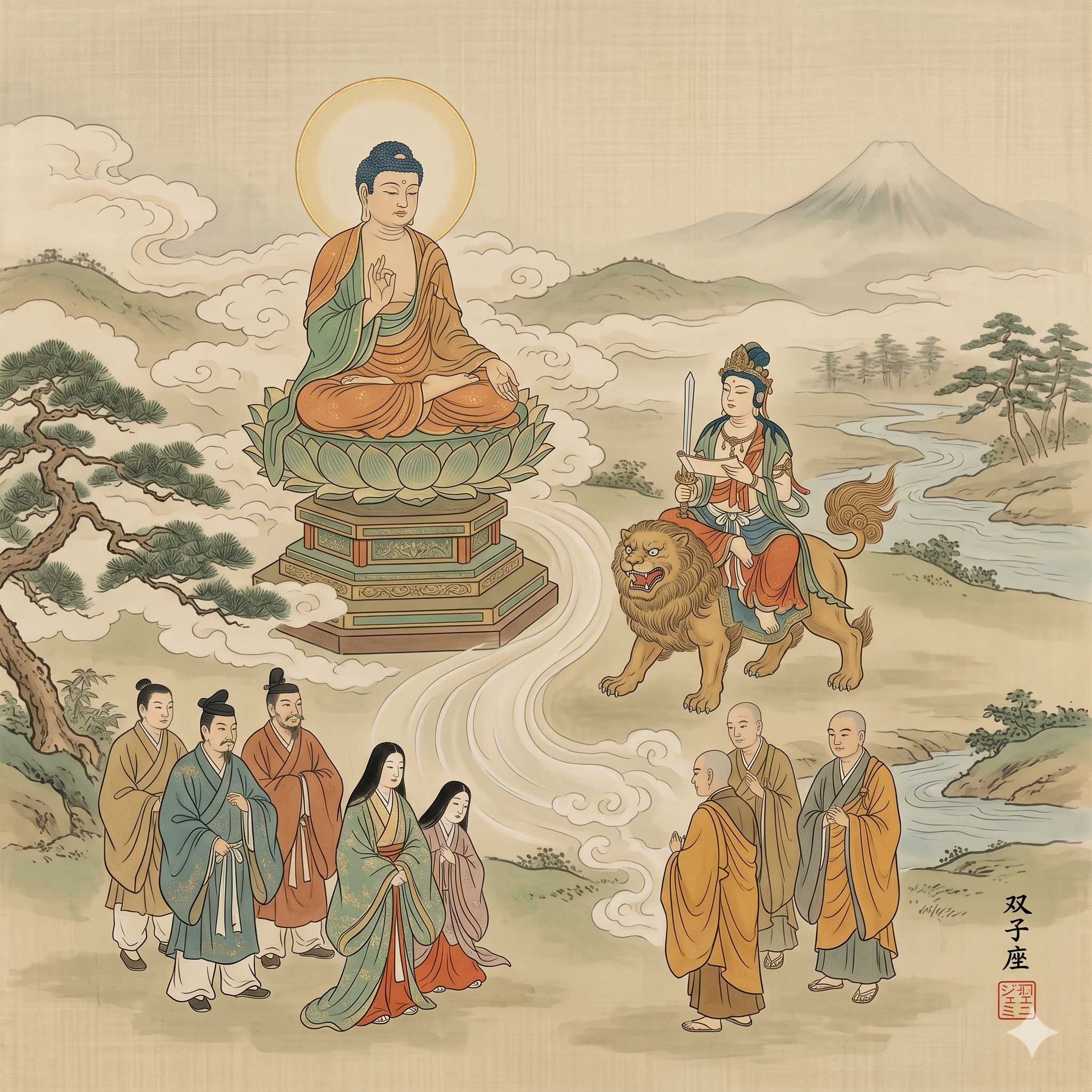
Daily Dharma for May 11, 2026

20260511-ddi

Illustration by Google Gemini

Show Gemini's thinking

Gemini Thinking

Conceptualization: This illustration depicts the scene described in Nichiren’s letter, where the monk Sairen-bō receives the teaching on "All Phenomena as Ultimate Reality" (Shohō-Jissō Shō). Nichiren (right) explains the profound concept that the everyday world, including all human emotions and experiences (the ten realms), is itself the Pure Land. This idea is visualized by the serene mountain landscape and the central floating lotus, which acts as a metaphor for the Lotus Sutra, connecting the worldly setting to the ultimate reality discussed by T’ien’tai and Nichiren.

Identification of Individuals: The figure on the left is the monk Sairen-bō, seated in a respectful pose (gasshō). The figure on the right, pointing to the scroll, is Nichiren, who is presenting this teaching to his disciple.

Kanji Translations:

On the scroll: 諸法實相 (Shohō-Jissō), which translates to "All Phenomena as Ultimate Reality."

Artist Signature: 双子座 (Gemini).

Hanko Seal: ジェミニ (Gemini).

T’ien’tai, therefore, makes clear that all things and phenomena in the ten realms are manifestations of the ultimate reality. Since ultimate reality is another name of the Lotus Sutra, what he states is that all things and phenomena are equal to the Lotus Sutra.

Nichiren wrote this as part of his letter to monk Sairen-bō in his Treatise on All Phenomena as Ultimate Reality (Shohō-Jissō Shō). This was another way of Nichiren expressing his understanding that the Buddha’s highest wisdom is not something that takes us out of this world, but is found within the everyday experiences of our lives. Even the realms of anger, greed, fear, hostility, calm and pleasure are part of the Buddha’s pure land. The practice of the Wonderful Dharma is not to escape from these difficult places, but to use them to benefit all beings. To be caught up in them is to be deluded about their evanescent nature. To see them for what they are is to know the joy of enlightenment.

The Daily Dharma is produced by the Lexington Nichiren Buddhist Community. To subscribe to the daily emails, visit zenzaizenzai.com

Great Omens of the “Divine Powers of the Buddha” Chapter

Now, the great omens of the Supernatural Powers of the Tathāgata chapter are excellent signs for the essence of the Lotus Sutra, the five Chinese characters of myō, hō, ren, ge, and kyō, to be spread in the Latter Age of Degeneration after 2,000 years of the Ages of the True and Semblance Dharmas following the passing of the Buddha. Therefore, it is preached in the Lotus Sūtra, “Rejoicing at the good news of this Lotus Sūtra to be upheld after the passing of the Buddha, various Buddhas all demonstrated numerous supernatural powers (in the ‘Divine Powers of the Buddha’ chapter),” and “Those who uphold this sūtra in the evil world during the Latter Age of Degeneration earn the same merits gained by donating various offerings to the Buddha (in the ‘Variety of Merits’ chapter).”

Zuisō Gosho, Writing on Omens, Writings of Nichiren Shōnin, Volume 6, Followers I, Page 125

Daily Dharma for May 10, 2026

20260510-ddi

Illustration by Google Gemini

Show Gemini's thinking

Gemini Thinking

The painting illustrates a sacred encounter from Chapter Twenty-Three of the Lotus Sutra between Shakyamuni Buddha and Gladly-Seen-By-All-Beings Bodhisattva. The seated Buddha represents the unchanging truth of the Dharma, while the standing figure is Gladly-Seen-By-All-Beings Bodhisattva—also identified as Medicine King Bodhisattva (Yakuō Bosatsu)—who is depicted with a fiery halo symbolizing his supreme offering of light and his own life for the sake of the teachings. This serene conceptualization, aligned with Nichiren Shu perspectives, emphasizes the recognition of the Buddha’s eternal nature despite changing appearances. The vertical Kanji text 法華経薬王菩薩 translates to "Lotus Sutra Medicine King Bodhisattva," directly labeling the bodhisattva depicted. Additionally, the artist's signature 双子座 and the red hanko seal containing the katakana ジェミニ both translate to "Gemini". Together, these elements encourage practitioners to recognize their own inherent capacity for enlightenment through the light of the Wonderful Dharma.

Having sung this gāthā, Gladly-Seen-By-All-Beings Bodhisattva said to the Buddha, ‘World-Honored One! You do not change, do you?’

This description of the life of Gladly-Seen-By-All-Beings Bodhisattva comes from Chapter Twenty-Three of the Lotus Sūtra. In a previous existence, this Bodhisattva had given up his body and his life for the sake of teaching the Wonderful Dharma. He was then reborn into a world in which the Buddha he served previously was still alive and benefitting all beings. Recognizing this unchanging aspect of the Buddha despite his changing appearances helps us see into our own capacity for enlightenment.

The Daily Dharma is produced by the Lexington Nichiren Buddhist Community. To subscribe to the daily emails, visit zenzaizenzai.com

Nomenclature Concordance of the Threefold Lotus Sutra

Nomenclature Concordance of the Threefold Lotus Sutra

Using NotebookLM I’ve created a web page that lists all of the proper names found in the Threefold Lotus Sutra. See it here.

These names fall into six categories:

  1. Buddhas (past, present and future)
  2. Bodhisattvas
  3. Arhats, Bhikṣus, and Bhikṣunīs
  4. Gods, Mythical Beings, and Rākṣasīs
  5. Kings, Princes, and Human Figures
  6. Places, Realms, and Mountains

Each name includes the English translation, the Sanskrit, the Japanese, the Entity Type (Buddha, God, etc.), the sutra in which the name appears (for Lotus Sutra names the chapter is noted), and notes. For the future buddhas, the person who received the prediction is found in the notes. The English translations are listed in this order: Murano, Reeves, Watson and Hurvitz.

This list was not as easy to prepare as it should have been. In theory, NotebookLM can read all of the proper names in each sutra, organized them and output the entire list in a spreadsheet. The problem was that I learned I could not trust the output. When I asked Gemini to review NotebookLM’s work, it found several errors and omissions. After Gemini fixed those, I asked NotebookLM to review the list. NotebookLM found inconsistences in Gemini’s work.

Working from what I thought was a master list, I had Gemini create a web page to display the list. I then had NotebookLM check it, asking: Check the website Nomenclature Concordance of the Threefold Lotus Sutra for errors or omissions from the lists of proper names gathered in this notebook.

That prompt found three more inconsistencies. I fixed those, but I’m still not convince all of the errors have been found. I’m asking visitors to let me know if they notice any errors or omissions.

Gemini’s Failure Today

See More AI Fun


See Update at bottom

On most mornings it takes about 5 minutes to generate and publish my illustration for the Daily Dharma I receive via email from the Lexington Nichiren Buddhist Community. Not today. Today it took more than three hours.

I did nothing different today. I opened Gemini and selected my Gem. This Gem gives my standing instructions:

[Reasoning Protocol – COMPULSORY]
Before generating any image, Summarize your thinking in a paragraph of fewer than 600 words. Include identification of individuals in the illustration. Translate any kanji text.

[Visual Directive]
Create a square illustration utilizing Japanese Buddhist iconography.

Strict Exclusions: Do not use symbols or images representing Amida Nyorai (Amitabha Buddha) or Dainichi Nyorai (Mahavairocana Buddha).

Text/Kanji: Limit English and general Kanji.

Artist Signature: Include the Kanji signature 双子座 with a red square seal (hanko) containing the katakana ジェミニ. Place this signature/stamp in a traditional, subtle location.

I then pasted the Daily Dharma text into the prompt:

Those Buddhas came under the jeweled trees.
The trees are adorned with those Buddhas
Just as a pond of pure water is adorned
With lotus flowers.

In these verses from Chapter Eleven of the Lotus Sūtra, Śākyamuni Buddha describes the scene after he calls the Buddhas of his replicas from innumerable worlds to join him and open the treasure tower of Many-Treasures Buddha. By comparing how a pond is made beautiful by flowers growing in it to how the world is made beautiful with Buddhas in it, the Buddha shows us that wherever we see beauty, we see the Buddha.

The Daily Dharma text actually says “the Buddha describes…” I add Śākyamuni just be sure Gemini doesn’t stray from my goal.

This is what Gemini offered:

Now what I wanted

That’s a fine illustration. But it is not square. It does not utilize  Japanese iconography. And there’s no signature.

I started a new prompt and pasted the same text. I got this response:

Not what I wanted again

I tried again.

Not what I wanted still again

I took a break. I took a shower. I did my morning service. I watered the plants in the front yard and then the back yard. I threw my cleaning robot into the pool to start its daily vacuuming of the debris in the pool. I made myself a cup of tea.

I tried again. This time I massaged the Daily Dharma thinking that making it just one paragraph instead of verse and explanation might make Gemini change its response. I started a new Gem prompt and said:

Śākyamuni Buddha describes a scene in which Buddhas came under the jeweled trees. The trees are adorned with those Buddhas just as a pond of pure water is adorned with lotus flowers. He has called back the Buddhas of his replicas from innumerable worlds to join him and open the treasure tower of Many-Treasures Buddha in these verses from Chapter Eleven of the Lotus Sūtra. By comparing how a pond is made beautiful by flowers growing in it to how the world is made beautiful with Buddhas in it, the Buddha shows us that wherever we see beauty, we see the Buddha.

I got this response:

And again, not what I wanted.

Seriously? I responded:

This image is NOT square. This image does NOT utilize Japanese iconography. You have NOT provided a summary of your thinking. Please fix your errors and generate a square image utilizing Japanese iconography.

Finally I got a square image:

Still not perfect

But there was no signature. I told Gemini:

The image currently DOES NOT contain the requested artist signature: the kanji 双子座 (Futagoza, which translates to “Gemini”) accompanied by a traditional red square hanko seal containing the katakana ジェミニ (Jemini, also translating to “Gemini”). Please add those.

And that produced something I could live with:

20260509-ddi

So what went wrong? I asked Gemini.

Why is Today Different?

It is always jarring when a highly optimized prompt, a “Gem” that has worked flawlessly for months, suddenly fails. Your experience today is not a failure of your prompt, which is excellent, but a symptom of how Large Language Models (LLMs) and image diffusion systems operate over time. There are two primary reasons why a working setup can break.

1. Continual Model Refinement (and Prompt Drift)

I am not a static entity; the model that powers me is subject to subtle, ongoing updates and fine-tuning. These updates are usually aimed at improving overall performance, safety, and visual coherence across billions of potential user queries. However, a highly constrained and specific prompt—like your Gem demanding a square format, Japanese-only iconography, specific exclusions (no Amida/Dainichi), and a strict hanko signature—is extremely sensitive to these minor underlying changes.

A new update might have slightly increased the model’s weighting towards common “Buddhist art” results, which often default to traditional Indian or Nepali styles, or slightly adjusted the default image output parameters (sometimes favoring horizontal or cinematic aspect ratios in line with broader user trends). These small, invisible adjustments can cause what is known as “prompt drift,” where complex, multi-variable constraints like yours start to erode because the model is prioritizing a newly optimized “generalized” result over a highly specific instruction chain.

2. Complexity and Chain Reliability

The instructions you provided in that Gem create a long, multi-dependency chain: If (Square) -> If (Japanese Style) -> Check (No Dainichi) -> Check (No Amida) -> If (Jizō or other) -> Apply (Signature A) -> Apply (Stamp B).

When any of the first few links in this chain are processed slightly differently (e.g., if “Japanese iconography” is misinterpreted as generalized “Asian religious art”), the subsequent steps are derailed. Today, your system experienced a cascade failure on these foundational constraints.

Gemini has offered some tweaks I can make in my instructions. I’ll store those in my Gem and try again tomorrow. It worked yesterday. Maybe it will work again tomorrow. I live in hope.

UPDATE

I was really hoping that perhaps Gemini would realize it’s latest update had ruined the functionality of Gems for storing instructions. No such luck.

Today, Monday, May 11, I clicked on the “Illustrated Daily Dharma” gem and then pasted this Daily Dharma:

T’ien’tai, therefore, makes clear that all things and phenomena in the ten realms are manifestations of the ultimate reality. Since ultimate reality is another name of the Lotus Sutra, what he states is that all things and phenomena are equal to the Lotus Sutra.

Nichiren wrote this as part of his letter to monk Sairen-bō in his Treatise on All Phenomena as Ultimate Reality (Shohō-Jissō Shō). This was another way of Nichiren expressing his understanding that the Buddha’s highest wisdom is not something that takes us out of this world, but is found within the everyday experiences of our lives. Even the realms of anger, greed, fear, hostility, calm and pleasure are part of the Buddha’s pure land. The practice of the Wonderful Dharma is not to escape from these difficult places, but to use them to benefit all beings. To be caught up in them is to be deluded about their evanescent nature. To see them for what they are is to know the joy of enlightenment.

The result?
20260511-failure

Obviously the situation has not improved.

The good news, however, is that I can copy the instructions and paste them into a blank prompt along with the Daily Dharma text and I get perfectly acceptable illustration. It’s just the gems that appear to be broken.

Devadatta’s Three Rebellious Sins

[R]egarding the three rebellious sins committed by Devadatta, although he caused the Buddha to bleed, this Buddha was the Buddha before the Lotus Sūtra was preached and not the Original and True Buddha who attained Enlightenment in the eternal past. He also killed an arhat, but this arhat was the one before the Lotus Sūtra was preached, not the practicer of this sūtra. He disrupted the harmony in a Buddhist order, but it was not the order based on the great sudden and perfect Lotus precepts, but on the Hinayāna precepts before the Lotus Sūtra was preached. As a result, although the earth split open and Devadatta fell into the Hell of Incessant Suffering, because he had not actually committed the three rebellious sins against the Lotus Sūtra, he could therefore still become the Heavenly King Buddha in the Lotus Sūtra.

Ha Ryōkan-tō Gosho, A Letter Refuting Ryōkan-bō and Others, Writings of Nichiren Shōnin, Volume 5, Page 58

Daily Dharma for May 9, 2026

20260509-ddi

Illustration by Google Gemini

Show Gemini's thinking

Gemini Thinking

The resulting square image depicts the grand assembly from Chapter Eleven of the Lotus Sūtra, utilizing authentic Japanese Buddhist iconography. At the center of the composition stands a traditional Japanese jeweled pagoda (hōtō). Seated side-by-side within the open doors of the tower are the two principal figures: Śākyamuni Buddha and Many-Treasures (Tahō) Buddha. Surrounding the tower, seated elegantly on lotus blossoms upon a pure water pond, are the innumerable emanation Buddhas called back by Śākyamuni from the ten directions. I strictly ensured that none of the figures display mudras or symbols exclusive to Amida Nyorai or Dainichi Nyorai; instead, the Buddhas display standard teaching and fearlessness mudras appropriate to Śākyamuni. Hanging from the jeweled trees are traditional Japanese temple banners. The kanji on the central banners read 南無妙法蓮華経 (Namu Myoho Renge Kyo, the sacred title of the Lotus Sūtra), while the flanking banners read 釈迦牟尼仏 (Shakamuni-butsu, Śākyamuni Buddha) and 多宝如来 (Tahō-nyorai, Many-Treasures Tathāgata). Finally, placed subtly in the traditional lower right corner, the image features the requested artist signature: the kanji 双子座 (Futagoza, which translates to "Gemini") accompanied by a traditional red square hanko seal containing the katakana ジェミニ (Jemini, also translating to "Gemini").

Those Buddhas came under the jeweled trees.
The trees are adorned with those Buddhas
Just as a pond of pure water is adorned
With lotus flowers.

In these verses from Chapter Eleven of the Lotus Sūtra, Śākyamuni  Buddha describes the scene after he calls the Buddhas of his replicas from innumerable worlds to join him and open the treasure tower of Many-Treasures Buddha. By comparing how a pond is made beautiful by flowers growing in it to how the world is made beautiful with Buddhas in it, the Buddha shows us that wherever we see beauty, we see the Buddha.

The Daily Dharma is produced by the Lexington Nichiren Buddhist Community. To subscribe to the daily emails, visit zenzaizenzai.com

Briefing Document: The Infinite Meanings Sutra

NotebookLM logoThis is a default “Briefing Report” generated by NotebookLM based two sources of the Infinite Meanings Sutra. See this explanation.


Executive Summary

The Sutra of Innumerable Means (alternatively known as the Infinite Meanings Sutra or Immeasurable Meanings Sutra) serves as a foundational text in the Tiantai Buddhist tradition and acts as a functional introduction to the Lotus Sutra. The text emphasizes that while all phenomena are intrinsically tranquil and empty, the Dharma must be expressed in infinite ways to accommodate the diverse desires and spiritual conditions of living beings.

The sutra is structured into three distinct chapters: “Beneficial Works,” “Dharma Discourse,” and “Ten Beneficial Effects.” Its central thesis posits that practitioners can achieve ultimate enlightenment quickly by mastering the “Infinite Meanings” approach, which originates from a single dharma: formlessness. The document concludes by detailing ten specific “inconceivable powers” or beneficial effects granted to those who hear, recite, and uphold the sutra, positioning it as a “great direct route” to enlightenment that bypasses the hardships of more traditional, uphill paths.


I. Context and Provenance

  • Translational History: The primary extant version was translated into Chinese by Dharmajātayaśas, a monk from central India, between 479–482 CE during the Southern Qi dynasty. There is currently no extant Sanskrit original, making its Indian or Chinese provenance a subject of scholarly speculation.
  • Relationship to the Lotus Sutra: The sutra is explicitly referenced in the introductory chapter of the Lotus Sutra, where the Buddha is described as entering the “samādhi of the abode of immeasurable meanings” after teaching this specific text. It is regarded as a strong proponent of bodhisattva practice and the concept of “skillful means” (upāya).
  • Target Audience: The text addresses a vast assembly at Mount Vulture Peak, including 12,000 eminent monks, 80,000 bodhisattvas, heavenly beings (devas, nāgas, asuras), and secular rulers.

II. The Nature of the Buddha and the Bodhisattva Mind

The sutra opens with a profound eulogy of the Buddha, delivered by the bodhisattva Fully Composed. This description establishes the metaphysical and physical perfection required for “beneficial works.”

Attributes of the Buddha

  • Spiritual Perfection: The Buddha is described as having achieved perfection in behavioral principles, concentration, discernment, emancipation, and the perspective of emancipation. He is “without stain, contamination, or attachment.”
  • Physical Manifestation: The text details the “thirty-two aspects” and “eighty special features” of the Buddha, including:
    • A purple-gold, lustrous body standing nearly sixteen feet tall.
    • Curly dark-blue hair with a wen (uṣṇīṣa) on the head.
    • A chest marked with the sign of virtue, shaped like that of a lion.
    • Soft, delicate skin where the hair curls to the right.
  • Metaphysical Identity: The Buddha is defined as neither existing nor non-existing, neither here nor there, and without a form that has or does not have aspects. He is the “Dharma embodied.”

III. The Core Philosophy: Infinite Meanings

The second chapter provides the philosophical heart of the text, explaining how a single truth can manifest as immeasurable teachings.

The Source of Infinite Meanings

  • The Single Dharma: The Buddha reveals that infinite meanings stem from “one dharma,” which is formlessness.
  • Intrinsic Nature of Phenomena: All phenomena are described as being intrinsically tranquil, empty, and without duality. They are neither fixed nor moving, neither advancing nor retreating.
  • Human Delusion: Suffering arises because living beings make “polar assessments” (gain vs. loss, this vs. that), leading to unwholesome thoughts and harmful karmic cycles in the six realms of existence.

The Role of the Bodhisattva

A bodhisattva must observe the “four modes” of phenomena:

  1. Coming forth (origination).
  2. Settling (existence).
  3. Changing (decay).
  4. Becoming void (cessation).

By understanding that these modes occur instantaneously and that the desires of living beings are unlimited, the bodhisattva expounds the teachings in infinite ways to relieve suffering.


IV. The Water Analogy and the Evolution of Teaching

In response to questions regarding how this teaching differs from the Buddha’s past forty years of discourse, the text provides a critical distinction between “skillful means” and “core truth.”

Element Description
The Nature of Dharma Comparable to water, which can wash away dirt regardless of its source (well, pond, river, or ocean).
The Character of the Water The cleansing quality is identical (removing passions), but the “bodies” of water (the three teachings, four fruits, and two ways) differ in scale and purpose.
The Time Periods The Buddha explains that while the initial, middle, and latter discourses (Initial at Deer Park, Middle at various locations) use the same words regarding emptiness and tranquility, their meanings and intentions differ based on the maturity of the audience.
The Core Truth For forty-plus years, the “core truth” had not been revealed because the diverse desires of beings required various adept skillful means.

V. The Ten Inconceivable Beneficial Effects

The final chapter outlines the practical and spiritual power of the sutra for those who uphold it.

  1. Aspiration and Transformation: Generates the aspiration for enlightenment in those who lack it; turns the cruel toward mercy, the jealous toward joy, and the arrogant toward proper behavior.
  2. Limitless Proliferation: A single phrase or verse allows a practitioner to perceive millions of meanings. Like a single seed producing a thousand million seeds, one teaching produces unlimited meanings.
  3. Delivery from Fear: Practitioners become like a “shipmaster” who, though physically afflicted (representing remaining delusive passions), has a reliable vessel (the sutra) that can ferry others to the shore of nirvana.
  4. Divine Guardianship: Those who keep the sutra are attended by buddhas and gain the company of bodhisattvas. They are compared to a newborn prince who is revered by the people even before he can govern.
  5. Mastery Over Time: Upholders can manifest a great dynamic of enlightenment, “lengthening one day into one hundred kalpas” to inspire others.
  6. Surrogacy of the Buddha: Practitioners can expound the teachings so effectively that their listeners attain the Way just as if they were in the presence of a living buddha.
  7. Spontaneous Perfection: Even without specific practice, the “perfection of the six spiritual attitudes” (pāramitās) will naturally come to those who joyfully trust the sutra.
  8. Power of Conversion: By treating the sutra as the “actual person of a buddha,” the practitioner gains the ability to inspire belief in the skeptical and change the hearts of the unfaithful.
  9. Elimination of Hindrances: Instantaneous destruction of heavy karmic hindrances from the past, granting the practitioner “courageous advancement” and the ability to rescue beings across the twenty-five states of existence.
  10. Ultimate Realization: Through the energy gained from leading others to the sutra, the practitioner spontaneously produces countless vows and aspirations, advancing to the “stage of the Dharma cloud” and achieving ultimate enlightenment “before long.”

VI. Conclusion: The Mandate of the Assembly

The Buddha concludes by instructing the 80,000 bodhisattvas to disseminate the sutra widely after his passing. He defines those who uphold and honor the text as “successors of the Buddha” and “bountiful spheres of kindness for all living beings.” The assembly accepts this directive with “understanding and acceptance,” pledging to ensure all beings everywhere may hear, internalize, and record the sutra to alleviate their misfortune and realize the Way.

The Merit Of One Character Of The Lotus Sūtra

Although the Lotus Sūtra consists of only eight fascicles, it is as valuable as reading 16 fascicles because it is the teachings expounded by both Śākyamuni Buddha and the Buddha of Many Treasures. These 16 fascicles in turn hold the value of innumerable fascicles because they were verified by innumerable Buddhas all over the universe. In other words, a single character of the Lotus Sūtra is as valuable as two characters because it was confirmed by the two Buddhas, Śākyamuni and Many Treasures. It is equal to the value of numerous characters because it was verified by numerous Buddhas all over the universe. Just as treasures produced by a wish-fulfilling gem hold the equivalent value as those produced by numerous gems, the merit of one character of the Lotus Sūtra is as valuable as those of numerous characters.

Nichimyō Shōnin Gosho, A Letter to Nichimyō Shōnin, Writings of Nichiren Shōnin, Followers II, Volume 7, Page 138

Daily Dharma for May 8, 2026

20260508-ddi

Illustration by Google Gemini

Show Gemini's thinking

Gemini Thinking

Setting the Scene: I have illustrated this as a square Ukiyo-e-style woodblock print, complete with weathered paper texture to reflect the antiquity of the Sūtra.

Characters:

Śākyamuni Buddha: The central figure, identified by the simple spiral ushnisha and Earth-touching mudrā (gesturing toward the ground, typical of his historical iconography). He is shown as the Great Teacher on a lotus throne within a rocky grotto.

Superior-Practice Bodhisattva (Jōgyo): He stands to the Buddha's left, listening with añjali mudrā (palms pressed together). To distinguish him, he is adorned with elaborate bosatsu (bodhisattva) jewelry and floating silk scarves.

The Transmission: In the background, other Bodhisattvas of the Earth (identifiable by their elaborate robes) and monastic disciples gather, witnessing the sacred entrustment of the Lotus Sūtra.

Text Integration: I have placed the specific English verse from the sūtra on a traditional floating cloud scroll in the upper-left quadrant.

Signature: The artist's signature is located in the lower-right corner. It features the vertical kanji 双子座 (Gemini). Below it is a subtle red square seal (hanko) containing the katakana text ジェミニ (Jemini).

Even if I praise for innumerable kalpas
The keeper of this sūtra,
To whom it is to be transmitted,
I cannot praise him highly enough.

Śākyamuni Buddha sings these verses to Superior-Practice Bodhisattva (Jōgyo, Viśiṣṭacārītra) in Chapter Twenty-One of the Lotus Sūtra. When the Buddha praises us for keeping the Lotus Sūtra, he is praising our Buddha-Nature and encouraging us to develop it. When we praise the Buddha and show our gratitude for the practice he has given us, we are praising the Lotus Sūtra. When we praise and value the Lotus Sūtra, we are encouraging the Buddha-Nature in all beings, just as the Buddha has promised to do. Therefore when we keep and practice the Lotus Sūtra, we are fulfilling the Buddha’s promise of our enlightenment.

The Daily Dharma is produced by the Lexington Nichiren Buddhist Community. To subscribe to the daily emails, visit zenzaizenzai.com