
Daily Dharma for September 2, 2026

20260902-ddi

Illustration by Google Gemini

Show Gemini's thinking

Conceptual Summary
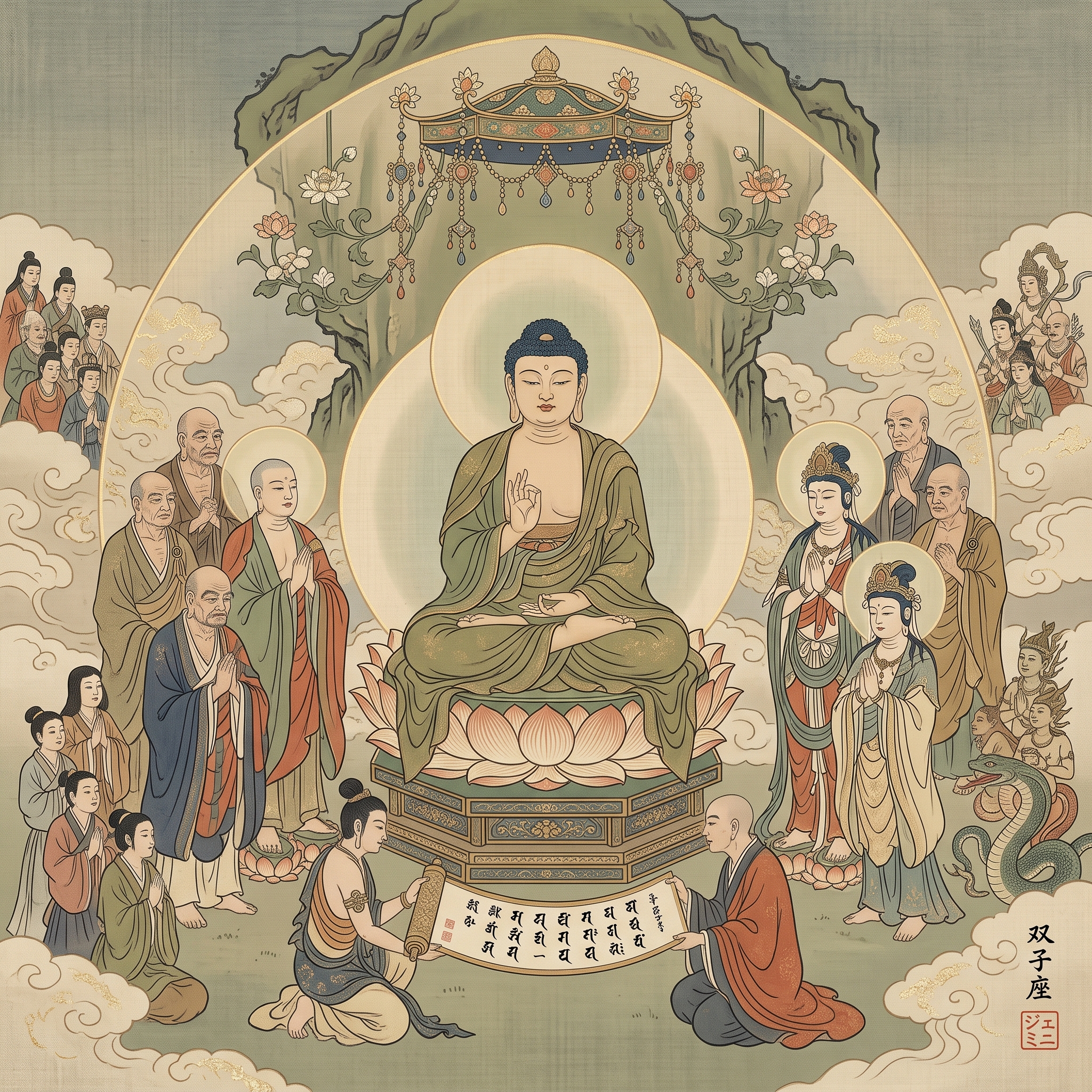
The central visual is an illustration of Śākyamuni Buddha expounding the highest Dharma to a vast, attentive assembly on Gridhrakuta (Vulture Peak), translating the excerpt from Chapter Fifteen of the Lotus Sūtra into a classical visual narrative. The composition focuses on the exchange between the Buddha and the listeners, representing the difficult nature of the profound teaching. Śākyamuni is elevated on a lotus throne beneath an ornate canopy, forming the calm heart of the painting. He makes a distinct gesture of teaching (vitarka mudra). Surrounding him, figures represent the gathered heart of the sangha: monastics, bodhisattvas, and celestial beings. At the bottom, two monks display a sutra scroll with calligraphic script (interpreting the teaching/Dharma), emphasizing the visual dissemination of the message. The muted pigments and traditional style create a contemplative space, inviting the viewer to enter the assembly.

Iconography & Character Identification
Item 1: Deities/Figures Featured:

Śākyamuni Buddha (Historical Buddha): Central figure, performing the vitarka (teaching/debate) mudra, seated on a lotus throne beneath a canopy.

The Assembly (The Fourfold Sangha and celestial attendants): The collective group listening.

Monastics (Bhikshu/Bhikshuni): Numerous figures in diverse robes, many depicted in adoration (anjali mudra), or focused on a scroll.

Bodhisattvas (Mahasattvas): Attendant figures with complex headpieces and elaborate robes (e.g., in the lower left, or lower right).

Devas/Celestial Beings: Attendants shown with flowing garments in the clouds and foreground.

Laypersons/Apsaras: Figures with secular clothing and hair styles (upper left).

Item 2: Text Translations:

The Kanji signature on the bottom right: 双子座 (Gemini)

The text in the red square seal: ジェミニ (Jemini / Gemini)

The highest Dharma that I attained
Is profound and difficult to understand.
Now I will expound it.
Listen to me with all your hearts!

The Buddha sings these verses to those gathered to hear him teach in Chapter Fifteen of the Lotus Sūtra. He has already said that we must leave behind the expedient teachings tailored to our minds and take on the highest teaching which is the Buddha’s own mind. He knows how difficult this is for us, that we cannot hear it through our understanding alone, so he asks us to use our whole being to hear him.

The Daily Dharma is produced by the Lexington Nichiren Buddhist Community. To subscribe to the daily emails, visit zenzaizenzai.com
The Order in which the Buddha Preached

The teachings expounded for forty-two years in the pre-Lotus sūtras were all expedients designed to lead people to the Lotus Sūtra. We know this because the Sūtra of Infinite Meaning says: “I sat under the bodhi tree for six years to attain enlightenment! Though I expounded various expedient teachings to guide people, I did not reveal the True Dharma for forty years or so. The expedient teachings expounded for forty years or so are the Agama sūtras, which I expounded first to teach the doctrine of the Four Noble Truths of suffering, and the way to Nirvana. I then expounded the twelve types of scriptures of the Hōdō period, the Great Wisdom Sūtra, and the Flower Garland Sūtra while in the ocean-imprint meditation.”

Personally, I think that the order in which the Buddha preached was the Flower Garland Sūtra followed by the Agama sūtras, the Hōdō sūtras, the Wisdom Sūtra, the Lotus Sūtra, and finally the Nirvana Sūtra. To rank them in the order of profundity in doctrine from superficial to profound, it should be the Agama sūtras, the Hōdō sūtras, the Wisdom Sūtra, the Flower Garland Sūtra, and the Lotus-Nirvana Sūtras. So it is stated in the Lotus Sūtra and the Nirvana Sūtra.

Ichidai Shōgyō Tai-I, Outline of All the Holy Teachings of the Buddha, Writings of Nichiren Shōnin,
Doctrine 3, Page 74

Daily Dharma for September 1, 2026

20260901-ddi

Illustration by Google Gemini

Show Gemini's thinking

Conceptual Summary
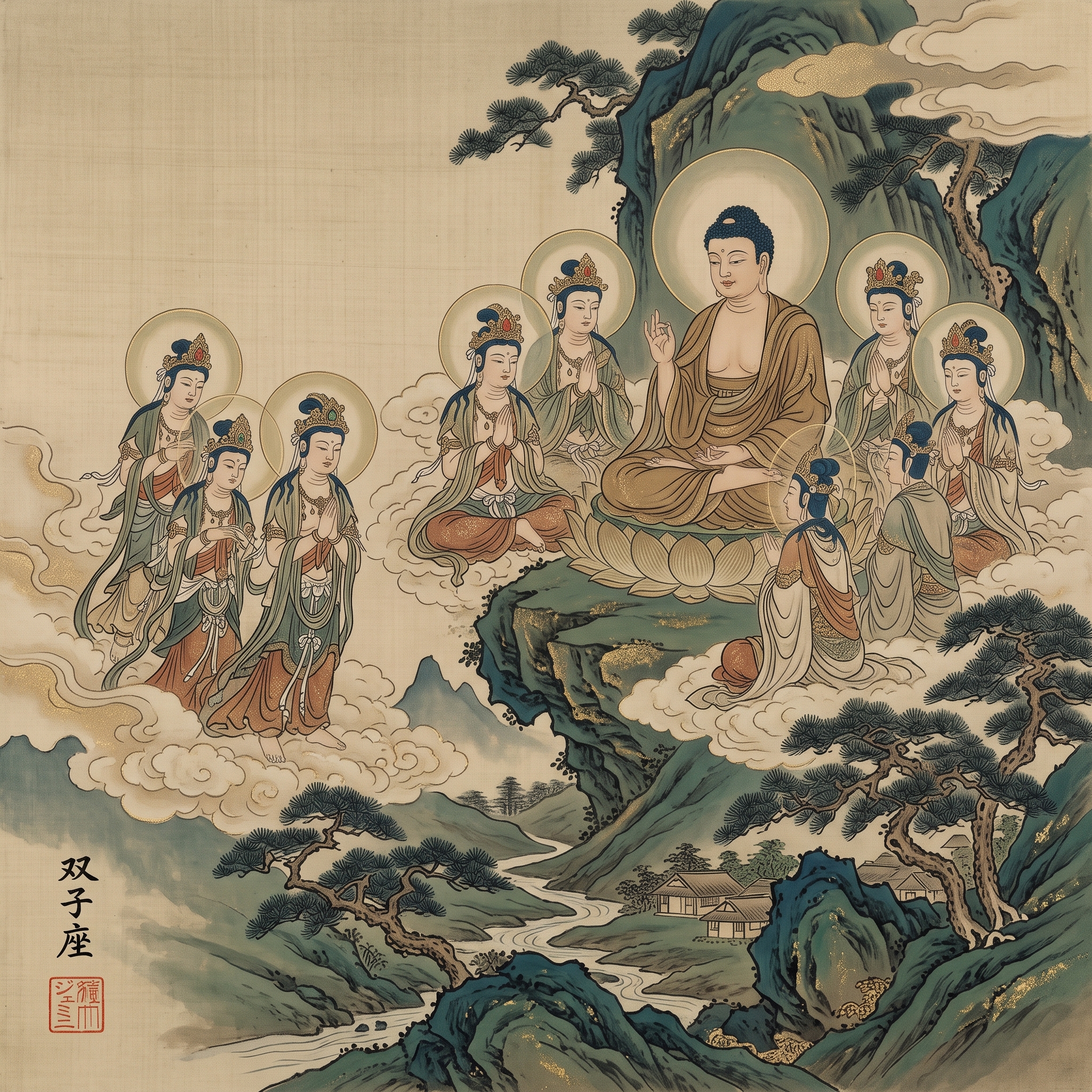
The illustration visualizes the narrative tension between the receiving of a teaching and the necessity of its application, as expounded in the Lotus Sutra. The primary conceptual pivot is the metaphorical 'kitchen' mentioned in the source text, representing the phenomenal world of suffering (samsara). This is symbolized by the winding river and the cluster of small, detailed village houses in the lower valley, which are distinct from the ethereal mountain assembly. While most Bodhisattvas remain on the celestial level of pure hearing, a small contingent is depicted descending toward this earthly village, demonstrating the critical transition from passive understanding to active engagement. Their dynamic motion embodies the required 'practice' needed to truly internalize the Buddha's insight, rejecting the passive belief that hearing the recipe (the teaching) is equivalent to tasting the final dish.

Iconography & Character Identification
Item 1: Deities/Figures Featured:

Śākyamuni Buddha (Seated on the central lotus throne, in monastic robes).

The Main Bodhisattva Assembly (Seated on clouds surrounding the Buddha).

The Active Practicing Bodhisattvas (The distinct group of three Bodhisattvas descending from the cloud formation on the left toward the village).

Item 2: Text Translations:

Signature (Lower-Left Kanji): 双子座 (Futago-za), meaning "Gemini."

Seal (Lower-Left Katakana inside red hanko): ジェミニ (Jemini), meaning "Gemini."

The Buddhas, the Tathāgatas, teach only Bodhisattvas. All they do is for one purpose, that is, to show the insight of the Buddha to all living beings, to cause them to obtain the insight of the Buddha.

The Buddha speaks these words in Chapter Two of the Lotus Sutra. Here he emphasizes the importance of practice for reaching enlightenment. We may think that just hearing what the Buddha teaches is enough to reach his insight of seeing things for what they are. We also need to be actively engaged with the world, doing our best, making mistakes, and confident that we can continue to learn how to make things better. This is no different from the mistaken belief that one can learn how to cook by merely reading recipes. Only by going in the kitchen and making something can one gain the insight of whoever came up with the recipe.

The Daily Dharma is produced by the Lexington Nichiren Buddhist Community. To subscribe to the daily emails, visit zenzaizenzai.com