
The Karma of Words, p87Much like the dharmas described in a crucial section of the hōben chapter, they are characterized by “the absolute identity [or equality] of their beginning and end.”
Recognizing this makes it possible to see the sutra as much more sophisticated and philosophical than we had been led to think; we can also see why it had such profound implications for subsequent literary and aesthetic expression. By being self-reflexive, the sutra twists the reader’s attention into unexpected areas, areas that seem calculated to help him jettison his ordinary expectations about reading and interpretation. The parables (chapters three to seven) of the Lotus are presented as if they are going to illustrate what is meant by upāya (hōben) (chapter two); but it is equally true that the chapter on hōben explains, and is a means for understanding, the parabolic narratives. Thus, the illustration is in no way subordinate to what it illustrates. Unlike the Platonic allegory in the medieval Christian West—”a shadow of something else more real or more significant” —the narratives of the Lotus are not a means to an end beyond themselves. Their concrete mode of expression is not “chaff” to be dispensed with in order to attain a more abstract, rational, or spiritual truth. The Lotus is unequivocal on this point: “One may seek in every one of the ten directions but will find no mode [hōben] other than the Buddha’s.” This accounts for what may seem to be an inordinate amount of praise directed by the sutra toward itself. It also implies that within the sutra there is an unmistakable philosophical move opposite to that in Plato’s Republic, a move to affirm the complete reality of the world of concrete phenomena in spite of the fact that they are impermanent.
All posts by John Hughes
Daily Dharma – Aug. 23, 2024
To enter the room of the Tathāgata means to have great compassion.
To wear his robe means to be gentle and patient.
To sit on his seat means to see the voidness of all things.
Expound the Dharma only after you do these [three] things!
The Buddha sings these verses in Chapter Ten of the Lotus Sūtra. Our compassion leads us to engage with the world and benefit others. Cultivating our gentle and patient nature lets us live the peace everyone wants and show them how to obtain it. To see the voidness of things does not mean acting as if they don’t exist. We presume that things that do not exist forever do not exist at all. A wisp of smoke. A fleeting smile. The Buddha teaches that there is nothing permanent and self-existing. Only what is interdependent and changing truly exists.Only that which is connected with everything else truly exists.Nothing hinders us. Nothing opposes us. When we see the harmony in our changing existence, then we see the Buddha Dharma.
The Daily Dharma is produced by the Lexington Nichiren Buddhist Community. To subscribe to the daily emails, visit zenzaizenzai.com
Day 20
Day 20 completes Chapter 15, The Appearance of Bodhisattvas from Underground, and concludes the Fifth Volume of the Sutra of the Lotus Flower of the Wonderful Dharma.

Having last month considered in gāthās Maitreya’s plea for an explanation, we conclude Chapter 15, The Appearance of Bodhisattvas from Underground.
Suppose a man twenty-five years old
Points to grey-haired and wrinkle-faced men
A hundred years old,
And says, “They are my sons.”
Suppose old men point to a young man
And say, “He is our father.”
No one in the world will believe
That a father is younger than his sons.You are like the father.
You attained enlightenment quite recently.
These Bodhisattvas are resolute in mind.
They are not timid.
They have practiced the Way of Bodhisattva
For the past innumerable kalpas.They are good at answering difficult questions.
They are fearless and patient.
They are handsome, powerful and virtuous.
They are praised by the Buddhas
Of the worlds of the ten quarter .
They expound [the Dharma] clearly.They did not wish to live among men.
They preferred dwelling in dhyana-concentration.
They lived in the sky below
In order to attain the enlightenment of the Buddha.We do not doubt your words
Because we heard them direct from you.
Explain all this so that the living beings in the future
May be able to understand your words, Buddha!Those who doubt this sūtra
And do not believe it
Will fall into the evil regions.
Explain all this to us now!How did you teach these innumerable Bodhisattvas
In such a short time,
And cause them to aspire for enlightenment
And not falter in seeking enlightenment?[Here ends] the Fifth Volume of the Sūtra of the Lotus Flower of the Wonderful Dharma.
The Daily Dharma offers this:
How did you teach these innumerable Bodhisattvas
In such a short time,
And cause them to aspire for enlightenment
And not falter in seeking enlightenment?
Maitreya Bodhisattva sings these verses to the Buddha in Chapter Fifteen of the Lotus Sūtra. Despite the Buddha’s explanation that he personally taught all of the Bodhisattvas who appear in Chapter Fifteen, Maitreya and others are still confused by what the Buddha has told them. Since they have faith that whatever the Buddha teaches is for their benefit, they persist with their sincere questioning, assured that the Buddha is leading them to enlightenment. While faith is an important part of our practice, recognizing our own confusion, and using questions to resolve that confusion are equally important. The Buddha does not ask for blind obedience. He knows we cannot find peace until we bring our whole being to his practice.
The Daily Dharma is produced by the Lexington Nichiren Buddhist Community. To subscribe to the daily emails, visit zenzaizenzai.com
Bodhisattva Actions Empty and Pure
The Karma of Words, p54-55The following discussion by Kajiyama Yūichi [Professor of Buddhist Studies at Kyoto University, 1925-2004] concerns the element of play (asobi) in the Prajn͂āpāramitā (Hannya) literature and the Avataṃsaka-sūtra (Kegon-kyō). He makes an important point about the conception of the bodhisattva as working within the realm of suffering so that he might help all sentient beings (shujō) to find release.
A bodhisattva is not one who pursues the perfection of wisdom while all the time thinking of his activity as painful austerities. He will never be able to do anything good for sentient beings while having the idea that he is an ascetic; on the contrary, it is only when he begins to enjoy what he is doing that he will be successful. The reason for this is that, because there is to be no self whatsoever, even that of the bodhisattva is emptiness.
Kajiyama then refers to what is often called the “Jūji-kyō,” a chapter of the Kegon Sutra in which ten of the most important bhūmi, or “stages in the development of a bodhisattva,” are described. He summarizes what the sutra says concerning the highest stages:
Then all the bodhisattva’s activities are performed freely, not with the notion that some kind of effort must be expended (muku yūgyō). This means that his actions are not things he intends in order to realize his own definite goals; they are, therefore, not conditioned by such intention. This implies that salvation is by easy practice, something equivalent to “play” (asobi, or yuge jintsū). Even compassion is not thought of as compassion but becomes, so to speak, unconcerned compassion, because in it there is no attachment to goals. This is why the actions of the bodhisattva are empty and pure.
Daily Dharma – Aug. 22, 2024
Ajita! The good men or women who hear of my longevity of which I told you, and understand it by firm faith, will be able to see that I am expounding the Dharma on Mt. Gṛdhrakūṭa, surrounded by great Bodhisattvas and Śrāvakas. They also will be able to see that the ground of this Sahā-World is made of lapis lazuli, that the ground is even, that the eight roads are marked off by ropes of jāmbūnada gold, that the jeweled trees are standing in lines, and that the magnificent buildings are made of treasures.
The Buddha gives this explanation to Maitreya Bodhisattva, whom he calls Ajita – Invincible, in Chapter Seventeen of the Lotus Sūtra. We can hear this explanation as a promise of some great otherworldly vision which will be revealed to us if our faith is strong enough. We can also hear it as a promise that we will learn to deny that all the terrible things in the world as as bad as we think. But when we remember the Buddha telling us, “I do not see the world as others do,” then we realize that our faith brings us to the Buddha’s own mind, where we can accept this frightening and dangerous world for what it is, and work to make it better for all beings.
The Daily Dharma is produced by the Lexington Nichiren Buddhist Community. To subscribe to the daily emails, visit zenzaizenzai.com
Day 19
Day 19 concludes Chapter 14, Peaceful Practices, and begins Chapter 15, The Appearance of Bodhisattvas from Underground.
Having last month considered the Bodhisattva’s dream, we conclude Chapter 14, Peaceful Practices.
He also will dream:
‘I am now in the forest of a mountain.
[ studied and practiced good teachings.
[ attained the truth of the reality of all things.
I am now in deep dhyāna-concentration.
I see the Buddhas of the worlds of the ten quarters.’He also will have a good dream:
‘The bodies of the Buddhas are golden-colored.
They are adorned with a hundred marks of merits.
Having heard the Dharma from them,
I am now expounding it to others.’He also will dream:
‘Although I was a king,
I gave up the five desires
And the most wonderful pleasures.
I left my palace and attendants,
And reached the place of enlightenment.
I sat on the lion-like seat under the Bodhi-tree,
And sought enlightenment.
After seven days, I obtained the wisdom of the Buddhas
And attained unsurpassed enlightenment.
I emerged [from dhyāna] and turned the wheel of the Dharma.
I expounded the Dharma to the four kinds of devotees
For a thousand billion kalpas.
I expounded the Wonderful Dharma-without-āsravas
And saved innumerable living beings.
Then I entered into Nirvana
Just as a flame dies when smoke is gone.’Anyone who expounds
This supreme teaching
In the evil world after [my extinction]
Will obtain great benefits as previously stated.
The Certainty of Karmic Retribution
The Karma of Words, p48-49This notion of karma in the Nihon ryōi-ki was closely related to the various modes of salvation that proliferated throughout the medieval period in Japan. The concept of karma and that of the rokudō system provided an answer to one kind of question but also posed, or, at least, exacerbated, an old problem. Like most explanatory systems, the Buddhist one satisfied on one level and disturbed on another. My discussion of the Nihon ryōi-ki up to this point has focused on the way its basic paradigm provided a cognitive explanation of the world’s workings and a way of classifying various kinds of beings both seen and unseen. But it is necessary to recognize that there was also something deeply disquieting about the notion of karma.
As presented in the Nihon ryōi-ki, there is an inexorability in the way karma works: rewards and punishments are exactly equivalent to their corresponding good or bad deeds. Scholars have noted that the work is not necessarily pessimistic, however; Kyōkai is fairly sanguine both about the possibility of evading dire effects and about achieving upward mobility along the six courses. For him it is simply a matter of recognizing the way the system works. Such knowledge, he holds, will change behavior and produce good results. It is, he claims, a matter of “pulling the ears of people over many generations, offering them a hand of encouragement, and showing them how to cleanse the evil from their feet.” Although there are references to Buddhas and bodhisattvas in the work, these do not cancel the karmic results of earlier actions; they are not savior figures in that sense. The author of the Nihon ryōi-ki holds that knowledge of the system will so change behavior that people will move voluntarily and effectively up the ladder of transmigration.
Some of his contemporaries and people of later times were, however, much less sanguine. A satisfying answer to questions concerning the basic functioning of the cosmos did not remove the fears of individuals about their personal destinies. Natural fears vis-a-vis death’s uncertainties were now exacerbated by deep anxiety about the danger of transmigration downward in the taxonomy and a fall into hell. There is abundant evidence that people in all strata of society, fully convinced of the workings of karma, were anxious—perhaps, especially during periods of warfare, when many found themselves killing their fellows in battle.
Unless they were to be in a state of continuing despair, the people of Japan needed to have some relief from the conception of karma and transmigration as exact, inexorable, and unmitigated. They required what has been called rokudō-bakku, or “escape from suffering in the six courses.” In the medieval period, theories of salvation proliferated. Though it would be impossible to survey them all here, each in its own way contributed to the possibility of optimism and hope.
Daily Dharma – Aug. 21, 2024
Have faith in the Great Mandala Gohonzon, the Most Venerable One in the entire world. Earnestly endeavor to strengthen your faith, so that you may be blessed with the protective powers of Śākyamuni Buddha, the Buddha of many treasures, and Buddhas in manifestation throughout the Universe. Strive to carry out the two ways of practice and learning. Without practice and learning Buddhism will cease to exist. Endeavor yourself and cause others to take up these two ways of practice and learning, which stem from faith. If possible, please spread even a word or phrase of the sutra to others.
Nichiren wrote this as part of his letter to monk Sairen-bō about the nature of reality (Shohō-Jissō Shō). One way of reading this passage is that as we develop our faith in the Great Mandala Gohonzon, the Buddhas will provide more protection for us. Another way to read it is that as our faith develops, so does the power we have to protect others, free them from suffering and help them to awaken their Buddha nature. Either way, Nichiren shows us the practical results of our faith.
The Daily Dharma is produced by the Lexington Nichiren Buddhist Community. To subscribe to the daily emails, visit zenzaizenzai.com
Day 18
Day 18 concludes Chapter 13, Encouragement for Keeping this Sutra, and begins Chapter 14, Peaceful Practices.
Having last month considered the merits of the expounder of the Lotus Sutra, we consider how a Bodhisattva should see others who study Buddhism.
“Again, Mañjuśrī! A Bodhisattva-mahāsattvas who wishes to keep, read and recite this sūtra in the latter days after [my extinction] when the teachings are about to be destroyed, should not nurse jealousy against others, or flatter or deceive them. He should not despise those who study the Way to Buddhahood in any way. He should not speak ill of them or try to point out their faults. Some bhikṣus, bhikṣunīs, upāsakās or upāsikās will seek Śrāvakahood or Pratyekabuddhahood or the Way of Bodhisattvas. He should not disturb or perplex them by saying to them, ‘You are far from enlightenment. You cannot obtain the knowledge of the equality and differences of all things because you are licentious and lazy in seeking enlightenment.’ He should not have fruitless disputes or quarrels about the teachings with others. He should have great compassion towards all living beings. He should look upon all the Tathāgatas as his loving fathers, and upon all the Bodhisattvas as his great teachers. He should bow to all the great Bodhisattvas of the worlds of the ten quarters respectfully and from the bottom of his heart. He should expound the Dharma to all living beings without partiality. He should be obedient to the Dharma. He should not add anything to the Dharma or take away anything from the Dharma. He should not expound more teachings to those who love the Dharma more [than others do].
The Daily Dharma offers this:
He should not have fruitless disputes or quarrels about the teachings with others. He should have great compassion towards all living beings. He should look upon all the Tathāgatas as his loving fathers, and upon all the Bodhisattvas as his great teachers. He should bow to all the great Bodhisattvas of the worlds of the ten quarters respectfully and from the bottom of his heart. He should expound the Dharma to all living beings without partiality. He should be obedient to the Dharma. He should not add anything to the Dharma or take away anything from the Dharma.
The Buddha declares this passage in Chapter Fourteen of the Lotus Sūtra. In an earlier teaching, the Buddha proclaimed, “I do not quarrel with the world. The world quarrels with me.” The Buddha does not need to prove anything to anyone. He realized the truth and teaches it out of his compassion for all beings. He understood that when people reacted poorly to his teaching and began to argue with him or chastise him, it was due to the illusions they had not yet eliminated. This chapter of the sūtra instructs us to keep the same mind when we spread the Dharma. We teach from our compassion and respect.
The Daily Dharma is produced by the Lexington Nichiren Buddhist Community. To subscribe to the daily emails, visit zenzaizenzai.com
The Karma of Words
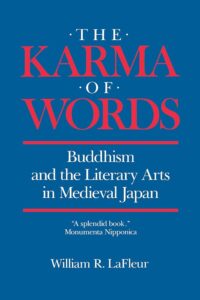
In “Visions of Awakening Space and Time,” Taigen Dan Leighton quotes from William R. LaFleur’s “The Karma of Words: Buddhism and the Literary Arts in Medieval Japan.” For example:
Dōgen and the Lotus Sutra, p27In The Karma of Words, William LaFleur discusses the sophisticated nature of the Lotus Sutra as literature and its impact on medieval Japanese poetics: “The surprising feature of [the parables] in the Lotus is that they are simultaneously the vehicle and the tenor of that vehicle. In a very important sense, the parables of the Lotus are about the role and status of parabolic speech itself. They are what I would call self-reflexive allegory; that is, their trajectory of discourse behaves like a boomerang. Much like the Dharma described in a crucial section of the hōben chapter, they are characterized by ‘the absolute identity [or equality] of their beginning and end.’ ”
And, as is my want, after reading this I sent away for a copy of LaFleur’s book, which was published by University of California Press in 1986.
This book is not about the Lotus Sutra but, instead, about Medieval Japan, the period in which Nichiren lived.
LaFleur explains in his Preface to the book:
The origin of this study lies in the simultaneous frustration and fascination I felt nearly two decades ago when for the first time I saw a performance of nō drama in Japan. I was greatly moved by what I saw, but I was also greatly perplexed by the presence in this form of drama of energies, assumptions, and aesthetic values that seemed very different from those present in the classical theaters of ancient Greece and Renaissance Europe. Here was a form of drama that had evidently been shaped by a set of religious and philosophical assumptions—but these were neither those of Aristotle nor those of European Christianity. My curiosity about this led me to search for relevant books and to question people who I thought might provide information.
I soon discovered a certain consensus; it was that, although the components in nō are many and complex, it is probably Japanese Buddhism which did most to shape the world of nō. Beyond this, however, my frustration continued, since the available materials in Western languages provided information about Buddhist elements in this form of drama but stopped short of a real reconstruction of the way the Japanese in the medieval period of their history saw their world and envisioned their destinies in and through Buddhist terms and concepts. Footnotes gave definitions of things like arhats, asuras, and Amida, but these things collectively never added up to a satisfying account of the intellectual and religious assumptions of the Buddhist poets, dramatists, and writers of prose in medieval Japan.
This book is first an attempt to provide what I could not find then and was subsequently forced to pursue in the original texts and in modern scholarly studies in Japanese.
Of course, I’m less interested in nō, which I’ve never seen performed, than I am in understanding how Buddhism shaped Japan’s world view.
As a self-styled “modern Buddhist,” I was particularly taken by this observation by LaFleur:
Buddhism gained ascendency in medieval Japan largely because it successfully put forward a coherent explanation of the world and of human experience; it was the single most satisfying and comprehensive explanation available to the Japanese people at the time. This is to deny neither that Buddhism was espoused by persons who had great social and political power nor that it provided justifications for their power and prestige. Moreover, this is not to disembody it or overlook the impressive technological and artistic side of the Buddhism that came to Japan from China and Korea—its magnificent architecture, paintings, icons, vestments, illuminated scrolls, and choreographed ritual. It is merely to call attention to the cognitive dimension and to observe that Buddhism provided not only salvation but also explanation. That is, as a religion in a medieval context, it was considerably more comprehensive, than religion in modern settings. In many ways, Buddhism performed in medieval Japan much of the role now customarily assigned to science. It did so by giving to the epoch a basic map of reality, one that provided cognitive satisfaction not only to learned monks in monasteries but also to unlettered peasants in the countryside.
The Karma of Words, p26-27
Perhaps it is time for Buddhists to take back the role taken by modern science and reassert Buddhism’s “basic map of reality” – the law of cause and effect and all of its ramifications.
Over the next four days I’ll publish quotes from “The Karma of Words.”