All posts by John Hughes

Daily Dharma – Jan. 2, 2024

Their tongues will be purified.
Their tongues will not receive anything bad.
Anything they eat will become
As delicious as nectar.

The Buddha sings these verses to Constant-Endeavor Bodhisattva in Chapter Nineteen of the Lotus Sūtra, describing those who keep the Lotus Sūtra. With food and drink it is easy to see how different people will find the same food either delicious or disgusting. Our experience and beliefs shape what we are comfortable putting into our bodies, and whether we do so for the sake of our health or the pleasure that comes from experiencing their flavor. But when we find that something with good flavor is bad for our health, or vice versa, we can change our tastes. This is another example of how the Lotus Sūtra teaches us how to live in the world. We learn to embrace situations we once found frightening or intolerable. We increase our capacity with our focus on benefiting others. As a wise teacher once said, we learn to enjoy problems the way we enjoy ice cream.

The Daily Dharma is produced by the Lexington Nichiren Buddhist Community. To subscribe to the daily emails, visit zenzaizenzai.com

The Vision of Buddhism

The Wife adheres to a New Year’s Day rule: Don’t do anything on New Year’s Day that you don’t want to end up doing all year long.1 She cleans and straightens the house over the days leading to New Year’s Eve in order to enjoy her relaxed holiday. Having been married 34 years, I’ve adopted her rule – do only things you want to do all year long on New Year’s Day – but without all the preparatory inconvenience.

So today, Jan. 1, 2024, I’ve strictly limited television viewing. I’ve ignored the leaves littering the bottom of the pool in the backyard. And I’ve spent the majority of the day in my recliner reading.

I picked up Richard J. Smith’s “The I Ching: A Biography,” which I had been reading the day before. This is one of the “Lives of Great Books” series which “recount the complex and fascinating histories of important religious texts from around the world.” I’ve previously read “The Lotus Sutra: A Biography” and “The Tibetan Book of the Dead: A Biography,” both by Donald S. Lopez Jr.

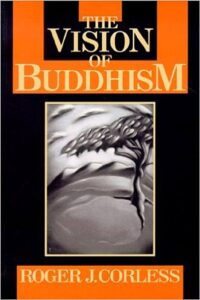
Vision of Buddhism bookcoverHowever, in keeping with my “only do things you want to do all year long,” I put The I Ching biography down and picked up “The Vision of Buddhism” by Roger J. Corless. This was an introductory Buddhism text recommended by Jan Nattier in her book “Once Upon A Future Time: Studies in a Buddhist Prophecy of Decline.” (More about that book tomorrow and subsequent days.)

I was attracted to this book by Corless’ effort to reject the Western tendency to teach Buddhism as a linear historical tale.

History is an academic discipline that has developed in the western hemisphere. The western hemisphere has been strongly influenced by the Abrahamic traditions (Judaism, Christianity, and Islam) and their conception of time as something created by God in and through which God manifests himself. On this view, time is meaningful. It has a beginning and an end, and the end is a goal, so that there is development, a progressive achievement of the goal. It makes sense to ask “What is the meaning of life?” A Christian hymn says “God is working his purpose out as year succeeds to year.” As soon as we substitute the word Buddha for God in this sentence, however, there is a problem.

History as a secular discipline has many of the features of the Abrahamic tradition’s view of time. God has been gradually eased out, and the notion of goal or purpose has become suspect, but the assumption that time is meaningful and that development is real does not seem to have been given up by even the most radical critics of the philosophy of history.

Buddhism, on the other hand, sees things as changing over time, but it does not see things as becoming more meaningful as they change. Change, for Buddhism, is a primary characteristic of cyclic existence (samsara), and history is just a lot of change. All that we can say about history, Buddhistically, is that as time goes on we get more of it.

I greatly enjoyed his summary of the basic story of the Buddha’s life, which uses the Tibetan story of the “Twelve Acts of the Buddha”:

  1. Waiting in the Tushita Heaven
  2. Growing in the womb of Mayadevi
  3. Birth as a human for the last time.
  4. Attainment of intellectual and physical skills
  5. Marriage and the enjoyment of sensuality
  6. Renunciation of the worldly life
  7. The practice of extreme self-denial
  8. The march to the center
  9. Overcoming Mara
  10. Attaining enlightenment
  11. Teaching
  12. Final Nirvana

His summary of the teaching of emptiness – or as he explains it, “transparency” – was very useful and I was looking forward to seeing how his college textbook published in 1989 would proceed. At that moment, however, I needed to run an errand with The Wife. (All year long I’ll do this!)

When I was able to return to my recliner, I picked up “The Vision of Buddhism” but instead of returning to where I had left off I decided to first browse the book index.

As a Nichiren Buddhist I’m always interested in what an introductory college text has to say about the Kamakura period of Japan’s Buddhist development.

Nothing. The word Kamakura does not appear in the index. The entry for “Japan, and Buddhism” points to pages 59-62.

This happens to be the place where Corless has devoted a little more than two full pages to “Nichiren Shoshu (“The Orthodox Nichiren Lineage”). There is no other index entry for Nichiren.

In Corless’ Chapter 2, The Value of Worldly Skills (Act 4 of the Buddha), in the subsection entitled “Social Buddhism,” he writes:

Social Buddhism
There are two forms of Buddhism that, in very different ways, emphasize social action above all else: the Nichiren Shoshu of Japan, and the reform movement of Dr. Ambedkar in India.

NICHIREN SHOSHU
Nichiren Shoshu, “The Orthodox Nichiren Lineage,” is nothing if not clear, organized, and motivated. It claims to have the true Buddhism, proves it by its physical success, and aims at the destruction of all other forms of religion. Its roots are in a medium length Mahayana Sutra, Saddharmapundarika Sutra or Sutra on the True Dharma which is like a White Lotus, called the Lotus Sutra for short. This text presents Shakyamuni in his gigantic-sized, Sambhogakaya form preaching the Mahayana doctrines that had been withheld from the Hinayana. It may have been written about the beginning of the Christian era. Partly perhaps because it was chosen by the Chinese monk Chih-i (531-597 C.E.) as the perfect expression of Mahayana, it has become one of the most popular texts of Far Eastern Buddhism. It was studied by Nichiren (1222-1282 C.E.), a Japanese Tendai monk practising on Mount Hiei. He seems to have decided that the scholastic exegesis of the Lotus Sutra had become over-subtle, and that its main points had been missed. The Sutra was not concerned, he felt, with voluminous doctrinal formulae, but with the victory of the oppressed under the leadership of the Bodhisattva Vishishtacharitra (“He of Superlative Action”; known as Jogyo Bosatsu in Japan), who is mentioned in chapter 15 of the Lotus Sutra as the leader of a vast army of Bodhisattvas who emerge from below the earth to worship the Buddha. Coming out of the earth signified, for Nichiren, the release of the lowly from injustice, and he identified Vishishtacharitra with himself. Later followers came to regard Nichiren as the pre-eternal Buddha, superior to all other Buddhas. Only by cleaving to the supreme doctrine of the Lotus Sutra could anyone be free, either relatively (i.e., within samsara) or absolutely (i.e., by leaving samsara). He expressed his contempt for competing forms of Buddhism in four staccato phrases:

  1. “Nembutsu muken”: Those who recite the Buddha’s Name in the hope of paradise will be reborn in hell.
  2. “Zen temma”: The practitioners of Zen are deluding demons.
  3. “Shingon bokoku”: The Tantric Buddhists, who say they are protecting the country, are traitors.
  4. “Ritsu kokuzoku”: The Buddhists who punctiliously observe the monastic regulations are rebels.

The government attempted to execute Nichiren as a troublemaker, but he was saved by a miracle, and exiled to the island of Sado between 1271 and 1274. He founded two temples before he died, and began the Hokke Shu, “Lotus Lineage” which emphasized the great merit of reciting the mantra NAM’MYOHO-REN-GE-KYO, “Hail to the Lotus Sutra.” Since the Lotus Sutra says that reciting a single phrase from it earns as much merit as reciting all of it, and since, according to classical Chinese thought, the essence of a book is encapsulated in its name or title, those who recite NAM’MYO-HO-REN-GE-KYO will find that they get all that they need.

After Nichiren’s death, the lineage did not have a large following until Toda Josei (1900-1958 C.E.) became president of the Soka Gakkai, “Value-Creation Society,” in 1951. Soka Gakkai is a lay organization that grew out of the educational theories of Makiguchi Tsunesaburo (1871-1944) who, in his four-volume work Soka Kyoikugaku Taikei, “A System of Value-Creation Education,” written between 1930 and 1934, offered the unexceptionable idea that education should increase the student’s sense of values. Toda befriended Makiguchi, both joined the Nichiren Shoshu (an outgrowth of the Hokke Shu), and, after Makiguchi’s death, Toda whipped up what had been a study circle into a tightly run missionary society. He vowed to obtain the conversion of seven hundred and fifty thousand families before his death, and far exceeded his goal.

Today, Soka Gakkai is a potent force in Japanese society, able to stage breathtakingly unified mass meetings and, through the Komeito, “Clean Government Party,” it is powerfully influential in the Diet (the Japanese parliament). Its militancy alarms non-members, who may argue that it is not really Buddhism. Soka Gakkai claims, for instance, that Japan lost the Second World War because the Four Divine Kings deserted Japan when the Lotus Sutra was neglected. Soka Gakkai also has a world mission, with an American headquarters near Los Angeles and branches throughout the United States. Members of Soka Gakkai in America, where it is called Nichiren Shoshu of America (N.S.A.), attribute such varied practical benefits as release from drug addiction, a happy sex life, improved sports performance, good business deals, and successful hitch-hiking to the persistent recitation of the mantra NAM’MYO-HO-REN-GE-KYO. Unlike most Buddhists, they make great efforts to gain converts, and may claim that other Buddhists are not “real” Buddhists. And, whereas Nichiren himself originally claimed the Lotus Sutra as the salvation of Japan, American devotees patriotically use it to pay homage to the Stars and Stripes, sometimes with fife-and-drum bands.

After reading this I was exhausted and took a nap. I set my watch’s timer for 30 minutes and closed my eyes.

Napping I don’t mind doing for the rest of the year. Reading Corless’ book, not so much. When I got up from my nap I went to my office to write this. Writing is something I want to do all year. Explaining how many ways Corless gets Nichiren Buddhism wrong, I can do without.

I’ll go do gonyo now while my wife proof-reads this. After I do my 32 Days of the Lotus Sutra post I’ll consider my wife’s suggestions and post this. Tomorrow I plan to pick up Jan Nattier’s “A Few Good Men: The Bodhisattva Path according to The Inquiry of Ugra (Ugraparip̣rcchā)


1
The Wife’s objection: I feel this is misleading. The rule is – What you do on NYD will dominate or be a major focus for the coming year. Therefore you want to do pleasurable and rewarding things. return

Day 24

Day 24 concludes Chapter 19, The Merits of the Teacher of the Dharma, and closes the Sixth Volume of the Sutra of the Lotus Flower of the Wonderful Dharma.


Having last month concluded Chapter 19, The Merits of the Teacher of the Dharma, we return to the top of today’s portion of Chapter 19 and consider the eight hundred merits of the nose.

“Furthermore, Constant-Endeavor! The good men or women who keep, read, recite, expound or copy this sūtra, will be able to obtain eight hundred merits of the nose. With their pure noses, they will be able to recognize all the various things above, below, within and without the one thousand million Sumeru-worlds.
“Those who keep this sūtra will be able to recognize, without moving about, the scents of the sumanas-flowers, jātika-flowers, mallikā-flowers, campaka-flowers, pāṭala-flowers, red lotus flowers, blue lotus flowers, white lotus flowers, flower-trees and fruit-trees. They also will be able to recognize the scents of candana, aloes, tamālapattra and tagara, and the scents of tens of millions of kinds of mixed incense which are either powdered or made in lumps or made applicable to the skin. They also will be able to recognize the living beings including elephants, horses, cows, sheep, men, women, boys and girls by smell. They also will be able to recognize without fallacy grasses, trees, thickets and forests by smell, be the nearby or at a distance.

“Those who keep this sūtra also will be able to recognize the gods [and things] in heaven by smell while they are staying [in the world of men]. They will be able to recognize the scents of the pārijātaka-trees, kovidāra-trees, mandārava-flowers, mahā-mandārava-flowers, mañjūṣaka-flowers, mahā-mañjūṣaka-flowers [in heaven]; the powdered incense of candana and aloes, the scents of other flowers, and the mixture of these scents in heaven without fail. They will be able to recognize the gods by smell. They will be able to recognize from afar the scent that Śakra-Devānām-Indra gives forth when he satisfies his five desires and enjoys himself in his excellent palace, or when he expounds the Dharma to the Trāyastriṃs̒a Gods at the wonderful hall of the Dharma, or when he plays in the gardens. They also will be able to recognize by smell from afar the gods and goddesses of the other heavens, including the Heaven of Brahman and the Highest Heaven. They also will be able to recognize the incense burned by the gods in those heavens. They also will be able to locate the Śrāvakas, Pratyekabuddhas, Bodhisattvas, and Buddhas by smelling their bodies from afar. Even when they recognize all this by smell, their organ of smell will not be destroyed or put out of order. If they wish, they will be able to tell others of the differences [of those scents] because they remember them without fallacy.”

Thereupon the World-Honored One, wishing to repeat what he had said, sang in gāthās:

Their nose will be purified.
They will be able to know
The smells of all things,
Be they good or bad.

They will be able to recognize by smell
The sumanas-flowers and jātika-flowers;
Tamala[pattra] and candana;
Aloes and sappanwood;
Various flowers and fruits;
And all living beings including men and women.

Anyone who expounds the Dharma will be able to locate
All living beings from afar by smell.
He will be able to locate by smell
The wheel-turning-kings of great [countries],
The wheel-turning-kings of small [countries],
And their sons, ministers and attendants.

He will be able to locate by smell
The wonderful treasures of personal ornaments,
The underground stores of treasures,
And the ladies of the wheel-turning-kings.

He will be able to recognize persons
By smelling their ornaments or garments
Or by smelling their necklaces
Or by smelling the incense applied to their skin.

Anyone who keeps
This Sūtra of the Lotus Flower of the Wonderful Dharma
Will be able to know by smell
Whether the gods are walking, sitting, playing or performing wonders.

Anyone who keeps this sūtra
Will be able to locate by smell, without moving about,
The flowers and fruits of trees,
And the oil taken from sumanas-flowers.

He will be able to recognize by smell
The flowers of the candana-trees
Blooming in steep mountains,
And the living beings in those mountains.

Anyone who keeps this sūtra
Will be able to locate by smell
The living beings in the Surrounding Iron Mountains,
In the oceans, and underground.

He will be able to know by smell
Whether asuras and their daughters
And their attendants are fighting
Or playing with each other.

He will be able to locate by smell
Lions, elephants, tigers,
Wolves, wild oxen and buffalos
In the wilderness and in steep places.

He will be able to know by smell
Whether an unborn child is a boy or a girl,
Or a child of ambiguous sex,
Or the embryo of a nonhuman being.

He will be able to know by smell
Whether a woman is an expectant mother,
Or whether she will give an easy birth
To a happy child or not.

He will be able to know by smell
What a man or a woman is thinking of,
Or whether he or she is greedy, ignorant or angry,
Or whether he or she is doing good.

He will be able to recognize by smell
The gold, silver, and other treasures
Deposited underground,
And the things enclosed in a copper box.

He will be able to know by smell
The values of various necklaces,
And the deposits of their materials,
And also to locate the necklaces [when they are lost].

He will be able to recognize by smell
The mandārava-flowers,
And the mañjūṣaka-flowers,
And the pārijātaka-trees in heaven.

He will be able to know by smell
Whether a heavenly palace
Adorned with jeweled flowers
Is superior, mean or inferior.

He will be able to recognize by smell
Gardens, forests, excellent palaces,
And the wonderful hall of the Dharma in heaven,
And other stately buildings where [the gods] enjoy themselves.

He will be able to know by smell
Whether the gods are hearing the Dharma
Or satisfying their five desires,
Or coming, going, walking, sitting or reclining.

He will be able to know by smell
Whether the goddesses, clad in the garments
Adorned with fragrant flowers,
Are playing as they are moving about.

He will be able to know by smell
Who has reached the Heaven of Brahman,
Who has entered into dhyāna,
And who has come out of it.

He will be able to know by smell
The person who has appeared for the first time in the Light-Sound Heaven
Or in the Universal-Pure Heaven or in the Highest Heaven,
And who has disappeared from there.

Anyone who keeps this sūtra
Will be able to locate by smell
The bhikṣus who are sitting or walking about
In seeking the Dharma strenuously,
And the bhikṣus who are reading or reciting [this] sūtra
Or devoting themselves
To sitting in dhyāna
Under the trees of forests.

He will be able to know by smell
The Bodhisattvas who are resolute in mind,
And who are sitting in dhyāna or reading [this] sūtra
Or reciting it or expounding it to others.

He will be able to locate by smell
The World-Honored One who is expounding the Dharma
Out of his compassion
Towards all living beings who respect him.

He will be able to know by smell
Those who rejoice at hearing [this] sūtra
From the Buddha,
And act according to the Dharma.

Anyone who keeps this sūtra
Will be able to have these merits of the nose
Although he has not yet obtained the nose
Of the Bodhisattva [who attained] the
Dharma without āsravas.

See The Merit of This Teaching

10 Years on the Journey to the Place of Treasures

Today, Jan. 1, 2024, marks the start of my 10th year on this journey.

I began in 2015 with a 500-day challenge inspired by Rev. Ryusho Jeffus‘ book “The Magic City: Studying the Lotus Sutra.”

“I wonder what you could accomplish in your life if you made a commitment from today for 500 days to practice on a regular consistent basis towards the achievement of some change in your life? Would you be able to travel the entire 500 days without giving up or abandoning or forgetting your goal and effort?”

The days counted to 500 and then again and again and again.

Ryusho had said early on that a 500-day journey was trivial. A 10-year timeframe, he said, would be more useful for judging the merits of the practice of Nichiren Buddhism.

In this tenth year I will complete reciting the Lotus Sutra more than 100 times. I’m currently on my 91st cycle through the Lotus Sutra. I’m on my 47th cycle through the Sutra of Innumerable Meanings and The Sutra of Contemplation of the Dharma Practice of Universal Sage Bodhisattva, the two additional sutras within the Threefold Lotus Sutra.

Before I complete this 10-year challenge, I hope to finish two projects:

  1. Create a 365-day collection of the promises contained in the Lotus Sutra. For an example, see Anyone, which I wrote as part of my 800 Years of Faith project in 2022. This would then become a Daily Promise to remind us of the power of the Lotus Sutra.
  2. Divide the text of the 28 chapters of the Lotus Sutra into 365 roughly equal portions. Each day would include a brief commentary, perhaps a quote from Shinkyo Warner Shonin’s Daily Dharma or a quote from one of the many books I’ve read. This would become the Daily Practice, a simple way to read the Lotus Sutra.

In 2025, these would then replace the Daily Dharma and 32 Days of the Lous Sutra posts.

At least that’s the plan today, the first day of my 10th year on this journey to the place of treasures.

Daily Dharma – Jan. 1, 2024

Listen! World-Voice-Perceiver practiced
According to the conditions of the places [of salvation].
His vow to save [people] is as deep as the sea.
You cannot fathom it even for kalpas.

The Buddha gives this description of World-Voice-Perceiver Bodhisattva (Kannon, Kanzeon, Kuan Yin, Avalokitesvara) to Endless-Intent Bodhisattva in Chapter Twenty-Five of the Lotus Sūtra. As the embodiment of Compassion, World-Voice perceiver demonstrates the boundlessness of our ability to benefit others. We can often feel overwhelmed by the problems in the world, and believe that we are not capable of doing everything that is necessary to lead beings out of their delusions. This chapter reminds us that we are not working alone, and that by depending on wisdom rather than power, we learn to see the wonders that surround us.

The Daily Dharma is produced by the Lexington Nichiren Buddhist Community. To subscribe to the daily emails, visit zenzaizenzai.com

Day 23

Day 23 covers all of Chapter 18, The Merits of a Person Who Rejoices at Hearing This Sutra, and opens Chapter 19, The Merits of the Teacher of the Dharma.


Having last month considered the merits will be given to a good man or woman who rejoices at hearing this Sūtra of the Lotus Flower of the Wonderful Dharma, we compare the merits of the great almsgiver to the merit of the fiftieth person who rejoices at hearing even a gāthā of this Sūtra.

“Suppose the Jambudvipa was filled with wonderful treasures such as gold, silver, lapis lazuli, shell, agate, coral and amber; elephant-carts and horse-carts; and palaces and stately buildings made of the even treasures. Suppose a man who was seeking merits gave all those pleasing things [filling the Jambudvipa] to the living beings of four hundred billion asaṃkhya worlds according to their wishes. A world consists of the six regions. The living beings [of the six regions] are of one or another of the four kinds of births: oviparous, viviparous, from moisture, or without any medium. Some of them have form while others do not. Some have desire while others do not. Some have no feet while other have two feet or four or more. Having continued giving those alms to them for eighty years, this great almsgiver thought, ‘I gave those pleasing things to them according to their wishes. Now they are old and decrepit. They are more than eighty years old. Their hair is grey; and their face , wrinkled. They will die before long. I will lead them by the Dharma of the Buddha.’

“Then he collected them. He propagated the Dharma to them, led them by the Dharma, showed them the Dharma, taught them, benefited them, and caused them to rejoice. He caused them to attain in a moment the enlightenment of the Srota-āpanna, of the Sakrdāgāmin, of the Anāgāmin or of the Arhat, eliminate all āsravas, practice deep dhyāna-concentration without hindrance, and obtain the eight emancipations. What do you think of this? Do you think that the merits obtained by this great alms giver were many or not?”

Maitreya said to the Buddha:

“World-Honored One! I think that his merits were many, immeasurable and limitless. His merits were already immeasurable when he gave all those pleasing things to them. Needless to say, so were his merits when he caused them to attain Arhatship.”

The Buddha said to Maitreya:

“Now I will tell you clearly. The merits of the person who gave all those pleasing things to the living beings of the six regions of four hundred billion asaṃkhya worlds, and caused them to attain Arhatship are less than the merit of the fiftieth person who rejoices at hearing even a gāthā of this Sūtra of the Lotus Flower of the Wonderful Dharma. The merits of the former person are less than a hundredth or a thousandth of the merits of the latter person, or less than the merits of the latter person divided by a hundred thousand billion. [The superiority of the merits of the latter person to those of the former person] cannot be explained by any calculation, parable or simile.

“Ajita! The merits of the fiftieth person who rejoices at hearing this Sūtra of the Lotus Flower of the Wonderful Dharma are immeasurable, limitless, asaṃkhya. Needless to say, so are the merits of the first person who rejoices at hearing [this sūtra] in the congregation. His merits are immeasurable, limitless, asaṃkhya and incomparable.

The Daily Dharma from June 21, 2023, offers this:

Now I will tell you clearly. The merits of the person who gave all those pleasing things to the living beings of the six regions of four hundred billion asaṃkhya worlds, and caused them to attain Arhatship are less than the merits of the fiftieth person who rejoices at hearing even a gāthā of this Sūtra of the Lotus Flower of the Wonderful Dharma.

The Buddha gives this explanation to Maitreya (whom he calls Ajita – Invincible) in Chapter Eighteen of the Lotus Sūtra. He compares the benefit created by someone who teaches innumerable beings and makes exorbitant offerings through following the pre-Lotus sūtras to the benefits of finding joy in the Buddha’s Highest teaching. This joy is not the same as just getting what we want, or being relieved from what we do not want. It is the joy of seeing the world for what it is, and our place in it as Bodhisattvas who exist for the benefit of all beings.

The Daily Dharma is produced by the Lexington Nichiren Buddhist Community. To subscribe to the daily emails, visit zenzaizenzai.com

Daily Dharma – Dec. 31, 2023

The [perverted] people think:
“This world is in a great fire.
The end of the kalpa [of destruction] is coming.”
In reality this world of mine is peaceful.

The Buddha sings these verses in Chapter Sixteen of the Lotus Sūtra. Here he draws a stark contrast between how those caught in the web of delusion see the world and how things really are. The world is constantly changing. When we expect the world to be as we want it, rather than as it is, any change is frightening. We assume that the world is falling apart and will sweep us along in its demise. When we practice the Wonderful Dharma of the Lotus Sūtra, we know that we and all beings will become enlightened. The change in the world is part of our practice. We know how it will turn out and there is no fear. Only peace.

The Daily Dharma is produced by the Lexington Nichiren Buddhist Community. To subscribe to the daily emails, visit zenzaizenzai.com

Day 22

Day 22 covers all of Chapter 17, The Variety of Merits.


Having last month considered the merits of those who hear of the Buddha’s longevity, we consider the merits of those who keep or copy this sutra or cause others to copy it.

“Ajita! Anyone who, after hearing this sūtra, keeps or copies it or causes others to copy it after my extinction, should be considered to have already built many hundreds of thousands of billions of monasteries, that is to say, innumerable monasteries, each of which was installed with thirty-two beautiful halls made of red candana, eight times as tall as the tala-tree, and spacious enough to accommodate one hundred thousand bhikṣus. He also should be considered to have already furnished [those monasteries] with gardens, forests, pools for bathing, promenades, and caves for the practice of dhyāna, and filled [those monasteries] with clothing, food, drink, bedding, medicine, and things for amusements, and offered [those monasteries] to me and to the Saṃgha of bhikṣus in my presence. Therefore, I say, ‘Anyone who keeps, reads or recites this sūtra, expounds it to others, copies it, causes others to copy it, or makes offerings to a copy of it after my extinction, need not build a stupa or a monastery, or make offering to the Saṃgha.’ Needless to say, anyone who not only keeps this sūtra but also gives alms, observe the precepts, practices patience, makes endeavors, concentrates his mind, and seeks wisdom, will be able to obtain the most excellent and innumerable merits. His merits will be as limitless as the sky is in the east, west, south, north, the four intermediate quarters, the zenith, and the nadir. These innumerable merits of his will help him obtain the knowledge of the equality and differences of all things.

“Anyone who reads, recites or keeps this sūtra, expounds it to others, copies it, or causes others to copy it [in my lifetime,] should be considered to have already built stupas and monasteries, made offerings to the Saṃgha of Śrāvakas, praised them, praised Bodhisattvas for their merits by hundreds of thousands of billions of ways of praising, expounded this Sūtra of the Lotus Flower of the Wonderful Dharma to others with various stories of previous lives according to the meanings of it, observed the precepts without fallacy, lived with gentle persons, practiced patience, refrained from anger, become resolute in mind, preferred sitting in dhyāna, practiced deep concentrations of mind, become strenuous and brave, practiced good teachings, become clever and wise, and answered questions satisfactorily.

Ajita! Any good man or woman who keeps, reads, or recites this sūtra after my extinction, also will be able to obtain these merits. Know this! He or she should be considered to have already reached the place of enlightenment, approached Anuttara-samyak-saṃbodhi, and sat under the tree of enlightenment. Ajita! Erect a stupa in the place where he or she sat, stood or walked! All gods and men should make offerings to that stupa just as they do to the stupa of a Buddha.”

The Daily Dharma for Sept. 24, 2023, offers this:

Needless to say, anyone who not only keeps this sūtra but also gives alms, observes the precepts, practices patience, makes endeavors, concentrates his mind, and seeks wisdom, will be able to obtain the most excellent and innumerable merits. His merits will be as limitless as the sky is in the east, west, south, north, the four intermediate quarters, the zenith, and the nadir. These innumerable merits of his will help him obtain the knowledge of the equality and differences of all things.

The Buddha makes this declaration to Maitreya Bodhisattva in Chapter Seventeen of the Lotus Sūtra. We often think of merits as bonus points we get for good deeds. Good karma we create to offset the bad karma that came from our less skillful actions. Another way of looking at merits is as a measure of clarity. The more merit we gain, the more we see things for what they are. When we offer our merits for the benefit of all beings, we resolve to use this clarity to enhance the lives of others.

The Daily Dharma is produced by the Lexington Nichiren Buddhist Community. To subscribe to the daily emails, visit zenzaizenzai.com

Daily Dharma – Dec. 30, 2023

Although the time is ripe for the Lotus Sutra to convert everyone, teachers who propagate it are ordinary teachers while their disciples are wicked and sickened by the three poisons of greed, anger and ignorance. They avoid teachers who preach the True Dharma, befriending teachers who preach false Dharma. Is it not natural then that he who practices the Lotus Sutra, the true teaching of the Buddha, and his disciples and followers and lay followers are persecuted more severely than the three kinds of enemies?

Nichiren wrote this passage in his Treatise on the True Way of Practicing the Teaching of the Buddha (Nyosetsu Shugyō-shō). In our efforts to uphold and practice the Wonderful Dharma of the Lotus Sūtra, we may be surprised to be the targets of anger or aggression from others, especially from others who also practice the Dharma with us. These difficulties will be opportunities for us to practice wisdom and nourish our compassion. We can learn to recognize others’ delusions within our own minds and remain focused on ridding ourselves of the three poisons, rather than attempting to change someone else’s behavior. In this way we become an example for how to live, and allow the Ever-Present Buddha Śākyamuni to work within our hearts.

The Daily Dharma is produced by the Lexington Nichiren Buddhist Community. To subscribe to the daily emails, visit zenzaizenzai.com

Day 21

Day 21 covers all of Chapter 16, The Duration of the Life of the Tathāgata.


Having last month considered the reasons for the Buddha’s various teachings, we consider the Buddha’s nirvana.

“Good men! The duration of my life, which I obtained by the practice of the way of Bodhisattvas, has not yet expired. It is twice as long as the length of time as previously stated. Although I shall never enter into Nirvāṇa, I say to men of little virtue, ‘I shall pass away.’ I teach them with this expedient. Why is that? It is because, if they see me for a long time, they will not plant the roots of good, but become poor and base, and cling to the five desires so much that they will be caught in the nets of wrong views. If they think that I am always here, and do not think that I will pass away, they will become too arrogant and lazy to realize the difficulty of seeing me, and they will not respect me. Therefore I say [to them] expediently, ‘Bhikṣus, know this! It is difficult to see a Buddha who appears in [this] world.’ Why is that? It is because some men of little virtue cannot see me even during many hundreds of thousands of billions of kalpas while the others can. Therefore, I say [to them], ‘Bhikṣus! It is difficult to see a Tathāgata.’ Those who hear this and know that it is difficult to see me, will adore me, admire me, and plant the roots of good. Therefore l say [to them], ‘I shall pass away,’ although I shall not.

“Good men! All the Buddhas, all the Tathāgatas, do the same as I do. [They expound their teachings] for the purpose of saving all living beings. Therefore, [their teachings] are true, not false.

The Daily Dharma from Feb. 5, 2023, offers this:

Although I shall never enter into Nirvāṇa, I say to men of little virtue, ‘I shall pass away.’ I teach them with this expedient. Why is that? It is because, if they see me for a long time, they will not plant the roots of good, but become poor and base, and cling to the five desires so much that they will be caught in the nets of wrong views.

The Buddha gives this explanation in Chapter Sixteen of the Lotus Sutra. This Chapter is the first time he reveals himself as the Ever-Present Buddha who became enlightened in the far distant past and will continue to lead all beings to enlightenment into the far distant future. The Buddha uses the death of his physical body as an expedient so that those who take him for granted will make efforts to practice his teachings. When we practice the Wonderful Dharma of the Lotus Sūtra, then we learn to see the Buddha in ourselves and all beings.

The Daily Dharma is produced by the Lexington Nichiren Buddhist Community. To subscribe to the daily emails, visit zenzaizenzai.com