
Conceptual Summary
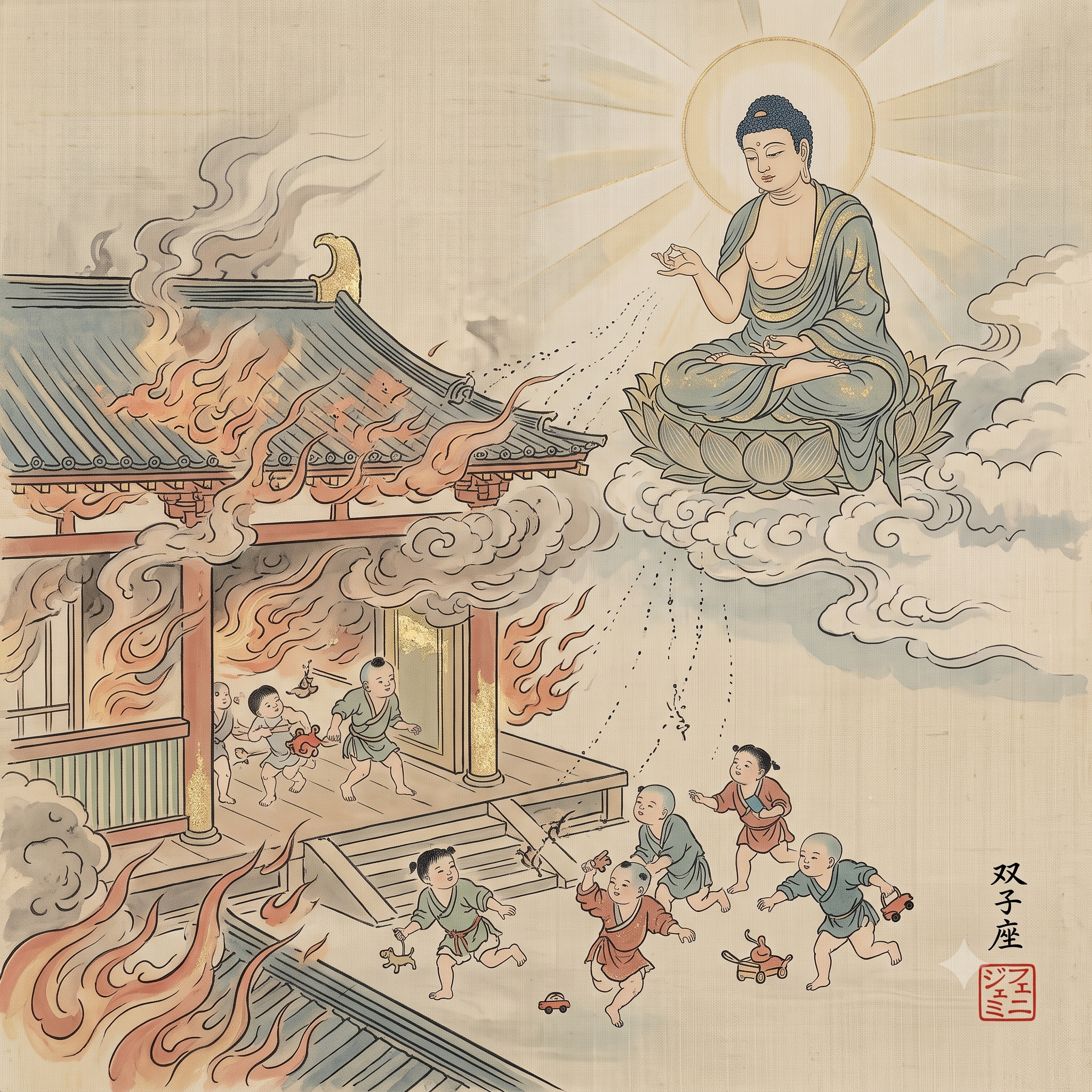
The illustration translates the Lotus Sūtra passage into a dramatic, vertically-structured Japanese Buddhist silk painting. At the apex, the central figure is Śākyamuni Buddha, depicted with compassionate serenity to visualize the "good words" of a father. Below him, the scene shifts drastically to a traditional structure consumed by swirling flames and thick ink smoke, embodying the "burning house" that is the suffering world. This juxtaposition emphasizes the urgency of the situation. The children, as the source text describes, are scattered across the compound, engrossed in play with simplified, period-appropriate toys. Their joyful activity and obliviousness to the danger capture the core message: that sentient beings are "too much engrossed" in worldly attachments to recognize the suffering that surrounds them or hear the Buddha's call to escape. The soft color palette and traditional aesthetic provide a historical context for the timeless teaching.
Iconography & Character Identification
Item 1: Deities/Figures Featured: Śākyamuni Buddha (or Shakyamuni Buddha), a group of playing children, and stylized, personified elements representing the "Burning House."
Item 2: Text Translations: The Kanji signature is '双子座' (futagoza), meaning "Gemini." The red square seal (hanko) contains the Katakana 'ジェミニ' (jemini), also meaning "Gemini."
Having thought this, he said to his children as he had thought, ‘Come out quickly!’ He warned them with these good words out of his compassion towards them, but they were too much engrossed in playing to hear the words of their father. They were not frightened or afraid. They did not wish to come out. They did not know what a fire was, what a house was, and what they would lose. They ran about happily. They only glanced at their father occasionally.
This passage is part of the Parable of the Burning House, told by the Buddha in Chapter Three of the Lotus Sūtra. In this story, he compares us living in this world of conflict to children playing in a dangerous house. As the children in the story were too distracted by their games to hear their father’s warnings, we are often too distracted by the attachments of our world to hear the voice of the Buddha.
The Daily Dharma is produced by the Lexington Nichiren Buddhist Community. To subscribe to the daily emails, visit zenzaizenzai.com