
Conceptual Summary
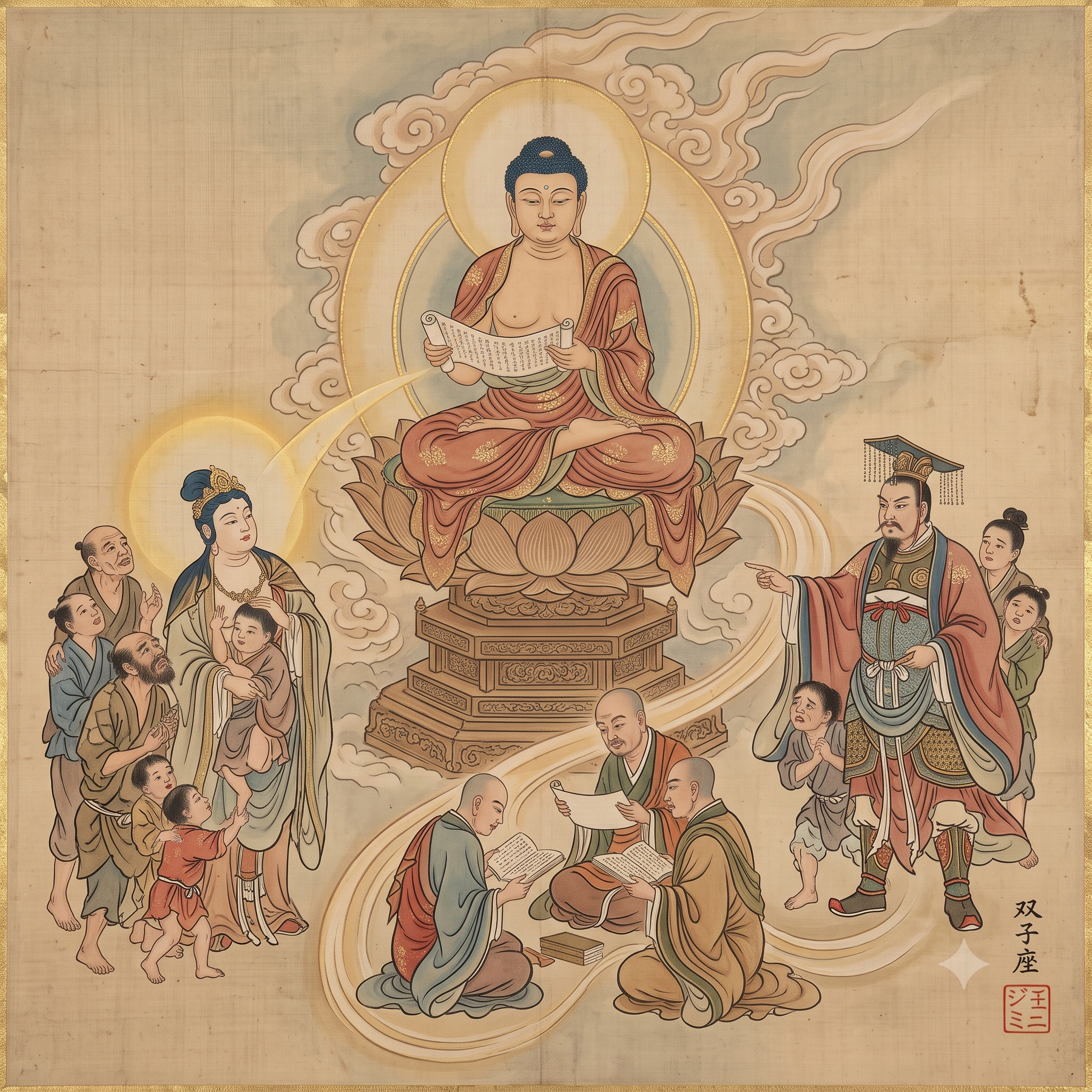
This 1:1 composition visually translates Nichiren's metaphor of the Buddha's three virtues—Sovereign (Master), Parent, and Teacher—using a traditional Japanese ink and mineral pigment style on textured silk. A central, serene Shakyamuni Buddha sits enthroned, holding a sutra, representing his absolute authority and leadership. He is flanked by two illustrative groups representing partial virtues: On the left, a compassionate mother cradling her child illustrates 'parental virtue' but lacks the power of a sovereign. On the right, a powerful noble figures issuing commands, complete with followers and a cowering subject, personifies the frightening aspects of 'sovereign virtue' without compassion. Below, devoted monks study texts, embodying the transmission of wisdom and the active 'teacher virtue' that guides all. The traditional style, soft colors, and gold leaf reflect ancient Japanese Buddhist paintings, and the strict exclusion of Amida and Dainichi iconography ensures thematic focus on Shakyamuni as the all-encompassing guide.
Iconography & Character Identification
Item 1: Deities/Figures Featured: Shakyamuni Buddha (seated centrally, holding a sutra); A Compassionate Mother (holding a child, representing Parental Virtue); A Child (cradled by mother); An Imperial Sovereign/Master (authoritative figure, representing Master Virtue); Attendants/Subjects (grouped near the Master); Monks (studying scrolls and texts, representing the transmission of Teacher Virtue).
Item 2: Text Translations:
Kanji Signature: '双子座' (Gemini / Twin Stars)
Seal (Hanko): 'ジェミニ' (Gemini)
The Buddha is the master of the human and heavenly realms, the parent of all living beings, and the teacher who opens the way and leads us all to enlightenment. Lowly parents lack the virtue of a master, and the master without the virtue of parents is frightening. People with the virtues of parents or master do not necessarily possess the virtue of the teacher.
Nichiren wrote this passage in his Treatise on Prayers (Kitō-shō). This illustrates three aspects of the ever-present Buddha to which we can aspire as we practice his highest teachings. Parents care about their children, but they can lack the skill and knowledge necessary to benefit them. A skillful master can be wise about how to live in this world of conflict, but without a true concern for the well-being of those he leads, can degenerate into cruelty and selfishness. As a teacher, the Buddha has found us all within himself, and cares for us as he cares for himself. He has also found himself within all of us, and knows what it takes to lead us to his wisdom.
The Daily Dharma is produced by the Lexington Nichiren Buddhist Community. To subscribe to the daily emails, visit zenzaizenzai.com