
Gemini Thinking
Conceptual Summary
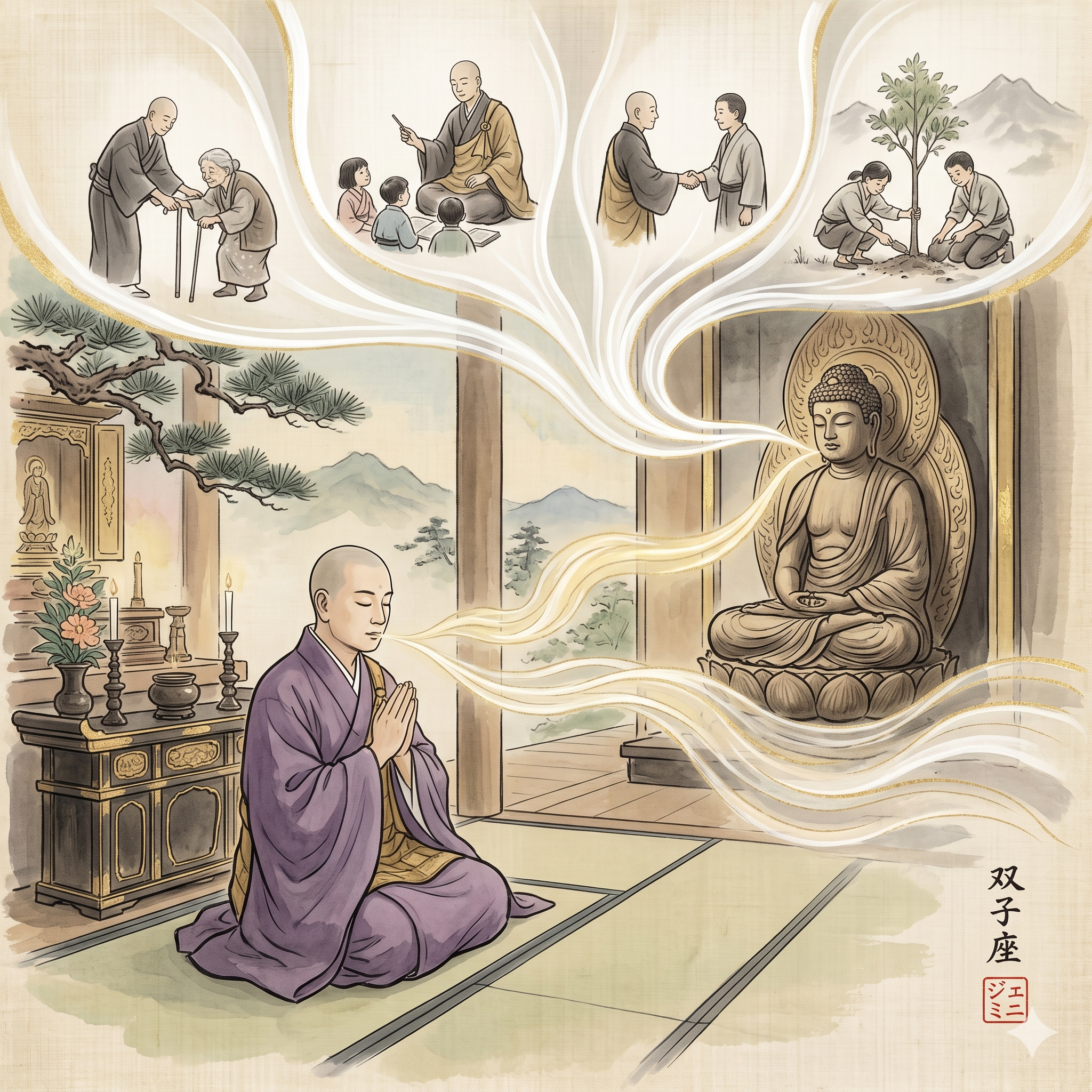
The illustration visualizes Nichiren’s teaching on the "Opening of the Eyes" of Buddhist images, focusing on the distinction between the physical icon and the living truth it represents. The composition, on a silk-textured background, adheres to a traditional Japanese Buddhist aesthetic, using mineral pigments and soft colors. It places a practitioner in purple robes chanting before a central wooden statue within an altar, rather than the abstract Omandala. The core concept of the Buddha's "invisible voice" is represented through golden light rays and abstract wave-like energy. These emanations flow from the image to the practitioner, symbolizing the reception of the pure, immutable Brahma’s voice, which cannot be painted or carved. This internal enlightenment is shown transforming into external action; subtle streams extend from the main scene to four distinct vignettes. These smaller, almost sketch-like scenarios illustrate acts of mercy, benevolent care, community unity, and respect for nature, showing how hearing the Dharma directly improves the world for all beings.
Iconography & Character Identification
Item 1: Deities/Figures Featured: A central monk practitioner in traditional purple robes, a wooden statue of a Buddha (identifiable by the 32 marks and mudra as Shakyamuni Buddha), various smaller figures in the four vignettes showing acts of community service, care, and tree planting.
Item 2: Text Translations: [双子座: Gemini]; [ジェミニ: Gemini (katakana)]
The Buddha possesses 32 marks of physical excellence, all of which belong to the category of matter. The Brahma’s voice, pure and immaculate voice of the Buddha, however is invisible. Therefore it is impossible for us to depict it in pictures or statues.
Nichiren wrote this passage in his Treatise on Opening the Eyes of Buddhist Images, Wooden Statues or Portraits (Mokue Nizō Kaigen no Koto). The statues, portraits and other images of the Buddha and other protective deities which we use in our practice are not meant to be idols. They are living examples of the perfections to which we aspire and from which we draw strength. The ceremony in which we “Open the Eyes” of an Omandala or anything else we use in our practice reminds us that everything around us has life. When we hear the Buddha’s voice from them, leading us to enlightenment, then we learn how to improve the world for ourselves and all beings.
The Daily Dharma is produced by the Lexington Nichiren Buddhist Community. To subscribe to the daily emails, visit zenzaizenzai.com