
Gemini Thinking
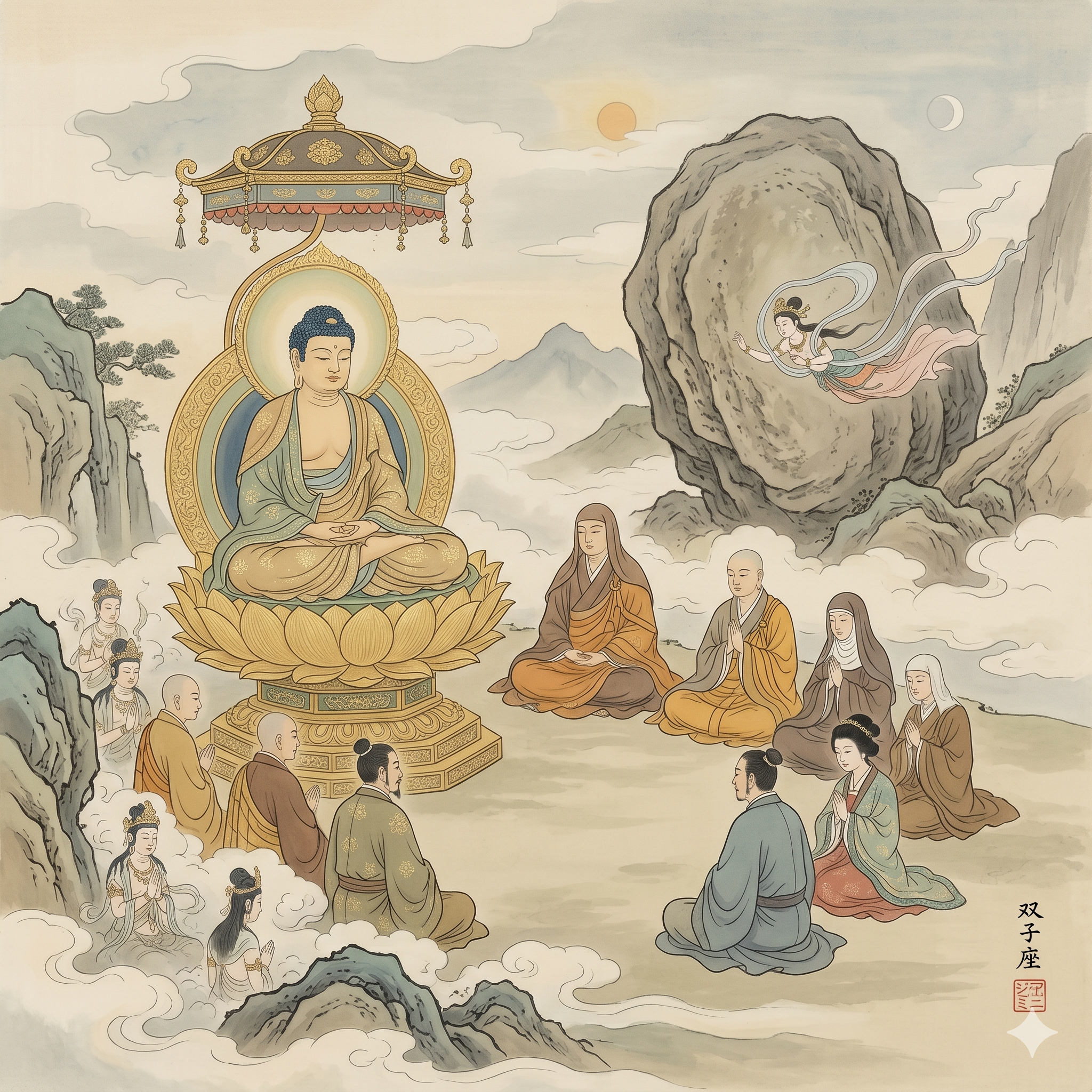
Śākyamuni Buddha (Shaka Nyorai), pictured centrally on his lotus throne, sits in deep meditative silence, surrounded by the four kinds of devotees—monks, nuns, laymen, and laywomen—who appear to wait for only half a day, though fifty small kalpas pass. This illustration from Chapter Fifteen of the Lotus Sūtra visually interprets the immense difference between human and enlightened concepts of time. While innumerable Bodhisattvas spring from the ground to pay their respects on the left, the grand metaphor for a kalpa is depicted on the right: a vast stone mountain being brushed by a flying celestial being's trailing veil, representing the unimaginably long periods required to wear down the stone. The text in the bottom right includes the kanji 双子座 (Futagoza), which translates to "Gemini," and a red seal inscribed with the katakana ジェミニ (Jemini), which also translates to "Gemini."
All this while Śākyamuni Buddha sat in silence. The four kinds of devotees also kept silence for the fifty small kalpas. By his supernatural powers, however, the Buddha caused the great multitude to think that they kept silence for only half a day.
We find this description of the Buddha and his congregation in Chapter Fifteen of the Lotus Sūtra. Innumerable Bodhisattvas have sprung up from underground and come to pay their respects to the Buddha. This passage shows that in our suffering and attachment, we have a different concept of time than the Buddha. The kalpas the Lotus Sūtra uses to measure time are unimaginably long periods. When a stone a mile on each side is worn down to a pebble by a celestial being flying past it every thousand years and brushing it with her veil, a kalpa expires. When we see the world on this scale of time, rather than the limited years we have in our lives, it opens us up to the Buddha’s wisdom.
The Daily Dharma is produced by the Lexington Nichiren Buddhist Community. To subscribe to the daily emails, visit zenzaizenzai.com