
Category Archives: LS32

Day 16

Day 16 concludes Chapter 11, Beholding the Stupa of Treasures, and completes the Fourth Volume of the Sutra of the Lotus Flower of the Wonderful Dharma.

Having last month taken on the hard and easy things, it is time to review the The Difficulty of Retaining the Sutra, the Hotoge section read twice each day following the chanting of Daimoku as part of the Nichiren Shu practice.

It is difficult to keep this sutra.
I shall be glad to see
Anyone keeping it even for a moment.
So will all the other Buddhas.
He will be praised by all the Buddhas.
He will be a man of valor,
A man of endeavor.
He should be considered
To have already observed the precepts,
And practiced the dhuta.
He will quickly attain
The unsurpassed enlightenment of the Buddha.

Anyone who reads and recites this sutra in the future
Is a true son of mine.
He shall be considered to live
On the stage of purity and good.

Anyone, after my extinction,
Who understands the meaning of this sutra,
Will be the eye of the worlds
Of gods and men.

Anyone who expounds this sutra
Even for a moment in this dreadful world,
Should be honored with offerings
By all gods and men.
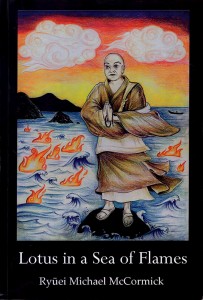
Lotus in a Sea of Flames bookcover
Lotus in a Sea of Flames can be purchased from the Nichiren Buddhist International Center or by by sending a check for $31 (this includes shipping and handling) made out to the San Jose Nichiren Buddhist Temple and mailed to San Jose Nichiren Buddhist Temple, 3570 Mona Way, San Jose, CA 95130.
And this also allows me to reintroduce Rev. Ryuei Michael McCormick’s Lotus in the Sea of Flames. Recently I’ve begun republishing by quote collection, but I don’t have quotes from this novelization of Nichiren’s life. I do, however, have the book’s explanation for the rhythmic reading that is performed when reciting this section.

At this point in the book, Nichiren is being taken away to Izu on his first exile.

“I am no magistrate,” said the official. “I am not interested in your arguments. I am only interested in getting you onto that ship, out of Kamakura, and on to Izu. Now keep quiet!”

Nichiren put his palms together and bowed. His disciples cried out to him, some in tears. The guards kept back all but one. Nichiro, now a strong young man of 16, would not be cowed. He slipped past the guards and ran down to the boat just as it was being pushed off into the surf.

“Get back!” screamed the official.

But Nichiro would not get back. Crying for his master as he reached out to him, he waded out into the bay after the boat. Nichiren exhorted him to be calm, but his disciple was too overwrought and would not listen. “Take me with you!” He shouted again and again. Exasperated, the official took an oar and struck the young monk with bone shattering force. Clutching at his broken right arm, Nichiro finally backed away, his face white with pain.

Tears fell from Nichiren’s eyes as he saw his faithful disciple so brutalized. “Nichiro! Calm yourself. Is this how a disciple of the Buddha should act? From now on, when you see the sun setting in the west behind Izu, think of me. When I see the sun rising from the sea, I shall think of you.”

Nichiro nodded. “Forgive me, master.” Becoming faint, he went down on his knees in the water, sweat and tears coursing down his face. One of the guards finally reached him and escorted him back to where Nissho and the other monks were gathered.

As the boat moved away Nichiren began to chant the final verses from the eleventh chapter of the Lotus Sutra, “It is difficult to keep this sutra. I shall be glad to see anyone keeping it even for a moment.” The rocking of the waves caused his voice to fade in and out, giving the recitation an odd rhythm. The passage ended with, “Anyone who expounds this sutra even for a moment in this dreadful world should be honored with offerings by all gods and men.” From that point on Nichlren knew that he and his disciples had truly become practitioners of the Lotus Sutra as its predictions of hardships that would be faced by the teachers of the True Dharma began to be fulfilled in their own lives.
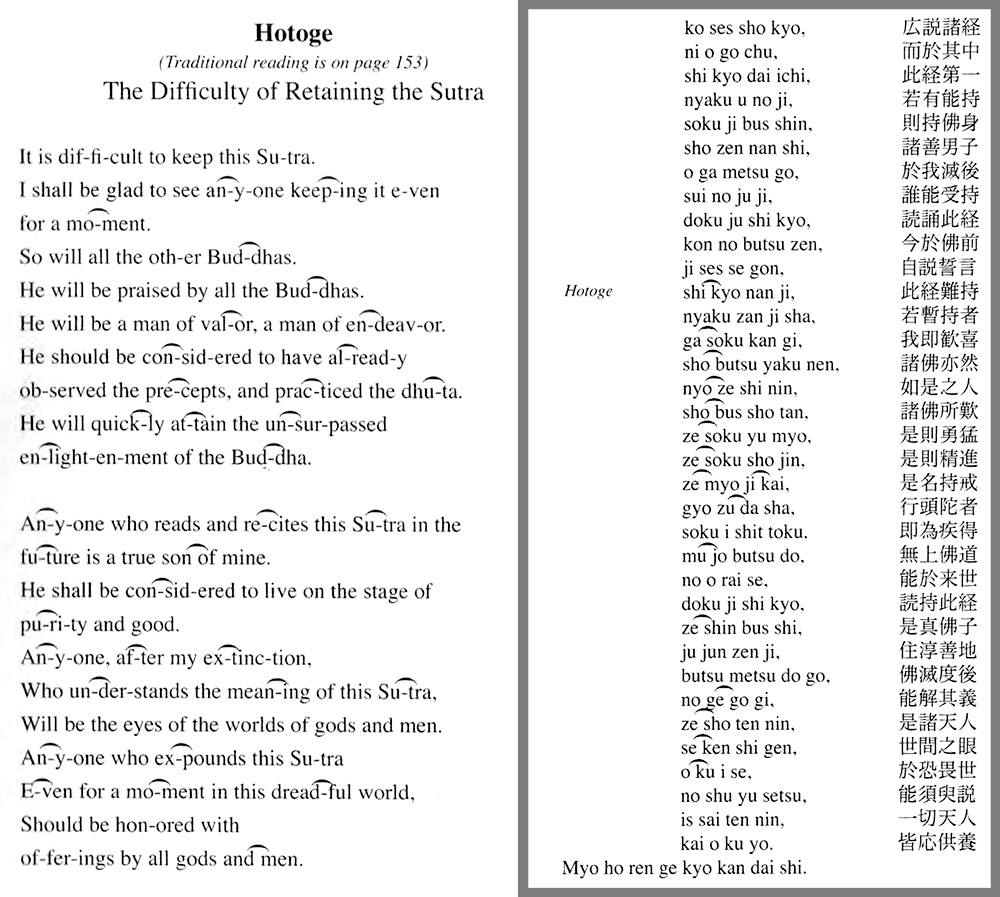
Hotoge with rhythm markings

Day 15

Day 15 concludes Chapter 10, The Teacher of the Dharma, and opens Chapter 11, Beholding the Stūpa of Treasures.

Last month covered the concept that a stupa housing the Lotus Sutra contains the Buddha’s perfect body. And this month, I dig for the water of Anuttara-samyak-sambodhi.

Medicine-King! Although many laymen or monks will practice the Way of Bodhisattvas, they will not be able to practice it satisfactorily, know this, unless they see, hear, read, recite, copy or keep this Sutra of the Lotus Flower of the Wonderful Dharma or make offerings to it. If they hear this sutra, they will. Anyone who, while seeking the enlightenment of the Buddha, sees or hears this Sutra of the Lotus Flower of the Wonderful Dharma, and after hearing it, understands it by faith and keeps it, know this, will approach Anuttara-samyak-sambodhi.

Medicine-King! Suppose a man on a plateau felt thirsty and sought water. He dug a hole in order to get water. As long as he saw the dug-out lumps of earth were dry, he knew that water was still far off. He went on digging, and then found the dug-out lumps of earth wet. When he finally found mud, he was convinced that water was near. In the same manner, know this, the Bodisattvas who have not yet heard, understood or practised this Sutra of the Lotus Flower of the Wonderful Dharma, are still far from Anuttara-­samyak-sambodhi. [The Bodhisattvas] who hear, understand, think over and practice this sutra, will approach Anuttara-samyak-­sambodhi. Why is that? It is because Anuttara-samyak-sambodhi which all the Bodhisattvas [should attain] is expounded only in this sutra. This sutra opens the gate of expedients and reveals the seal of the truth. The store of this Sutra of the Lotus Flower of the Wonderful Dharma is sound and deep. No one can reach its core. Now I show it to the Bodhisattvas in order to teach them and cause them to attain [Anuttara-samyak-sambodhi].

Medicine-King! The Bodhisattvas who, having been surprised at hearing this Sutra of the Lotus Flower of the Wonderful Dharma, doubt and fear it, know this, are beginners in Bodhisattvahood. The Sravakas who, having been surprised at hearing this sutra, doubt and fear it, know this, are men of arrogance.

We are far from water without the Lotus Sutra.

The Daily Dharma offers this explanation:

Medicine-King! Although many laymen or monks will practice the Way of Bodhisattvas, they will not be able to practice it satisfactorily, know this, unless they see, hear, read, recite, copy or keep this Sūtra of the Lotus Flower of the Wonderful Dharma or make offerings to it.

The Buddha gives this explanation to Medicine-King Bodhisattva in Chapter Ten of the Lotus Sūtra. For us to aspire to benefit all beings is rare and wonderful. However, without the guidance of the Buddha, our efforts to benefit others can degenerate into expectations of separate benefits for ourselves. In the Lotus Sūtra, the Buddha explains the limitations of his previous teachings, assures us of our capacity for enlightenment and how he is always helping us, and gives examples of great Bodhisattvas whose experience we can apply to our own lives.

The Daily Dharma is produced by the Lexington Nichiren Buddhist Community. To subscribe to the daily emails, visit zenzaizenzai.com

Day 14

Day 14 covers all of Chapter 9, The Assurance of Future Buddhahood of the Śrāvakas Who Have Something More to Learn and the Śrāvakas Who Have Nothing More to Learn, and opens Chapter 10, The Teacher of the Dharma.

Last month I promised to answer the question: Who are these people who keep, read, recite, expound and copy even a phrase of the Sutra of the Lotus Flower of the Wonderful Dharma?

People worthy of respect:

Medicine-King! If anyone asks you who will become a Buddha in his future life, answer that such a person as previously stated [anyone who rejoices, even on a moment’s thought, at hearing even a gatha or a phrase of the Sutra of the Lotus Flower of the Wonderful Dharma] will! Why is that? The good men or women who keep, read, recite, expound and copy even a phrase of the Sutra of the Lotus Flower of the Wonderful Dharma, and offer flowers, incense, necklaces, incense powder, incense applicable to the skin, incense to burn, canopies, banners, streamers, garments and music to a copy of this sutra, or just join their hands together respectfully towards it, should be respected by all the people of the world. All the people of the world should make the same offerings to them as they do to me.

Who gave up their own benefits to benefit others:

Know this! These good men or women are great Bodhisattvas. They should be considered to have appeared in this world by their vow to expound the Sutra of the Lotus Flower of the Wonderful Dharma out of their compassion towards all living beings, although they already attained Anuttara-samyak-sambodhi [in their previous existence]. Needless to say, those who keep all the passages of this sutra and make various offerings to this sutra [are great Bodhisattvas]. Medicine­King, know this! They should be considered to have given up the rewards of their pure karmas and appeared in the evil world after my extinction in order to expound this sutra out of their compassion towards all living beings.

Dispatched by the Buddha:

The good men or women who expound even a phrase of the Sutra of the Lotus Flower of the Wonderful Dharma even to one person even in secret after my extinction, know this, are my messengers. They are dispatched by me. They do my work. It is needless to say this of those who expound this sutra to many people in a great multitude.

Beyond reproach:

Medicine-King! An evil man who speaks ill of me in my presence with evil intent for as long as a kalpa is not as sinful as the person who reproaches laymen or monks with even a single word of abuse for their reading and reciting the Sntra of the Lotus Flower of the Wonderful Dharma.

Day 13

Day 13 covers all of Chapter 8, The Assurance of Future Buddhahood of the Five Hundred Disciples.

Last month I discussed what a Buddha world would look like and used Good-Purity, where Purna would preside as the Buddha Dharma-Brightness in the kalpa called Treasure-Brightness.

This time through I stumbled over this line, wondering at the meaning of it:

He will perform the Way of Bodhisattvas step by step for innumerable, asamkhya kalpas, and then attain Anuttara-samyak-sambodhi in this world.

This world as in Saha World?

The gathas section doesn’t repeat that detail:

In the future also he will make offerings
To innumerable Buddhas, protect their right teachings,
Help them propagate their teachings,
And purify their worlds.

He will always fearlessly expound the Dharma
With expedients.
He will save countless living beings
And cause them to have the knowledge of all things.

He will make offerings to many Tathagatas
And protect the treasure-store of the Dharma.
After that he will be able to become a Buddha
Called Dharma-Brightness.

But a translation used by Soka Gakkai suggests the same idea:

Little by little he will become fully endowed with the way of the bodhisattva, and when immeasurable asamkhya kalpas have passed, here in the land where he is dwelling he will attain supreme perfect enlightenment.

Does this mean anything?

Purna, like Sariputra, doesn’t ask for some explicit promise he will become a Buddha. But unlike Sariputra, who reveals his feelings of betrayal before he learned of the use of expedients, Purna simply accepts with faith the teachings he has heard:

The World-Honored One is extraordinary. What he does is exceptional. He expounds the Dharma with expedients by his insight according to the various natures of all living beings of the world, and saves them from various attachments. The merits of the Buddha are beyond the expression of our words. Only the Buddha, only the World-Honored One, knows the wishes we have deep in our minds.’

Contrast that with the “the twelve hundred Arhats, who had already obtained freedom of mind”:

We have never been so joyful before. How glad we shall be if we are assured of our future Buddhahood by the World-Honored One just as the other great disciples were!

Day 12

Day 12 concludes Chapter 7, The Parable of the Magic City, and completes the Third Volume of the Sutra of the Lotus Flower of the Wonderful Dharma.

Yesterday and the day before’s discussions of the 16 princes set the stage for the big reveal on the final day of Chapter 7. But before I get to that I want to underline what constituted the initial turning of the wheel of the Dharma.

Thereupon Great-Universal-Wisdom-Excellence Tathagata, having assented to the appeals made by the Brahman-heavenly­kings of the worlds of the ten quarters and also by the sixteen princes, turned the wheel of the teaching [of the four truths] three times, making twelve proclamations altogether. The wheel of this teaching could not be turned by any other one in the world, be he a sramana, a brahmana, a god, Mara or Brahman. The Buddha said, ‘This is suffering. This is the cause of suffering. This is extinction of suffering. This is the Way to extinction of suffering.’

Then he expounded the teaching of the twelve causes, saying, ‘Ignorance causes predisposition. Predisposition causes consciousness. Consciousness causes name-and-form. Name­and-form causes the six sense organs. The six sense organs cause impression. Impression causes feeling. Feeling causes craving. Craving causes grasping. Grasping causes existence. Existence causes birth. Birth causes aging-and-death, grief, sorrow, suffering and lamentation. When ignorance is eliminated, predisposition is eliminated. When predisposition is eliminated, consciousness is eliminated. When consciousness is eliminated, name-and-form is eliminated. When name-and-form is eliminated, the six sense organs are eliminated. When the six sense organs are eliminated, impression is eliminated. When impression is eliminated, feeling is eliminated. When feeling is eliminated, craving is eliminated. When craving is eliminated, grasping is eliminated. When grasping is eliminated, existence is eliminated. When existence is eliminated, birth is eliminated. When birth is eliminated, aging-and-death, grief, sorrow, suffering and lamentation are eliminated.’

When the Buddha expounded these teachings to the great multitude of gods and men, six hundred billion nayuta men emancipated themselves from asravas, and obtained profound and wonderful dhyana-concentrations, the six supernatural powers including the three major supernatural powers, and the eight emancipations because they gave up wrong views. At his second, third and fourth expoundings of these teachings also, thousands of billions of nayutas of living beings, that is, as many living beings as there are sands in the River Ganges, emancipated themselves from asravas because they gave up wrong views. [They became Sravakas.] Those who became Sravakas thereafter were also innumerable, uncountable.

And this was all fine and good and what Buddhas do, but the 16 princes wanted more.

The sixteen princes were young boys at that time. They renounced the world and became sramaneras. Their sense organs were keen; and their wisdom, bright. They had already made offerings to hundreds of thousands of billions of Buddhas, performed brahma practices, and sought Anuttara-samyak­sambodhi in their previous existence. They said to the Buddha simultaneously, ‘World-Honored One! All these Sravakas of great virtue, many thousands of billions in number, have already done [what they should do]. World-Honored One! Expound to us the teaching of Anuttara-samyak-sambodhi! If we hear that teaching, we will study and practice it. World-Honored One! We wish to have the insight of the Tathagata. You know what we have deep in our minds.’

Young boys reminding their father that half-measures won’t return full results.

Day 11

Day 11 continues Chapter 7, The Parable of the Magic City

This middle section of Chapter 7 is all about an amazing new light that illumines the entire universe. Last month I discussed what the universe had been like before the light, a time when “the three evil regions are crowded; And the living beings in heaven, decreasing.”

From each of the 10 directions, Brahman-heavenly-kings travel in search of the source of the light illumining their palaces. When they arrive in the Well-Composed World of Great-Universal-Wisdom-Excellence Buddha they find him sitting on the lion-­like seat under the Bodhi-tree at the place of enlightenment, surrounded respectfully by gods, dragon-kings, gandharvas, kirµnaras, mahoragas, men and nonhuman beings.

Continuing yesterday‘s focus on the 16 princes, I’ll note that they play an integral role begging the Buddha to turn the wheel of the Dharma.

All of the Brahman-heavenly-kings encourage the Buddha:

Great Saint, turn the wheel of the Dharma
And reveal the reality of all things!
Save the suffering beings
And cause them to have great joy!

If they hear the Dharma, some will attain enlightenment;
Others will be reborn in heaven.
The living beings in the evil regions will decrease;
And those who do good patiently will increase.

Doing good patiently

Day 10

Day 10 concludes Chapter 6, Assurance of Future Buddhahood, and opens Chapter 7, The Parable of a Magic City.

Last month I promised to focus on the 16 princes.

On this twelfth time through these verses it is still hard not to feel like a “spoiler” when I discuss the princes.

At the end of Chapter 6, Assurance of Future Buddhahood, we get the great teaser of what is to come:

Now I will tell you
About my previous existence
And also about yours.
All of you, listen attentively!

Underline And also about yours

We then learn of a Buddha called Great-Universal-Wisdom-Excellence who lived in a time so long ago it is beyond calculation. More important than the distance in the past, is this:

I remember the extinction of that Buddha
As vividly as if he had passed away just now,
By my unhindered wisdom; I also remember
The Sravakas and Bodhisattvas who lived [with him].

Bhiksus, know this!
My wisdom is pure, wonderful,
Free from asravas and from hindrance.
I know those who lived innumerable kalpas ago.

And now the princes:

Before [the king who became Great-Universal-Wisdom-Excellence] left home, he had sixteen sons. The first son was called Accumulated-Wisdom. Each of the sons had various playthings. When the sons heard that their father had attained Anuttara-samyak-sambodhi, they gave up the playthings, left home, and came to that Buddha.

Note that these 16 princes gave up their playthings without needing to be offered various toy carts.

In praising the Buddha, the princes point out something that will be repeated several times in tomorrow’s section:

All living beings are suffering.
Being blind, they have no leader.
They do not know how to stop suffering,
Or that they should seek emancipation.
In the long night fewer people go to heaven,
And more people go to the evil regions.
They go from darkness to darkness, and do not hear
Of the names of the Buddhas.

You are the Most Honorable One.
You have obtained the peaceful Dharma-without-asravas. Not only we but also all gods and men
Will be able to obtain the greatest benefit.
Therefore, we bow and devote ourselves to you,
The Most Honorable One.

Without a Buddha in the world, “fewer people go to heaven, And more people go to the evil regions.”

Day 9

Day 9 covers Chapter 5, The Simile of Herbs, and introduces Chapter 6, Assurance of Future Buddhahood.

The Simile of the Herbs (I always pronounce the “h”) is my favorite of the seven parables in the Lotus Sutra. And beyond the actual parable the message of this chapter is among the most important in my view:

I see all living beings equally.
I have no partiality for them.
There is not ‘this one’ or ‘that one’ to me.
I transcend love and hatred.

I am attached to nothing.
I am hindered by nothing.
I always expound the Dharma
To all living beings equally.
I expound the Dharma to many
In the same way as to one.

I always expound the Dharma.
I do nothing else.
I am not tired of expounding the Dharma
While I go or come or sit or stand.
I expound the Dharma to all living beings
Just as the rain waters all the earth.

I am not tired of giving
The rain of the Dharma to all living beings.
I have no partiality for them,
Whether they are noble or mean,
Whether they observe or violate the precepts,
Whether they live a monastic life or not,
Whether they have right or wrong views,
Whether they are clever or dull.

Those who hear the Dharma from me
Will reach various stages
[Of enlightenment]
According to their capacities.

The equality despite the difference.

Day 8

Day 8 concludes Chapter 4, Understanding by Faith, and closes the second volume of the Sutra of the Lotus Flower of the Wonderful Dharma.

For the past couple of months – here and here, for example – I’ve been fixated on the fact the “faith” is not present in the chapter Understanding by Faith. But there are other points here.

I can relate to old guys thinking that what they’ve been doing is fine. – “A day’s pay” – but even more I relate to the concept of a son who does not know he has a father, let alone the treasure that is his inheritance, and the compassion that a father would have for a lost son.

The poor son, having wandered from town to town, from country to country, from village to village, came to the city where his father was living. The father had been thinking of him for more than fifty years since he had lost him, but never told others [that he had a missing son]. He was alone, pining for his son.

And…

The rich man gave him a name and called him son. The poor son was glad to be treated kindly, but still thought that he was a humble employee. Therefore, the rich man had him clear dirt for twenty years. After that the father and son trusted each other. Now the son felt no hesitation in entering the house of his father, but still lodged in his old place.

Yes, Understanding by Faith, is the answer.

Day 7

Day 7 concludes Chapter 3, A Parable, and begins Chapter 4, Understanding by Faith.

As I cycle through each day one topic at a time I get to return to the “fun” things. And the Buddha as a vehicle salesman is tops in fun when juxtaposed with our modern consumer economy.

This vehicle is
The purest and most wonderful.
This is unsurpassed by any other vehicle
In all the worlds.
This vehicle is approved with joy by the Buddhas. All living beings should extol it.
They should make offerings to it,14
And bow to it.

The powers, emancipations,
dhyana-concentrations, wisdom,
And all the other merits [of the Buddhas],
Many hundreds of thousands of millions in number,
Are loaded in this vehicle.

I will cause all my children
To ride in this vehicle
And to enjoy themselves
Day and night for kalpas.

The Bodhisattvas and Sravakas
Will be able to go immediately
To the place of enlightenment
If they ride in this jeweled vehicle.

Therefore, even if you try to find another vehicle
Throughout the worlds of the ten quarters,
You will not be able to find any other one
Except those given by the Buddhas expediently.

As a child I loved weekend drives with the family. Happy am I to be able “to ride in this vehicle and to enjoy [myself] day and night for kalpas.”