
Category Archives: LS32

Day 28

Day 28 covers all of Chapter 24, Wonderful-Voice Bodhisattva, and concludes the Seventh Volume of the Sutra of the Lotus Flower of the Wonderful Dharma.

Having last month covered the powers already attained by a Bodhisattva called Wonderful-Voice in the All-Pure-Light-Adornment World, I get to review the traveling tips offered by All-Pure-Light-Adornment Buddha to Wonderful-Voice Bodhisattva before he traveled to the Saha world.

When he was illumined by the light of Sakyamuni Buddha, [Wonderful-Voice Bodhisattva] said to the Pure-Flower-Star-King-Wisdom Buddha:

World-Honored One! I wish to visit the Saha-World, bow to Sakyamuni Buddha, attend on him, and make offerings to him. I also wish to see Manjusri Bodhisattva, who is the Son of the King of the Dharma. [I also wish to see] Medicine-King Bodhisattva, Brave­In-Giving Bodhisattva, Star-King-Flower Bodhisattva, Superior­Practice-Intent Bodhisattva, Adornment-King Bodhisattva, and Medicine-Superior Bodhisattva.

Thereupon Pure-Flower-Star-King-Wisdom Buddha said to Wonderful-Voice Bodhisattva:

Do not despise that world! Do not consider it to be inferior [to our world]! Good Man! The Saha-World is not even. It is full of mud, stones, mountains and impurities. The Buddha [of that world] is short in stature! So are the Bodhisattvas [of that world]. You are forty-two thousand yojanas tall. I am six million an eight hundred thousand yojanas tall. You are the most handsome. You have thousands of millions of marks of merits, and your light is wonderful. Do not despise that world when you go there! Do not consider that the Buddha and Bodhisattvas of that world are inferior [to us]! Do not consider that that world is inferior [to ours]!

Wonderful-Voice Bodhisattva said to the Buddha: World­Honored One! I can go to the Saha-World by your powers, by your supernatural powers of traveling, and by your merits and wisdom which adorn me.

The Daily Dharma from June 28, 2016, applies this instruction to those who seek to propagate the Lotus Sutra:

Thereupon Pure-Flower-Star-King-Wisdom Buddha said to Wonderful-Voice Bodhisattva: “Do not despise that world! Do not consider it to be inferior [to our world]! Good Man! The Sahā-World is not even. It is full of mud, stones, mountains and impurities. The Buddha [of that world] is short in stature. So are the Bodhisattvas [of that world]. You are forty-two thousand yojanas tall. I am six million and eight hundred thousand yojanas tall. You are the most handsome. You have thousands of millions of marks of merits, and your light is wonderful. Do not despise that world when you go there! Do not consider that the Buddha and Bodhisattvas of that world are inferior [to us]! Do not consider that that world is inferior [to ours]!”

In Chapter Twenty-Four of the Lotus Sūtra, the Buddha sends a light from his forehead to the world in which Wonderful-Voice Bodhisattva lives. When that Bodhisattva saw this light from Śākyamuni Buddha, he asked permission from the Buddha he was attending to visit our world of conflict. The instruction he receives from his Buddha reminds us that no matter what advantages we have gained from our practice of the Buddha Dharma, these do not make us any better or worse than those we are determined to benefit.

The Daily Dharma is produced by the Lexington Nichiren Buddhist Community. To subscribe to the daily emails, visit zenzaizenzai.com
Day 27

Day 27 concludes Chapter 23, The Previous Life of Medicine-King Bodhisattva.

Yesterday focused on a powerful statement by Sakyamuni that “all the teachings of the Tathagata, all the unhindered, supernatural powers of the Tathagata, all the treasury of the hidden core of the Tathagata, and all the profound achievements of the Tathagata are revealed and expounded explicitly in this sutra.”

Following the story of Gladly-Seen-By-All-Beings Bodhisattva as a previous life of Medicine-King Bodhisattva, Sakyamuni offers a string of comparisons that reveal the position of the Lotus Sutra.

Star-King-Flower! Just as the sea is larger than the rivers, this Sutra of the Lotus Flower of the Wonderful Dharma is more profound than any of the other sutras expounded by the Tathagatas. Just as Mt. Sumeru is the largest of all the mountains including earth mountains, black mountains, the Small Surrounding Iron Mountains, the Great Surrounding Iron Mountains, and the Ten Treasure Mountains, this Sutra of the Lotus Flower of the Wonderful Dharma is above all the other sutras. Just as the Moon God is brighter than the stars, this Sutra of the Lotus Flower of the Wonderful Dharma gives us more light than any of the other sutras numbering thousands of billions. Just as the Sun God dispels all darkness, this sutra drives away all the darkness of evils. Just as the wheel-turning-holy-king is superior to the kings of small countries, this sutra is more honorable than the other sutras. Just as King Sakra is the king of the thirty-three gods, this sutra is the king of all the sutras. Just as the Great Brahman Heavenly-King is the father of all living beings, this sutra is the father of all the sages and saints, of the Sravakas who have something more to learn, of the Sravakas who have nothing more to learn, and of those who aspire for Bodhisattvahood. Just as Srota-apannas, Sakrdagamins, Anagamins, Arhats, and Pratyekabuddhas are superior to ordinary men, this sutra is superior to any of the other sutras expounded either by Tathagatas or by Bodhisattvas or by Sravakas. The person who keeps this sutra is superior to any other living being. Just as Bodhisattvas are superior to Sravakas or to Pratyekabuddhas, this sutra is superior to any other sutra. Just as the Buddha is the king of the Dharma, this sutra is the king of all the sutras.

Day 26

Day 26 concludes Chapter 21, The Supernatural Powers of the Tathāgatas, includes Chapter 22, Transmission, and introduces Chapter 23, The Previous Life of Medicine-King Bodhisattva.

Starting over on this day’s content, I get to touch on what I find the most powerful statement of the Buddha about this sutra. He is addressing the Bodhisattvas who arose from underground headed by Superior-Practice:

To sum up, all the teachings of the Tathagata, all the unhindered, supernatural powers of the Tathagata, all the treasury of the hidden core of the Tathagata, and all the profound achievements of the Tathagata are revealed and expounded explicitly in this sutra. Therefore, keep, read, recite, expound and copy this sutra, and act according to the teachings of it with all your hearts after my extinction! In any world where anyone keeps, reads, recites, expounds or copies this sutra, or acts according to its teachings, or in any place where a copy of this sutra is put, be it in a garden, in a forest, under a tree, in a monastery, in the house of a person in white robes, in a hall, in a mountain, in a valley, or in the wilderness, there should a stupa be erected and offerings be made to it because, know this, the place [where the stupa is erected] is the place of enlightenment. Here the Buddhas attained Anuttara­samyak-sambodhi. Here the Buddhas turned the wheel of the Dharma. Here the Buddhas entered into Parinirvana.

The Daily Dharma addressed this on July 22, 2016:

To sum up, all the teachings of the Tathāgata, all the unhindered, supernatural powers of the Tathāgata, all the treasury of the hidden core of the Tathāgata, and all the profound achievements of the Tathāgata are revealed and expounded explicitly in this sūtra. Therefore, keep, read, recite, expound and copy this sūtra, and act according to the teachings of it with all your hearts after my extinction!

The Buddha makes this declaration to Superior-Practice Bodhisattva (Jōgyo, Viśiṣṭacārītra) in Chapter Twenty-One of the Lotus Sūtra. In Chapter Two, the Buddha told those gathered to hear him teach that his highest teaching could not be attained by reasoning alone. These two passages show us faith to look beyond the words in this book to find the Buddha Dharma in every aspect of our lives, and the ever-present Buddha leading us all to enlightenment.

The Daily Dharma is produced by the Lexington Nichiren Buddhist Community. To subscribe to the daily emails, visit zenzaizenzai.com

Personally deep in faith.

Day 25

Day 25 covers all of Chapter 20, Never-Despising Bodhisattva, and opens Chapter 21, The Supernatural Powers of the Tathāgatas.

Bodhisattva Never-Despising’s practice has always intrigued me. I could imagine myself in another life being this guy:

There lived arrogant bhiksus in the age of the counterfeit of the right teachings of the first Powerful-Voice-King Tathagata, that is, after the end of the age of his right teachings which had come immediately after his extinction. [Those arrogant bhiksus] were powerful. At that time there lived a Bodhisattva called Never­Despising.’ He took the form of a bhiksus.

Great-Power-Obtainer! Why was this bhiksu called Never­Despising? It was because, every time he saw bhiksus, bhiksunis, upasakas or upasikas, he bowed to them and praised them, saying, ‘I respect you deeply. I do not despise you. Why is that? It is because you will be able to practice the Way of Bodhisattvas and become Buddhas.’

He did not read or recite sutras. He only bowed to the four kinds of devotees. When he saw them in the distance, he went to them on purpose, bowed to them, and praised them, saying, ‘I do not despise you because you can become Buddhas.’

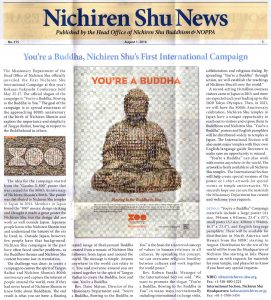
And it is that universal quality of Bodhisattva Never-Despising’s practice that the Missionary Department of Nichiren Shu is tapping into as it seeks ways to honor the upcoming 800th anniversary of Nichiren Shonin’s birth in 2021. Here’s the text of an article that appeared in the Aug. 1, 2016, issue of Nichiren Shu News:

Nichiren Shu News, Aug. 1, 2016
The Missionary Department of the Head Office of Nichiren Shu officially unveiled the first Nichiren Shu International Campaign at this year’s Kokusai Fukyoshi Conference held May 25-27. The official slogan of the campaign is “You’re a Buddha, Bowing to the Buddha in You.” The goal of the campaign is to spread awareness of the approaching 800th anniversary of the birth of Nichiren Shonin and explain the importance and simplicity of Tangyo Raihai, bowing in respect to the Buddhahood in others.

The idea for the campaign started from the “Gassho X 800” poster that was created for the 800th Anniversary of Nichiren Shonin’s Birth. The poster was distributed tlo Nichiren Shu temples in Japan in 2014. Members in Japan found the “800” mosaic design striking. and thought it made a great poster for Nichiren Shu, but the design did not work as well outside Japan. Japanese people know who Nichiren Shonin was and understand the history of the era he lived in. Outside Japan, however, few people have that background. Nichiren Shu campaigns in the past have often faced similar problems, as the Buddhist themes and Nichiren Shu content become lost in translation.

The challenge was clear: to create a campaign to convey the spirit of Tangyo Raihai and Nichiren Shonin’s 800th anniversary and capture the interest of people around the world, even if they had never heard of Nichiren Shonin or knew little about Buddhism. The end result is what you see here: a floating seated image of Shakyamuni Buddha created from a mosaic of Nichiren Shu followers from Japan and around the world. The message is simple. Anyone anywhere in the world can relate to it. You and everyone around you are joined together in the spirit of Tangyo Raihai to create the Buddha, here and now. You’re a Buddha.

Rev. Daiei Matsui, Director of the Missionary Department said, ” ‘You’re a Buddha, Bowing to the Buddha in You’ is the basis for a universal concept of values in human relations in all cultures. By spreading this concept, we can overcome religious hostility between cultures and work together for world peace.”

Rev. Kobun Sasaki, Manager of the International Section, said, “We want to promote the logan ‘You’re a Buddha, Bowing to the Buddha in You’ in many ways internationally, including international exchange visits, collaboration and religious dialog. By spreading “You’re a Buddha” through action, we will establish the teachings of Nichiren Shu all over the world.”

A record-setting 19 million overseas visitors came to Japan in 2015, and more are expected each year leading up to the 2020 Tokyo Olympics. Then, in 2021, we will have the 800th Anniversary celebration. Nichiren Shu temples in Japan have a unique opportunity to reach out to visitors and expose them to Buddhism and Nichiren Shu. “You’re a Buddha” posters and English pamphlets will be distributed widely to temples in Japan. The International Section will also assist major temples with their own English-language guide literature to make sure no opportunity is missed.

“You’re a Buddha” can also work with events anywhere in the world. The artwork is freely available to all Nichiren Shu temples. The International Section will help create special versions of the poster or t-shirt artwork for special events or temple anniversaries. We sincerely hope you can use the materials the Missionary Department has created and welcome your requests.

As my contribution, I took artwork on the Nichiren Shu website in Japan and created this animation:

Day 24

Day 24 concludes Chapter 19, The Merits of the Teacher of the Dharma and closes the Sixth Volume of the Sutra of the Lotus Flower of the Wonderful Dharma.

Those good men or women who keep, read, recite, expound or copy this sutra, we are told in Chapter 19, will receive eight hundred merits of the eye, twelve hundred merits of the ear, eight hundred merits of the nose, twelve hundred merits of the tongue, eight hundred merits of the body, and twelve hundred merits of the mind. And since I limit myself to a single topic each time through I can move on to the merits of the body after having covered the merits of the tongue and the merits of the nose.

The Buddha explains to Constant-Endeavor Bodhisattva:

The good men or women who keep, read, recite, expound or copy this sutra, will be able to obtain eight hundred merits of the body. Their bodies will become as pure as lapis lazuli. All living beings will wish to see them. Some of the living beings in the one thousand million Sumeru-worlds are just born or have just died. All living beings are either noble or humble. They are either handsome or ugly. They are destined to be reborn either in a better region or in a worse region. All of them will be reflected on the pure bodies [of the good men or women]. The Surrounding Iron Mountains, the Great Surrounding Iron Mountains, Mt. Meru, Mt. Maha-Meru, and the other great mountains, and the living beings in those mountains also will be reflected on their bodies. [All the six regions] down to the Avrci Hell and up to the Highest Heaven and the living beings therein also will be reflected on their bodies. The Sravakas, Pratyekabuddhas, and Bodhisattvas as well as the Buddhas who are expounding the Dharma, also will show their reflections on their bodies.

The Daily Dharma of Dec. 12, 2015, covered this portion of Chapter 19 with this explanation:

All living beings are either noble or humble. They are either handsome or ugly. They are destined to be reborn either in a better region or in a worse region. All of them will be reflected on the pure bodies [of the good men or women].

The Buddha makes this declaration to Constant-Endeavor Bodhisattva in Chapter Nineteen of the Lotus Sūtra, describing those who keep the Lotus Sūtra. Much of what we see in the world is a projection of our own biases and ignorance. We see things for what we want them to be rather than what they are. We classify the people in our lives as friends, enemies or strangers not because of their inherent qualities, but because of how they treat us. When we act for the benefit of others rather than our own gratification, we are showing them their true qualities. We let them see themselves for what they are.

The Daily Dharma is produced by the Lexington Nichiren Buddhist Community. To subscribe to the daily emails, visit zenzaizenzai.com

Day 23

Day 23 covers all of Chapter 18, The Merits of a Person Who Rejoices at Hearing This Sutra, and opens Chapter 19, The Merits of the Teacher of the Dharma.

Last month dealt with the example of the propagation of the Lotus Sutra contained in the story of the 50th “good man or woman who rejoices at hearing this sutra.”

In the Liturgy of Nichiren Shu booklet published by the Nichiren Buddhist International Center in Hayward, Calif., is an excerpt from the Gassui Gosho (Letter on Menstruation):

You may chant the whole twenty eight chapters, one chapter, one paragraph, one sentence or even one character, of the Lotus Sutra a day. Or, you may chant the daimoku, “Namu Myoho Renge Kyo,” just once in a day or once in your whole life. Even if you may never chant the daimoku yourself, you may rejoice at hearing others chant it just once in your whole life. Or you may rejoice with others who rejoice at hearing a voice chanting the daimoku. The joy of the daimoku chanting transmitted 50 times this way from person to person, will grow weaker steadily until in tho last fiftieth person it will be as uncertain as the mind of a two or three year old baby or as unpredictable as a horse or a cow, which cannot tell the difference between head and tail. Nevertheless, the merit of such people is one hundred thousand billion times greater than that of those whose wisdom is as great as Sariputra, Maudgalyayana, Manjusri and Maitreya. …

So it is with good man or woman who rejoices at hearing this daimoku.

Day 22

Day 22 covers all of Chapter 17, The Variety of Merits.

Yesterday discussed “the real and unreal Triple World” and I’ll continue with that theme today.

Ajita! The good men or women who hear of my longevity of which I told you, and understand it by firm faith, will be able to see that I am expounding the Dharma on Mt. Grdhrakuta, surrounded by great Bodhisattvas and Sravakas. They also will be able to see that the ground of this Saha-World is made of lapis lazuli, that the ground is even, that the eight roads are marked off by ropes of jambunada gold, that the jeweled trees are standing in lines, and that the magnificent buildings are made of treasures. They also will be able to see that the Bodhisaltvas are living in those buildings. They will be able to see all this because, know this, they have already understood [my longevity] by firm faith.

The Daily Dharma of Sept. 17, 2015, offers this on the topic:

The Buddha gives this explanation to Maitreya Bodhisattva, whom he calls Ajita – Invincible, in Chapter Seventeen of the Lotus Sūtra. We can hear this explanation as a promise of some great otherworldly vision which will be revealed to us if our faith is strong enough. We can also hear it as a promise that we will learn to deny that all the terrible things in the world as as bad as we think. But when we remember the Buddha telling us, “I do not see the world as others do,” then we realize that our faith brings us to the Buddha’s own mind, where we can accept this frightening and dangerous world for what it is, and work to make it better for all beings.

The Daily Dharma is produced by the Lexington Nichiren Buddhist Community. To subscribe to the daily emails, visit zenzaizenzai.com

Day 21

Day 21 covers all of Chapter 16, The Duration of the Life of the Tathāgata.

Last month, I introduced the underlying theme of this chapter – and really all of the Lotus Sutra – the need to “Understand my sincere and infallible words by faith.”

The real and unreal Triple World is a place to start.

Good men! All the sutras that I expounded [hitherto] were for the purpose of saving all living beings. I told the stories of my previous lives [in some sutras,] and the stories of the previous lives of other Buddhas [in other sutras]. I showed my replicas [in some sutras,] and my transformations [in other sutras]. I described my deeds [in some sutras,] and the deeds of others [in other sutras]. All that I say is true, not false, because I see the triple world as it is. I see that the triple world is the world in which the living beings have neither birth nor death, that is to say, do not appear or disappear, that it is the world in which I do not appear or from which I do not disappear, that it is not real or unreal, and that it is not as it seems or as it does not seem. I do not see the triple world in the same way as [the living beings of] the triple world do. I see all this clearly and infallibly. The living beings are various in their natures, desires, deeds, thoughts and opinions. Therefore, I expounded the dharma with various stories of previous lives, with various parables, similes and discourses, in order to cause all living beings to plant the roots of good. I have never stopped doing what I should do. As I said before, it is very long since I became the Buddha. The duration of my life is innumerable, asamkhya kalpas. I am always here. I shall never pass away.

Each afternoon I recite a prayer that includes:

May I realize this world is the Eternal Buddha’s Pure Land!

The difficulty of doing this was underscored last month in a quote from Doctrines of Nichiren (1893):

Now the real state of visible things is one of emptiness and relativity. All phenomena, mental and material, in all times and spaces, are to be conceived of as existing subjectively in the consciousness of every individual, as his own physical and mental states, and thus only; so that the differences and varieties which distinguish things from one another must be regarded as purely imaginary and misleading, without any foundation in fact. Grasp this, and you have the Truth, and everything will then appear to you as it is in reality; you will see it as it is in itself.
Doctrines of Nichiren (1893)

Day 20

Day 20 completes Chapter 15, The Appearance of Bodhisattvas from Underground, and concludes the Fifth Volume of the Sutra of the Lotus Flower of the Wonderful Dharma.

As the 20th day opens the Buddha is responding to the leaders of the Bodhisattvas who arose from the underground. They had asked:

World-Honored One, are you peaceful?
Are you in good health?
Are you not tired
With teaching the living beings?
Are they ready
To receive your teaching,
Or are they not?
Do they not fatigue you?

And Sakyamuni’s response:

Truly, truly good men! I am peaceful. I am in good health. The living beings are ready to be saved. They do not fatigue me because I already taught them in their consecutive previous existences, and also because they have already honored the past Buddhas respectfully and planted the roots of good. As soon as they saw me and heard my teachings, they received my teachings by faith and entered into the wisdom of the Tathagata, except those who had previously studied and practiced the teachings of the Lesser Vehicle. Now I am causing [the followers of the Lesser Vehicle] to hear this sutra and to enter into the wisdom of the Buddha.

Thereupon the [four] great Bodhisattvas sang in gathas:

The living beings are ready to be saved
Because in their previous existence
They already asked the [past] Buddhas
About their profound wisdom,
And having heard about it, understood it by faith.
We rejoice at seeing you.

The Daily Dharma from April 3, 2015, addresses this section:

Truly, truly good men! I am peaceful. I am in good health. The living beings are ready to be saved. They do not fatigue me because I already taught them in their consecutive previous existences, and also because they have already honored the past Buddhas respectfully and planted the roots of good.

The Buddha makes this proclamation to the leaders of the Bodhisattvas from Underground in Chapter Fifteen of the Lotus Sūtra. These Bodhisattvas appeared when the Buddha asked who would teach the Lotus Sūtra after the Buddha’s death, and asked about the Buddha’s health and whether those he was teaching could keep what he provided for them. The Buddha assures us not only of the certainty of our future enlightenment, but that for us to receive his teaching, there was an earlier time, which we may have forgotten, when we met him. This awareness of our future and our past helps us to see our place in the world and maintain our determination to benefit all beings.

The Daily Dharma is produced by the Lexington Nichiren Buddhist Community. To subscribe to the daily emails, visit zenzaizenzai.com

It’s deja vu all over again.

Day 19

Day 19 concludes Chapter 14, Peaceful Practices, and begins Chapter 15, The Appearance of Bodhisattvas from Underground.

Having covered the third set of peaceful practices yesterday, I’m going to finish with the fourth set of peaceful practices today.

Again, Manjusri! A Bodhisattva-mahasattva who keeps this Sutra of the Lotus Flower of the Wonderful Dharma in the latter days after [my extinction] when the teachings are about to be destroyed, should have great loving-kindness towards laymen and monks, and great compassion towards those who are not Bodhisattvas. He should think: ‘They do not know that the Tathagata expounded expedient teachings according to the capacities of all living beings. They do not hear, know or notice it, or ask a question about it or believe or understand it. Although they do not ask a question about this sutra, or believe or understand it, I will lead them and cause them, wherever they may be, to understand the Dharma by my supernatural powers and by the power of my wisdom when I attain Anuttara-samyak-sarpbodhi.’

“Manjusri! A Bodhisattva-mahasattva who performs this fourth set of [peaceful] practices after my extinction, will be able to expound the Dharma flawlessly. Bhikss, bhiksunis, upasakas, upasikas, kings, princes, ministers, common people, brahmanas and householders will make offerings to him, honor him, respect him, and praise him. The gods in the sky will always serve him in order to hear the Dharma from him. When someone comes to his abode located in a village, in a city, in a retired place or in a forest, and wishes to ask him a question, the gods will protect him day and night for the sake of the Dharma so that the hearer may rejoice because this sutra was, is, and will be protected by the supernatural powers of the past, present and future Buddhas.

In discussing this fourth set of peaceful practices, the Daily Dharma of May 19, 2016, says:

The Buddha gives this explanation to Mañjuśrī Bodhisattva in Chapter Fourteen of the Lotus Sūtra. Until we reach enlightenment, we may not be able to reach all beings. Rather than blaming them for not having the capacity to learn from us, or blaming ourselves for not being skillful enough to reach them, the Buddha reminds us to be patient and realize there is no hurry to being free from our delusions.

The Daily Dharma is produced by the Lexington Nichiren Buddhist Community. To subscribe to the daily emails, visit zenzaizenzai.com

Next month it will be time to discuss the difficulty in hearing this sutra and Parable of the Priceless Gem in the Top-Knot.