Twice each year at the Spring and Winter Equinox Nichiren Buddhists are asked to “strive to consciously reflect upon ourselves and our deeds. Have our words hurt anyone around us? Are our actions serving ourselves more than others? How can we be productive for the sake of society? Are our decisions creating a world of strife rather than peace? Does our lifestyle encroach upon the liberty or happiness of others? Are we aware of how our actions may adversely affect our environment – the soil, air, plants, insects, fish, birds, and animals? In sum, the basic question from a Buddhist point of view is whether or not we are following the right path.” (Higan brochure)
Specifically, Nichiren Buddhists are asked to reflect on the six pāramitās of Bodhisattva practice for three days before the equinox and for three days after.
This year for Higan week, which begins tomorrow, I’m going to post content taken from Chinese Master Hsuan Hua’s commentary on the Lotus Sutra and specifically from Chapter 1, Introductory.
The subject of Bodhisattva Practices and the Six Pāramitās comes up after the Buddha emitted a ray of light from the white curls between his eyebrows, and illumined all the corners of eighteen thousand worlds in the east and prompting Maitreya Bodhisattva to ask what this omen meant.
Hsuan Hua’s commentary includes on outline of the Lotus Sutra created by Ouyi Zhixu (1599-1655 CE).
H5. Asking About Cultivation Of Bodhisattva Practices In Other Lands
I1. Asking In General
I2. Asking About The Six Pāramitās In Sequence
J1. Question About Giving
J2. Question About Upholding Precepts
J3. Question About Patience
J4. Question About Vigor
J5. Question About Dhyāna
J6. Question About Wisdom
I3. Asking About The Six Pāramitās Out Of Sequence
I’m going to post content from “Asking About The Six Pāramitās In Sequence” beginning tomorrow and “Asking About The Six Pāramitās Out Of Sequence” in September for the Fall Equinox.
“Those who keep Myōhō Renge Kyō also will be able to recognize the gods [and things] in heaven by smell while they are staying [in the world of men]. They will be able to recognize the scents of the pārijātaka-trees, kovidāra-trees, mandārava-flowers, mahā-mandārava-flowers, mañjūṣaka-flowers, mahā-mañjūṣaka-flowers [in heaven]; the powdered incense of candana and aloes, the scents of other flowers, and the mixture of these scents in heaven without fail. They will be able to recognize the gods by smell. They will be able to recognize from afar the scent that Śakra-Devānām-Indra gives forth when he satisfies his five desires and enjoys himself in his excellent palace, or when he expounds the Dharma to the Trāyastriṃs̒a Gods at the wonderful hall of the Dharma, or when he plays in the gardens.
Although the world in which he appears will not be an evil one, that Buddha will expound the teaching of the Three Vehicles according to his original vow.
The teaching of the three vehicles was designed originally for the impure ages. Now that the lands have been purified, there is no need for the three. But why does [the Buddha] speak of the three? He wants to show that the three are identical with the One; there is no separate “three” anymore. What he formerly understood as three is the One; hence, former vow. He did not really mean to preach the three kinds of transformative teaching as such.
My body is pure and indestructible.
I will appear in any of many thousands of billions of worlds
During many hundreds of millions of kalpas,
And expound Myōhō Renge Kyō to the living beings.
Under two billion Buddhas in the past, I always taught you in order to cause you to attain unsurpassed enlightenment. You studied under me in the long night. I led you with expedients. Therefore, you have your present life under me.
“Śāriputra! I caused you to aspire for the enlightenment of the Buddha in your previous existence. You forgot all this, and thought that you had already attained extinction. In order to cause you to remember the Way you practiced under your original vow, I now expound to the Śrāvakas this sūtra of the Great Vehicle called the ‘Lotus Flower of the Wonderful Dharma, the Dharma for Bodhisattvas, the Dharma Upheld by the Buddhas.’
Formerly [Śāriputra wrongly assumed] with delight that he was enlightened, but [the Buddha], contradicting him, admonished him to drive himself to achieve it. The fact that the Lesser Vehicle had no great hope in earlier times, but now [the Buddha] grants the group a prophecy, implies that there is no “lesser” in li. The [Buddha’s] motive fog reviewing the practices [of Śāriputra] in the remote past is to show that it was [Śāriputra’s own] merits that invited such prophecies, but he did not mention this, because he had his mind set on secretly directing the collective sentiment of the congregation at the time.
“Great-Power-Obtainer, know this! Myōhō Renge Kyō benefits Bodhisattva-mahāsattvas, and causes them to attain Anuttara-samyak-saṃbodhi. Therefore, they should keep, read, recite, expound and copy Myōhō Renge Kyō after my extinction.”
Thereupon the Buddha said to Śāriputra: “Now I will tell you in the presence of this great multitude including gods, men, śramaṇas, and brāhmanas.”
This is the second segment. The gist of this part is that because there never has been the path of the Lesser Vehicle (Hinayāna) it turns out that [the Lesser] merely has been pointing toward the Buddha [path]. The enlightenment Body-son [Śāriputra] has built up was so profoundly manifest that [the Buddha] granted him a prophecy of his enlightenment. The story of the prophecy should not be held to be true in a real sense. [It was designed] merely for leading forward those who aspired to the prophecy.
Thereupon the Buddha said to Constant-Endeavor Bodhisattva-Mahāsattva:
“The good men or women who keep, read, recite, expound or copy Myōhō Renge Kyō, will be able to obtain eight hundred merits of the eye, twelve hundred merits of the ear, eight hundred merits of the nose, twelve hundred merits of the tongue, eight hundred merits of the body, and twelve hundred merits of the mind. They will be able to adorn and purify their six sense-organs with these merits.
I sat alone under a tree or walked about mountains and forests, thinking, ‘We [and the Bodhisattvas] entered the same world of the Dharma. Why does the Tathāgata save us only by the teachings of the Lesser Vehicle?’
Now I understand that the fault was on our side, not on yours…
The reason why he, upon hearing, was enlightened is because since earlier days he had had this thought every moment: “We will all equally enter into the Dharmahood; how could the Thus Come One limit it just to the Lesser [Vehicle] (Hinayāna)? Yet it is our own [fault] that we have taken merely the Lesser. Why did the Buddha do [it] this way? It is because [the Buddha] preached by means of a gradual process, namely, the Lesser first and the Greater later, certainly in that order [but not vice versa]. If I had waited for him to preach the Greater, I would have certainly obtained the Greater. But straight upon hearing [the Buddha] preach the Lesser, [I] immediately thought this to be the real Lesser. Having befriended my own [self-]interest, and ‘basing conclusions on it,’ [I] have always since been vexed at my own fault. Now hearing that they are one, and that we can enter into the Dharmahood without differentiating, [I] became awakened right away.” The intention of [the Buddha] himself was not in the Lesser; the disciples were thus vexed at their own fault. Now [Śāriputra] being awakened in such a way, his joy must be boundless. To wait also means “[We] should have waited.”
I’ve completed reading aloud the Buddhist Text Translation Society’s translation of the Lotus Sutra as part of my daily practice. While reading the sutra I was comparing it with Senchu Murano’s translation and the other English translations I’ve used in my daily practice.
Overall, this is an excellent translation and the quality of the printing – it was printed in Taiwan – puts my other translations to shame.
That’s not to say it is without its faults.
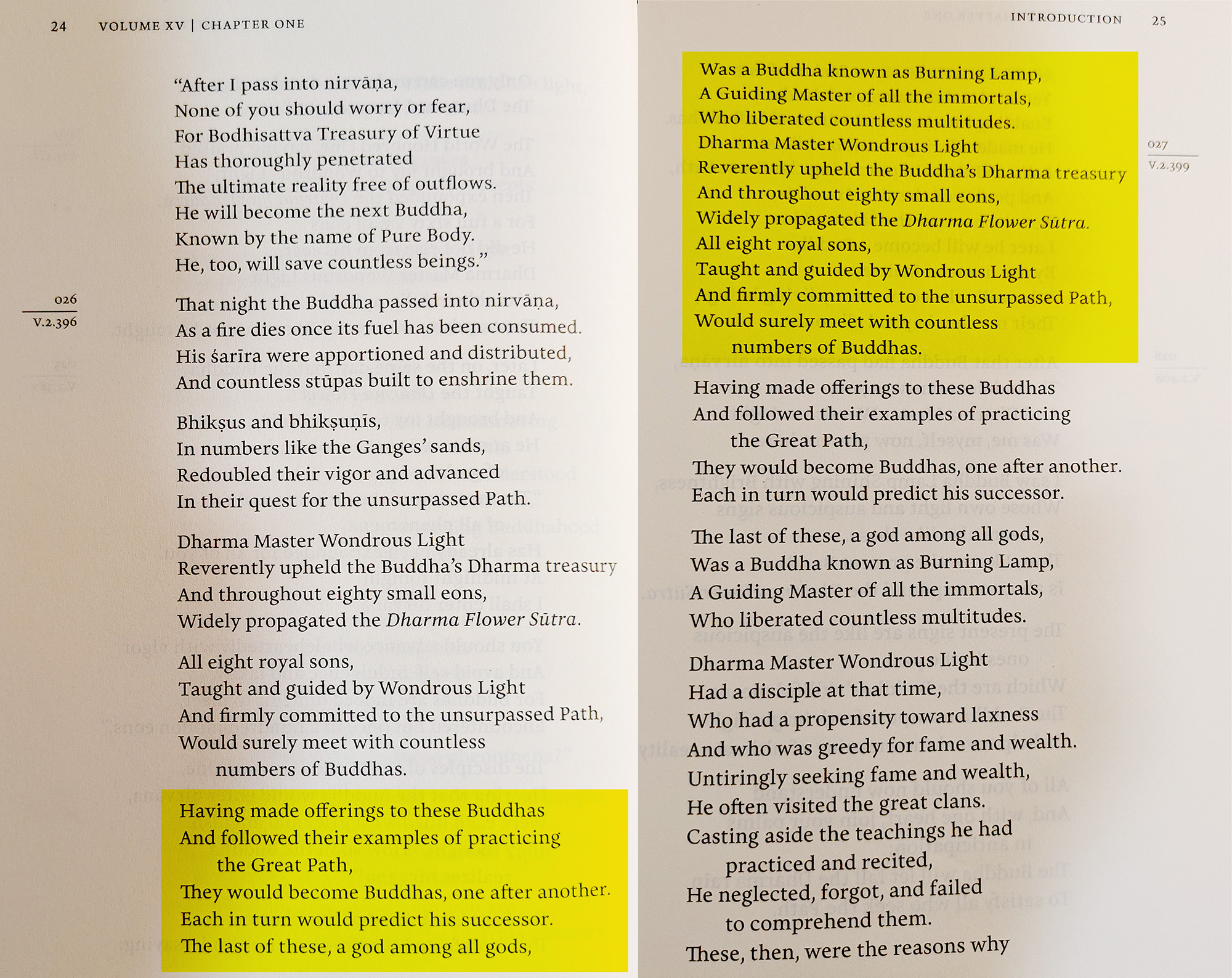
In Chapter 1, Introduction, pages 24 and 25, where Mañjuśrī is describing how Dharma Master Wondrous Light taught the eight sons of the Buddha Lamp Shining with the Brightness of the Sun and the Moon (Sun-Moon-Light Buddha in Murano’s translation) a block of 18 lines are duplicated. This is by far the most significant error in this translation.
I found simple typos on page 376:
“To those who can be saved by a mighty heavenly general, she appears as a might heavenly general and teaches them the Dharma.”
And on page 379:
If you are cast adrift upon an immense ocean
And subject to the perils of dragons, fish, and ghosts,
Invoke the powers of Guan Yin: Amidt the waves and breakers, you will not drown.
These are trivial, but as a retired newspaper copy editor I feel compelled to point them out. (Feel free to criticize me for the many, many typos I allow in my own writing!)
A more significant error appears in Chapter 4, Faith and Understanding, when the rich man wants to get close to his son, who has been convinced to come work for him. On page 107 it reads:
“Later, on another day, the elder looked through a window and saw his son at a distance. His son was feeble, emaciated, haggard, and soiled with dung, dirt, and filth. The elder removed his jeweled necklace, his soft, fine upper garments, and his ornaments, and put on a coarse, torn, and grease-stained robe. Smearing himself with dirt and holding a dung shovel in his right hand, he looked frightened.”
The word should be frightful or frightening, not frightened. In Senchu Murano’s translation we’re told:
He looked fearful. He [came to the workers and] said, ‘Work hard! Do not be lazy!’
The BTK English Tripiṭaka translation (PDF), the Rissho Kosei-kai modern translation and Leon Hurvitz’s translation (PDF) all agree that the rich man, dressed in work clothes, looked frightful or commanding.
In other cases, what I questioned as errors turned out to be discrepancies in Murano’s translation. I’ve read the Lotus Sutra more than 100 times in my daily practice and Murano’s translation is the one with which I’m most familiar.
For example, at the start of Chapter 23, The Previous Life of Medicine-King Bodhisattva, Murano has:
“World-Honored One! Why does Medicine-King Bodhisattva walk about this Sahā-World? World-Honored One! This Medicine-King Bodhisattva will have to practice hundreds of thousands of billions of nayutas of austerities in this world.” Note that Medicine-King would have to practice austerities.
I stumbled when I read the Buddhist Text Translation Society’s version in The Account of Bodhisattva Medicine King’s Past Lives on page 351:
“At that time Bodhisattva Constellation King Flowers said to the Buddha, “World Honored One, how is it that Bodhisattva Medicine King travels throughout the Sahā world? World Honored One, Bodhisattva Medicine King has undertaken several billions of koṭis of nayutas of ascetic practices that are difficult to practice.”
In this case, Murano is the outlier. The BTK English Tripiṭaka translation, the Rissho Kosei-kai translation and Leon Hurvitz’s translation all agree that Medicine-King has already accomplished these ascetic practices.
There was another place where Murano’s translation was problematic. In Chapter 26, Dhārānis, after Vaiśravaṇa offers his dhārānis, he says:
I also will protect the person who keeps this sūtra so that he may have no trouble within a hundred yojanas’ distance [from here].”
The parenthetical “from here” suggests that Vaiśravaṇa is promising people protection around a particular location “here.”
The Buddhist Text Translation Society has Vaiśravaṇa promise on page 387:
I shall also personally support and protect those who uphold this sūtra so that the area surrounding them for a hundred yojanas will be free of misfortunes and peril.
The other translations all agree that the area of protection encircles the keeper of the Lotus Sutra, not a particular place.
In several locations, the differences between the Buddhist Text Translation Society’s translation and the other English translations appear to be the result of coping with ambiguities in Kumarajiva’s Chinese translation.
Consider Chapter 15, Emerging from the Earth. In describing the behavior of the bodhisattvas who have emerged from underground, we are told that they went up to Many Treasure’s stupa in the sky, paid their respects to the two Buddhas seated side by side, and then went to the ground and paid homage to the countless replicas of Śākyamuni Buddha seated on lion thrones beneath jeweled trees.
The Buddhist Text Translation Society offers this on pages 266-267:
“They went on to where all the Buddhas were seated on lion thrones beneath jeweled trees, bowed to them, circumambulated them three times to the right with their palms joined together reverently, and praised them in various ways used by Bodhisattvas. Afterward, they withdrew to one side, gazing joyfully and respectfully at the two World Honored Ones.
“From the time the Bodhisattvas Mahāsattvas first emerged from the earth, a period of fifty small eons elapsed while they praised the Buddhas in various ways used by Bodhisattvas. During that period, Śākyamuni Buddha remained seated in silence, as did the fourfold assembly. By virtue of the Buddha’s spiritual power, the great assembly thought that the period of fifty small eons was only half a day long. At that time the fourfold assembly, also through the Buddha’s spiritual power, saw all the Bodhisattvas filling up the space of countless billions of koṭis of lands.”
Did these bodhisattvas stay on the ground or did they rejoin the congregation suspended in the air? The answer is found on page 272, where we’re told:
“At that time all the transformation bodies of Śākyamuni Buddha, having come from countless tens of millions of koṭis of lands in various directions, were sitting in lotus posture on lion thrones beneath jeweled trees in each of the eight directions. The attendants of these Buddhas, seeing this great multitude of Bodhisattvas emerging from the earth and hovering in space in the four directions of the trichiliocosm, each said to his Buddha, “World Honored One, where has this multitude of countless, limitless asaṃkhyeyas of Bodhisattvas come from?”
Murano’s translation takes care of this confusion with a parenthetical insertion. After praising the replicas of Śākyamuni Buddha:
“Then they [returned to the sky,] stood to one side, and looked up at the two World-Honored ones with joy.”
Murano then says later:
“Also by the supernatural powers of the Buddha, the four kinds of devotees were able to see that the skies of many hundreds of thousands of billions of worlds were filled with those Bodhisattvas.”
The BTK translation, the Rissho Kosei-kai translation and Leon Hurvitz’s translation each have the Bodhisattvas taking their places to one side and gazing up at the two world-honored ones. None takes Murano’s parenthetical route of specifically putting the bodhisattvas in sky with Many Treasures’ stupa. However, there’s disagreement with whether the bodhisattvas were “filling up the space of countless billions of koṭis of lands” or in the air.
The BDK translation:
Then, through the transcendent powers of the Buddha, the fourfold assemblies also saw the bodhisattvas filling the air throughout immeasurable hundreds of thousands of myriads of koṭis of lands.
Leon Hurvitz’s translation:
At that time, the fourfold assembly, thanks to the Buddha’s supernatural power, also saw bodhisattvas fill the open air of incalculable hundreds of thousands of myriads of millions of lands.
Only the Rissho Kosei-kai translation agrees with the Buddhist Text Translation Society:
At that time, the four groups, thanks to the transcendent powers of the Buddha, could see these bodhisattvas entirely filling the space of immeasurable hundreds of thousands of millions of domains.
There were a couple of places where I questioned the accuracy of what I read only to discover that my recollection was faulty. A good example of this occurred in Chapter 3, A Parable, where the Buddha lists the three vehicles as the vehicles of the Śrāvakas, the Pratyekabuddhas, and the Buddha. I was certain that the Boddhisattva Vehicle was the third vehicle. I was wrong. All of the translations of Chapter 3, even Murano, list the three vehicles as the Śrāvaka-Vehicle, Pratyekabuddha-Vehicle, and Buddha-Vehicle.
The Buddhist Text Translation Society was originally established by Chinese Master Hsuan Hua. This Chinese origin appears to have influenced the choice of words in several places.
In the Parable of the Burning House in Chapter 3, Murano has:
Mountain spirits, water spirits,
Yakṣas and other demons
Lived here and there.
They fed on people and poisonous vermin.
Hurvitz has “ghosts and demons,” the BDK translation has “Ogres of the mountains and valleys” and the modern Rissho Kosei-kai offers “goblins and ogres.”
On page 80 the Buddhist Text Translation Society has:
Chi, mei, and wangliang
Were everywhere.
Yakṣas and evil ghosts
Were eating human flesh.
After a little Googling we find “Chi, mei, and wangliang” are demons of the mountains and forests (chimei) and demons of the rivers and marshes (wangliang).
The Buddhist Text Translation Society also assumes more of its English readers than other translators.
In describing in Chapter 17, The Discourse on Merit and Virtue, the merits received from understanding the Buddha’s life span, the Buddhist Text Translation Society has on pages 291-292:
“Furthermore, Bodhisattvas Mahāsattvas as many as the dust motes in a single chiliocosm attained billions of koṭis of dhārāṇis of countless revolutions. Furthermore, Bodhisattvas Mahāsattvas as many as the dust motes in a trichiliocosm became capable of turning the irreversible Dharma wheel.
“Furthermore, Bodhisattvas Mahāsattvas as many as the dust motes in a medium chiliocosm became capable of turning the pure Dharma wheel. Furthermore, Bodhisattvas Mahāsattvas as many as the dust motes in a small chiliocosm were destined to attain Anuttara-samyaksaṃbodhi after eight lifetimes.
“Furthermore, Bodhisattvas Mahāsattvas as many as the dust motes in four world systems were destined to attain Anuttara-samyaksaṃbodhi after four lifetimes. Furthermore, Bodhisattvas Mahāsattvas as many as the dust motes in three world systems were destined to attain Anuttara-samyaksaṃbodhi after three lifetimes.
Chiliocosm, trichiliocosm?
Consider Murano’s translation:
Another group of Bodhisattva-mahāsattvas as many as the particles of earth of a Sumeru world obtained the dhārāṇis by which they could memorize many hundreds of thousands of billions of repetitions of teachings. Bodhisattva-mahāsattvas as many as the particles of earth of one thousand million Sumeru-worlds obtained the faculty of turning the irrevocable wheel of the Dharma. Bodhisattva-mahāsattvas as many as the particles of earth of one million Sumeru-worlds obtained the faculty of turning the wheel of the pure Dharma. Bodhisattva-mahāsattvas as many as the particles of earth of one thousand Sumeru-worlds obtained the faculty of attaining Anuttara-samyak-saṃbodhi after eight rebirths. Bodhisattva-mahāsattvas four times the number of the particles of earth of the four continents obtained the faculty of attaining Anuttara-samyak-saṃbodhi after four rebirths.
None of the other translations use chiliocosm or trichiliocosm. In place of trichiliocosm, Hurvitz uses “thousand millionfold world” and Rissho Kosai-kai offers “three-thousand-great-thousandfold world.” The closest to trichiliocosm is the BDK translation, which offers “the great manifold cosmos.”
There’s another example of this in Chapter 19, The Merits of the Teacher of the Dharma. In detailing the twelve hundred merits of the tongue, Murano has:
In order to hear the Dharma, dragons, dragons’ daughters, gandharvas, gandharvas’ daughters, asuras, asuras’ daughters, garuḍas, garuḍas’ daughters, kiṃnaras, kiṃnaras’ daughters, mahoragas, and mahoragas’ daughters also will come to them, respect them, and make offerings to them.
The Buddhist Text Translation Society offers on page 326:
“All the dragons, female dragons, yakṣas, yakṣniṇīs, gandharvas, female gandharvas, asuras, female asuras, garuḍas, female garuḍas, kiṃnaras, female kiṃnaras, mahoragas, and female mahoragas will all draw near to these Dharma teachers in order to hear the Dharma, and will reverently make offerings to them.
“Yakṣniṇīs” is a typo so rare that Google has no record of anyone using the word. Yakṣiṇī are female Yakṣa.
Hurvitz and the BDK translation agree with Murano and use daughters. Standing alone is Rissho Kosei-kai, which offers “Male and female dragons, male and female yakshas…” (See this discussion of Rissho Kosei-kai’s effort to edit out “potentially discriminatory language and ideas” in order to create its Modern translation.)
Even more odd was the decision to use the name Sugatacetana in place of Thinking of Buddha in Chapter 20, Bodhisattva Never Slighting.
In listing who in the present congregation formerly abused the Bodhisattva Never Slighting, the Buddhist Text Translation Society has on page 337:
“Great Strength, what do you think? Could the fourfold assembly who at that time constantly despised this Bodhisattva have been anyone else? They were Bodhisattva Bhadrapāla and the five hundred Bodhisattvas now in this assembly; Bhikṣu Lion Moon and the five hundred other bhikṣus; and Sugatacetana and the five hundred upāsakās.”
Murano and Rissho Kosei-kai both use the name Thinking of Buddha instead of Sugatacetana. Hurvitz uses “Thoughtful of the Buddha” and then in brackets ‘[Sugatachetanā, “she who is conscious of the Well Gone One”].’ Only the BTK translation uses Sugatachetanā and they have Siṃhacandrā in place of Lion Moon. (One of the problems with using the BTK translation in my daily practice of reading aloud is its failure to translate into English any of the Sanskrit names.)
The Buddhist Text Translation Society’s The Wonderful Dharma Lotus Sutra is actually volume 15 of Chinese Master Hsuan Hua’s commentary of the Lotus Sutra. I’m currently making my way through the 14 volumes of commentary and finding it fascinating.
Postscript:
Rissho Kosei-kai’s “The Threefold Lotus sutra: A Modern Translation for Contemporary Readers” was translated by Michio Shinozaki, Brook A. Ziporyn and David C. Earhart. The BTK English Tripiṭaka edition was translated by Tsugunari Kubo and Akira Yuyama.
The Buddhist Text Translation Society’s “The Wonderful Dharma Lotus Sutra: Volume XV” was translated by The International Institute for The Translation of Buddhist Texts. There’s not a lot of information about the institute online. It doesn’t appear to have a website of its own. The institute was founded in 1973 by Chinese Master Hsuan Hua. The institute is currently associated with or perhaps a part of the Dharma Realm Buddhist University. Bhikshuni Heng Yi, an assistant professor at DRBU, has been the director of the International Institute for the Translation of Buddhist Texts (IITBT) since 2015.