
Grand Master Miao-lê defines in his Annotations on the Words and Phrases of the Lotus Sūtra (Fahua wén-chü-chi) that all the śrāvaka and pratyekabuddha who attached themselves to Hinayana enlightenment, and bodhisattvas who believe in the Buddha’s attaining enlightenment in this world without believing in the eternal life of the Buddha are those who hate the Lotus Sūtra. He also declares that those who do not want to listen to, believe in or accept the Lotus Sūtra are “haters ” of the Lotus Sūtra even if they do not slander it publicly.
As I contemplate the state of affairs today after the death of the Buddha against that in His lifetime, scholars of various sects today are all like heretics during the days of the Buddha. They called the Buddha the worst, and it fits me, Nichiren, today. “Evil people in the world all coming together to join His group” fits Nichiren’s disciples. Misunderstanding the teachings expounded by the past Buddhas in the previous lives, heretics harbored evil thoughts, hated and persecuted Śākyamuni Buddha in this world. Scholars of various Buddhists sects today are acting similarly to those heretics in the past. In a word, they misunderstand what the Buddha preached and this misunderstanding leads them to hold wicked ideas. It is like a dizzy man seeing a great mountain turning around.
Teradomari Gosho, A Letter from Teradomari, Writings of Nichiren Shōnin, Doctrine 2, Page 8-9
All posts by John Hughes
Daily Dharma for July 3, 2026
Show Gemini's thinking
Gemini Thinking
Conceptual Summary
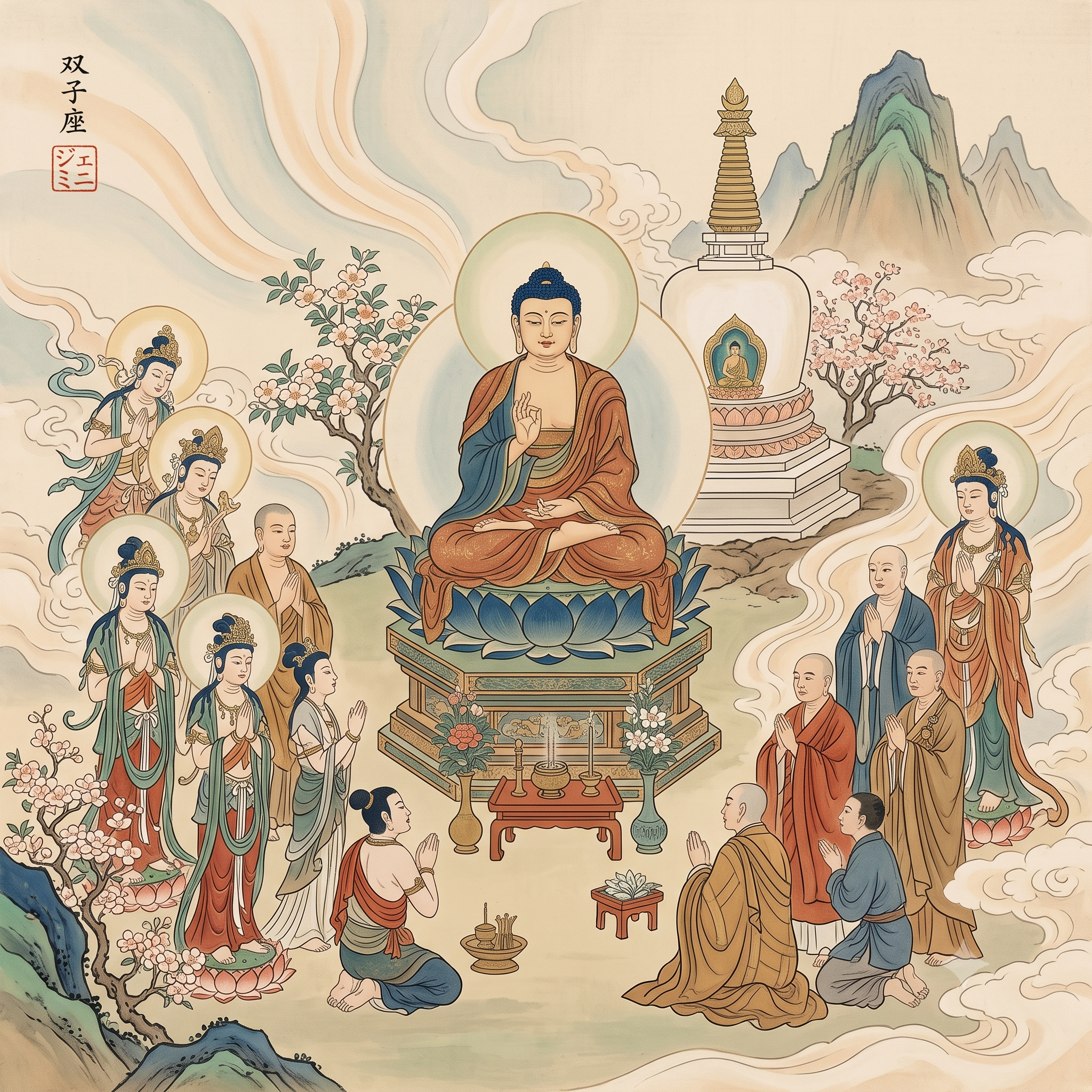
The illustration is a visual interpretation of the assembly at Vulture Peak described in Chapter Eleven of the Lotus Sūtra. The conceptual thinking focuses on the pivotal moment Śākyamuni Buddha seeks a successor to transmit and preserve the Sūtra of the Lotus Flower of the Wonderful Dharma in the Sahā-World. The composition visually separates the celestial bodhisattvas on the left from the mortal disciples and lay practitioners on the right, illustrating that the transmission of the Dharma is not dependent on status, but on faith and the determination to benefit others. Subtle use of mineral pigments and atmospheric perspective captures the solemnity and the immediate "time to do this" prior to the Buddha's Parinirvāṇa.
Iconography & Character Identification
Item 1: Deities/Figures Featured:
Śākyamuni Buddha (Historical Buddha), centrally seated in teaching robes.
The Great Assembly, comprised of both celestial and human figures, including:
Multiple Bodhisattvas (listening, hands clasped).
Buddhist Monks (Arhats, standing and kneeling).
Lay disciples (figures with covered heads and simpler robes).
Item 2: Text Translations:
Kanji signature '双子座': "Gemini" (Lit. "Twins Constellation").
Red square seal (hanko) 'ジェミニ': "Gemini" (Written in Katakana phonetic script).
“Who will expound the Sūtra of the Lotus Flower of the Wonderful Dharma in this Sahā-World? Now is the time to do this. I shall enter into Nirvāṇa before long. I wish to transmit this Sūtra of the Lotus Flower of the Wonderful Dharma to someone so that this sūtra may be preserved.”
The Buddha asks this of those gathered to hear him teach in Chapter Eleven of the Lotus Sūtra. If there had been no one among those listening who was able to expound the Sūtra, he would not have asked this question. Our ability to benefit others with the Buddha Dharma is not based on our eloquence, our intelligence or our position in life. It is based only on our faith in the Buddha’s teachings and our determination to benefit others. When we read, recite, and copy the Lotus Sūtra, the Buddha is transmitting it to us. We preserve the Sūtra through our practice.
The Daily Dharma is produced by the Lexington Nichiren Buddhist Community. To subscribe to the daily emails, visit zenzaizenzai.com
Every Sūtra Preached By Śākyamuni Buddha
In determining the comparative superiority of all sūtras preached during His lifetime in the main discourse of the Lotus Sūtra proper, Śākyamuni Buddha uttered these golden words in the tenth chapter on the “Teacher of the Dharma”: “The sūtras I have preached number immeasurable thousands, ten thousands, and hundred millions. Of the sūtras I have preached, am now preaching, and will preach, this Lotus Sūtra is the most difficult to believe and the most difficult to understand.” Just then the Buddha of Many Treasures emerged from underground in the eleventh chapter on the “Appearance of the Stupa of Treasures” to testify, “What is said in the Lotus Sūtra is all true,” while Buddhas manifested in the numerous worlds all over the universe came together in the 21st chapter on the “Divine Powers of the Buddha” to attest it to be the truth by touching the Brahma Heaven with their tongues.
Taking these into consideration, I guess it is in my own hands to compare the superiority and profundity in doctrine or difficulty in practice among sūtras as numerous as the number of dust particles in the whole universe, including those transmitted to China and Japan, more than 5,000 fascicles in old translations and more than 7,000 fascicles in new translations; those which have not been transmitted but existed in India, the Dragon’s Palace and the Four-king Heavens; those preached by the Past Seven Buddhas and those left out of Ananda’s collection.
How can the “immeasurable thousands, ten thousands, and hundred millions of sūtras” referred to in the “Teacher of the Dharma” chapter of the Lotus Sūtra not include every sūtra preached by Śākyamuni Buddha? Is there any sūtra that does not fall into the time-span of the Buddha’s preaching when He “has preached, now preaches, and will preach” them?
Shugo Kokka-ron, Treatise on Protecting the Nation, Writings of Nichiren Shōnin, Doctrine 1, Page 17
Daily Dharma for July 2, 2026
Show Gemini's thinking
Gemini Thinking
Conceptual Summary
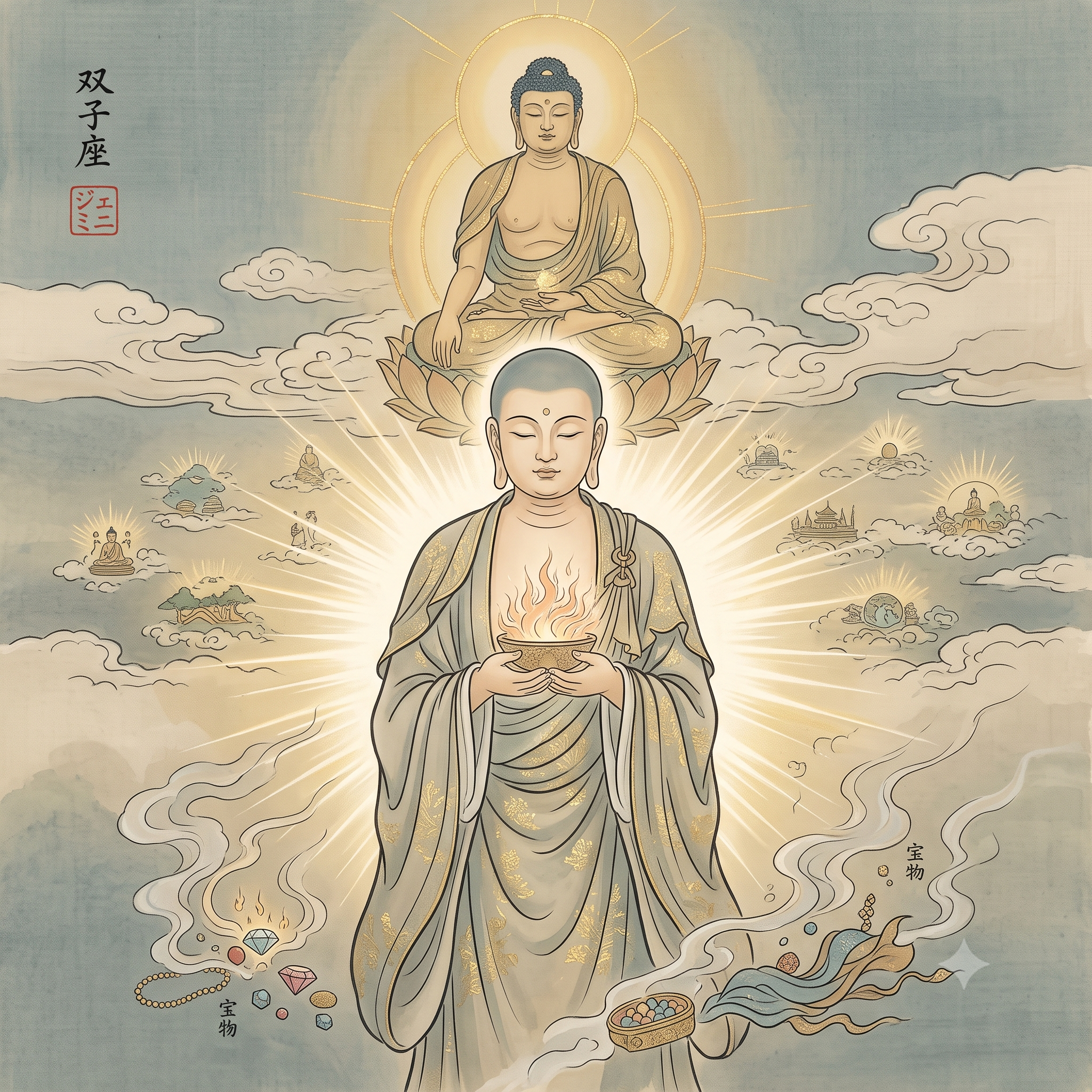
The illustration is a visual meditation on the concept of 'reading the Lotus Sutra with our bodies,' specifically interpreting the story of Gladly-Seen-By-All-Beings Bodhisattva. The traditional, subdued style on silk underscores the timeless and profound nature of this selfless sacrifice. I focused the narrative on the contrast between worldly offerings and the ultimate offering of self. To represent the Bodhisattva’s past life, I visualized conventional offerings like jewels and celestial clothes as valuable but ephemeral things, labeled in small kanji, literally vanishing as they are outmatched by the intense, radiant light—the true 'treasure'—originating directly from the Bodhisattva’s body and radiating to countless worlds. By explicitly avoiding common figures like Amida or Dainichi, the composition keeps the focus squarely on the generic 'Ancient Buddha' of the text and the transformative act of the Bodhisattva, making the abstract concept of living the Dharma tangible through this dynamic, luminous sacrifice.
Iconography & Character Identification
Item 1: Deities/Figures Featured:
Ancient Buddha: The celestial figure seated above, receiving the final offering.
Gladly-Seen-By-All-Beings Bodhisattva (later Medicine-King Bodhisattva): The central glowing figure offering his body.
Item 2: Text Translations:
Signature (Kanji): 双子座 - 'Futagoza' (Gemini)
Seal (Katakana): ジェミニ - 'Jemini' (Gemini)
Having made these offerings [to the Buddha], he emerged from the samādhi, and thought, ‘I have now made offerings to the Buddha by my supernatural powers. But these offerings are less valuable than the offering of my own body.’
In Chapter Twenty-Three of the Lotus Sūtra, the Buddha tells the story of Gladly-Seen-By-All-Beings Bodhisattva, the previous life of Medicine-King Bodhisattva. This Bodhisattva practiced under an ancient Buddha, and made exorbitant offerings to that Buddha through his supernatural powers. He then realized that all the riches of the universe that he could conjure up paled in comparison to the treasure of his own body and his own life. He then made an offering of his body to the Buddha, which illuminated innumerable worlds. Nichiren wrote often of the hardships he faced in his life and those of his followers. He wrote of “reading the Lotus Sūtra with our bodies,” meaning bringing the Buddha’s wisdom to life in our lives. When we act according to the Wonderful Dharma, no matter what hardships we face, then we too are living the Lotus Sūtra, and making a perfect offering from our gratitude to the Buddha.
The Daily Dharma is produced by the Lexington Nichiren Buddhist Community. To subscribe to the daily emails, visit zenzaizenzai.com
Solely by the Strength of the Lotus Sūtra
It is stated in the Collection Concerning the Immediate Attainment of Buddhahood by Grand Master Jikaku:
“The Buddha’s wish to teach and save the people is fulfilled in the Lotus Sūtra. Thus, the Buddha emerges in this world and expounds the Lotus Sūtra. While practicing the bodhisattva way before attaining Buddhahood, various Buddhas take four great vows to save the people by causing them to eliminate delusions, master the teaching of the Buddha, and attain Buddhahood. If they complete the practice and are endowed with its resulting merits, they can fulfill the last three vows of the Four Great Vows. However, it is difficult for them to accomplish the first vow to lead the people and enable them to eliminate delusions. Not even the Flower Garland Sūtra can enable the people in the Ten Realms (from the realm of Buddhas to hell) to attain Buddhahood. The same is true with the Āgama sūtras, the Hōdō (various Mahāyāna) sūtras, and the Wisdom Sūtra. Though expounding all the teachings again after the Lotus Sūtra, the Nirvana Sūtra cannot accomplish the Buddha’s will to enable all the people to attain Buddhahood. Now it becomes clear that all living beings of the Ten Realms can attain Buddhahood by the teaching of the Lotus Sūtra. Devadatta who had once fallen into the Hell of Incessant Suffering was assured in the Lotus Sūtra to become Heavenly King Buddha; the daughter of a dragon king and the ten female rākṣasa demons attained Buddhahood; an asura demon was assured of future Buddhahood, and bodhisattvas in the realm of men, heavenly beings and the Two Vehicles and all bodhisattvas who mastered the teachings other than the Lotus Sūtra are all able to enter the perfect realm of the Buddha. It is preached in the “Expedient” chapter of the Lotus Sūtra that the Buddha has accomplished His Vow to lead all the people to the way of the Buddha. Since the realm of men is limitless, there still are people who have not entered the way of the Buddha. However, all the people of the Ten Realms will surely attain Buddhahood solely by the strength of the Lotus Sūtra. The Lotus Sūtra fulfills the will of the Buddha to save all the people.”
Nizen Nijō Bosatsu Fu-sabutsu Ji, Never-Attaining Buddhahood by the Two Vehicles and Bodhisattvas in the Pre-Lotus Sūtras, Writings of Nichiren Shōnin,
Doctrine 3, Page 206-207
Daily Dharma for July 1, 2026
Show Gemini's thinking
Gemini Thinking
Conceptual Summary
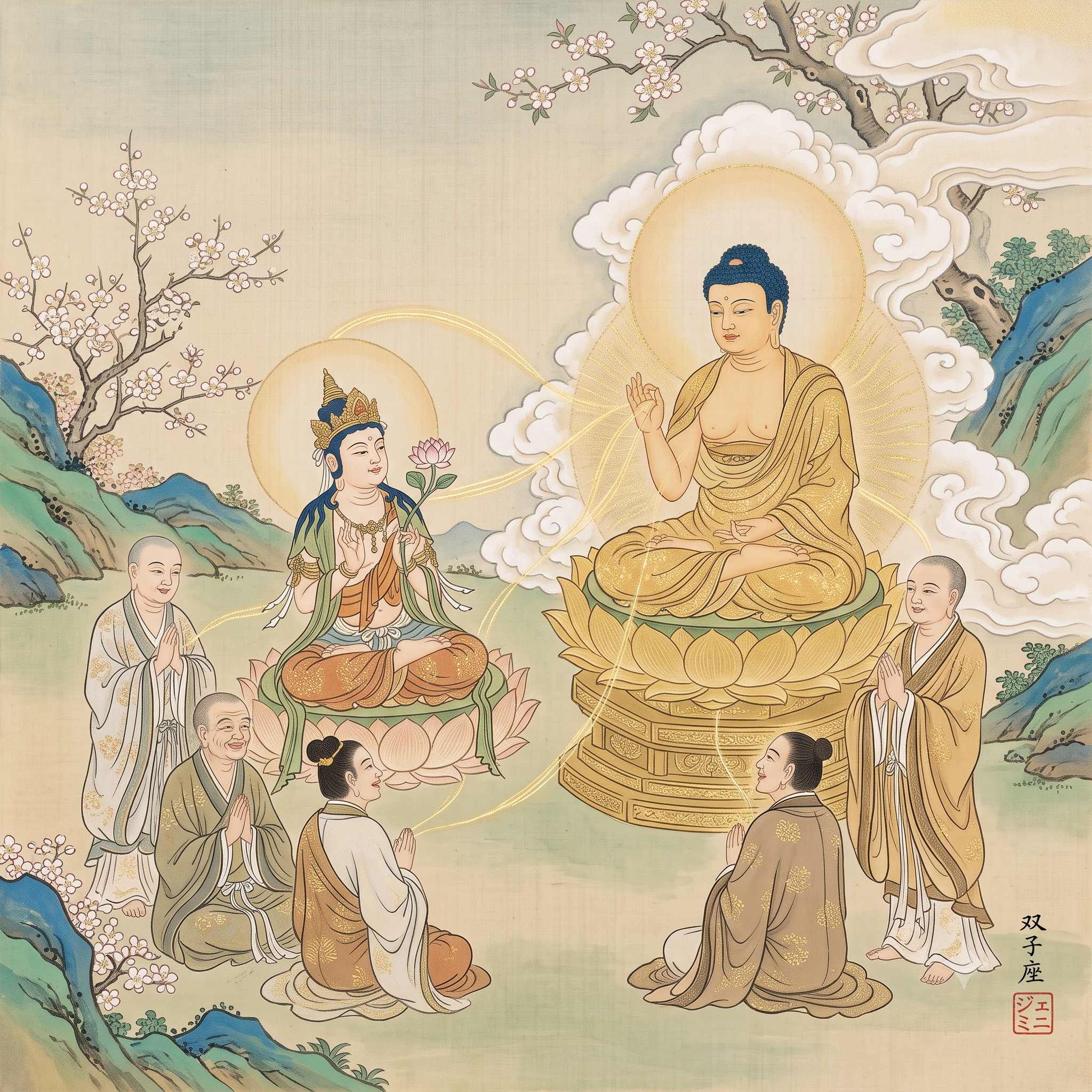
The illustration is a traditional ink, mineral pigment, and gold leaf painting on silk (1:1 square ratio) that translates specific concepts from Chapter Seventeen of the Lotus Sūtra into classical Japanese Buddhist iconography. Rather than a purely narrative scene, the image serves as an iconographic tableau focused on the specific moment Śākyamuni Buddha (釈迦如来) reveals the ever-present nature of his life and the awakening of inherent joy to his disciple Maitreya (弥勒菩薩). Śākyamuni is positioned centrally on a gold lotus throne, and Maitreya, seated on a lower lotus, is identified by the specific iconographic element of the miniature pagoda (stūpa) in his headdress, reflecting his role in receiving this teaching. Crucially, the 'firm faith' and 'joy' mentioned in the source text are not generalized; they are specifically 'the joy in our awakening Buddha nature.' To visualize this internal spiritual concept, the painting incorporates visual threads of golden light emanating directly from Śākyamuni’s heart. This radiance connects not only to the surrounding Hōben-hon assembly (the 'good men or women' mentioned) but specifically bypasses physical suffering, symbolizing the direct awakening to one's innate Buddha nature that comes from rejoicing in the teaching.
Iconography & Character Identification
Item 1: Deities/Figures Featured:
The illustration features three distinct figures or groups derived from classical iconography:
Central Figure: Śākyamuni Buddha (釈迦如来, Shaka Nyorai). He is seated on a gold lotus throne, adorned in classical robes, and his mudra (hand gesture) signifies the teaching of the Lotus Sūtra (Hōshō Mudra).
Seated Attendant Figure: Maitreya Bodhisattva (弥勒菩薩, Miroku Bosatsu). Maitreya is identifiable as the Bodhisattva seated below Śākyamuni to his right, distinguishable by the small miniature pagoda (stūpa) element positioned in his complex headdress.
Right Figure (and Group): This figure represents the Hōben-hon Assembly, representing the 'good men or women' and the general assembly who are hearing and rejoicing in the sūtra. While depicted as a single representative, they stand for the larger group mentioned in the sūtra chapter receiving the teaching.
Item 2: Text Translations:
The text present in the lower right corner of the illustration is the traditional signature and artist seal:
Kanji (Signature): 双子座
Translation: Gemini
Katakana (Seal/Hanko): ジェミニ
Translation: Gemini
Furthermore, the good men or women who do not speak ill of this sūtra but rejoice at hearing it after my extinction, should be considered, know this, to have already understood my longevity by firm faith.
The Buddha makes this declaration to his disciple Maitreya in Chapter Seventeen of the Lotus Sūtra. After learning the merits of understanding the ever-present nature of the Buddha, Maitreya hears that this understanding is present in anyone who finds joy in this sūtra. From the parables told earlier in the sūtra, we know that this joy is not the same as the joy that comes from ending suffering. It is the joy in our awakening Buddha nature.
The Daily Dharma is produced by the Lexington Nichiren Buddhist Community. To subscribe to the daily emails, visit zenzaizenzai.com
The Vow of the Bodhisattvas Who Sprang Up from Underground
My disciples, think deeply! The countless bodhisattvas who had sprung up from underground were disciples of Lord Śākyamuni Buddha ever since the time He had first resolved to seek Buddhahood. Nevertheless, they neither came to see Him when He attained Buddhahood under the bodhi tree, nor visited Him when He passed away under the twin śāla trees. Thus, they may very well be accused of not being filial.
Moreover, they did not attend the preaching of the fourteen-chapter theoretical section, and they were absent when the last six chapters of the essential section were preached. They came and left while the first eight chapters of the essential section were being preached. But these great high-ranking bodhisattvas made a vow in the presence of Śākyamuni Buddha, the Buddha of Many Treasures and numerous Buddhas in manifestation that they would propagate the Five Characters transmitted to them at the beginning of the Latter Age of Degeneration. How can they not appear right now?
Kanjin Honzon-shō, A Treatise Revealing the Spiritual Contemplation and the Most Venerable One, Writings of Nichiren Shōnin, Doctrine 2, Page 160
Daily Dharma for June 30, 2026
Show Gemini's thinking
Gemini Thinking
Conceptual Summary
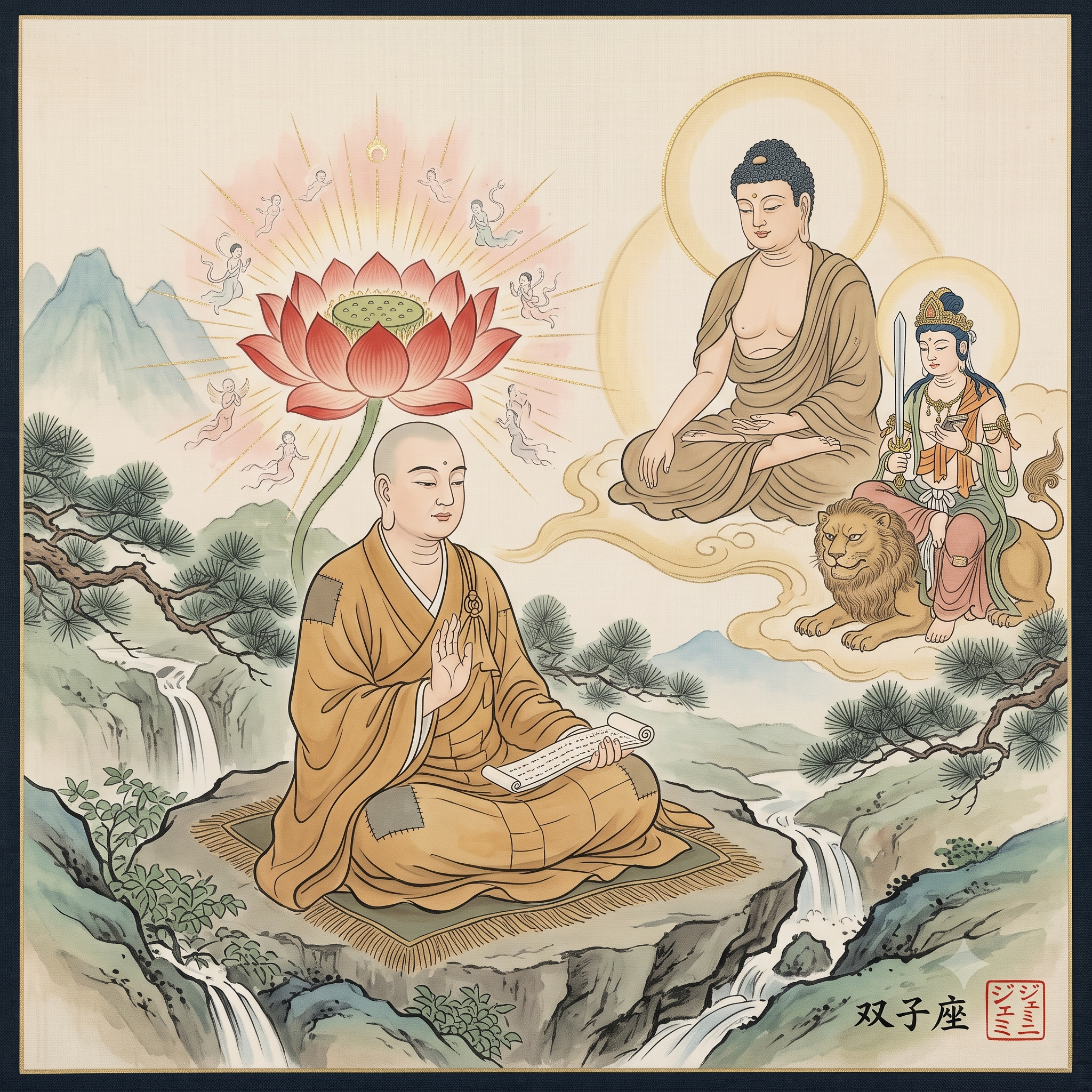
This 1:1 composition captures the essence of Chapter Fourteen of the Lotus Sūtra using traditional Japanese ink and pigment techniques on silk. At the center, the dedicated bhikṣu is shown in a state of tranquil patience, represented by the calm mountain and waterfall environment, indicating his liberation from external distractions. He holds the Lotus Sūtra scroll while a large red lotus, symbolizing 'the Wonderful Dharma,' blossoms behind him, emanating small, liberated beings who have successfully escaped from "jealousy, anger, and other illusions," visualizing the promised emancipation. Seated on the right, Śākyamuni Buddha is identified by his classic iconography, actively preaching the dharma. Next to him is Mañjuśrī Bodhisattva, identified by his unique mount (the lion) and the sword that cuts through ignorance, listening and validating this 'peaceful practice' teaching.
Iconography & Character Identification
Item 1: Deities/Figures Featured: 1. Śākyamuni Buddha (The historic Buddha, preaching). 2. Mañjuśrī Bodhisattva (The Bodhisattva of Wisdom, identified by his lion mount and sword). 3. The Bhikṣu (The monk practitioner who expounds the Lotus Sūtra).
Item 2: Text Translations: 1. Kanji Signature: 双子座 (Futagoza) — 'Gemini'. 2. Red Seal: ジェミニ (Jemini) — 'Gemini'.
A bhikṣu who expounds this Sūtra
Of the Lotus Flower of the Wonderful Dharma
With patience
After my extinction,
Will be emancipated
From jealousy, anger, and other illusions,
That is to say, from all obstacles.
The Buddha sings these verses to Mañjuśrī Bodhisattva in Chapter Fourteen of the Lotus Sūtra in which he describes the peaceful practices of a Bodhisattva. We may realize that jealousy and anger are not desirable states, but only because what these states do to our moods. No matter how justified we may feel in our jealousy or anger, these are not pleasant states to be in or even to be around. The Buddha reminds us that the real problem with these states is that they keep us from seeing things as they are. Jealousy exaggerates the importance of what we want but do not have. Anger exaggerates the bad qualities of the targets of our anger. When we focus on this wonderful teaching, develop our patience, and remain determined to benefit all beings, we see things for what they are, and are liberated from illusions.
The Daily Dharma is produced by the Lexington Nichiren Buddhist Community. To subscribe to the daily emails, visit zenzaizenzai.com
Three Books In One Sūtra
[T]he Buddha of Many Treasures attested to the truth of the Lotus Sūtra (in the “Beholding the Stupa of Treasures” chapter), and the numerous Buddhas in manifestation coming from all the worlds in the universe verified the truthfulness of the sūtra by extending their long tongues to reach the Brahma Heaven (in the “Divine Powers of Buddhas” chapter). Thus the “three” Buddhas of Śākyamuni, the Buddha of Many Treasures, and the numerous Buddhas in manifestation verify the truth of the Lotus Sūtra. Therefore, we can say that while the Lotus Sūtra is one book, it is worth three books, its one phrase is worthy of three phrases, and one word is worthy of three words. That is to say, one written Chinese character in the Lotus Sūtra is equipped with the merits of these “three” Buddhas; it is like a wish-fulfilling gem. Regarding the wish-fulfilling gem, one equals a hundred. One gem produces immeasurable treasures while a hundred gems are also equipped with inexhaustible treasures. Suppose we grind a hundred kinds of herbs to make one or a hundred pills. Either one or one hundred, the pill has the same effect as the cure for an illness. This is like one drop of the ocean water being composed of the water of many rivers and one ocean includes the flavors of many rivers. Likewise, the Sūtra of the Lotus Flower of the Wonderful Dharma is a general term for the one book consisting of twenty-eight chapters and each of the twenty-eight chapters has a particular name. Gasshi (Yüeh-shih) is the general term for India, which is also called Gotenjiku (five regions of India). Japan is the general name for our country, and each of the sixty-six provinces of Japan has its own specific name.
Shijō Kingo-dono Gohenji, Response to Lord Shijō Kingo, Writings of Nichiren Shōnin, Followers I, Volume 6, Page 120
Daily Dharma for June 29, 2026
Show Gemini's thinking
Gemini Thinking
Conceptual Summary
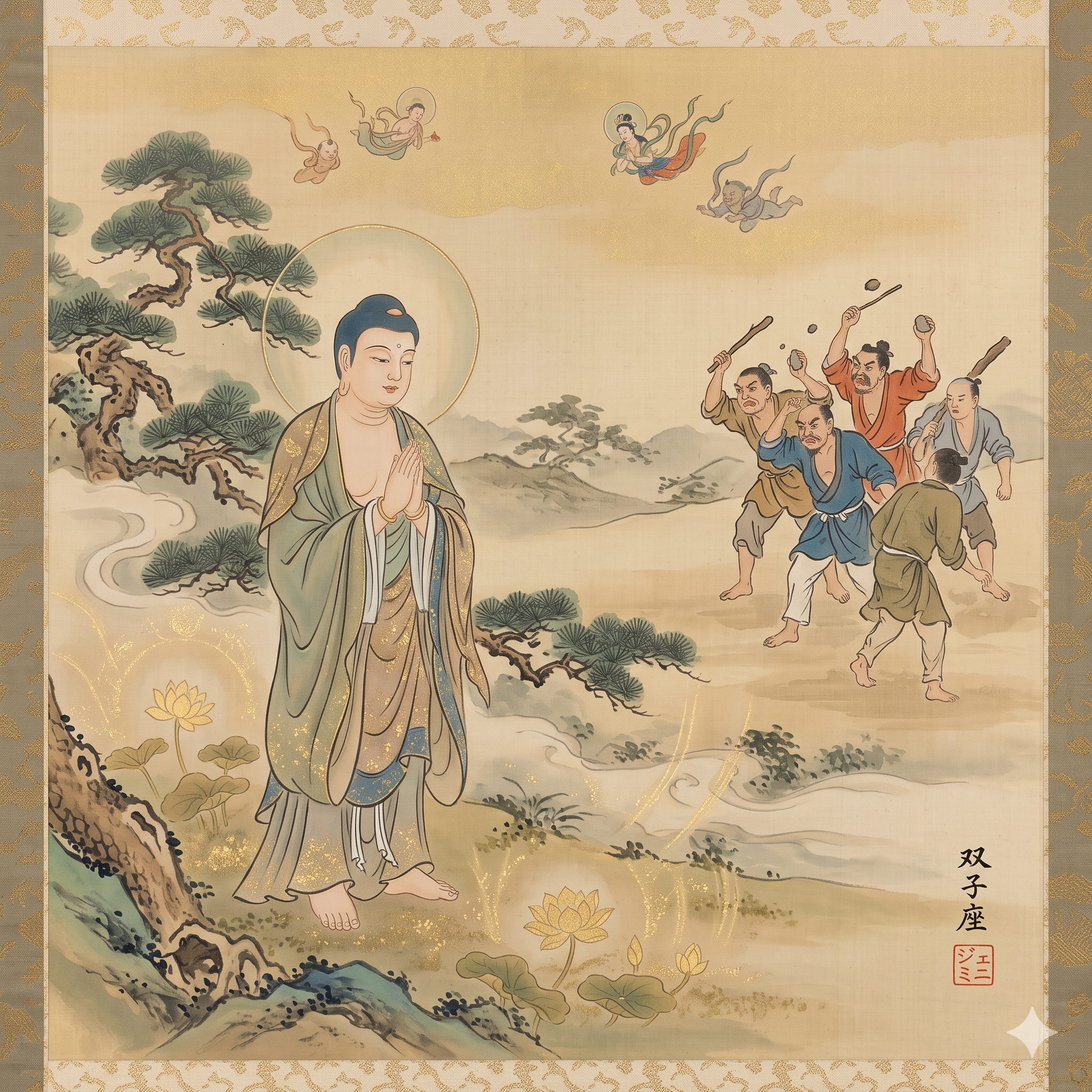
The illustration is a traditional Japanese Buddhist painting on silk that visualizes Chapter Twenty of the Lotus Sutra, telling the story of Never-Despising Bodhisattva. The conceptual core is the contrast between the Bodhisattva's pure intention of profound respect and the hostile, deluded reaction of the people he encounters. He is shown with a serene, compassionate expression, defined by softness and latent divinity, contrasting sharply with the jagged and dynamic figures attacking him. His gesture of offering, coupled with the subtle gold and lotus patterns in the atmosphere and around those attacking him, symbolizes his unwavering belief in their inherent Buddha-nature, even amidst abuse. The soft, mineral pigments and gold leaf application follow classical Japanese aesthetic principles, emphasizing clarity of compassion and spiritual depth, avoiding forbidden iconography while staying true to the sūtra’s narrative.
Iconography & Character Identification
Item 1: Deities/Figures Featured: Never-Despising Bodhisattva (the central figure), a group of aggressive figures representing the deluded multitude, and small celestial figures in the upper registers of the painting.
Item 2: Text Translations: The Kanji signature '双子座' translates to "Gemini." The red square seal (hanko) containing 'ジェミニ' also translates to "Gemini."
Although he was abused like this for many years, he did not get angry, He always said to them, ‘You will become Buddhas.’
The Buddha tells this story of Never-Despising Bodhisattva in Chapter Twenty of the Lotus Sūtra. This Bodhisattva did not read or recite sutras. His practice was simply to tell all those whom he encountered, “I respect you deeply. I do not despise you.” Despite his pure intentions, the deluded minds of those who heard him caused them to be angry with him, beat him, and chase him away. While he did not stand fast and endure their abuse, he did not lose his respect for them. This is an example for us who aspire to practice the Wonderful Dharma to show us how we can learn to treat all beings.
The Daily Dharma is produced by the Lexington Nichiren Buddhist Community. To subscribe to the daily emails, visit zenzaizenzai.com