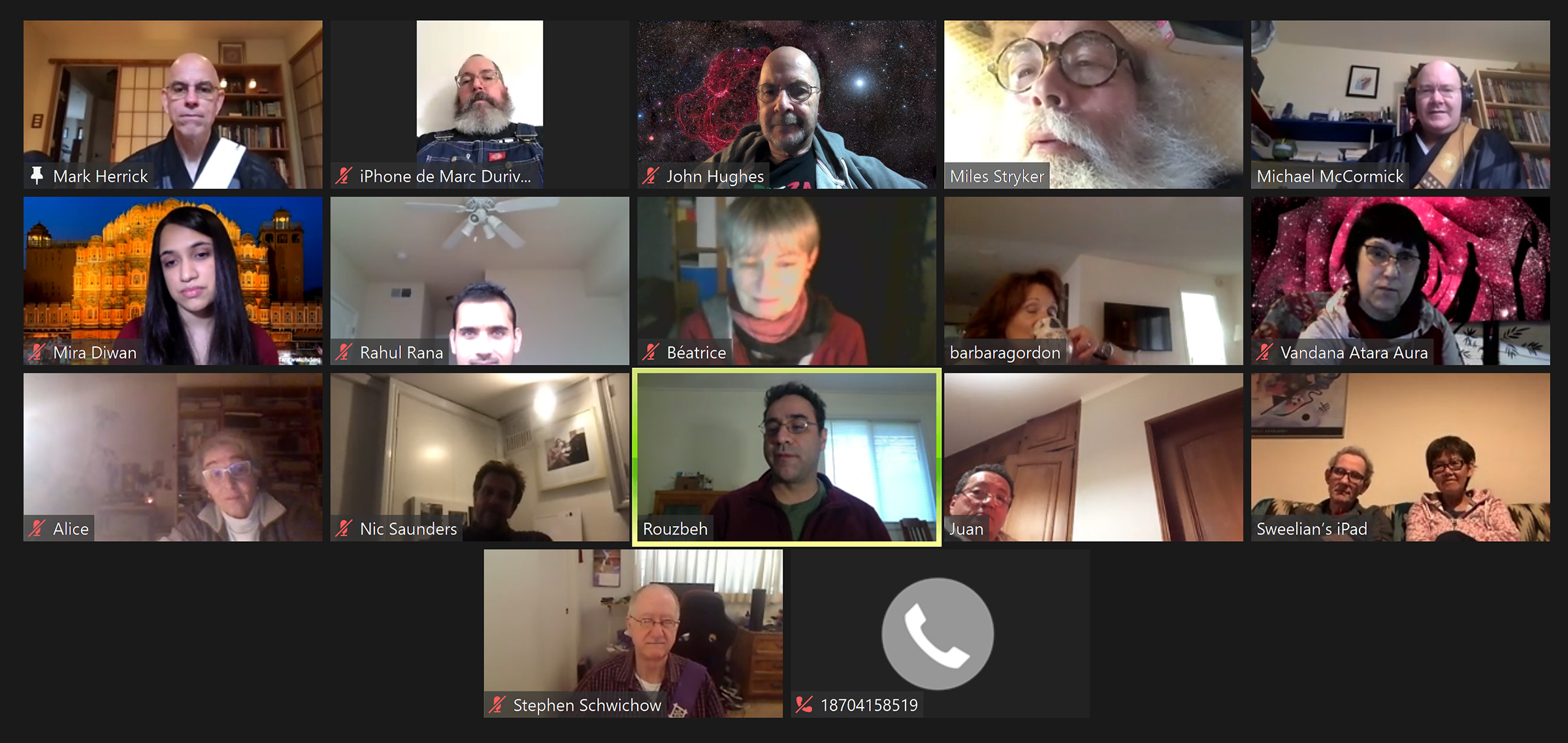
I am in the process of preparing to publish Masaharu Anesaki’s book, “Nichiren, The Buddhist Prophet.” It will be posted in 57 segments matching the divisions in the book’s table of contents. My hope is to provide bite-sized morsels daily that whet the appetite for the story of Nichiren and the Lotus Sutra. The PDF of the book is available here if you want to get a head start.
While working on the section of the book that deals with Nichiren’s Kaimoku-shō, Open Your Eyes to the Lotus Teaching (Writings of Nichiren Shōnin, Doctrine 2, p29-117), I came upon a discussion of morality that I couldn’t resist publishing now during my ongoing Higan celebration.
The duties of the true Buddhist, then, consist in fully knowing the vast scheme of Buddha’s salvation working upon us, in being convinced of our indebtedness to Buddha, and in requiting it by practicing the true morality.
Morality in human relation means, according to this point of view, a life of gratitude shown in fidelity to the Lord, obedience toward one’s master, and filial piety toward one’s parents; all other moral relations flow out of these fundamental ones. But this passive aspect of morality implies the active duty of showing gratitude by perpetuating the will of the benefactor. The ruled fulfills his duty by cooperating with the ruler in the maintenance of order and government, the disciple by propagating the truth taught by the master, and the child by perpetuating the life given by his parents. Similarly, with moral duties viewed from the standpoint of religion: the true faith consists in propagating the Truth, and in ourselves living the life of Truth as revealed by Buddha. This is what is inculcated in the [Lotus Sutra] and is the real import of the vows taken by the saints, the faithful disciples of Buddha.
Recently I was asked this question by a visitor here:
What does one need to do in order to be reborn in Mount Eagle Pureland?
This was my response:
Faith, Practice and Study.
As Rev. Ryuei McCormick explains: “Faith inspires practice and study. Study informs faith and practice. Practice actualizes faith and study.”
We need faith in the Three Treasures: Faith in the Eternal Sakyamuni Buddha as revealed in Chapter 16 of the Lotus Sutra. Faith in the Dharma as revealed in the Lotus Sutra. Faith in the Great Bodhisattva Nichiren Shonin, dispatched by the Original Buddha Sakyamuni to guide people in the Latter Age.
The practice? Chanting Namu Myōhō Renge Kyō
As Nichiren writes in Shohō Jisso-shō, Treatise on All Phenomena as Ultimate Reality, Writings of Nichiren Shōnin, Faith and Practice, Volume 4, Page 79-80:
Have faith in the Great Mandala Gohonzon, the Most Venerable One in the entire world. Earnestly endeavor to strengthen your faith, so that you may be blessed with the protective powers of Śākyamuni Buddha, the Buddha of Many Treasures, and Buddhas in manifestation throughout the Universe. Strive to carry out the two ways of practice and learning. Without practice and learning Buddhism will cease to exist. Endeavor yourself and cause others to practice these two ways of practice and learning, which stem from faith. If possible, please spread even a word or phrase of the sūtra to others.
As for being reborn in Mount Eagle Pureland, consider what Nichiren writes in Shugo Kokka-ron, Treatise on Protecting the Nation, Writings of Nichiren Shōnin, Doctrine 1, Pages 67-68:
QUESTION: Which “Pure Land” should practicers of the Lotus Sūtra pray to be reborn in?
ANSWER: It is stated in the sixteenth chapter on “The Life Span of the Buddha,” the essence of the Lotus Sūtra consisting of 28 chapters, “I will always stay in this Sahā World;” “I reside here always;” and “This world of Mine is at peace.” According to these statements, the Eternal True Buddha, the origin of all Buddhas in manifestation, is always in this Sahā World. Then why should we wish to be anywhere other than this Sahā World? You should know that there is no Pure Land other than the very place where the practicer of the Lotus Sūtra resides. Why should we concern ourselves seeking a Pure Land in any other place?
It is, therefore, stated in the twenty-first chapter on the “Divine Powers of the Buddha” of the Lotus Sūtra: “Wherever scrolls of the sūtra are placed, whether it may be in a garden, a forest, under a tree, in a monastery, a layman’s house, a palace, a mountain, a valley or a wilderness…, you should know that it is the very place to practice Buddhism.” The Nirvana Sūtra states: “You should know, Gentlemen, that wherever this Nirvana Sūtra spreads becomes the Pure Land as indestructible as a diamond, inhabited by people with bodies as imperishable as a diamond.” Those who believe in and practice the Lotus-Nirvana Sūtras, thus, should not seek the Pure Land anywhere other than the very place where they, believers of this sutra, reside.
I’ve decided this year to devote the month of March and September, when the Spring and Fall Equinox occur, to Higan. As explained in a Nichiren Shu brochure:
For Buddhists, this period is not just one characterized by days with almost equal portions of light and dark. Rather, it is a period in which we strive to consciously reflect upon ourselves and our deeds.
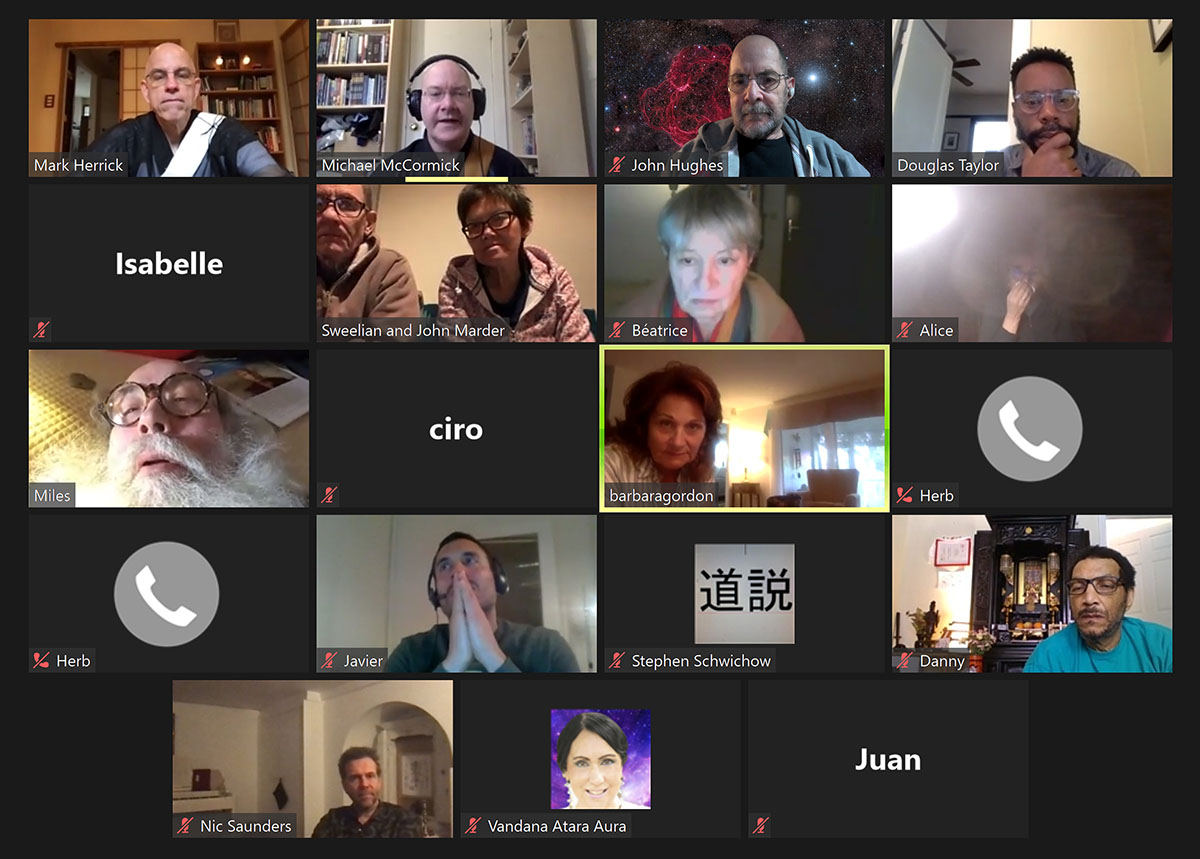
Recently, while participating in a Nichiren Buddhist Sangha of the San Francisco Bay Area meeting, I brought up the importance of merit transference through our practice as a means of comforting both the dead and the living. That discussion elicited a criticism from one of the participants. This man felt focusing on funerary services is bad for Buddhism. This was a written comment during a Zoom session and I didn’t take the opportunity to discuss the issue at the time.
I am well aware of the criticism toward the Japanese temple system reliance on funerary services to keep the lights on. While I, too, wish more effort within Nichiren Shu temples was directed toward propagation and education, I do not share the opinion that funerary services have no value. For me, the lack of any formal funerary services within Soka Gakkai was one of my motivations for seeking something more. I am very fortunate to have been able to experience practicing with Ven. Kenjo Igarashi and the Sacramento Nichiren Buddhist Church.
Higan is traditionally a week-long practice, with the three days before and the three days after the Equinox devoted to the six paramitas and the Equinox devoted to memorials for the dead. As I have learned from Rev. Igarashi, at the Equinox the veil between this world and the spiritual world is at its thinnest.
I say “traditionally” three days before and after the Equinox focus on the six paramitas, but I am unable to find any American priest who actually performs week-long services or other observations as part of Higan. So, here I am. I’m creating my own Higan week observance with two, month-long introductions. In future years I envision devoting just the week around the Spring and Fall Equinoxes to the six paramitas and a memorial service.
For the month of March I’ve postponed my daily quotes from the Foundations of T’ien-T’ai Philosophy. Tomorrow I’ll reprint the official Nichiren Shu brochure explaining Higan. For the rest of March, Wednesdays will be devoted to the perfection of charity. Thursdays will be devoted to the perfection of morality. Fridays will be devoted to the perfection of tolerance. Saturday March 20 is the Equinox. Saturdays in March will be devoted to merit transference and the meaning of “the other shore.” Sundays will be devoted to the perfection of energy. Mondays will be devoted to the perfection of meditation. Tuesdays will be devoted to the perfection of wisdom.
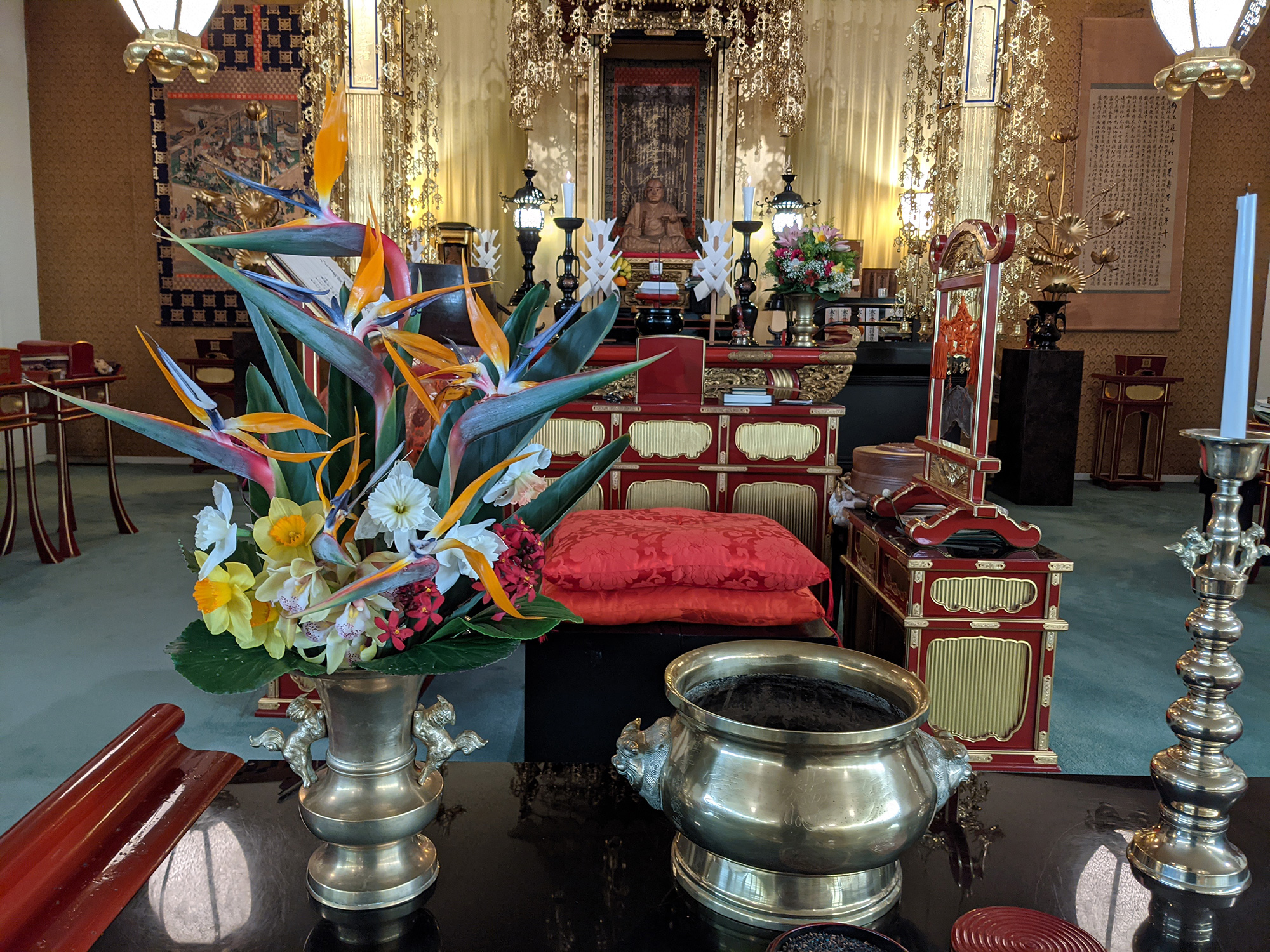
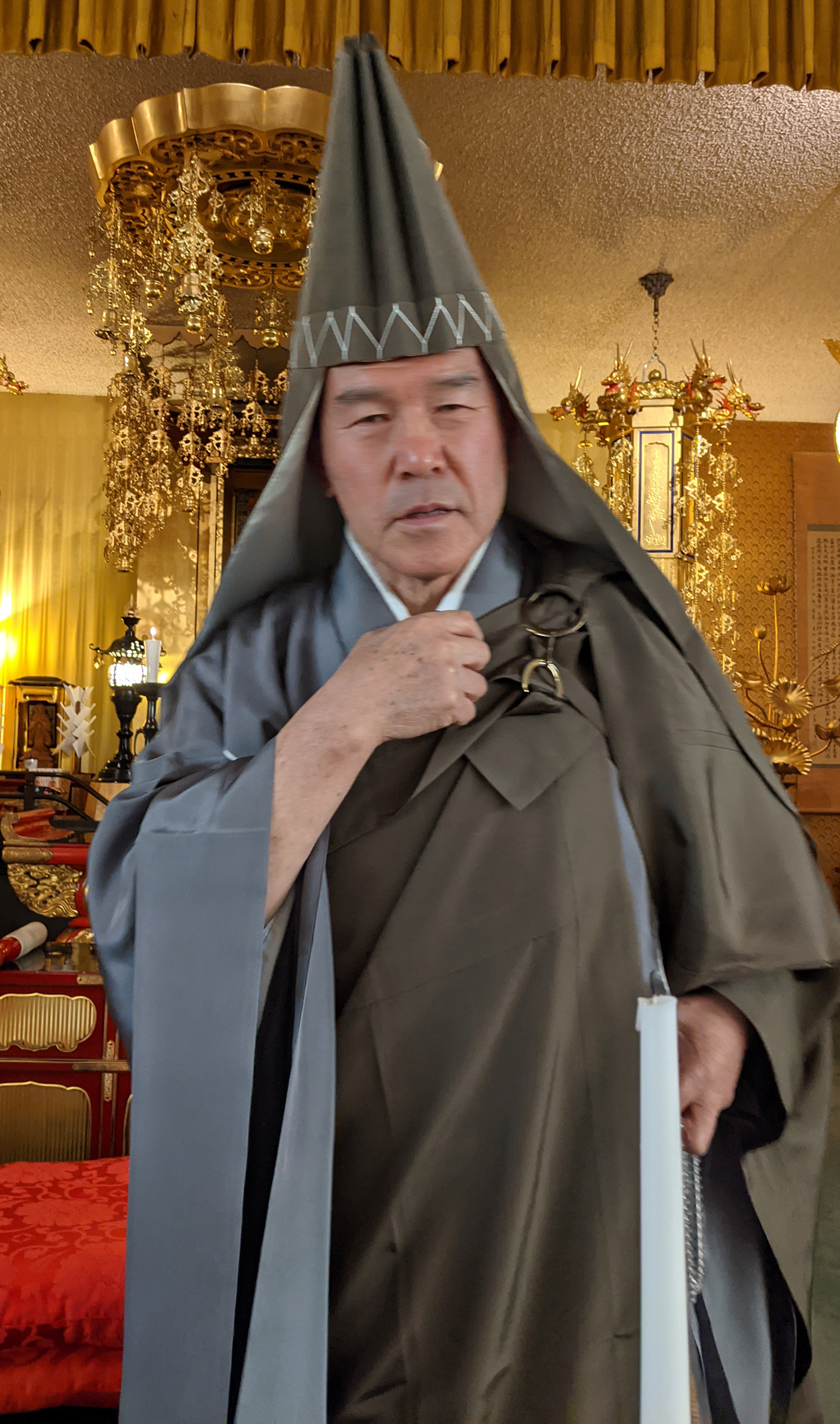
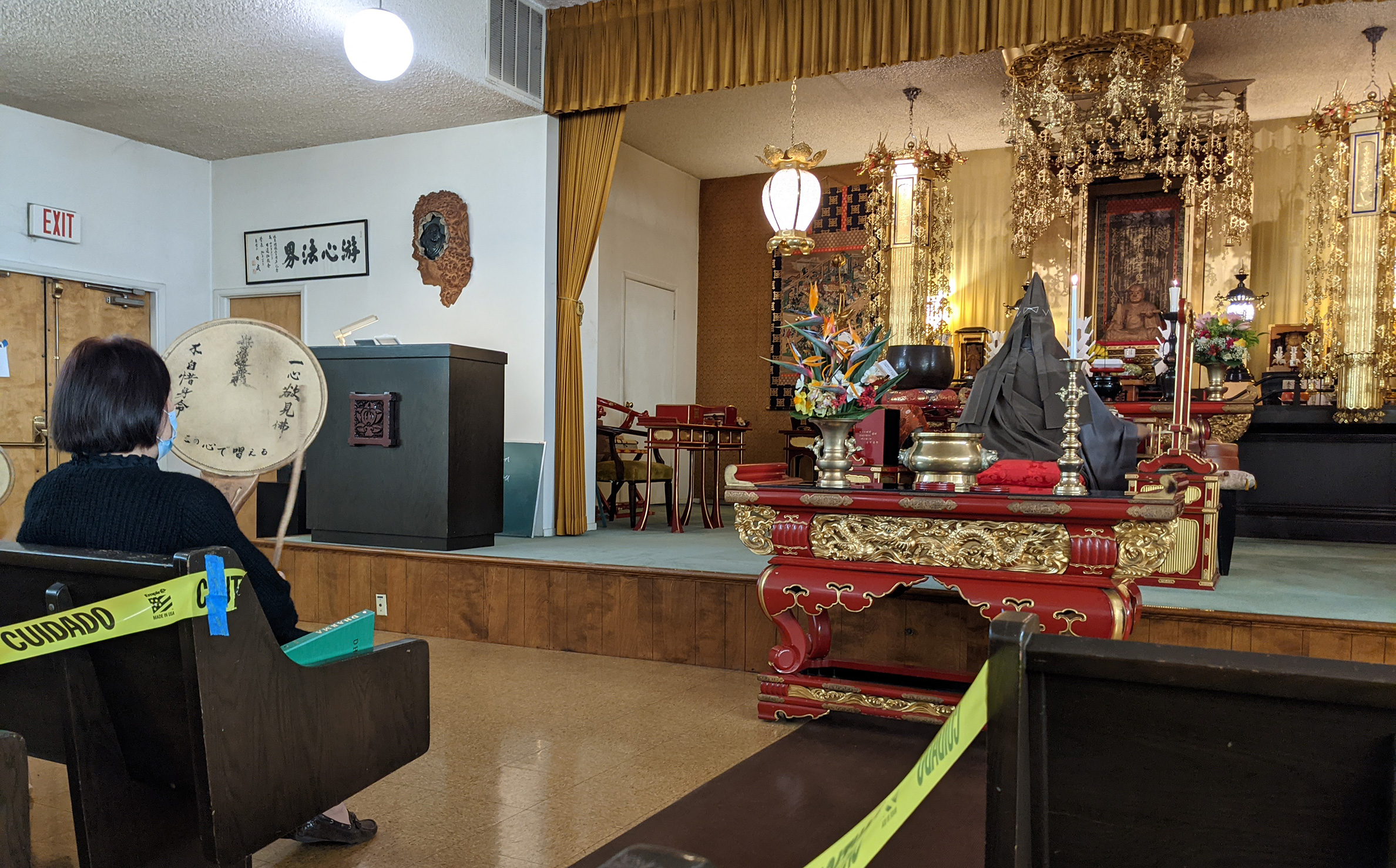
Sacramento Nichiren Buddhist church altar flowers for the Sunday, Feb. 28, service honoring the 800th birthday of NichirenRev. Kenjo Igarashi in full regalia for the service honoring the 800th birthday of Nichiren. Socially distant but happy to have opportunity to meet inside the Sacramento Nichiren Buddhist Church to celebrate the 800th birthday of Nichiren
Paul L. Swanson’s “Foundations of T’ien-T’ai Philosophy: The Flowering of the Two Truths Theory in Chinese Buddhism” includes a 96 page English translation of a portion of the first chapter of Chih-i’s Profound Meaning of the Lotus Sutra. For the next 80 or so days I’ll be offering quotes from this along with Swanson’s footnotes.
Some of these I find beautiful:
The water does not rise, nor does the moon descend, yet the one moon in a single instant is manifest in all [bodies of] water. The Buddhas do not come, and the sentient beings do not go [yet they are united through the “empathy” or capacity of the believer and the “approach” or power of the Buddha]. The power of the capacity of goodness and compassion is to be perceived in this way. Therefore it is called subtle empathy and response.
The capacities [of beings] in the ten dharma realms are illumined; if there is a capacity [among sentient beings] there will certainly be a response [from the Buddha].
If the Buddha’s response is to be offered according to the capacity [of sentient beings], then first the physical body should be utilized [to get the attention of sentient beings] with a show of supranormal powers.
After [sentient beings] see the supranormal powers of transformation, they will be amenable to accepting the way [of the Buddha]. Then with a verbal [turning of] the wheel [of the law], the way is proclaimed and revealed to guide [sentient beings].
If they are moistened with the rain of the dharma, they accept the teachings and receive the way and become attendants of the dharma.
The attendants undertake the practice [of the Buddhist way], remove the basis [reasons for rebirth] in saṃsāra, expose the Buddha’s knowledge and insight, and attain great benefit.
And while beautiful, appreciation of Chih-i’s quotes is often enhanced by Swanson’s footnotes:
The objects of the [true] aspects of reality are not something produced by Buddhas, gods, or men. They exist inherently on their own and have no beginning. Therefore they come first [on the list of ten subtleties].
Delusions arise due to illusion concerning reality. If one understands reality, then wisdom is born.
Wisdom is the basis for practice. The undertaking of practice is aroused due to the eye of wisdom.371 The three dharmas of the [wisdom] eye, the [practice] feet, and objects become the vehicle [for salvation].
By riding on this vehicle one enters the pure and clear lake [of Buddhahood] and advances on the stages [to attain enlightenment].
‘The eye of wisdom is the cause and the feet of action are aroused.” It is only when one can see with the eye of wisdom that one can walk to where one needs to go. return
Finally, some of Chih-i’s commentary simply requires footnotes.
[The correct interpretation of conditioned co-arising involves] another fourfold classification: clarification of twelvefold conditioned co-arising conceptually understood as arising and perishing; clarification of twelvefold conditioned co-arising conceptually understood as neither arising nor perishing; clarification of twelvefold conditioned co-arising as beyond conceptual understanding yet as arising and perishing; and clarification of twelvefold conditioned co-arising as beyond conceptual understanding and as neither arising nor perishing.375
During the Feb. 7 presentation on Chapter 4, Understanding by Faith, it was suggested that the rich man’s initial failure to bring his son to him was in some way an illustration that the Buddha is fallible. That suggestion is as wrong as it would be to say that the rich man in Chapter 3 reveals the Buddha is neglectful since he fails to maintain his property and allows his small children to play unsupervised in knowingly dangerous surroundings.
The point in Chapter 4 of the rich man dispatching a messenger to bring his son to him is to illustrate that our inheritance is unconditioned. We are the Buddha’s children. Nothing is required of us to inherit. It is only because we can’t believe we could have such great fortune that the Buddha must bring us along in steps, helping us to gain confidence.
The dire condition of the Triple World (the rich man’s manor house) is the manifestation of our delusions, our misperception. As we will learn in Chapter 16, “I do not see the triple world in the same way as [the living beings of] the triple world do. I see all this clearly and infallibly.” And in gāthās: “[This] pure world of mine is indestructible. / But the [perverted] people think: / “It is full of sorrow, fear, and other sufferings. / It will soon burn away.”
The father pines for his missing son and wishes to welcome him home, but the poor son faints in fright
The poor son is incapable of believing he could be wealthy beyond measure. Instead, when he is released and told he is free to go, “The poor son had the greatest joy that he had ever had.”
The poor son, too base and mean, chooses to live in poverty and deprivation.
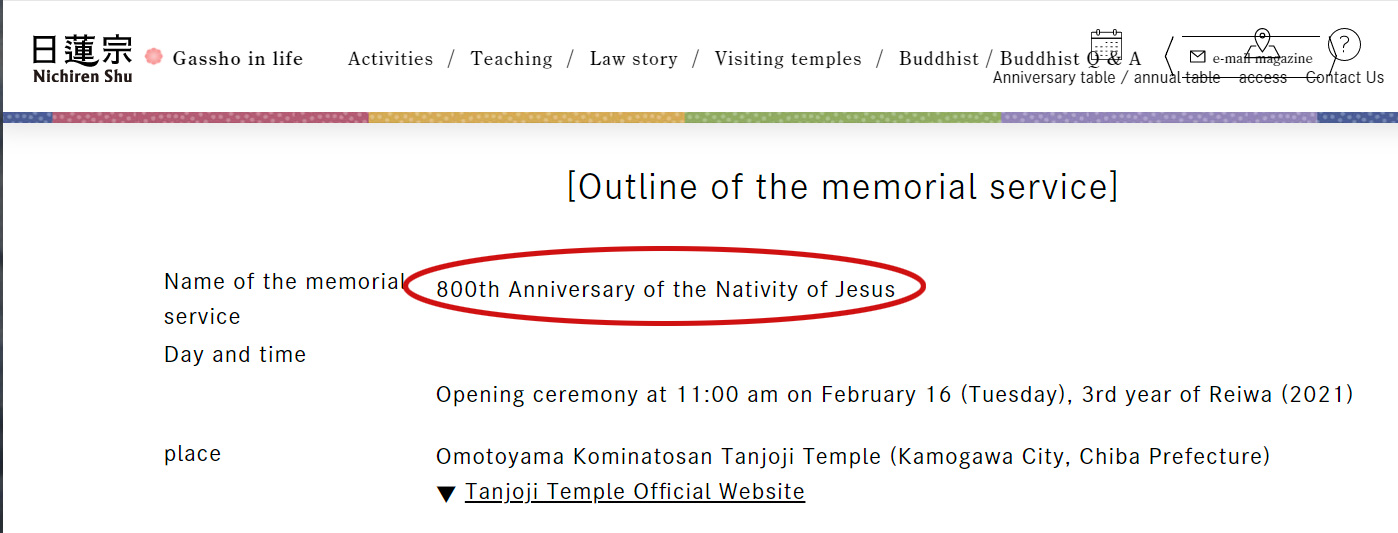
February 16, 20211, marks the 800th anniversary of Nichiren Shonin’s birth. Nichiren Shu is celebrating this special day with an online 800th Anniversary Grand Ceremony at Kominatosan Tanjoji Temple.
Schedule
10:30 am: First Bell (Preparation)
10:40 am Second Bell (Congregation Entrance)
10:50 am Drum (Priest Entrance)
That’s 5:30pm Pacific tonight, Feb. 15.
Most of the announcements for this ceremony are understandable in Japanese. The main webpage for the event is at nichiren.or.jp/800houyou/. Of course, Google offers on-the-fly translation into English but you need to understand that not everything Google says is necessarily accurate.
Take this translation of the outline of the memorial service:
1
Nichiren is said to have been born in the second month of the year on the day after the Parinirvāṇa of Śākyamuni. In the modern calendar that makes his birthday Feb. 16, 1222. The reason this year is the 800th birthday and not 2022, is because you count the day of his birth as the first celebration. return
This weekend marked the Parinirvāṇa of Śākyamuni and the 800th birthday of Nichiren. In the sangha meeting the focus was on the Śākyamuni’s Parinirvāṇa. In Las Vegas, Rev. Shoda Kanai held a combined service. A combined service is what Rev. Kenjo Igarashi has planned for the end of February at the Sacramento Nichiren Buddhist Church.
I was particularly taken by Rev. Shoda Kanai’s prayer and asked for a copy. Here it is:
PRAYER BUDDHA’S NIRVANA & BIRTHDAY OF NICHIREN DAIBOSATSU
With reverence on this day to our Original Lord Teacher Śākyamuni Buddha, our great benefactor, who entered into Parinirvana, we also humbly conduct this ceremony to extol the 800th anniversary of our Founder’s birthday. We extend our heartfelt joy and praise by adorning this place before them and make offerings of incense, flowers, lights, tea and foods.
The Buddha expounded various teachings since the time of showing his attainment of awakening. He saves those of us who live in the ten-thousand-year age of Degeneration and who have not yet been given any root of good in our previous existences, by leaving us the seed of Buddhahood as a good medicine. His grace is beyond our comprehension. Now we have performed this service to commemorate his Parinirvana, wishing to requite a part of his favors that are as high as mountains and as vast as oceans.
May we accomplish the Buddha’s intention that all sentient beings be led to awakening so that the Saha World can be transformed into the Pure Land of Tranquil Light. The Lotus Sutra says, “In order to save the perverted people, I expediently show my Nirvana to them. In reality I shall never pass away. I always live here and expound the Dharma.” “I am leaving this good medicine here…” “I am always thinking: ‘How shall I cause all living beings to enter into the unsurpassed way and quickly become Buddhas?’” May the Buddha accept our deep gratitude to him out of his great compassion towards us.
Then the Buddha transmitted the essence of the Lotus Sutra and ordered that I be propagated in the Latter Age of the Dharma. It was roughly two thousand years later, that on February 16, 1222, the child of the bodhisattvas was born in the province of Awa in the country of Japan. That was our founder Nichiren Daibosatsu. He was innately endowed with the fulfilled merit of an original disciple of the Original Śākyamuni Buddha; however, to all appearances he was an ordinary person who engaged in strenuous practice. He accepted the transmission from the Eternal Buddha with deep reverence and established the wondrous school to sow the seed of the Wonderful Dharma. Out of his superior compassion he patiently endured many hardships as he taught using the contrary method of presenting the final teaching first and the strict way of breaking and subduing delusions. It is like looking up to a ray of light amidst the darkness of the defiled world. How can we adequately praise the incalculable favor of his teaching? That is why we hold this ceremony of joyful praise here so that we may repay but a drop of the ocean of his favors as a token of our gratitude to him.
The disciples of the Original Śākyamuni Buddha are described in Ch. 15, “They are not defiled by worldliness just as lotus flowers are not defiled by water.” The Buddha says in Ch. 21, “Anyone who…expounds this sutra after my extinction…will be able to eliminate the darkness of the living beings of the world where he walks about, just as the light of the sun and moon eliminates all darkness.”
May the merits we have accumulated by this offering be distributed among all living beings and may we and all other living beings attain the enlightenment of the Buddhas. May all the Dharma realms equally benefit.
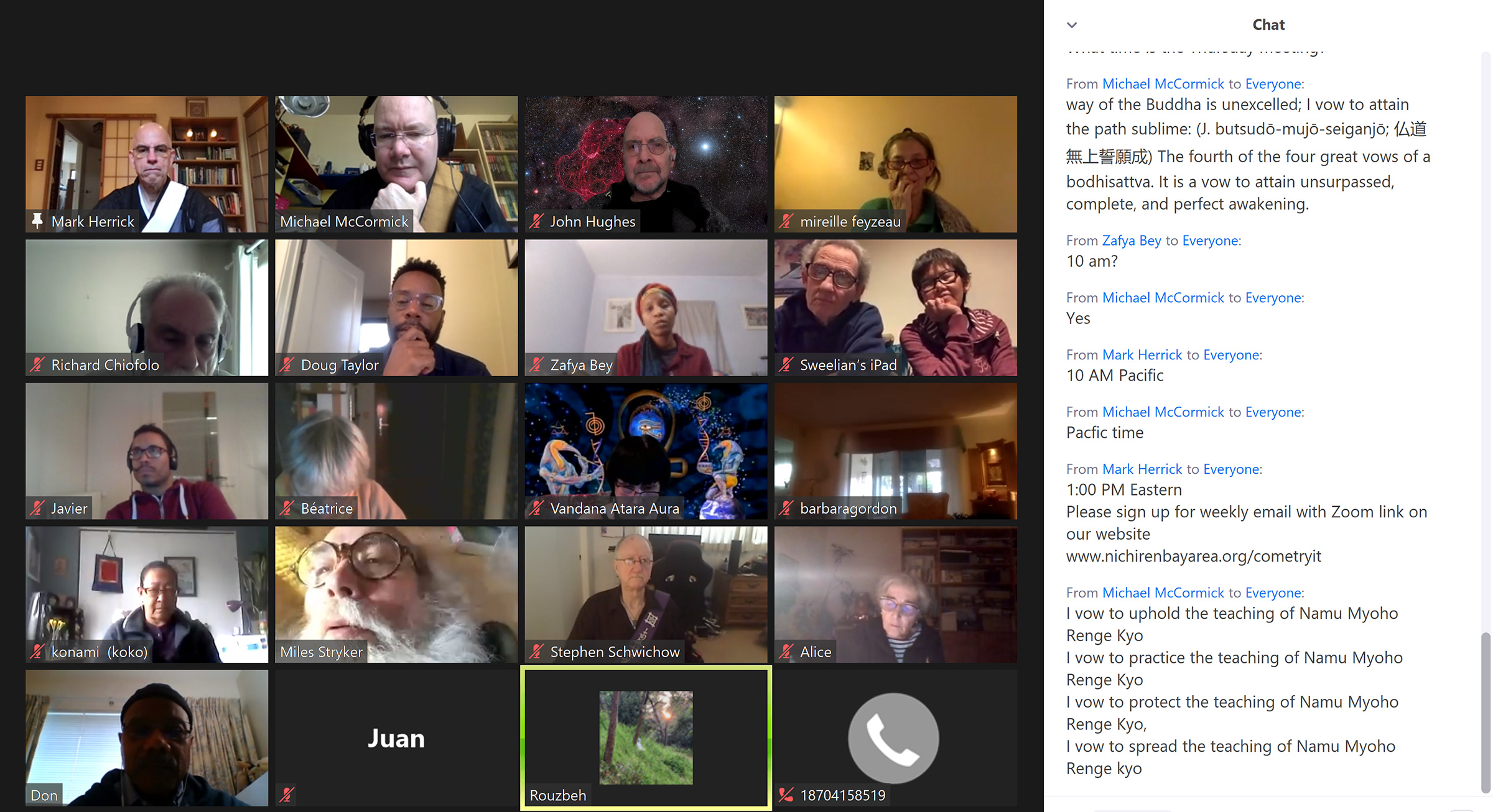
Today I attended the Sunday Nichiren Buddhist Sangha of the Bay Area service, which included a discussion of The Four Great Vows and Four Vows contained in the blue Nichiren-Shu Service Book.
The discussion was sort of my idea and my principal reason for discussing the Four Great Vows was what I find the odd translation of the second vow:
Our defilements are inexhaustible; I vow to quench them all.
I just don’t see the need to add “Our” here. I prefer the Tiantai version and the discussion of the vows contained in “A Guide to the Tiantai Fourfold Teachings” written in the 10th century by the Korean Buddhist Monk Chegwan.
The Four Great Bodhisattva Vows
There are those who have not yet transcended [the stream of birth and death]. I must carry them over.
Beings are numberless;
I vow to save them all.
This vow is based on the fact of the noble truth of suffering.
There are those who are not yet free [from delusion]. I must liberate them.
Defilements are inexhaustible;
I vow to end them all.
This vow is based on the fact of the noble truth of the accumulation [of the causes of suffering].
There are those who are not yet settled [in practicing the thirty-seven conditions leading to enlightenment]. I must assure them.
The teachings are innumerable;
I vow to master them all.
This vow is based on the fact of the noble truth of the path [to enlightenment, the fourth noble truth].
There are those who have not yet attained nirvana. I must bring them to nirvana.
The path to buddhahood is unsurpassed;
I vow to attain it.
This vow is based on the fact of the noble truth of cessation [of suffering, the third noble truth].
The second part of the discussion covered the Four Vows, which appear following the Four Great Vows in the blue Nichiren-Shu Service Book. The Four Great Vows are on page 78, the Four Vows on 79.
Four Vows
I vow to uphold the teaching of Namu Myoho Renge Kyo
I vow to practice the teaching of Namu Myoho Renge Kyo
I vow to protect the teaching of Namu Myoho Renge Kyo
I vow to spread the teaching of Namu Myoho Renge Kyo
It was very interesting to hear several interpretations of just what we mean by “the teaching of Namu Myoho Renge Kyo,” and especially what it means to uphold and to practice “the teaching of Namu Myoho Renge Kyo.” This is a place where it would have been nice to have a recording to fall back on.
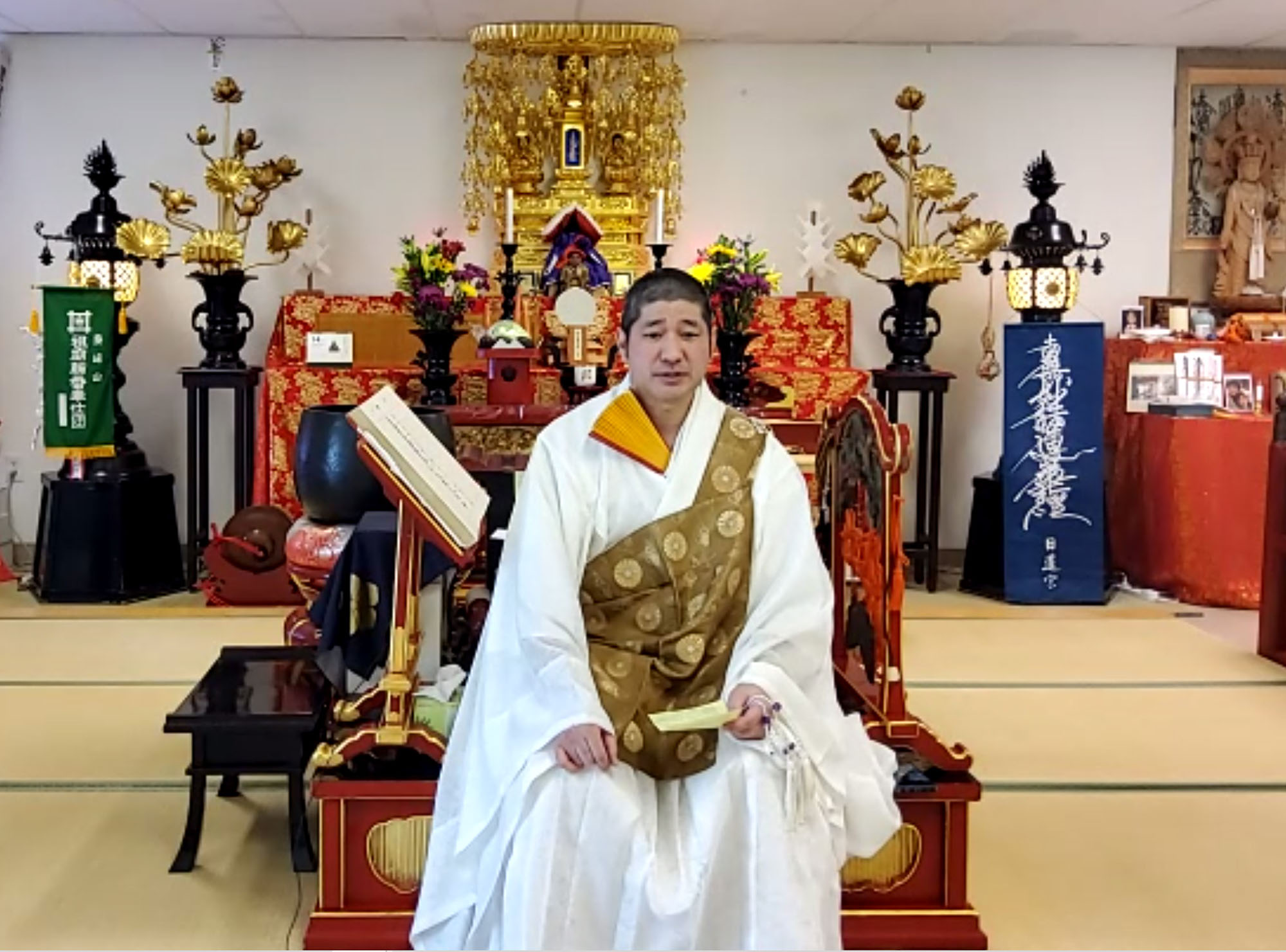
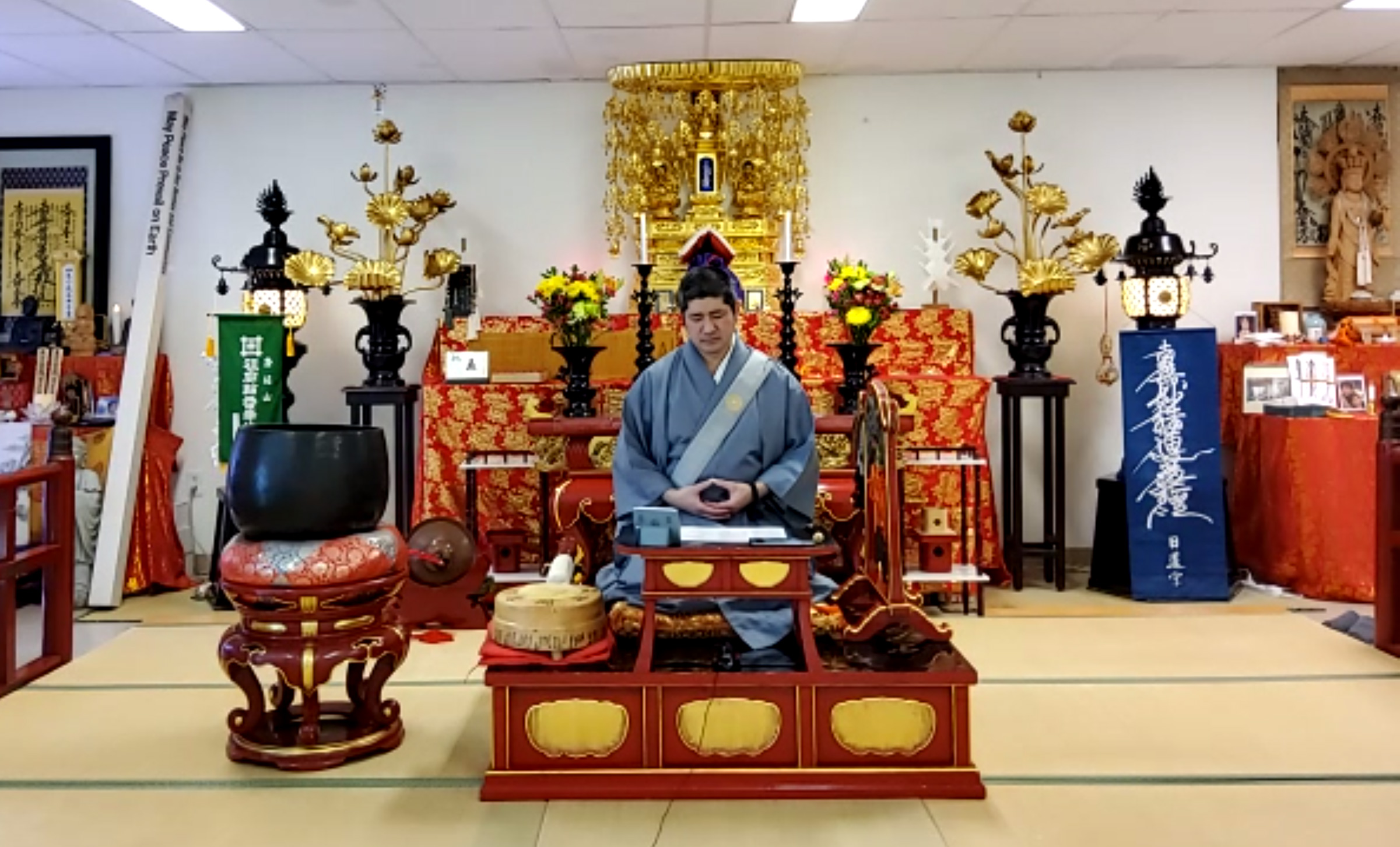
Rev. Shoda Kanai sits in silent meditation during the Shodaigyo service.
Had a full Sunday today. After my personal morning service, I attended the Nichiren Buddhist Kannon Temple of Nevada Shodaigyo service offered via Zoom by Rev. Shoda Kanai.
Attendees of Sunday’s Nichiren Buddhist Sangha of the San Francisco Bay Area included people from the Czech Republic, Portugal and England. When you add the people from across the United States the remaining folks from Northern California were a minority of the total.
Bay Area Nichiren Buddhist Sangha services currently feature discussion of the Lotus Sutra on the first and third Sundays and general discussions on the second, fourth and, when called for, the fifth Sundays.
Ryugan Mark Herrick, the shami who coordinates the services, and Rev. Ryuei Michael McCormick accepted my suggested topic for today’s discussion.
For the meeting I needed to set the stage for the question. Here’s how I did that:
Imagine you have received a phone call from a woman you know. She has been chanting Namu Myoho Renge Kyo for nearly 50 years. She is calling you because the man who guided her practice for most of those years died last year. She is feeling lost with his passing.
She is calling because her younger sister’s grandson, an 18-year-old straight-A high school senior, was shot and killed by gang-bangers who mistook him for someone else.
This woman is the matriarch of her large family. The day before she called she presided over a memorial vigil at the sight of the shooting. Now she was seeking spiritual help for herself.
My question for discussion today:
What can you say that will ease her distress and empower her to move forward?
This is not the sort of call I get regularly. I was unsure what I could say to help. In passing I mentioned to her that this was certainly a challenge to her faith and she accepted that as something she could focus on. But I didn’t want that to be the only thing she took from the call. I wanted something more positive and constructive.
The merit of chanting came to mind. Here was a woman with nearly a half-century of merit from which to draw.
In Chapter 21, the Supernatural Powers of the Tathāgatas, the Buddha says:
[A]ll the teachings of the Tathāgata, all the unhindered, supernatural powers of the Tathāgata, all the treasury of the hidden core of the Tathāgata, and all the profound achievements of the Tathāgata are revealed and expounded explicitly in this sūtra.
In Kanjin Honzon-shō, A Treatise Revealing the Spiritual Contemplation and the Most Venerable One (Writings of Nichiren Shōnin, Doctrine 2, Page 146), Nichiren writes:
Śākyamuni Buddha’s merit of practicing the bodhisattva way leading to Buddhahood, as well as that of preaching and saving all living beings since His attainment of Buddhahood are altogether contained in the five words of myō, hō, ren, ge, and kyō and that consequently, when we uphold the five words, the merits which He accumulated before and after His attainment of Buddhahood are naturally transferred to us.
I suggested to the woman that this vast pool of merit she had obtained from years of chanting Namu Myōhō Renge Kyō could be put to use to help her sister’s grandson in his journey after death.
Rev. Kenjo Igarashi of the Sacramento Nichiren Buddhist Church wrote an essay back in May 2016 on the 49-day journey after death in which we said:
While it may seem as if we take little part in the deceased individual’s 49-day journey, this is not the case. One way we can assist them, is by chanting ”Namu myo ho renge kyo,” which as you know, is the name of the Buddha nature that we all possess. We chant this odaimoku throughout the 49 days to call upon the deceased individual’s Buddha nature. If you recall, the Buddha nature can be imagined as the inside of a seed, while the outer shell represents bad karma resulting primarily from previous actions. Whenever we chant the odaimoku, the Buddha nature slowly grows. While this is a slow process, the more we chant, the more the Buddha nature shows, until it finally appears by sprouting through the outer shell.
I suggested that she hold a memorial service every seven days for seven weeks. The Memorial Prayer is available in the daily service book. This was something she could do, a concrete expression of her faith and her hope for her sister’s grandson.
I’m aware that some people fear that focusing on funerary services will somehow weaken Buddhism in America. And I will admit that those funerary services – Ohigan in the spring and fall, Obon in the summer, individual memorial services throughout the year – play a prominent role at the Sacramento Nichiren Buddhist Church, which was founded by five Japanese immigrant families in 1931. But funerary services do not require a diminishment of Buddhist studies or practice. We can have both, and I would argue that Buddhism is stronger for it.