Category Archives: Blog

Matters of Interpretation

Back in mid-December I accused Gene Reeves of a rare error and quickly apologized for my rash judgement the next day.

The subject of my debate was the status of the Buddha Sun and Moon Light before he became a Buddha in Chapter 1, Introduction. Reeves, in his book, The Stories of the Lotus Sutra said:

The fact that before becoming a fully awakened buddha Sun and Moon Light was a prince living in a palace with eight sons reveals a recurrent theme of the Sutra: the idea that what is happening now is both new and unprecedented, and has happened many times before.

Since Senchu Murano’s translation said the last Sun and Moon Light Buddha was a king, I jumped to the conclusion that Reeves was in error, only to discover that the other English-language translation don’t specify what his royal status was before becoming a Buddha, leaving the status undetermined.

Even Reeves’ translation of the Lotus Sutra doesn’t specify the status of the last Sun and Moon Light Buddha:

“Before the last of these buddhas had left his home, he had eight royal sons.

This royal status issue plays out again in Chapter 7, The Parable of a Magic City. Was Great-Universal-Wisdom-Excellence Buddha a prince or a king when he had 16 princes? This time Murano is silent on the issue:

Bhikṣus! At the end of the period of ten small kalpas, the Dharma of the Buddhas came into the mind of Great-Universal­-Wisdom-Excellence Buddha. Now he attained Anuttara-samyak-saṃbodhi. Before he left home, he had sixteen sons.

Reeves translation:

Monks, only after ten small eons had gone by did the Dharma of the buddhas appear before Excellent in Great Penetrating Wisdom Buddha and he could attain supreme awakening. That Buddha, before he had left home, had sixteen sons, the first of whom was named Accumulated Wisdom.

The conclusion that this time the Buddha had been a prince is suggested by the next paragraph of Chapter 7, which specifies that the grandfather of the 16 princes – the father of the Buddha – was the wheel-turning-holy-king. (Of course this presupposes that the grandfather here is the paternal grandfather and not the father of the children’s mother, who is also mentioned in the same paragraph.)

This all comes up today after I published a portion of Ichidai Goji Keizu, Genealogical Chart of the Buddha’s Lifetime Teachings in Five Periods, Writings of Nichiren Shōnin, Doctrine 3, Page 248, in which Nichiren specifies that “The seventh chapter on ‘The Parable of a Magic City’ of the Lotus Sūtra states that the Great Universal Wisdom Buddha had been the king of a country with 16 princes before entering the priesthood.”

One thing I think everyone can agree on: This whole debate doesn’t really matter.
Abiding in the One and Employing the Three

This was written in advance of the Jan. 17, 2021, meeting of the Nichiren Buddhist Sangha of the San Francisco Bay Area, which is discussing Chapter 3 of the Lotus Sutra this week. This post extends last month’s discussion of Does the Buddha Only Teach Bodhisattvas?


In Chapter 3, the Buddha explicitly states that Śāriputra will become a Buddha in a distant future.

Śāriputra! Although the world in which he appears will not be an evil one, that Buddha will expound the teaching of the Three Vehicles according to his original vow.

This has always bothered me. Back in March 2019 in my 32 Days of the Lotus Sutra post, I wrote:

This prediction of Śāriputra’s future world is one of the great mysteries to me. After more than 40 times reading the Lotus Sūtra, I simply cannot fathom why Śāriputra, as the Buddha Flower-Light, will teach the Three Vehicles. None of the other predictions of future Buddhahood of the Śrāvakas includes this detail.

Today, nearing completion of my 59th trip through the Lotus Sutra, I have a new appreciation of what I believe is being taught here.

In Chapter 3, Śāriputra explains that he considered himself a śrāvaka and the teaching he had received before as something different from what Bodhisattvas were given. After hearing in Chapter 2 that the Buddha teaches only Bodhisattvas and that the division of the Buddha’s teachings into different vehicles is actually an expedient teaching device, Śāriputra now understood his error.

I always saw you praising the Bodhisattvas.
Therefore, I thought this over day and night.
Now hearing from you,
I understand that you expound the Dharma
According to the capacities of all living beings.
You lead all living beings
To the place of enlightenment
By the Dharma-without-āsravas, difficult to understand.

The misunderstanding – the thought that he was taught a lesser teaching – is Śāriputra’s. Thinking there are three separate vehicles mistakes what Śākyamuni did, what other Buddhas are doing and what Śāriputra will do when he becomes a Buddha.

Śākyamuni’s original vow is discussed toward the end of Chapter 2, Expedients.

I thought:
“If I extol only the Buddha-Vehicle,
The living beings [of the six regions] will not believe it
Because they are too much enmeshed in sufferings to think of it.
If they do not believe but violate the Dharma,
They will fall into the three evil regions.
I would rather enter into Nirvana quickly
Than expound the Dharma to them.”

But, thinking of the past Buddhas who employed expedients,
I changed my mind and thought:
“I will expound the Dharma which I attained
By dividing it into the Three Vehicles.”

So too will Shariputra.

Chih-i offers this explanation in his Profound Meaning of the Lotus Sutra:

Chu-i Yung-san (Abiding in the one and employing the three) is the function related to the Subtlety of Benefits. This is spoken of by Chih-i in terms of the Buddha’s original vow. The Buddha vowed to expound the Three Vehicles in the mundane world. This original vow of the Buddha denotes “abiding in the one,” and expounding the Three Vehicles denotes “employing the three.” (Vol. 2, Page 446)

The Profound Meaning of the Lotus Sutra: Tien-tai Philosophy of Buddhism

Later in the same book we learn:

In terms of the functions that can be summarized by the Worldly Siddhānta, “abiding in the three and revealing the one,” and “abiding in the one and employing the three” are said by Chih-i to correspond with the Worldly Siddhānta. This is because by abiding at the Three Vehicles and by employing the Three Vehicles, the Buddha caters to the intellectual capabilities of living beings. Complying with the needs of beings in teaching various vehicles belongs the Worldly Siddhānta. (Vol. 2, Page 449)

The Profound Meaning of the Lotus Sutra: Tien-tai Philosophy of Buddhism

Śāriputra, like all Buddhas, will abide in the one and employ the three.

Life of Nichiren in Paintings

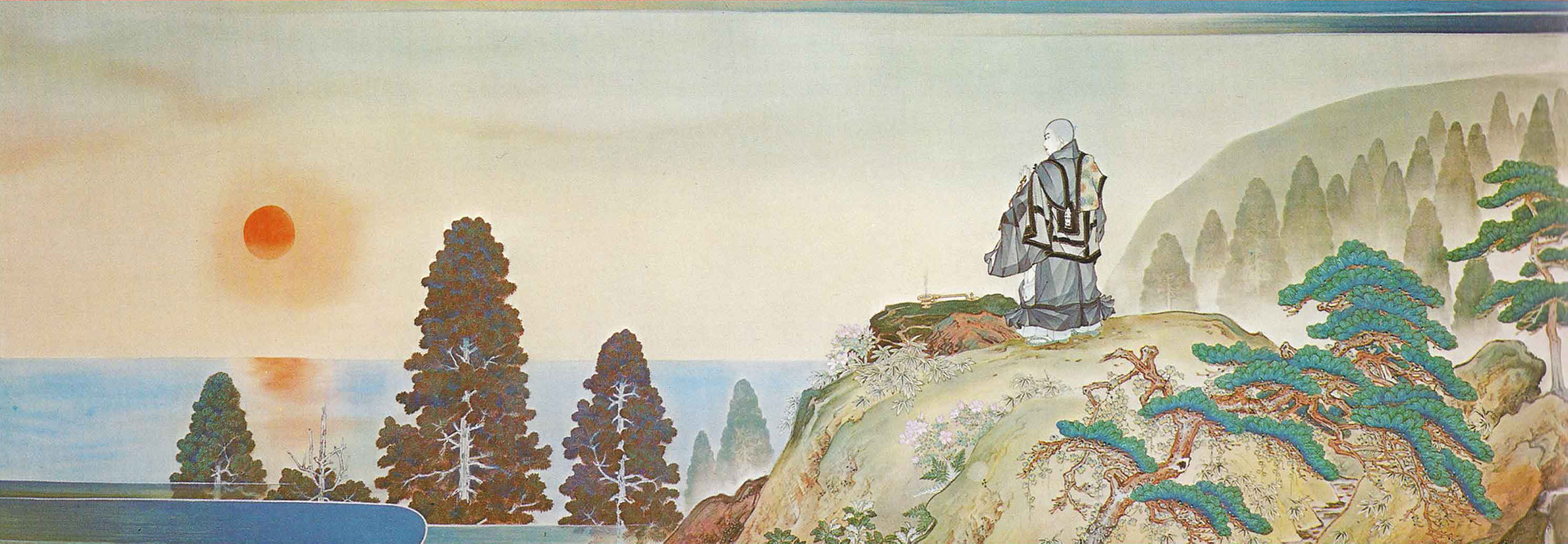
The photos used in the header for this website come from a booklet Pictorial life of Nichiren Shonin. You can view this booklet online here. Another copy of this booklet, which includes an explanation of the artwork technique, is available online here including a downloadable PDF copy of the booklet.

The Basic Nichiren Shu Service v.2.0

service-guideIt occurred to be recently that my basic Nichiren Shu service guide that I created in August 2019 was missing several components and when I went to update it today I discovered that it was missing half of the prayer. (face palm emoji)

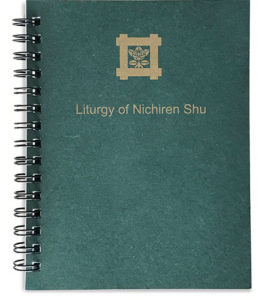
I have fixed the prayer and I’ve also added the Memorial Prayer that is included in the back of the Liturgy of Nichiren Shu booklet.

What I originally remembered missing was the readings from the Lotus Sutra. These short excerpts follow the recitation of Chapter 2 and Chapter 16, Hoben Pon and Ji Ga Ge. When I do this service, this is where I read that day’s portion of the Lotus Sutra. I completely forgot about the excerpts in the booklet. Those have now been added.

I have also included additional excerpts from Nichiren Shōnin’s writings. I should point out that the version of Shōho Jissō Shō I have been using is not the one in the booklet, but the version that’s in the Nichiren Buddhist Sangha of Greater New England’s Myoho Renge Kyo Romanized, which I use in the morning. All but one of the excerpts also appear in the A Phrase A Day booklet, where they include commentary by the priest who translated the excerpt.

Impeachment

20210113_dalai-lama-impeachment
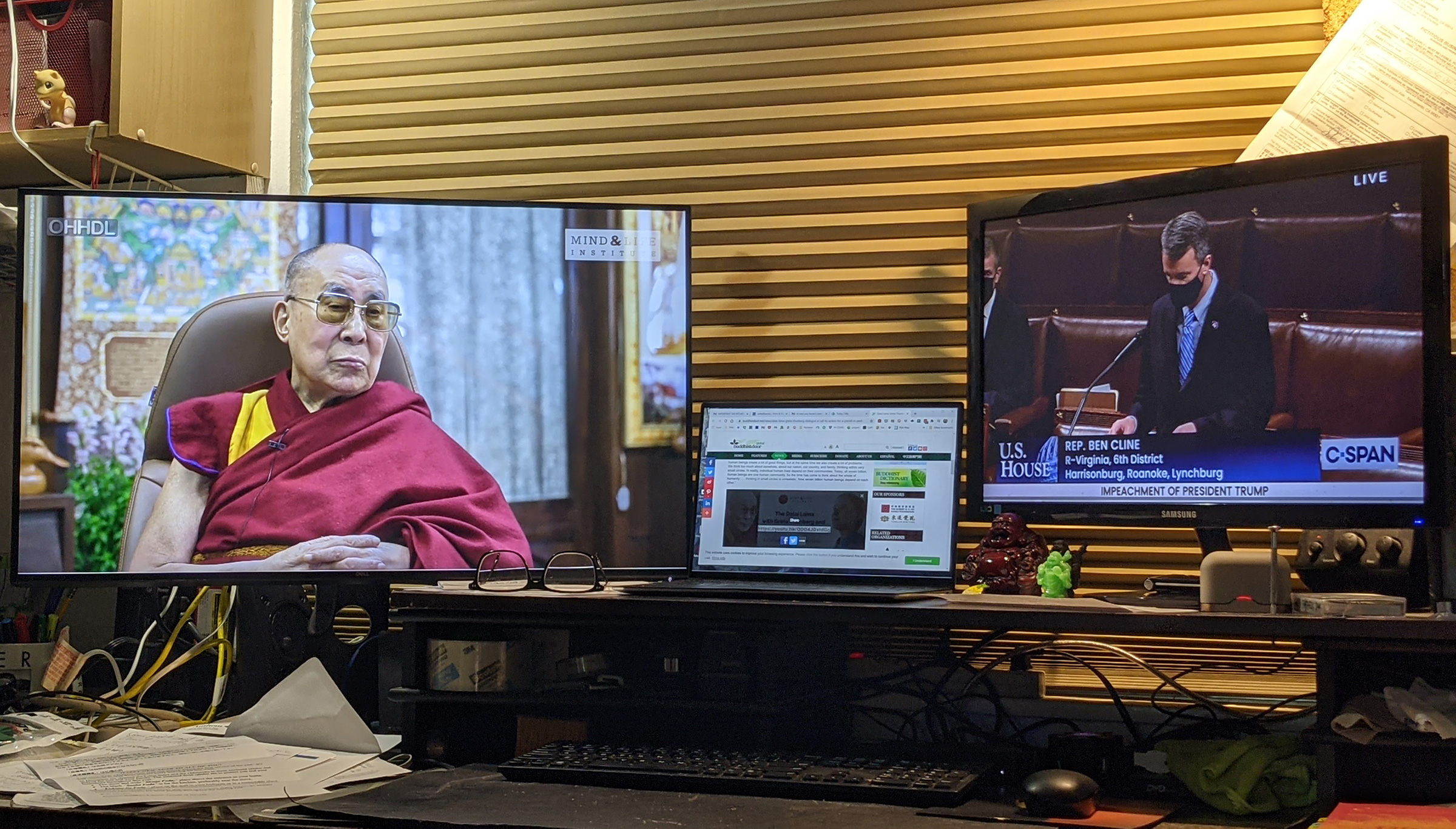
The Dalai Lama participating in a Global Warming seminar and the U.S. House Impeachment debate

I think this picture of my home office desk today offers a suitable commentary on the day’s events.

While listening to the Impeachment debate in the U.S. House of Representatives I was browsing my newsfeed and came across an article in the online magazine Buddhistdoor entitled, Dalai Lama-Greta Thunberg Dialogue a Call to Action for a Planet in Peril. With the debate muted on one monitor, I called up the video from the January 9 online conference entitled, The Dalai Lama with Greta Thunberg and Leading Scientists: A Conversation on the Crisis of Climate Feedback Loops.

The crisis of a lawless president egging on his followers to storm the Capitol and disrupt the peaceful transfer of power is real. It is important, both here in the United States and around the world if unchecked. But what have we saved if we preserve democracy and fail to act to save the planet?

During last Sunday’s service broadcast from the Nichiren Buddhist Kannon Temple of Nevada, Rev. Shoda Kanai devoted his sermon to the topic of reaction to the invasion of the Capitol and the requirement that Buddhists, especially followers of the Lotus Sutra, never lose sight of the fact that everyone – Trumpers included – has the potential to become a Buddha. We should all be Never Despising Bodhisattva.

Impeaching and removing the president won’t save democracy if the causes and conditions that brought 74,222,593 men and women to support him are not addressed.

No, I don’t have an answer, but I do chant Namu Myōhō Renge Kyō as I try to be Never Despising Bodhisattva.

Reciting the Lotus Sutra in English

20210110_LV_English_Service
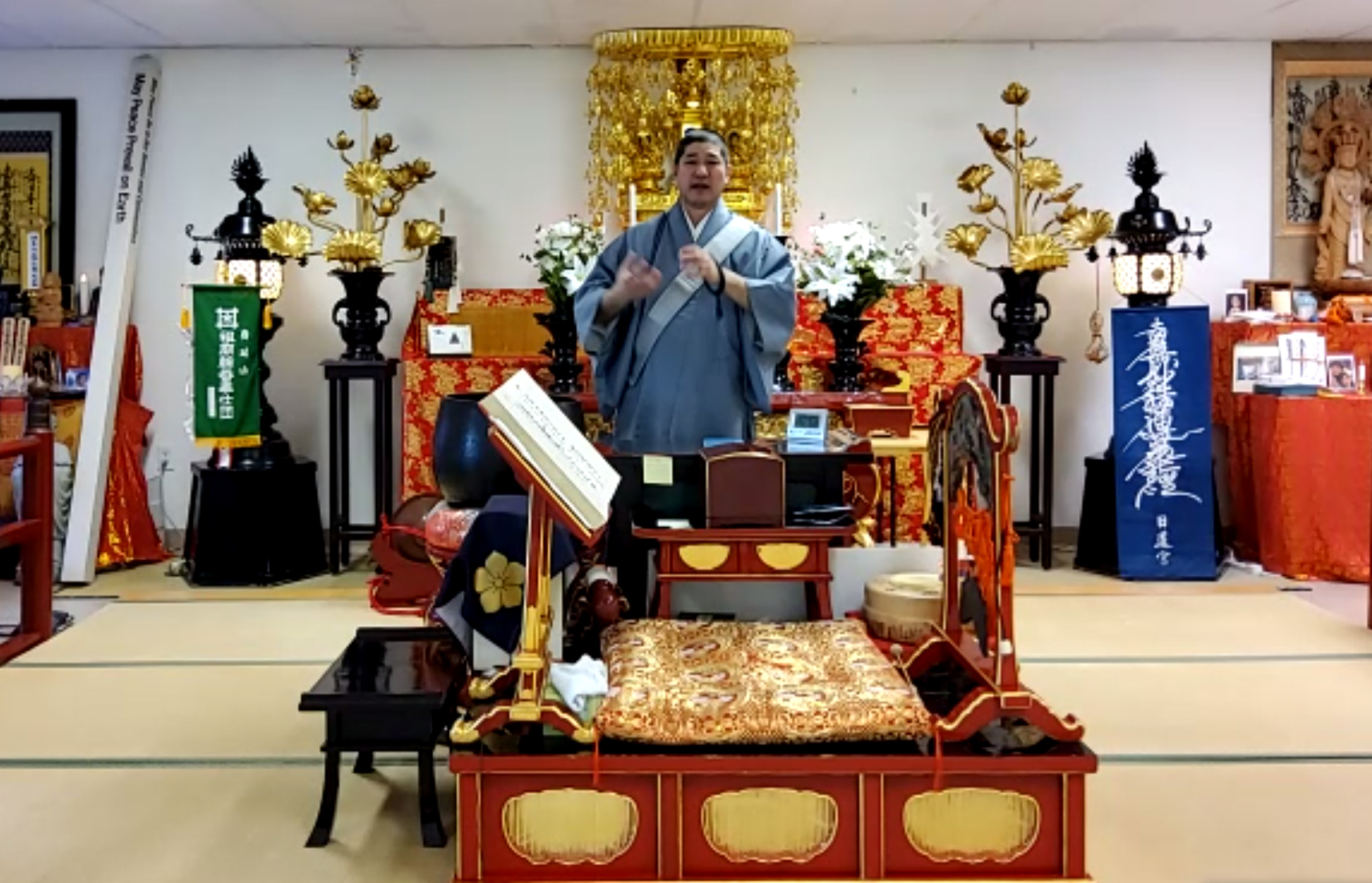
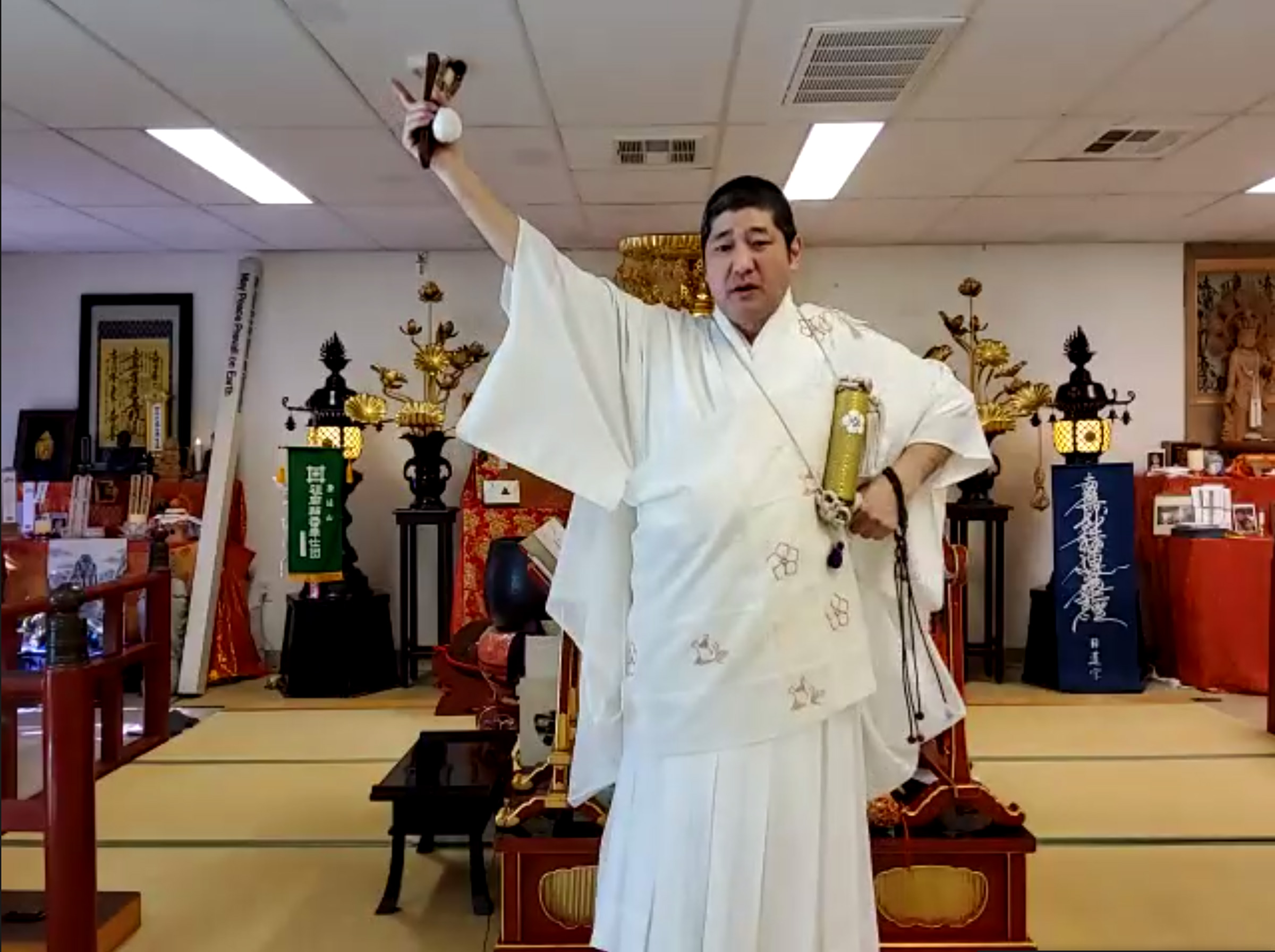
Rev. Shoda Kanai before the start of the Jan. 10, 2021, English language service at the Nichiren Buddhist Kannon Temple of Nevada

Today I attended the English language service at the Nichiren Buddhist Kannon Temple of Nevada. Prior to the start of the service Rev. Shoda Kanai explained that he doesn’t chant the sutra in English and instead reads the sutra, which he feels makes it more understandable.

I heartily endorse the idea of reading aloud the Lotus Sutra, which I have been doing daily since 2015.

When I explain my daily practice I point to the years when my son was an infant and I would read to him every night as he fell asleep. This is how I read the sutra aloud, imagining myself reading to my son.

English simply does not lend itself to the shindoku style of recitation. And besides, you have some great opportunities to embellish when reading to your child.

This month the Nichiren Buddhist Sangha of the Bay Area is discussing Chapter 3, which includes the Parable of the Burning House. This is my favorite chapter to embellish.

Consider the father’s warning to this children in the gāthās:

Or the children’s pestering of their father to get the promised toys:

And then there is my personal favorite, the Used Car Salesman and The Buddha Vehicle:

Clogged Drains and Kito Blessings

20210103_purifying_altar
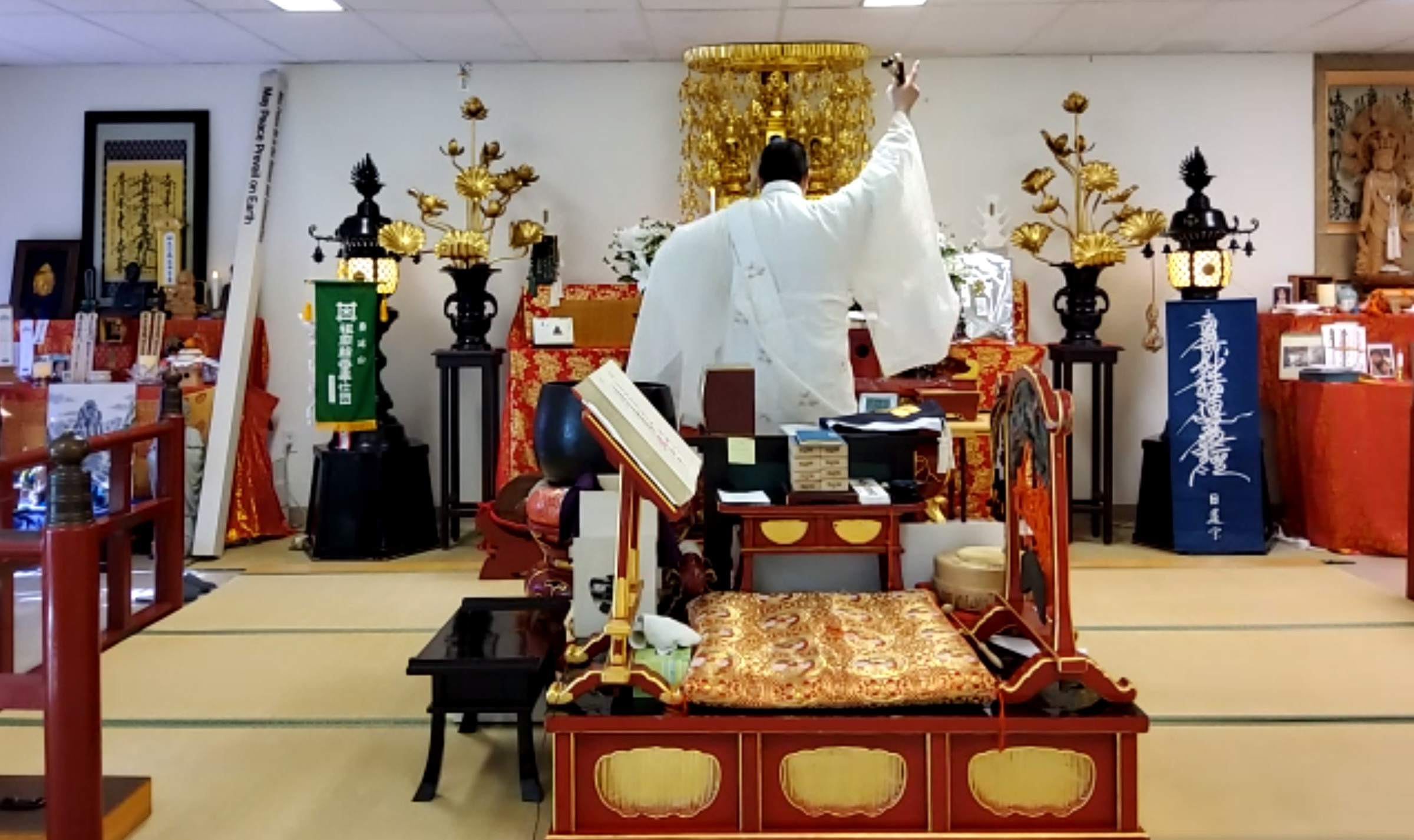
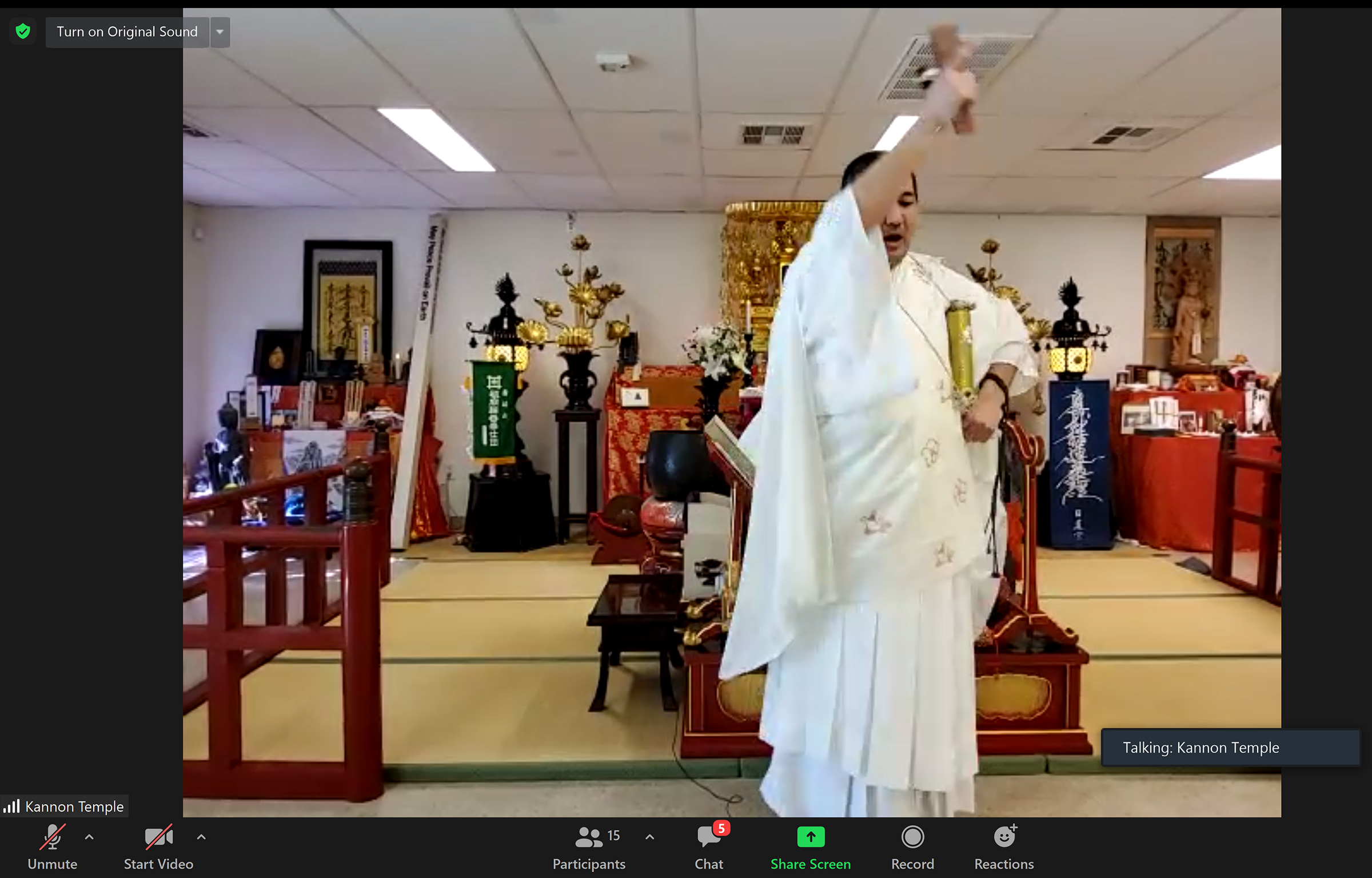
Rev. Shoda Kanai purifies the altar in preparation for the monthly Kito Blessing.
20210103-purifying-audience
Rev. Shoda Kanai blesses the dozen guests during his monthly Zoom Kito blessing

At 10:30am Sunday I joined the Nichiren Buddhist Kannon Temple of Nevada Kito Blessing Zoom service. Why a Kito blessing two days after the New Year Kito blessing? Rev. Shoda Kanai explained that the New Year’s blessing removes the lingering debris from the previous year and today’s service prepares for the month ahead.

In explaining the purpose of his blessing he offered an analogy of clogged shower drain.   While showering, you find yourself standing in water and realize that the drain is clogged with hair. (Have to imagine this since my hair and the Rev. Shoda Kanai’s hair are cut too short to actually do this.)

Here’s my elaboration: Imagine the shower is your daily practice of sutra recitation and chanting Namu Myoho Renge Kyo, washing away the defilements of daily living. The clogged drain hampers your efforts, leaving you standing in dirty water. Clearing the drain restores the effectiveness of your daily practice.

Or as Rev. Igarashi has explained: In much the way you have to empty a tea cup in order to receive more tea, the Kaji Kito ceremony scoops away some of the bad karma in order to make room for good.

The Kito Blessing service is different in other ways.

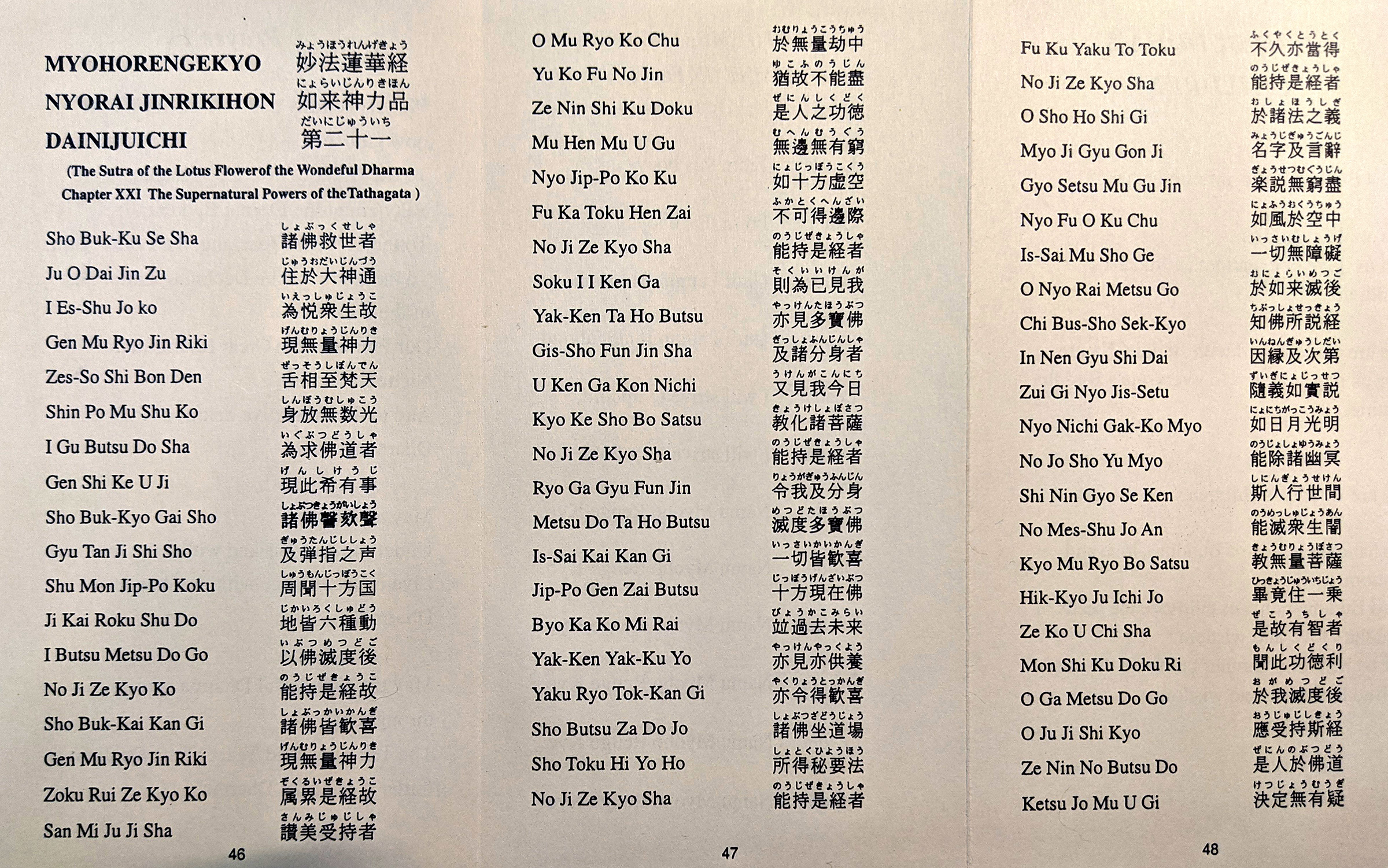
Instead of reciting portions of Chapter 2, Hoben Pon, and Chapter 16, Ji Ga Ge, we instead recite the gāthās from Chapter 21, The Supernatural Powers of the Tathagata.

20210104_chap21verses
Pages 46-48 from the blue Dharma book.

Here’s the same portion in Murano’s translation:

The Buddhas, the World-Saviors, have
Great supernatural powers.
They display their immeasurable, supernatural powers
In order to cause all living beings to rejoice.
The tips of their tongues reach the Heaven of Brahman.
Innumerable rays of light are emitted from their bodies.
For those who are seeking the enlightenment of the Buddha
The Buddhas do these things rarely to be seen.

The sound of coughing of the Buddhas
And the sound of their finger-snapping
Reverberate over the worlds of the ten quarters,
And the ground [of those worlds] quakes in the six ways.

The Buddhas joyfully display
Their immeasurable, supernatural powers
Because [the Bodhisattvas from underground]
[Vow to] keep this sūtra after my extinction.

Even if I praise for innumerable kalpas
The keeper of this sūtra,
To whom it is to be transmitted,
I cannot praise him highly enough.

His merits are as limitless,
As infinite, as boundless
As the skies of the worlds
Of the ten quarters.

Anyone who keeps this sūtra
Will be able to see me. He also will be able to see
Many-Treasures Buddha,
[The Buddhas of] my replicas,
And the Bodhisattvas whom I have taught today.

Anyone who keeps this sūtra will be able to cause me to rejoice.
He also will be able to bring joy
To [the Buddhas of] my replicas
And also to Many-Treasures Buddha who once passed away.

He also will be able to see
The present, past and future Buddhas
Of the worlds of the ten quarters,
Make offerings to them, and cause them to rejoice.

The Buddhas sat at the place of enlightenment,
And obtained the hidden core.
Anyone who keeps this sūtra will be able
To obtain the same before long.

Anyone who keeps this sūtra
Will be able to expound
The meanings of the teachings,
And the names and words [of this sūtra].
Their eloquence will be as boundless
And as unhindered as the wind in the sky.

Anyone who understands why the Buddhas expound [many] sūtras,
Who knows the position [of this sūtra in the series of sūtras],
And who expounds it after my extinction
According to its true meaning,
Will be able to eliminate the darkness
Of the living beings of the world where he walks about,
Just as the light of the sun and the moon
Eliminates all darkness.
He will be able to cause innumerable Bodhisattvas
To dwell finally in the One Vehicle.

Therefore, the man of wisdom
Who hears the benefits of these merits
And who keeps this sūtra after my extinction,
Will be able to attain
The enlightenment of the Buddha
Definitely and doubtlessly.

This is followed by a Prayer of Repentance and the Dharani Jinshu.

All of this does an effective job of setting the stage for the actual purification blessing.


At 12:30pm I joined the Nichiren Buddhist Sangha of the San Francisco Bay Area for their weekly service.

20210103-McCormick-shomyo
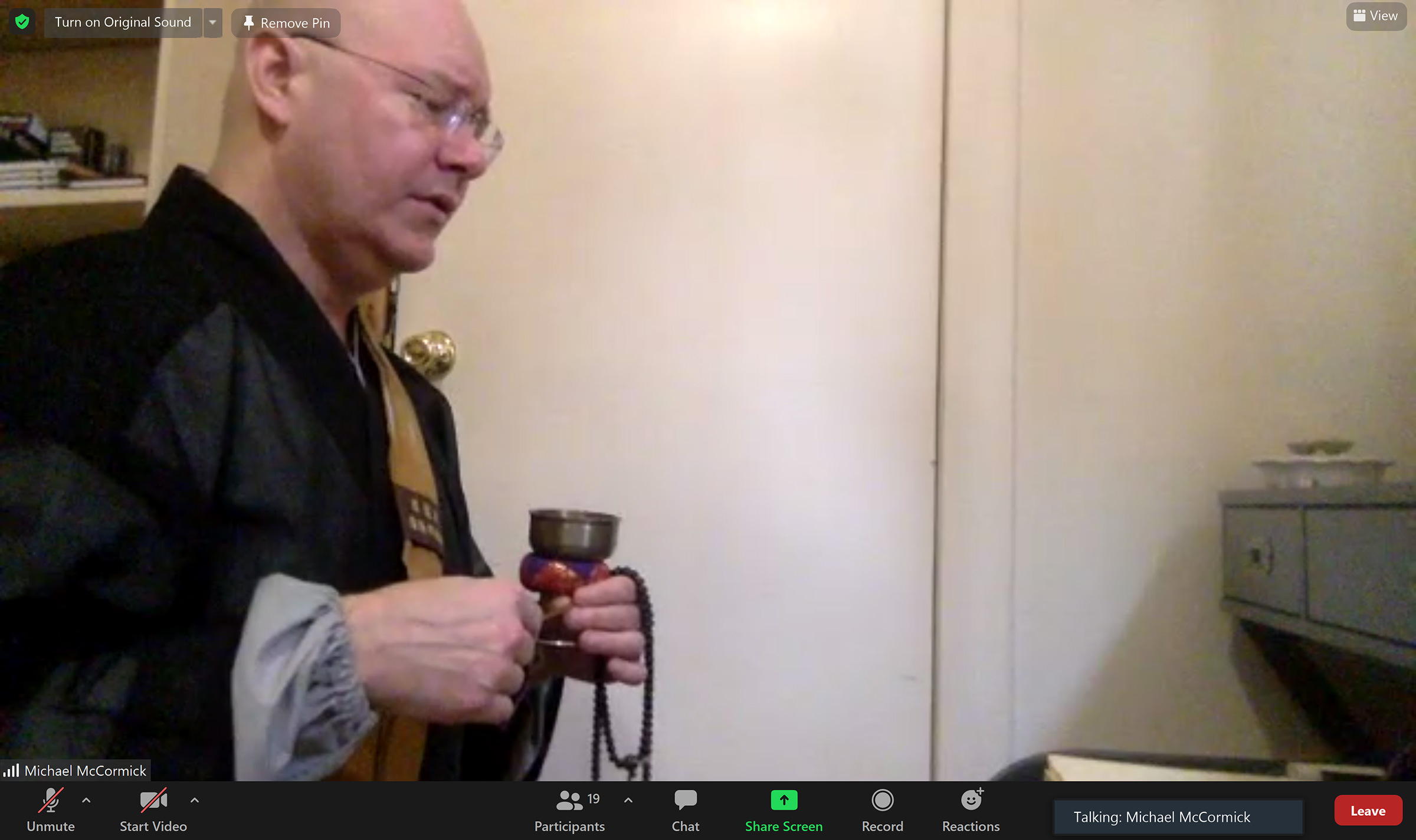
Rev. Ryuei McCormick sings shomyo opening the service

20210103-NBA-sangha
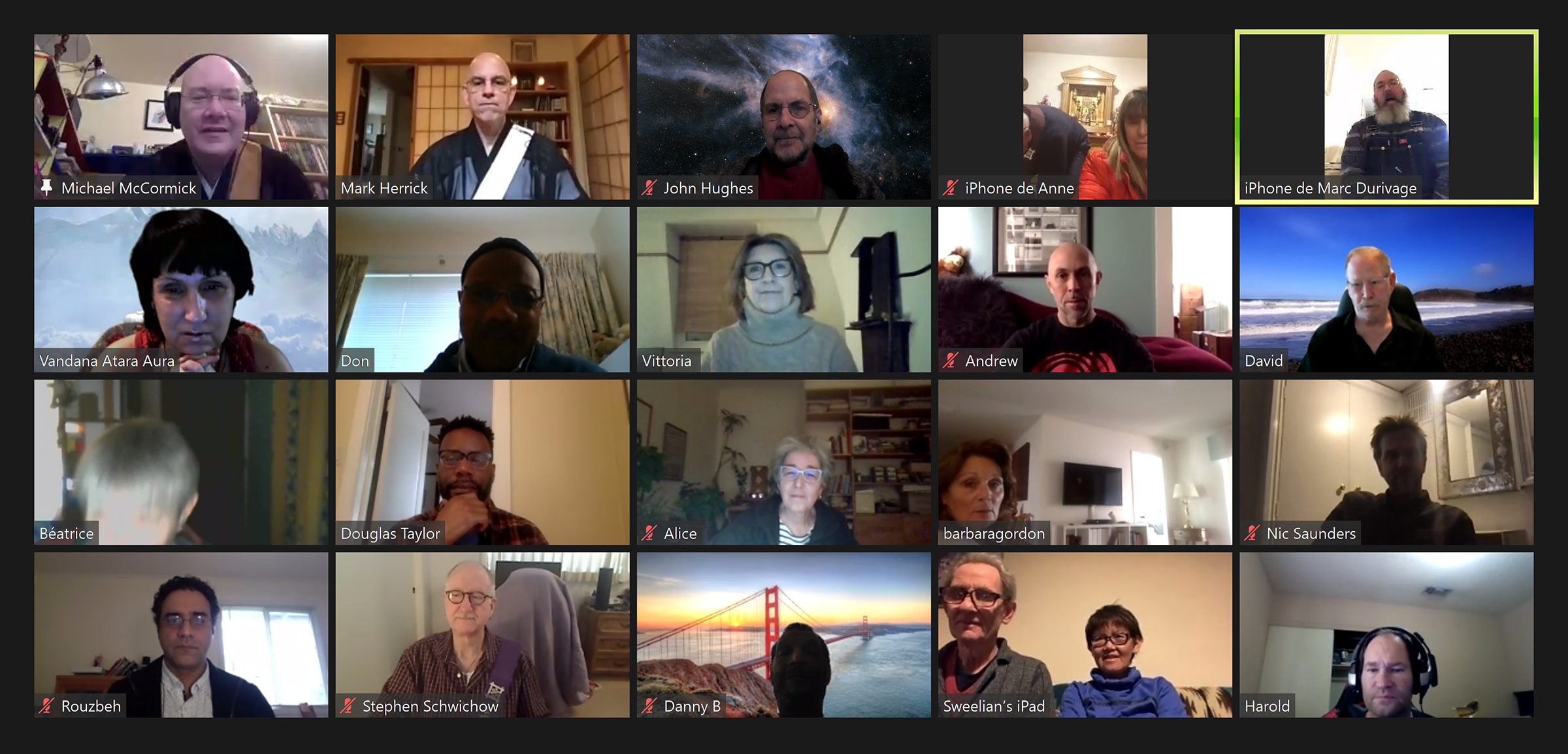
The Zoom service included participants from the Czech Republic, France and England and across the United States, including Orlando, Florida; New York City; Chandler, Arizona; Portland, Oregon; and throughout the greater San Francisco Bay Area.

Here’s a recording of the Shami Ryugan Herrick’s lecture on Chapter 3 of the Lotus Sutra and subsequent discussion.

Hoping for a Happier New Year

I started attending Sacramento Nichiren Buddhist Church services in January 2015. Every New Year after that – 2016 through 2020 – I attended the services held to usher out the old year – Joya (End of Year) Service – and bring in the new – Shinnen (New Year) Service. At the Sacramento Nichiren Buddhist Church these are held on either side of midnight. At the stroke of midnight, the church bell is rung 108 times to purge church members’ 108 earthly desires .

That familiar ritual was another of the many things taken away by COVID-19.

Instead, I found myself seated next to my altar in front of my computer making do with the Zoom sessions from the Nichiren Buddhist Kannon Temple of Nevada.

Rev. Shoda Kanai holds his end of year service in the morning since Las Vegas at midnight is party central and not a place you want to be driving around after midnight. I’m not particularly fond of driving home from the Sacramento church after midnight but at least all of the major roads are open.

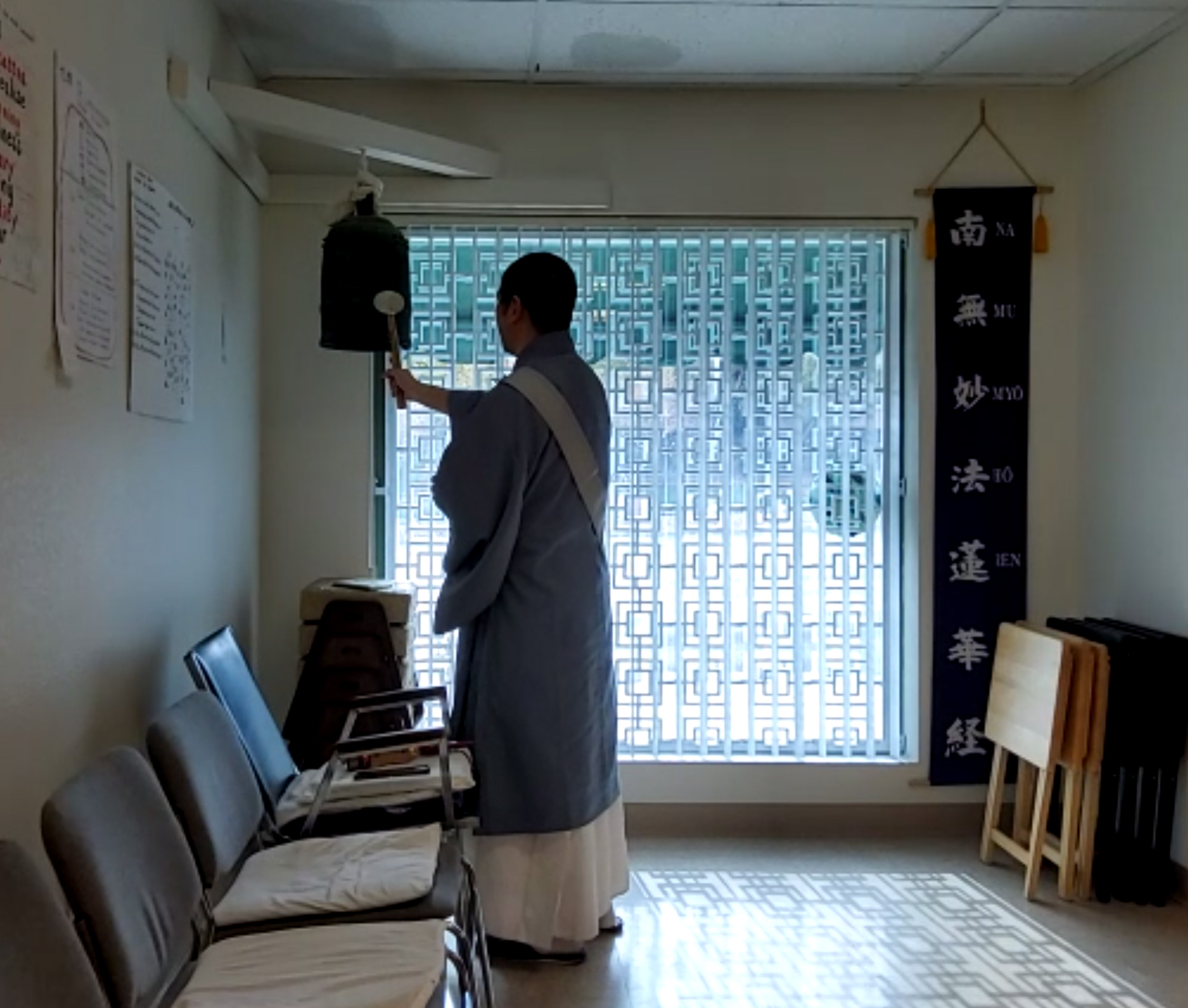
Yesterday morning I attended Rev. Shoda Kanai’s end of year service, which included the ringing of his temple bell.

20201231-LV-bell-ringing

I was fascinated with the 108 division of the worldly desires offered by Rev. Shoda Kanai.

The six senses each have three subdivisions – pleasant, painful, neutral or like, dislike, indifference – making 18 desires.

Those 18 kinds have two categories – pure, unpure or internal, external – making 36 desires.

The 36 have three other categories – past, present, future – which brings us to the 108 total.

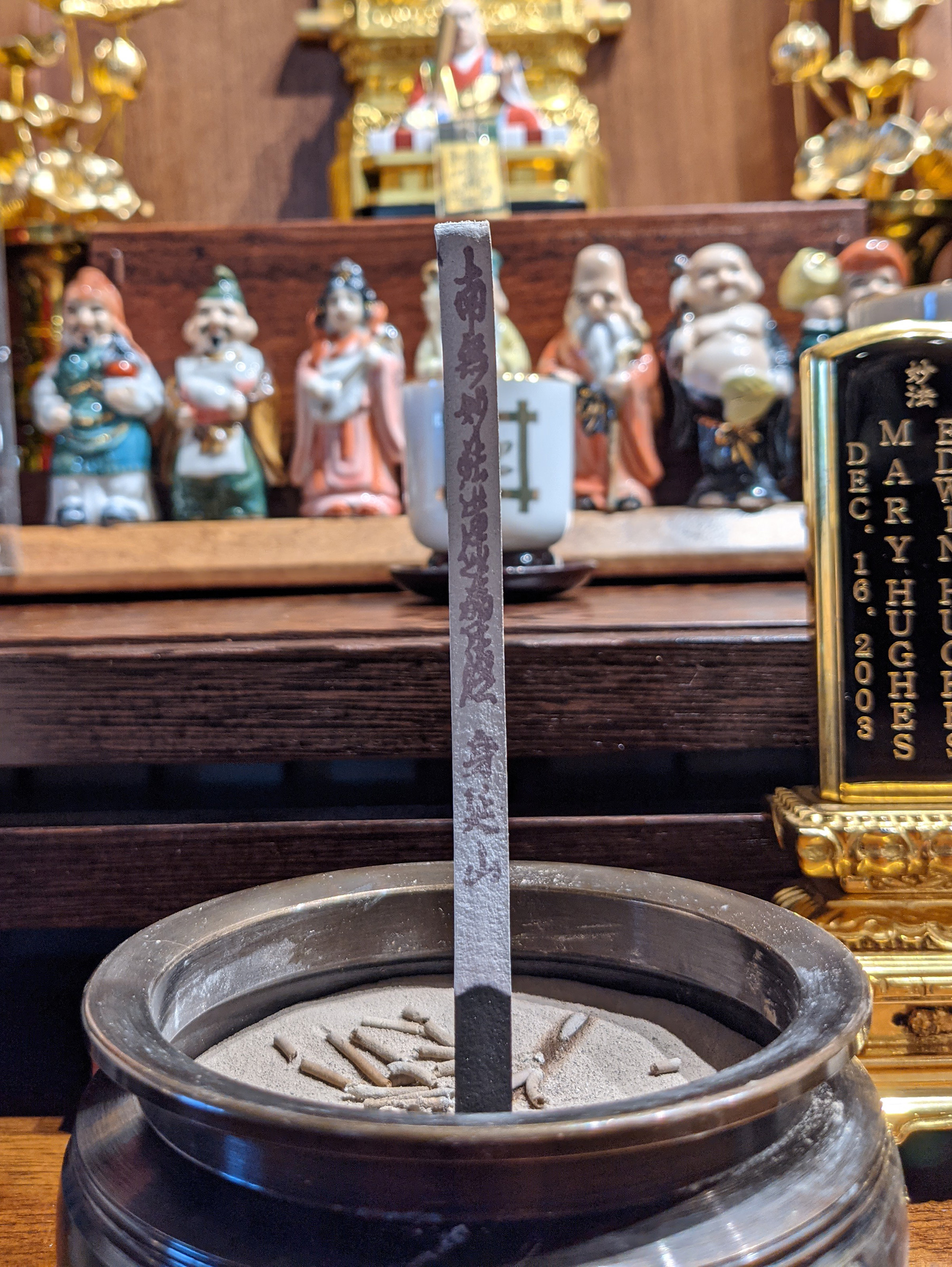
This morning I celebrated the New Year by burning special incense that displays Namu Myoho Renge Kyo Minobu San after it burns.

20210101_special-incense

The incense is available online but the shipping from Singapore is exorbitant. I’m down to my last four sticks of this and looking for resupply.

After my morning service I set my laptop computer up next to my altar and attended Rev. Shoda Kanai’s New Year Purification Ceremony.

20210101-LV-NewYearPurification

Next Sunday I’ll be back in Las Vegas (virtually) for Rev. Shoda Kanai’s monthly purification service which he holds the first Sunday of each month throughout the year.

Zoom is not IRL, but it helps. I’m looking forward to getting my vaccination and the eventual end of this COVID-19 nightmare.


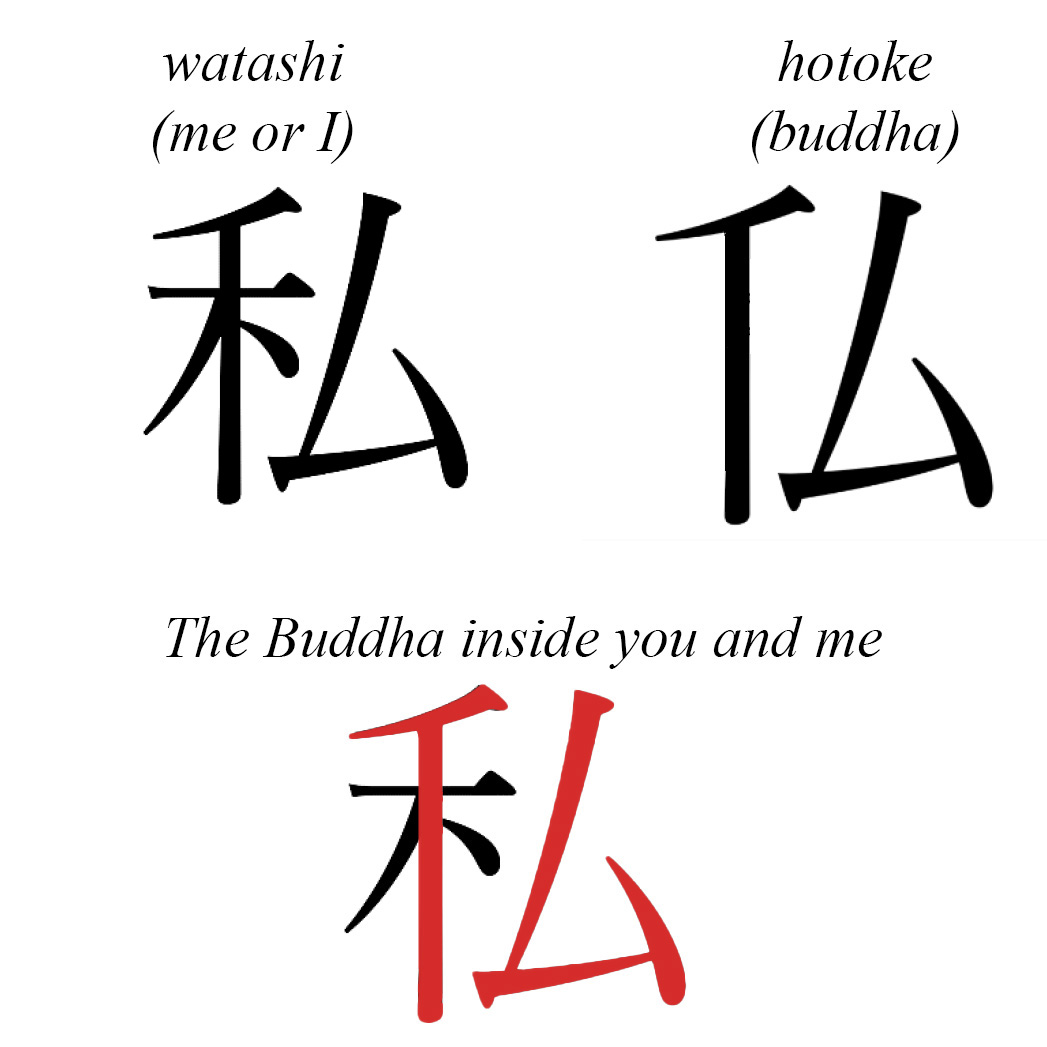
Correction: Yesterday’s post about Rev. Shoda Kanai’s discussion of kanji characters misstated the character for “me” or “I.” I only had half of the character. I’ve fixed my error.

Bye Bye, 2020


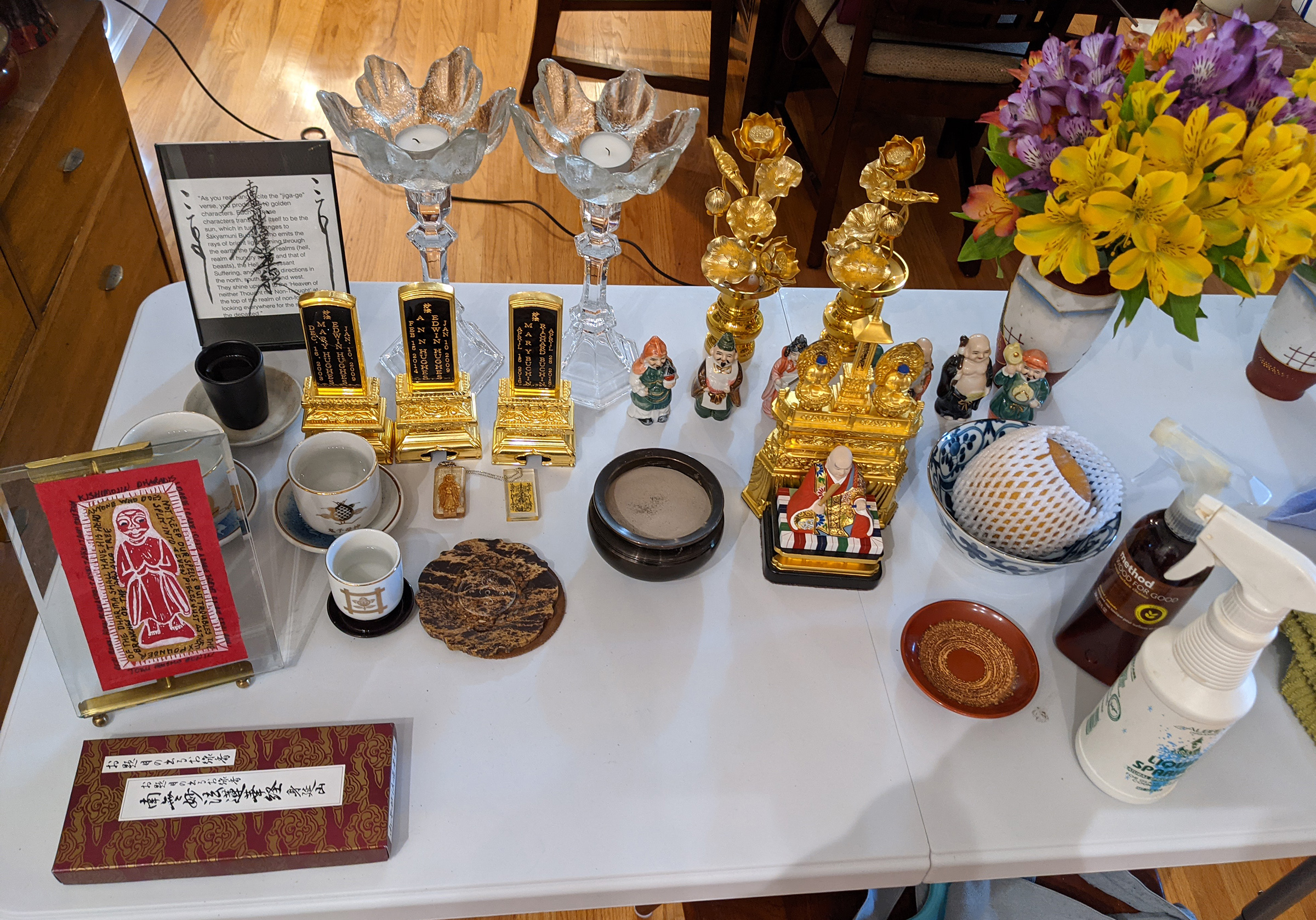
Traditionally I clean my altar on the last day of the year in preparation for the New Year. Never before have I looked forward to the end of a year as I do 2020.

While I’m here I figure I should clean out my blog to-do list.


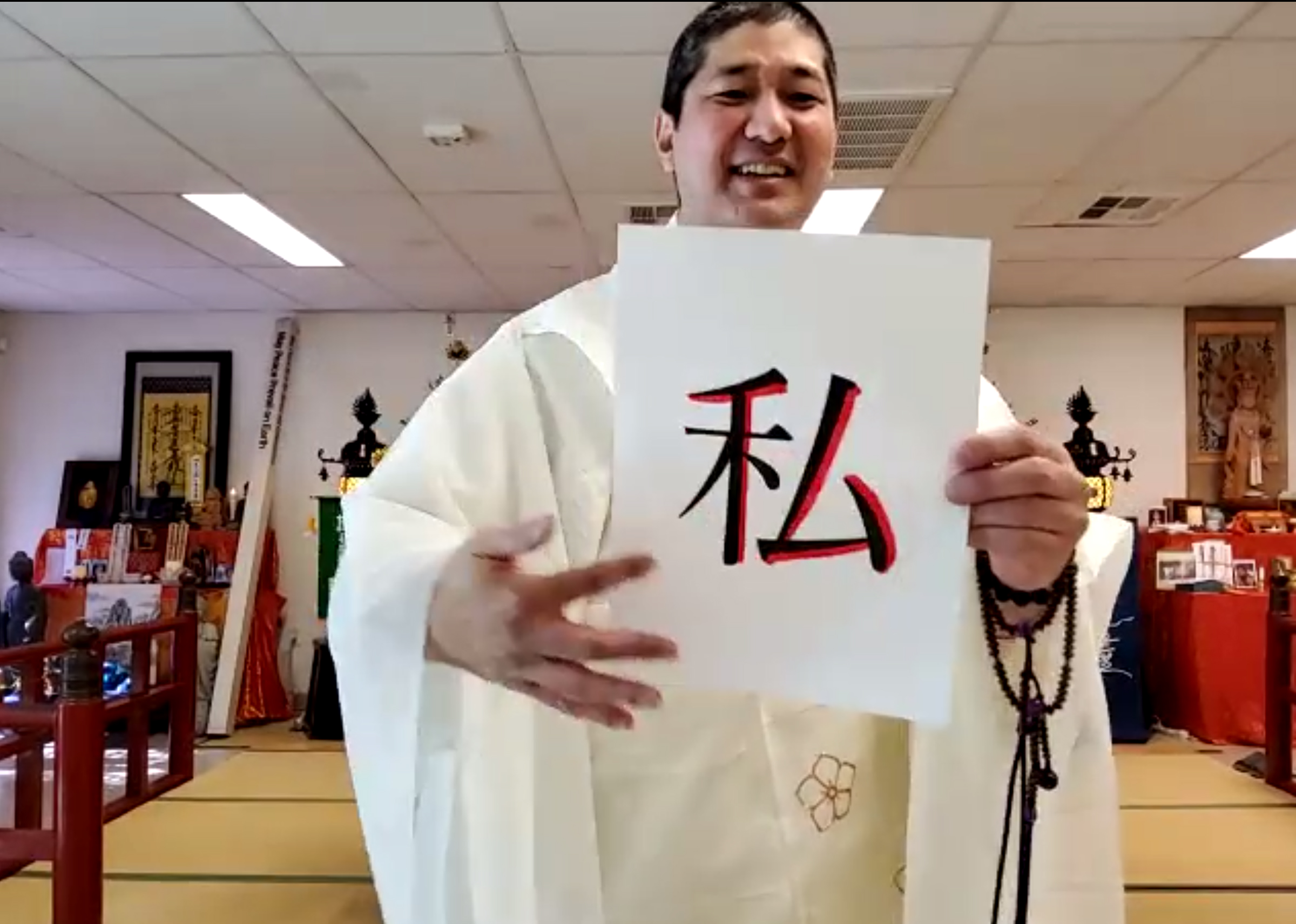
Following an online service back on December 6 at the Nichiren Buddhist Kannon Temple of Nevada, Rev. Shoda Kanai gave a sermon playing with kanji character for “Buddha” and the kanji character for “me” or “I” and showing how, in kanji, the Buddha is literally inside you and me.

The Buddha Inside you and ame

Here’s PDF copy of the article in the January 2021 Radiance newsletter that Rev. Shoda Kanai adapted from his sermon.


Back in September, Rev. Ryuei McCormick was interviewed as part of a video series organized by filmmaker Yujiro Seki, who is promoting his movie Carving the Divine.

The stated topic of the interview is the The Four Aims (Siddhantas) of Buddhist Practice. When I first saw that the interview lasts nearly 40 minutes I kept putting off listening to it. As result it was only last week when I finally realized what I had missed. Yes, there is a discussion the question “What are the four siddantas/the four aims?” But that is only a minor portion of the full video.

While I recommend everyone watch the full video, I’ve created links to the various topics for those with a particular interest.

The Whiteness of the Buddha’s Wisdom

This was written in advance of Sunday’s meeting of the Nichiren Buddhist Sangha of the San Francisco Bay Area, which has been discussing Chapter 2 of the Lotus Sutra this month.

Last week I asked, Does the Buddha Only Teach Bodhisattvas? And my short answer was that since the Buddha is seeking to lead everyone to buddhahood, there are no śrāvakas, only bodhisattvas, among his disciples.

Before moving to Chapter 3 and the Buddha’s prediction that Śāriputra will teach the Three Vehicles according to his original vow, I want to discuss the One Vehicle.

From the last part of Chapter 2, Expedients, we are taught:

Any Śrāvaka or Bodhisattva
Who hears even a gāthā
Of this sūtra which I am to expound
Will undoubtedly become a Buddha.

There is only one teaching, that is, the One Vehicle
In the Buddha-worlds of the ten quarters.
There is not a second or a third vehicle
Except when the Buddhas teach expediently.

The Buddhas lead all Living beings
By tentative names [of vehicles]
In order to expound their wisdom.
They appear in the worlds
Only for the One Vehicle.

And shortly after that:

Know this, Śāriputra!
I once vowed that I would cause
All living beings to become
Exactly as I am.

That old vow of mine
Has now been fulfilled.
I lead all living beings
Into the Way to Buddhahood.

One Goal. One Vehicle. Inseparable.

The Tathāgatas save all living beings
With innumerable expedients.
They cause all living beings to enter the Way
To the wisdom-without-āsravas of the Buddha.
Anyone who hears the Dharma
Will not fail to become a Buddha.

Every Buddha vows at the outset:
“I will cause all living beings
To attain the same enlightenment
That I attained.”

The future Buddhas will expound many thousands
Of myriads of millions of teachings
For just one purpose,
That is, for the purpose of revealing the One Vehicle.

In considering this, it occurred to me that here again the light of the Buddha’s wisdom is an apt analogy.

The Buddha’s wisdom shines in perfect brightness. A Buddha and another Buddha – Yui Butsu Yo Butsu – perceive this light as uniformly white, but those who have not eliminated all of their defilements filter this light into innumerable colors, failing to see the full spectrum of the Buddha’s wisdom.

In the Profound Wisdom of the Lotus Sutra, Chih-i writes:

Briefly, there are three differences [in the kind of preaching undertaken by the Buddha] called “in accordance with the feelings” [of the listener] ; “in accordance with the feelings [of the listener] and the wisdom” [of the Buddha] ; and “in accordance with the wisdom” [of the Buddha.]

The preaching in accordance with the feelings [or capacities of sentient beings] refers to [the teaching of the Buddha which takes into account] the fact that the feelings and natures [of sentient beings] are not the same, so the explanation which is taught in accordance with the feelings is different [for each person]. As it is clarified in the Abhidharma-mahāvibhāṣā Śāstra, there are immeasurable varieties of the dharma supreme in the world [laukikāgra-dharmāh].

It is the same for the real ultimate truth. How much more so for the others. It is like a blind man following his feelings when presented with many different [analogies for the whiteness of] milk.

The blind man, hearing various explanations, argues about the color white. Do they not all refer to [the whiteness of] milk? All the masters have failed to understand this meaning. They each are attached to a certain text, and present their own opinions and argue. They each deny each other’s [opinions], believing one and not believing another. What vigorous bickering! They do not know which side is correct.
Foundations of T'ien T'ai Philosophy, p 237

There is only one teaching, One Vehicle.