
Category Archives: LS32

Day 30

Day 30 covers all of Chapter 26, Dhāraṇīs

Having last month received the dhārāni spells of World-Holding Heavenly-King, we meet the 10 rākṣasas and their mother, Mother-Of-Devils.

There are rākṣasas called 1. Lambā, 2. Vilambā, 3. Crooked-Teeth, 4. Flower-Teeth, 5. Black-Teeth, 6. Many-Hairs, 7. Insatiable, 8. Necklace-Holding, 9. Kuntī, and 10. Plunderer-Of-Energy-Of-All-Beings. These ten rākṣasas [and their attendants] came to the Buddha, together with Mother-Of-Devils and her children and attendants. They said to the Buddha simultaneously:

“World-Honored One! We also will protect the person who reads, recites and keeps the Sūtra of the Lotus Flower of the Wonderful Dharma so that he may have no trouble. No one shall take advantage of the weak points of this teacher of the Dharma.”

Then they uttered spells before the Buddha:

“Ideibi (1), ideibin (2), ideibi (3), adeibi ( 4), ideibi (5), deibi (6), deibi (7), deibi (8), deibi (9), deibi (10), rokei (11), rokei (12), rokei (13), rokei (14), takei (15), takei (16), takei (17), tokei (18), tokei (19).”

[They said to the Buddha:]

“Anyone may step on our heads, but shall not trouble this teacher of the Dharma. Neither shall any yakṣa, rākṣasa, hungry spirit, pūtana, kṛtya, vetāda, kumbhāṇḍa, umāraka, apasmāraka, yakṣa-kṛtya or human kṛtya. Neither shall anyone who causes others to suffer from a fever for a day, two days, three days, four days, seven days or forever. Neither shall anyone who takes the shape of a man, a woman, a boy or a girl and appears in his dream.”

Then they sang in gāthās before the Buddha:

Anyone who does not keep our spells
But troubles the expounder of the Dharma
Shall have his head split into seven pieces
Just as the branches of the arjaka-tree [ are split].

Anyone who attacks this teacher of the Dharma
Will receive the same retribution
As to be received by the person who kills his parents,
Or who makes [sesame] oil without taking out worms [from the sesame],
Or who deceives others by using wrong measures and scales,
Or by Devadatta who split the Saṃgha.

Having sung these gāthās, the rākṣasas said to the Buddha:

“World-Honored One! We also will protect the person who keeps, reads and recites this sūtra, and acts according to it so that he may be peaceful, that he may have no trouble, and that poison taken by him may be neutralized.”

Lotus World offers this:

The ten rakshasis, or female rakshasas, are the daughters of Hariti.

Rakshasas are a kind of flesh eating, blood drinking, or spirit draining demon or spirit. The tamer ones are known as yakshas and are the spirits of the trees, forests, and villages. They are considered a powerful type of hungry ghost. They appear as beautiful women (though they are sometimes shown with fangs) in courtly attire bearing various weapons or other symbolic objects.
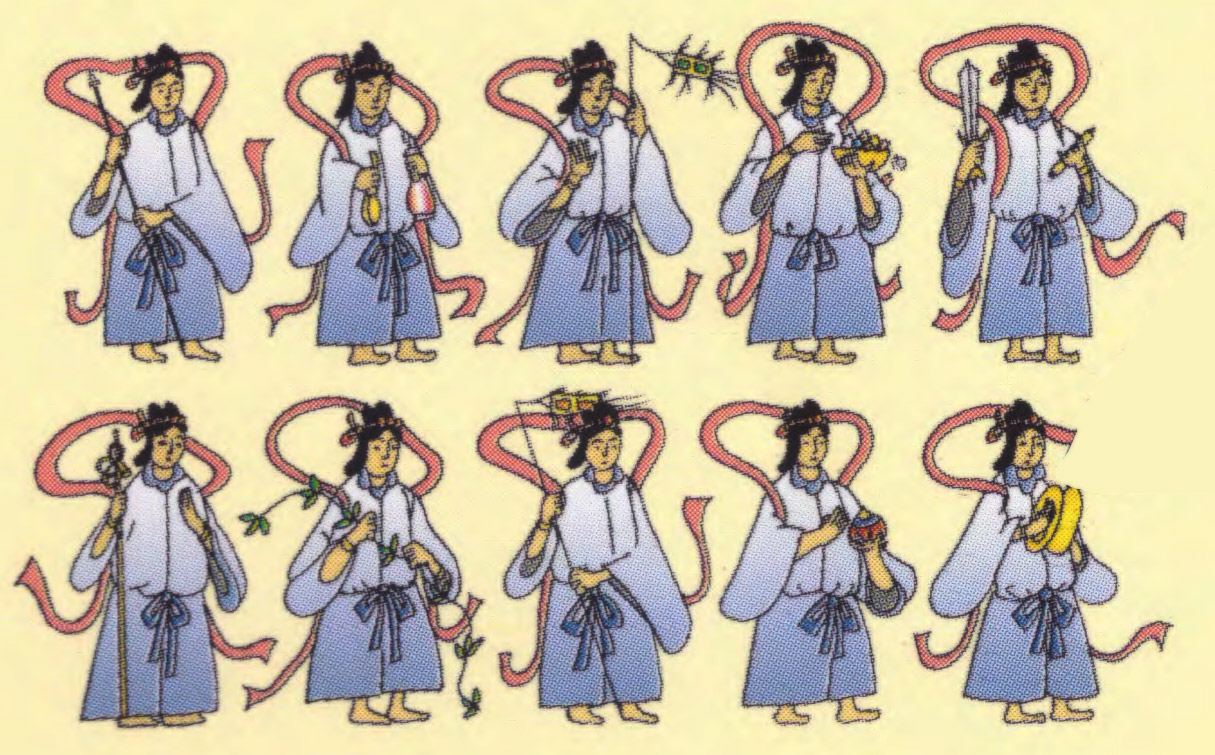
10 Rākṣasas Daughters from book Lotus World
  • Lamba holds a sword in her right hand and a sutra in her left.
  • Vilamba carries cymbals.
  • Crooked Teeth carries a tray of flowers.
  • Flower Teeth carries the cintamani, or “wish-fulfilling gem.”
  • Black Teeth carries a banner in her left hand.
  • Many Hairs carries a banner in both hands.
  • Insatiable carries a curved scepter in her right hand, while her left hand holds a flower vase.
  • Necklace Holding holds a garland in both hands.
  • Kunti carries a spear.
  • Plunderer of Energy of All Beings holds a staff with rings.

The ten rakshasis and their mother, Hariti., appear in Chapter 26 of the Lotus Sutra and together offer dharanis for the protection of the teacher of the Lotus Sutra.

Day 29

Day 29 covers all of Chapter 25, The Universal Gate of World-Voice-Perceiver Bodhisattva.

Having last month considered how World-Voice-Perceiver Bodhisattva goes about this Sahā-World, we witness Endless-Intent Bodhisattva’s attempt to offer a gift to World-Voice-Perceiver Bodhisattva.

The Endless-Intent Bodhisattva said to the Buddha, “World-Honored One! Now I will make an offering to World-Voice-Perceiver Bodhisattva.” From around his neck, he took a necklace of many gems worth hundreds of thousands of ryo of gold, and offered it [to the Bodhisattva], saying, “Man of Virtue! Receive this necklace of wonderful treasures! I offer this to you according to the Dharma!”

World-Voice-Perceiver Bodhisattva did not consent to receive it. Endless-Intent said to World-Voice-Perceiver Bodhisattva again, “Man of Virtue! Receive this necklace out of your compassion towards us!”

Thereupon the Buddha said to World-Voice-Perceiver Bodhisattva:

“Receive it out of your compassion towards this Endless-Intent Bodhisattva, towards the four kinds of devotees, and towards the other living beings including gods, dragons, yakṣas, gandharvas, asuras, garuḍas, kiṃnaras, mahoragas, men and nonhuman beings!”

Thereupon World-Voice-Perceiver Bodhisattva received the necklace out of his compassion towards the four kinds of devotees, and towards the other living beings including gods, dragons, men and nonhuman beings. He divided [the necklace] into two parts, and offered one part of it to Śākyamuni Buddha and the other to the stupa of Many-Treasures Buddha.

Whenever I reach this point in the Lotus Sūtra I puzzle over why World-Voice-Perceiver initially rejects this offering. At the Sacramento Nichiren Buddhist Church, the members are attempting to plan a dinner honoring Ven. Kenjo Igarashi‘s 30 years of service to the church. The anniversary is this August. We have to keep it a secret from Rev. Igarashi for as long as possible in order to prevent him from sabotaging our efforts to honor him. If we can reserve a restaurant and get to the point of sending out invitations, then it will be a fait accompli. Google Translate suggest that’s “Nashitoge rareta jijitsu” in Japanese. Of course, I’m assuming no one reads this blog post and tips off Rev. Igarashi.

Day 28

Day 28 covers all of Chapter 24, Wonderful-Voice Bodhisattva, and concludes the Seventh Volume of the Sutra of the Lotus Flower of the Wonderful Dharma.

Having last month concluded Chapter 24, Wonderful-Voice Bodhisattva, we begin again at the top with Śākyamuni Buddha emitting rays of light illumining one hundred and eight billion nayuta Buddha-worlds in the east.

Thereupon Śākyamuni Buddha [faced the east and] emitted rays of light from the fleshy tuft on his head, that is, from one of the marks of a great man, and also from the white curls between his eyebrows. The light illumined one hundred and eight billion nayuta Buddha-worlds, that is, as many worlds in the east as there are sands in the River Ganges. There was a world called [All-] Pure-Light-Adornment [in the east] beyond those worlds. In that world was a Buddha called Pure-Flower-Star-King-Wisdom, the Tathāgata, the Deserver of Offerings, the Perfectly Enlightened One, the Man of Wisdom and Practice, the Well-Gone, the Knower of the World, the Unsurpassed Man, the Controller of Men, the Teacher of Gods and Men, the Buddha, the World-Honored One. He expounded the Dharma to a great multitude of innumerable Bodhisattvas who were surrounding him respectfully. The ray of light, which was emitted from the white curls [between the eyebrows] of Śākyamuni Buddha, also illumined that world.

At that time there was a Bodhisattva called Wonderful-Voice in the All-Pure-Light-Adornment World. He had already planted roots of virtue a long time ago. He had already made offerings to many hundreds of thousands of billions of Buddhas, and attended on them. He had already obtained profound wisdom. He had already obtained hundreds of thousands of billions of great samadhis, that is, as many great samadhis as there are sands in the River Ganges, such as the samadhi as wonderful as the banner of a general, the samadhi for the traveling of the king of the stars, the samadhi for freedom from causality, the samadhi for the seal of wisdom, the samadhi by which one could understand the words of all living beings, the samadhi by which one could collect all merits, the samadhi for purity, the samadhi for exhibiting supernatural powers, the samadhi for the torch of wisdom, the samadhi for the Adornment-King, the samadhi for pure light, the samadhi for pure store, the samadhi for special teachings, and the samadhi for the revolution of the sun.

The Introduction to the Lotus Sūtra offers this observation on the world of Wonderful-Voice Bodhisattva:

In Chapter 24, Wonderful-Voice Bodhisattva, the Pure Land of Wonderful-Voice Bodhisattva is described as existing in the east. According to the Lotus Sutra, however, the Pure Land should not be anywhere else than right here in our Sahā-world. This idea was presented in Chapter Sixteen, the “Duration of the Life of the Tathagata.” It is a principal theme of the Lotus Sutra, which always emphasizes practice in our real world. It concludes that “the Sahā-world itself is the Pure Land.

Introduction to the Lotus Sutra

Day 27

Day 27 concludes Chapter 23, The Previous Life of Medicine-King Bodhisattva.

Having last month concluded Chapter 23, The Previous Life of Medicine-King Bodhisattva, we begin again with today’s portion and Gladly-Seen-By-All-Beings Bodhisattva’s greeting to Sun-Moon-Pure-Bright-Virtue Buddha.

“Having sung this gāthā, Gladly-Seen-By-All-Beings Bodhisattva said to the Buddha, ‘World-Honored One! You do not change, do you?’

“Sun-Moon-Pure-Bright-Virtue Buddha said to Gladly-Seen-By-All-Beings Bodhisattva, ‘Good man! The time of my Nirvana is near at hand. The time of my extinction is coming. Prepare me a comfortable couch! I shall enter into Parinirvana tonight.’ “Then he instructed Gladly-Seen-By-All-Beings Bodhisattva, saying, ‘Good man! I will transmit all my teachings to you. [I also will transmit] to you all the Bodhisattvas and all my great disciples. [I also will transmit] to you my teachings for Anuttara-samyak-saṃbodhi. I also will transmit to you the one thousand Sumeru worlds made of the seven treasures, the jeweled trees, the jeweled platforms, and the gods attending on me. I also will transmit to you the śarīras to be left after my extinction. Distribute my śarīras far and wide and make offerings to them! Erect thousands of stupas [to enshrine them]!’

The Daily Dharma from May 10, 2018, offers this:

Having sung this gāthā, Gladly-Seen-By-All-Beings Bodhisattva said to the Buddha, ‘World-Honored One! You do not change, do you?’

This description of the life of Gladly-Seen-By-All-Beings Bodhisattva comes from Chapter Twenty-Three of the Lotus Sūtra. In a previous existence, this Bodhisattva had given up his body and his life for the sake of teaching the Wonderful Dharma. He was then reborn into a world in which the Buddha he served previously was still alive and benefitting all beings. Recognizing this unchanging aspect of the Buddha despite his changing appearances helps us see into our own capacity for enlightenment.

The Daily Dharma is produced by the Lexington Nichiren Buddhist Community. To subscribe to the daily emails, visit zenzaizenzai.com

Day 26

Day 26 concludes Chapter 21, The Supernatural Powers of the Tathāgatas, includes Chapter 22, Transmission, and introduces Chapter 23, The Previous Life of Medicine-King Bodhisattva.

Having last month heard the Buddha’s instruction to the great Bodhisattvas headed by Superior-Practice, we repeat the Supernatural Powers of the Tathāgatas in gāthās.

Thereupon the World-Honored One, wishing to repeat what he had said, sang in gāthās:

The Buddhas, the World-Saviors, have
Great supernatural powers.
They display their immeasurable, supernatural powers
In order to cause all living beings to rejoice.
The tips of their tongues reach the Heaven of Brahman.
Innumerable rays of light are emitted from their bodies.
For those who are seeking the enlightenment of the Buddha
The Buddhas do these things rarely to be seen.

The sound of coughing of the Buddhas
And the sound of their finger-snapping
Reverberate over the worlds of the ten quarters,
And the ground [of those worlds] quakes in the six ways.

The Buddhas joyfully display
Their immeasurable, supernatural powers
Because [the Bodhisattvas from underground]
[Vow to] keep this sūtra after my extinction.

Even if I praise for innumerable kalpas
The keeper of this sūtra,
To whom it is to be transmitted,
I cannot praise him highly enough.

His merits are as limitless,
As infinite, as boundless
As the skies of the worlds
Of the ten quarters.

There being no Daily Dharma for this section nor a comment about it by Nichiren, I’m left with my own thoughts. What strikes me is the concept of Buddhas “joyfully” acting in response to the vow of Bodhisattvas from underground. Pure, undiluted joy.

Day 25

Day 25 covers all of Chapter 20, Never-Despising Bodhisattva, and opens Chapter 21, The Supernatural Powers of the Tathāgatas.

Having last month learned whose past lives are revealed in this story, we repeat in in gāthās the story of a Buddha Called Powerful-Voice-King and a Bodhisattva Called Never-Despising.

Thereupon the World-Honored One, wishing to repeat what he had said, sang in gāthās:

There was once a Buddha,
Called Powerful-Voice-King.
His supernatural powers and wisdom
Were immeasurable.
Leading all living beings, he is honored
By gods, men and dragons with offerings.

Some time after the extinction of that Buddha,
His teachings had almost died out.
At that time there lived a Bodhisattva
Called Never-Despising.
The four kinds of devotees at that time
Were attached to views.

Never-Despising Bodhisattva
Went to them,
And said,
“I do not despise you
Because you will practice the Way
And become Buddhas.”

When they heard this,
They spoke ill of him and abused him.
But Never-Despising Bodhisattva
Endured all this.

Thus he expiated his sin.
When he was about to pass away,
He heard this sūtra,
And had his six sense-organs purified.
He prolonged his life
By his supernatural powers,
And expounded this sūtra
To many people.

Those who were attached to views
Were led into the Way
To the enlightenment of the Buddha
By this Bodhisattva.

I’m going to take advantage of this opportunity to point out a difference of interpretation of the verse:

Thus he expiated his sin.

Senchu Murano includes a footnote for this verse.

“4. The expiation of sin is referred to in connection with those who abuse the Bodhisattva, not with the Bodhisattva, on p. 294.”

Nichiren, however, makes a very different interpretation in his letter, Tenjū Kyōju Hōmon, Lightening the Karmic Retribution. He writes:

It was not without reason that Never Despising Bodhisattva was spoken ill of, slandered, beaten with sticks and pieces of wood, or had rubble thrown at him. His persecution in this life seems to be the consequences of his slandering the True Dharma in his previous lives. Therefore it is stated in the sūtra, “His sins have been atoned.” I believe it means that Never Despising Bodhisattva’s past sin ceased to exist through his persecution.

Tenjū Kyōju Hōmon, Lightening the Karmic Retribution, Writings of Nichiren Shōnin, Followers I, Volume 6, Page 29
Source

Day 24

Day 24 concludes Chapter 19, The Merits of the Teacher of the Dharma, and closes the Sixth Volume of the Sutra of the Lotus Flower of the Wonderful Dharma.

Having last month considered the twelve hundred merits of the mind, we conclude today’s portion of Chapter 19, The Merits of the Teacher of the Dharma, in gāthās.

Thereupon the World-Honored One, wishing to repeat what he had said, sang in gāthās:

Their minds will become pure, clear, keen and undefiled.
They will be able to recognize with their wonderful minds
The superior, mean and inferior teachings.
When they hear even a gāthā [of this sūtra],
They will be able to understand
The innumerable meanings of [this sūtra].

When they expound [this sūtra]
In good order according to the Dharma
For a month, four month or a year,
They will be able to understand at once
The thoughts of gods, dragons, men, yakṣas, demigods,
And of all the other living beings
Inside and outside this world
Composed of the six regions
Because they keep
The Sūtra of the Lotus Flower of the Wonderful Dharma.

They also will be able to hear and keep
The Dharma expounded to all living beings
By the innumerable Buddhas of the worlds of the ten quarters
Who are adorned with the marks of one hundred merits.

When they think over the innumerable meanings [of this sūtra],
And endlessly repeat the expounding of those meanings,
They will not forget or mistake the beginnings and ends [of quotations]
Because they keep the Sūtra of the Lotus Flower of the Wonderful Dharma.

They will see the reality of all things.
Knowing the position [of this sūtra in the series of sūtras],
And the names and words [of this sūtra], according to the meanings of it,
They will expound [this sūtra] as they understand it.

They will expound the Dharma
Already taught by the past Buddhas.
Therefore, they will be fearless
Before the multitude.

Anyone who keeps the Sūtra of the Lotus Flower of the Wonderful Dharma
Will have his mind purified as previously stated.
Although he has not yet obtained the [wisdom-]without-āsravas,
He will be able to obtain [these merits of the mind].

When he keeps this sūtra,
He will be able to reach a rare stage.
He will be joyfully loved and respected
By all living beings.

He will be able to expound the Dharma
With tens of millions of skillful words
Because he keeps
The Sūtra of the Lotus Flower of the Wonderful Dharma.

[Here ends] the Sixth Volume of the Sūtra of the Lotus Flower of the Wonderful Dharma.

The Daily Dharma from Dec. 10, 2018, offers this:

They will expound the Dharma
Already taught by the past Buddhas.
Therefore, they will be fearless
Before the multitude.

The Buddha declares these lines to Constant-Endeavor Bodhisattva in Chapter Nineteen of the Lotus Sūtra, describing those who keep the Lotus Sūtra. By understanding fear, and demonstrating our fearlessness in this world of conflict, we can inspire and bring courage to other beings. One form of fear arises when we believe that we are in a situation that we cannot handle. This is simply a form of arrogance: believing that something is true when in reality we do not know that it is true. When the Buddha assures us who practice this Wonderful Dharma of the certainty of our future enlightenment, we then know how things will turn out. No matter what difficulties we find ourselves in, there are always more choices available to us. Often outcomes that seem horrible at the time can bring us more wisdom and compassion.

The Daily Dharma is produced by the Lexington Nichiren Buddhist Community. To subscribe to the daily emails, visit zenzaizenzai.com

Day 23

Day 23 covers all of Chapter 18, The Merits of a Person Who Rejoices at Hearing This Sutra, and opens Chapter 19, The Merits of the Teacher of the Dharma.

Having last month begun Chapter 19: The Merits of the Teacher of the Dharma, we consider the eight hundred merits of the eye.

With their pure eyes given by their parents, these good men or women will be able to see all the mountains, forests, rivers and oceans inside and outside the one thousand million Sumeru-worlds, [each of which is composed of six regions] down to the Avici Hell and up to the Highest Heaven. They also will be able to see the living beings of those worlds, to know the karmas which those living beings are now doing and the region to which each of those living beings is destined to go by his karmas.”

Thereupon the World-Honored One, wishing to repeat what he had said, sang in gāthās:

Listen! I will tell you of the merits
Of those who fearlessly expound
To the great multitude
This Sūtra of the Lotus Flower of the Wonderful Dharma.

They will be able to obtain the excellent eyes
Adorned with eight hundred merits.
Their eyes will be pure
Because of this adornment.

With their eyes given by their parents,
They will be able to see Mt. Meru, Mt. Sumeru,
The Surrounding Iron Mountains,
And the other mountains,
And the forests, oceans and rivers
Inside and outside the one thousand million Sumeru-worlds.

They will be able to see the living beings
Of those worlds [each being composed of the six regions]
Down to the Avici Hell and up to the Highest Heaven.
Although they have not yet obtained heavenly eyes,
They will be able to see all this
With their natural eyes.

The Introduction to the Lotus Sūtra offers this explanation of the Five Kinds of Practices.

In the Lotus Sutra, we often see the sentence, “You should keep, read, recite, expound, and copy this Sutra.” These activities are called the Five Kinds of Practice for a Teacher of the Dharma. To keep the Sutra is to steadily accept and uphold the Lotus Sutra in one’s mind. To read the sutra means to peruse the Sutra and read it. To recite the Sutra means to recite it or portions of it by heart. To expound the Sutra means to interpret it and teach it to others. To copy the Sutra means to copy it by hand. Practitioners of the Lotus Sutra should undertake these five practices. They have two aspects: practice for one’s self and practice for others. [Chapter 19, The Merits of the Teacher of the Dharma] says that persons who endeavor to practice the Five Kinds of Practice will be rewarded with splendid merits of their six sense-organs of the eyes, ears, nose, tongue, body, and mind. Sakyamuni explains this to a great Bodhisattva by the name of Constant-Endeavor.

Introduction to the Lotus Sutra

Day 22

Day 22 covers all of Chapter 17, The Variety of Merits.

Having last month considered the merits of those who keep or copy this sūtra or causes others to copy it after the Buddha’s extinction, we consider what those who believe will see.

“Ajita! The good men or women who hear of my longevity of which I told you, and understand it by firm faith, will be able to see that I am expounding the Dharma on Mt. Gṛdhrakūṭa, surrounded by great Bodhisattvas and Śrāvakas. They also will be able to see that the ground of this Sahā-World is made of lapis lazuli, that the ground is even, that the eight roads are marked off by ropes of Jambunada gold, that the jeweled trees are standing in lines, and that the magnificent buildings are made of treasures. They also will be able to see that the Bodhisattvas are living in those buildings. They will be able to see all this because, know this, they have already understood [my longevity] by firm faith.

The Daily Dharma from Dec. 21, 2018, offers this:

Ajita! The good men or women who hear of my longevity of which I told you, and understand it by firm faith, will be able to see that I am expounding the Dharma on Mt. Gṛdhrakūṭa, surrounded by great Bodhisattvas and Śrāvakas. They also will be able to see that the ground of this Sahā-World is made of lapis lazuli, that the ground is even, that the eight roads are marked off by ropes of jāmbūnada gold, that the jeweled trees are standing in lines, and that the magnificent buildings are made of treasures.

The Buddha gives this explanation to Maitreya Bodhisattva, whom he calls Ajita – Invincible, in Chapter Seventeen of the Lotus Sūtra. We can hear this explanation as a promise of some great otherworldly vision which will be revealed to us if our faith is strong enough. We can also hear it as a promise that we will learn to deny that all the terrible things in the world as as bad as we think. But when we remember the Buddha telling us, “I do not see the world as others do,” then we realize that our faith brings us to the Buddha’s own mind, where we can accept this frightening and dangerous world for what it is, and work to make it better for all beings.

The Daily Dharma is produced by the Lexington Nichiren Buddhist Community. To subscribe to the daily emails, visit zenzaizenzai.com

Day 21

Day 21 covers all of Chapter 16, The Duration of the Life of the Tathāgata.

Having last month considered the purpose of the sūtras expounded to this point, we learn why Śākyamuni says ‘I shall pass away.’

“Good men! The duration of my life, which I obtained by the practice of the way of Bodhisattvas, has not yet expired. It is twice as long as the length of time as previously stated. Although I shall never enter into Nirvāṇa, I say to men of little virtue, ‘I shall pass away.’ I teach them with this expedient. Why is that? It is because, if they see me for a long time, they will not plant the roots of good, but become poor and base, and cling to the five desires so much that they will be caught in the nets of wrong views. If they think that I am always here, and do not think that I will pass away, they will become too arrogant and lazy to realize the difficulty of seeing me, and they will not respect me. Therefore I say [to them] expediently, ‘Bhikṣus, know this! It is difficult to see a Buddha who appears in [this] world.’ Why is that? It is because some men of little virtue cannot see me even during many hundreds of thousands of billions of kalpas while the others can. Therefore, I say [to them], ‘Bhikṣus! It is difficult to see a Tathāgata.’ Those who hear this and know that it is difficult to see me, will adore me, admire me, and plant the roots of good. Therefore l say [to them], ‘I shall pass away,’ although I shall not.

The Daily Dharma from July 8, 2018, offers this:

Although I shall never enter into Nirvāṇa, I say to men of little virtue, ‘I shall pass away.’ I teach them with this expedient. Why is that? It is because, if they see me for a long time, they will not plant the roots of good, but become poor and base, and cling to the five desires so much that they will be caught in the nets of wrong views.

The Buddha gives this explanation in Chapter Sixteen of the Lotus Sutra. This Chapter is the first time he reveals himself as the Ever-Present Buddha who became enlightened in the far distant past and will continue to lead all beings to enlightenment into the far distant future. The Buddha uses the death of his physical body as an expedient so that those who take him for granted will make efforts to practice his teachings. When we practice the Wonderful Dharma of the Lotus Sūtra, then we learn to see the Buddha in ourselves and all beings.

The Daily Dharma is produced by the Lexington Nichiren Buddhist Community. To subscribe to the daily emails, visit zenzaizenzai.com