It is not feasible to explain the true meaning of the doctrine of “3,000 existences contained in one thought” even in the theoretical section of the Lotus Sūtra. Needless to say, it is not mentioned at all in the pre-Lotus sūtras. The doctrine stems from the passage describing the ten aspects of existence in the paragraph on the “brief replacement of the three vehicles with the one true vehicle” (ryaku kaisan-ken’ichi) in the second chapter in the theoretical section of the Lotus Sūtra. Nevertheless, the true meaning of the doctrine is based solely on the essential section of the sūtra. The pre-Lotus sūtras should be judged according to the meaning of the theoretical section, which in turn should be judged by the meaning of the essential section. Only the essential section of the Lotus Sūtra can define its meaning as it preaches.
Jisshō-shō, A Treatise on the Ten Chapters of the Great Concentration and Insight, Writings of Nichiren Shōnin, Doctrine 2, Page 3-4
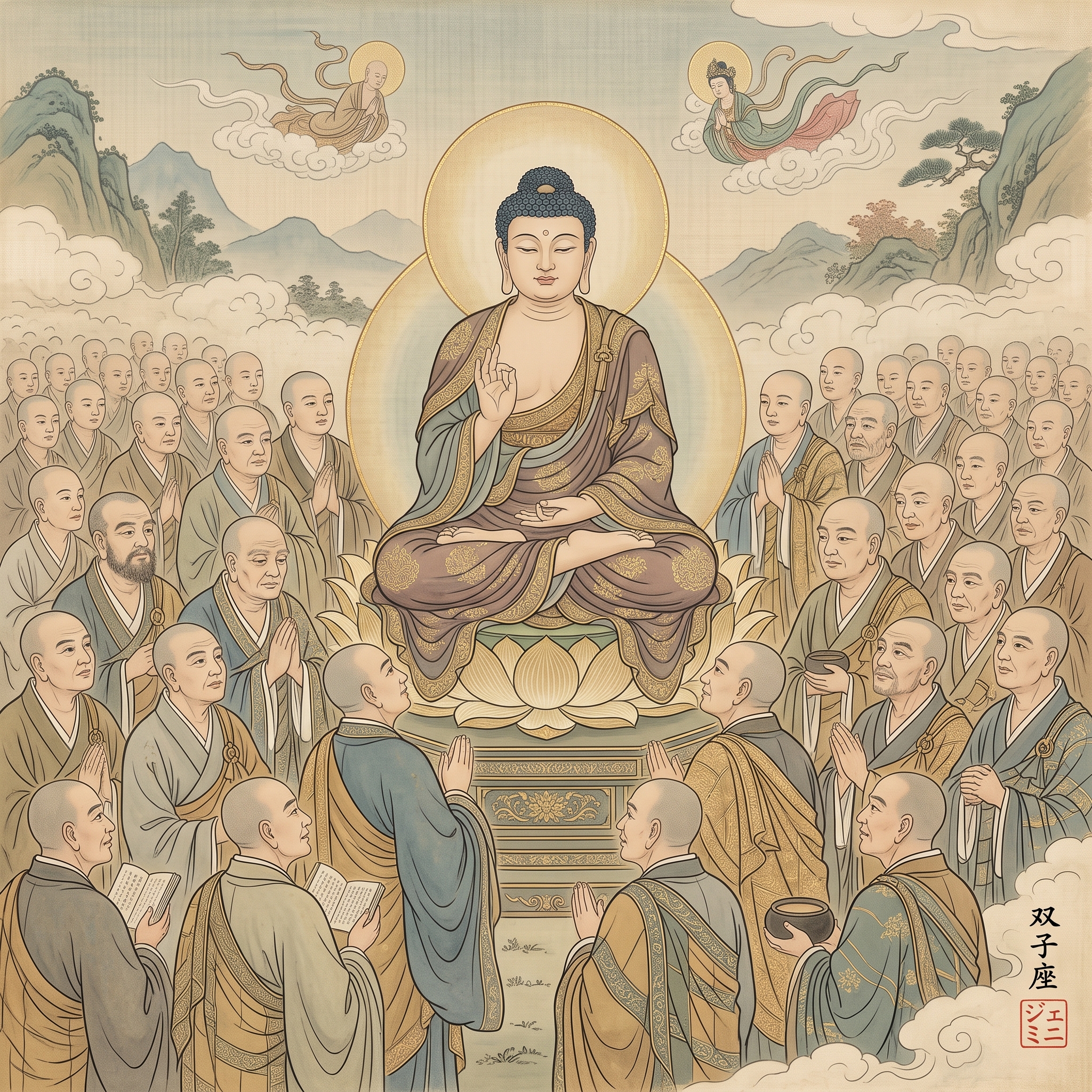
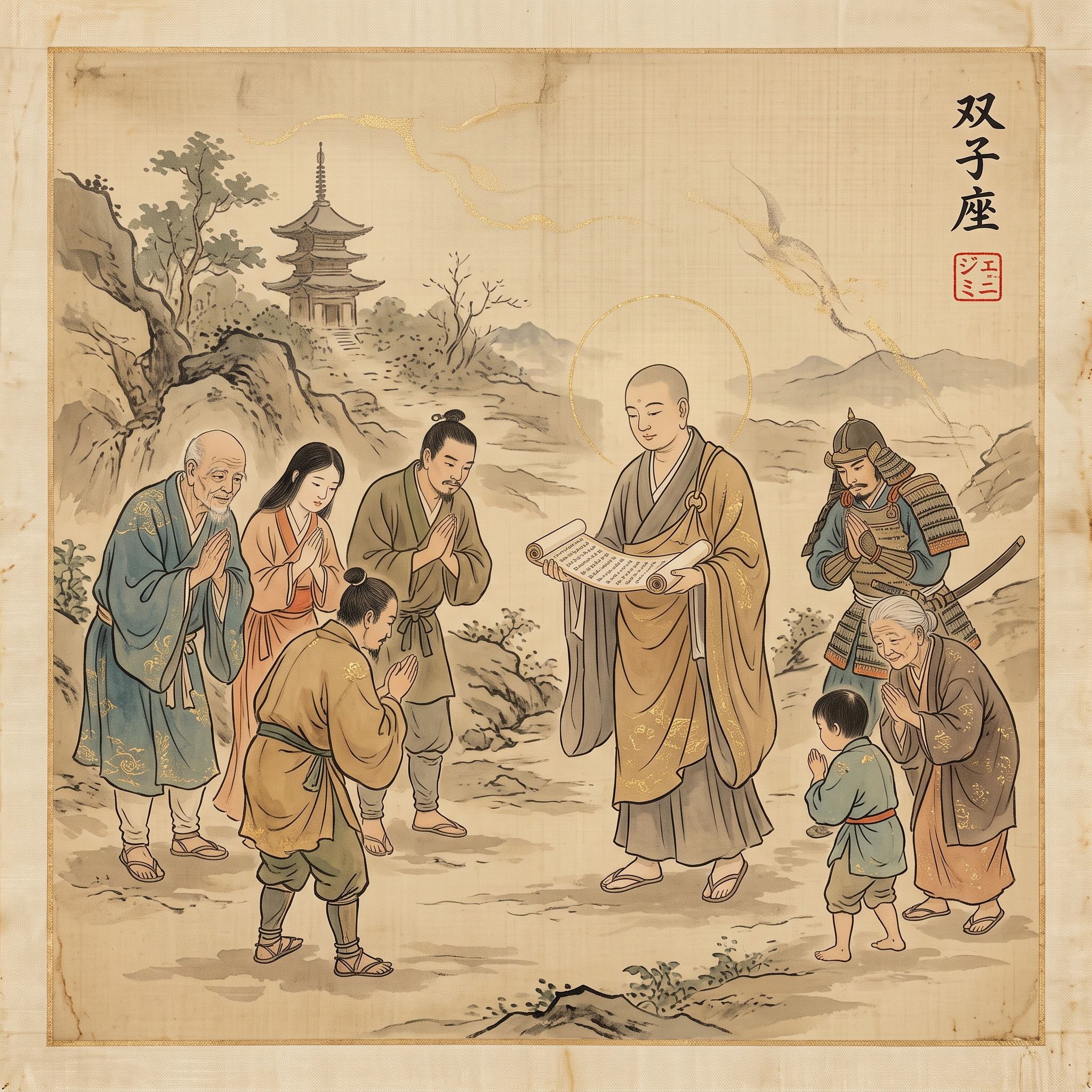
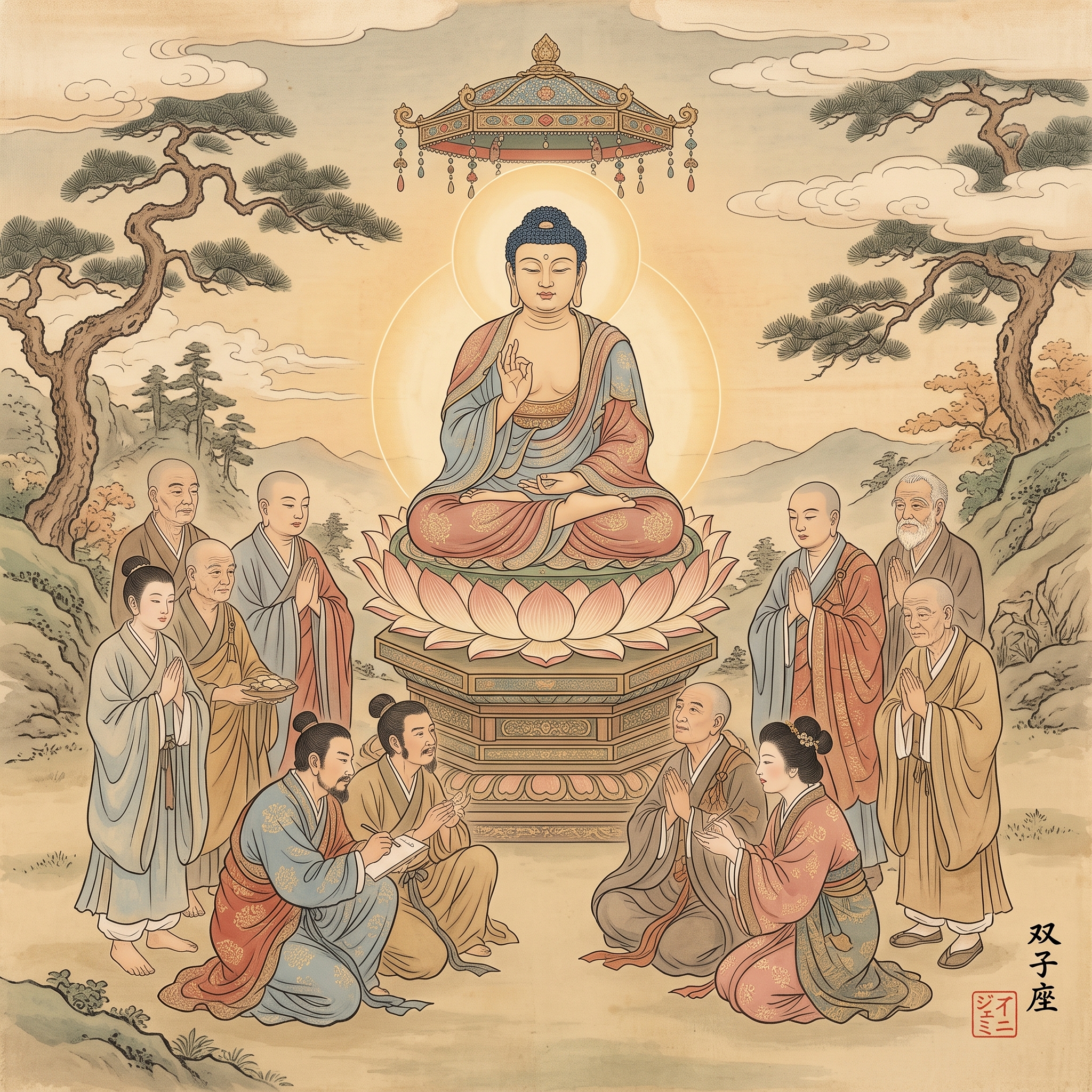
I have conceptualized the provided Lotus Sūtra verses through a traditional classical Japanese Buddhist style, featuring Šākyamuni Buddha preaching to Medicine-King Bodhisattva and an assembly of monastic and lay practitioners. The scene illustrates the dual themes of "keeping the sūtra" and "making offerings" with figures shown writing, holding scrolls, and presenting devotional items. The setting integrates the suffering saha world in the background with the blissful wonders of the Lotus sūtra in the foreground, illuminated by divine light to symbolize the opening of one's eyes to the truth.
Identified Individuals: The central preaching deity is Šākyamuni Buddha. Seated to his right, holding a sūtra, is Medicine-King Bodhisattva. The surrounding figures represent various monastics and lay devotees ("keepers of the sūtra").
Kanji Translations: The vertical signature text reads 双子座 (Gemini). Within the red hanko seal, the Katakana text reads ジェミニ (Gemini). The text on the primary sūtra scroll is purely symbolic calligraphic text meant to evoke classical sacred sūtra handwriting and has no translation.
If you wish to obtain quickly the knowledge
Of the equality and differences of all things,
Keep this sūtra, and also make offerings
To the keeper of this sūtra!
The Buddha sings these verses to Medicine-King Bodhisattva at the beginning of Chapter Ten of the Lotus Sūtra. When we see things for what they are, how they are similar and how they are different, we see them with the eyes of the Buddha. This Wonderful Dharma in the Lotus Sūtra is the Buddha showing us how to open our eyes to the joys and wonders that exist in this world of conflict and suffering. When we find something valuable, we offer it our time, our thoughts and our devotion. By making offerings to this Wonderful Dharma, and to all those who keep it, our eyes open even more to the truth of our lives.
The Daily Dharma is produced by the Lexington Nichiren Buddhist Community. To subscribe to the daily emails, visit zenzaizenzai.com
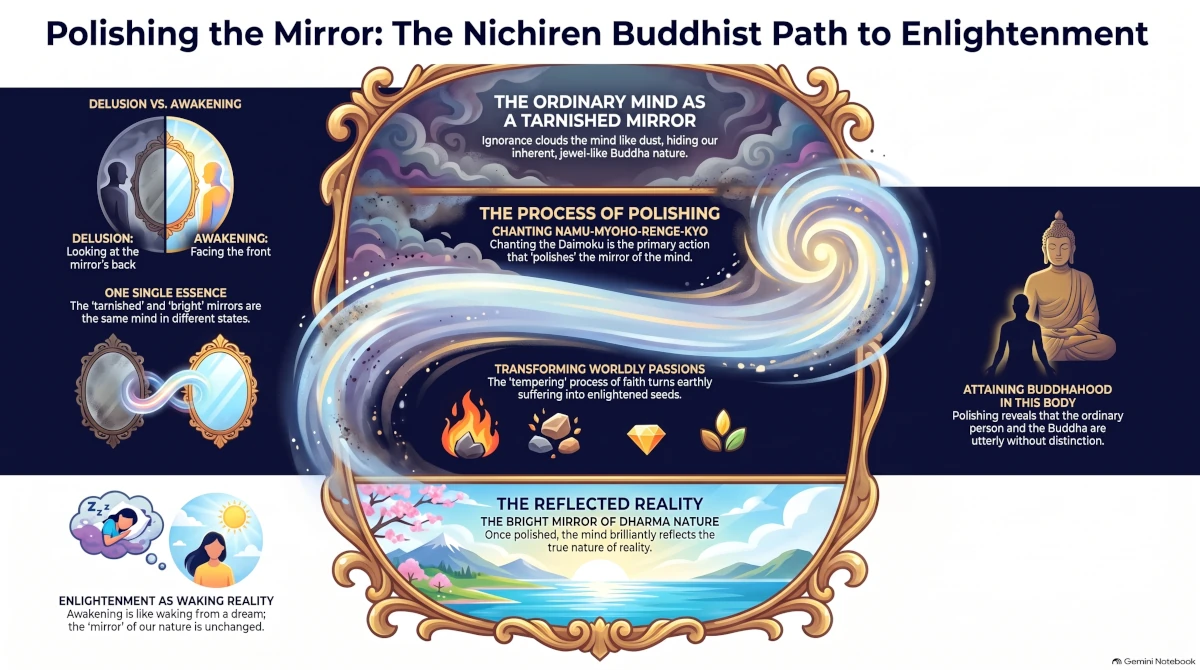
This essay was created from the sources uploaded to Gemini Notebook. Ask questions of these sources here.
20260530-From_Scholasticism_to_Chanting_Law
The trajectory of medieval Japanese Buddhist thought is defined by a radical ontological shift: the transition from “linear” asceticism, predicated on gradual progress, to a “simultaneous” realization. In traditional paradigms, enlightenment was envisioned as a distant shore, accessible only through the exhaustive accumulation of merit over asankhya-kalpas . However, Nichiren Buddhism precipitated a “Copernican Revolution” in this soteriology by asserting that Buddhahood is the foundational ground of practice rather than its terminal result. This is encapsulated in the inversion from Jūin Shika (From Cause to Fruit)—the teleological movement from practice toward enlightenment—to Jūka Kōin (From Fruit to Cause), wherein the practitioner begins from the Buddha’s enlightened state.To grasp this simultaneity, one must look to the source’s vivid metaphors: just as the moon rising over the eastern mountain is reflected in water the very instant it appears, or as a sound and its echo occur in the same moment, the “Fruit” of enlightenment and the “Cause” of practice are non-dual. The objective of this monograph is to analyze how Nichiren identified a strategic necessity to bridge the chasm between the abstract heights of Tendai “Original Enlightenment” ( Hongaku ) and the spiritual exhaustion of the Mappō era. By crystallizing these scholastic theories into the concrete practice of chanting Namu-Myoho-Renge-Kyo , Nichiren transformed the practitioner from a seeker into a recipient of the Buddha’s own merit.
2. Historical Foundations: The Quest for Rapid Enlightenment
The early Heian period was characterized by an obsession with “Speedy Enlightenment” ( Sokushitsu Jōbutsu ), a doctrinal reaction against the Hosso school’s staggering timeline for Buddhahood. Saichō and Kūkai, the giants of this era, sought to provide a “direct path” ( Jikidō ) that bypassed the traditional requirement of three asankhya-kalpas .
Kūkai (Shingon): Kūkai’s model of Sokushin Jōbutsu (Becoming a Buddha in this lifetime) relied on the esoteric union of the “Three Mysteries” ( Sanmitsu ). By aligning mudra (body), mantra (mouth), and visualization (mind), the practitioner synchronized their finite existence with the cosmic Buddha, Mahavairocana.
Saichō (Tendai): Saichō utilized the Lotus Sutra to argue for a universal path, specifically citing the Dragon King’s daughter ( Ryūnyo ). Crucially, while previous Chinese commentators like Ji-zang and Kuei-chi (Ki) argued her attainment was possible only because she was already at the 10th Stage of a Bodhisattva, Saichō “lowered the bar” by redefining her as being at the First Dwelling ( Hatsu-jū ) stage. This was a critical transfer point where an ordinary person ( bonbu ) could shed their mundane status for a sagely one.This historical trajectory involved a progressive “lowering of the bar.” Scholastic successors like Annen and Enchin pushed this further, moving the stage of realization down from the First Dwelling to the Stage of Name and Words ( Myōji-soku )—the very inception of the path. This set the stage for the medieval era’s total inversion of Buddhist praxis.
3. The Hongaku Inversion: Transitioning from “Cause-to-Fruit” to “Fruit-to-Cause”
In medieval Tendai, Hongaku (Original Enlightenment) discourse became the mainstream philosophical apparatus. It abandoned the notion of “becoming” a Buddha in favor of “self-awareness” that one is already enlightened. This shift was grounded in the structural tension between the two halves of the Lotus Sutra.
Contrast between Trace and Essential Teachings
Feature
Trace Teaching (Shakumon)
Essential Teaching (Honmon)
Logic
Jūin Shika (From Cause to Fruit)
Jūka Kōin (From Fruit to Cause)
Temporal Orientation
Linear / Past-to-Future
Simultaneous / Eternal Now
Buddha Type
Historical Buddha (Shakyamuni)
Eternal Buddha (Kuon Jitsujō)
Nature of Fruit
“Dream-like” goal (Mumei no kenka)
Inherent Reality (Ji-jōjū)
Status of Practice
Cultivation to attain Wisdom
Manifesting inherent Enlightenment
The “So What?” of this logic is found in the metaphor of the Lotus Flower , where the flower (cause) and the fruit (effect) appear simultaneously. This eliminates the temporal gap between practice and result. However, while Tendai Hongaku was intellectually sophisticated, it remained an elite monastic “meditation on the mind” ( Kanshin ). It was a theory of awareness that lacked a visceral, physical methodology for the masses struggling in a declining age.
4. Nichiren’s Rupture: Transforming Theory into the Daimoku
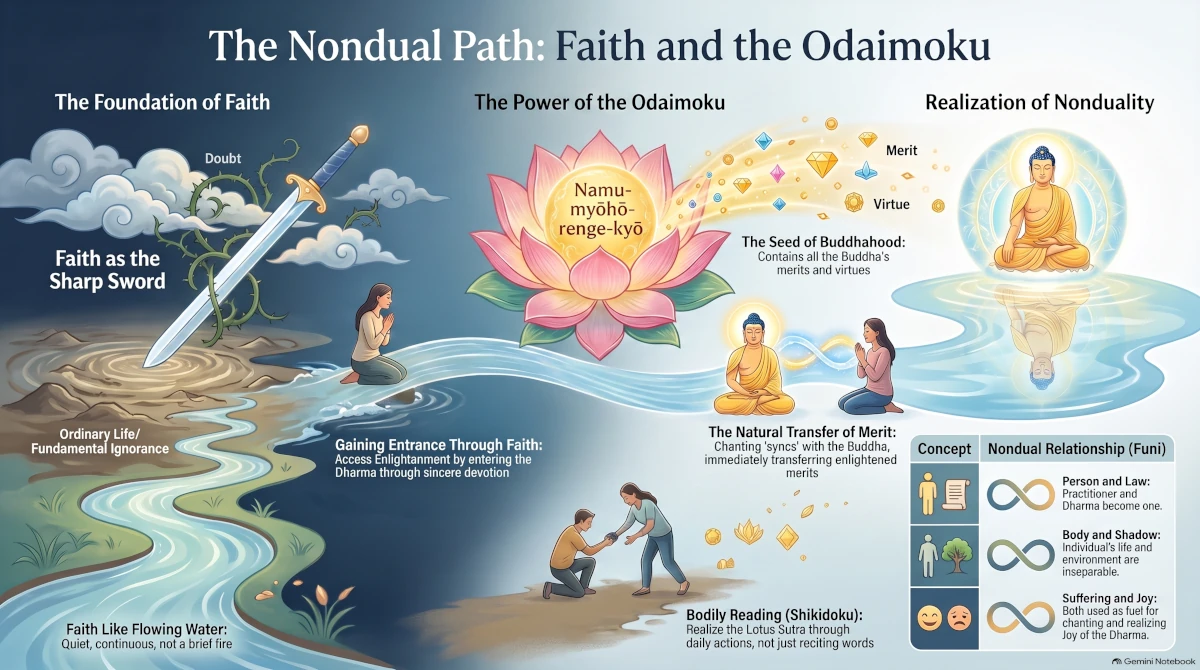
Nichiren identified a strategic necessity to ground the abstract ontological heights of Hongaku in a concrete religious practice accessible to the people of Mappō . His rupture with the past was total; he inhibited ( seishi ) the traditional practices of the Precepts ( Kai ) and Meditation ( Jō ), arguing they were insufficient for the age. Instead, he proposed the substitution of Faith for Wisdom .Nichiren’s innovation was the concept of the “Bottom of the Text” ( Mombutei ). He argued that the “Cause” (the Buddha’s practices) and the “Fruit” (the Buddha’s virtues) are entirely contained within the five or seven characters of the Daimoku. This is the Seed of the Law ( Shimmin ).
Key Differentiators of Nichiren’s Practice
Mediation through Sound: In contrast to the “silent contemplation” of Tendai monks, Nichiren emphasized enlightenment through the mouth and ear. Chanting is a physical act that “puts the Buddha into the mouths of the people,” bypassing the need for intellectual mastery.
Faith as the Cause of Wisdom: At the Myōji-soku stage, where ordinary people lack the capacity for profound wisdom ( E ), Nichiren asserted that Faith ( Shin ) serves as the functional equivalent, allowing the practitioner to access the Buddha’s enlightened state instantly.
Mandala as Environment: Nichiren externalized the internal state of enlightenment through the Gohonzon . By facing this mandala, the practitioner’s environment is not merely a place of suffering but is revealed as the “Constant Pure Land.”Through this shift, the practitioner is no longer a “seeker” toiling up a mountain; they are a “recipient” inheriting the total merit of the Eternal Buddha.
5. Soteriology in the Age of Mappō: The Mission of the “Bodhisattvas of the Earth”
In the era of Mappō , the “Fruit-to-Cause” model is not merely a philosophical preference but a soteriological requirement. Nichiren distinguished between those who had “sown seeds in past lives” ( Hon-ni-uzen ) and those of the current age who have “no previous merit” ( Honmi-uzen ). For the latter, linear practice is impossible because there is no seed to cultivate. Only the Seed of the Law ( Shimmin )—the Daimoku found at the Mombutei —can plant the potential for Buddhahood directly into their lives.This realization fundamentally reinterprets the practitioner’s identity through the concept of the Bodhisattvas of the Earth ( Jiyu no Bosatsu ). By adopting the “Fruit-to-Cause” model, one’s perspective on suffering undergoes a profound transformation:
From Karma to Vow: Personal sufferings are no longer viewed as “debts” from the past (a linear, past-focused view) to be endured. Instead, they are seen as a voluntarily chosen circumstance —a vow made to demonstrate the power of the Law in the midst of adversity.
From Seeker to Provider: The practitioner moves from being “one who is saved” to “one who saves.” Their life becomes an expression of the Buddha’s work, actualized through Risshō Ankoku (establishing the correct teaching for the peace of the land).In this framework, the “Fruit” is the internal state of the Buddha, and the “Cause” is the outward manifestation of that state through compassionate action in a troubled world.
6. Conclusion: The Enduring Impact of the Simultaneous Path
The doctrinal journey from early Heian scholasticism to Nichiren’s praxis reveals a profound continuity in the logic of “Fruit-to-Cause” ( Jūka Kōin ), yet it marks a sharp rupture in implementation. While Tendai provided the theoretical framework that collapsed the distance between cause and effect, it remained trapped in abstract contemplation. Nichiren liberated this logic, turning it into a tangible reality for the common person by replacing the “wisdom” of the elite with the “faith” of the many.
Critical Takeaways of the “Fruit-to-Cause” Paradigm
The Collapse of Linear Time: The “Fruit-to-Cause” model posits that practice is not a means to an end but the end itself, removing the anxiety of a distant, unattainable goal.
The Primacy of the Seed: For those in a state of spiritual decline ( Honmi-uzen ), enlightenment is only possible by receiving the “Seed of the Law” ( Shimmin ) contained at the “Bottom of the Text” ( Mombutei ).
The Agency of the Vow: By beginning from the “Fruit,” practitioners reinterpret their lives as a mission, transforming their identity from passive victims of karma to active messengers of the Buddha.Ultimately, Nichiren’s transformation of Buddhist doctrine provided a limitless sense of purpose to the ordinary individual. It suggests that even in an era of decline, one can stand as a Buddha in the present moment, transforming both self and society through the simple yet profound act of chanting.
Google’s Gemini Notebook allows you to upload sources and then ask questions. The answers will be drawn strictly from the sources uploaded. If a question cannot be answered from those sources, Gemini Notebook will say that. Here’s a link to that notebook.
A listing of sources included in the Nichiren Study Notebook:
Below is a summary of the articles generated from this notebook. Last updated June 27, 2026
Understanding Esho Funi
An explanation of the Buddhist principle of Esho Funi, which posits that an individual’s inner life and one’s external environment are deeply interconnected and ultimately inseparable.
A discussion on the Mahayana concept that the ideal, enlightened world (the Pure Land) is not a distant afterlife destination, but a reality that can be manifested in our present environment through faith and practice.
An exploration of the “Diamond Chalice Precept” (Kongo Hoki Kai), detailing its significance as an indestructible, eternal vow and a foundational ethical principle within the Bodhisattva path.
A comprehensive look into the origins, meaning, and practical application of the Diamond Chalice Precept for maintaining spiritual discipline and purity in daily life.
An analysis of the Ten Suchnesses through the specific lens of Nichiren Buddhism, exploring how these principles outline the fundamental architecture of reality and human experience.
From Zhiyi to Nichiren: The Architecture of Awakening
Traces the doctrinal evolution of Buddhist awakening, bridging the theoretical frameworks established by the Tiantai patriarch Zhiyi with the practical, reality-based teachings of Nichiren.
An examination of the profound doctrinal shift in Nichiren Buddhism regarding the concept of moving from the “fruit” (the effect of enlightenment) back to the “cause” (the practice in the nine realms) to save others.
A chronological overview of the life and major events of Nichiren, providing essential historical context for his teachings, his persecutions, and the establishment of his Buddhist lineage.
(Hitherto missing) A sleeping lion does not turn angry unless it is provoked. Waves do not rise unless a pole is thrust in the river. Likewise, if we do not refute the slanderer of the True Dharma, we will not encounter hardship. It is preached in the Nirvana Sūtra, “If a virtuous priest upon seeing a person who destroys the dharma disregards him and does not censure him, such a priest is a mortal enemy of the Buddha Dharma.” If we do not take the word “disregard” seriously in this citation, it is inevitable that we will fall into the Hell of Incessant Suffering in the next life, though we seemingly may be able to pass through this life without trouble.
Therefore, Grand Master Nan-yüeh states in his Lotus Sūtra’s Four Peaceful Practices, “Suppose a bodhisattva protects an evil person and is unwilling to punish him, allowing his evil to increase, thus bringing trouble to virtuous people, and destroying the True Dharma. Such a bodhisattva is not a true bodhisattva. Outwardly he pretends to be a bodhisattva to deceive others, saying always, ‘I am practicing the paramita of perseverance.’ Such a person will fall into hell together with all the other evil people.”
The Ten Wheel Sūtra also preaches, “Do not live with a slanderer of the True Dharma. Do not befriend him or approach him. Doing so, will inevitably lead you to fall into the Avīci Hell.” When one enters a forest of sandalwood, the sweet fragrance clings to one’s body even though no branches are broken. Likewise, when one befriends or approaches a slanderer of the True Dharma, the merits one has accumulated will vanish and that person will fall into hell together with the slanderer. Therefore, Grand Master Miao-lê warns in his Annotations on the Great Concentration and Insight, “If one, who is not initially evil, approaches and befriends an evil person, it is inevitable that one will become evil in time, spreading his wicked ways throughout the country.”
Nambu Rokurō-dono Gosho, A Letter to Lord Nambu Rokurō, Writings of Nichiren Shōnin, Followers II, Volume 7, Page 170-171
The illustration conceptualizes the verses from Chapter Twenty-Six of the Lotus Sūtra, focusing on the vow of protection and the psychological consequences of creating harm. The painting centers on an 'expounder of the Dharma,' a monk reading a scroll, who is flanked by supportive figures representing the Mother-of-Devils and the rakṣasī demons (though fewer than ten, representing the group). In the lower section, three figures represent those who 'trouble' the teacher; they are shown in varying states of mental and physical anguish, their heads symbolically 'split' (indicated by stress lines), paralleling the bare, broken branches of the arjaka-tree on the far left. The natural, cohesive landscape represents living in harmony, as Śākyamuni Buddha looks down with compassion from the upper realm.
Translation:
双子座 (Signature): Gemini
ジェミニ (Hanko Seal): Gemini
Anyone who does not keep our spells
But troubles the expounder of the Dharma
Shall have his head split into seven pieces
Just as the branches of the arjaka-tree [are split].
The ten rakṣasī demons and Mother-of-Devils sing these verses in Chapter Twenty-Six of the Lotus Sūtra. They are among the many gods and other supernatural beings who vow to protect all those who keep and practice the Buddha Dharma. These verses help us to understand the nature of those who create harm in the world and to develop a heart of compassion towards them. The nature of delusion is that it sets up a world separate from the world we all share. It puts a barrier between us and the world out of fear that this world will harm us. The Buddha’s teachings show us how to develop the courage to live in harmony with this world, rather than splitting ourselves from it, and splitting ourselves in it.
The Daily Dharma is produced by the Lexington Nichiren Buddhist Community. To subscribe to the daily emails, visit zenzaizenzai.com
Of the 25 transmitters of the Buddhist dharma, all except the Buddha are men of temporary manifestation dispatched by the Buddha to lead living beings. Āryadeva, the 14th of the 25 transmitters, was killed by a non-Buddhist, and Venerable Simha, the 25th transmitter, was beheaded by King Dammira. Many others such as Buddhamitra and Bodhisattva Nāgārjuna encountered various difficulties. On the other hand, some were firmly supported by the rulers and were able to spread the dharma without encountering difficulties. Why is it that some transmitters were persecuted while others were not? I believe it is because there exist good and wicked countries in the world and aggressive and persuasive means of spreading a religion. This was true even during the Ages of the True Dharma and the Semblance Dharma. It was also true even in India, the central land of the Buddhist dharma. All the more so in Japan, a remote country land, at the beginning of the Latter Age of Degeneration. It has been expected from the beginning that I would encounter great difficulties when I tried to spread the teaching of the Lotus Sutra. I simply waited for them to arise.
Tenjū Kyōju Hōmon, Lightening the Karmic Retribution, Writings of Nichiren Shōnin, Followers 1, Volume 6, Page 30
Here is a conceptual summary and translation of the elements included in this visual Dharma teaching:
Conceptual Thinking:
This illustration visualizes the passage from Chapter Fifteen of the Lotus Sūtra by depicting the inseparable connection between faith, benevolent action, and the realization of the highest Dharma. In the heavenly realm, Śākyamuni Buddha emits a stream of golden light representing the "power of faith," which flows directly to a monk practicing good deeds in the earthly realm. The monk, representing the practitioner, is actively "doing good patiently" by offering food to those in need. This act of creating benefit in the world allows him to "hear" or perceive the golden verses of the Dharma that rise around him—teachings only accessible through direct practice.
Identified Figures & Deities:
Śākyamuni Buddha: Seated on the lotus throne in the heavenly realm.
A Buddhist Monk: In the foreground, practicing compassion.
Kanji Translation:
信力 (Shinriki): The Power of Faith.
聞未曾有法 (Mon Mizouhou): Hear the Dharma that you have never heard before.
Arouse your power of faith,
And do good patiently!
You will be able to hear the Dharma
That you have never heard before.
The Buddha sings these verses in Chapter Fifteen of the Lotus Sūtra. These are another emphasis of the superiority of those who put the Buddha’s teachings into practice rather than those who merely hear and understand them. It is only when we are engaged in creating benefit in the world, in helping all beings to become enlightened, that we are able to hear the Buddha’s highest teaching, the teaching of his own enlightenment.
The Daily Dharma is produced by the Lexington Nichiren Buddhist Community. To subscribe to the daily emails, visit zenzaizenzai.com
[T]he only dependable teaching is a phrase in fascicle seven of the Lotus Sūtra saying: “Propagate this sūtra throughout Jambudvipa during the last 500-year period after My passing.” Grand Master Dengyō interprets this: “The Ages of the True Dharma and Semblance Dharma are approaching the end, and the Latter Age of Degeneration is around the corner. It is the time when the One Vehicle teaching of the Lotus Sūtra will be propagated.”
Mikoshi Buri Gosho, Intimidation with the Portable Shrine, Writings of Nichiren Shōnin, Biography and Desciples, Volume 5, Page 143
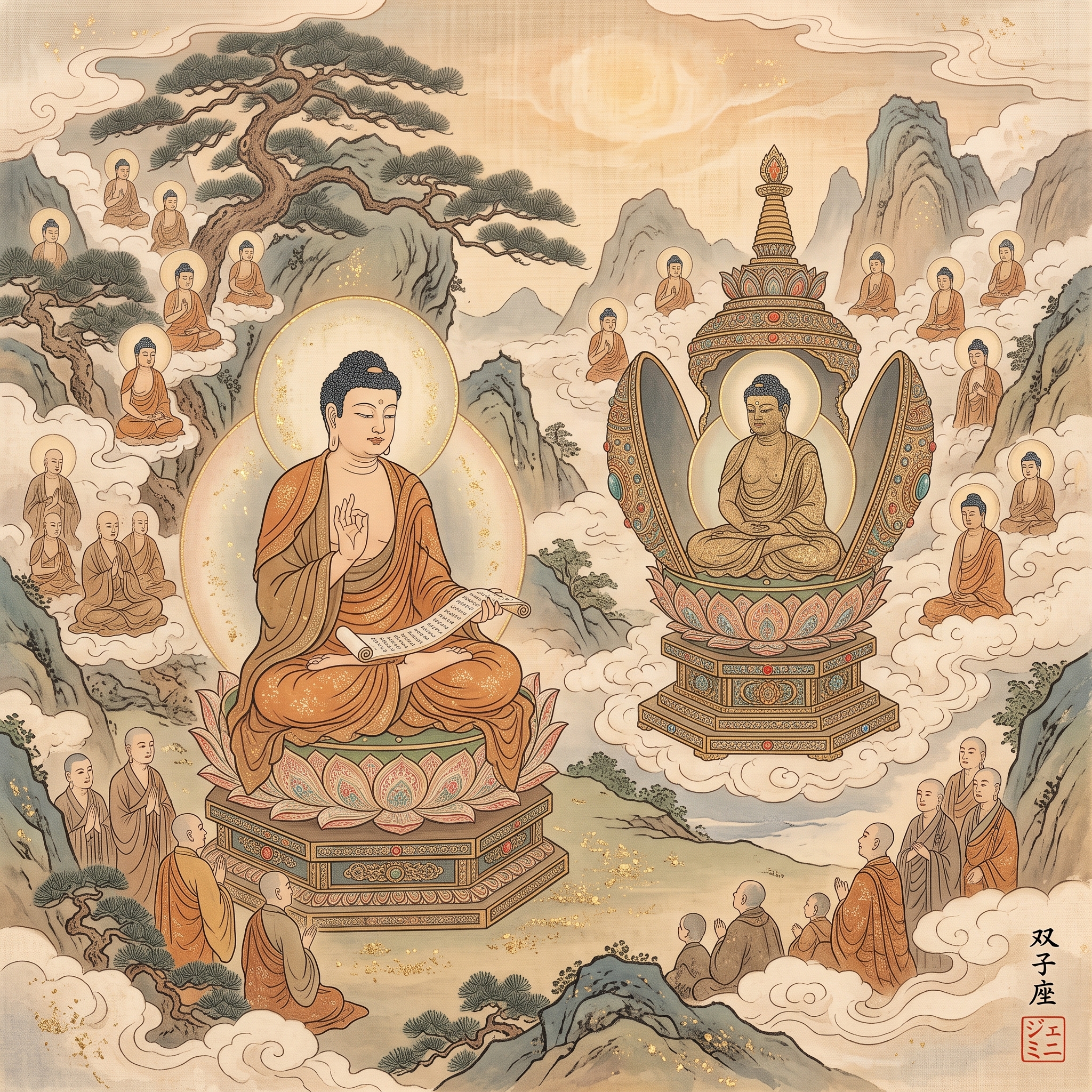
A serene, classical Japanese Buddhist painting (yamato-e style) rendered on an aged silk scroll, composed perfectly in a 1:1 square format. The artwork utilizes traditional mineral pigments (azurite blue, malachite green, cinnabar red), subtle colors, and extensive, soft application of gold leaf for halos and decorative elements.
The composition centers on a large, multi-storied, jewel-encrusted Japanese-style stūpa (pagoda) floating amidst swirling, stylized clouds. The central structure of the stūpa has miraculously split open, revealing Many-Treasures Buddha (Tahō Nyorai) seated inside. He is bathed in a warm, golden radiance, depicted with a compassionate expression and wearing ornate robes adorned with gold leaf patterns. His hands are in a gesture of praise and confirmation as he looks down toward Śākyamuni.
Below the floating stūpa, seated upon a multi-tiered lotus throne supported by a jeweled dais, is Śākyamuni Buddha (Shaka Nyorai). He has a calm, meditative expression and a prominent circular gold halo. He is performing the dharmachakra mudra (teaching gesture), expounding the Lotus Sutra. He is surrounded by a large multitude of monks, bodhisattvas, and lay disciples gathered on the ground, looking up with expressions of reverence and awe at the miraculous appearance of the stūpa and Tahō Buddha.
The background shows a stylized, peaceful landscape of rolling green hills, ancient pine trees, and a distant temple compound, all depicted with soft, flowing brushwork characteristic of classical Japanese painting. The overall color palette is muted yet rich, emphasizing warm golds, deep reds, and natural mineral tones.
Text Integration
In the lower-right corner, subtly integrated into the composition, is the vertical Kanji artist's signature: 双子座.
Immediately below the signature is a small, red square hanko (seal) containing the Katakana text: ジェミニ.
Along the upper-right edge of the painting, a narrow, vertical cartouche features the title of the sutra in classical Kanji: 妙法蓮華經 (Myōhō Renge Kyō).
The painting possesses an antique, devotional quality, with subtle aging and fine crackle texture visible on the silk surface.
Thereupon a loud voice of praise was heard from within the stūpa of treasures: “Excellent, excellent! You, Śākyamuni, the World-Honored One, have expounded to this great multitude the Sūtra of the Lotus Flower of the Wonderful Dharma, the Teaching of Equality, the Great Wisdom, the Dharma for Bodhisattvas, the Dharma Upheld by the Buddhas. So it is, so it is. What you, Śākyamuni, the World-Honored One, have expounded is all true.”
This declaration comes from Many-Treasures Buddha (Tahō, Prabhutaratna) at the beginning of Chapter Eleven of the Lotus Sūtra. In the story, Many-Treasures came from a world far away from this world of conflict when he heard the Buddha giving his highest teaching and appeared in a tower (stūpa) of wonderful treasures to confirm the truth of this teaching. By the Teaching of Equality, he means that all beings can become enlightened through this teaching. By the Great Wisdom, he means that the teaching is the same as the Buddha’s own mind. By the Dharma for Bodhisattvas, he means that to receive this teaching we awaken to our natures to benefit all beings. And by the Dharma Upheld by the Buddhas, he means that all Buddhas in all worlds encourage and help those who practice this sūtra.
The Daily Dharma is produced by the Lexington Nichiren Buddhist Community. To subscribe to the daily emails, visit zenzaizenzai.com