
All posts by John Hughes

The Practice of the Lotus Teaching

Grand Master Miao-lê, in explaining the practice of the Lotus teaching in his Annotations on the Great Concentration and Insight, declared that the Lotus Sūtra would be easy to practice for the ignorant and slow in the Latter Age because they would be able to meet Universal Sage Bodhisattva, the Buddha of Many Treasures and Buddhas manifested in various worlds throughout the universe, by simply practicing the teaching of the sūtra. In addition, Miao-lê declared, “You may recite the Lotus Sūtra inattentively; you don’t have to meditate or concentrate; with your whole heart pray to characters of the Lotus Sūtra all the time whether sitting, standing or walking.”

The aim of this interpretation is solely to save the ignorant in the Latter Age. The “inattentive mind” meaning the mind of an ordinary person engaged in daily routines is contrasted to the “concentrated mind.” “Reciting the Lotus Sūtra” means to recite either the whole eight fascicles or just one fascicle, one character, one phrase, one verse or the daimoku; it means also to rejoice upon hearing the Lotus Sūtra even for a moment or the joy of the fiftieth person who hears the sūtra transmitted from one person to the next. “Whether sitting, standing or walking” means regardless of what you are doing in daily life. “Whole heart” means neither spiritual concentration nor the rational faculty of the mind; it is the ordinary inattentive mind. “Praying to characters of the Lotus Sūtra” means that each character of the Lotus Sūtra, unlike that of other sūtras, contains all the characters of all the Buddhist scriptures and the merit of all Buddhas.

Grand Master T’ien-t’ai, therefore, states in his Profound Meaning of the Lotus Sūtra, fascicle 8, “Without opening this sūtra he who believes in the Lotus Sūtra reads it all the time; without uttering a word, recites various sūtras widely; without the Buddha preaching, always listens to the resounding voice of the Buddha; and without contemplating, shines over the entire dharma world.” The meaning of this statement is that, those who believe in the Lotus Sūtra are upholders of this sūtra twenty-four hours a day, even if a person does not hold the eight fascicles; that those who believe in the Lotus Sūtra are the same as those who continuously read all the Buddhist scriptures every day, hour and second even if they do not raise their voices in reciting the sūtras; that it has already been more than 2,000 years since the passing of the Buddha, whose voice remains in the ears of those who believe in the Lotus Sūtra, reminding them every hour and minute that the Buddha has always been in this Sahā World; and that without contemplating the doctrine of the “3,000 existences contained in one thought,” those who believe in the Lotus Sūtra observe all the worlds throughout the universe.

These merits are endowed solely to those who practice the Lotus Sūtra. Therefore, those who believe in the Lotus Sūtra have the virtue of shining over the dharma world without intention, reciting all the scriptures of Buddhism without voice, and upholding the eight-fascicled Lotus Sūtra without touching it, although they do not pray to the Buddha at the moment of death, do not recite sūtras by voice or enter
an exercise hall.

Shugo Kokka-ron, Treatise on Protecting the Nation, Writings of Nichiren Shōnin, Doctrine 1, Pages 36-37

Daily Dharma for April 3, 2026

20260403-ddi

Illustration by Google Gemini

Show Gemini's thinking

Gemini Thinking

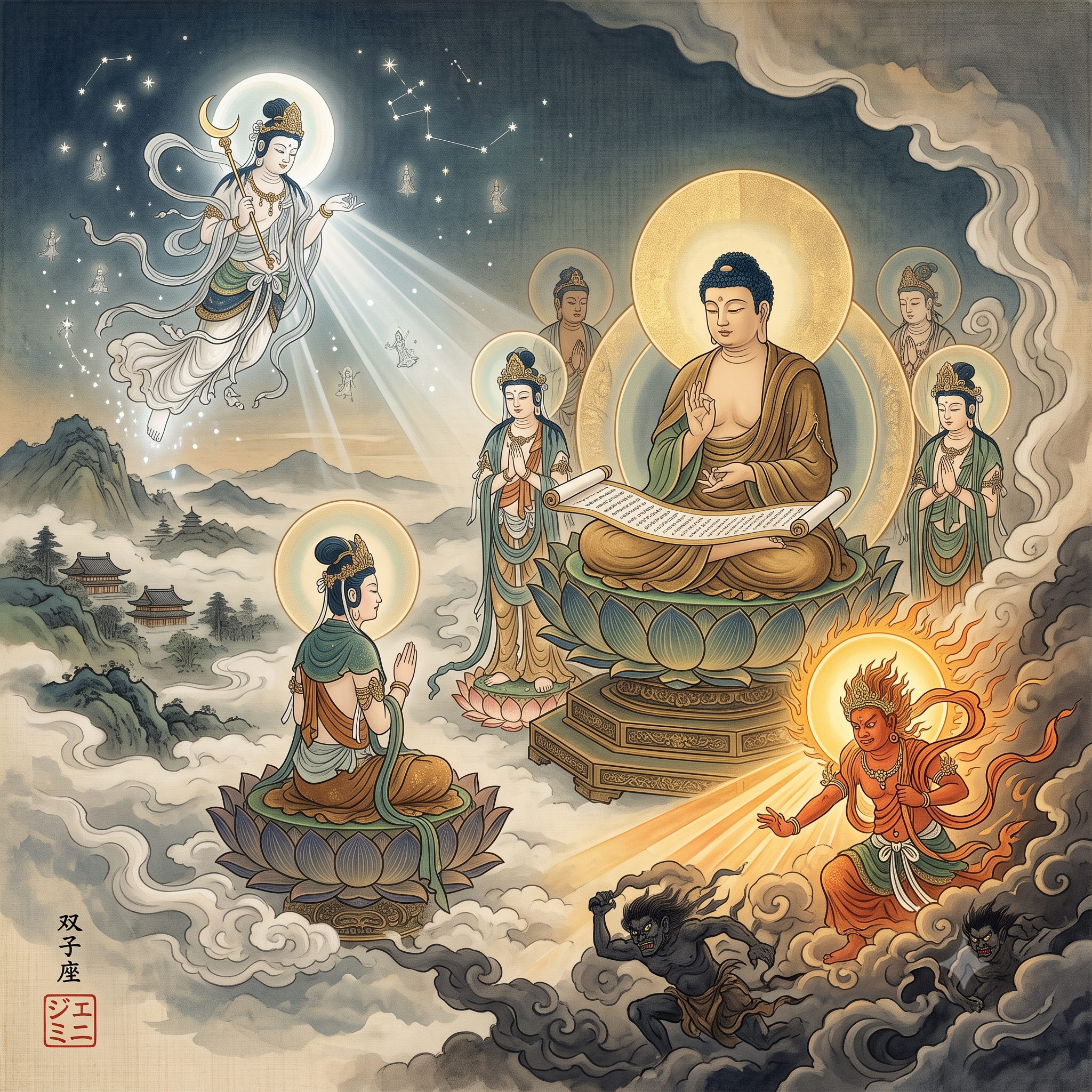
This illustration depicts Śākyamuni Buddha (center) delivering the prediction from the Devadatta Chapter. He is surrounded by Buddhas of the worlds of the ten quarters. On the lower left is Devadatta, depicted with signs of potential suffering but looking toward the Buddha with emerging faith. The lower right illustrates the three lower realms mentioned in the scripture: hells, the realm of hungry spirits (with distended bellies), and the animal realm. Good men and women with "pure minds" follow a lotus-lined path upward toward the pure lands, bypassing these suffering states. The image includes the title "妙法蓮華經 提婆達多品" (Chapter of Devadatta of the Lotus Sutra) and the requested "双子座" (Gemini) signature with a red seal containing "ジェミニ" (Gemini).

Good men or women in the future who hear this Chapter of Devadatta of the Sūtra of the Lotus Flower of the Wonderful Dharma with faithful respect caused by their pure minds, and have no doubts [about this chapter], will not fall into hell or the region of hungry spirits or the region of animals. They will be reborn before the Buddhas of the worlds of the ten quarters.

Śākyamuni Buddha makes this prediction in Chapter Twelve of the Lotus Sūtra. In this Chapter, he assures Devadatta, an evil man who creates great harm, that he too will eventually reach the enlightenment of the Buddha. This prediction is for the rest of us too. It shows that when we nourish our capacity for respect for all beings, no matter how much harm they create, then we uproot the causes of our own greed and fear, and we will always find ourselves in a realm where the Buddha teaches the Wonderful Dharma.

The Daily Dharma is produced by the Lexington Nichiren Buddhist Community. To subscribe to the daily emails, visit zenzaizenzai.com
10 Reasons To Discard Provisional Sūtras

[L]et me explain why we should discard provisional sūtras, putting faith in the true sūtras instead.

QUESTION: What scriptural statements support your contention?

ANSWER: Ten scriptural statements support my contention. First, it is stated in the Lotus Sūtra, chapter 3 on the “Parable,” “You should try to uphold only Mahāyāna sūtras … without putting faith in even a verse of other sūtras.”

Secondly, the Nirvana Sūtra states, “We should depend on sūtras which thoroughly reveal the truth and not on those which do not.” Sūtras which do not thoroughly reveal the truth refer to those sūtras expounded in forty years or so before the Lotus Sūtra.

Thirdly, it is stated in the Lotus Sūtra, chapter 11 on the “Appearance of the Stupa of Treasures”, “It is difficult to uphold this sūtra. If anyone upholds it even for a moment, I, as well as the other Buddhas, will rejoice and praise him. He is a man of valor and endeavor; he is observing the precepts and practicing the rules of frugal living.” In the Latter Age of Degeneration, we may not observe various precepts defined in the sūtras expounded during forty years or so before the Lotus Sūtra. Upholding the Lotus Sūtra single-mindedly may be called observing the precepts and rules of frugal living.

Fourthly, the Nirvana Sūtra states, “Those who do not exhort themselves to uphold the dharma may be called indolent, but those who do not exhort themselves to observe the precepts may not be. Bodhisattvas, if you are not lax in putting faith in this Mahāyāna dharma, you deserve to be called the upholders of the precepts. In order to uphold that True Dharma, you bathe in the water of Mahāyāna. Therefore, even when bodhisattvas break the precepts, they may not be called indolent.” This scriptural passage elaborates the spirit of observing the precepts in the Lotus Sūtra.

For the fifth, it is stated in the Lotus Sūtra, fascicle 4, chapter 11 on the “Appearance of the Stupa of Treasures”, “The Lotus Sūtra is entirely true.” This is the attestation by the Buddha of Many Treasures.

For the sixth, in the Lotus Sūtra, fascicle 8, chapter 28 on the “Encouragement of Universal Sage Bodhisattva, Universal Sage Bodhisattva, swearing to Śākyamuni Buddha, declares, “I will make sure that this sūtra will be spread all over the world (Jambudvīpa) and not be destroyed after the extinction of the Buddha.”

For the seventh, it is stated in the Lotus Sūtra, fascicle 7, chapter 23 on the “Previous Life of Medicine King Bodhisattva”, “I will not let this sūtra perish in the world (Jambudvīpa) during the fifth 500-year period after My extinction.” This is an oath by Śākyamuni Buddha Himself.

For the eighth, explaining why the Buddha of Many Treasures and various Buddhas manifested in many worlds all over the universe gathered together around Śākyamuni Buddha, the Lotus Sūtra, fascicle 4, chapter 11, on the “Appearance of the Stupa of Treasures” declares, “They have come together in order to perpetuate the dharma in this world.”

For the ninth, regarding the place where practicers of the Lotus Sūtra reside, the sūtra, fascicle 7, chapter 21 on the “Divine Powers of the Buddha” preaches:

“After the extinction of the Buddha, you should single-mindedly uphold, read, recite, expound, copy this sūtra and act according to its teachings. … Wherever a copy of this sūtra is, regardless where it may be, in a garden, in a forest, under a tree, in a monastery, in the house of a layman, in a hall, in a mountain, in a valley or in a wilderness, a Stupa should be erected and offerings be made to it. Why should it be? It is because this is the place of enlightenment. It was here that Buddhas attained Buddhahood.”

And for the tenth, it is stated in fascicle 9 of the Nirvana Sūtra, a sūtra preached for amplification of the Lotus Sūtra:

“During the last 80 years when the True Dharma will be about to expire after My death, this sūtra will spread widely in this world (Jambudvīpa). Then, however, evil monks will steal this sūtra, cutting it up into pieces to kill its original color, fragrance and flavor. In reading this sūtra, unable to understand the essence of the Buddha’s profound enlightenment, they will insert flowery phrases and meaningless sentences just to save appearances. They might put a beginning sentence at the end, an ending sentence at the beginning, a beginning or ending sentence in the middle, or a middle sentence at the beginning or at the end. You should know that these evil monks are not the Buddha’s disciples but the Devil’s companions. … Those evil monks are like a dairymaid who dilutes cow’s milk with much water to make a quick profit. Likewise, they will mix the Buddha’s words in this sūtra with worldly words, making it misleading. Many people will not be able to talk about, copy and comprehend this sūtra correctly, or be able to praise, make offerings to and revere it. Guided solely by self-interest, those wicked monks will be unable to spread this sūtra widely; it will spread so slightly that it will not be worth mentioning. It is just like a poor dairymaid selling cow’s milk, which was resold and repurchased many times. …When, finally, milk gruel is made of it, it will have no taste of milk. Likewise, this great Nirvana Sūtra, a Mahāyāna sūtra, while being transmitted from person to person, will lose its flavor until in the end it will be tasteless. Nevertheless, it is still 1,000 times superior to other sūtras just as the taste of milk, no matter how much diluted, is 1,000 times better than the taste of bitterness. It is because this great Nirvana Sūtra, a Mahāyāna sūtra, is supreme of all the sūtras transmitted by the direct disciples of Śākyamuni Buddha.”

Shugo Kokka-ron, Treatise on Protecting the Nation, Writings of Nichiren Shōnin, Doctrine 1, Page 13-15

Daily Dharma for April 2, 2026

20260402-ddi

Illustration by Google Gemini

Show Gemini's thinking

Gemini Thinking

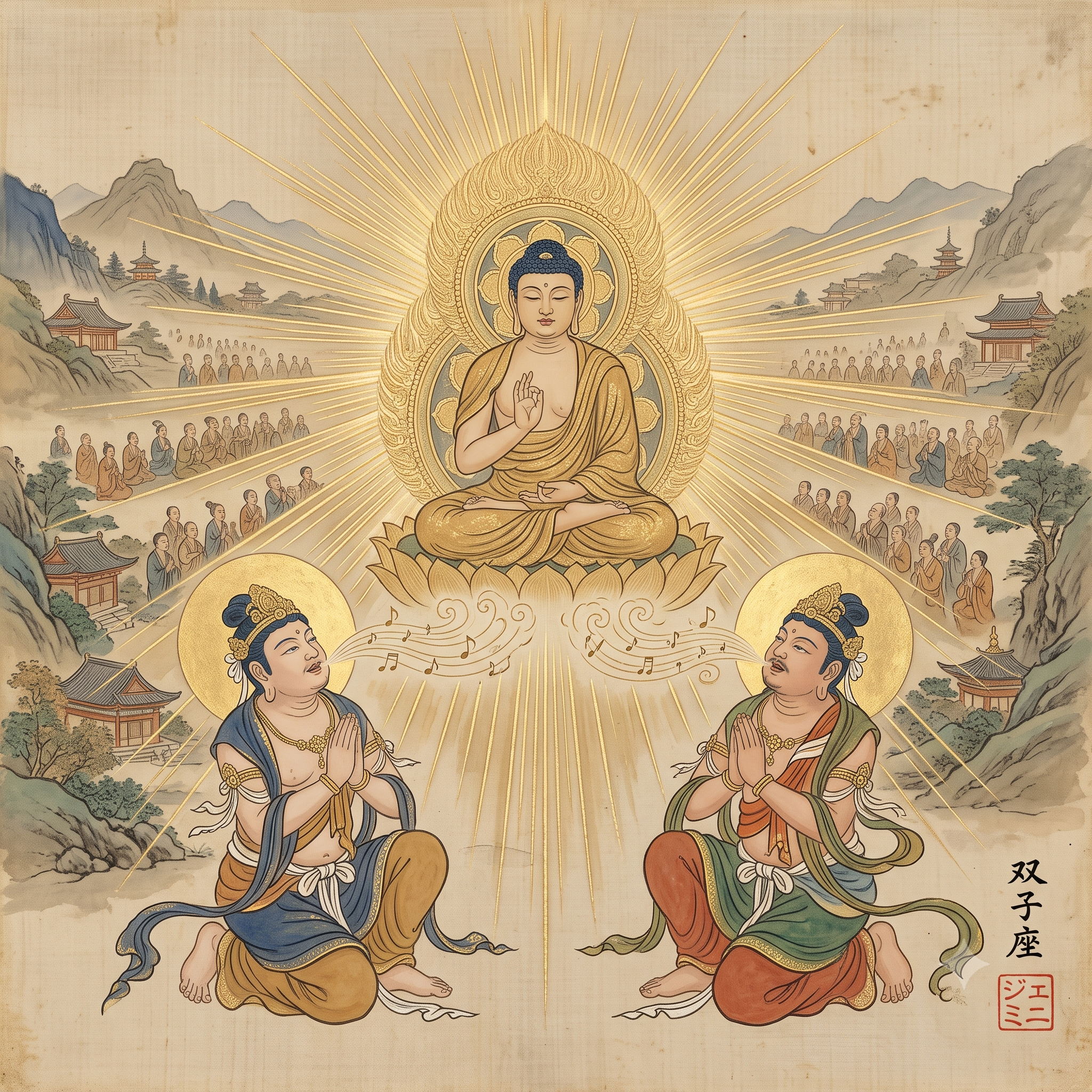
In this square illustration, I have sought to visualize the profound message of Chapter Sixteen of the Lotus Sūtra, focusing on the visual cues found within the parable of the skilled physician. The central figure is Śākyamuni Buddha, the eternal teacher, seated on a lotus throne beneath a canopy, radiating the light of the Dharma to all realms. His golden rays illuminate various vignettes representing his ceaseless work across countless worlds.

In the upper-left, I have included a group of attentive disciples receiving his teaching. Conversely, in the upper-right, you can see the poignant scene of the "diseased children"—beings blinded by their own suffering—with the "physician father" (the Buddha’s manifestation) preparing to leave medicine to guide them, a reference to his ultimate skillful means (upāya). Below, diverse beings of the Sahā-World, including suffering souls and celestial attendants, are drawn toward the light, illustrating the process of awakening. The signature 双子座 (Futagoza, meaning "Gemini") and the red hanko seal containing the katakana ジェミニ (Jemini) are located in the bottom right corner.

All this time I have been living in this Sahā-World, and teaching [the living beings of this world] by expounding the Dharma to them. I also have been leading and benefiting the living beings of one hundred thousand billion nayuta asaṃkhya worlds outside this world.

Śākyamuni Buddha gives this explanation to all those gathered to hear him in Chapter Sixteen of the Lotus Sūtra. In the parable of the physician and his children, the Buddha explains how if he were to reveal himself explicitly to those still focused on their own suffering, they would take him for granted and not believe the Wonderful Dharma he provides for him. It is by learning to recognize the Buddha living with us here today, who is helping us all awaken from our delusions, and taking on his work of benefiting all beings, that we lose our suffering and attachment, and realize the potential for enlightenment that is at the core of our true being.

The Daily Dharma is produced by the Lexington Nichiren Buddhist Community. To subscribe to the daily emails, visit zenzaizenzai.com
Women Attain Buddhahood Only Through Lotus Sūtra

Grand Master T’ien-t’ai states in his Words and Phrases of the Lotus Sūtra, “Buddhist sūtras other than the Lotus Sūtra recognize the attainment of Buddhahood only by men but not by women.” This means that women can attain Buddhahood only through the Lotus Sūtra, doesn’t it? The Emitting Ten-million Rays of Light Buddha appearing in the Lotus Sūtra (chapter 13) is Mahā-Prajāpatī, foster mother of Śākyamuni Buddha. Reasoning from these accounts, isn’t it so that the attainment of Buddhahood by women is possible only through the Lotus Sūtra?

“Without fail I will expound the truth.” These are the golden words of Lord Śākyamuni Buddha (chapter 2). The truth of his words was attested to by the Buddha of Many Treasures (chapter 11) by saying, “This is entirely true.” Furthermore, it was upheld by various Buddhas by “Stretching their wide long tongues touching the Brahma Heaven” (chapter 21). Will the sun and moon ever fall on the ground? Will Mt. Sumeru ever collapse? Will the ebb and flow of the ocean stop? Will the earth ever be overturned? As long as these events do not occur, the attainment of Buddhahood by women through the Lotus Sūtra is certain.

Hōe Sho, Writing on Vestments, Writings of Nichiren Shōnin, Followers II, Volume 7, Page 186

Daily Dharma for April 1, 2026

20260401-ddi

Illustration by Google Gemini

Show Gemini's thinking

Gemini Thinking

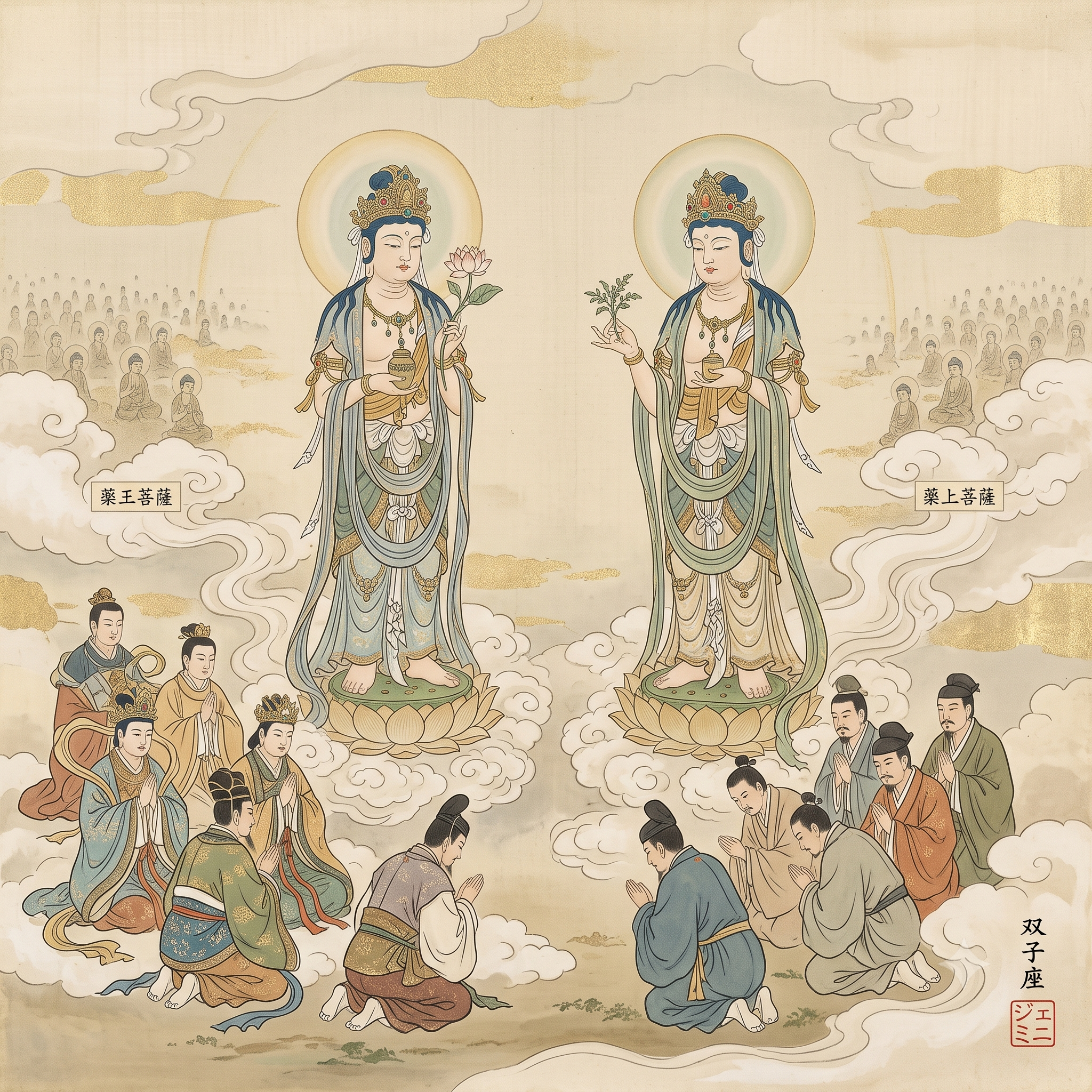
In this square illustration, Lord Ueno is depicted reading a scroll in the foreground, with an expression of resolute confidence. Looming behind him are grim-faced officials and samurai, representing the formidable opponents of his faith who might threaten his life and property. On the right, the sea features a small turtle approaching a wooden plank with a hole, a classic Buddhist metaphor for the extreme rareness of encountering the correct teaching. Above this, the uḍumbara flower, which blooms but once in a millennium, grows from the wave, while the text 千 (one thousand) is visible within its petals. The artist's signature and seal are in the lower right corner.

If those of high rank reproach you, view them as formidable enemies of the Lotus Sutra. Consider the opportunity as rare as seeing an uḍumbara that blooms only once in 1000 years, or a blind turtle by chance encountering a log floating in the ocean, and respond with confidence. Even a person who possesses a fief as large as 1000 or 10,000 chō may have his land confiscated or lose his life over a small matter. If you must lay down your life for the sake of the Lotus Sutra, have no regrets.

Nichiren wrote this passage in a Reply to Lord Ueno (Ueno-dono Gohenji). Lord Ueno enjoyed a privileged position in society and was concerned about losing his status and belongings as a result of his faith in the Lotus Sūtra. In this letter, Nichiren reminded Lord Ueno of his true purpose in life, that he had come as a Bodhisattva to benefit all beings by leading them to enlightenment with the Buddha Dharma.

The Daily Dharma is produced by the Lexington Nichiren Buddhist Community. To subscribe to the daily emails, visit zenzaizenzai.com
The Horse King of Parthia

Once in the neighboring land of India there was a great king in a country called Parthia, who loved to breed horses. He not only improved the quality of horses but also tried to transform cattle into horses. Eventually he even changed the men of Parthia into horses and rode them. The people of his own land were so grief-stricken over his actions that he began to change foreigners into horses instead.

When a merchant from a foreign country visited his country, the great king forced him to take a potion, turned him into a horse, and tied him in a stable. The merchant missed his native land and longed for his wife and children but was unable to go home without the king’s permission. Even if he were able to return home, what could he do in the form of a horse?

While he grieved over his misfortune day and night, his only son in his homeland began to prepare for a trip to look for him, since the expected date of his father’s return had passed. The son wondered, “Was my father murdered? Or is he too sick to move? How can I, his child, stay here and not go looking for my father?” His mother lamented saying, “My husband has not yet returned from abroad. What will I do if my only son goes away too and doesn’t return?” Nevertheless, the son missed his father deeply, so he went all the way to Parthia to look for him.

While staying in a small house, the master of the house told him:

“What a pity! You are still very young and extraordinarily handsome. I had a son, but he went abroad and never returned. I don’t know whether he is dead or what became of him if he is still alive. When I think of my own son, it saddens me to even look at you. The reason why I feel very sorry for you is that there is a terrible development in this country. The king of this country, out of his love for horses, uses a mysterious herb. When the king forces a person to eat a slender leaf of the herb, that person will become a horse, and when the king feeds a horse with a wide leaf, the horse becomes a man. Recently the king forced a foreign merchant to eat the herb, changing him into a horse, and tied him in the first royal stable and keeps him as a treasure.”

Believing that the king must have changed his father into a horse, the young man asked the master, “Do you know what kind of hair the horse has?” The master replied, “It is a chestnut horse with white dapples on its shoulders.”

Hearing this, the young man devised a secret plan and entered the royal palace, stole a wide leaf herb, and fed it to the horse, which reverted to its original form as a human being.

The great king, who investigated the whole episode, was impressed by the filial act of the young man, returned the father to his son and stopped changing men into horses. Unless a child is filial, how can a child go to such lengths to go abroad searching for his father?

Venerable Maudgalyāyana saved his late mother who suffered among hungry beings, and Princes Pure Store and Pure Eyes changed the erroneous views of their father, Wonderful Adornment King. These are the fine examples of good children being the treasure of parents.

Sennichi-ama Gohenji, A Reply to Sennichi-ama, Writings of Nichiren Shōnin, Followers II, Volume 7, Pages 162-163

Daily Dharma for March 31, 2026

20260331-ddi

Illustration by Google Gemini

Show Gemini's thinking

Gemini Thinking

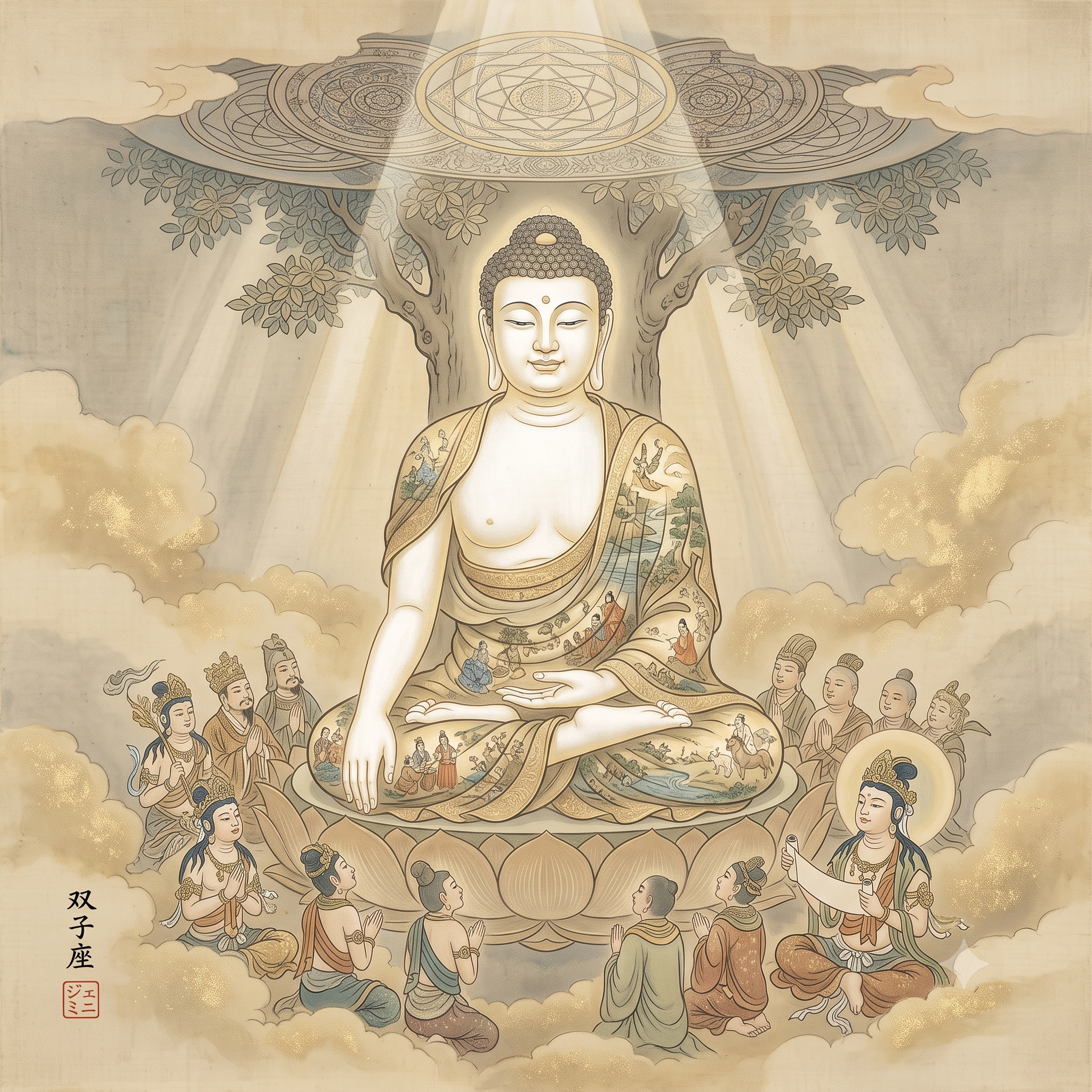
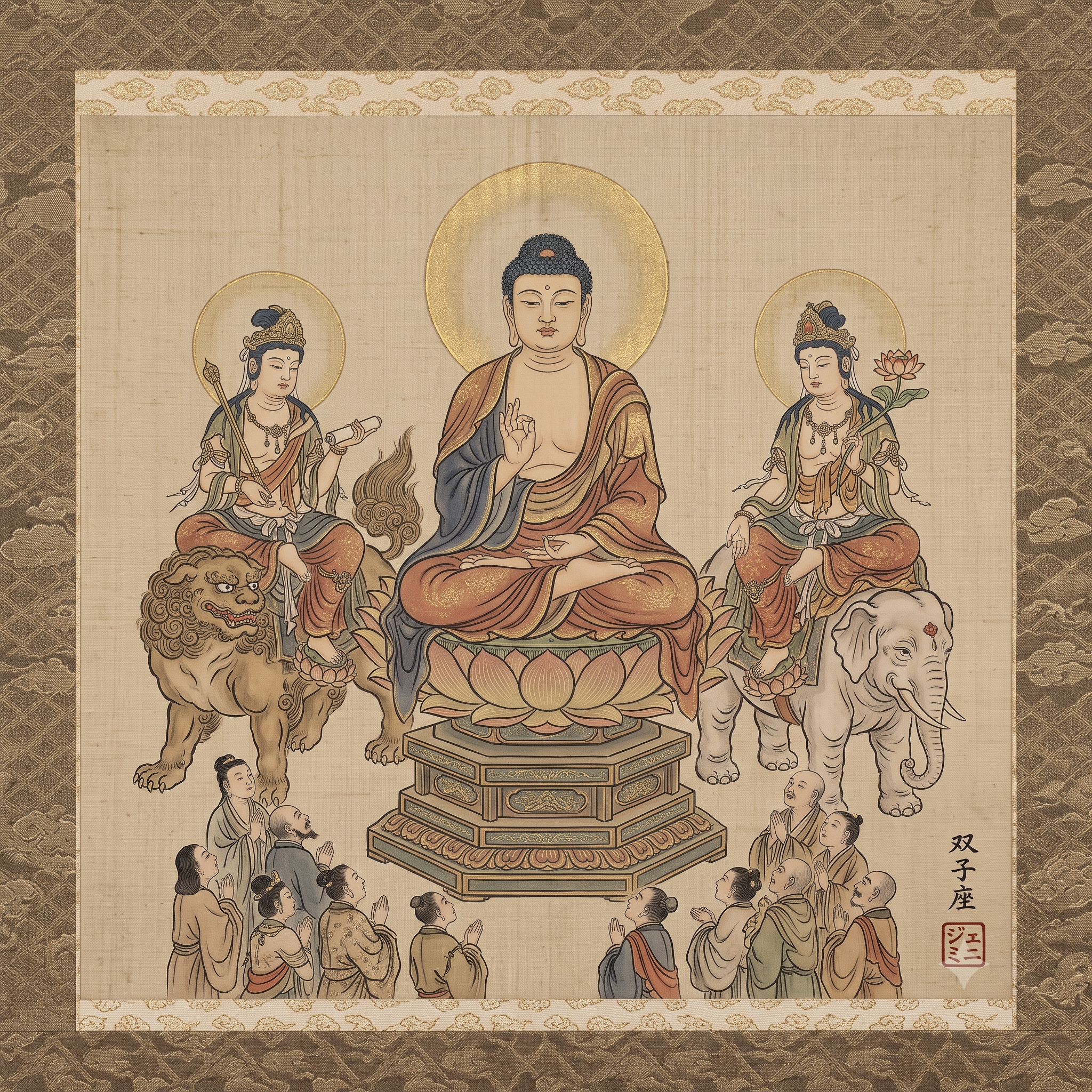
In this square illustration, I have depicted the historical Śākyamuni Buddha (known in Japanese as Shaka Nyorai) surrounded by a diverse assembly of disciples, including monks, laypeople, and celestial beings. While specific individuals like Maitreya are not named in your text, the assembly represents all sentient beings to whom the Buddha addresses his teaching. The floating roundels surrounding the central Buddha illustrate various scenes from "previous existences," showing how the karmic seeds planted through former actions shape our current reality. True to your request, symbols specific to Amida Nyorai or Dainichi Nyorai are excluded. The artist signature 双子座 (Gemini) and the red square hanko seal (ジェミニ) are subtly placed in the bottom right corner.

Now I will tell you
About my previous existence
And also about yours.
All of you, listen attentively!

Śākyamuni Buddha sings these verses in Chapter Six of the Lotus Sūtra. When the Buddha taught in India 2500 years ago, people took for granted that their lives continued from previous lives and would continue on into future lives. Whatever comforts we enjoy or calamities we endure in this life were thought to be caused by what we did in our former lifetimes. Our actions today were thought to determine what happens in our future lives. To our modern understanding this can sound mystical and unlikely. But if we understand that everything, including our joy and suffering, has causes and conditions, whether or not we realize these results immediately, we know that the result of creating benefit is benefit, and the result of creating harm is harm. When we hold the happiness of all beings to be as precious as our own, we would no more mistreat others than we would want them to mistreat us.

The Daily Dharma is produced by the Lexington Nichiren Buddhist Community. To subscribe to the daily emails, visit zenzaizenzai.com

The Gohonzon Treasured by Śākyamuni Buddha

[T]he gohonzon that I revealed was not revealed by any of the many Tripiṭaka masters entering China from India or by those who went to India from China. Looking at such books as the Record of the Western Regions by Hsūan-tsung, the honzon of various temples in many states in all of India are all recorded. I have also exhaustively studied the gohonzon of Chinese temples recorded by Chinese sages coming to Japan and by wise men of Japan entering China. Regarding those in Japan, they are all recorded in the diaries of numerous temples starting with the Gangōji and Shitennōji Temples, the first Buddhist temples in Japan, and many secular books and diaries beginning with a book called Nihongi. Therefore, the gohonzon of each temple is ascertained. The gohonzon that I revealed is not among them.

Some people may have doubts about me saying, “Isn’t it correct to say that the honzon revealed by Nichiren is not based on sūtras or commentaries? Isn’t this why many sages in the past did not portray it or carve it in wood?” Despite this, the honzon is based on the scriptural statements, as clear as day. Those who doubt this should investigate whether or not the scriptural base in fact exists. It is not right to criticize it just because it was not created or portrayed in the previous era.

For instance, when Śākyamuni Buddha went up to the Trāyastriṃsá Heaven in order to make obeisance for his late mother, no one in the entire world (Jambudvīpa) was aware of this. Only Venerable Maudgalyāyana knew this, but it was due to the divine power of the Buddha. Likewise, the Buddha Dharma, which exists before our very eyes, cannot be seen unless one has the capacity for perceiving it, and it cannot be spread unless the time is ripe. There is a natural reason for this. For instance, it is like the ebb and flow of the ocean tide or the waxing and waning of the moon in the sky according to time.

Now this gohonzon had been treasured by Lord Preacher Śākyamuni Buddha in his heart for 500 (million) dust-particle kalpa in the past before appearing in this world. Even after attaining Enlightenment, he did not reveal it for forty years before expounding it in the Lotus Sūtra. And even while preaching the Lotus Sūtra, the Buddha passed through most of the theoretical section without referring to it until he began preaching it in the “Beholding the Stupa of Treasures” chapter, revealing it in the truth in the “Life Span of the Buddha” chapter in the essential section, and completing it in the “Divine Power of the Buddha” and the “Transmission” chapters.

Many bodhisattvas such as Mañjuśrī of the Konjiki Sekai (Golden World), Maitreya of the Tuṣita Heaven, Avalokiteśvara of Mt. Potalaka, and Medicine King, a disciple of Sun Moon Pure Bright Virtue Buddha, eagerly volunteered to spread it, but they were not allowed to do so. Śākyamuni Buddha then stated, “These bodhisattvas, though widely known for their wisdom and wit, have not placed their faith in the Lotus Sūtra for long and their learning is not deep enough, making it difficult for them to endure the great challenges of the Latter Age of Degeneration. I have instead my treasured disciples whom I have secretly kept in the bottom of the earth since 500 million dust-particle kalpa ago. I am entrusting them with this great duty.”

Thus, the Buddha called out such bodhisattvas as Superior Practice Bodhisattva in the “Emerging from the Earth” chapter and granted to them the five characters of Myō, Hō, Ren, Ge, and Kyō, the gist of the essential section of the Lotus Sūtra, declaring:

“Listen carefully! Listen carefully! This dharma should not be spread during the millennium Age of the True Dharma nor the millennium Age of the Semblance Dharma. In the beginning of the Latter Age of Degeneration, priests slandering the True Dharma will fill the world (Jambudvīpa) evoking the anger of various heavenly beings, causing a comet to appear in the sky, and unleashing a violent earthquake that will shake the great earth like a great wave of the ocean. What is more, severe droughts, huge conflagrations, deluges, storms, widespread epidemics, famines, and the horrors of war will compete with each other. At such time when all the people in the entire world don armor and carry swords and bows, when various Buddhas, bodhisattvas, and virtuous deities have become powerless, and when people all die and fall like heavy rainfall into the Hell of Incessant Suffering, the rulers will be able to save their countries and the people will be able to free themselves from calamities if they carry the great mandala of five Chinese characters with them and put faith in it. Not only will they experience peace in this life but also will be able to escape the suffering of fire in hell after death.”

Now, although I am not Superior Practice Bodhisattva, I understood beforehand nearly everything about Buddhism in the Latter Age of Degeneration. Believing that it was at the discretion of Superior Practice Bodhisattva, I have devoted myself to spreading the five characters of the Lotus Sūtra during these twenty years or so.

Nii-ama Gozen Gohenji, A Response to My Lady, the Younger Nun, Writings of Nichiren Shōnin, Volume 7, Followers II, Pages 147-149

Daily Dharma for March 30, 2026

20260330-ddi

Illustration by Google Gemini

Show Gemini's thinking

Gemini Thinking

In this square illustration, the Parable of the Magic City is rendered in a traditional Japanese Buddhist iconographic style. The scene captures the pivotal moment from the Lotus Sūtra where the compassionate guide encourages the group of four weary travelers. The guide is depicted in a traditional green and blue monk's robe, with his left arm pointing toward a radiant "Magic City" that has appeared amidst cloud-capped mountains. This intermediate destination, featuring prominent pagodas and golden roofs, symbolizes a place of resting and comfort. Farther above it, in the upper right, a second and more distant luminous realm is visible—the ultimate "place of treasures" representing true enlightenment.

The four travelers, appearing exhausted and resting upon a dangerous mountain path, are looking back toward the guide, illustrating their fatigue and desire to abandon their journey. Next to them, a trail marker points back down the difficult "Tough Road."

The text on the road signs says:
The top sign (left arrow): 尋雪峰庵 (Seeking Snowy Peak Hermitage)
The bottom sign (right arrow): 須彌驛 (Sumeru Station)

The artist’s signature is located in the bottom right: the kanji 双子座 (Futagoza, meaning "Gemini"), alongside a red hanko seal containing the katakana ジェミニ (Jemini). The entire illustration is framed by a stylized decorative border featuring lotus flowers.

He said to them, ‘Do not be afraid! Do not go back! You can stay in that great city, and do anything you like. If you enter that city, you will be peaceful. If you go on afterwards and reach the place of treasures, then you can go home.

This is part of the Parable of the Magic City, told by Śākyamuni Buddha in Chapter Seven of the Lotus Sūtra. In the story, a guide is leading a group of travelers through a dangerous road to a city of treasures. Halfway through the trip, the travelers, overcome by their fear and fatigue, consider giving up their journey and returning to their previous lives. The guide makes a resting place for them where they can relax before continuing. When the travelers mistake this resting place for their destination, the guide makes the city disappear so that they will keep moving towards the true treasures. The Buddha compares himself to the guide, us to the travelers, the magic city to that place we all want where even our unspoken desires are met, and his enlightenment to the city of treasures. To see the world as it is and find true happiness, we need to let go of our delusions and keep faith in our guide and his highest teaching.

The Daily Dharma is produced by the Lexington Nichiren Buddhist Community. To subscribe to the daily emails, visit zenzaizenzai.com