Category Archives: LS32

Helping Even Such an Evil King as Ajātaśatru

With such great virtues as these, the Buddha was able to help even such an evil king as Ajātaśatru who called together wrong doers from 16 major states, took non-Buddhists in the world into his circle, had Devadatta as his teacher, incited slander among scoundrels, physically abused and even murdered the Buddha’s disciples. Moreover, Ajātaśatru crucified his father, a great Buddhist king reputed to have been a wise ruler, by nailing him on the cross with seven 12-inch long nails, and also destroyed his own mother’s jeweled ornamental hairpin and threatened to have her beheaded. Due to such serious sins compounded Ajātaśatru suffered from seven malignant tumors for which he was destined to fall into the Hell of Incessant Suffering within three weeks time on the seventh day of the third month through a hole in the earth and suffer in the hell for as long as one kalpa (aeon). Nevertheless, when he visited the Buddha and paid homage to Him, his malignant tumors were healed, he was saved from the severe torment of the Hell of Incessant Suffering, and moreover, his life span was prolonged by 40 years. Minister Jīvaka is said to have entered a blazing flame to save a child of millionaire Campā. It was only because he was the messenger of the Buddha that he was able to do this. Reflecting on this, there is no doubt that anyone who made an offering to the Buddha is bound to attain Buddhahood no matter how evil a man or woman is.

Hōren-shō, Letter to Hōren, Writings of Nichiren Shōnin, Volume 6, Followers I, Page 47-48

Returning to a Good Friend

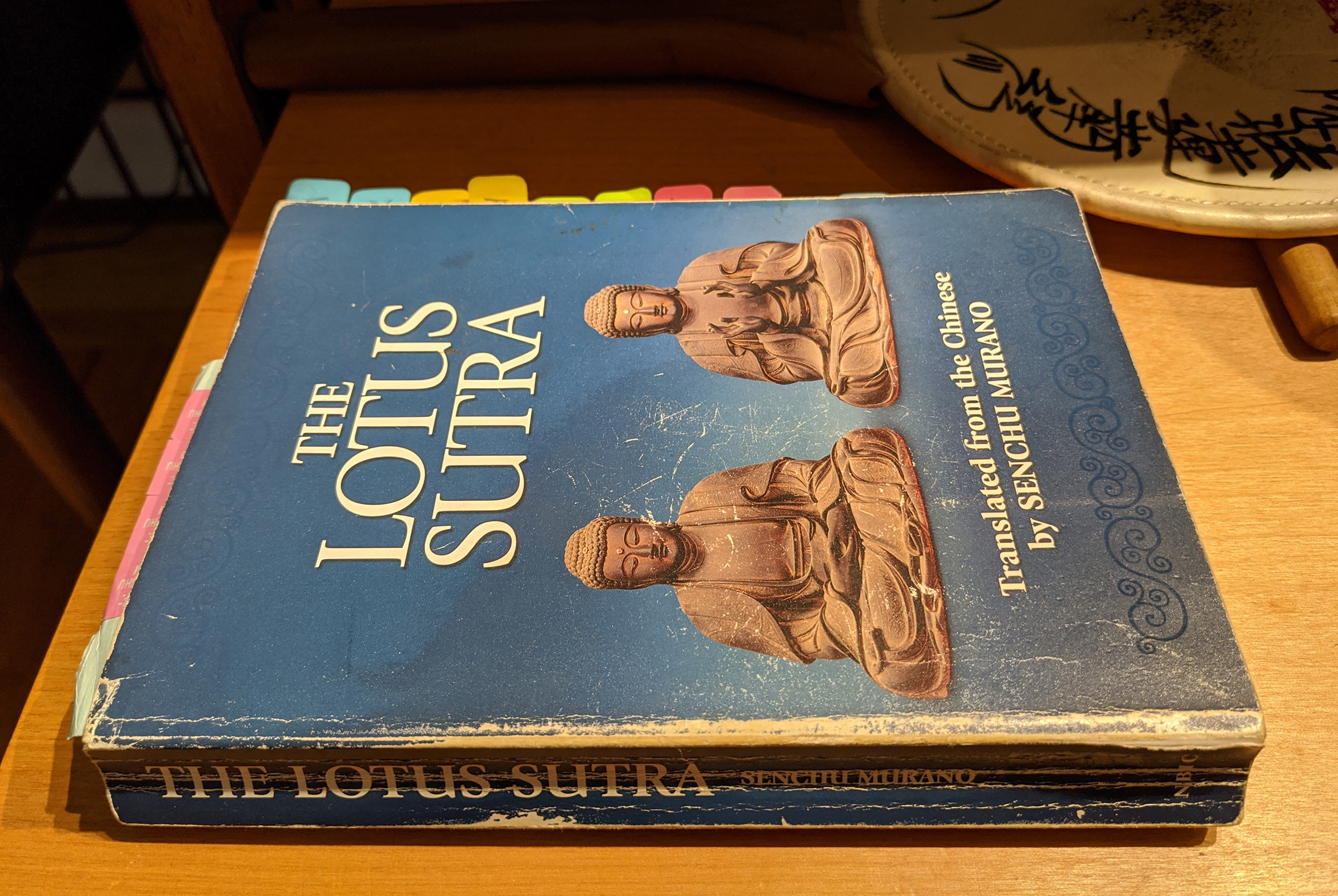
Lotus Sutra by Senchu Murano

For this evening’s service I welcomed an old friend, my Senchu Murano translation of the Lotus Sutra. For the past 10 cycles through my 32 Days of the Lotus Sutra practice I have been working my way through all of the English translations of Kumarajiva’s Chinese translation of the Lotus Sutra, beginning with “The Scripture of the Lotus Blossom of the Fine Dharma,” the translation of the Lotus Sutra made by Leon Hurvitz, and concluding with Burton Watson’s translation for Soka Gakkai. I suspect that Rissho Kosei-kai’s translation, “The Threefold Lotus Sutra: A Modern Translation for Contemporary Readers,” which was published in 2019, will become the modern standard. The Nichiren Shu Buddhist Sangha of the San Francisco Bay Area intends to use this translation rather than Murano’s for its service booklet. Personally, I’m not convinced that the translators’ aggressive effort to remove gender bias is beneficial. I wrote about this in a January blog post.

In any event, on this 51st cycle through the Lotus Sutra, I’m very happy to return to Murano’s translation.

Day 1

Day 1 covers the first half of Chapter 1, Introductory


Having last month considered the additional practices of the Bodhisattvas that Maitreya sees, we considered the final practices of those Bodhisattvas that Maitreya sees.

I also see some Bodhisattvas
Offering delicious food and drink
And hundreds of kinds of medicines
To the Buddha and the Sangha.

Some offer garments and beautiful robes
Worth tens of millions
Or beyond monetary value
To the Buddha and the Sangha.

Some offer thousands of billions
Of jeweled houses made of candana
And wonderful bedding
To the Buddha and the Sangha.

Some offer pure gardens and forests
Abounding in flowers and fruits,
And furnished with rivers, springs,
and pools for bathing,
To the Buddha and the Saṃgha.

I see those Bodhisattvas
Making offerings of those wonderful things
Joyfully and untiringly
In order to attain unsurpassed enlightenment.

Some Bodhisattvas expound
The truth of tranquil extinction,
And with various expedients,
Teach innumerable living beings.

I also see some Bodhisattvas
Who attained the following truth:
“The nature of things is not dual.
It is [formless] like the sky.”

I also see some sons of the Buddha
Having no attachment in their minds.
They seek unsurpassed enlightenment
With this wonderful wisdom.

Mañjuśrī!
Some Bodhisattvas make offerings
To the śarīras of a Buddha
After his extinction.

I also see some sons of the Buddha
Adorning the world of the Buddha
With as many stupa-mausoleums
As there are sands in the River Ganges.

Those stupas of treasures are
Lofty and wonderful.
They are five thousand yojanas high,
And two thousand yojanas wide and deep.

Each of the stupa-mausoleums has
One thousand pairs of banners and streamers.
It also has curtains adorned with gems.
It also has jeweled bells ringing.

Gods, dragons, men, and nonhuman beings
Constantly offer incense, flowers, and music
[To the stupa-mausoleums].

Mañjuśrī!
Those sons of the Buddha
Adorn the stupa-mausoleums
And offer the adornments
To the śarīras [of the Buddha].

The worlds [of the Buddha] naturally become
As wonderful and as beautiful
As the [flowers] of the kingly tree
In full bloom on the top of Mt. Sumeru.
The multitude of this congregation and I
Can see the various wonderful things
Of those worlds
By the ray of light of the Buddha [of this world].

The Introduction to the Lotus Sutra explains the omens that confounded Maitreya:

In Chapter 1, Introduction, the congregation waited anxiously for this definitive sermon, the way to which had already been prepared by the Sutra of Innumerable Teachings. But Sakyamuni did not begin immediately. First, he preached the opening sutra … . Then he entered into its deep meditation. His body and mind became motionless. The assembled gods rained mandarava flowers upon him. The world quaked in six ways. The assembled beings looked on in astonishment and joined their hands together in supplication. Finally the Buddha emitted a ray of light from the white curl between his eyebrows (the so-called “third eye”) and illuminated all the eighteen thousand worlds to the east, from their lowest hells up to their highest heavens.

These are called the “Six Omens Shown in This World.” In order, they are “Preaching,” “Entering into Samadhi,” “Raining Flowers,” “Quaking,” “Delighting,” and “Emitting a Ray of Light.”

Introduction to the Lotus Sutra

Expiating His Past Errors

Nichiren … read the story of Sadāparibhūta [Never-Despising Bodhisattva] in a way that reflected — and perhaps inspired — his understanding of his own ordeals as a form of redemptive suffering. The prose portion of the “Sadāparibhūta” chapter says that those who mocked the bodhisattva suffered for a thousand eons in the Avici hell, but after expiating this offense, they were again able to meet him and were led by him to attain “the highest, complete enlightenment.” The verse section, however, suggests that the bodhisattva himself had “expiated his past errors” by patiently bearing the insults and mistreatment he received in the course of his practice. Nichiren focused on this second reading, encouraging his followers, and himself as well, by explaining that hardship encountered for the Lotus Sūtra’s sake would eradicate one’s past slanders against the dharma. “The bodhisattva Sadāparibhūta was not reviled and disparaged, and assailed with sticks and stones, for no reason,” Nichiren suggested. “It would appear that he had probably slandered the true dharma in the past. The phrase ‘having expiated his past errors’ seems to mean that because he met persecution, he was able to eradicate his sins from prior lifetimes.”

Two Buddhas, p209-210

Another Innumerable Day Before Day 1

For today’s journey through The Sutra of Innumerable Meanings, I offer Nikkyō Niwano’s discussion of the 10 Merits gained by the practicer of this sutra:

This [Ten Merits] chapter expounds the merit one can gain, the virtuous deeds he can accomplish, and the service he can render to society if he understands the teachings preached in this sutra. Some people say that religion should not bring merit to its believers, but this is a specious argument. It would be, rather, a wonder if one did not gain merit when he truly understood a correct religion, believed in it deeply, and practiced it. Needless to say, there are varying degrees of merit according to one’s degree of understanding and the speed of the actual manifestation of merit. In any case, it is natural for one to gain merit through his religion when he has faith in it.

As mentioned earlier, the teachings of the Buddha are the truth of the universe, which of course includes human beings. It is no wonder, and certainly no miracle, that if one lives according to the truth, his life works out well. This is like the fact that if we switch on the television set and tune in exactly to the wavelength beamed from a particular television station, a vivid image appears on the screen and a clear voice is heard.

If no image appears on the television screen, however often we try to tune in the channel, the television set is useless. It will be put away in some storeroom, where it will be covered with dust. Numerous religions have sprung up throughout history, but some of them have gradually lost their power and finally have become distant from the people. This is because they have forgotten the merit to be gained by believers, or because they have preached only the merit to be gained after death – that one will go to heaven or be reborn in paradise.

The true teachings of the Buddha, however, do not preach an intangible merit that one cannot realize until after death. The merit preached by the Buddha appears clearly in our lives in this world. In addition to ourselves, it is a merit that exerts an influence upon all of society and upon all people. If we disregard this merit and make light of it, it is as if we deliberately shut out the light of the Buddha’s teachings with a black curtain. Such an attitude is due to the shallow understanding peculiar to people today.

We should abandon such shallow thinking and bathe ourselves in the light of the Buddha by drawing aside the curtain. This is the true hope of the Buddha and the sole purpose of his appearance in this world.

Buddhism for Today, p13-14

An Exemplar of Practice for the Latter Age

Nichiren took Sadāparibhūta [Never-Despising Bodhisattva] as a personal model and strongly identified with him. First, there were obvious parallels in their practice. “Sadāparibhūta was a practitioner at the initial stage of rejoicing,” Nichiren wrote, “while I am an ordinary person at the level of verbal identity. He sowed the seeds of buddhahood with twenty-four characters, while I do so with just five characters [Myō-hō-ren-ge-kyō]. The age differs, but the buddhahood realized is exactly the same.” This passage suggests that Nichiren saw Sadāparibhūta, like himself, as someone at the initial stages of practice who was carrying out shakubuku, planting the seeds of buddhahood in the minds of people who had never before received them. He saw other similarities as well. Both Nichiren and Sadāparibhūta lived long after the passing of the respective buddhas of their age, in an era of decline when there was much hostility. And both persevered in the face of emnity, enabling their persecutors to form a “reverse connection” (J. gyakuen) with the Lotus Sūtra. In short, Sadāparibhūta was for Nichiren an exemplar of practice for the latter age, and in this sense, he wrote, “The heart of the practice of the Lotus Sūtra is found in the ‘Sadāparibhūta’ chapter.”

Two Buddhas, p208-209

Between Day 32 and Day 1: Envisioning Śākyamuni Buddha

Text of the Contemplation of Universal Sage

Through the power of the Great Vehicle, words of praise will resound in the air:

“Well done, you of good intent! Well done! You practice in accordance with the Great Vehicle! Your capacity to perceive buddhas is a beneficial effect of that cause! But even though you have now gained perception of buddhas, the World-honored Ones, you are not yet capable of perceiving Śākyamuni Buddha, the buddhas that emanate from him, or the stupa of the buddha Many-Treasures.”

After hearing the voice in the air, the practitioner will again devotedly internalize and master the Great Vehicle sutras. As a result of internalizing the comprehensive Great Vehicle sutras, the practitioner soon envisions Śākyamuni Buddha in great assemblies at Mount Vulture Peak teaching the Dharma Flower Sutra and discoursing on the meanings of the one reality. After being taught, the practitioner will do self-amendment; then, reverentially wishing to see him, the practitioner will face toward Mount Vulture Peak, formally kneel, place his or her palms together, and say:

“O Tathāgatha, Hero of the Universe, you are always present in the world: Out of compassion for me, reveal yourself to me for my sake!”

After saying these words, the practitioner will perceive Mount Vulture Peak composed of the seven precious metals and gems, monks and śrāvakas with countless others together in a great assembly, rows of jewel trees lining level jewel ground on which a magnificent jeweled lion seat has been arranged, and Śākyamuni Buddha, who emits from between his eyebrows a beam of light that passes through the innumerable worlds of the ten directions and illuminates worlds everywhere in the universe. From everywhere this light reaches in the ten directions, the buddhas that emanated from Śākyamuni gather together at one time into a great assembly, as is extensively expounded in the Dharma Flower Sutra. Each emanated buddha has a body that is purple-gold in color and boundless in size, each sits on a lion seat, and each has a retinue of countless thousands of millions of great bodhisattvas. Each bodhisattva follows the same practice as Universal Sage; it is like this as well in the bodhisattva retinues of all of the innumerable buddhas in the ten directions.

See Aiming Toward the Ultimate Ideal

Aiming Toward the Ultimate Ideal

Especially noteworthy [in The Sutra of Contemplation of the Dharma Practice Of Universal Sage Bodhisattva] is the following expression: “How, without cutting off their earthly cares and renouncing their five desires, can they also purify their organs and destroy their sins?”

The ideal of our practice is to cut off our earthly cares and renounce our five desires. Though such an ideal should be demanded of Buddhist monks, it is much more difficult for lay devotees to pursue because they must maintain their faith while living and working in secular society. In their circumstances, situations caused by the five desires occur continually, and they are surrounded by people and situations that cause them earthly cares. Ideally speaking, they should become free from all desires, but in actuality, to expect them to reach such a spiritual level immediately is asking too much. Nevertheless, as long as they are believers, they must aim toward their ultimate ideal. But how should they bridge the gap between their ideal and actuality? This sutra teaches the answer to this practical question, which believers face in the age of degeneration.

Buddhism for Today, p426

In Chanting the Daimoku All Have Full Access to Merits of Buddhahood

Nichiren’s assertion that, for Lotus practitioners of the mappō era, the daimoku replaces cultivation of the traditional three disciplines in effect opened the merits of the sūtra to persons without learning or insight. Here he used the analogies of a patient who is cured by medicine without understanding its properties, or of plants that, without awareness, bloom when they receive rainfall. In like manner, he said, beginning practitioners may not understand the meaning of the daimoku, but by chanting it, “they will naturally accord with the sūtra’s intent.” In making such claims, Nichiren was not taking an anti-intellectual stance that would deny the importance of Buddhist study. Nor was he negating the need for continuing effort in practice or the value of the qualities that the six perfections describe: generosity, self-discipline, forbearance, diligence, and so forth, even though he rejected the need to cultivate them formally as prerequisites for enlightenment. It is important to recall that Nichiren often framed his teaching in opposition to Pure Land teachers who insisted that the Lotus Sūtra should be set aside as too profound for ignorant persons of the Final Dharma age. As we have seen, this assertion appalled Nichiren, who saw it as blocking the sole path by which the people of this age could realize liberation. In response, he argued passionately that the Lotus Sūtra’s salvific scope embraces even the most ignorant persons; in chanting the daimoku, all have full access to the merits of buddhahood, without practicing over countless lifetimes or seeking liberation in a separate realm after death.

Two Buddhas, p198

Verifying the Prediction of the Lotus Sūtra

It is stated in the Lotus Sūtra, Chapter 11 that it is not so difficult to shoulder a load of hay and stay unburned in the fire of the kalpa of destruction at the end of the world as it is difficult to uphold this sūtra and expound it for even one person after the Buddha’s extinction. What I, Nichiren, have done and consequent persecutions of me fit perfectly in this scriptural statement. It is stated also in the sūtra, Chapter 13, that ignorant people will speak ill of us, abuse us, and threaten us with swords or sticks. The Buddha predicts in the 13th and 23rd chapters of the sūtra that a practicer of the Lotus Sūtra will appear in the fifth 500-year period after the Buddha’s extinction, and he will be spoken ill of, abused, threatened with swords and sticks, exiled or executed by ignorant people. If I were not here, the prediction made by Śākyamuni Buddha, the Buddha of Many Treasures and other Buddhas in all the worlds throughout the universe would be groundless.

Shingon Shoshū Imoku, Differences between the Lotus Sect and Other Sects Such as the True Word Sect, Writings of Nichiren Shōnin, Doctrine 2, Page 123