
Category Archives: LS32

Day 1

Day 1 covers the first half of Chapter 1, Introductory

Having last month considered some of the practices of the Bodhisattvas that Maitreya sees, we consider additional practices of the Bodhisattvas that Maitreya sees.

I also see some sons of the Buddha
Concentrating their minds, having wisdom,
Expounding the Dharma to the multitude
With innumerable parables and similes,
Expounding the Dharma with joy,
Teaching [other] Bodhisattvas,
Defeating the army of Mara,
And beating the drum of the Dharma.

I also see some Bodhisattvas
Being tranquil and peacefully calm,
Not delighting in being respected
By gods or dragons.

I also see some Bodhisattva
Living in forests, and emitting ray of light
In order to have the denizens in hell,
And cause them to enter the Way to Buddhahood.

I also see some sons of the Buddha
Walking about forests without sleeping
In order to attain
The enlightenment of the Buddha.

I also see some of them
Observing the precepts with due deportment,
And keeping purity like that of gems,
In order to attain the enlightenment of the Buddha.

I also see some sons of the Buddha
Enduring abuse
Or blows with sticks
Inflicted by arrogant people
In order to attain
The enlightenment of the Buddha.

I also see some Bodhisattvas
Giving up wanton pleasures,
Parting from foolish companions,
Approaching men of wisdom,

Controlling their minds from distraction,
And concentrating their minds in hills or forests
For thousands of billions of years
In order to attain the enlightenment of the Buddha.
See Our Stagnation or Retrogression Hinders Others

Our Stagnation or Retrogression Hinders Others

The Buddha’s teachings instruct us that sin and evil did not originally exist in this world. They are due to the cessation of the proper progress of human life or the return to a wrong course. Therefore, the moment we abandon such negative uses of energy, that is, as soon as we are free from illusion, evil disappears and the world of the light of the brilliant rays of the Buddha is revealed before us. Our “non-advance,” our “non-approach” to the Buddha, is sin and evil because such action is contrary to the proper course of human life.

From the selfish point of view of ego, we think that we can do as we like so long as we are prepared to accept the consequences of our actions, and we ask only to be left alone and not be interfered with by others. However, such an attitude is a fundamental error because our lives are related in some way to the lives of all others, so that the evil produced by one per son inevitably exerts an influence upon other people somewhere, and the negligence of one person is sure to prevent others from advancing. If we understand this, we can be spiritually awakened to the fact that our own stagnation or retrogression hinders others, so that we determine to advance upward bit by bit. This is the true spirit of the law that nothing has an ego, and this is the reason why the true spirit of Buddhism consists in constant endeavor.

Buddhism for Today, p31-32

Never for an Instant Separated from the Wish-Granting Jewel

In Chapter Eight [The Assurance of Future Buddhahood of the Five Hundred Disciples], to express their understanding of the one vehicle teaching, five hundred arhats who have just received a prediction from the Buddha relate the parable of the jewel hidden in the garment. Like the other parables of the Lotus Sūtra, this one was well known to educated Japanese and provided a frequent subject for traditional waka poems based on the sūtra, as in this twelfth-century example:

if the wind
from Vulture Peak
had not blown
my sleeves inside out—
would I have found
the jewel
inside the reverse
of my coat?

Here the poet expresses his recognition that, without the Buddha’s preaching of the Lotus Sūtra, he would never have discovered the treasure he had possessed all along.

For Nichiren, the daimoku of the Lotus Sūtra is what enables that discovery. He writes that living beings “have never for an instant been separated from the wish-granting jewel.” Although they could quickly realize buddhahood simply by chanting Namu Myōhō-renge-kyō, being deluded by the wine of ignorance, they do not realize this and are instead satisfied with trivial gains, such as achieving rebirth in the heavens as the gods Brahmā or Indra or the status of rulers or great ministers of state in the human world. But the Buddha taught that these are mere illusory pleasures. Rather, “we should simply uphold the Lotus Sūtra and quickly become buddhas.” In the sūtra text, the man being “satisfied if he just obtains a very meagre amount” represents the Buddha’s disciples accepting the teachings of the two lower vehicles and being content with the arhat’s goal of nirvāṇa, not aspiring to the bodhisattva path. It thereby conveys an implicit criticism of the Indian Buddhist mainstream at the time of the sūtra’s compilation. Nichiren reorients the parable to suggest that any transient acquisition — including all the wealth, pleasures, and power to be had in the human or heavenly realms — is vastly inferior to realizing buddhahood by embracing the Lotus Sūtra.

Two Buddhas, p125-126

Another Innumerable Day Before Day 1

Each time through The Immeasurable Meanings Sutra (Watson translation this time), I’m confronted with the question of how to describe the Buddha’s appearance. In particular, the sign that appears on his chest.

It was during my 21-day stay-cation retreat last year that I first read The Sutra of Innumerable Meanings (Reeves translation that time) and found this:

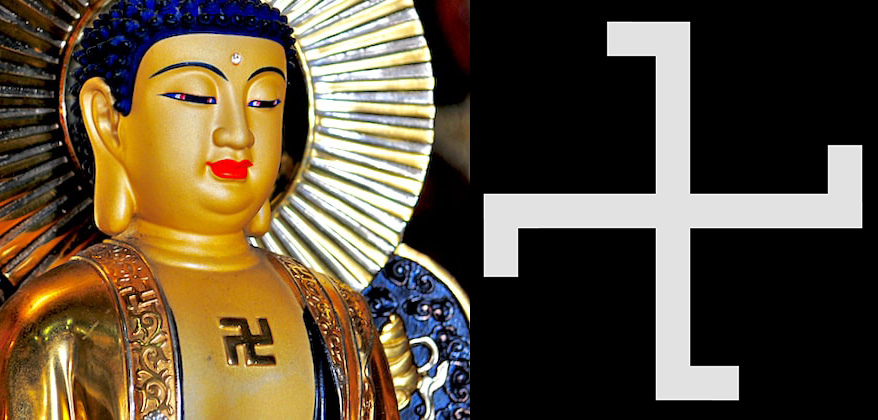
His chest, marked with a swastika,
Is like the chest of a lion.

I have known about the use of the swastika as a Buddhist marking for some time. I wrote about the decoration atop the Hanamatsuri shrine at the Sacramento Nichiren Buddhist Church. That post has a lot of nice background information that I won’t bother to duplicate here.

The point today is the decision of translators – other than Reeves – to avoid confusing the mark with the Nazi symbol.

The BDK English Tripitaka translation by Kubo and Logan offers:

Your chest is like that of a lion, and it is marked with the sign of virtue. (Page 13)

While the Kosei publishing 1975 translation by Tamura, Schiffer and Del Campana used the “swastika mark,” the “Modern Translation for Contemporary Readers” (Kosei 2019) translated by Shinozaki, Ziporyn and Earhart follows the BDK English Tripitaka example and offers:

His chest, bearing the mark of virtue, is like a lion’s chest.

Which brings us the reason I’m rehashing all this today.

Burton Watson’s translation of The Immeasurable Meanings Sutra chooses to keep the literal character while eschewing the word swastika.

… breast displaying a fylfot pattern; lion chested; …

The Buddha and the Fylfot

While I admire Watson’s effort to remain true to the literal text (see A Note About Translations at the bottom of yesterday’s post for another example), why can’t translators use the proper spelling of the word swastika, which is svastika? That eliminates the Nazi baggage and restores the idea that this image on the Buddha’s chest “is a statement of affirmation, ‘It is!’ ‘Life is good!’ ‘There is value’ ‘There is meaning!’ Svastika is a term that affirms the positive values of life.” (Also see this discussion of the Japanese meaning of the symbol Manji.)

And getting back to the topic of The Immeasurable Meanings Sutra …

See The Essential Point

The Essential Point

The Sutra of Innumerable Meanings ends with the following words: “At that time all in the great assembly, greatly rejoicing together, made salutation to the Buddha, and taking possession of the sutra, withdrew.” To sum up briefly the essential point of this sutra, it is that all the laws originate from one Law, namely, the real state of all things. All phenomena of the universe, including human life, manifest themselves in myriad different ways, and appear, disappear, move, and change. Man’s mind is apt to be led astray in suffering from and worrying about discrimination and change. If we pay no attention to such visible discrimination and change, and if we are able to see in depth the true state of things transcending surface discrimination, the true state that is unchangeable forever, we will be able to attain the mental state of being free of all things while leading ordinary everyday lives.

However, the Sutra of Innumerable Meanings does not explain in detail what the “real state of all things” is and what we should do to discern it. This important point is elucidated in the Lotus Sutra, which follows.

Buddhism for Today, p19

Reciprocal Bonds

Nichiren … commented on the “great king’s feast” [Chapter 6: Assurance of Future Buddhahood] in connection with memorial prayers that he offered on behalf of followers who had lost family members. In so doing, he evoked associations between the arhat Maudgalyāyana (Ch. Mulian, J. Mokuren), whose attainment of buddhahood is predicted in this chapter of the Lotus Sūtra, and Buddhist funerary and memorial rites. Maudgalyāyana was celebrated in the early Buddhist tradition as the Buddha’s disciple most accomplished in supernatural powers. After his mother had died, the story goes, Maudgalyāyana scanned the cosmos with his divine eye to see where she had been reborn and found her suffering in the realm of hungry ghosts as retribution for her greed and stinginess when alive. He then attempted to send her magically conjured food, but it burst into flames and scorched her when she tried to eat it. Bewildered, he consulted the Buddha, who advised him to offer a meal to the assembly of monks at the end of the summer monsoon retreat. Maudgalyāyana did so, and with that merit, his mother gained release from the hungry ghost realm. This legend became the basis throughout East Asia of the annual “Ghost Festival” (Skt. Ullambana; Ch. Yulanpen; J. Urabon), in which lay people make special offerings to monks at the close of the summer retreat, a period during which monastics are said to heighten their spiritual powers. The monks in turn perform services to transfer merit to their patrons’ deceased relatives, confirming the reciprocal bonds between monastics and laity, the living and the dead. Maudgalyāyana’s story was also related to the “ritual for hungry ghosts,” a merit offering for those deceased who had no relatives to sponsor services on their behalf. In Japan, this ritual was often performed in conjunction with Urabon, or for persons who had died in battle, of starvation, or under other unfortunate circumstances.

Two Buddhas, p107-108

Never-Despising Bodhisattva’s Hurry to Preach the Lotus Sūtra

The Words and Phrases of the Lotus Sūtra, fascicle 10, says, “A question was asked why Never-Despising Bodhisattva was in such a hurry in preaching the Lotus Sūtra while the Buddha had not expounded it for 42 years after appearing in the world. It was answered that the Buddha preached the Hinayāna teaching first for the people who had possessed the seed of Buddhahood by listening to the Lotus Sūtra in the past life, whereas Never-Despising Bodhisattva sowed the seed of Buddhahood by preaching the true Mahāyanā teaching of the Lotus Sūtra for the people who had never heard of the sūtra in the past life.”

This interpretation by Grand Master T’ien-t’ai means that as we look at the past of those who listened to the pre-Lotus sūtras such as the Flower Garland Sūtra preached at the place of Enlightenment, the Āgama sūtras preached in the Deer Park, the Sūtra of the Great Assembly preached at the Daihōbō, and the Wisdom Sūtra preached by the White Heron Pond, including both the Hinayāna and Mahāyanā and provisional and true teachings as well as the four doctrinal teachings and the eight teachings (the four doctrinal teachings plus the four methods of teaching), they had received the pure and perfect seed of Buddhahood in the eternal past at the time of the Eternal Buddha and the Great Universal Wisdom Buddha. Nevertheless, because of their sin of slandering the One Vehicle teaching of the Lotus Sūtra, they have been unable to attain Enlightenment wandering instead around in the world of darkness for as long as “500 (million) dust-particle kalpa” and “3,000 dust-particle kalpa.” However, the seed they had received grew gradually until finally the time had come for them to hear the Lotus Sūtra on Mt. Sacred Eagle and to become aware of the gem (Buddhahood) given by the Buddha in the past. For 40 years or so till the Lotus Sūtra was preached, the Buddha preached the Hinayāna and provisional sūtras to them in order to prepare their capacity to understand as the Buddha thought that even those who had established a relationship with the Lotus Sūtra in a past life might speak ill of it for a variety of reasons.

Soya Nyūdō-dono-gari Gosho, A Letter to Lay Priest Lord Soya, Writings of Nichiren Shōnin, Doctrine 3, Pages 149-150.

Between Day 32 and Day 1: The Meaning of the Great Vehicle

So this morning as I was reading the Sutra of How to Practice Meditation on Bodhisattva Universal Worth (Burton Watson’s translation), I was struck by this instruction:

After the practitioner has made this vow, then at six times in the day and night he should pay obeisance to the buddhas of the ten directions, practice the method of repentance, read the great vehicle sutra, recite the great vehicle sutra, ponder the meaning of the great vehicle, keep in mind the concerns of the great vehicle, and reverently offer alms to those who uphold the great vehicle.

For a brief moment — the time it takes to complete one sentence and then move on to the next — I flashed on the question: What does it mean to ponder “the meaning of the great vehicle, keep in mind the concerns of the great vehicle”?

And in the next sentence was my answer:

He should view all people with the thought that they are buddhas, and all living beings with the thought that they are his father and mother.

Never despising. Always respectful.

See Washing Away Muddy Illusions Covering Our Invaluable Gem


A note about translations

In the Burton Watson translation of this sutra, it says on page 383:

Then Universal Worthy will speak once more: ‘Over a period of many kalpas, because of the organ of your ear you have chased about after external sounds. When you heard some wonderful sound, your mind was roused to delusion and attachment, and when you heard an evil sound, your mind gave way to eight hundred varieties of earthly desires that plagued you.

This puzzled me because I knew that in the new Threefold Lotus Sutra translated by Shinozaki, Ziporyn and Earhart for Kosei Publishing the number of earthly desires was the expected 108.

When you heard beautiful sounds, you produced delusive attachments to them. And when you heard dreadful sounds, you gave rise to one hundred and eight kinds of delusions that inflict damage and harm.

Did characters for eight and 100 get transposed?

I found the answer in a footnote added to the BDK English Tripitaka translation by Kubo and Logan:

We chose to follow the phrasing of the Yuan and Ming editions, as indicated in note 3 in the Taishō text, which give the number as one hundred and eight rather than the number eight hundred that appears in the source text.

Washing Away Muddy Illusions Covering Our Invaluable Gem

Through the Lotus Sutra, we have become able to understand that all people have the buddha-nature equally. Through this sutra we are awakened to the fact that all of us possess the invaluable gem of the buddha-nature. In fact, the Lotus Sutra can be said to be the teaching of the disclosing of our buddha-nature.

Immediately after it is mined, a gemstone is covered with mud and does not display its true brilliance. It does not disclose its nature as an invaluable gem until the mud is washed off. Washing the mud from the gem is like the first stage of repentance. The surface of our buddha-nature is covered with various illusions acquired in the course of our daily lives. Through repentance we remove such illusions from our buddha-nature, just as water washes the mud from a precious stone.

Repentance toward others is the first stage of repentance. We must pass through this stage, but as our faith deepens, eventually we come to repent all our sins directly toward the Buddha. We examine ourselves as being imperfect and mistaken, study the Buddha’s teachings more deeply, meditate on Buddhist doctrines, and elevate ourselves ever higher. This is the secret principle of repentance; this is true repentance.

This second stage of repentance is the practice through which we constantly polish the gem of our buddha-nature. A gem does not reveal its brilliance even after the mud has been washed from it. Its surface is coated with mineral deposits, and it cannot display its intrinsic brilliance until polishing removes such impurities from its surface. The same thing can be said of our buddha-nature. The second stage of repentance is the practice by which we polish our buddha-nature.

As stated in chapter 20 of the Lotus Sutra, “The Bodhisattva Never Despise,” in order to disclose the buddha-nature of others it is important for us to revere it, that is, to pay respect to everyone. We must have a much stricter attitude toward ourselves. We must constantly cleanse and polish our buddha-nature. We feel pain when we pour cold water on our body and scrub vigorously with a wet towel in order to cleanse it. When we dare to cleanse and polish our buddha-nature despite pain, it begins to emit a brilliant light.

The Sutra of Meditation on the Bodhisattva Universal Virtue teaches concretely and thoroughly the meaning and practice of the second stage of repentance. Let us now proceed to the sutra itself.

Buddhism for Today, p423-424

Grieving Deeply Over Slandering

Like his contemporaries, Nichiren embraced the idea that human beings are an integral part of the cosmos, and their actions affect both society and the natural world. He attributed the disasters confronting Japan during his lifetime — famine, epidemics, earthquakes, and the Mongol threat — to this fundamental error of “disparaging the Lotus Sutra.” Rejection of the sutra, in his eyes, would destroy the country in this life; in the future, it would condemn its people to countless rebirths in the Avici hell. The horrific sufferings described in the verse section of [Chapter 3] were for him not mere rhetorical hyperbole but an actual account, coming from the Buddha’s own mouth, of the fate that awaited the great majority of his contemporaries, something that grieved him deeply.

Two Buddhas, p85