Category Archives: LS32

Day 1

Day 1 covers the first half of Chapter 1, Introductory

Having last month considered the Bodhisattvas and kings whom Maitreya sees, we consider some of the practices of the Bodhisattvas that Maitreya sees.

I also see some Bodhisattvas
Becoming bhikṣus,
Living alone in retired places,
And joyfully reciting sūtras.

I also see some Bodhisattvas
Zealously and courageously
Entering remote mountains, and pondering
The enlightenment of the Buddha.

I also see some of them having given up desires,
And living in retired places,
Entering deep into dhyāna-concentration,
And obtaining the five supernatural powers.

I also see some Bodhisattvas finding peace in dhyāna,
Joining their hands together [towards the Buddha],
And praising the King of the Dharma
With tens of millions of gāthās.

I also see some Bodhisattvas resolute in mind.
They have obtained profound wisdom
By questioning the Buddha.
And now they remember what they heard from him.

See The Meaning of the Title

The Meaning of the Title

Before discussing the Sutra of the Lotus Flower of the Wonderful Law itself, I wish to comment on the title of the sutra, which expresses in brief the form and content of the sutra. I believe that this title is unique in its succinct expression of the profound meaning of the entire sutra.

The Sutra of the Lotus Flower of the Wonderful Law, written in Sanskrit, is called Saddharma-puṇḍrika-sūtra. The title as translated into Chinese by Kumārajīva is Miao-fa-lien-hua-ching (Japanese, Myōhō Renge-kyō). In the Sutra of the Lotus Flower of the Wonderful Law the absolute truth realized by Sakyamuni Buddha is presented. This truth is called the “Wonderful Law” (saddharma, miao-fa, myōhō) because of its profound meaning, as shown in the discussion of the Sutra of Innumerable Meanings.

First, as shown by the words “real state of all things, “Law” means all things that exist in the universe and all events that occur in the world. Secondly, it means the one truth that penetrates all things. Thirdly, it means the Law as an established rule when the truth appears as a phenomenon that we can see with our eyes and hear with our ears. Fourthly, it means the teaching of the truth.

The truth that expresses the original idea of these four meanings of “Wonderful Law” is the Buddha. Accordingly, the Law that rules the relationships of all things, including man, is also the Buddha; and the teaching, explaining how one should live on the basis of the truth, is the Buddha too. In short, the Law and the Buddha are one and the same. In other words, the Buddha and all the functions of the Buddha can be expressed with the word “Law.” Because the Law has such a supreme, profound, and inexpressible meaning, it is modified by the adjective “Wonderful.”

“Lotus” (puṇḍarīka, lien-hua, renge) means the lotus flower. In India this flower was regarded as the most beautiful in the world, for a lotus is rooted in mud but opens as a pure and beautiful flower unsoiled by the mud. This is an allegorical expression of thee fundamental idea of the Lotus Sutra, that though man lives in this corrupt world, he is not tainted by it nor swayed by it, and he can live a beautiful life with perfect freedom of mind.

“Sutra” literally means a string or the warp threads in weaving. The people of ancient India had a custom of decorating their hair with beautiful flowers threaded on a string. In the same way, the holy teachings of the Buddha were gathered into compositions called sutras. Altogether, the title “Sutra of the Lotus Flower of the Wonderful Law” means “the supreme teaching that man can lead a correct life, without being swayed by illusions, while living in this corrupt world.”

Buddhism for Today, p23-24

Emptiness Inside a Lotus Sutra Circle

Lotus Sutra Burton Watson bookcoverIn 1993 I had been practicing what I considered to be Nichiren Buddhism for four years. I had started with Nichiren Shoshu of America before the split with Soka Gakkai and continued with Soka Gakkai after the divorce was finalized. I don’t recall ever being  encouraged to read the Lotus Sutra. I was certainly never encouraged to do more sutra recitation than the shindoku [the Japanese pronunciation of the Chinese translation using Romanized text] and nothing beyond the Hoben Pon portion of Chapter 2, and Ji Ga Ge of Chapter 16. It was in this setting that I learned that Columbia University Press had published Burton Watson’s translation of the Lotus Sutra. Soka Gakkai held the copyright for the book and the local SGI community center bookstore had the book for sale. I purchased a copy. I read it once. I recall realizing that a single reading would not be sufficient to gain any appreciation of the sutra, but I never picked up that copy again.

It would be another 22 years before I again read the Lotus Sutra.

Today I’m beginning my 49th cycle through my 32 Days of the Lotus Sutra practice. For 40 cycles I used Senchu Murano’s translation. Then I tried Leon Hurvitz’s Scripture of the Lotus Blossom of the Fine Dharma for a couple of cycles and followed that with the 1975 edition of The Threefold Lotus Sutra, which I dropped after just one cycle. I did one cycle with the BDK English Tripitaka translation and then shifted to Gene Reeves’ translation for two cycles. For the previous two cycles I’ve been using the 2019 edition of the Threefold Lotus Sutra.

I’ve now come full circle, back to Burton Watson’s translation. I’m curious what it will be like to read it again after 27 years.

In Watson’s Preface I still have the page corner turned down marking this quote:

The Lotus Sutra tells us at times that the Lotus Sutra is about to be preached, at other times it says that the Lotus Sutra has already been preached with such-and-such results, and at still other times it gives instructions on just how the Lotus Sutra is to be preached or enumerates in detail the merits that accrue to one who pays due honor to the text. But the reader may be forgiven if he comes away from the work wondering just which of the chapters that make it up was meant to be the Lotus Sutra itself. One writer has in fact been led to describe the sutra as a text “about a discourse that is never delivered, a lengthy preface without a book.*” This is no doubt because Mahayana Buddhism has always insisted that its highest truth can never in the end be expressed in words, since words immediately create the kind of distinctions that violate the unity of Emptiness. All the sutra can do, therefore, is to talk around it, leaving a hole in the middle where truth can reside.

Watson, pxx-xxi

* George J. Tanabe, Jr, and Wilma Jane Tanabe, eds., The Lotus Sutra in Japanese Culture (Honolulu: University of Hawaii Press, 1989), p. 2 in the introductory chapter by Professor George Tanabe.

When I first read this I could not have possibly fathomed the meaning of that hole in the middle, that central emptiness. As Watson points out in the Preface:

This is the first point to keep in mind in reading the Lotus Sutra. Its setting, its vast assembly of listeners, its dramatic occurrences in the end belong to a realm that totally transcends our ordinary concepts of time, space, and possibility. Again and again we are told of events that took place countless, indescribable numbers of kalpas or eons in the past, or of beings or worlds that are as numerous as the sands of millions and billions of Ganges rivers. Such “numbers” are in fact no more than pseudonumbers or non-numbers, intended to impress on us the impossibility of measuring the immeasurable. They are not meant to convey any statistical data but simply to boggle the mind and jar it loose from its conventional concepts of time and space. For in the realm of Emptiness, time and space as we conceive them are meaningless; anywhere is the same as everywhere, and now, then, never, forever are all one.

Watson, pxvi

How to comprehend this?

Very early in the sutra the Buddha warns us that the wisdom of the Buddhas is extremely profound and difficult to comprehend, and this warning is repeated frequently in later chapters. …

But of course in the view of religion there are other approaches to truth than merely through words and intellectual discourse. The sutra therefore exhorts the individual to approach the wisdom of the Buddhas through the avenue of faith and religious practice. The profound influence which the Lotus Sutra has exerted upon the cultural and religious life of the countries of eastern Asia is due as much to its function as a guide to devotional practice as to the actual ideas that it expounds. It calls upon us to act out the sutra with our bodies and minds rather than merely reading it, and in that way to enter into its meaning.

Watson, pxx-xxi

This is the Essential emptiness. Chih-i equated the Ultimate Truth with the empty space inside a house (The Ulimate Empty Space). The teachings of the Buddha provide the roof beams and pillars, and Lotus Sutra gathers the whole into a house with empty rooms in which to practice. The Emptiness is essential to the function of the house, to the teaching of the Lotus Sutra.

Merits of Praising the Practicer of the Lotus Sūtra

It is preached in the “Teacher of the Dharma” chapter of the Lotus Sūtra, fascicle 4, that the merits of those who praise the practicer of the Lotus Sūtra are superior to the merits of those who endeavored to seek the Buddhist Way for as long as a kalpa (aeon). Grand Master Miao-lê interprets this scriptural statement saying, “He who torments the upholder of the Lotus Sūtra will have his head split into seven pieces. On the contrary he who sustains the upholder of the Lotus Sūtra will be rewarded with merit greater than the merit of the one giving offerings to the Buddha, who holds the ten epithets.”

Hōren-shō, Letter to Hōren, Writings of Nichiren Shōnin, Volume 6, Followers I, Page 44-45

Another Innumerable Day Before Day 1

I feel it somehow fitting to begin this extended cycle through the Lotus Sutra with Nikkyō Niwano’s conclusion of his commentary on the Lotus Sutra in his book, Buddhism For Today: A Modern Interpretation of the threefold Lotus Sutra.

When you have read through the entire Threefold Lotus Sutra and have examined yourself in the light of its teachings, you may find that the actual state of your mind is so imperfect as to seem hopeless, and you may feel at a loss as to what to do. I was told that someone confessed that he found it hard to approach the Lotus Sutra again after having read it because of its extreme profundity. I can understand why he felt cowed by the profundity of the sutra. I suspect, however, that he had not read the sutra deeply enough, and that if he had read it repeatedly, he would have come to regard it as the teaching capable of leading all of us directly to salvation. We should start our practice from even one teaching in the Lotus Sutra and from even the smallest act in our daily lives. The sutra itself exhorts us not to think that its teachings are beyond our capacities.

There is an appropriate story in the Sutra of a Hundred Parables (Hyakuyu-kyō) … . Once there was a very stupid man. As he was parched with thirst, he roamed here and there looking for water. While walking about, he luckily arrived at the shore of the Sindh River. For some reason, however, he just stood on the riverbank instead of drinking. A friend nearby wondered at his behavior and asked him, “Why don’t you drink the water in the river?” The man answered, “I am dying for a drink! But the river has so much water that I cannot possibly drink it all. So I am hesitating as to whether I should drink or not.”

I sincerely hope that no one will harbor such a foolish idea toward the teaching of the Threefold Lotus Sutra.

Buddhism for Today, p460

The Sutra of Innumerable Meanings list 10 benefits of progressively more impressive stature for those who read or hear the sutra, but the first benefit, when one is just introduced to the sutra, is its most profound:

The Buddha said: “Good sons, first, this sutra leads a not-yet-awakened bodhisattva to aspire to awakening, leads one without human kindness to aspire to kindness, leads one with a murderous heart to aspire to great compassion, leads one who is jealous to aspire to respond with joy, leads one with attachments to aspire to impartiality, leads one who is greedy to aspire to generosity, leads one who is full of arrogance to aspire to be moral, leads one who is angry to aspire to patience, leads one who is lazy to aspire to perseverance, leads one who is distracted to aspire to meditation, leads one who is ignorant to aspire to wisdom, leads one who lacks concern for saving others to aspire to saving others, leads one who commits the ten evils to aspire to do ten good things, leads one who is willful to aspire to let things be, leads one who is prone to backsliding to aspire to never retreat, leads one who commits faulty acts to aspire to being faultless, and leads one who suffers from afflictions to aspire to detachment. Good sons, this is called the first amazing power of blessing of this sutra.”

(Reeves, p42)

Sutra Recitation

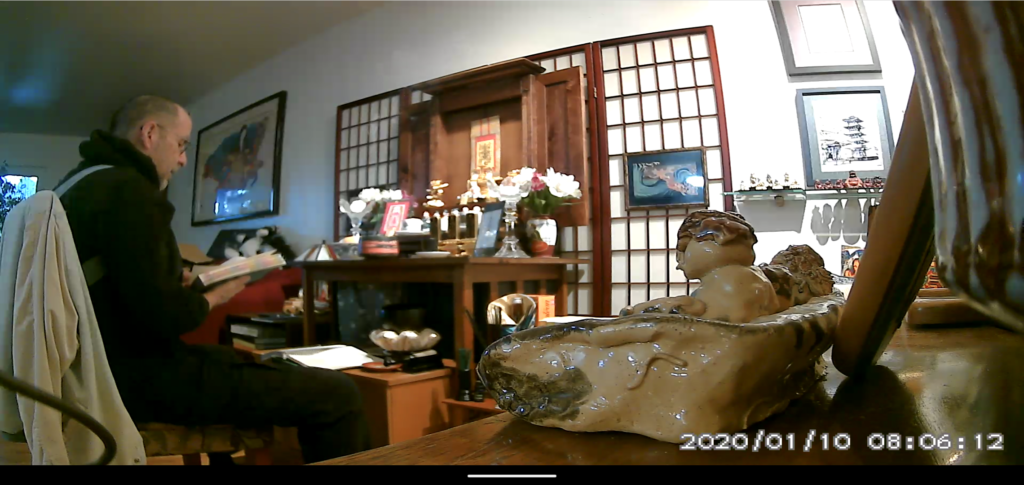
Screenshot of sutra recitation
Daily sutra recitation as caught by security camera pointed at altar.

I’ve completed my 48th cycle through the 32 Days of the Lotus Sutra and before I set aside The Threefold Lotus Sutra: A Modern Translations for Contemporary Readers, I want to publish some quotes from the Preface discussing the importance of sutra recitation.

In chapter 17, “Specification of Merits,” the Buddha teaches another formula for how, after he has passed into nirvana, his followers can be true practitioners of the Lotus Sutra. This method consists of five elements: (1) rejoicing in the sutra, (2) reading and reciting it, (3) expounding it, (4) concurrently practicing the Six Paramitas, and (5) intensely practicing the Six Paramitas. Here the meaning of “reading and reciting” is deeper than in the aforementioned five practices of Dharma teachers: as our faith deepens, we do not simply read the sutra aloud but also come to appreciate it in our hearts and minds and study it in great depth.

In short, we are diligent in the practice of reading and reciting the sutra so that we can firmly receive and embrace it, that is, so that we can deepen our faith and devotion to it and make progress toward the attainment of buddhahood (the perfection of oneself). This is the first function of the practice of sutra recitation.

The second function of reading and reciting the sutra is to serve as an “offering,” or kuyo in Japanese, to the Three Treasures – the Buddha, his teachings, and the community of those who practice them – and it is also a bodhisattva practice undertaken for the sake of others. …

The third function of sutra recitation is to go beyond a merely intellectual understanding of the sutra’s contents. There are two ways of comprehending the Lotus Sutra: understanding it intellectually and understanding it bodily, that is, by reciting it orally. The act of reading the sutra aloud helps readers totally concentrate their consciousness on recitation without engaging their intellect to grasp the meaning of the words and phrases of the sutra. While the strength of modern intellectual comprehension is coherent logic founded on rational understanding, rhythmic recitation is capable of adding something more to our rational understanding of the literal meanings of the sutra.

According to the Japanese traditional belief called kotodama, spiritual power dwells within words, and therefore, when the mouth gives voice to words, it releases their inherent power, which is capable of stirring heaven and earth and all the living beings therein. Words work phonetically to produce rhythm and resonance, which are in turn the agents that guide the body and mind of the reciter to the realm of the sutra, that is, to the Buddha’s world of great harmony. Sutra recitation, in particular its rhythm and resonance, can liberate us from the disadvantage of the modern age — the habit of limiting our horizon of understanding to the intellectual comprehension of the sutra.

The experience of reciting the sutra aloud is quite different from reading it silently because sutra recitation provides more than just an intellectual understanding of the sutra. When we recite the sutra, we enjoy the pleasure of the rhythm of its sentences as well as the repetition of its set phrases and idioms, just as if we were reciting a poem or singing a song. We may even feel surrounded by the Buddha’s light and embraced by his compassion. This is a form of meditation.

The Threefold Lotus Sutra (2019), pxvii-xix

This March will mark the completion of five years of daily Lotus Sutra recitation. It is a practice unlike anything I attempted during more than 25 years with Soka Gakkai. It is a practice that has brought profound benefit in my life and encouraged my Bodhisattva vow to help others attain the path. It is a practice I heartily recommend.

Between Day 32 and Day 1: The Sutra of Repentance

With today’s post I’ll begin weaving in quotes from Nikkyō Niwano’s Buddhism for Today.

[The Sutra Of Meditation On The Bodhisattva Universal Virtue*] teaches the practice of the Bodhisattva Universal Virtue. It consists of the sermon that Sakyamuni preached at the Great Forest Monastery of Vaiśāli in central India after he had taught the Lotus Sutra, and establishes the way of repentance as the practice of the spirit of the Lotus Sutra.

We are greatly encouraged when we read the Lotus Sutra, grasp the true meaning of the sermons that Sakyamuni preached during his lifetime, and realize that we can attain the same state of mind as the Buddha through practicing his teachings. However, the fact is that in our daily lives we are continually troubled with suffering and distress, and we are continually seized by desires of one kind or another. For this reason, we are apt to become disheartened and forget the valuable lessons of the sutra.

Although we understand theoretically that we can become buddhas, we do not know how to rid ourselves of our illusions; our minds are liable to be covered with a dark cloud of illusion. Repentance means the sweeping away of such dark clouds, and the Sutra of Meditation on the Bodhisattva Universal Virtue teaches the way to do this. Therefore this sutra also has a close relationship to the Lotus Sutra, and, as the epilogue of the Lotus Sutra, is called the “closing sutra” (kekkyō) of the Lotus Sutra. Because of its content, it is also called the “Sutra of Repentance.”

Buddhism for Today, pxxvi-xxvii

* Universal Virtue is called Universal Sage in Murano’s translation.

The Language of Modern Buddhism

Threefold Lotus Sutra bookcoverIn my blog post on Nikkyō Niwano and the Lotus Sutra I made a passing reference to “what Risshō Kōsei-kai did to the Lotus Sutra when it re-edited its English translation of the Threefold Lotus Sutra.” Here’s what I was referencing.

Kosei Publishing, the publishing arm of Risshō Kōsei, published in 2019 “The Threefold Lotus Sutra: A Modern Translation for Contemporary Readers.” The work is translated by Michio Shinozaki, Brook A. Ziporyn and David C. Earhart. The new edition replaced “The Threefold Lotus Sutra,” first published by Kosei Publishing in 1975.

Michio Shinozaki declares the goal of the new translation in the Preface to this edition:

[E]very classic has to be reborn according to the demands of time, and The Threefold Lotus Sutra is no exception. Owing to significant revision, this magnificent sutra is now reborn as a newly translated publication for people today. This translation responds to the needs of the twenty-first century, in which both the study and the practice of Buddhism have spread far beyond traditional Buddhist cultures, and people of all races, ethnicities, genders, and walks of life throughout the world are turning to Buddhism in ever greater numbers to find spiritual solace and bring meaning to their lives. In the context of a truly globalized Buddhism, two of the most important demands of our time are, first, an English translation suitable to the fundamental Buddhist practice of daily sutra recitation, and second, a translation that renders potentially discriminatory language and ideas, which often appear in ancient religious classics, in ways appropriate to the overall spirit of the text, the fundamental principles of Buddhism, and contemporary notions of equality and human dignity.

The Threefold Lotus Sutra (2019), pxiv

In the Introduction to the new edition, Brook A. Ziporyn expands on the reasoning behind the modernization.

The Lotus Sutra categorically affirms our unity with the Buddha: all of us, regardless of who we are or the circumstances of our birth in this world, will absolutely become buddhas. However, this positive message of universal liberation is, at times, undercut by language and expressions that may cause readers to doubt the Lotus Sutra’s dedication to the equality of all living beings as well as its respect for the dignity of life. I therefore would like to touch upon one of the most difficult and delicate issues to which this translation of the Threefold Lotus Sutra responds: potentially offensive or seemingly discriminatory words and phrases within the text itself. A correct understanding of these passages necessarily depends on the way we interpret and make sense of such expressions. As Dr. Earhart mentions in the textual notes on the translation (see below), we endeavored to create a well-balanced translation that takes into consideration both adherence to textual integrity and the spiritual requirements of readers today.

Let me point out a few examples. By using auxiliary verbs we mitigated some passages in chapter 3 that could be taken to imply that physical impairments are punishment for having slandered the sutra. One line of this section reads:

“Even if they [people who slander this sutra] can become human beings,
They may be unhearing, unseeing, and mute,
Or wrap themselves in
Poverty and decay.”

We are under no obligation to interpret such expressions literally, and as is often the case with sacred literature, reading these kinds of passages allegorically allows us to reconcile them with the overall spirit of the text and our commitment to human rights and the dignity of all life. Accordingly, we should understand this line of the sutra as a precaution against slandering the Dharma, which makes people deaf or blind in a spiritual sense and causes them to suffer the poverty of not knowing the Buddha’s teaching and being unable to attain happiness.

The Threefold Lotus Sutra (2019), pxx-xxi

I agree that the alternate meaning offered fits fully with the intent of the Lotus Sutra. However, such a translation ignores the most basic teaching of Buddhism, a teaching affirmed by the Lotus Sutra. Our provisional existence is the sum of our past causes and the conditions in which we exist. Our physical impairments must be included, otherwise we open the door to the chaos outside the law of cause and effect. Yes, it is more socially acceptable to say my Dyslexia is just a product of a random combination of genetic material when my father’s seed fertilized my mother’s egg. And yet, personally, I would rather accept that I don’t know what past causes I made, and instead focus on the assurance I am given in the Lotus Sutra that the causes that I make will affect my future — in this lifetime and the next.

In his Notes on the Translation, David C. Earhart explains:

Changes were made in this new translation based on the following four criteria.

One: Modernize the language to reflect current usage and common understanding. …

Two: Bring as much accuracy as possible to the translation by following the standard definitions of words and phrases, key terminology in particular. …

Three: Make the language more inclusive and avoid phrases that could be construed as prejudicial. To this end, gender-neutral language has been privileged throughout the text, which will be discussed below. Doctrinal terminology closely tied to other religious traditions has been avoided. For instance, “salvation” has been replaced with “liberation”; “repent” with “acknowledge and express remorse” and “repentance” with “acknowledgment and remorse”; and “creatures” with “living beings.”

We have tried to open a larger window for freer interpretation of some of the more controversial passages, taking inspiration from chapter 12, where the reader is first confronted with the notion (widely accepted in Asia at the time of the sutra’s exposition and compilation) that the female body is an unacceptable vehicle for Supreme Perfect Awakening but then encounters the remarkably protofeminist refutation of this patently bogus supposition. Indeed, the concept of skillful means (Chn., fang bian; Jpn., hoben), so carefully laid out in the first several chapters of the Sutra of the Lotus Flower of the Wondrous Dharma, supports these minor liberties within the text. Many of these changes toward a more gender-neutral translation, including comparisons to more traditional versions of the passages in question, are discussed in detail in the endnotes.

Four: Provide a translation that lends itself to being read aloud. …

The Threefold Lotus Sutra (2019), plvii

Some examples

In describing Pūrṇa’s future Buddha realm in Chapter 8, the Buddha says:

“There will be no evil ways and no womankind, [for] all living beings will be born transformed and have no carnal passion.

The Threefold Lotus Sutra (1975), p 172

and in gāthās:

“Joy in the Law and pleasure in meditation
Shall be their food, with no thought of other;
No womankind will be there,
Nor any evil ways.”

The Threefold Lotus Sutra (1975), p 175

In the new translation we get:

“In that land, there will be no gender distinction, for all living beings there will come into existence by transformation, free of carnal desire.”

The Threefold Lotus Sutra (2019), p191

and in the gāthās:

“Rejoicing in the Dharma and delighting in meditation
Will be their food, and they will think of no other.
There will be no carnal temptations in that place,
Nor any evil paths.”

The Threefold Lotus Sutra (2019), p194

In Chapter 23, the Former Deeds of the Bodhisattva Medicine-King:

“His domain had no women, no hells, no hungry ghosts, no animals, no asuras, no disasters…”

The Threefold Lotus Sutra (1975), p304

In the new translation we get:

“His domain was free of gender distinction. It had no hells, no hungry spirits, no beasts, no asuras and no perils.”

The Threefold Lotus Sutra (2019), p336

And later in Chapter 23:

“Star Constellation King Flower! If there be anyone who hears this chapter of the former deeds of the Medicine King Bodhisattva, he will also obtain infinite and boundless merits. If there be any woman who hears this chapter of the former deeds of the Medicine King Bodhisattva and is able to receive and keep it, she, after the end of her present woman’s body, will not again receive [one]. If, after the extinction of the Buddha, in the last five hundred years, there be any woman who hears this sutra and acts according to its teaching, at the close of this life she will go to the Happy World, where Amita Buddha dwells, encompassed by his host of great bodhisattvas, and will [there] be born in the middle of a lotus flower upon a jeweled throne. Never again will he be harassed by desire, nor be harassed by anger and foolishness, nor again be harassed by pride, envy, or uncleanliness, … “

The Threefold Lotus Sutra (1975), p309-310

In the new translation we get:

“Constellation King Flower, if a man hears this chapter of the Former Deeds of the Bodhisattva Medicine King, he will receive infinite and boundless merits. If a woman who hears this chapter of the Former Deeds of the Bodhisattva Medicine King is able to receive and embrace it, then after her present female body comes to its end, she will not receive another one in the next lifetime.

If, in the last five-hundred-year period following the Tathagata’s passing, a woman who hears this sutra practices it as taught, at the end of her lifetime she will go to the world of peace and ease where Amitabha Buddha resides surrounded by a multitude of great bodhisattvas. There she will be born upon a jeweled seat within a lotus flower, never again to be vexed by greed, anger, and ignorance, or be troubled by such defilements as arrogance and envy.

The Threefold Lotus Sutra (2019), p342-343

A footnote on this change says:

In an earlier passage in this chapter, the absence of female bodies in a buddha’s purified domain was understood to mean the absence, in that world, of gender distinctions and desires associated with them. In other words, freedom from gender is itself a form of purity. In this passage, however, gender plays a very different role. Here, the description of a woman who “is able to receive and embrace” the sutra and therefore be freed from further rebirth in a female body in subsequent lives is something of a refutation of prejudices against women in historical Indian society. The meaning of this passage can only be fully appreciated when understood in the context of this historical background: despite this traditional Indian view of women being inferior to men and therefore undergoing greater suffering, this passage affirms that women can, indeed, reach the same state of awakening as men, as the following sentence discusses the merit of women who practice the sutra as taught and therefore attain rebirth in Amitabha’s land of peace and bliss. One historical interpretation of these two sentences was to read them together, such that a woman’s not receiving a female body becomes a function of being reborn in the pure land of Amitabha, which at the time of the sutra’s compilation, was a message of equality put forth in a patriarchal society. Even this understanding presents difficulties for an entirely gender-neutral rendering, however, as the living beings in Amitabha’s pure land are described in other sutras and commentaries as possessing the thirty-two marks of a great person, which include biologically male features, suggesting that the reward for women practicing the teaching is to be reborn in a higher realm but in a male form. As a result of these constraints, the translators rendered this passage “after her present female body comes to its end, she will not receive another one in the next lifetime.” Nonetheless, readers should be aware that this passage, taken together with the story of the dragon king’s daughter attaining Perfect Awakening in chapter 12, has been seen as a positive affirmation that women will attain buddhahood, or rebirth in Amitabha’s pure land, a message of equality that has inspired significant devotion to the text.

The Threefold Lotus Sutra (2019), p425-426

Ignored in the footnote explanation is the decision to have the reward body of the woman reborn in Amitabha’s pure land to be female, thus ignoring the historical meaning of the thirty-two marks of a great person. Still, in this case I am less disturbed by that change. At least the translators didn’t feel compelled to change the transformation that the daughter of the dragon king went through on her way to quickly becoming a Buddha. They did, however, ignore her transformed gender once she began her Bodhisattva practices. Even the old version felt compelled to insert [she] where this now male Bodhisattva “sat on a precious lotus flower, attaining Perfect Enlightenment, with the thirty-two signs and the eighty kinds of excellence, and universally proclaiming the Wonderful Law to all living creatures in the universe.” The Murano translation does a much better job of handling this: “Thereupon the congregation saw that the daughter of the dragon-king changed into a man all of a sudden, performed the Bodhisattva practices, went to the Spotless World in the south, sat on a jeweled lotus-flower, attained perfect enlightenment, obtained the thirty-two major marks and the eighty minor marks [of the Buddha], and [began to] expound the Wonderful Dharma to the living beings of the worlds of the ten quarters.” Needlessly inserting she, as the new version repeatedly does, is not helpful.

The final chapter of the Lotus Sutra, gets several changes:

Moreover, I will give them dhārāṇis, and obtaining these dhārāṇis, no human or nonhuman being can Injure them, nor any woman beguile them.

The Threefold Lotus Sutra (1975), p341

Becomes:

Moreover, I will give them a dharani incantation. Because they will have received this dharani, nonhuman beings will be unable to do them harm or damage, and human beings will be unable to distract or seduce them.

The Threefold Lotus Sutra (2019), p377

A note attached to this sentence offers this defense:

We have rendered the Chinese word nuren, literally, “women,” as “human beings” in accord with our translation policy of gender neutrality, so that “bodhisattvas” in this passage becomes an inclusive term. A traditional reading might suggest that the bodhisattvas are all male and their seducers, female.

The Threefold Lotus Sutra (2019), p427

Elsewhere, the reward received by anyone who copies this sūtra is originally described as involving nymphs. [Murano specifies eighty-four thousand goddesses]

If they only copy it, these when their life is ended will be born in the Heaven Trāyastriṃsá, on which occasion eighty-four thousand nymphs, performing all kinds of music, will come to welcome them, and they, wearing seven-jeweled crowns, will joy and delight among those beautiful nymphs; how much more those who receive and keep, read and recite, rightly remember it, comprehend its meaning, and practice it as preached! If there be any who receive and keep, read and recite it, and comprehend its meaning, when their life is ended the hands of a thousand buddhas will be proffered, that they fear not, neither fall into any evil destiny, [but] go straight to Maitreya Bodhisattva in the Tushita heaven, [where] Maitreya Bodhisattva, possessed of the thirty-two signs, is surrounded by a host of great bodhisattvas and has hundreds of thousands of myriads of koṭis of nymph-followers, amongst whom they will be born. Such are their merits and benefits.

The Threefold Lotus Sutra (1975), p341-342

This reward is changed to become:

“Even if people only copy it, when their lifetimes come to an end, they will be born in Trayastrimsha Heaven, and on that occasion, eighty-four thousand heavenly beings, performing all kinds of music, will be there to welcome them. These people will put on crowns of the precious seven and pleasantly enjoy themselves in the company of refined attendants. How much greater, then, will be the merits and benefits of those who receive, embrace, read, and recite this sutra, rightly bear it in mind, comprehend its meaning, and practice it as taught.

“Those people who receive, embrace, read, and recite it and comprehend its meaning will, when their lifetimes are over, have the hands of a thousand buddhas extended to them. Therefore, they will have no fear and will not fall into an evil state of existence but will proceed directly to the place of Maitreya Bodhisattva in Tushita Heaven. There they will be born in the presence of Maitreya Bodhisattva, who possesses the thirty-two marks and is surrounded by a host of great bodhisattvas, and they will be accompanied by a retinue of hundreds of thousands of millions of heavenly beings. Such will be their merits and benefits.”

The Threefold Lotus Sutra (2019), p328

A note here underscores the deliberate nature of this change:

Taking into consideration gender neutrality—one of the guiding principles of this translation—we rendered three phrases in these two preceding paragraphs as follows: in the first paragraph, the original word tiannu, literally, “female heavenly beings,” was translated “heavenly beings,” and cainu, literally, “female attendants,” was translated “refined attendants”; and in the second paragraph, tiannu, was again translated as “heavenly beings.” Traditionally, the imagery of these two paragraphs would have male practitioners rewarded in a heavenly realm where they would be attended to by female beings, reflecting the patriarchal worldview of ancient Indian society.

The Threefold Lotus Sutra (2019), p427

Back in July 2016, I addressed this chapter’s patriarchal worldview and suggested it might be considered as simply a recruiting tool: “How could the youthful be awakened and their enthusiasm tapped? Perhaps ‘eighty-four thousand goddesses’ could convince some teenaged boys to give up their toys and leave the burning house.”

Something is lost when we take away the historical setting of the Buddha’s teaching. Will this new gender-neutral lesson better make the case for Buddhism today? I’m not convinced.

Showing Comparative Superiority of Various Sūtras

QUESTION: What is the purpose of discussing the comparative superiority among sūtras, which were all preached by one Buddha?

ANSWER: It is preached in the Lotus Sūtra, fascicle 7 (Chapter 23, “The Previous Life of Medicine King Bodhisattva”), “He who upholds this sūtra is foremost among all living beings just as this sūtra is foremost among all the sūtras.” This chapter of the Lotus Sūtra also enumerates ten similes that expound the Lotus Sūtra as supreme among all sūtras which have already been preached, are now being preached, and will be preached (i-kon-tō). The eighth of the ten similes is the one just cited above. In short, the true intent of the Buddha in preaching this sūtra is not to show the comparative superiority of various sūtras but to preach that the practicers of the Lotus Sūtra are foremost among all the people. The practicers of expedient sūtras such as the Great Sun Buddha Sūtra are like various mountains, stars, rivers, and the people whereas the practicers of the Lotus Sūtra are like Mt. Sumeru, the sun and the moon, a great ocean, and the great king.

Ōta-dono-gari Gosho, A Letter to Lord Ōta, Writings of Nichiren Shōnin, Doctrine 3, Pages 200-201.

Day 32

Day 32 covers Chapter 28, The Encouragement of Universal-Sage Bodhisattva, closing the Eighth Volume of the Sutra of the Lotus Flower of the Wonderful Dharma.

Having last month witnessed the arrival of Universal Sage, we hear the Buddha answer how the good men or women will be able to obtain this Sūtra of the Lotus Flower of the Wonderful Dharma.

The Buddha said to Universal-Sage Bodhisattva:

“The good men or women will be able to obtain this Sūtra of the Lotus Flower of the Wonderful Dharma after my extinction if they do the following four things: 1. secure the protection of the Buddhas, 2. plant the roots of virtue, 3. reach the stage of steadiness [in proceeding to enlightenment], and 4. resolve to save all living beings. The good men or women will be able to obtain this sūtra after my extinction if they do these four things.”

Thereupon Universal-Sage Bodhisattva said to the Buddha:

“World-Honored One! If anyone keeps this sūtra in the defiled world in the later five hundred years after [your extinction], I will protect him so that he may be free from any trouble, that he may be peaceful, and that no one may take advantage [of his weak points]. Mara, his sons, his daughters, his subjects, his attendants, yakṣas, rākṣasas, kumbhāṇḍas, piśācakas, kṛtyas, pūtanas, vetādas or other living beings who trouble men shall not take advantage [of his weak points]. If anyone keeps, reads and recites this sūtra while he walks or stands, I will mount a kingly white elephant with six tusks, go to him together with great Bodhisattvas, show myself to rum, make offerings to him, protect him, and comfort him, because I wish to make offerings to the Sūtra of the Lotus Flower of the Wonderful Dharma. If he sits and thinks over this sūtra, I also will mount a kingly white elephant and appear before him. If he forgets a phrase or a gāthā of the Sūtra of the Lotus Flower of the Wonderful Dharma, I will remind him of it, and read and recite it with him so that he may be able to understand it. Anyone who keeps, reads and recites the Sūtra of the Lotus Flower of the Wonderful Dharma [after your extinction], will be able to see me with such joy that he will make more efforts. Because he sees me, he will be able to obtain samadhis and a set of dhārāṇis. The set of dhārāṇis will be the dhārāṇis by which he can memorize repetitions of teachings, the dhārāṇis by which he can memorize hundreds of thousands of billions of repetitions of teachings, and the dhārāṇis by which he can understand the expediency of the voice of the Dharma.

See The Promise of Protection