
Category Archives: LS32

Day 26

Day 26 concludes Chapter 21, The Supernatural Powers of the Tathāgatas, includes Chapter 22, Transmission, and introduces Chapter 23, The Previous Life of Medicine-King Bodhisattva.

Having last month repeated the Supernatural Powers of the Tathāgatas in gāthās, we conclude the chapter with the vow of Śākyamuni that all will be able to attain enlightenment “definitely and doubtlessly.”

Anyone who keeps this sūtra
Will be able to see me. He also will be able to see
Many-Treasures Buddha,
[The Buddhas of] my replicas,
And the Bodhisattvas whom I have taught today.

Anyone who keeps this sūtra will be able to cause me to rejoice.
He also will be able to bring joy
To [the Buddhas of] my replicas
And also to Many-Treasures Buddha who once passed away.

He also will be able to see
The present, past and future Buddhas
Of the worlds of the ten quarters,
Make offerings to them, and cause them to rejoice.

The Buddhas sat at the place of enlightenment,
And obtained the hidden core.
Anyone who keeps this sūtra will be able
To obtain the same before long.

Anyone who keeps this sūtra
Will be able to expound
The meanings of the teachings,
And the names and words [of this sūtra].
Their eloquence will be as boundless
And as unhindered as the wind in the sky.

Anyone who understands why the Buddhas expound [many] sūtras,
Who knows the position [of this sūtra in the series of sūtras],
And who expounds it after my extinction
According to its true meaning,
Will be able to eliminate the darkness
Of the living beings of the world where he walks about,
Just as the light of the sun and the moon
Eliminates all darkness.
He will be able to cause innumerable Bodhisattvas
To dwell finally in the One Vehicle.

Therefore, the man of wisdom
Who hears the benefits of these merits
And who keeps this sūtra after my extinction,
Will be able to attain
The enlightenment of the Buddha
Definitely and doubtlessly.

Nichiren uses this section to underscore the importance of this teaching in the Latter Age:

In the Lotus Sūtra, after forty some years [wherein the other sūtras taught that women could not attain Buddhahood,] a woman at last attained Buddhahood; and even Devadatta, who was called an icchantika who broke the five rebellious sins, attained Buddhahood. Thus, there is no doubt that in this evil age those monks, laymen, nuns, and laywomen who are icchantika because they have broken the five rebellious sins and slandered the Dharma, will all attain Buddhahood through the Lotus Sūtra. Moreover, we must trust these words from fascicle seven of the Lotus Sūtra:

After my passing
He who upholds this sūtra
Will attain the Buddha Way
Definitely and without a doubt.

Minobu-san Gosho, Mt. Minobu Letter, Writings of Nichiren Shōnin, Volume 5, Page 131
Day 25

Day 25 covers all of Chapter 20, Never-Despising Bodhisattva, and opens Chapter 21, The Supernatural Powers of the Tathāgatas.

Having last month learned in gāthās the story of a Buddha Called Powerful-Voice-King and a Bodhisattva Called Never-Despising, we conclude Chapter 20, Never-Despising Bodhisattva.

Never-Despising [Bodhisattva] met
Innumerable Buddhas after the end of his life.
He expounded this sūtra,
And obtained innumerable merits,
He quickly attained the enlightenment of the Buddha
By these accumulated merits.

Never-Despising [Bodhisattva] at that time
Was myself.
The four kinds of devotees,
Who were attached to views at that time,
Were able to meet innumerable Buddhas
After they heard
The words of Never-Despising [Bodhisattva]:
“You will become Buddhas.”
They are now present here
In this congregation.

They are the five hundred Bodhisattvas
And the four kinds of devotees
Including men and women of pure faith,
Who are now hearing the Dharma from me.

In my previous existence
I encouraged them
To hear this sūtra,
That is, the most excellent Dharma.
In all my previous existences
I taught them the Way to Nirvana.
But really this is the sūtra
I taught them to keep.

This Sūtra of the Lotus Flower of the Wonderful Dharma
Can be heard only once
In hundreds of millions of billions of kalpas,
That is, in an inconceivable number of kalpas.

The Buddhas, the World-Honored Ones,
Expound this sūtra only once
In hundreds of millions of billions of kalpas,
That is, in an inconceivable number of kalpas.

Therefore, anyone who hears this sūtra
And practices the Way
After my extinction,
Should have no doubts about [this sūtra].

He should expound this sūtra with all his heart;
Then he will be able to meet Buddhas
Throughout all his existences,
And quickly attain the enlightenment of the Buddha.

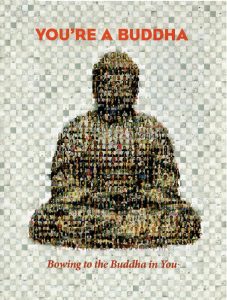
This is a good time to recall that Nichiren Shu has a brochure that focuses on the lesson of Never-Despising Bodhisattva. The brochure begins:

When we press our palms together in gassho and bow to greet others, we are seeing the Buddha within them that is part of their true nature. Never-Despising Bodhisattva never met a man or woman he didn’t like. Within every person, he could see the divine Buddha nature or Buddha seed within waiting to be acknowledged and nourished. This is one of the most compelling teachings of Buddhism. We are all Buddhas. Everything we need is already inside us. It’s just a matter of our faith and practice to peel away layers to reveal what is already there.

You're A Buddha
Click on the image to read the brochure.

Day 24

Day 24 concludes Chapter 19, The Merits of the Teacher of the Dharma, and closes the Sixth Volume of the Sutra of the Lotus Flower of the Wonderful Dharma.

Having last month concluded today’s portion of Chapter 19, The Merits of the Teacher of the Dharma, we return to the top to discuss the eight hundred merits of the nose.

“Furthermore, Constant-Endeavor! The good men or women who keep, read, recite, expound or copy this sūtra, will be able to obtain eight hundred merits of the nose. With their pure noses, they will be able to recognize all the various things above, below, within and without the one thousand million Sumeru-worlds.
“Those who keep this sūtra will be able to recognize, without moving about, the scents of the sumanas-flowers, jātika-flowers, mallikā-flowers, campaka-flowers, pāṭala-flowers, red lotus flowers, blue lotus flowers, white lotus flowers, flower-trees and fruit-trees. They also will be able to recognize the scents of candana, aloes, tamālapattra and tagara, and the scents of tens of millions of kinds of mixed incense which are either powdered or made in lumps or made applicable to the skin. They also will be able to recognize the living beings including elephants, horses, cows, sheep, men, women, boys and girls by smell. They also will be able to recognize without fallacy grasses, trees, thickets and forests by smell, be the nearby or at a distance.

“Those who keep this sūtra also will be able to recognize the gods [and things] in heaven by smell while they are staying [in the world of men]. They will be able to recognize the scents of the pārijātaka-trees, kovidāra-trees, mandārava-flowers, mahā-mandārava-flowers, mañjūṣaka-flowers, mahā-mañjūṣaka-flowers [in heaven]; the powdered incense of candana and aloes, the scents of other flowers, and the mixture of these scents in heaven without fail. They will be able to recognize the gods by smell. They will be able to recognize from afar the scent that Śakra-Devānām-Indra gives forth when he satisfies his five desires and enjoys himself in his excellent palace, or when he expounds the Dharma to the Trāyastriṃs̒a Gods at the wonderful hall of the Dharma, or when he plays in the gardens. They also will be able to recognize by smell from afar the gods and goddesses of the other heavens, including the Heaven of Brahman and the Highest Heaven. They also will be able to recognize the incense burned by the gods in those heavens. They also will be able to locate the Śrāvakas, Pratyekabuddhas, Bodhisattvas, and Buddhas by smelling their bodies from afar. Even when they recognize all this by smell, their organ of smell will not be destroyed or put out of order. If they wish, they will be able to tell others of the differences [of those scents] because they remember them without fallacy.”

The Introduction to the Lotus Sūtra offers this on the Five Kinds of Practice:

In the Lotus Sutra, we often see the sentence, “You should keep, read, recite, expound, and copy this Sutra.” These activities are called the Five Kinds of Practice for a Teacher of the Dharma. To keep the Sutra is to steadily accept and uphold the Lotus Sutra in one’s mind. To read the sutra means to peruse the Sutra and read it. To recite the Sutra means to recite it or portions of it by heart. To expound the Sutra means to interpret it and teach it to others. To copy the Sutra means to copy it by hand. Practitioners of the Lotus Sutra should undertake these five practices. They have two aspects: practice for one’s self and practice for others. [Chapter 19, The Merits of the Teacher of the Dharma] says that persons who endeavor to practice the Five Kinds of Practice will be rewarded with splendid merits of their six sense-organs of the eyes, ears, nose, tongue, body, and mind. Sakyamuni explains this to a great Bodhisattva by the name of Constant-Endeavor.

Introduction to the Lotus Sutra

Day 23

Day 23 covers all of Chapter 18, The Merits of a Person Who Rejoices at Hearing This Sutra, and opens Chapter 19, The Merits of the Teacher of the Dharma.

Having last month considered the eight hundred merits of the eye, we consider the twelve hundred merits of the ear and conclude today’s portion of Chapter 19, The Merits of the Teacher of the Dharma.

“Furthermore, Constant-Endeavor! The good men or women who keep, read, recite, expound or copy this sūtra, will be able to obtain twelve hundred merits of the ear. With their pure ears, they will be able to recognize all the various sounds and voices inside and outside the one thousand million Sumeru-worlds, [each of which is composed of the six regions] down to the Avici Hell and up to the Highest Heaven. They will be able to recognize the voices of elephants, horses and cows; the sounds of carts; cryings and sighings; the sounds of conch-shell horns, drums, gongs and bells; laughter and speech; the voices of men, women, boy and girls; meaningful voices, meaningless voices; painful voices, delightful voices; the voices of the unenlightened ones, the voices of the enlightened ones; joyful voices, joyless voices; the voices of gods, dragons, yakṣas, gandharvas, asuras, garuḍas, kiṃnaras and mahoragas; the sounds of fire, water and wind; the voices of hellish denizens, animals and hungry spirits; and the voices of bhikṣus, bhikṣunīs, Śrāvakas, Pratyekabuddhas, Bodhisattvas and Buddhas. In a word, with their pure and natural ears given by their parents, they will be able to recognize all the sounds and voices inside and outside the one thousand million Sumeru-worlds, although they have not yet obtained heavenly ears. Even when they recognize all these various sounds and voices, their organ of hearing will not be destroyed.”

Thereupon the World-Honored One, wishing to repeat what he bad said, sang in gāthās:

Their ears given by their parents will be purified, not defiled.
With their natural ears,
They will be able to recognize the sounds of voices
Of the one thousand million sumeru-worlds.

They will be able to recognize
The voices of elephants, horses and cows;
Th sounds of carts, gongs, bells, conch-shell horns,
And of drums, lyres, harps, reed-pipes and flutes.
Although they recognize pure and sweet songs,
They will not be attached to them.
They also will be able to recognize
The countless kinds of voices of men.

They will be able to recognize
The voices of gods,
The wonderful songs [of gods],
And the voices of men, women, boy and girls.

They will be able to recognize
The songs of kalavinkas, of jivakajivakas,
And of the other birds in mountains,
And on rivers and ravines.

The expounder of the Dharma
Will be able to recognize from afar,
While he is staying in the world [of men],
The cryings and shriekings
Of the denizens in hell,
The shoutings of hungry and thirsty spirits
Who are seeking food and drink,
And the voices of asuras
Bellowing to each other
[As they pound] on the seacoasts.
Even when he recognizes all this by hearing,
His organ of hearing will not be destroyed.

The expounder of the Dharma will be able to recognize,
While he is staying [in this world],
The voices of birds and animals calling each other
In the worlds of the ten quarters.

The teacher of the Dharma will be able to recognize,
While he is staying [in the world of men],
The voices of the gods of the heavens
Above the Heaven of Brahman,
[That is,] of the Light-Sound Heaven,
Of the Universal-Pure Heaven, and of the Highest Heaven.

The teacher of the Dharma
Will be able to recognize,
Without moving about,
The voices of the bhikṣus and bhikṣunīs
Who read or recite sūtras
Or expound them to others.

He will be able to recognize
The voices of the Bodhisattvas
Who read or recite sūtras
Or expound the meanings
Of quotations from them
To others.

Anyone who keeps this Sūtra
Of the Lotus Flower of the Wonderful Dharma
Will be able to recognize the voices of the Buddhas,
That is, the voices of the Great Honorable Saints
Who teach all living beings,
And who expound the Wonderful Dharma in great congregations.

He will be able to recognize
All the sounds and voices
Inside and outside the one thousand million Sumeru-worlds,
[Each being composed of the six regions]
Down to the Avici Hell and up to the Highest Heaven.
And yet his organ of hearing will not be destroyed.
He will be able to recognize everything by hearing
Because his ears are sharp.

Anyone who keeps
This Sūtra of the Lotus Flower of the Wonderful Dharma
Will be able to obtain these merits with his natural ears
Although he has not yet obtained heavenly ears.

The Daily Dharma from Feb. 7, 2019, offers this:

He will be able to recognize
All the sounds and voices
Inside and outside the one thousand million Sumeru-worlds,
[Each being composed of the six regions]
Down to the Avīci Hell and up to the Highest Heaven.
And yet his organ of hearing will not be destroyed.
He will be able to recognize everything by hearing
Because his ears are sharp.

The Buddha sings these verses in Chapter Nineteen of the Lotus Sūtra about those who practice the Buddha Dharma. We may believe that a spiritual practice leads us to “otherworldly” experiences that allow us to escape the problems we find in the world around us. These verses remind us that the teachers of the Dharma become more engaged with the world around us rather than becoming separate from it. It is through our right practice of the Lotus Sūtra that we become aware of the world as it is, and our place in making it better.

The Daily Dharma is produced by the Lexington Nichiren Buddhist Community. To subscribe to the daily emails, visit zenzaizenzai.com

Day 22

Day 22 covers all of Chapter 17, The Variety of Merits.

Having last month considered what those who believe will see, we consider who those rejoice at hearing the longevity of the Buddha after his extinction.

“Furthermore, the good men or women who do not speak ill of this sūtra but rejoice at hearing it after my extinction, should be considered, know this, to have already understood my longevity by firm faith. It is needless to say this of those who [not only rejoice at hearing this sūtra but also] read, recite and keep it. They also should be considered to be carrying me on their heads. Ajita! They need not build a stupa or a monastery in my honor, or make the four kinds of offerings’ to the Saṃgha because those who keep, read and recite this sūtra should be considered to have already built a stupa or a monastery or made offerings to the Saṃgha. They should be considered to have already erected a stupa of the seven treasures tall enough to reach the Heaven of Brahman, the upper part of the stupa being the smaller. They should be considered to have already equipped the stupa with streamers, canopies and jeweled bells, and enshrined my śarīras therein. They also should be considered to have already offered flowers, incense, necklaces, incense powder, incense applicable to the skin, incense to burn, drums, music, reed pipes, flutes, harps, various kinds of dances, and songs of praise sung with wonderful voices [to the stupa ] continuously for many thousands of billions of kalpas.

“Ajita! Anyone who, after hearing this sūtra, keeps or copies it or causes others to copy it after my extinction, should be considered to have already built many hundreds of thousands of billions of monasteries, that is to say, innumerable monasteries, each of which was installed with thirty-two beautiful halls made of red candana, eight times as tall as the tala-tree, and spacious enough to accommodate one hundred thousand bhikṣus. He also should be considered to have already furnished [those monasteries] with gardens, forests, pools for bathing, promenades, and caves for the practice of dhyāna, and filled [those monasteries] with clothing, food, drink, bedding, medicine, and things for amusements, and offered [those monasteries] to me and to the Saṃgha of bhikṣus in my presence. Therefore, I say, ‘Anyone who keeps, reads or recites this sūtra, expounds it to others, copies it, causes others to copy it, or makes offerings to a copy of it after my extinction, need not build a stupa or a monastery, or make offering to the Saṃgha.’ Needless to say, anyone who not only keeps this sūtra but also gives alms, observe the precepts, practices patience, makes endeavors, concentrates his mind, and seeks wisdom, will be able to obtain the most excellent and innumerable merits. His merits will be as limitless as the sky is in the east, west, south, north, the four intermediate quarters, the zenith, and the nadir. These innumerable merits of his will help him obtain the knowledge of the equality and differences of all things.

Nichiren uses this section of this chapter to underscore the various levels of practice.

Because in a later section, when speaking of the fourth stage of practice the sūtra says, “Needless to say, anyone who not only keeps this sūtra but also gives alms, observes the precepts, practices patience, makes endeavors, concentrates his mind, and seeks wisdom, will be able to obtain the most excellent and innumerable merits.” This passage from the sūtra makes it clear that people in the first, second, and third stages of practice should refrain giving alms, observing the precepts, and the rest of the first five bodhisattva practices until they arrive at the fourth stage of practice and then they are allowed to begin practicing them. Therefore, if they are only allowed to practice them at this stage, we know that they should refrain from practicing them in the first stage.

Shishin Gohon-shō, The Four Depths of Faith and Five Stages of Practice, Writings of Nichiren Shōnin, Faith and Practice, Volume 4, Page 104

See also this portion of the same letter.

Day 21

Day 21 covers all of Chapter 16, The Duration of the Life of the Tathāgata.

Having last month learned why Śākyamuni says ‘I shall pass away,’ we begin the Parable of the Skillful Physician and His Sick Children.

“Good men! All the Buddhas, all the Tathāgatas, do the same as I do. [They expound their teachings] for the purpose of saving all living beings. Therefore, [their teachings] are true, not false.

“I will tell you a parable. There was once an excellent and wise physician. He was good at dispensing medicines and curing diseases. He had many sons, numbering ten, twenty, or a hundred. [One day] he went to a remote country on business. After he left home, the sons took poison. The poison passed into their bodies, and the sons writhed in agony, rolling on the ground. At that time the father returned home. Some sons had already lost their right minds while the others still had not. All the sons saw their father in the distance and had great joy. They begged him on their knees, saying, ‘You came back safely. We were ignorant. We took poison by mistake. Cure us, and give us back our lives!’

“Seeing his sons suffering so much, the father consulted books of prescriptions, and collected good herbs. having a good color, smell and taste. He compounded a medicine by pounding and sieving the herbs, and gave it to them, saying, ‘This is a very good medicine. It has good color, smell and taste. Take it! It will remove the pain at once and you will not suffer any more.’

“The sons who had not lost their right minds saw that this good medicine had a good color and smell, took it at once, and were cured completely. But the sons who had already lost their right minds did not consent to take the medicine given to them, although they rejoiced at seeing their father come home and asked him to cure them, because they were so perverted that they did not believe that this medicine having a good color and smell had a good taste.

Nichiren discusses the sick children in his letter A Treatise Revealing the Spiritual Contemplation and the Most Verable One:

When we think of the Buddha’s intent reflected upon the clear mirror of these scriptures, we see that His appearance in this world was not for the sake of those who heard Him preach the Lotus Sūtra for eight years on Mt. Sacred Eagle. It was for those in the Ages of the True Dharma and the Semblance Dharma, and in the Latter Age of Degeneration. More precisely, it was not for the sake of those in the 2,000 years of the True Dharma and the Semblance Dharma, but for those like myself in the beginning of the Latter Age. The “sick ones” refer to the slanderers of the Lotus Sūtra after the death of Śākyamuni Buddha. It was “for those who did not perceive and accept this medicine excellent both in color and flavor” that the Buddha said he would “leave this excellent medicine.”

If we think of it this way, we can see why the bodhisattvas from underground did not appear during the Ages of the True Dharma and the Semblance Dharma. The 1,000-year Age of the True Dharma was appropriate for Hinayāna and provisional Mahāyāna Buddhism, but not fit for the preaching of the Lotus Sūtra in terms of both the “capacity” of those to be taught and the “time” for it to be preached. Therefore, four ranks of Bodhisattva-teachers (Four Reliances) preached the Hinayāna and provisional Mahāyāna teachings in order for the people to attain Buddhahood by nurturing the seed of Buddhahood that they had received during the lifetime of Śākyamuni Buddha. They did not preach the Lotus Sūtra then because they knew that if they had preached it, many people would have slandered it rendering it impossible to nurture the seed of Buddhahood. The capacity of the people for comprehension then was like that of those who listened to the Buddha preach in the first four of the five periods during His lifetime.

Kanjin Honzon-shō, A Treatise Revealing the Spiritual Contemplation and the Most Verable One, Writings of Nichiren Shōnin, Doctrine 2, Page 161

Day 20

Day 20 completes Chapter 15, The Appearance of Bodhisattvas from Underground, and concludes the Fifth Volume of the Sutra of the Lotus Flower of the Wonderful Dharma.

Having last month heard Śākyamuni explain that he is the teacher of these Bodhisattva-mahāsattvas, we learn of the doubts this causes among Maitreya and the other Bodhisattvas.

Thereupon Maitreya Bodhisattva-mahāsattva and the innumerable Bodhisattvas in the congregation doubted the Buddha’s words which they had never heard before. They thought:

‘How did the World-Honored One teach these great, innumerable, asaṃkhya Bodhisattvas, and qualify them to attain Anuttara-samyak-saṃbodhi in such a short time?’

[Maitreya Bodhisattva] said to the Buddha:

“World-Honored One! When you, the Tathāgata, were a crown prince, you left the palace of the Śākyas, sat at the place of enlightenment not far from the City of Gaya, and attained Anuttara-samyak-saṃbodhi. It is only forty and odd years since then.

“World-Honored One! How did you do these great deeds of the Buddha in such a short time? Did you teach these great, innumerable Bodhisattvas, and qualify them to attain Anuttara-samyak-saṃbodhi by your powers or by your merits?

“World-Honored One! No one can count the number of these great Bodhisattvas even if he goes on counting them for thousands of billions of kalpas. They have already planted roots of good, practiced the way, and performed brahma practices under innumerable Buddhas from the remotest past.

Nichiren discusses the importance of the question raised by Maitreya in his letter, Open Your Eyes to the Lotus Teaching:

Prince Shōtoku of Japan was a son of Emperor Yōmei, the thirty-second sovereign of Japan. When he was six years old, elderly men coming from Paekche, Koguryō, and T’ang China paid homage to the Emperor. The six-year old crown prince declared that they were his disciples, and these elderly men holding hands in reverence said that the crown prince was their teacher. It was indeed a wonder. It is also said in a non-Buddhist work that a certain man, while walking on a street, came across a young man about thirty years old beating an old man of about eighty years old on the street. Asked what was the matter, the story says, the young man answered that this elderly man he was beating was his son. The relationship between Śākyamuni and great bodhisattvas from underground is similar to these stories.

Therefore, Bodhisattva Maitreya and others asked a question, “World Honored One! When You were the crown prince, You left the palace of the Śākya clan and sat in meditation under the bodhi tree not far from the town of Gayā until You attained perfect enlightenment. It has only been forty years or so. How could You, World Honored One, achieve so much in so short a time?”

For forty years or so starting with the Flower Garland Sūtra, bodhisattvas have asked questions in every assembly to dispel the doubts all beings might have had. This, however, is the most serious question of all. In the Sūtra of Infinite Meaning, for instance, 80,000 bodhisattvas such as Great Adornment put forth a serious question concerning the apparent discrepancy in time required for attaining Buddhahood. While it has been said in the sūtras preached in the first forty years or so that it would take many kalpa, now it was preached that one could obtain Buddhahood quickly through the teaching of the Sūtra of Infinite Meaning. However serious the question of Great Adornment Bodhisattva was, that of Maitreya was more crucial. …

The thirty-six questions asked by Kāśyapa in the Nirvana Sūtra were also not as serious as the one asked by Maitreya. If the Buddha had not squarely answered the question to dispel this doubt, all the holy teachings of the Buddha’s lifetime would have appeared to be as worthless as bubbles, and the questions of everyone would have remained unanswered. Here lies the importance of the sixteenth chapter, “The Life Span of the Buddha,” of the Lotus Sūtra.

Kaimoku-shō, Open Your Eyes to the Lotus Teaching, Writings of Nichiren Shōnin, Doctrine 2, Page 72-74

Day 19

Day 19 concludes Chapter 14, Peaceful Practices, and begins Chapter 15, The Appearance of Bodhisattvas from Underground.

Having last month considered at the start of Chapter 15 the question posed by Bodhisattva-mahāsattvas, more than eight times the number of the sands of the River Ganges, who had come from the other worlds, we greet the many thousands of billions of Bodhisattva-mahāsattvas who sprang up from underground.

When he had said this, the ground of the Sahā-World, which was composed of one thousand million Sumeru-worlds, quaked and cracked, and many thousands of billions of Bodhisattva-mahāsattvas sprang up from underground simultaneously. Their bodies were golden-colored, and adorned with the thirty-two marks and with innumerable rays of light. They had lived in the sky below this Sahā-World. They came up here because they heard these words of Śākyamuni Buddha. Each of them was the leader of a great multitude. The Bodhisattvas included those who were each accompanied by attendants as many as sixty thousand times the number of the sands of the River Ganges. Needless to say, [they included those who were each accompanied by less attendants, for instance,] fifty thousand times, forty thousand times, thirty thousand times, twenty thousand times or ten thousand times the number of the sands of the River Ganges, or by attendants just as many of the sands of the River Ganges, or by attendants as many as a half, or a quarter of the number of the sands of the River Ganges, or by attendants as many as the sands of the River Ganges divided by a thousand billion nayuta, a billion, ten million, a million, ten thousand, a thousand, a hundred, ten, five, four, three or two attendants, or only by one attendant. [The Bodhisattvas] who preferred a solitary life came alone. The total number of the Bodhisattvas was innumerable, limitless, beyond calculation, inexplicable by any parable or simile.

Those Bodhisattvas who appeared from underground, came to Many-Treasures Tathāgata and Śākyamuni Buddha both of whom were in the wonderful stūpa of the seven treasures hanging in the sky. They [joined their hands together] towards the two World-Honored Ones, and worshipped their feet with their heads. Then they [descended onto the ground and] came to the Buddhas sitting on the lion-like seats under the jeweled trees, bowed to them, walked around them from left to right three times, joined their hands together respectfully, and praised them by the various ways by which Bodhisattvas should praise Buddhas. Then they [returned to the sky,] stood to one side, and looked up at the two World-Honored ones with joy. A period of fifty small kalpas elapsed from the Bodhisattva-mahāsattvas’ springing up from underground till the finishing of the praising of the Buddhas by the various ways by which Bodhisattvas should praise Buddhas. All this while Śākyamuni Buddha sat in silence. The four kinds of devotees also kept silence for the fifty small kalpas. By his supernatural powers, however, the Buddha caused the great multitude to think that they kept silence for only half a day. Also by the supernatural powers of the Buddha, the four kinds of devotees were able to see that the skies of many hundreds of thousands of billions of worlds were filled with those Bodhisattvas.

Nichiren offers this description of these Bodhisattvas, who “are simultaneously followers of the Original Buddha and bodhisattvas who reside in the minds of us,” in his letter, A Treatise Revealing the Spiritual Contemplation and the Most Verable One:

The bodhisattvas described in the fifteenth chapter, “Appearance of Bodhisattvas from Underground,” who have sprung out of the great earth, as numerous as the number of dust-particles of 1,000 worlds, are followers of the Original Buddha Śākyamuni who resides within our minds.

They are like T’ai-kung-wang and Duke of Chou, retainers of King Wu of the Chou dynasty in ancient China, who at the same time served the King’s young son, King Ch’eng; or Takeuchi no Sukune of ancient Japan, a leading minister to Empress Jingu, who concurrently served her son, Prince Nintoku. Just like them Bodhisattvas Superior Practice (Jōgyō), Limitless Practice (Muhengyō), Pure Practice (Jōgyō), and Steadily Established Practice (Anryūgyō), the four leaders of these bodhisattvas sprung from the earth, are simultaneously followers of the Original Buddha and bodhisattvas who reside in the minds of us, ordinary people.

Therefore, Grand Master Miao-lê has declared in his Annotations on the Mo-ho chih-kuan (Mo-ho chih-kuan fu-hsing-chiian hungchiieh): “You should know that both our bodies and the land on which we live are a part of the 3,000 modes of existence which exist in our minds. Consequently, upon our attainment of Buddhahood, we are in complete agreement with the truth of ‘3,000 existences contained in one thought,’ and our single body and single thought permeate through all the worlds in the universe.”

Kanjin Honzon-shō, A Treatise Revealing the Spiritual Contemplation and the Most Verable One, Writings of Nichiren Shōnin, Doctrine 2, Page 147

Day 18

Day 18 concludes Chapter 13, Encouragement for Keeping this Sutra, and begins Chapter 14, Peaceful Practices.

Having last month considered that all things are insubstantial, we consider in gāthās the proper practices and proper things to approach.

Thereupon the World-Honored One, wishing to repeat what he had said, sang in gāthās:

A Bodhisattva who wishes
To expound this sūtra without fear
In the evil world
After [my extinction]
Should perform proper practices
And approach proper things.

He should keep away
From kings, princes and ministers,
From other government officials,
From players of dangerous sports,
From caṇḍālas, from heretics,
And from aspirants for the teaching of Brahman.

He should not approach arrogant people,
Or the scholars who are deeply attached
To the Three Stores of the Lesser Vehicle,
Or the bhikṣus
Who violate the precepts,
Or self-appointed Arhats,
Or the bhikṣunīs/
Who like to laugh playfully.

He should not approach the upāsikās
Who are attached to the five desires
Or who seek in their present life
The extinction[-without-remainder].

When they come to him
With good intent
In order to hear
About the enlightenment of the Buddha,
He should expound the Dharma to them
Without fear,
But should not wish to receive
Anything from them.

He should not approach
Or make friends with a widow
Or with an unmarried woman
Or with a eunuch.

He should not approach
Slaughterers or cooks
Or those who kill for profit,
Such as hunters or fishermen.

He should not approach
Butchers
Or procurers
Of prostitutes.

He should not approach
Dangerous wrestlers
Or makers of various amusements
Or immoral women.

He should not expound the Dharma
To a woman in an enclosed place.
When he expounds the Dharma to her,
He should not laugh playfully.

When he goes to a village to beg for food,
He should take a Bhikṣu with him.
If he cannot find a Bhikṣu [to take with him],
He should think of the Buddha with all his heart.

These are the proper practices he should perform
And the proper things he should approach.
He should expound the Dharma peacefully
Only after doing all this!

This part of Chapter 14 is an example of why “Peaceful Practices” served as an unofficial Mahāyāna precepts.

I’ve been reading Paul Groner’s The Establishment of the Japanese Tendai School, which focuses almost entirely on Saichō’s effort to establish Mahāyāna precepts to distinguish his Tendai monks from the Nara establishment, which required new monks to take the Hinayāna precepts. Saichō’s efforts expanded on Chih-i’s concept of precepts, as Groner points out:

Besides the concept of a bodhisattva who performed Sudden practices, Chih-i also introduced another concept utilized by Saichō, the Perfect precepts (enkai). The term ‘Perfect precepts’ referred to Chih-i’s classification of Buddhist doctrine into four categories and designated the precepts appropriate for followers of the Perfect teaching. Chih-i equated the Perfect precepts with the precepts of the Buddha. They were realized through meditation, practice, and the development of a mind which was free from passions and thus able to perceive things as they really are (jissōshin). The Perfect precepts were usually not identified in Chih-i’s writings with any particular set of rules such as the precepts of the Fan wang ching (Sūtra of Brahma’s Net), Hinayāna sets or even with the anrakugyō (Serene and Pleasant Activities) of the Lotus Sūtra. Elsewhere, however, Chih-i stated that adherence to the Lotus Sūtra (jikyō) was equivalent to holding the most profound precepts. Such precepts were called absolute (rikai) and were free of specific content. They were realized in two ways. A monk or nun might gradually practice precepts of increasing subtlety until the Perfect precepts were attained, or he or she might attain them in an instant through Sudden practices. (Page 224-225)

The Establishment of the Japanese Tendai School

Day 17

Day 17 covers all of Chapter 12, Devadatta, and opens Chapter 13, Encouragement for Keeping this Sutra.

Having last month heard Medicine-King Bodhisattva-mahāsattva and Great-Eloquence Bodhisattva-mahāsattva’s vow to uphold the Lotus Sūtra, we hear from Arhats and Śrāvakas who vow to preach the Lotus Sūtra in some other world.

At that time there were five hundred Arhats in this congregation. They had already been assured of their future attainment [of Anuttara-samyak-saṃbodhi]. They said to the Buddha, “World-Honored One! We also vow to expound this sūtra [but we will expound it] in some other worlds [rather than in this Sahā-World].”

There were also eight thousand Śrāvakas some of whom had something more to learn while others had nothing more to learn. They had already been assured of their future attainment [of Anuttara-samyak-saṃbodhi]. They rose from their seats, joined their hands together towards the Buddha and vowed:

“World-Honored One! We also will expound this sūtra in some other worlds because the people of this Sahā-World have many evils. They are arrogant. They have few merits. They are angry, defiled, ready to flatter others, and insincere.”

In his letter Treatise on the Teaching, Nichiren used the hesitance of the Arhats and Śrāvakas to preach in the Sahā world to show what he was up against:

It is predicted in the Lotus Sūtra, in the 13th chapter “Encouragement for Upholding This Sūtra,” that 2000 years after the Buddha’s extinction, in the Latter Age of Degeneration, three kinds of enemies will appear against those who spread the Lotus Sūtra. The time at hand matches exactly the Latter Age of Degeneration preached in the Lotus Sūtra as the “fifth 500-year period” after the death of the Buddha. As I, Nichiren, contemplate whether or not the Buddha’s words have proved to be true, three kinds of enemies surely exist today. If I deny the existence of the three enemies and spread the Lotus Sūtra in a manner so as to avoid persecution, I cannot claim to be a practicer of the Lotus Sūtra. On the other hand, if I spread the sūtra in such a way that I am persecuted by enemies, I certainly will lose my life.