
Category Archives: LS32

Day 12

Day 12 concludes Chapter 7, The Parable of the Magic City, and completes the Third Volume of the Sutra of the Lotus Flower of the Wonderful Dharma.

Having last month considered the Parable of the Magic City in gāthās, we consider the Buddha’s explanation of the parable as we complete Chapter 7, The Parable of the Magic City.

I am like the leader.
I am the leader of all living beings.
I saw that halfway some got tired
With the seeking of enlightenment,
And that they could not pass through the dangerous road
Of birth-and-death and illusions.
Therefore, I expounded to them the teaching of Nirvāṇa
As an expedient to give them a rest, saying:
“You have already eliminated sufferings.
You have done everything you should do.”

Now I see that they have already attained Nirvāṇa
And that they have become Arhats.
Therefore, I now collect the great multitude,
And expound to them the true teaching.

The Buddhas expound the teaching of the Three Vehicles
Only as an expedient.
There is only the One Buddha-Vehicle.
The two [vehicles] were taught only as resting places.

Now I will tell you the truth.
What you attained is not [true] extinction.
Make great efforts in order to obtain
The Buddha’s knowledge of all things.
When you obtain the knowledge of all things
And the ten powers of the Buddha,
And the thirty-two physical marks,
You will be able to say that you attained true extinction.
The Buddhas, the Leaders, expound the teaching of Nirvāṇa
In order to give a rest [to all living beings].
When they see them having already had a rest,
They lead them to the wisdom of the Buddha.

[Here ends] the Third Volume of the Sūtra of the Lotus Flower of the Wonderful Dharma.

The Daily Dharma from Jan. 30, 2019, offers this:

The Buddhas expound the teaching of the Three Vehicles
Only as an expedient.
There is only the One Buddha-Vehicle.
The two [vehicles] were taught only as resting places.

The Buddha declares these verses in Chapter Seven of the Lotus Sūtra after telling the parable of the Magic City. The parable is his explanation of why expedient teachings are necessary, and why we must eventually set them aside to attain the enlightenment that is our true nature.

The Daily Dharma is produced by the Lexington Nichiren Buddhist Community. To subscribe to the daily emails, visit zenzaizenzai.com
Day 11

Day 11 continues Chapter 7, The Parable of the Magic City

Having last month considered what occurred when Great-Universal-Wisdom-Excellence Buddha attained Anuttara-samyak-saṃbodhi, we consider the reaction of the Brahman-heavenly-kings of the five hundred billion worlds in the east.

“The palaces of the Brahman-heavenly[-kings] of the five hundred billion worlds in the east were illumined twice as brightly as ever. The Brahman-heavenly-kings [of those worlds] each thought, ‘My palace has never been illumined so brightly before. Why is that?’ They visited each other and discussed the reason. There was a great Brahman-heavenly-king called All-Saving among them. He said to the other Brahmans in gāthās:

Why are our palaces illumined
More brightly than ever?
Let us find [the place]
[From where this light has come].
Did a god of great virtue or a Buddha
Appear somewhere in the universe?
This great light illumines
The worlds of the ten quarters.

“Thereupon the Brahman-heavenly-kings of the five hundred billion worlds went to the west, carrying flower-plates filled with heavenly flowers, in order to find [the place from where the light had come]. Their palaces also moved as they went. They [reached the Well-Composed World and] saw that Great­Universal-Wisdom-Excellence Tathāgata was sitting on the lion­like seat under the Bodhi-tree at the place of enlightenment, surrounded respectfully by gods, dragon-kings, gandharvas, kiṃnaras, mahoragas, men and nonhuman beings. They also saw that the sixteen princes were begging the Buddha to turn the wheel of the Dharma. Thereupon the Brahman-heavenly­kings worshipped the Buddha with their heads, walked around him a hundred thousand times, and strewed heavenly flowers to him. The strewn flowers were heaped up to the height of Mt. Sumeru. The Brahman-heavenly-kings offered flowers also to the ten-yojana-tall Bodhi-tree of the Buddha. Having offered flowers, they offered their palaces to the Buddha, saying, ‘We offer these palaces to you. Receive them and benefit us out of your compassion towards us!’ In the presence of the Buddha, they simultaneously praised him in gāthās with all their hearts:

You, the World-Honored One, are exceptional.
It is difficult to meet you.
You have innumerable merits.
You are saving all living beings.

As the great teacher of gods and men,
You are benefiting all living beings
Of the worlds of the ten quarters
Out of your compassion towards them.

We have come here from five hundred billion worlds.
We gave up the pleasure
Of deep dhyāna-concentration
Because we wished to make offerings to you.
Our palaces are beautifully adorned
Because we accumulated merits in our previous existence.
We offer [these palaces] to you.
Receive them out of your compassion towards us!

“Thereupon the Brahman-heavenly-kings, having praised the Buddha with these gāthās, said, ‘World-Honored One! Turn the wheel of the Dharma and save all living beings! Open the Way to Nirvāṇa!’ They simultaneously said in a gāthā with all their hearts:

Hero of the World,
Most Honorable Biped!
Expound the Dharma!
Save the suffering beings
By the power of your great compassion!

“Thereupon Great-Universal-Wisdom-Excellence Tathāgata gave his tacit consent to their appeal.

The Daily Dharma from April 15, 2018, offers this:

Did a god of great virtue or a Buddha
Appear somewhere in the universe?
This great light illumines
The worlds of the ten quarters.

The Brahma Heavenly Kings of the East sing these verses as part of a story the Buddha tells in Chapter Seven of the Lotus Sūtra. Long ago there was another Buddha named Great-Universal-Wisdom-Excellence. When he became enlightened, the entire universe was illuminated. Beings who had never seen each other could recognize each other clearly. We can see this story as a metaphor for what happens when the Buddha’s wisdom comes into our lives. We leave the darkness of our ego attachment and come into the light of the world as it is.

The Daily Dharma is produced by the Lexington Nichiren Buddhist Community. To subscribe to the daily emails, visit zenzaizenzai.com

Day 10

Day 10 concludes Chapter 6, Assurance of Future Buddhahood, and opens Chapter 7, The Parable of a Magic City.

Having last month heard the prediction for the future Buddhahood of Subhūti, we hear the prediction for Great Kātyāyana.

Thereupon the World-Honored One said to the bhikṣus:

“Now I will tell you. This Great Kātyāyana will make many offerings to eight hundred thousand millions of Buddhas, attend on them, respect them, and honor them in his future life. After the extinction of each of those Buddhas, he will erect a stūpa-mausoleum a thousand yojanas high, and five hundred yojanas wide and deep. He will make it of the seven treasures: gold, silver, lapis lazuli, shell, agate, pearl and ruby. He will offer flowers, necklaces, incense to apply to the skin, incense powder, incense to burn, canopies, banners and streamers to this stūpa-mausoleum. After that he will make the same offerings to two billions of Buddhas. Having made offerings to those Buddhas, he will complete the Way of Bodhisattvas, and become a Buddha called Jambunada-Gold-Light, the Tathāgata, the Deserver of Offerings, the Perfectly Enlightened One, the Man of Wisdom and Practice, the Well-Gone, the Knower of the World, the Unsurpassed Man, the Controller of Men, the Teacher of Gods and Men, the Buddha, the World-Honored One. The ground [of his world] will be even, made of crystal, and adorned with jeweled trees. The roads will be marked off by ropes of gold, and wonderful flowers will cover the ground to purify it. Anyone will rejoice at seeing it. The four evil regions: hell, the region of hungry spirits, that of animals, and that of asuras, will not exist in that world. Many gods and men will live there. Śrāvakas and Bodhisattvas, many billions in number, also will live there to adorn that world. The duration of the life of that Buddha will be twelve small kalpas. His right teachings will be preserved for twenty small kalpas, and the counterfeit of his right teachings also will be preserved for twenty small kalpas.”

Thereupon the World-Honored One, wishing to repeat what he had said, sang in gāthās:

Bhikṣus!
Listen with one mind!
What I say
Is true, not false.

This Kātyāyana
Will make
Wonderful offerings
To the Buddhas.

After the extinction of each of the Buddhas,
He will erect a stūpa of the seven treasures,
And offer flowers and incense to the śarīras
[Of the Buddha enshrined in the stūpa].

On the final stage of his physical existence,
He will obtain the wisdom of the Buddha
And attain perfect enlightenment.
His world will be pure.
He will save many billions of living beings.
All living beings
In the worlds of the ten quarters
Will make offerings to him.

No light will surpass
The light of that Buddha.
The name of that Buddha will be
Jambu [nada]-Gold-Light.

Innumerable Bodhisattvas and Śrāvakas
Will live in his world, and adorn that world.
They will have already eliminated
The bonds of existence.

It is of note that Katyayana was foremost in explaining the Dharma, according to list of the top 10 Voice Hearers. But as Nichiren points out, it is only through the Lotus Sūtra that these great disciples can attain Buddhahood.

The purpose of the Tripiṭaka teaching is to emancipate people from the Six Realms of the triple world. As a result, because the teaching reveals no place but the triple world to attain emancipation, śrāvaka and pratyekabuddha are unaware of the existence of the Pure Land where bodhisattvas are born. They also do not know that they still possess other evil passions and attachments besides the delusions in view and thought. Śrāvakas and pratyekabuddhas believe they will eliminate the cause of being reborn in the triple world if they do away with the delusions in view and thought and that they will exist in a void where there is no body or mind, since they will have transformed the body to ashes and annihilated consciousness. Thus it is said that men of the two Vehicles cannot be saved by the Tripiṭaka teaching, and that they will never be able to become Buddhas without the teaching of the Lotus Sūtra.

Ichidai Shōgyō Tai-I, Outline of All the Holy Teachings of the Buddha, Writings of Nichiren Shōnin, Doctrine 3, Page 72

Odds and Ends from The Lotus Sutra: A Biography

This is a followup to yesterday’s post about The Lotus Sutra: A Biography with a few additional ideas I want to save for later retrieval.

On the fate of the 5,000 arrogant monks who walked out in Chapter 2, Expedients, of the Lotus Sūtra:

For Zhiyi, and for many readers over the centuries, the Lotus Sūtra has two major messages. The first, found in the first half of the sūtra, is that there are not three vehicles; there is one vehicle, which will eventually transport all sentient beings to buddhahood. The second, found in the second half of the sūtra, is that the lifespan of the Buddha is immeasurable. These two doctrines are generally compatible with the Nirvāṇa Sūtra, allowing Zhiyi to continue to uphold the supremacy of the Lotus. But if everything is said in the Lotus, what is the purpose of the Nirvāṇa? Here, those five thousand haughty monks and nuns who walked out in the second chapter of the Lotus Sūtra come to the rescue. The sūtra does not explain what became of them, but Zhiyi explains that they returned to the assembly that surrounded the Buddha’s deathbed. The Buddha thus compassionately reiterated the central message of the Lotus Sūtra to those who had missed it the first time. It was also important, at the moment of his apparent passage into Nirvāṇa, for the Buddha to reiterate what he had declared in the Lotus: that like the wise physician, the Buddha only pretends to die; in fact his lifespan is immeasurable. (Page 56-57)

On the great merit earned by the grasshopper.

Discussing Great Japanese Miraculous Tales of the Lotus Sūtra (Dainihonkoku hokekyōkenki), completed in 1044 by the monk Chingen:

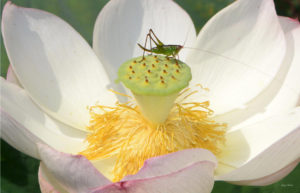
Grasshopper on a lotusOne of several anthologies of miracle tales about the Lotus, this collection includes rather standard Buddhist stories of miracle cures (a blind woman regains her sight by reciting the Lotus), divine retribution (a man who ridicules a reciter of the Lotus loses his voice), and deaths attended by heavenly fragrances, beautiful music, and auspicious dreams. In one story, a monk memorizes the first twenty-five chapters of the Lotus but, despite repeated efforts, is unable to memorize the final three. He eventually learns in a dream that in a previous life he had been a grasshopper who perched in a temple room where a monk was reciting the sūtra. After reciting the first seven scrolls of the sūtra (which contain the first twenty-five chapters), the monk rested before beginning the final roll. He leaned against the wall and inadvertently killed the grasshopper. The grasshopper was reborn as a human as a result of the merit he received from hearing the first twenty-five chapters of the Lotus. When he became a monk, however, he was unable to memorize the final three chapters because he, as the grasshopper, had died before he heard them. (Page 79-80)

On how Nichiren judged the six Buddhist schools of Nara.

He seems to have arrived at this conviction [of the supremacy of the Lotus Sūtra] through something of a process of elimination, but only after a serious survey of the Japanese sects of the day. He began with the belief that the word of the Buddha was superior to that of the various Indian Buddhist masters, such that one’s allegiance should be to a sūtra rather than to a treatise (śāstra). This immediately eliminated five of the six “Nara schools” of Buddhism, which were based on various Madhyamaka (Sanron), Yogācāra (Hossō), and Abhidharma treatises (Kusha and Jōjitsu), as well as on (in the case of Ritsu) the monastic code (vinaya). Among the Nara schools, that left only Kegon, based on the Flower Garland Sūtra, which Nichiren rejected. He already had an antipathy for Pure Land, but he was attracted to Shingon, famous for its doctrine that it is possible to “achieve buddhahood in this very body” (sokushin jōbutsu), that is, during the present lifetime. He found what would prove to be for him a more compelling doctrine in the Tendai sect, which, based in part on Zhiyi’s famous doctrine of “the three thousand realms in a single thought,” proclaimed that all beings are endowed with original enlightenment (hongaku). Nichiren eventually decided that the Tendai sect, with its conviction that the Lotus Sūtra was the Buddha’s highest teaching, was the superior form of Buddhism, although he felt that in the centuries since its founding, its purity had been diluted by the admixture of other practices, especially devotion to Amitābha. (Page 82-83)

On the topic of Nichiren Shoshu.

“We recall that in Nichiren Shōshū, the dharma in the three jewels is not the Lotus Sūtra; it is the three great secret doctrines: the honzon, the daimoku, and the kaidan.” (Page 221)

On SGI as a separate Buddhist organization

We find in the charter no mention of slandering the dharma (or the consequences of doing so), no mention of shakubuku, and no mention of the Lotus Sūtra. (Page 211)

Day 9

Day 9 covers Chapter 5, The Simile of Herbs, and introduces Chapter 6, Assurance of Future Buddhahood.

Having last month considered how the dharma is of the same content and the same taste, we hear the Buddha praise the understanding of those present.

“Although I knew the equality and differences of all things, I refrained from expounding it to them in order to protect them because I saw their [various] desires.

“Kāśyapa, and all of you present here! It is an extraordinarily rare thing to see that you have understood, believed and received the Dharma which I expounded variously according to the capacities of all living beings because it is difficult to understand the Dharma which the Buddhas, the World-Honored Ones, expound according to the capacities of all living beings.”

The Daily Dharma from Dec. 30, 2018, offers this:

Kāśyapa, and all of you present here! It is an extraordinarily rare thing to see that you have understood, believed and received the Dharma which I expounded variously according to the capacities of all living beings because it is difficult to understand the Dharma which the Buddhas, the World-Honored Ones, expound according to the capacities of all living beings.

The Buddha makes this declaration to his disciple Kāśyapa and all those gathered to hear him teach in Chapter Five of the Lotus Sūtra. The Buddha knows how hard it is to set aside our delusions and understand what he is teaching us. When the Buddha teaches with expedients, he lets us stay in the comfort of our own minds. With the Wonderful Dharma of the Lotus Sūtra, he takes us into the unfamiliar areas of his own mind. Only when we gain confidence in the Buddha as our guide can we stay with this teaching and not regress to the contentment of our attachments.

The Daily Dharma is produced by the Lexington Nichiren Buddhist Community. To subscribe to the daily emails, visit zenzaizenzai.com

The Great Secret Practice of Rahula

It is the ordinary day-to-day practice that each of us performs that is actually the great secret practice of Rahula. It isn’t fame or acquiring a big name that is required to attain enlightenment. It isn’t being famous that will lead others to practice the Lotus Sutra. It is our practice of the Lotus Sutra in our everyday lives that will enable countless others just like us to ultimately take faith in the Lotus Sutra. We should not be discouraged, instead we can look at Rahula who will become Walking-On-Flowers-Of-Seven-Treasures Buddha and we too can walk on the flowers of the seven treasures of Myoho-Renge-Kyo.

Lecture on the Lotus Sutra

Day 8

Day 8 concludes Chapter 4, Understanding by Faith, and closes the second volume of the Sutra of the Lotus Flower of the Wonderful Dharma.

Having last month considered in gāthās the rich man’s success in making his son feel at home, Mahā-Kāśyapa explains the meaning of the parable.

You are like the father.
Knowing that we wished
To hear the Lesser Vehicle,
You did not say to us, “You will become Buddhas.”
You said of us to others:
“Though they are my disciples, they are Śrāvakas.
They eliminated āsravas,
But attained only the Lesser Vehicle.”

You said to us:
“Expound the most excellent Way [to Bodhisattvas]!
Those who practice the Way
Will be able to become Buddhas.”

By this order of yours
We expounded the unsurpassed Way
To the great Bodhisattvas
With various stories of previous lives,
With various parables and similes
And with various discourses.•

Hearing the [Way, that is, the] Dharma from us,
Those sons of yours
Thought it over day and night,
And practiced it strenuously.

Thereupon the Buddha assured them
Of their future Buddhahood, saying to them:
“You will become Buddhas
In your future lives.”

You expounded the real thing,
That is, the store
Of the hidden core of the Buddhas
Only to the Bodhisattvas.
You did not expound
This truth to us.

The poor son came to his father,
And took custody
Of the things of his father,
But wished to take none of them.

The same can be said of us.
We did not wish to have the treasure-store
Of the teachings of the Buddhas
Although we expounded it [to the Bodhisattvas].

We were satisfied with the elimination
Of illusions within ourselves.
What we accomplished was that elimination.
We did nothing more.

The Daily Dharma from April 17, 2018, offers this:

We were satisfied with the elimination
Of illusions within ourselves.
What we accomplished was that elimination.
We did nothing more.

These verses are sung by Subhūti, Mahā-Kātyāyana, Mahā-Kāśyapa, and Mahā-Maudgalyāyana in Chapter Four of the Lotus Sūtra. They use the parable of the wayward son in this chapter to describe their own realization that the Buddha had not held any teaching back from them. Instead, the Buddha earlier allowed them to remain in the satisfaction of ending their own suffering. But before they can continue their progress towards the Buddha’s own enlightenment, they must give up their preoccupation with suffering, as the boy in the parable had to give up his idea of himself as a lowly hired worker, rather than the heir to his father’s treasure.

The Daily Dharma is produced by the Lexington Nichiren Buddhist Community. To subscribe to the daily emails, visit zenzaizenzai.com

Day 7

Day 7 concludes Chapter 3, A Parable, and begins Chapter 4, Understanding by Faith.

Having last month considered why the Buddha expounds only to people of profound wisdom this Sūtra of the Lotus Flower of the Wonderful Dharma, we consider the fate of those who scowl at this sūtra.

Some will scowl at this sūtra
And doubt it.
Listen! I will tell you
How they will be punished.

In my lifetime or after my extinction
Some will slander this sūtra,
And despise the person
Who reads or recites
Or copies or keeps this sūtra.
They will hate him,
Look at him with jealousy,
And harbor enmity against him.
Listen! I will tell you
How they will be punished.

When their present lives end,
They will fall into the Avici Hell.
They will live there for a kalpa,
And have their rebirth in the same hell.
This rebirth of theirs will be repeated
For innumerable kalpas.

Nichiren discusses the depths of hell in his Letter to Hōren:

QUESTION: What kind of hell do slanderers of the practicer of the Lotus Sūtra fall into?

ANSWER: The Lotus Sūtra, fascicle 2 (“A Parable” chapter), preaches, “Those who despise, hate, envy, and bear a grudge against a person who reads, recites, copies and upholds the Lotus Sūtra will fall into Avici Hell upon death. After suffering in this hell for as long as a kalpa, they will again die at the end of the kalpa and fall into the same hell to suffer. They will repeat this countless times and continue to suffer for innumerable kalpa (aeons).”

The palace of King Yama is located 500 yojana below the surface of the earth. Below the palace, between the depths of 500 and 1,500 yojana underground are located 136 hells such as the Eight Great Hells. 128 of the 136 hells are the abodes of minor criminals while the Eight Great Hells are the abodes of felons. Seven of the Eight Great Hells are for the offenders of the Ten Evil Acts while the last of the Eight Great Hells, the Hell of Incessant Suffering, is the abode of those who committed the Five Rebellious Sins, undutiful children, and slanderers of the Lotus Sūtra. To sum up, this passage cited from the “Parable” chapter of the Lotus Sūtra preaches that those who speak ill of or slander the practicer of the Lotus Sūtra in the Latter Age of Degeneration in this world even in jest must fall into the Hell of Incessant Suffering.

Hōren-shō, Letter to Hōren, Writings of Nichiren Shōnin, Volume 6, Followers I, Page 45

Day 6

Day 6 continues Chapter 3, A Parable

Having last month considered why the rich man gave the largest carts to his children, we begin the Parable of the Burning House in gāthās with the condition of the house.

Thereupon the Buddha, wishing to repeat what he had said, sang in gāthās:

I will tell you a parable.
A rich man had a manor house.
It was old, rotten,
Broken and ruined.
The house was about to collapse.
The lower parts of the pillars were rotten;
The beams and ridge-poles, tilting and slanted;
The foundation and steps, broken;
The fences and walls, corrupt;
The plaster of the walls, peeling;
The rush thatched on the roof, falling;
The rafters and eaves, slipping out of each other;
The hedges around the house, bent;
And refuse and debris, scattered all over.

In this house lived
Five hundred people.
Kites, owls, crested eagles,
Eagles, crows,
Magpies, doves, pigeons,
Lizards, snakes, vipers, scorpions,
Millipedes, wall lizards, centipedes,
Weasels, badgers, mice, rats,
And poisonous vermin
Were moving about.

Maggots and other vermin
Assembled on the excretions
Scattered all over
In the house.

Foxes, wolves, and small foxes
Were crawling on corpses,
Biting them, chewing them,
And dismembering them.

Many dogs were scrambling for their prey.
Weak and nervous from hunger,
They were seeking food here and there.
They were fighting with each other,
Snapping at each other,
And barking at each other.
The house was
So dreadful, so extraordinary.

Mountain spirits, water spirits,
Yakṣas and other demons
Lived here and there.
They fed on people and poisonous vermin.

Wild birds and beasts
Hatched their eggs,
Suckled or bred.
They protected their offspring.
Yakṣas scrambled for their young,
Took them, and ate them.
Having eaten to their hearts’ content,
They became more violent.
They fought with each other.
Their shrieks were dreadful.

The demons called kumbhandas
Crouched on the ground
Or jumped a foot or two above the ground.
They walked to and fro
And played at their will.
They seized dogs by the legs,
Or hit them
Until they lost their voices,
And held their feet against their necks.
They enjoyed seeing them frightened.

Some demons,
Tall, large,
Naked, black, and thin,
Lived in the house.
They were crying for food
With loud and evil voices.

The necks of some demons
Were as slender as needles.
The heads of some demons
Were like that of a cow.
They ate people or dogs.
Their hair was disheveled
Like mugworts.
They were cruel and dangerous.
Always hungry and thirsty,
They were running about, shrieking.

Yakṣas, hungry spirits,
And wild birds and beasts
Were unbearably hungry.
They were looking out of the windows
In all directions for food.
The house was so dangerous, so dreadful.

The Introduction to the Lotus Sūtra offers this on the suffering world that is the burning house:

Another important point of the parable [of the Burning House] is that we humans are allegorically illustrated as living in a burning house. The burning, of course, symbolizes our suffering. From the Buddhist viewpoint, suffering is an inescapable fact of life, as illustrated in the dictum, “All existence is suffering.” Many people think this view is too pessimistic, but that is not the case. The dictum is presented as a bare fact, neither good or bad. Biological suffering is a part of life. The question is, What can we do about it?

Introduction to the Lotus Sutra

Day 5

Day 5 begins Chapter 3, A Parable

Having last month heard Śāriputra’s dancing joy in gāthās, we consider Śāriputra’s fear that he was listening to Mara in the form of a Buddha.

In the midst of the great multitude,
You said to me, “You will become a Buddha.”
Hearing this truthful voice,
All my doubts are gone.

When I had heard this from you,
I was much frightened and perplexed; I thought:
“The Buddha troubles me.
Isn’t he Mara in the form of a Buddha?”

You skillfully expound the Dharma with various parables and similes,
And with various stories of previous lives.
Now my mind is as peaceful as the sea.
Hearing you, I have removed the mesh of doubts.

You said:
“The innumerable Buddhas in the past
Expounded the Dharma with expedients.
The numberless Buddhas at present
Also expound the Dharma
With expedients.
So will the countless Buddhas
In the future.”

You appeared in this world,
Left your home, attained enlightenment,
And now turn the wheel of the Dharma,
Also with expedients.

You expound the true teaching;
Papiyas does not.
Therefore, I know
That you are not a transformation of Mara.
I thought that the Dharma was expounded by Mara
Because I was in the mesh of doubts.

I hear your gentle voice.
Your voice is deep and wonderful.
You expound the Pure Dharma.
My heart is filled with great joy.
All my doubts are gone.
I have obtained true wisdom.

I shall become a Buddha without fail.
I shall be respected by gods and men.
I will turn the wheel of the unsurpassed Dharma,
And teach Bodhisattvas.

This expedient lesson is discussed by Nichiren in his letter on Genealogical Chart of the Buddha’s Lifetime Teachings in Five Periods:

When Śāripūtra, a man of the Two Vehicle considered unable to attain Buddhahood in the pre-Lotus sūtras, was guaranteed future Buddhahood, he expressed his astonishment in the third chapter, “A Parable,” “Is this not a devil pretending to be the Buddha, trying to trouble and confuse my mind?” The Buddha preaches in the fifth chapter, “The Simile of Herbs,” “Regarding this essential doctrine, I kept silent for a long time without revealing it at once.” These make clear that the sūtras preached before the Lotus Sūtra are all expedient; only the Lotus Sūtra is the True Dharma.

Ichidai Goji Keizu, Genealogical Chart of the Buddha’s Lifetime Teachings in Five Periods, Writings of Nichiren Shōnin, Doctrine 3, Page 243