
Category Archives: LS32

Day 29

Day 29 covers all of Chapter 25, The Universal Gate of World-Voice-Perceiver Bodhisattva.

Having last month covered examples of World-Voice-Perceiver’s wisdom, we conclude the chapter.

Suppose you are in a law-court for a suit,
Or on a battlefield, and are seized with fear.
If you think of the power of World-Voice-Perceiver,
All your enemies will flee away.

His wonderful voice [comes from] his perceiving the voice of the world.
It is like the voice of Brahman, like the sound of a tidal wave.
It excels all the other voices of the world.
Therefore, think of him constantly!

Do not doubt him even at a moment’s thought!
The Pure Saint World-Voice-Perceiver is reliable
When you suffer, and when you are confronted
With the calamity of death.

By all these merits, he sees
All living beings with his compassionate eyes.
The ocean of his accumulated merits is boundless.
Therefore, bow before him!

Thereupon Earth-Holding Bodhisattva rose from his seat, proceeded to the Buddha, and said to him:

“World-Honored One! Those who hear of his supernatural powers by which he opened the universal gate without hindrance, and which are expounded in this chapter of World-Voice-Perceiver Bodhisattva, know this, will be able to obtain not a few merits.”

When the Buddha expounded this chapter of the Universal Gate, the eighty-four thousand living beings in the congregation began to aspire for the unparalleled Anuttara-samyak-saṃbodhi.

The Daily Dharma from June 28, 2017, offers this:

Do not doubt him even at a moment’s thought!
The Pure Saint World-Voice-Perceiver is reliable
When you suffer, and when you are confronted
With the calamity of death.

The Buddha sings these verses in Chapter Twenty-Five of the Lotus Sūtra. The calamity of death is something we all will face eventually, whether it our own or that of those we love. The other calamities in our lives are relatively minor losses which can prepare us for this great calamity. The Bodhisattva World-Voice-Perceiver is the embodiment of Compassion: the desire to benefit all beings. When we learn to use all of the suffering in our lives, especially the calamity of death, as a way to remove our delusions and benefit others, then we can see the world with the eyes of the Buddha and know the joy he declares is at the core of our being.

The Daily Dharma is produced by the Lexington Nichiren Buddhist Community. To subscribe to the daily emails, visit zenzaizenzai.com
Day 28

Day 28 covers all of Chapter 24, Wonderful-Voice Bodhisattva, and concludes the Seventh Volume of the Sutra of the Lotus Flower of the Wonderful Dharma.

Having last month the arrival of Wonderful-Voice Bodhisattva in the Sahā World, we consider Flower-Virtue Bodhisattva’s question and Śākyamuni Buddha’s answer.

Thereupon Flower-Virtue Bodhisattva said to Śākyamuni Buddha:

“World-Honored One! What root of good did this Wonderful-Voice Bodhisattva plant and what kind of meritorious deeds did he do in order to obtain this supernatural power?”

Śākyamuni Buddha said to Flower-Virtue Bodhisattva:

“There was once a Buddha called Cloud-Thunder-Sound-King, the Tathāgata, the Arhat, the Samyak-sambuddha. His world was called Appearance-Of-All-Worlds; and the kalpa in which he lived, Gladly-Seen. [There lived] a Bodhisattva called Wonderful-Voice [under that Buddha. The Bodhisattva] offered hundreds of thousands of kinds of music and eighty-four thousand patras of the seven treasures to Cloud-Thunder-Sound-King Buddha for twelve thousand years. Because of this, he was able to appear in the world of Pure-Flower-Star-King-Wisdom Buddha, and obtain supernatural power such as this.

“Flower-Virtue! What do you think of this? Wonderful-Voice Bodhisattva who had offered the music and the jeweled bowls to Cloud-Thunder-Sound-King Buddha [at that time] was no one but this Wonderful-Virtue Bodhisattva-mahāsattva [whom you see here now].

“Flower-Virtue! This Wonderful-Voice Bodhisattva already made offerings to innumerable Buddhas, attended on them, and planted the roots of virtue a long time ago. He also already saw hundreds of thousands of billions of nayutas of Buddhas, that is, as many Buddhas as there are sands in the River Ganges.

What root of good, indeed.

Day 27

Day 27 concludes Chapter 23, The Previous Life of Medicine-King Bodhisattva.

Having last month witnessed Gladly-Seen-By-All-Beings Bodhisattva’s reaction to Sun-Moon-Pure-Bright-Virtue Buddha’s entry into parinirvana, we consider what happened after Gladly-Seen-By-All-Beings burned his arms.

“Having seen him deprived of his arms, the Bodhisattvas, gods, men, asuras and others were overcome with sorrow. They said, ‘This Gladly-Seen-By-All-Beings Bodhisattva is our teacher. He is leading us. Now he has burned off his arms. He is deformed.’

“Thereupon Gladly-Seen-By-All-Beings Bodhisattva vowed to the great multitude, saying, ‘I shall be able to obtain the golden body of the Buddha because I gave up my arms. If my words are true and not false, I shall be able to have my arms restored.’

“When he had made this vow, his arms were restored because his merits, virtues and wisdom were abundant. Thereupon the one thousand million Sumeru-worlds quaked in the six ways, and the gods rained down jeweled flowers. All the gods and men had the greatest joy that they had ever had.”

Underscore here his arms were restored because his merits, virtues and wisdom were abundant.

Day 26

Day 26 concludes Chapter 21, The Supernatural Powers of the Tathāgatas, includes Chapter 22, Transmission, and introduces Chapter 23, The Previous Life of Medicine-King Bodhisattva.

Having last month concluded Chapter 21, The Supernatural Powers of the Tathāgatas, we begin Chapter 22, Transmission.

Thereupon Śākyamuni Buddha rose from the seat of the Dharma, and by his great supernatural powers, put his right hand on the heads of the innumerable Bodhisattva-mahāsattvas, and said:

“For many hundreds of thousands of billions of asaṃkhyas of kalpas, I studied and practiced the Dharma difficult to obtain, and [finally attained] Anuttara-samyak-saṃbodhi. Now I will transmit the Dharma to you. Propagate it with all your hearts, and make it known far and wide!”

He put his [right] hand on their heads twice more, and said:

“For many hundreds of thousands of billions of asaṃkhyas of kalpas, I studied and practiced the Dharma difficult to obtain, and [finally attained] Anuttara-samyak-saṃbodhi. Now I will transmit [the Dharma] to you. Keep, read, recite and expound [this sūtra in which the Dharma is given], and cause all living beings to hear it and know it! Why is that? It is because I have great compassion. I do not begrudge anything. I am fearless. I wish to give the wisdom of the Buddha, the wisdom of the Tathāgata, the wisdom of the Self-Existing One, to all living beings. I am the great almsgiver to all living beings. Follow me, and study my teachings without begrudging efforts! In the future, when you see good men or women who believe in the wisdom of the Tathāgata, you should expound this Sūtra of the Lotus Flower of the Wonderful Dharma to them, and cause them to hear and know [this sūtra] so that they may be able to obtain the wisdom of the Buddha. When you see anyone who does not receive [this sūtra] by faith, you should show him some other profound teachings of mine, teach him, benefit him, and cause him to rejoice. When you do all this, you will be able to repay the favors given to you by the Buddhas.”

The Daily Dharma from Feb. 23, 2017, offers this:

When you see anyone who does not receive [this sūtra] by faith, you should show him some other profound teachings of mine, teach him, benefit him, and cause him to rejoice. When you do all this, you will be able to repay the favors given to you by the Buddhas.

The Buddha gives these instructions in Chapter Twenty-Two of the Lotus Sūtra. They remind us to be patient with those whom we work to benefit. Even though they may not be ready to hear the Wonderful Dharma, we can use the Expedient Teachings to prepare them for the Buddha’s highest teaching. When we are assured that countless beings are helping us all to become enlightened, we are less likely to be disappointed in the progress that we see.

The Daily Dharma is produced by the Lexington Nichiren Buddhist Community. To subscribe to the daily emails, visit zenzaizenzai.com

Day 25

Day 25 covers all of Chapter 20, Never-Despising Bodhisattva, and opens Chapter 21, The Supernatural Powers of the Tathāgatas.

Having last month witnessed the World-Honored One display his great supernatural powers, we conclude Day 25’s portion of Chapter 21, The Supernatural Powers of the Tathāgatas with the reaction of the gods in the skies of the worlds of the ten quarters.

At that time the gods in the skies [of the worlds of the ten quarters] said loudly:

“There is a world called Sahā beyond a distance of many hundreds of thousands of billions of asaṃkhyas of worlds. In that world lives a Buddha called Śākyamuni. He is now expounding to Bodhisattva-mahāsattvas a sūtra of the Great Vehicle, called the ‘Lotus Flower of the Wonderful Dharma, the Dharma for Bodhisattvas, the Dharma Upheld by the Buddhas.’ Rejoice from the bottom of your hearts! Bow and make offerings to Śākyamuni Buddha!”

Having heard their voice from the skies, the living beings of those worlds joined their hands together towards the Sahā World, and said, “Namah Sakyamunaye Buddhaya, namah Sakyamunaye Buddhaya.” Then they strewed various flowers, various kinds of incense, various necklaces, streamers, canopies, personal ornaments, treasures, and other wonderful things to the Sahā-World from afar.

The strewn things came from the worlds of the ten quarters like gathering clouds and changed into a jeweled awning over the Sahā-World. The awning extended over the Buddhas staying in this world. At that time the worlds of the ten quarters became passable through each other without hindrance as if they had been a single Buddha-world.

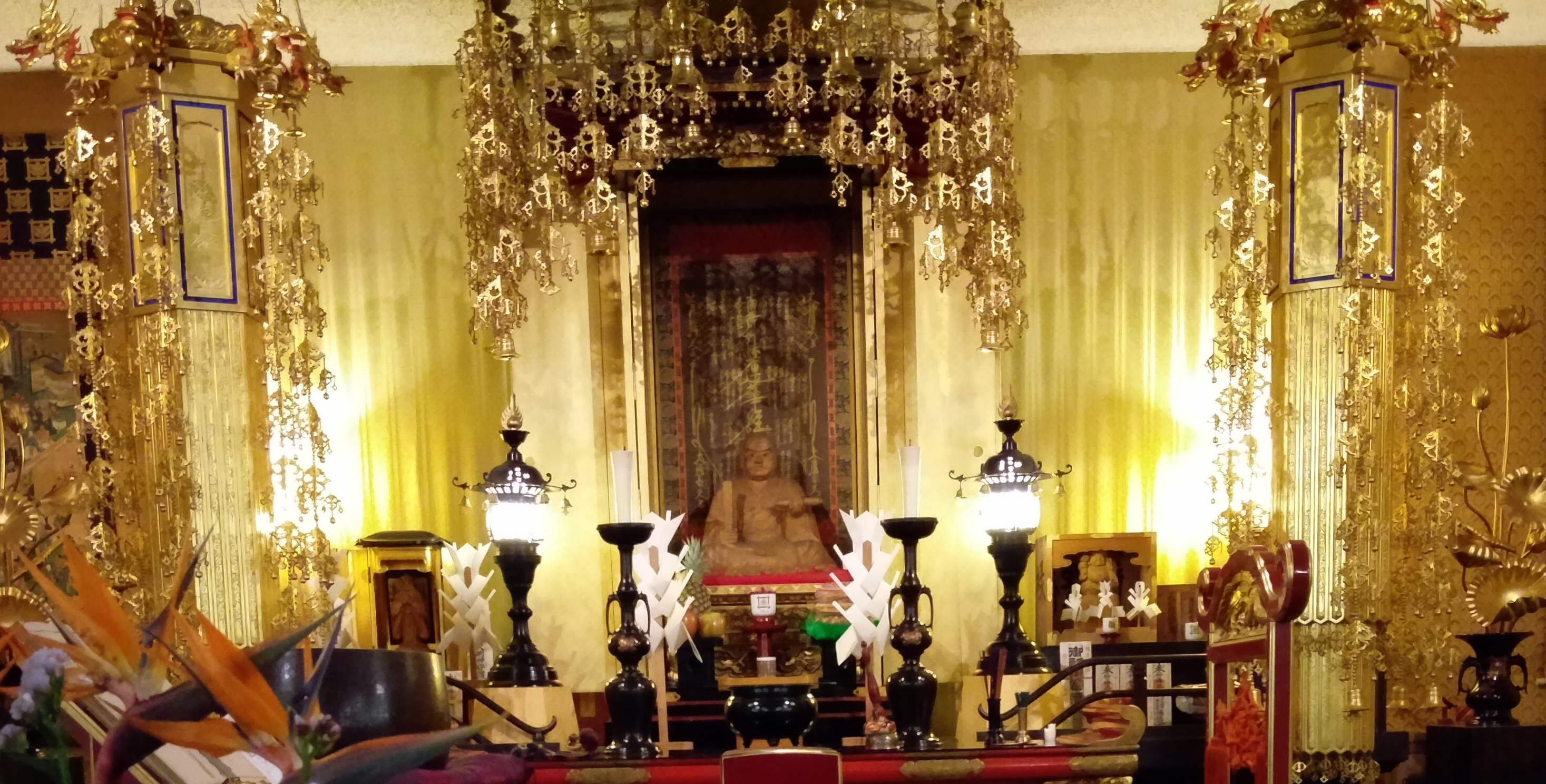
Again when I read that the offerings gathered like clouds and changed into a jeweled awning, I’m reminded on the decorations that frame the altar at the Sacramento Nichiren Buddhist Church.

Decorations framing the altar at the Sacramento Nichiren Buddhist Church

Day 24

Day 24 concludes Chapter 19, The Merits of the Teacher of the Dharma and closes the Sixth Volume of the Sutra of the Lotus Flower of the Wonderful Dharma.

Having last month completed the eight hundred merits of the body in gāthās, we consider the 1200 merits of the mind.

“Furthermore, Constant-Endeavor! The good men or women who keep, read, recite expound or copy this sūtra after my extinction, will be able to obtain twelve hundred merits of the mind. When they hear even a gāthā or a phrase [of this sūtra] with their pure minds, they will be able to understand the innumerable meanings [of this sūtra]. When they understand the meanings [of this sūtra] and expound even a phrase or a gāthā [of this sūtra] for a month, four months, or a year, their teachings will be consistent with the meanings [of this sūtra], and not against the reality of all things. When they expound the scriptures of non-Buddhist schools, or give advice to the government, or teach the way to earn a livelihood, they will be able to be in accord with the right teachings of the Buddha. They will be able to know all the thoughts, deeds, and words, however meaningless, of the living beings of the one thousand million Sumeru-worlds each of which is composed of the six regions. Although they have not yet obtained the wisdom-without-āsravas, they will be able to have their minds purified as previously stated. Whatever they think, measure or say will be all true, and consistent not only with my teachings but also with the teachings that the past Buddhas have already expounded in their sūtras.”

The Daily Dharma from May 10, 2016, offers this:

The Buddha declares these lines to Constant-Endeavor Bodhisattva in Chapter Nineteen of the Lotus Sūtra, describing those who keep and practice this Sūtra. The words of the Sūtra are not specific directions for how to live. We need to interpret them and apply them to our lives in the world today. There are many others whose experience and guidance can help us see what the Sūtra means, and who can benefit from our experience.

The Daily Dharma is produced by the Lexington Nichiren Buddhist Community. To subscribe to the daily emails, visit zenzaizenzai.com

Day 22

Day 22 covers all of Chapter 17, The Variety of Merits.

Having last month heard the innumerable merits of those hear of the Buddha’s longevity and understand the meaning, we consider those who do not speak ill of this sūtra but rejoice at hearing.

“Furthermore, the good men or women who do not speak ill of this sūtra but rejoice at hearing it after my extinction, should be considered, know this, to have already understood my longevity by firm faith. It is needless to say this of those who [not only rejoice at hearing this sūtra but also] read, recite and keep it. They also should be considered to be carrying me on their heads. Ajita! They need not build a stupa or a monastery in my honor, or make the four kinds of offerings’ to the Saṃgha because those who keep, read and recite this sūtra should be considered to have already built a stupa or a monastery or made offerings to the Saṃgha. They should be considered to have already erected a stupa of the seven treasures tall enough to reach the Heaven of Brahman, the upper part of the stupa being the smaller. They should be considered to have already equipped the stupa with streamers, canopies and jeweled bells, and enshrined my śarīras therein. They also should be considered to have already offered flowers, incense, necklaces, incense powder, incense applicable to the skin, incense to burn, drums, music, reed pipes, flutes, harps, various kinds of dances, and songs of praise sung with wonderful voices [to the stupa ] continuously for many thousands of billions of kalpas.

The Daily Dharma from Aug. 5, 2017, offers this:

Furthermore, the good men or women who do not speak ill of this sūtra but rejoice at hearing it after my extinction, should be considered, know this, to have already understood my longevity by firm faith.

The Buddha makes this declaration to his disciple Maitreya in Chapter Seventeen of the Lotus Sūtra. After learning the merits of understanding the ever-present nature of the Buddha, Maitreya hears that this understanding is present in anyone who finds joy in this sūtra. From the parables told earlier in the sūtra, we know that this joy is not the same as the joy that comes from ending suffering. It is the joy in our awakening Buddha nature.

The Daily Dharma is produced by the Lexington Nichiren Buddhist Community. To subscribe to the daily emails, visit zenzaizenzai.com

Day 21

Day 21 covers all of Chapter 16, The Duration of the Life of the Tathāgata.

Having last month heard Śākyamuni explain his longevity in gāthās, we consider why he disappears.

In order to save the [perverted] people,
I expediently show my Nirvāṇa to them.
In reality I shall never pass away.
I always live here and expound the Dharma.

Although I always live here
With the perverted people
I disappear from their eyes
By my supernatural powers.

When they see me seemingly pass away,
And make offerings to my śarīras,
And adore me, admire me,
And become devout, upright and gentle,
And wish to see me
With all their hearts
At the cost of their lives,
I reappear on Mt. Sacred Eagle
With my Saṃgha,
And say to them:
“I always live here.
I shall never be extinct.
I show my extinction to you expediently
Although I never pass away.
I also expound the unsurpassed Dharma
To the living beings of the other worlds
If they respect me, believe me,
And wish to see me.
You have never heard this
Therefore, you thought that I pass away.”

I see the [perverted] people sinking
In an ocean of suffering.
Therefore, I disappear from their eyes
And cause them to admire me.
When they adore me,
I appear and expound the Dharma to them.

The Daily Dharma from May 21, 2017, offers this:

In order to save the [perverted] people,
I expediently show my Nirvāṇa to them.
In reality I shall never pass away.
I always live here and expound the Dharma.

The Buddha sings these verses in Chapter Sixteen of the Lotus Sūtra. This is part of the explanation that his existence in the physical form of Śākyamuni was only one way that he leads all beings to enlightenment. The Buddha described his ever-present nature as the most difficult of his teachings to believe and understand. Recognizing the presence of the Buddha in the world is the same as recognizing Buddha nature in ourselves and all beings. Knowing that the Buddha is always available to help us in this difficult practice of the Wonderful Dharma means we do not need to rely on our own limited abilities. The store of the Dharma is always available to us. We just need to find it and use it.

The Daily Dharma is produced by the Lexington Nichiren Buddhist Community. To subscribe to the daily emails, visit zenzaizenzai.com

The One Rain Falling from a Single Cloud

There are not different rains there is only the one rain falling from the single cloud. The Buddha in his skillful wisdom knew what each of his disciples was capable of understanding. He taught according to that capacity with the objective of eventually leading them deeper so they could partake of the complete Dharma. This is one reason why we say that previous to the Lotus Sutra the Buddha taught according to the minds of those he was teaching, and in the Lotus Sutra the Buddha teaches according to his own mind.

Lecture on the Lotus Sutra

Day 20

Day 20 completes Chapter 15, The Appearance of Bodhisattvas from Underground, and concludes the Fifth Volume of the Sutra of the Lotus Flower of the Wonderful Dharma.

Having last month heard Maitreya question Śākyamuni, we now repeat in gāthās.

Thereupon Maitreya Bodhisattva, wishing to repeat what he had said, sang in gāthās:

It is not long
Since you renounced the family of the Śākyas
And sat under the Bodhi-tree
Near Gaya.

These sons of yours are innumerable.
They have practiced
The way to Buddhahood for a long time.
They have supernatural powers and the power of wisdom.

They have studied the Way of Bodhisattvas well.
They are not defiled by worldliness
Just as the lotus-flower
Is not defiled by water.

They sprang up from underground,
And are now standing before you respectfully.
This is difficult to understand.
How can we believe this?

Lotus World: An Illustrated Guide to the Gohonzon offers this on the relationship of a Lotus Flower and its muddy lifesource.

The lotus flower is rich in symbolism within Buddhism. In Nichiren Buddhism, two aspects are particularly emphasized. The first is the unification of cause and effect, the simultaneous nature of the aspiration for enlightenment and its realization. The lotus flower symbolizes this because it produces flowers and seeds at the same time. By chanting the Odaimoku, we express both the aspiration for enlightenment – the seed of awakening to the Wonderful Dharma – and also our awakened devotion to the Wonderful Dharma – the flowering of enlightenment. The second aspect is the undefiled flowering of enlightenment arising out of the defilements of ordinary life that are transformed by the power of Buddhist practice. In the same way, lotus flowers blossom untainted above the mud and water from which they draw their nourishment. Because it illustrates these two key principles, the lotus flower is a particularly important symbol for Nichiren Buddhists.Lotus World: An Illustrated Guide to the Gohonzon